Downloaded from ht
tp://www.jr
i.ir
J Reprod Infertil. 2018;19(3):152-156
Original Article
Safety Profile of Levonorgestrel: A Disproportionality Analysis of Food and
Drug Administration Adverse Event Reporting System (Faers) Database
Anitha Kurian 1, Kanika Kaushik 1, Viswam Subeesh 1, Eswaran Maheswari 1, Radhika Kunnavil 2
1- Department of Pharmacy Practice, Faculty of Pharmacy, M.S. Ramaiah University of Applied Sciences, Bangalore, India 2- Department of Community Medicine, M.S. Ramaiah Medical College, Bangalore, India
Abstract
Background: Levonorgestrel is most commonly utilized as an emergency oral con-traceptive. Little is known and/or studied about the adverse effects of levonorgestrel, therefore, current investigation was aimed to generate signal for unreported adverse drug reactions of levonorgestrel using disproportionality analysis in food and drug administration adverse events reporting system database.
Methods: In FDA Adverse Events Reporting System (FAERS) database, all adverse event reports for levonorgestrel between January 2006 to June 2015 were identified and disproportionality analysis was conducted for selected adverse events of levo-norgestrel using Reporting Odds Ratio, Proportional Reporting Ratio and Infor-mation Component with 95% confidence interval.
Results: A disproportionality analysis was done for 15 adverse events of levonor-gestrel; out of these, signal for 10 adverse events was found and among them men-struation delayed was reported maximum (1791), followed by pregnancy after post-coital contraception (942), breast tenderness (901), metrorrhagia (899), dysmenor-rhea (822), menorrhagia (541), nipple disorder (141), breast enlargement (77), ectop-ic pregnancy (61) and premenstrual syndrome (35). Pregnancy after post-coital con-traception showed the highest signal having the Information Component value of 129.2, Reporting Odds Ratio value of 6.51 and Proportional Reporting Ratio value of 6.49.
Conclusion: In this paper, ten novel AEs were identified that were disproportionate-ly reported with the use of LNG by using data mining techniques. Although a causal relationship cannot be established, the number of cases reported suggests that there might be an association. If confirmed by epidemiologic studies, the findings from this study would have potential implications for the use of LNG and patient man-agement in clinical practice.
Keywords: Contraceptive, Data mining, Levonorgestrel.
To cite this article: Kurian A, Kaushik K, Subeesh V, Maheswari E, Kunnavil R. Safety
Profile of Levonorgestrel: A Disproportionality Analysis of Food and Drug Administration Adverse Event Reporting System (Faers) Database. J Reprod Infertil. 2018;19(3):152-156.
Introduction
ontraception or birth control prevents preg-nancy by interfering with the normal process of ovulation, fertilization, and implantation (1-3).Themethodsofemergencycontraception
in-cludeEmergencyContraceptionPills(ECPs),
com-bined oral contraceptive pills or the Yuzpe meth-od, Copper-bearing Intrauterine Devices (IUDs) (4, 5). Levonorgestrel (LNG) is a synthetic and
biologically active progestogen that inhibits ovu-lation or fertilization and is used as an oral emer-gency contraceptive (EC) (6).
It is difficult to determine all the adverse effects of a drug in plicensure clinical trials due to stricted sample size, limited exposure time, re-duced follow-up, exclusion of testing in special population and subjects with multiple
co-morbi-* Corresponding Author:
Viswam Subeesh, Department Of Pharmacy Practice, Faculty Of Pharmacy, M.S. Ramaiah University Of Applied Sciences, Bangalore, India
E-mail:
subeeshkviswam@gmail. com
Received: May 12, 2018
Downloaded from ht
tp://www.jr
i.ir
J Reprod Infertil, Vol 19, No 3, Jul-Sept 2018 153
Kurian A, et al.
JRI
dities.The need for post-marketing surveillance
(PMS) is a direct result of these limitations. PMS is the identification and collection of safety in-formation regarding medications after their ap-proval by the U.S. Food and Drug Administration (FDA) which evaluates the drugs taken by indi-viduals under a wide range of circumstances over an extended period of time (7, 8). It plays a major role in identifying previously unrecognized newer adverse events (AEs). Other important compo-nents of PMS include unapproved/ off-label drug use, problems with orphan drugs and lack of pae-diatric formulations. Signal detection is one of the major aims of Pharmacovigilance (PV), i.e., the identification of potential drug-event associations that may be novel by virtue of their nature, severi-ty and/or frequency. The WHO has defined "sig-nal" as "Reported information on a possible causal relationship between an adverse event and a drug, the relationship being unknown or incompletely documented" (9, 10). Signal detection is used to identify previously unknown AEs of marketed drugs.
An emergency contraceptive like LNG is a relia-ble, simple and effective way to avoid unwanted pregnancy. The healthcare professionals and con-sumers are quite ignorant about the complications
associatedwiththeemergencycontraception.Lack
of awareness about the appropriate usage of LNG and easy availability as over the counter (OTC) drug, made it more vulnerable for serious AEs (11). Hence, our study aimed to generate signal for unreported adverse drug reactions of LNG using disproportionality analysis in food and drug administration adverse events reporting system (FAERS) database.
Methods
Data source: AE reports from the FAERS data-base were used for the study. It is a surveillance program useful for detecting serious AEs not identified during premarketing analysis. Our study was based on all reports of levonorgestrel re-ceived by the FDA from 2006Q1-2015Q2(12).
Study variables: The information contained with-in FAERS report with-includes the name of one or more suspect drugs (Those suspected by the re-porter of causing, or being causally related to, an AE), concomitant drugs, and patient characteris-tics (age and sex). An unlimited number of AEs can be reported in a single report (12). Each event
was coded using the standardized terminology of
the MedDRA®.
Study procedure: The FAERS database from 2006 Q1 to 2015Q2, each year consisting of 4 quad-rants, Q1, Q2, Q3, and Q4 was utilized. Every quadrant file had details about the demographics, reactions, statistics, and drugs associated with the AE reported in that quadrant.
In the first step, case IDs of the LNG drug were isolated from drug file, out of which only primary and secondary reports were included, and others were excluded. These case IDs were transferred to the reaction file, which consisted of all the reac-tions of that quadrant. In the reaction file, using case IDs of LNG the corresponding reactions were sorted. The obtained reactions were arranged al-phabetically and frequently reported AEs were listed and their frequency in each quadrant was noted.
Few repeatedly reported clinically relevant and rare ADRs were chosen and evaluated for IC, ROR and PRR. For the evaluation of each AE number of Ni (The event of interest), Nj (Drug of interest), Nij (Both events of interest and drug of interest) were listed. The further calculation was carried out for IC, ROR and PRR to find the correlation between LNG and AE.
Statistical analysis: The threshold for statistical
significance was predefined as a PRR of ≥2.0 with
a Chi-squared test statistic of ≥4.0, at least three
reports (n ≥3) of that preferred term (PT), IC with
IC-2SD>0 and ROR with ROR-1.96SE>1. Any PT that met all of these three criteria was dispro-portionally reported for levonorgestrel at a higher rate than expected (13). In order to evaluate PRR and ROR with 95% confidence interval (95% CI), the calculation was done using the equation ROR,
CI=eln(ROR)±1.96 and PRR, CI=eln(PRR)±1.96,
respective-ly. Positive signals were highlighted using bold letters. Detailed calculation of ROR, PRR and IC were discussed by Poluzzi et al. (9).
Results
A total of 6,248,355 ADR reports were recorded during the period of 2006Q1 to 2015Q2 (38 Quar-ters) (Figure 1). Out of these, 43582 ADR reports were primarily or secondarily suspected by LNG.
Downloaded from ht
tp://www.jr
i.ir
154 J Reprod Infertil, Vol 19, No 3, Jul-Sept 2018 Safety Profile of Levonorgestrel
JRI
The majority of PTs were reproductive system related disorders (Breast enlargement, breast ten-derness, dysmenorrhea, ectopic pregnancy, men-orrhagia, menstruation delayed, metrmen-orrhagia, nip-ple disorder, pregnancy after post coital contra-ception, premenstrual syndrome) and the remain-ing were categorized under miscellaneous catego-ry (Diarrhoea, dysuria, fungal infection, muscle spasm, pollakiuria).
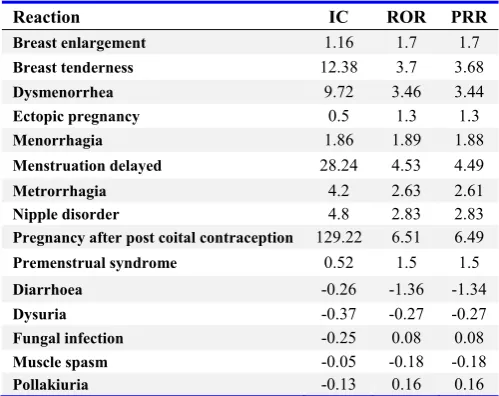
Positive signals identified using ROR: The ROR for 10 PTs ranged from 6.51 (95% CI, 6.34-6.67), being the highest for pregnancy post-coital con-traception to 1.3 (95% CI, 1.04-1.55), being the lowest for ectopic pregnancy. The ROR values were as follows for the PTs menstruation delayed 4.5 (95% CI, 4.46-4.59), breast tenderness 3.7 (95% CI, 3.62-3.77), dysmenorrhea 3.46 (95% CI, 3.38-3.53), nipple disorder 2.83 (95% CI, 2.65-3), metrorrhagia 2.63 (95% CI, 2.56-2.69), menor-rhagia 1.89 (95% CI, 1.8-1.97), breast enlarge-ment 1.7 (95% CI, 1.47-1.92), and premenstrual syndrome 1.5 (95% CI, 1.16-1.83) (Table 1).
Positive signals identified using PRR: The PRR for 10 PTs ranged from 6.49 (95% CI, 6.32-6.65), being the highest for pregnancy post-coital con-traception to 1.3 (95% CI, 1.04-1.55), being the lowest for ectopic pregnancy. The PRR values were as follows for the PTs menstruation delayed 4.49 (95% CI, 4.43-4.54), breast tenderness 3.68 (95% CI, 3.6-3.75), dysmenorrhea 3.44 (95% CI, 3.36-3.51), nipple disorder 2.83 (95% CI, 2.65-3),
metrorrhagia 2.61 (95% CI, 2.54-2.67), menor-rhagia 1.87 (95% CI, 1.79-1.96), breast enlarge-ment 1.7 (95% CI, 1.47-1.92), and premenstrual syndrome 1.5 (95% CI, 1.16-1.83) (Table 1).
Positive signals identified using IC: The IC for 10 PTs ranged from 129.2 (95% CI, 128.67-129.76), being the highest for pregnancy post-coital con-traception to 0.5 (95% CI, -0.35-1.35), being the lowest for ectopic pregnancy. The IC values were as follows for the PTs menstruation delayed 28.2 (95% CI, 28.03-28.44), breast tenderness 12.38 (95% CI, 12.12-12.63), dysmenorrhea 9.7 (95% CI, 9.46-9.97), nipple disorder 4.8 (95% CI, 4.20-5.39), metrorrhagia 4.2 (95% CI, 3.96-4.43), me-norrhagia 1.87 (95% CI, 1.57-2.16), premenstrual syndrome 1.52 (95% CI, -0.61-1.65), and breast enlargement 1.16 (95% CI, 0.38-1.93) (Table 1).
Discussion
The regulatory agencies and pharmaceutical in-dustry use data mining to propose drug-AE pairs for further clinical review by screening large da-tabases like FAERS. Data mining is used to iden-tify previously unknown AEs of marketed drugs (12). In this study, ten novel AEs were identified that were disproportionately reported and poten-tially associated with the use of LNG, by using data mining techniques.
AE reported disproportionately for a particular drug can be identified by the application of data mining algorithms to spontaneous reports of AEs. Conversely, they do not establish a causal rela-tionship between the drug and the event. Previous knowledge and potential mechanisms should be integrated during the clinical review to determine if the signal identified by data mining requires additional evaluation (12).
By applying data mining algorithms in sponta-neous reports, a number of clinical case reports
(Breastenlargement,breastpain,dysmenorrhea,
ec-topicpregnancy,menorrhagia,metrorrhagia,
men-struation delayed, nipple disorder, pregnancy after post coital contraception, premenstrual syndrome) were found suggesting some justification for fur-ther analysis of a possible causal link with LNG.
AEs related to breast tissue such as breast en-largement, tenderness and nipple disorder showed a positive signal. Breast enlargement and breast tenderness could be due to edema and fluid reten-tion which is caused by estrogen and progesterone in the breast tissues. Also, progesterone plays a role in lobular–alveolar structure formation. At
Table 1. Data mining algorithm values of all clinically relevant
reactions associated with levonorgestrel use
Reaction IC ROR PRR
Breast enlargement 1.16 1.7 1.7
Breast tenderness 12.38 3.7 3.68
Dysmenorrhea 9.72 3.46 3.44
Ectopic pregnancy 0.5 1.3 1.3
Menorrhagia 1.86 1.89 1.88
Menstruation delayed 28.24 4.53 4.49
Metrorrhagia 4.2 2.63 2.61
Nipple disorder 4.8 2.83 2.83
Pregnancy after post coital contraception 129.22 6.51 6.49
Premenstrual syndrome 0.52 1.5 1.5
Diarrhoea -0.26 -1.36 -1.34
Dysuria -0.37 -0.27 -0.27
Fungal infection -0.25 0.08 0.08
Muscle spasm -0.05 -0.18 -0.18
Pollakiuria -0.13 0.16 0.16
Downloaded from ht
tp://www.jr
i.ir
J Reprod Infertil, Vol 19, No 3, Jul-Sept 2018 155
Kurian A, et al.
JRI
the end of the luteal phase, there is an increase in mitosis of epithelial cells and hence DNA synthe-sis could cause an increase in breast cells. During clinical trials of Plan B one Step (LNG), 8.2% of total AEs were comprised of breast tenderness (14-16). Nipple discharge and nipple pain may be caused by progesterone effects in hypothalamus-pituitary-ovarian axis and its interference with prolactin inhibition by the hypothalamus. The ty-rosine releasing hormone can enhance release of prolactin which can contribute to galactorrhea, the milky discharge from the nipple (17, 18).
In our study, increased reports of menstruation-associated AEs were found. Delayed menstruation (>7 days) [4.5% of AEs] and heavier menstruation (menorrhagia) [30% of AEs] were reported in Plan B One-Step clinical trials. Progestin-only pill
causevariationsinhypothalamus-pituitary-ovarian
axis leading to changes in the secretion of gona-dotropin-releasing hormone (GnRH) from the hy-pothalamus. This produces alterations in the re-lease of luteinizing hormone (LH) and follicle-sti-mulating hormone (FSH) delaying ovulation and release of progesterone from corpus luteum hence causing a delay in menses (19). Progesterone-estrogen balance is essential for the normal men-strual flow and any imbalance in the hormones re-sults in increased endometrium development cul-minating in heavy menstrual bleeding (Menorrha-gia) (20). Disproportionate reporting for a pre-menstrual syndrome was found which can also be attributed to an imbalance in estrogen and proges-terone (21). Dysmenorrhea was identified as an AE during post-marketing surveillance. Proges-terone levels fall in the late luteal phase,
increas-ing the levels of prostaglandins (F2α) in the
en-dometrium which stimulates myometrium and causes uterine contractions. Ischemia in the endo-metrium generates anaerobic metabolites, which increases the pain sensitivity in the uterus causing type C pain. This leads to the effects of dysmenor-rhea (22, 23).
Ectopic pregnancy and pregnancy after post-coital contraception were found to have a co-relation with LNG, latter having a strong cor-relation. Alteration in the tubal motility causes a delay in the egg to reach the endometrium, lead-ing to ectopic pregnancy. Failure of the progestin-only pill to inhibit ovulation by negative feedback mechanism on the hypothalamus and decrease in LH and FSH production can lead to pregnancy (24, 25).
Other AEs like diarrhoea, dysuria, fungal
infec-tion,musclespasm,pollakiuriareportedtoFAERS
had no positive signal till 2015Q2. This study was subject to certain limitations. It had been reported that when a drug first obtains marketing authorisa-tion, there is a significant increase in spontaneous reporting of ADRs (Especially in the first two years), which then plateaus and finally declines; this phenomenon is known as Weber effect. Also, notoriety bias is defined as "A case has a greater chance of being reported if the subject is exposed to a factor known, thought or likely to cause the event of interest" or in other words, increased re-porting for a drug following safety alert/ labelling changes.
Conclusion
Post-marketing studies help in determining po-tential safety issues. In this paper, ten novel AEs (Breast enlargement, breast tenderness, dysmenor-rhea, ectopic pregnancy, menorrhagia, menstrua-tion delayed, metrorrhagia, nipple disorder, preg-nancy after post-coital contraception and premen-strual syndrome) were identified that were dispro-portionately reported and associated with the use of LNG by using data mining techniques. Alt-hough a causal relationship cannot be established, the number of cases reported suggests that there might be an association. If confirmed by epidemi-ologic studies, the findings from this study would have potential implications for the use of LNG and patient management in clinical practice. Health-care providers should be vigilant about the possi-bility of encountering serious AEs identified in this analysis and should report them to the regula-tory authorities. By implementing guidelines for dispensing oral contraception, and making it pre-scription only drug, the number of AEs with the same can be reduced in future.
Acknowledgement
None of the authors received any kind of funds for this study.
Downloaded from ht
tp://www.jr
i.ir
156 J Reprod Infertil, Vol 19, No 3, Jul-Sept 2018 Safety Profile of Levonorgestrel
JRI
Conflict of Interest
Nil.
References
1. El Maghraby HA, Nafee T, Guiziry D, Elnashar A. Randomized controlled trial of the effects of met-formin versus combined oral contraceptives in ado-lescent PCOS women through a 24 month follow up period. Middle East Fertil Soc J. 2015;20(3): 131-7.
2. Ozgoli G, Sheikhan Z, Dolatian M, Simbar M, Bakhtyari M, Nasiri M. Comparison of sexual dys-function in women using depo-medroxyproge-sterone acetate (DMPA) and cyclofem. J Reprod Infertil. 2015;16(2):102-8.
3. Hedayati-Moghaddam MR, Eftekharzadeh-Mash-hadi I, Fathimoghadam F, Pourafzali SJ. Sexual and reproductive behaviors among undergraduate university students in Mashhad, a city in northeast of Iran. J Reprod Infertil. 2015;16(1):43-9.
4. Ibrahim ZM, Ahmed MR, Shaaban MM. Know-ledge, attitude and practice of emergency contra-ception among health care providers in Ismailia, Egypt. Middle East Fertil Soc J. 2013;18(4):246-52.
5. Cwiak C, Howard B, Hsieh J, Ricciotti N, Sucato GS. Sexual and contraceptive behaviors among adolescents requesting emergency contraception. J Pediatr Adolesc Gynecol. 2016;29(6):643-7. 6. Provenzano-Castro B, Oizerovich S,
Stray-Peder-sen B. LNG-emergency contraceptive pills: what do Argentinean healthcare students know? Sex Reprod Healthc. 2017;12:93-9.
7. Alshammari TM, AlMutairi EN. Use of an entaca-pone-containing drug combination and risk of death: analysis of the FDA AERS (FAERS) data-base. Saudi Pharm J. 2015;23(1):28-32.
8. Strom BL. Pharmacoepidemiology. 4th ed. Eng-land: John Wiley & Sons; 2007. 889 p.
9. Poluzzi E, Piccinni C, Raschi E, De Ponti F. Data mining techniques in pharmacovigilance: analysis of the publicly accessible FDA adverse event re-porting system (AERS). UK: Intech Open Access Publisher; 2012.
10. Hauben M, Hung E, Wood J, Soitkar A, Reshef D. The impact of database restriction on pharmaco-vigilance signal detection of selected cancer thera-pies. Ther Adv Drug Saf. 2017;8(5):145-56. 11. Shohel M, Rahman MM, Zaman A, Uddin MM,
Al-Amin MM, Reza HM. A systematic review of effectiveness and safety of different regimens of levonorgestrel oral tablets for emergency contra-ception. BMC Womens Health. 2014;14:54.
12. Shamloo BK, Chhabra P, Freedman AN, Potosky A, Malin J, Weiss Smith S. Novel adverse events of bevacizumab in the US FDA adverse event reporting system database. Drug Saf. 2012;35(6): 507-18.
13. Deshpande G, Gogolak V, Smith S. Data mining in drug safety. Pharm Med. 2010;24(1):37-43.
14. Graham JD, Clarke CL. Physiological action of progesterone in target tissues. Endocr Rev. 1997; 18(4):502-19.
15. Rothman KJ, Lanes S, Sacks ST. The reporting odds ratio and its advantages over the proportional reporting ratio. Pharmacoepidemiol Drug Saf. 2004;13(8):519-23.
16. Evans SJ, Waller PC, Davis S. Use of proportional reporting ratios (PRRs) for signal generation from spontaneous adverse drug reaction reports. Phar-macoepidemiol Drug Saf. 2001;10(6):483-6. 17. Barry M. Nipple Discharge. In: Walker HK, Hall
WD, Hurst JW, editors. Clinical methods: the his-tory, physical, and laboratory examinations. Bos-ton: Butterworths; 1990.
18. Gülay H, Bora S, Kìlìçturgay S, Hamaloğlu E, Göksel H. Management of nipple discharge. J Am Coll Surg. 1994;178(5):471-4.
19. Sasaki KJ. Menstruation Disorders in Adolescents [Internet]. New York: Medscape; 2016 [cited: 2017 Dec 22]. Available from: http://emedicine. medscape.com/article/953945-overview#a6. 20. Bégaud B. Dictionary of pharmacoepidemiology.
1sted. UK: John Wiley &Sons, Ltd; 2002; p. 15-22. 21. Pariente A, Gregoire F, Fourrier-Reglat A,
Haram-buru F, Moore N. Impact of safety alerts on mea-sures of disproportionality in spontaneous report-ing databases: the notoriety bias. Drug Saf. 2007; 30(10):891-8.
22. Calis KA, Rivlin ME. Dysmenorrhea Medication [Internet]. New York: Medscape; 2016 [cited: 2017 Dec 22]. Available from: https://emedicine. medscape.com/article/253812-medication.
23. Ekström P, Akerlund M, Forsling M, Kindahl H, Laudanski T, Mrugacz G. Stimulation of vasopres-sin release in women with primary dysmenorrhoea and after oral contraceptive treatment--effect on uterine contractility. Br J Obstet Gynaecol. 1992; 99(8):680-4.
24. WallensteinEJ,FifeD.TemporalpatternsofNSAID
spontaneous adverse event reports: the Weber effect revisited. Drug Saf. 2001;24(3):233-7. 25. Pereira PP, Cabar FR, Raiza LC, Roncaglia MT,
Zugaib M. Emergency contraception and ectopic pregnancy: report of 2 cases. Clinics (Sao Paulo). 2005;60(6):497-500.