On second derivative 3-stage Hermite–Birkhoff–Obrechkoff methods
for stiff ODEs: A-stable up to order 10 with variable stepsize
Truong Nguyen-Ba∗
Department of Mathematics and Statistics,
University of Ottawa, Ottawa, Ontario, Canada K1N 6N5. E-mail: [email protected]
Thierry Giordano
Department of Mathematics and Statistics,
University of Ottawa, Ottawa, Ontario, Canada K1N 6N5. E-mail: [email protected]
R´emi Vaillancourt
Department of Mathematics and Statistics,
University of Ottawa, Ottawa, Ontario, Canada K1N 6N5. E-mail: [email protected]
Abstract Variable-step (VS) second derivative k-step 3-stage Hermite–Birkhoff–Obrechkoff (HBO) methods of orderp= (k+ 3), denoted by HBO(p) are constructed as a com-bination of lineark-step methods of order (p−2) and a second derivative two-step diagonally implicit 3-stage Hermite–Birkhoff method of order 5 (DIHB5) for solving stiff ordinary differential equations. The main reason for considering this class of for-mulae is to obtain a set ofk-step methods which areL-stable and are suitable for the integration of stiff differential systems whose Jacobians have some large eigenvalues lying close to the imaginary axis with negative real part. The approach, described in the present paper, allows us to developL-stablek-step methods of order up to 10. Selected HBO(p) of order p,p= 9,10, compare favorably with existing Cash
L-stable second derivative extended backward differentiation formulae, SDEBDF(p),
p= 7,8 in solving problems often used to test stiff ODE solvers.
Keywords. Hermite–Birkhoff methods, generalized DIRK methods, A-stable, oscillatory stiff DETEST problems, confluent Vandermonde-type systems.
2010 Mathematics Subject Classification. 65L06, 65D05, 65D30.
1. Introduction
For solving stiff ordinary differential equations (ODE),
y′ =f(t, y), y(t0) =y0, where ′= d
dt and y∈R
n, (1.1)
a linear k-step method of order p−2 and a second derivative two-step diagonally implicit 3-stage Hermite–Birkhoff method of order 5 (DIHB5) are cast into ak-step 3-stage Hermite–Birkhoff–Obrechkoff (HBO) methods of orderp= (k+ 3), denoted
Received: 26 March 2017 ; Accepted: 24 September 2017.
∗Corresponding author.
by HBO(p). The method’s name was chosen because it uses Hermite–Birkhoff inter-polation polynomials, first and second order derivatives ofy like Obrechkoff methods [20]. Here, the DIHB5 is defined in Section2withp= 5 and step numberk= 2, and has three degree of freedom since the coefficients in (2.4) are free parameters. And, following the approach of Cash [3], the abscissae ci are allowed to be 0 ≤ ci ≤ 2, i= 2,3,4.
There is a variety of variable step (VS) methods designed to solve nonstiff and stiff systems of first-order differential equations (ODEs). Gear advocated a quasi-constant step size implementation in DIFSUB [9]. This software works with a constant step size until a change of step size is necessary or clearly advantageous. Then a continuous extension is used to get approximations to the solution at previous points in an equally spaced mesh. This was largely because constant mesh spacing is very helpful when solving stiff problems. Another possibility is fixed leading coefficient, which is seen in Petzold’s popular code DASSL [21]. Finally, the actual mesh can be chosen by the code as done in MATLAB’sode113. This is the equivalent of a PECE Adams formula in contrast with the Adams–Moulton formula of DIFSUB and DASSL. In this paper, a fully variable step size implementation is used with actual mesh.
A more basic point about the implementation of a method is the choice of the form. The present method uses a generalized Lagrange form and much of the paper is devoted to computing the coefficients efficiently. Remark 6.1 in Subsection 6.2 connects the computation of coefficients for three well known forms: generalized La-grange form, generalized Newton divided differences form (similar to Krogh’s modified divided differences [16]) and Nordsieck form [19].
A brief survey of methods for the numerical integration of (1.1) reveals that there are many advances in the class of generalized linear multistep methods for stiff ODEs, methods like second derivative multistep methods (SDMM) proposed by Enright [5], second derivative extended backward differentiation formulas (SDEBDF) by Cash [3], second derivative BDF methods (SDBDF) by Haireret al. [10], special classes of SDMM introduced by Ismailet al. [14], Hojjatiet al. [12] and Khalsaraeiet al. [15]. The first modification, introduced by Cash [3], was the SDEBDF in which one “super-future” point has been applied.
The current investigation and the results are offered as potentially useful additions to the contemporary repertory of variable step (VS)L-stable second derivative multi-step solvers for stiff differential equations (ODEs). This paper explores an alternative way to improve the order ofL-stable second derivative multistep methods.
The extra stability is particularly important when integrating stiff differential sys-tems whose Jacobians have some large eigenvalues lying close to the imaginary axis. Stiff oscillatory problems happen often in practice. In particular, they frequently de-velop when the method of lines technique is applied to a system of partial differential equations (PDE) that have some hyperbolic type of behaviour. Typical examples of such problems are the integro-differential equations describing the stiff beam problem [10], and advection-dominated PDE problems, as described, for example, in [11,23]. A good description of the difficulties involved in integrating these hyperbolic type equations can be found in [10, pp. 12].
The selected HBO(p),p= 9,10 compare favorably with SDEBDF(p),p= 7,8, [3] in solving problems often used to test highly stable stiff ODE solvers on the basis of number of steps (NS), CPU time (CPU) and the error at the endpoint (EPE) of the interval of integration.
The paper is organized as follows: in Section 2, we introduce new general VS HBO(p) methods of order p. Order conditions of general VS HBO(p) are listed in Section3. In Section4, particular variable step HBO(p) are defined by fixing a set of parameters and are represented in terms of Vandermonde-type systems. In Section5, symbolic elementary matrices are constructed as functions of the parameters of the methods in view of factoring the coefficient matrices of Vandermonde-type systems. Fast solution of Vandermonde-type systems for variable step HBO(p) is constructed in Section 6. Section 7 considers the regions of absolute stability of constant step L-stable HBO(p),p= 5,6, . . . ,10. Section8deals with the step control. In Section9, we compare the numerical performance ofL-stable methods considered in this paper. AppendixA lists the algorithms. Appendix Blists the coefficients of constant step L-stable HBO(p) methods of orderp= 9,10.
2. General variable step HBO(p)of order p
Variable step 3-stage HBO methods are constructed by the following formulae to perform integration fromtn totn+1.
Lethn+1 denote the step size. The abscissa vector [c1, c2, c3, c4]T defines the off-step pointstn+cjhn+1 withc1= 0 andc4= 1. Following the approach of Cash [3], ci are allowed to be 0≤ci≤2,i= 2,3.
Let F1 = fn and Fj := f(tn +cjhn+1, Yj), j = 2,3,4, denote the jth stage derivative.
With the initial stage value,Y1=yn, HB polynomials are used as implicit predic-tors Pi to obtain the stage valuesYi to orderp−2,
Yi=hn+1aiif(tn+cihn+1, Yi) +h2n+1γiif′(tn+cihn+1, Yi)
+yn+hn+1
[p∑−4
j=0
βijfn−j+ i−1
∑
j=2 aijFj
]
+h2n+1 i−1
∑
j=2
An HB polynomial is used as implicit integration formula IF to obtain yn+1 to orderp,
yn+1=hn+1b4f(tn+hn+1, yn+1) +h2n+1g4f′(tn+hn+1, yn+1)
+yn+hn+1
[p∑−4
j=0
βjfn−j+ 3
∑
j=2 bjFj
]
+h2n+1g3F3′. (2.2)
An HB polynomial is used as implicit predictor P4 to control the step size,hn+2, and obtainyen+1 to orderp−2,
e
yn+1=hn+1a44f(tn+hn+1, yn+1) +h2n+1γ44f′(tn+hn+1, yn+1)
+yn+hn+1
[p∑−4
j=0
β4jfn−j+ 3
∑
j=2 a4jFj
]
+h2n+1γ43F3′. (2.3)
Here, the forms (2.1) and (2.2) are used by the implicit algebraic equations system definingYi,i= 2,3 andyn+1 to handle implicitness in the context of stiffness.
The distinct implicit algebraic equations systems (2.1) and (2.2) definingYi,i= 2,3 andyn+1 are solved iteratively by the modified Newton–Raphson method similar to the usual resolution of system of implicit algebraic equations of BDF method [17, p. 11–13].
The following terminology will be useful. An HBO(p) method is said to be ageneral variable-step HBO method if its backstep and the coefficients
c2, c3, a22=a33=b4, (2.4)
in (2.1) and (2.2) are variable parameters. Hence, the general variable-step HBO method has three degrees of freedom (c2, c3, a22 =a33 = b4). If the coefficients in (2.4) are fixed, the method is said to be a particular variable-step method. If the step size is constant, and hence the backsteps and the coefficients in (2.4) are fixed parameters, the method is said to be aconstant-step method.
3. Order conditions of general HBO(p)
To derive the order conditions of 3-stage (p−3)-step HBO(p), we shall use the following expressions coming from the backsteps of the methods:
Bi(j) = p−4
∑
ℓ=1 βiℓ
ηℓ+1j−1
(j−1)!,
{
i= 2,3,
j= 1,2, . . . , p, (3.1)
and
ηj=− 1 hn+1
(tn−tn+1−j) =− 1 hn+1
j−2
∑
i=0
hn−i, j= 2,3, . . . , p−3. (3.2)
In the sequel,ηj will be frequently used without explicit reference to (3.2).
multistep-and several Runge–Kutta(RK)-type order conditions that must be satisfied by 3-stage HBO(p) methods.
To reduce a large number of RK-type order conditions (see [18]), we impose the following simplifying assumptions:
i
∑
j=2 γij
ckj−1
(k−1)! + i
∑
j=2 aij
ckj
k! +Bi(k+ 1) = ck+1i (k+ 1)!,
{
i= 2,3,
k= 0,1, . . . , p−3.
(3.3)
Thus, there remain only two sets of equations to be solved:
4
∑
i=3 gi
cki−1 (k−1)! +
4
∑
i=2 bi
ck i
k! +B(k+ 1) = 1
(k+ 1)!, k= 0,1, . . . , p−1, (3.4)
4
∑
i=3 gi
cpi−2 (p−2)!+
3
∑
i=2 bi
[∑i
j=2 γij
cpj−3
(p−3)! + i
∑
j=2 aij
cpj−2
(p−2)! +Bi(p−1)
]
+b4 cp4−1
(p−1)!+B(p) = 1
p!, (3.5)
where the backstep parts,B(j), are defined by
B(j) = p−4
∑
ℓ=1 βℓ
ηjℓ+1−1
(j−1)!, j= 1,2, . . . , p+ 1. (3.6)
These order conditions are simply RK order conditions with backstep partsBi(·) and B(·).
4. Vandermonde-type formulation of particular variable step HBO(p)
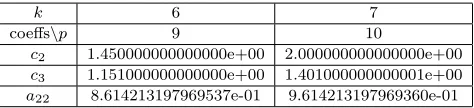
The general HBO(p) methods obtained in Section3contain free coefficients in (2.4), and depend onhn+1 and the previous nodes,tn, tn−1, . . . , tn−(p−4), which determine η2, η3, . . . , ηp−3 in (3.2). To obtain A-stability of particular HBO(p) methods, p = 9,10, the coefficients listed in Table1 were chosen. In Table1, sincea22=a33=b4, only values ofa22are listed.
It is to be noted that, to obtain the coefficients in Table1, the well-known exhaus-tive search method is used with possible candidates (c2, c3, a22), for c2 = 0.1,0.15, 0.2, . . . ,2.0, c3 = 0.1,0.15, 0.2, . . . ,2.0 and a22 with the same increment (or decre-ment) size 0.05. The value ofa22 which yields the largestαofA(α)-stability is used as a starting value (the exhaustive search method can be repeated with new starting values ofa22).
Table 1. Coefficientsci,i= 2,3 anda22 (=a33=b4) of particular VS HBO(p),p= 9,10.
k 6 7
coeffs\p 9 10
c2 1.450000000000000e+00 2.000000000000000e+00
c3 1.151000000000000e+00 1.401000000000001e+00
a22 8.614213197969537e-01 9.614213197969360e-01
4.1. Predictor P2. The (p−2)-vector of reordered coefficients of the predictor P2 in (2.1) withi= 2,
u2= [β20, β21, . . . , β2,p−4, γ22]T,
is the solution of the Vandermonde-type system of order conditions
M2u2=r2, (4.1)
where
M2=
1 1 1 · · · 1 0
0 η2 η3 · · · ηp−3 1
0 η22
2!
η2 3
2! · · ·
η2p−3
2! c2
0 η
3 2
3!
η33
3! · · ·
η3 p−3
3!
c22
2! . . . . . . 0 η
p−3 2
(p−3)!
η3p−3
(p−3)! · · ·
ηpp−−33
(p−3)!
cp2−4
(p−4)! , (4.2)
andr2=r
2(1 :p−2) has components
r2(i) = c i 2 i! −a22
ci2−1
(i−1)!, i= 1,2, . . . , p−2.
A truncated Taylor expansion of the right-hand side of (2.1) with i= 2 about tn gives
p+1
∑
j=0 S2(j)h
j n+1y
(j) n
with coefficients
S2(j) =a22 cj2−1 (j−1)! +M
2(j,1 :p−2)u2
=a22 cj2−1
(j−1)! +r2(j) = cj2
j!, j= 1,2, . . . , p−2,
S2(j) =a22S2(j−1) + p−4
∑
i=1 β2i
ηi+1j−1
(j−1)!, j=p−1, p, p+ 1.
We note that P2 is of orderp−2 since it satisfies the order conditions
S2(j) =c j
and its leading error term is
[
S2(p−1)− cp2−1 (p−1)!
]
hpn+1−1yn(p−1).
4.2. Integration formula IF. Thep-vector of reordered coefficients of the integra-tion formula IF in (2.2),
u1= [β0, b3, b2, β1, β2, . . . , βp−4, g3]T,
is the solution of the Vandermonde-type system of order conditions
M1u1=r1, (4.3)
where
M1=
1 1 1 1 1 · · · 1 0
0 c3 c2 η2 η3 · · · ηp−3 1
0 c23
2! c2 2 2! η2 2 2! η2 3
2! · · ·
η2p−3
2! c3 . . . . . . 0 c
p−1 3
(p−1)!
cp2−1
(p−1)!
η2p−1
(p−1)!
ηp3−1
(p−1)! · · ·
ηpp−−31
(p−1)!
cp3−2
(p−2)! , (4.4)
andr1=r1(1 :p) has components
r1(1) = 1−b4,
r1(i) = 1 i!−b4
ci4−1 (i−1)! −g4
ci4−2
(i−2)!, i= 2,3, . . . , p,
whereb4=a22andg4=γ22. The leading error term of IF is
[
g4 cp4−1 (p−1)! +b4
cp4 p! +
p−4
∑
j=1 βj
ηj+1p
p! + 3
∑
j=2 bj
cpj
p! +g3 cp3−1 (p−1)!−
1 (p+ 1)!
]
hp+1n+1ynp+1.
4.3. Predictor P3. We consider the (p−1)-vector of reordered coefficients of the predictor P3in (2.1) withi= 3,
u3= [β30, a32, β31, . . . , β3,p−4, γ32]T,
is the solution of the Vandermonde-type system of order conditions
M3u3=r3, (4.5)
where
M3=
1 1 1 1 · · · 1 0
0 c2 η2 η3 · · · ηp−3 1
0 c22 2! η2 2 2! η2 3 2! · · ·
η2 p−3
2! c2
..
. ...
0 c
p−2 2 (p−2)!
ηp2−2 (p−2)!
ηp3−2 (p−2)! · · ·
ηpp−−23 (p−2)!
cp2−3 (p−3)!
The first (p−2) components ofr3=r3(1 :p−1) are
r3(1) =c3−a33,
r3(i) = ci
3 i! −a33
ci3−1
(i−1)!−γ33 ci3−2
(i−2)!, i= 2,3, . . . , p−2,
the (p−1)th component is
r3(p−1) =S3(p−1)−a33 cp3−2
(p−2)!−γ33 cp3−3
(p−3)!, (4.7)
where
S3(p−1) = 1 b3
[
1
p!−b2S2(p−1)−b4 cp4−1 (p−1)!
−g3 cp3−2 (p−2)! −g4
cp4−2
(p−2)! −B(p)
]
,
a33=a22 andγ33=γ22.
The equation forr3(p−1) in (4.7) corresponds to order condition (3.5).
A truncated Taylor expansion of the right-hand side of (2.1), withi= 3, abouttn gives
p+1
∑
j=0
S3(j)hjn+1y(j)n
with coefficients
S3(j) =a33 cj3−1
(j−1)! +γ33 cj3−2 (j−2)! +M
3(j+ 1,1 :p−1)u3
=a33 cj3−1
(j−1)! +γ33 cj3−2
(j−2)! +r3(j) = cj3
j!, j= 1,2, . . . , p−2, S3(j) =a33S3(j−1) +γ33S3(j−2) +a32S2(j−1) +γ32S2(j−2)
+ p−4
∑
i=1 β3i
ηi+1j−1
(j−1)!, j =p−1, p, p+ 1.
4.4. Step control predictor P4. The (p−2)-vector of reordered coefficients of predictor P4in (2.3),
u4= [β40, a42, β41, . . . , β4,p−4]T,
is the solution of the system of order conditions
where
M4=
1 1 1 1 · · · 1
0 c2 η2 η3 · · · ηp−3
0 c22
2!
η22
2!
η32
2! · · ·
η2p−3
2!
. . .
. . .
0 c
p−3 2
(p−3)!
η2p−3
(p−3)!
η3p−3
(p−3)! · · ·
ηpp−−33
(p−3)!
, (4.9)
andr4=r
4(1 :p−2) has components
r4(1) = 1−(b4+ω4)−(b3+ω3),
r4(i) = 1
i!−(g4+ω
′
4) ci4−2
(i−2)! −(b4+ω4) ci4−1 (i−1)!
−(g3+ω′3) ci3−2
(i−2)! −(b3+ω3) ci3−1
(i−1)!, i= 2,3, . . . , p−2.
For arbitrary nonzeroω3and ω3′, P4 yieldsyen+1 to order (p−2). A good experi-mental choice isω3= 0.025,ω′3= 0.025,ω4= 0.025,ω4′ = 0.025.
The solutionsuℓ, ℓ= 1,2,3,4, form generalized Lagrange basis functions for rep-resenting the HB interpolation polynomials.
5. Symbolic construction of elementary matrix functions
Consider the matrices
Mℓ∈Rmℓ×mℓ, ℓ= 2,1,3,4, (5.1)
of the Vandermonde-type systems (4.1), (4.3), (4.5) and (4.8), where
m2=p−2, m1=p, m3=p−1, m4=p−2, (5.2)
andpis the order of the method.
The purpose of this section is to construct elementary lower and upper triangular matrices as symbolic functions of the parameters of HBO(p). These matrices are most easily constructed by means of a symbolic software. These functions will be used in Section6to factor
• Mℓ into a diagonal+last-1-column matrix, Wℓ
1, ℓ = 2,1,3, which will be further diagonalized by a Gaussian elimination,
• M4into the identity matrixI4.
This decomposition will lead to a fast solution of the systemsMℓuℓ=rℓ,ℓ= 2,1,3,4 in O(p2) operations.
5.1. Symbolic construction of lower bidiagonal matrices forMℓ,ℓ= 1,2,3,4. We first describe the zeroing process of a general vectorx= [x1, x2, . . . , xm]T with no zero elements. The lower bidiagonal matrix
Lk=
Ik−1 0 0 · · · 0
0 1 0 0
0 −τk+1 1 0
. . .
. .
. . .. . .. ...
0 0 0 −τm 1
, (5.3)
defined by the multipliersτi = xxi
i−1 =−Lk(i, i−1), i=k+ 1, k+ 2, . . . , m, zeros the last (m−k) components, xk+1, xk+2, . . . , xm, of x. This zeroing process will be applied recursively onMℓ,ℓ= 1,2,3,4, as follows. Fork= 2,3, . . ., left multiplying Tkℓ = Lℓk−1Lℓk−2· · ·L3ℓLℓ2Mℓ by Lkℓ zeros the last (mℓ −k) components of the kth column ofTℓ
k. Thus we obtain the upper triangular matrix
LℓMℓ=Lℓm
ℓ−1· · ·L ℓ 3L
ℓ 2M
ℓ, ℓ= 1,2,3,4, (5.4)
in (mℓ−2) steps, forℓ= 1,2,3,4.
We note thatLℓ does not change the first two rows ofMℓ.
Process 1. At thekth step, starting withk= 2,
• Mℓ(k−1)=Lℓ k−1L
ℓ k−2· · ·L
ℓ
2Mℓis an upper triangular matrix in columns 1 to k−1,
• The multipliers inLℓ
kare obtained fromM
ℓ(k−1)(k+1 :m
ℓ, k) sinceMℓ(i, k)̸= 0 fori=k+ 1, k+ 2, . . . , mℓ.
Algorithm1in AppendixAdescribes this process. The input isM =Mℓ;m=mℓ. The output isLk=Lℓk,k= 2,3, . . . , mℓ−1,ℓ= 1,2,3,4.
5.2. Symbolic construction of upper bidiagonal matrices forMℓ,ℓ= 1,2,3,4. For matrix LℓMℓ, ℓ = 1,2,3,4, we construct recursively upper bidiagonal matrices U1ℓ, U2ℓ. . . , Ukℓℓ
end
such that right multiplying LℓMℓ by the upper triangular matrix
Uℓ = Uℓ
1U2ℓ· · ·Ukℓℓ end
transforms LℓMℓ into a matrix Wℓ
Cℓ = L
ℓMℓUℓ with nonzero
diagonal elements,WCℓ
ℓ(i, i)̸= 0,i= 1,2, . . . , mℓ, the lastCℓnonzero columnsW ℓ
Cℓ(1 :
mℓ, j)̸= 0,j=mℓ− Cℓ+ 1, mℓ− Cℓ+ 2, . . . , mℓ, and zero elsewhere. We call such a matrix a “diagonal+last-Cℓ-column matrix”. Here
C1= 1, C2= 1, C3= 1, C4= 0, (5.5)
kend1 =m1−2, kend2 =m2−2, k3end=m3−2, k4end=m4−1, (5.6)
forMℓ, ℓ= 1,2,3,4, respectively.
We describe the zeroing process of the upper bidiagonal matrixUℓ
(LℓMℓ)(k:k+ 1,1 :mℓ)U1ℓU
ℓ
2· · ·U
ℓ k−1
=
[
yk1 · · · yk,k−1 1 · · · 1
yk+1,1 · · · yk+1,k−1 yk+1,k · · · yk+1,mℓ−Cℓ
yk,mℓ−Cℓ+1 yk,mℓ−Cℓ+2 · · · yk,mℓ yk+1,mℓ−Cℓ+1 yk+1,mℓ−Cℓ+2 · · · yk+1,mℓ
]
. (5.7)
The divisorsσi = yk+1,i−1yk+1,i−1 =Ukℓ(i, i), i=k+ 1, k+ 2, . . . , mℓ− Cℓ,define the upper bidiagonal matrix
Ukℓ=
Ik−1 0 · · · 0 · · · 0 0 0 · · · 0
0 1 −σk+1 0 · · · 0 0 0 · · · 0
0 0 σk+1 −σk+2 · · · 0 0 0 · · · 0 . . . . . . . .. . .. . . . . . . 0 0 0 · · · σmℓ−Cℓ−1 −σmℓ−Cℓ 0 0 · · · 0
0 0 0 · · · 0 σmℓ−C
ℓ 0 0 · · · 0
0 0 0 · · · 0 0 1 0 · · · 0
0 0 0 · · · 0 0 0 1 · · · 0
. . . . . . . . . . . . . . . . . . . .. . . .
0 0 0 · · · 0 0 0 0 · · · 1
. (5.8)
Right multiplying (5.7) by Uℓ
k zeros the 1’s in position k+ 1, k+ 2, . . . , mℓ− Cℓ in the first row and puts 1’s in positionk+ 1, k+ 2, . . . , mℓ− Cℓ in the second row:
(LℓMℓ)(k:k+ 1,1 :mℓ)U1ℓU
ℓ
2· · ·U
ℓ k−1U
ℓ k
=
[
yk1 · · · yk,k−1 1 0 · · · 0
yk+1,1 · · · yk+1,k−1 yk+1,k 1 · · · 1
yk,mℓ−Cℓ+1 yk,mℓ−Cℓ+2 · · · yk,mℓ yk+1,mℓ−Cℓ+1 yk+1,mℓ−Cℓ+2 · · · yk+1,mℓ
]
. (5.9)
Thus,Uℓ=Uℓ
1U2ℓ· · ·Ukℓℓ end
transforms the upper triangular matrixLℓMℓ into the diagonal+last-Cℓ-column matrix
WCℓℓ =LℓMℓU1ℓU2ℓ· · ·Ukℓℓ end
, (5.10)
inkℓendsteps. Herekℓendis defined in (5.6).
Process 2. At thekth step, starting withk= 1,
• Mℓ(k)=LℓMℓU1ℓU2ℓ· · ·Ukℓ is a diagonal+last-Cℓ-column matrix in rows 1 to k,
• The divisors in Ukℓ are obtained from Mℓ(k−1)(k+ 1, k : mℓ − Cℓ) since Mℓ(k−1)(k+ 1, j)−Mℓ(k−1)(k+ 1, j−1)̸= 0,j=k+ 1, k+ 2, . . . , mℓ− Cℓ.
Algorithm2in AppendixAdescribes this process forMℓ,ℓ= 1,2,3,4. The input isM =Mℓ;m=mℓ. The output isUk=Ukℓ,k= 1,2, . . . , k
ℓ
endwherek ℓ
6. Fast solution of Vandermonde-type systems for particular variable step HBO(p)
Symbolic elementary matrix functions Lℓ k and U
ℓ
k, ℓ = 1,2,3,4, are constructed once as functions ofηj, forj= 2,3, . . . , p−3, by Algorithms1 and2in AppendixA to factor
• forℓ = 1,2,3,Mℓ into a diagonal+last-1-column matrix, Wℓ
1 which will be further diagonalized by a Gaussian elimination,
• M4into the identity matrixI4.
These elementary matrix functions are used, first, to find, successively, the solution
uℓ, ℓ = 2,1,3,4 in elementary matrix functions form and, then, to construct (a) fast Algorithm 3 in Appendix A, to solve systems (4.1), (4.3), (4.5) and (b) fast Algorithm4 to solve system (4.8), at each integration step.
6.1. Solution of Mℓuℓ=rℓ, ℓ= 1,2,3. We letm
1=p, m2=p−2 andm3=p−1 as defined in (5.2).
(1) The elimination procedure of Subsection 5.1 is applied to Mℓ to construct mℓ×mℓ lower bidiagonal matricesLℓk,k= 2,3, . . . , mℓ−1, with multipliers
τi= M ℓ(2,k) i−1 =−L
ℓ
k(i, i−1), i=k+ 1, k+ 2, . . . , mℓ.
Left multiplying the coefficient matrix Mℓ by the lower bidiagonal matrix Lℓ=Lℓ
mℓ−1· · ·L ℓ
3Lℓ2 transformsMℓ into the upper triangular matrix LℓMℓ in column 1 tomℓ−1 of the form (5.4).
(2) The elimination procedure of Subsection 5.2 is used to construct mℓ ×mℓ upper bidiagonal matricesUkℓ,k= 1,2, . . . , mℓ−2, with multipliers
σi=
k
Mℓ(2, i)−Mℓ(2, i−k)=U ℓ
k(i, i), i=k+ 1, k+ 2, . . . , mℓ−1. (6.1)
Right multiplyingLℓMℓby the upper triangular matrix Uℓ=Uℓ
1U2ℓ· · ·Umℓℓ−2transformsL
ℓMℓinto a diagonal+last-1-column matrix
W1ℓ of the form (5.10).
(3) Factored Gaussian eliminations,Lℓmℓ+1L ℓ
mℓ, will eliminate columnmℓ ofW ℓ 1 and transform Wℓ
1 into the identity matrix Iℓ = Lℓmℓ+1L ℓ mℓW
ℓ
1 where Lℓk, k=mℓ, mℓ+ 1 have nonzero entries listed in Table2 and zeros elsewhere.
Table 2. Nonzero entries of Gaussian elimination matricesLℓk,k= mℓ, mℓ+ 1,ℓ= 1,2,3.
Gaussian elimination matrices Lℓ
mℓ L
ℓ mℓ+1
Lℓmℓ(i, i) = 1, i= 1,2, . . . , mℓ−1 L ℓ
mℓ+1(i, i) = 1, i= 1,2, . . . , mℓ
Lℓmℓ(mℓ, mℓ) = 1/W ℓ(m
ℓ, mℓ) Lℓmℓ+1(1 :mℓ−1, mℓ) =−W ℓ(1 :m
ℓ− 1, mℓ)
This procedure transformsMℓinto the identity matrix
Iℓ=Lℓmℓ+1L ℓ mℓ· · ·L
ℓ
Thus we have the following factorization of Mℓ into the product of elementary matrices:
Mℓ=(Lℓmℓ+1L ℓ mℓ· · ·L
ℓ 2
)−1(
U1ℓU2ℓ· · ·Umℓℓ−2
)−1 ,
and the solution is
uℓ=U1ℓU2ℓ· · ·Umℓℓ−2Lℓmℓ+1Lℓmℓ· · ·Lℓ2rℓ, (6.2)
where fast computation goes from right to left.
Procedure (6.2) is implemented in Algorithm3in AppendixAinO(m2
ℓ) operations, ℓ= 1,2,3. The input isM =Mℓ; m=m
ℓ; r=rℓ; Lk =Lℓk, k= 2,3, . . . , mℓ+ 1; Uk=Ukℓ,k= 1,2, . . . , mℓ−2. The output isu=uℓ,ℓ= 1,2,3.
6.2. Solution of M4u4=r4. We letm4=p−2 as defined in (5.2).
Similar to steps (1) and (2) of Subsection 6.1, the matrix L4 = L4m4−1· · ·L43L42 transforms the coefficient matrix M4 into the upper triangular matrix L4M4 in column 1 to m4 −1 of the form (5.4). Next, the right-product of the Uk4, k = 1,2, . . . , m4−1, will transformL4M4 into the identity matrixI4 of the form (5.10).
Thus we have the following factorization of M4 into the product of elementary matrices:
M4=(L4m 4−1L
4
m4−2· · ·L 4 2
)−1(
U14U24· · ·Um4 4−1
)−1 ,
and the solution is
u4=U14U24· · ·Um44−1L 4
m4−1· · ·L 4
2r4, (6.3)
where fast computation goes from right to left.
Procedure (6.3) is implemented in Algorithm4in AppendixAinO(m24) operations. The input isM =M4; m=m4; r =r4; Lk =L4k, k= 2,3, . . . , m4−1; Uk =Uk4, k= 1,2, . . . , m4−1. The output isu=u4.
Remark 6.1. Formulae (2.1) to (2.3) can be put in matrix form. For instance, (2.2) can be written as
yn+1−yn=F1.u1+G1.v1
where
F1=hn+1
[
fn, F3, F2, fn−1, fn−2, . . . , fn−(p−4), hn+1F3′
]
,
G1=hn+1
[
f(tn+hn+1, yn+1), hn+1f′(tn+hn+1
]
,
and
u1= [β0, b3, b2, β1, β2, . . . , βp−4, g3]T,
v1= [b4, g4]T.
It is interesting to note the three decomposition forms of the systemFu:
F(U Lr) (generalized Lagrange interpolation),
(F U)Lr (generalized divided differences),
The first form is used in this paper, the form similar to the second form for Vander-monde systems is found in [16], and the third form is found in [19].
7. Regions of absolute stability
The regionsRof constant step HBO(p),p= 5,6, . . . ,10, listed in AppendixB, are obtained by applying formulae (2.1) and (2.2) of the predictors Pi, i= 2,3 and the integration formula IF with constanthto the linear test equation
y′=λy, y0= 1.
This gives the following difference equation and corresponding characteristic equation
k
∑
j=0
ηj(z)yn+j= 0, k
∑
j=0
ηj(z)rj= 0, (7.1)
respectively, where k=p−3 is the number of steps of the method andz =λh. A complex numberzis inRif thekroots of the characteristic equation in (7.1) satisfy the root condition (see [17, pp. 70]).
The scanning method used to findRis similar to the one used for Runge–Kutta methods (see [17]).
The stability functionsηj(z),j = 0,1, . . . , k in (7.1) are rational functions of the form
ηk(z) = 1, ηj(z) =
∑5 ℓ=0njℓzℓ
∑6 ℓ=0djℓzℓ
, j= 0,1, . . . , k−1.
Hence, in the difference equation of (7.1),yn+k →0 asz→ ∞. This implies that HBO(p),p= 5,6, . . . ,10 areL-stable since these methods areA-stable.
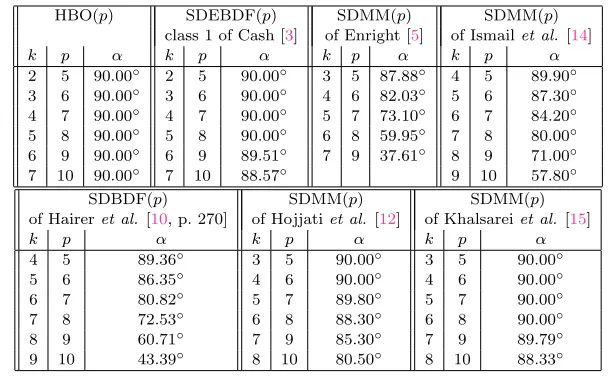
For each given step number k, Table 3 lists the α angles of A(α)-stability for HBO(5–10), SDEBDF(5–10) (class 1) of Cash [3], SDMM(5–9) of Enright [5], SDMM(5– 10) of Ismailet al. [14], SDBDF(5–10) of Hairer et al. [10, p. 270], SDMM(5–10) of Hojjati et al. [12] and SDMM(5–10) of Khalsarei et al. [15], respectively. It is seen thatαof HBO methods compare favorably withαof the considered methods of comparable orderp.
8. Controlling step size
The estimate∥yn−yen∥∞ and the current step hn are used to calculate the next step sizehn+1by means of formula [13]
hn+1= min
{
hmax, β hn
[
tolerance ∥yn−eyn∥∞
]1/κ ,4hn
}
, (8.1)
with κ= pSCP+ 1 and safety factor β = 0.81. Here pSCP is the order of the step control predictor (SCP) (it is to be noted that the valueyenis obtained by the formula (2.3)).
The procedure to advance integration fromtn totn+1 is as follows.
(a) The step size,hn+1, is obtained by formula (8.1).
Table 3. For each given step numberk, the table lists the orderp,
theαangles ofA(α)-stability for the listed methods.
HBO(p) SDEBDF(p) SDMM(p) SDMM(p) class 1 of Cash [3] of Enright [5] of Ismailet al. [14]
k p α k p α k p α k p α
2 5 90.00◦ 2 5 90.00◦ 3 5 87.88◦ 4 5 89.90◦ 3 6 90.00◦ 3 6 90.00◦ 4 6 82.03◦ 5 6 87.30◦ 4 7 90.00◦ 4 7 90.00◦ 5 7 73.10◦ 6 7 84.20◦ 5 8 90.00◦ 5 8 90.00◦ 6 8 59.95◦ 7 8 80.00◦ 6 9 90.00◦ 6 9 89.51◦ 7 9 37.61◦ 8 9 71.00◦ 7 10 90.00◦ 7 10 88.57◦ 9 10 57.80◦
SDBDF(p) SDMM(p) SDMM(p)
of Haireret al.[10, p. 270] of Hojjatiet al.[12] of Khalsareiet al. [15]
k p α k p α k p α
4 5 89.36◦ 3 5 90.00◦ 3 5 90.00◦
5 6 86.35◦ 4 6 90.00◦ 4 6 90.00◦
6 7 80.82◦ 5 7 89.80◦ 5 7 90.00◦
7 8 72.53◦ 6 8 88.30◦ 6 8 90.00◦
8 9 60.71◦ 7 9 85.30◦ 7 9 89.79◦
9 10 43.39◦ 8 10 80.50◦ 8 10 88.33◦
(c) The coefficients of predictors P2, integration formula IF, P3 and step control predictor P4 are obtained successively as solutions of systems (4.1), (4.3), (4.5) and (4.8).
(d) The valuesY2,Y3,yn+1, and eyn+1 are obtained by formulae (2.1) to (2.3). (e) The step is accepted if∥yn+1−eyn+1∥∞is smaller than the chosen tolerance
and the program goes to (a) withnreplaced byn+ 1. Otherwise the program returns to (a) and a new smaller step sizehn+1 is computed.
9. Numerical results of comparing L-stable methods
Theerror at the endpoint of the integration interval (EPE, endpoint error) is taken in the uniform norm,
EPE ={∥yend−zend∥∞},
whereyendis the numerical value obtained by the numerical method at the endpoint tendof the integration interval andzendis the “exact solution” obtained by MATLAB’s ode15swith stringent tolerance 5×10⁻¹⁴.
The necessary starting values att1, t2, . . . , tk−1for HBO(p) were obtained by MAT-LAB’sode15swith stringent tolerance 5×10⁻¹⁴.
Computations were performed on a PC with the following characteristics: Memory: 5.8 GB, Processor 0,1,. . . ,7: Intel(R) Core(TM) i7 CPU 920 @ 2.67GHz, Operating system: Ubuntu Release 11.04, Kernel Linux 2.6.38-12-generic, GNOME 2.32.1.
behaviour. We have chosen Problems3 and4 where the eigenvalues of the Jacobian matrix lie close to the imaginary axis, since it is problems of this type that cause major difficulties to many existing codes.
(1) The Oregonator equation describing Belusov-Zhabotinskii reaction [7].
Problem 1.
y1′ = 77.27(y2+y1−8.375·10−6y21−y1y2), y1(0) = 1,
y2′ = (y3−(1 +y1)y2)/77.27, y2(0) = 2,
y3′ = 0.161(y1−y3), y3(0) = 3,
(9.1)
withtend= 360.
(2) The van der Pol’s equation [10, pp. 4–6], [12].
Problem 2.
y1′ =y2, y1(0) = 2,
y2′ =µ2[(1−y21)y2−y1], y2(0) = 0,
(9.2)
whereµ= 500 and withtend= 0.8.
(3) The stiff DETEST problem B5 [6].
Problem 3.
y1′ =−10y1+αy2, y1(0) = 1,
y2′ =−αy1−10y2 y2(0) = 1,
y3′ =−4y3 y3(0) = 1,
y4′ =−y4 y4(0) = 1,
y5′ =−0.5y5 y5(0) = 1,
y6′ =−0.1y6 y6(0) = 1,
(9.3)
withα= 1000 andtend= 20.
(4) As above withα= 1500.
(5) A problem with large eigenvalues lying close to the imaginary axis [3].
Problem 4.
y1′ =−αy1−βy2+ (α+β−1)e−t y1(0) = 1,
y2′ =βy1−αy2+ (α−β−1)e−t y2(0) = 1,
y3′ = 1 y3(0) = 0,
(9.4)
withα= 1, β= 30, fixed steph= 0.09 andtend= 20. The exact solution is
y1(t) =y2(t) =e−t, y3(t) =t.
Figure 1. log10(global error) versus log10hattn= 20 for the listed HBO(p) applied to problem (9.2) with µ = 1 over t ∈ [0,20] with constant stepsizes h.
−1.6 −1.4 −1.2 −1 −0.8 −0.6 −12
−10 −8 −6 −4 −2 0
HBO(9) HBO(10)
9.1. Numerical verification of the order pof HBO(p). To show the relevance of the theoretical order of HBO(p), we have applied these methods with various constant stepsizeshon Problem (9.2) (van der Pol’s equation) withµ= 1 over t∈[0,20].
In Figure1, the global error ofy1andy2at tn= 20,
max{|y1,n−y1(tn)|,|y2,n−y2(tn)|}=O(hp),
is plotted in a log-log scale for the listed HBO(p) methods applied to problem (9.2) overt∈[0,20] with different constant stepsizeshso that the curves appear as straight lines with slope p whenever the leading term of the global error is of order p. For HBO(p), the slopes of the straight lines which approximate the data in the least-squares sense are very close top, which confirms the orders of the methods.
9.2. Comparing number of steps of selected L-stable HBO(p) and highly efficient existingL-stable methods. In our first tests, we numerically compare our most efficient methods HBO(p), p= 9,10 with the highly efficientL-stable methods which are the second derivative extended backward differentiation formulae, of class 1, of order 7 and 8 [3], denoted by SDEBDF(p),p= 7,8, on the basis of the EPE, endpoint error as a function of number of steps (NS). These classical SDEBDF(p) methods have been widely used to compare stiff ODE solvers.
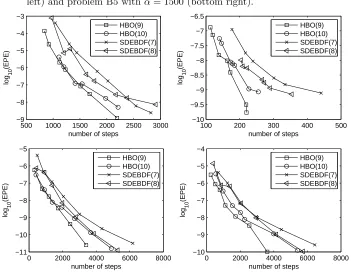
Figure2depicts the graph of log10(EPE) (vertical axis) as a function of number of steps (NS) (horizontal axis) for the considered test problems. Here, similar to Cash [4], we use also Problem3.
It is seen that, in general, HBO(p),p= 9,10, compare favorably with SDEBDF(p), p= 7,8.
Thenumber of steps percentage efficiency gain(NS PEG) of method 1 over method 2 is defined by the formula (cf. Sharp [22]),
NS PEG = 100
[∑
jNS2,j
∑
jNS1,j −1
]
Figure 2. log10(EPE) (vertical axis) as a function of number of steps (NS) (horizontal axis) for Oregonator equation (top left), van der Pol’s equation (top right), problem B5 with α= 1000 (bottom left) and problem B5 with α= 1500 (bottom right).
500 1000 1500 2000 2500 3000 −9
−8 −7 −6 −5 −4 −3
number of steps
log
10
(EPE)
HBO(9) HBO(10) SDEBDF(7) SDEBDF(8)
100 200 300 400 500
−10 −9.5 −9 −8.5 −8 −7.5 −7 −6.5
number of steps
log
10
(EPE)
HBO(9) HBO(10) SDEBDF(7) SDEBDF(8)
0 2000 4000 6000 8000
−11 −10 −9 −8 −7 −6 −5
number of steps
log
10
(EPE)
HBO(9) HBO(10) SDEBDF(7) SDEBDF(8)
0 2000 4000 6000 8000
−10 −9 −8 −7 −6 −5 −4
number of steps
log
10
(EPE)
HBO(9) HBO(10) SDEBDF(7) SDEBDF(8)
where NS1,j and NS2,j are the estimates of NS of methods 1 and 2, respectively, and j = −log10(EPE estimate). To compute NS2,j and NS1,j appearing in (9.5), we approximate the data (log10(EPE),log10(NS)) in a least-squares sense by MAT-LAB’spolyfit. Then, for chosen integer values of the summation index j, we take −log10(EPE estimate) = j and obtain log10(NS estimate) from the approximating curve, and finally the estimate of NS.
Table4lists the NS PEG of HBO(p),p= 9,10, over SDEBDF(p),p= 7,8, for the listed problems. It is seen that HBO(p),p= 9,10, win.
Table 4. NS PEG of HBO(p),p= 9,10, over SDEBDF(p),p= 7,8
for the listed problems.
NS PEG of HBO(9) over: NS PEG of HBO(10) over:
Problem SDEBDF(7) SDEBDF(8) SDEBDF(7) SDEBDF(8)
Oregonator equation 39% 33% 32% 26%
van der Pol’s equation 73% 37% 48% 17%
Prob. B5 withα= 1000 66% 30% 37% 8%
Prob. B5 withα= 1500 84% 56% 36% 16%
Table 5. CPU PEG of HBO(p), p= 9,10, over SDEBDF(p), p=
7,8 for the listed problems.
CPU PEG of HBO(9) over: CPU PEG of HBO(10) over:
Problem SDEBDF(7) SDEBDF(8) SDEBDF(7) SDEBDF(8)
Oregonator equation 17% 33% 5% -3%
van der Pol’s equation 73% 37% 26% -11%
Prob. B5 withα= 1000 65% 30% 28% -15%
Prob. B5 withα= 1500 96% 56% 33% -9%
The CPU percentage efficiency gain (CPU PEG) of method 1 over method 2 is defined by the formula (cf. Sharp [22]),
(CPU PEG)i = 100
[∑
jCPU2,ij
∑
jCPU1,ij −1
]
, (9.6)
where CPU1,ij and CPU2,ij are the estimates of CPU time of methods 1 and 2, re-spectively, associated with problemi, and estimate of EPE = 10−j. The computation of CPU2,j and CPU1,j appearing in (9.6) is similar to the computation of NS2,j and NS1,j appearing in (9.5).
Table5 lists the CPU PEG of HBO(p),p= 9,10, over SDEBDF(p),p= 7,8, for the listed problems. It is seen that HBO(9) wins. For HBO(10), the NS PEGs for HBO(10) in Table4are positive and tend to be larger than the CPU PEGs in Table5 since the equations of the problems listed in Table4or5are relatively not expensive to evaluate. This would suggest that, when these equations become more expensive to evaluate, HBO(10) will be more efficient in CPU time.
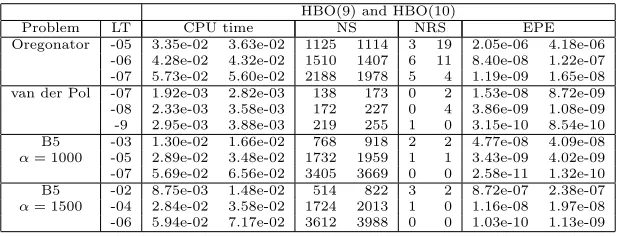
Table6compares the efficiency of HBO(9) and HBO(10) on 4 considered problems (9.1), (9.2), (9.3), (9.4) under listed LT = log10(TOL). The comparison is based on CPU time in seconds,number of steps (NS),number of rejected steps(NRS) andend point error (EPE). It is seen that, to solve these 4 particular problems, in general, HBO(9) is more efficient.
Table 6. For 4 considered problems (9.1), (9.2), (9.3), (9.4) and LT
= log10(TOL), the table lists CPU time in seconds, number of steps (NS), number of rejected steps (NRS) and end point error (EPE) in corresponding left and right columns for HBO(9) and HBO(10), re-spectively.
HBO(9) and HBO(10)
Problem LT CPU time NS NRS EPE
Oregonator -05 3.35e-02 3.63e-02 1125 1114 3 19 2.05e-06 4.18e-06 -06 4.28e-02 4.32e-02 1510 1407 6 11 8.40e-08 1.22e-07 -07 5.73e-02 5.60e-02 2188 1978 5 4 1.19e-09 1.65e-08 van der Pol -07 1.92e-03 2.82e-03 138 173 0 2 1.53e-08 8.72e-09 -08 2.33e-03 3.58e-03 172 227 0 4 3.86e-09 1.08e-09 -9 2.95e-03 3.88e-03 219 255 1 0 3.15e-10 8.54e-10 B5 -03 1.30e-02 1.66e-02 768 918 2 2 4.77e-08 4.09e-08 α= 1000 -05 2.89e-02 3.48e-02 1732 1959 1 1 3.43e-09 4.02e-09 -07 5.69e-02 6.56e-02 3405 3669 0 0 2.58e-11 1.32e-10 B5 -02 8.75e-03 1.48e-02 514 822 3 2 8.72e-07 2.38e-07 α= 1500 -04 2.84e-02 3.58e-02 1724 2013 1 0 1.16e-08 1.97e-08 -06 5.94e-02 7.17e-02 3612 3988 0 0 1.03e-10 1.13e-09
Table 7. Error results obtained for the solution of Problem4(with α= 1, β = 30, fixed step h= 0.09) as a function of step number k andt.
HBO methods SDEBDF methods
|Error iny1| |Error iny2| |Error iny1| |Error iny2|
k= 6
t= 10.0 0.125×10⁻¹⁵ 0.356×10⁻¹⁵ 0.895×10⁻¹⁴ 0.116×10⁻¹²
t= 15.0 0.157×10⁻¹⁷ 0.382×10⁻¹⁷ 0.520×10⁻¹³ 0.143×10⁻¹²
t= 20.0 0.176×10⁻¹⁹ 0.429×10⁻¹⁹ 0.103×10⁻¹² 0.675×10⁻¹³ k= 7
t= 10.0 0.126×10⁻¹⁶ 0.594×10⁻¹⁶ 0.121×10⁻¹⁴ 0.361×10⁻¹³ t= 15.0 0.620×10⁻¹⁶ 0.530×10⁻¹⁶ 0.139×10⁻¹² 0.164×10⁻¹² t= 20.0 0.476×10⁻¹⁶ 0.135×10⁻¹⁷ 0.144×10⁻¹¹ 0.933×10⁻¹²
Jacobians have some large eigenvalues lying close to the imaginary axis. For this comparison, similar to Cash [3], we use Problem4.
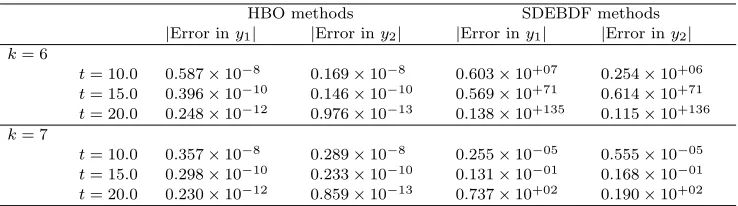
Table7presents error results obtained for the solution of Problem4 (withα= 1, β = 30, fixed step h= 0.09 suggested by Cash [3]) as a function of step number k andt. It is seen that HBO(p), p= 9,10, and SDEBDF(p), p= 9,10 remain stable for the integration of this problem.
Table 8. Error results obtained for the solution of Problem4(with
α= 1, β = 42, fixed step h= 1.00) as a function of step number k andt.
HBO methods SDEBDF methods
|Error iny1| |Error iny2| |Error iny1| |Error iny2|
k= 6
t= 10.0 0.587×10⁻⁸ 0.169×10⁻⁸ 0.603×10+07 0.254×10+06 t= 15.0 0.396×10⁻¹⁰ 0.146×10⁻¹⁰ 0.569×10+71 0.614×10+71 t= 20.0 0.248×10⁻¹² 0.976×10⁻¹³ 0.138×10+135 0.115×10+136 k= 7
t= 10.0 0.357×10⁻⁸ 0.289×10⁻⁸ 0.255×10−05 0.555×10−05 t= 15.0 0.298×10⁻¹⁰ 0.233×10⁻¹⁰ 0.131×10−01 0.168×10−01 t= 20.0 0.230×10⁻¹² 0.859×10⁻¹³ 0.737×10+02 0.190×10+02
10. Conclusion
Second derivative multistep 3-stage Hermite–Birkhoff–Obrechkoff (HBO) methods of orderspwere considered. It is seen that HBO(p) areL-stable up to order 10.
Selected HBO(p) of order p, p = 9,10, compare positively with existing Cash modified extended backward differentiation formulae, SDEBDF(p),p= 7,8 in solving differential equations problems often used to test highly stable stiff ODE solvers.
HBO(p) of order p,p= 5,6, . . . ,10, are members of general step variable-order (VSVO) highly stable 3-stage k-step of order p = k+ 3 which appear to be promising highly stable stiff ODE solvers in the light of the numerical results obtained in this paper.
11. Acknowledgment
Thanks are due to the reviewer whose deep and extended comments contributed to substantially improve the manuscript. Thanks are also due to Mart´ın Lara for supplying the authors with his programs and sharing his experience. This work was supported in part by the Natural Sciences and Engineering Research Council of Canada.
Appendix A. Algorithms
Algorithm 1. This algorithm constructs Lk(i, i−1) entries of lower bidiagonal matrices Lk (applied toIF,Pℓ,ℓ= 2,3,4) as functions ofηj,j= 2,3, . . ..
Fork= 2 :kend, do the following iteration:
Fori=m:−1 :k+ 1, do the following two steps: Step (1) Lk(i, i−1) =−M(i, k)/M(i−1, k). Step (2) Forj=k:m, compute:
M(i, j) =M(i, j) +M(i−1, j)Lk(i, i−1),
wherekend=mℓ−1,ℓ= 1,2,3,4 for IF, Pℓ,ℓ= 2,3,4.
Algorithm 2. This algorithm constructs diagonal entriesUk(j, j)of upper bidiagonal matrices Uk(applied toIF,P2,P3andP4) as functions ofηj,j= 2,3, . . . .
Fork= 1 :kend, do the following iteration:
Forj=j0:−1 :k+ 1, do the following two steps:
Step (2) fori=k:j, compute
M(i, j) = (M(i, j)−M(i, j−1))Uk(j, j).
wherekendvalues are defined in (5.6),j0=mℓ−1,ℓ= 1,2,3 for IF, P2, P3respectively andj0=m4for P4.
Algorithm 3. This algorithm solves the systems forPℓ,ℓ= 1,2,3inO(m2)operations. Given [η2, η3, . . . , ηp−3] and r = r(1 : m), the following algorithm overwrites r with the solution
u=u(1 :m) of the systemMu=r.
Step (1) The following iteration overwritesr=r(1 :m) withLm−1Lm−2· · ·,L2r: fork= 2,3, . . . , m−1, compute
r(i) =r(i) +r(i−1)Lk(i, i−1), i=m, m−1, . . . , k+ 1.
Step (2) This step forms the two matricesLmandLm+1which transformW1ℓ into the identity matrix Iℓ=L
m+1LmW1ℓ: this step computes the coefficientsGm(i),i= 1,2, . . . , mused to form the two matricesLmandLm+1, whose nonzero entries are listed in Table2, as follows.
First setGm(1 :m),
Gm(1 :m) =M(1 :m, m).
The following computation overwritesGm(1 :m) withLm−1Lm−2· · · L2Gm(1 :m): fork= 2,3, . . . , m−1, compute
Gm(i) =Gm(i) +Gm(i−1)Lk(i, i−1), i=m, m−1, . . . , k+ 1. Step (3) The following computation overwrites the newly obtainedrwithLm+1Lmr:
r(m) =r(m)/Gm(m), next, fork=m−1, m−2, . . . ,1,compute
r(k) =r(k)−Gm(k)r(m).
Step (4) The following iteration overwritesr=r(1 :m) withU1U2· · ·Um−2r: Fork=m−2, m−3, . . . ,1,compute
r(i) =r(i)Uk(i, i), i=k+ 1, k+ 2, . . . , m−1, r(i) =r(i)−r(i+ 1), i=k, k+ 1, . . . , m−2.
Algorithm 4. This algorithm solves the systems forP4 inO(m2)operations.
Given [η2, η3, . . . , ηp−3] and r = r(1 : m), the following algorithm overwrites r with the solution
u=u(1 :m) of the systemMu=r.
Step (1) The following iteration overwritesr=r(1 :m) withLm−1Lm−2· · ·L2r: fork= 2,3, . . . , m−1, compute
r(i) =r(i) +r(i−1)Lk(i, i−1), i=m, m−1, . . . , k+ 1. Step (2) The following iteration overwritesr=r(1 :m) withU1U2· · ·Um−1r:
Fork=m−1, m−2, . . . ,1,compute r(i) =r(i)Uk(i, i), i=k+ 1, k+ 2, . . . , m,
r(i) =r(i)−r(i+ 1), i=k, k+ 1, . . . , m−1.
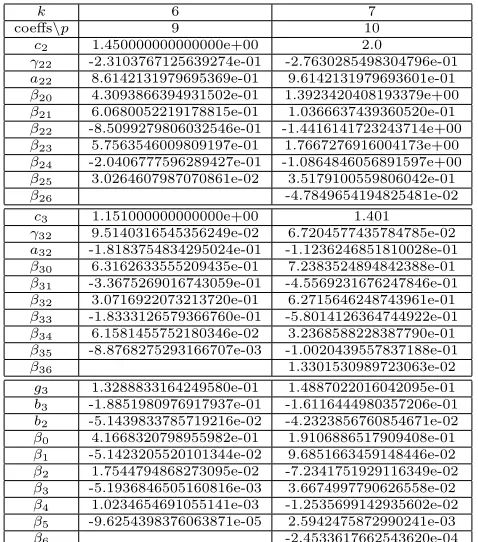
Appendix B. Coefficients of HBO(p), p= 9,10.
Table 9. Coefficients of the implicit predictors Pi, i = 2,3 and of
the integration formulae of HBO(p),p= 9,10.
k 6 7
coeffs\p 9 10
c2 1.450000000000000e+00 2.0
γ22 -2.3103767125639274e-01 -2.7630285498304796e-01 a22 8.6142131979695369e-01 9.6142131979693601e-01 β20 4.3093866394931502e-01 1.3923420408193379e+00 β21 6.0680052219178815e-01 1.0366637439360520e-01 β22 -8.5099279806032546e-01 -1.4416141723243714e+00 β23 5.7563546009809197e-01 1.7667276916004173e+00 β24 -2.0406777596289427e-01 -1.0864846056891597e+00 β25 3.0264607987070861e-02 3.5179100559806042e-01
β26 -4.7849654194825481e-02
c3 1.151000000000000e+00 1.401 γ32 9.5140316545356249e-02 6.7204577435784785e-02 a32 -1.8183754834295024e-01 -1.1236246851810028e-01 β30 6.3162633555209435e-01 7.2383524894842388e-01 β31 -3.3675269016743059e-01 -4.5569231676247846e-01 β32 3.0716922073213720e-01 6.2715646248743961e-01 β33 -1.8333126579366760e-01 -5.8014126364744922e-01 β34 6.1581455752180346e-02 3.2368588228387790e-01 β35 -8.8768275293166707e-03 -1.0020439557837188e-01
β36 1.3301530989723063e-02
g3 1.3288833164249580e-01 1.4887022016042095e-01 b3 -1.8851980976917937e-01 -1.6116444980357206e-01 b2 -5.1439833785719216e-02 -4.2323856760854671e-02 β0 4.1668320798955982e-01 1.9106886517909408e-01 β1 -5.1423205520101344e-02 9.6851663459148446e-02 β2 1.7544794868273095e-02 -7.2341751929116349e-02 β3 -5.1936846505160816e-03 3.6674997790626558e-02 β4 1.0234654691055141e-03 -1.2535699142935602e-02 β5 -9.6254398376063871e-05 2.5942475872990241e-03
β6 -2.4533617662543620e-04
References
[1] A. Bj¨orck and T. Elfving,Algorithms for confluent Vandermonde systems, Numer. Math.,21
(1973), 130–137.
[2] A. Bj¨orck and V. Pereyra, Solution of Vandermonde systems of equations, Math. Comp.,24
(1970), 893–903.
[3] J. R. Cash, Second derivative extended backward differentiation formulas for the numerical integration of stiff systems, SIAM J. Numer. Anal.,18(1981), 21–36.
[4] J. R. Cash,A comparison of some codes for the stiff oscillatory problem, Comput. Math. Appl.,
36(1998), 51–57.
[5] W. H. Enright, Second derivative multistep methods for stiff ordinary differential equations, SIAM J. Numer. Anal.,11(1974), 321–331.
[6] W. H. Enright and J. D. Pryce,Two Fortran packages for assessing initial value methods, ACM Trans. Math., Software,13(1987), 1–27.
[7] J. Field and R. M. Noyes,Oscillations in chemical systems. IV: Limit cycle behavior in a model of a real chemical reaction, J. Chem. Phys.,60(1974), 1877–1884.
[8] G. Galimberti and V. Pereyra,Solving confluent Vandermonde systems of Hermite type, Numer. Math.,18(1971), 44–60.

![Figure 1. log10(global error) versus log10 h at tn = 20 for the listedHBO(p) applied to problem (9.2) with µ = 1 over t ∈ [0, 20] withconstant stepsizes h.](https://thumb-us.123doks.com/thumbv2/123dok_us/8943630.1852998/17.612.217.391.166.300/figure-global-versus-listedhbo-applied-problem-withconstant-stepsizes.webp)