Implementation of Interprofessional Education
in Japan: An Exploratory Study
Sachiko Ogawa, PhD; Yoshinori Takahashi, MPD; & Misako Miyazaki, PhD
Abstract
Background: Although interprofessional education (IPE) has come to be consid-ered essential in health and social care education programs, most IPE programs in Japan focus on clinical settings. However, following the 2011 Great East Japan Earthquake, IPE programs are also considered essential for community ment, especially in disaster-affected areas. To identify key issues for the develop-ment of IPE, we aimed to clarify the current status of IPE programs and problems in their implementation using an original questionnaire.
Methods and Findings: The targets were 865 undergraduate courses that qualify students to take national registered health/social care examinations. Effective responses were received from 284 targets. Of these 284 respondents, 103 respon-dents had already implemented an IPE program and 181 responrespon-dents had not. Among the 103 respondents who had already implemented an IPE program, we found a tendency to collaborate with partners in clinical settings or in social set-tings. Furthermore, respondents who had implemented or were planning to imple-ment an IPE program had difficulty with “interdisciplinary and/or extramural collaboration” and “educational factors.”
Conclusions: These difficulties could be considered barriers to developing effective IPE programs for community-based collaboration between health and social care profes-sionals. Future research should investigate more specific solutions to these problems.
Keywords: Interprofessional education; IPE-implementing university; Non-IPE-implementing university; University planning IPE implementation
Introduction
Interprofessional education (IPE) has been recognized as an innovative approach for developing a collaborative, practice-ready health workforce [1,2]. In Japan, IPE pro-grams have been implemented at various institutions throughout the country, but most IPE programs are focused on clinical settings [3]. Moreover, the current status of IPE and problems related to IPE implementation remain unknown.
The Great East Japan Earthquake (Tohoku earthquake) struck in March 2011 and caused tremendous corporeal and economic damage. The survivors not only faced Journal of Research in
Interprofessional Practice and Education
Vol. 5.1 March 2015
Journal of Research in Interprofessional Practice and Education (JRIPE)
Vol. 5.1 © 2015
physical and psychological problems, they encountered the fear of radiation expo-sure [4]. The survivors’ recovery, both physical and psychological, requires interpro-fessional collaboration between healthcare and welfare prointerpro-fessionals, and collaboration within the community. As the population of the disaster-affected areas was aging, interprofessional collaboration for aging care was also urgently required [5]. The experience from the Tohoku earthquake emphasizes the need for innovative IPE programs that not only provide clinical support, but also community support, especially disaster management and humanitarian assistance in Japan.
Based on the experience following the Tohoku Earthquake, the Japanese Ministry of Health, Labour, and Welfare (MHLW) set aside funds from the 2012 disaster recovery budget for the development of a home healthcare collaboration network [6]. The MHLW’s aim was to develop a system and network for providing home healthcare services to anyone in a disaster-affected area. The MHLW also demanded that healthcare and welfare professionals initiate collaboration in communities. Therefore, the MHLW expects IPE programs to focus more closely on community-based healthcare professional collaboration.
In order to create new IPE programs based on the expectations of the MHLW, it is essential to determine what problems are being faced and what tasks must be com-pleted to reach acceptable solutions. Therefore, the present study aimed to investi-gate the current status of IPE programs, identify problems with IPE program implementation, and propose methods for improving responses in disaster-affected areas through effective IPE programs.
Methods
Definition of IPE
As defined by the Centre for the Advancement of Interprofessional Education (CAIPE), “Interprofessional Education occurs when two or more professions learn with, from and about each other to improve collaboration and the quality of care” [7]. However, many terms in this field are used interchangeably with seemingly precise, but differently interpreted, meanings [8]. In Japanese, interprofessional collaboration is termed “team-treatment,” but this term has not been defined and conceptualized, nor are there guidelines as to how team-treatment may be implemented in practice [9]. To more accurately reflect the current situation and problems faced in Japan, a more general definition of IPE was adopted for the present research. In this study, any education program that covered at least one of the following conditions was con-sidered an IPE program: 1) aiming to develop interprofessional skills among health/social care professionals, 2) providing more than two courses or the same course for more than two departments simultaneously, and 3) learning that com-bines different courses and/or departments or universities.
Design of the questionnaire
As no standardized questionnaire that reflects our study’s aims has been developed, we designed a questionnaire to collect the necessary data. This newly developed questionnaire consisted of three sections: 1) questions regarding the current status Journal of Research in
Interprofessional Practice and Education
Vol. 5.1 March 2015
2
Implementation of IPE in Japan
of IPE programs, including respondents’ attributes; 2) questions regarding IPE-implementing universities;and 3) questions regarding non-IPE-implementing uni-versities. All respondents answered the questions in the first section, and if the respondents had already started an IPE program, they answered the questions on IPE-implementing universities in the second section. Respondents who had not started an IPE program answered the questions regarding non-IPE-implementing universities in the third section.
Section on IPE-implementing universities
The section on IPE-implementing universities included questions on the following topics:
Implementation system: Respondents were asked whether the implemented IPE program was an interdisciplinary collaboration (collaboration within the universities) or extramural collaboration (collaboration with other universities). Respondents were also asked the specific universities, departments,and courses they collaborated with.
Presence or absence of problems after introducing the IPE program: Respondents were asked whether they had experienced any problems. If they had, they were asked to write the details in the free space provided.
Section on non-IPE-implementing universities
At the beginning of this section, respondents gave a yes/no response regarding any plan to implement an IPE program in the future. If they had a plan (universities plan-ning IPE implementation), they were asked questions about the following:
Project progress status:Respondents chose the most accurate status from the fol-lowing five options: 1) the project has already been completed and the start time was decided; 2) the project is nearly completed, but the start time has not been decided; 3) the project is under discussion, but it will take time to develop; 4) preparing for the project; and 5) hope to introduce an IPE program, but do not have any plans yet. Respondents could also write any other comments in the free space provided.
Problems while carrying out the project: If the respondents encountered any prob-lems while carrying out the project, especially administrative probprob-lems, we asked them to choose the responses that most accurately matched their problems from the following five options: 1) the IPE program curriculum (especially interdisciplinary curricular organization), 2) financing for management of the IPE program, 3) human resources for operating the IPE program, 4) difficulty with requesting sup-port for the IPE program (especially for securing practical training facilities and learning contents), and 5) difficulty with requesting support for the IPE program (especially for co-operation among educational institutions). Respondents could also write comments regarding other problems in the free space provided.
“If you could consult any IPE-implementing universities about implementing an IPE program, what would you ask?” (open question): If the respondents had any other problems or required advice, they could write them in the free space provided.
Journal of Research in Interprofessional Practice and Education
Vol. 5.1 March 2015
3
Implementation of IPE in Japan
Target population and responses
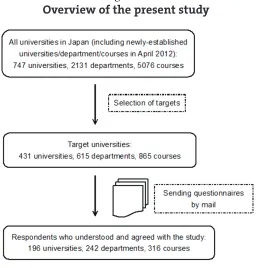
The target population was universities with departments or courses that qualify stu-dents to take national registered health/social care examinations. Figure 1 shows the overview of this study. Questionnaires were sent to the faculty members who were responsible for student/academic affairs or curriculum development or the heads of the respective departments at target universities. If they agreed to participate in our research, they completed the questionnaire and returned it by mail. The survey was conducted from January to February 2012.
Ethical considerations
The current study was approved by the ethics review board of the Chiba University School of Nursing. All respondents were assured that their responses would be kept confidential through all the phases of the study and that they would not be identifi-able in any written reports.
Data analysis
Questionnaire data were checked for errors and cleaned by eliminating contradic-tions. Quantitative data were analyzed using descriptive analysis. The analysis was performed using IBM© SPSS© Statistics version 20.0 (IMB SPSS, Chicago, IL). Qualitative data, including open questions, were independently coded by three researchers to classify statements into categories and themes. Codes were compared and all discrepancies were resolved.
Figure 1.
Overview of the present study
Results
According to the study overview (Figure 1), we selected the target universities from Journal of Research in
Interprofessional Practice and Education
Vol. 5.1 March 2015
4
Implementation of IPE in Japan
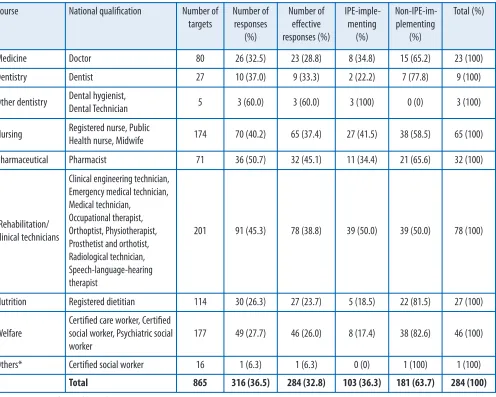
among all 747 universities, 2131 departments, and 5076 courses established in Japan as of April 2012 [10]. In total, 865 courses in 615 departments at 431 universities were selected as the target population. Questionnaires were sent to these 865 targets, and responses were received from 316 (response rate 36.5%). The number of effective responses was 284 (effective response rate 32.8%) (Table 1). The effective response rate was higher for the pharmaceutical (N= 32; 45.1%) and rehabilitation/clinical techni-cians (N= 78; 38.8%) courses than for the other courses (except “other dentistry”).
Demography of IPE implementation status in Japan
As shown in Table 1, among the 284 respondents, 103 (36.3%) have already started an IPE program (IPE-implementing universities) and 181 respondents (63.7%) have not (non-IPE-implementing universities).
According to the course-based IPE-implementing status among the 103 respon-dents in the IPE-implementing universities, the most common course was Journal of Research in
Interprofessional Practice and Education
Vol. 5.1 March 2015
5
Implementation of IPE in Japan
Ogawa, Takahashi, & Miyazaki
Course National qualification Number of
targets
Number of responses
(%)
Number of effective responses (%)
IPE-imple-menting
(%)
Non-IPE-im-plementing
(%)
Total (%)
Medicine Doctor 80 26 (32.5) 23 (28.8) 8 (34.8) 15 (65.2) 23 (100)
Dentistry Dentist 27 10 (37.0) 9 (33.3) 2 (22.2) 7 (77.8) 9 (100)
Other dentistry Dental hygienist,
Dental Technician 5 3 (60.0) 3 (60.0) 3 (100) 0 (0) 3 (100)
Nursing Registered nurse, Public
Health nurse, Midwife 174 70 (40.2) 65 (37.4) 27 (41.5) 38 (58.5) 65 (100)
Pharmaceutical Pharmacist 71 36 (50.7) 32 (45.1) 11 (34.4) 21 (65.6) 32 (100)
"Rehabilitation/ clinical technicians
Clinical engineering technician, Emergency medical technician, Medical technician,
Occupational therapist, Orthoptist, Physiotherapist, Prosthetist and orthotist, Radiological technician, Speech-language-hearing therapist
201 91 (45.3) 78 (38.8) 39 (50.0) 39 (50.0) 78 (100)
Nutrition Registered dietitian 114 30 (26.3) 27 (23.7) 5 (18.5) 22 (81.5) 27 (100)
Welfare
Certified care worker, Certified social worker, Psychiatric social worker
177 49 (27.7) 46 (26.0) 8 (17.4) 38 (82.6) 46 (100)
Others* Certified social worker 16 1 (6.3) 1 (6.3) 0 (0) 1 (100) 1 (100)
Total 865 316 (36.5) 284 (32.8) 103 (36.3) 181 (63.7) 284 (100)
Table 1
Current status of IPE implementation, by course
Rehabilitation/clinical technicians (N =9; 50.0%),followed by nursing (N =27; 41.5%). In contrast, among the 181 respondents in the non-IPE-implementing universities, welfare (N= 38; 82.6%) was the most common course, followed by nutrition (N= 22; 81.5%).
IPE-implementing universities
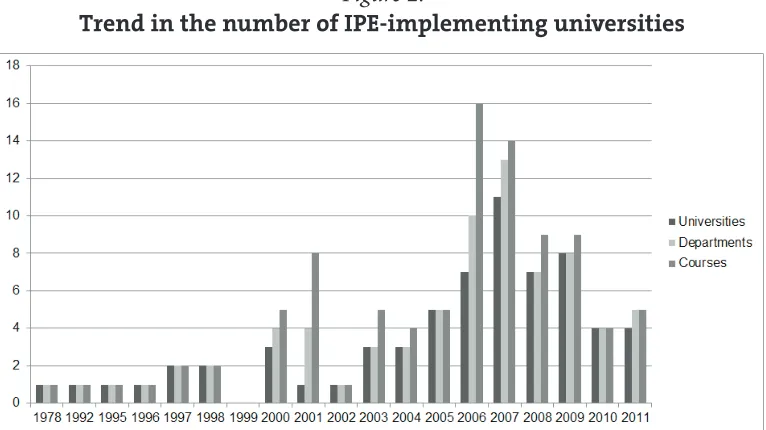
Figure 2 shows the frequency of implementation of IPE programs from 1978 to 2011. The number of respondents who have started an IPE program increased from 2000, and peaked in 2006. At that time, among the 103 respondents, 16 (7 universities, 10 departments, and 16 courses) had started an IPE program. This period overlapped with the term of the Ministry of Education, Culture, Sports, Science, and Technology (MEXT) Support Program for Contemporary Education Needs (2004–2007) and the MEXT’s Support Program for Distinct University Education (2003–2007). At that time, many universities applied for and received grants from the MEXT.
Figure 2.
Trend in the number of IPE-implementing universities
Implementation system for the IPE program
Respondents’ answers regarding the collaboration system for the IPE program are shown in Table 2. Overall, 93 (91.2%) of the 102 respondents (one not applicable) managed their IPE program by interdisciplinary collaboration, and four respondents (3.9%) collaborated extramurally. Five respondents (4.9%) indicated that both collab-oration systems were used depending on the specific department and/or course.
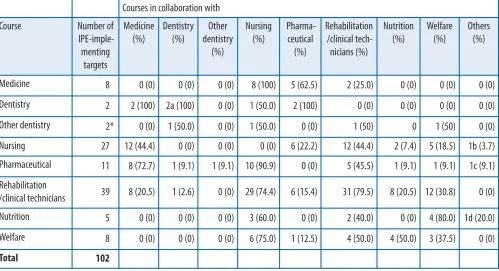
Table 3 shows the partners the respondents collaborate with. The most common collaborations were between medicine and nursing (N= 8; 100%), between pharma-ceutical and nursing (N= 10; 90.9%), between nutrition and welfare (N = 4; 80.0%), and between welfare and nursing (N= 6; 75.0%). Although the rehabilitation/clinical technician courses were involved in the largest number of collaborations (N= 31; 79.5%), overall, these courses had little collaboration among all courses.
Journal of Research in Interprofessional Practice and Education
Vol. 5.1 March 2015
6
Implementation of IPE in Japan
Problems after the implementation of the IPE program
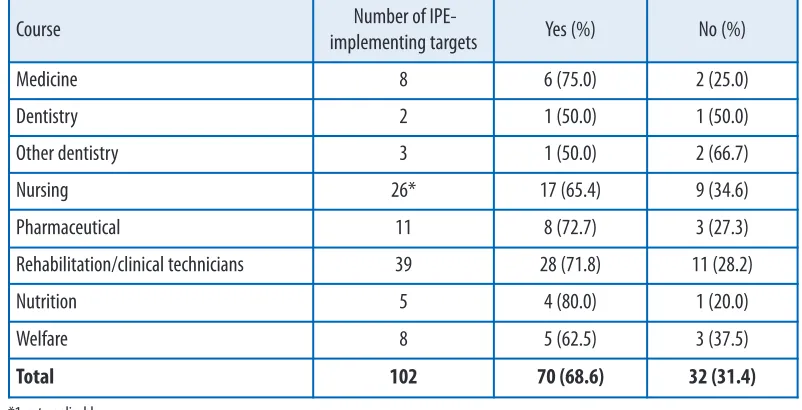
In terms of problems after the implementation of the IPE program, on a course basis, 70 (68.6%) of the 102 respondents reported having problems, while 32 respondents (31.4%) did not report having problems (Table 4-1).
Journal of Research in Interprofessional Practice and Education
Vol. 5.1 March 2015
7
Implementation of IPE in Japan
Ogawa, Takahashi, & Miyazaki
Courses in collaboration with
Course Number of
IPE-imple-menting
targets
Medicine (%)
Dentistry (%)
Other dentistry
(%)
Nursing (%)
Pharma-ceutical
(%)
Rehabilitation /clinical tech-nicians (%)
Nutrition (%)
Welfare (%)
Others (%)
Medicine 8 0 (0) 0 (0) 0 (0) 8 (100) 5 (62.5) 2 (25.0) 0 (0) 0 (0) 0 (0)
Dentistry 2 2 (100) 2a (100) 0 (0) 1 (50.0) 2 (100) 0 (0) 0 (0) 0 (0) 0 (0)
Other dentistry 2* 0 (0) 1 (50.0) 0 (0) 1 (50.0) 0 (0) 1 (50) 0 1 (50) 0 (0)
Nursing 27 12 (44.4) 0 (0) 0 (0) 0 (0) 6 (22.2) 12 (44.4) 2 (7.4) 5 (18.5) 1b (3.7)
Pharmaceutical 11 8 (72.7) 1 (9.1) 1 (9.1) 10 (90.9) 0 (0) 5 (45.5) 1 (9.1) 1 (9.1) 1c (9.1)
Rehabilitation
/clinical technicians 39 8 (20.5) 1 (2.6) 0 (0) 29 (74.4) 6 (15.4) 31 (79.5) 8 (20.5) 12 (30.8) 0 (0)
Nutrition 5 0 (0) 0 (0) 0 (0) 3 (60.0) 0 (0) 2 (40.0) 0 (0) 4 (80.0) 1d (20.0)
Welfare 8 0 (0) 0 (0) 0 (0) 6 (75.0) 1 (12.5) 4 (50.0) 4 (50.0) 3 (37.5) 0 (0)
Total 102
* 1 not applicable; a Extramural cooperation; b Department of Design; c Department of Chemistry; d Department of Early Childhood Education * 1 not applicable
Table 3.
Current IPE-implementing status, by course
Course Number of
IPE-imple-menting targets
Interdisciplinary collaboration (%)
Extramural col-laboration (%)
Both (%)
Medicine 8 8 (100) -
-Dentistry 2 - 1 (50.0) 1 (50.0)
Other dentistry 2* 1 (50.0) - 1 (50.0)
Nursing 27 24 (88.9) 1 (3.7) 2(7.4)
Pharmaceutical 11 9 (81.8) 2 (18.2)
-Rehabilitation/clinical technicians 39 38 (97.4) - 1 (2.6)
Nutrition 5 5 (100) -
-Welfare 8 8 (100) -
-Total 102 93 (91.2) 4 (3.9) 5 (4.9)
Table 2.
A total of 45 problem items were identified from the respondents’ comments (Table 4-2). These items were qualitatively categorized into the following four groups: 1) faculty, 2) interdisciplinary and/or extramural co-operation, 3) educa-tional issues in the IPE program, and 4) administration of the IPE program. Journal of Research in
Interprofessional Practice and Education
Vol. 5.1 March 2015
8
Implementation of IPE in Japan
Ogawa, Takahashi, & Miyazaki
Table 4-1.
Problems after the implementation of the IPE program, by course
Course Number of IPE-
implementing targets Yes (%) No (%)
Medicine 8 6 (75.0) 2 (25.0)
Dentistry 2 1 (50.0) 1 (50.0)
Other dentistry 3 1 (50.0) 2 (66.7)
Nursing 26* 17 (65.4) 9 (34.6)
Pharmaceutical 11 8 (72.7) 3 (27.3)
Rehabilitation/clinical technicians 39 28 (71.8) 11 (28.2)
Nutrition 5 4 (80.0) 1 (20.0)
Welfare 8 5 (62.5) 3 (37.5)
Total 102 70 (68.6) 32 (31.4)
Table 4-2.
Details of problems encountered after the implementation of the IPE program
Q. If yes, what problems did you have? (Open question)
No. Categories N(%)
1 Faculty 12 (26.7)
2 Interdisciplinary and/or extramural co-operation 17 (37.8)
2-a: Environmental factor 1
2-b: Curricular co-ordination 7
2-c: Knowledge and/or skills distinction 3
2-d: Operation 6
3 Educational issues in the IPE program 15 (33.3)
3-a: Educational contents 9
3-b: Evaluation of students and/or the IPE programs 4
3-c: Other 2a
4 Administration of the IPE program 1 (2.2)
Total items 45 (100)
Moreover, categories 2 and 3 were further classified into more specific categories. As Table 4-2 shows, category 2 was the most common answer (N= 17; 37.8%) followed by category 3 (N= 15; 33.3%). Within categories 2 and 3, “curricular co-ordination” was the most common answer in category 2 (7 of 17 items) and “educational con-tents” was the most common in category 3 (9 of 15 items).
Non-IPE-implementing universities
Universities planning IPE implementation: The progress of IPE introduction
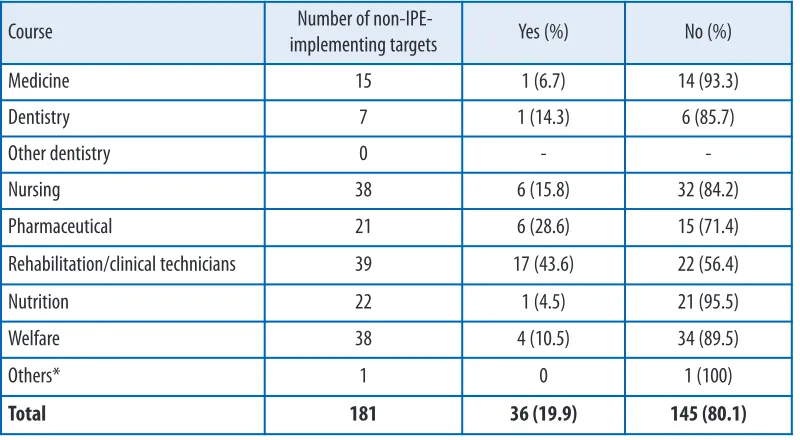
Table 5 shows the demographics of the non-IPE-implementing universities. On a course basis, 36 of the 181 respondents (19.9%) were planning to introduce an IPE program (universities planning IPE implementation). The most common response was for rehabilitation/clinical technician courses (N = 17; 43.6%), followed by phar-maceutical course (N=6; 28.6%).
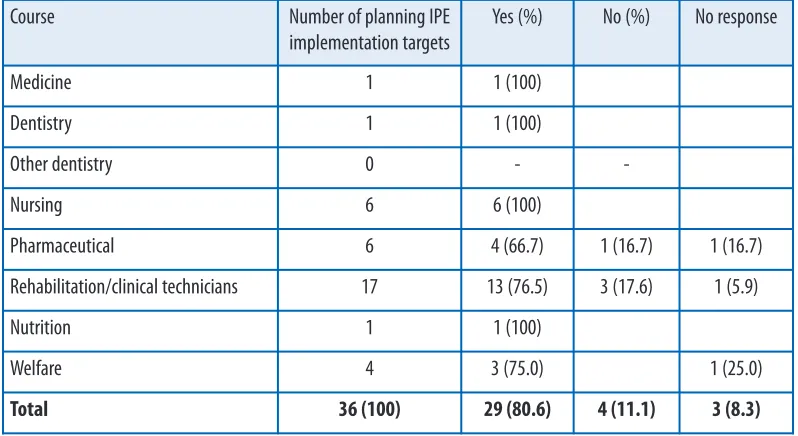
Regarding the universities planning IPE implementation, we also asked about the progress of their planning. As shown in Table 6, 14 of the 36 respondents replied “hope to introduce an IPE program, but do not have any plans yet” (38.9%), and 9 answered “the project is nearly completed, but the start time has not been decided” (25.0%). Six of the 36 respondents (16.7%) had already completed their plan and decided the time to start their program.
Universities planning IPE implementation: Problems encountered during the project
As shown in Table 7-1, among the 36 respondents, 29 (80.6%) had problems whereas 4 (11.1%) did not. The most common problems reported were: “the IPE program cur-riculum: especially interdisciplinary curricular organization” |(N= 23; 79.3%), “per-Journal of Research in
Interprofessional Practice and Education
Vol. 5.1 March 2015
9
Implementation of IPE in Japan
Ogawa, Takahashi, & Miyazaki
Table 5.
Plans for implementing an IPE program, by course
Course Number of non-IPE-
implementing targets Yes (%) No (%)
Medicine 15 1 (6.7) 14 (93.3)
Dentistry 7 1 (14.3) 6 (85.7)
Other dentistry 0 -
-Nursing 38 6 (15.8) 32 (84.2)
Pharmaceutical 21 6 (28.6) 15 (71.4)
Rehabilitation/clinical technicians 39 17 (43.6) 22 (56.4)
Nutrition 22 1 (4.5) 21 (95.5)
Welfare 38 4 (10.5) 34 (89.5)
Others* 1 0 1 (100)
Total 181 36 (19.9) 145 (80.1)
sonnel resources for administering the IPE program” (N = 19; 65.5%), and “difficulty requesting support for the IPE program, especially for securing practical training facilities and learning contents” (N = 11; 37.9%). Additionally, the following three “other” problems were described: “too many students taking the same course,” “do not have a university hospital,” and “just established several years ago (quite a new uni-versity)” (Table 7-2).
Journal of Research in Interprofessional Practice and Education
Vol. 5.1 March 2015
10
Implementation of IPE in Japan
Ogawa, Takahashi, & Miyazaki
Course Number of planning IPE
implementation targets
Yes (%) No (%) No response
Medicine 1 1 (100)
Dentistry 1 1 (100)
Other dentistry 0 -
-Nursing 6 6 (100)
Pharmaceutical 6 4 (66.7) 1 (16.7) 1 (16.7)
Rehabilitation/clinical technicians 17 13 (76.5) 3 (17.6) 1 (5.9)
Nutrition 1 1 (100)
Welfare 4 3 (75.0) 1 (25.0)
Total 36 (100) 29 (80.6) 4 (11.1) 3 (8.3)
Table 6.
Progress of planning IPE implementation, by course
Table 7-1
Problems while carrying out IPE project, by course
Course Number of
planning IPE implementa-tion targets
The project has already been com-pleted
The project is nearly completed
The project is under consid-eration
Preparing for the project
Hope to intro-duce an IPE program
Medicine 1 - - - - 1
Dentistry 1 - - - - 1
Other dentistry 0 - - - -
-Nursing 6 2 1 1 2
Pharmaceutical 6 1 1 2 2
Rehabilitation/
clinical technicians 17 3 6 1 2 5
Nutrition 1 - - - - 1
Welfare 4 1 1 - - 2
Universities planning IPE implementation: What advice was required?
For the last question regarding advice from IPE-implementing universities, a total of 52 items were collected from the respondents’ written comments. These items were divided into the following categories: 1) faculty, 2) interdisciplinary and/or extramu-ral co-operation, 3) educational issues in the IPE program, 4) administration of the
Journal of Research in Interprofessional Practice and Education
Vol. 5.1 March 2015
11
Implementation of IPE in Japan
Ogawa, Takahashi, & Miyazaki
Table 7-2.
Details of problems encountered during the IPE project, by course
Table 8.
Details of problems encountered during the IPE project, by course
Q. If yes, what problems did you have? (multiple answers)
No. Problems N
1 Interdisciplinary curricular organization 23
2 Financial resources for administering the IPE program 6
3 Human resources for administering the IPE program 19
4 Requesting support for the IPE program, especially for learning content 11
5 Requesting support for the IPE program, especially for interdisciplinary co-operation 7
99 Other 2*
If you could consult any IPE-implementing universities about implementing an IPE program, what you would ask? (open question)
No. Categories N(%)
1 Faculty 4 (7.7)
2 Interdisciplinary and/or extramural co-operation 19 (36.6)
2-a: Environmental issues 9
2-b: Curricular coordination 7
2-c: Knowledge and/or skills distinction from other universities 1
2-d: Operation 2
3 Educational issues in the IPE program 15 (28.9)
3-a: Contents of the IPE program 12
3-b: Evaluation of students and/or the IPE programs 3
4 Administration of the IPE program 6 (11.5)
5 Any experiences during IPE implementation 6 (11.5)
6 Other 2 (3.8)
Total items 52 (100)
IPE program, 5) any experiences during IPE implementing process, and 6) other. Categories 2 and 3 were further classified into specific categories, as was done for the IPE-implementing universities. As Table 8 shows, 19 of the 52 items were in category 2 (36.6%), and 15 items were in category 3 (28.9%). Among these two categories, the most common items were “environmental issues” (9 of 19 items) in category 2, and “contents of the IPE program” in category 3 (12 of 15 items).
Discussion
The data collected in the present study provide insight into the IPE programs that existed prior to the Tohoku Earthquake and offer suggestions for future IPE pro-grams, such as those demanded by the MHLW.
Tendency in collaboration partners and potential problems
As previously mentioned, IPE programs are not only required for clinical settings. As shown in Table 3, although a diverse range of fields are covered by IPE programs, col-laboration was most common between medicine and nursing courses and between pharmaceutical and nursing courses, as these professionals work very closely in clin-ical settings. In contrast, rehabilitation/clinclin-ical technician courses had less collabora-tion with medicine and pharmaceutical courses. In particular, the welfare course had no collaboration with medicine or dentistry. One of the possible reasons for this lack of collaboration could be the function of each university. The respondents could be categorized into two groups: universities with their own hospital and universities without a hospital. Kamiyama et al. [3] described one example of a university with nursing and welfare courses, but no university hospital.
This university has a different perspective on IPE programs than other universities with a range of healthcare departments (e.g., medicine, pharmaceutical, nursing and rehabilitation/clinical technician) and/or their own hospitals. This is because the for-mer university implements the IPE program based on a community support centre, whereas the latter universities focus on clinical institutions [3]. Kamiyama et al. also pointed out that IPE programs are currently in strong demand in Japan; however, the specific demands depend on the perspective of the institution [3]. Given the problems with interdisciplinary collaboration reported by respondents, future IPE programs must make such collaboration easier to achieve. As reported by Kuwabata, before the Tohoku earthquake, some affected areas already had serious chronic problems, such as an aging population, depopulation, and a lack of doctors and medical institutions. Moreover, before the Tohoku earthquake, patient and/or healthcare service user infor-mation was not effectively shared between healthcare and welfare professionals in the affected areas [11]. In aging communities, welfare professionals spend a great deal of time with elderly people. Consequently, welfare professionals are very close to them and are very experienced in caring for elderly and/or handicapped people. If patient and/or healthcare service user information had been effectively shared after the Tohoku earthquake, the network of healthcare and welfare professionals and the regional administration would have functioned more effectively in caring for the vic-tims, especially the elderly and/or handicapped people, in the affected areas.
Journal of Research in Interprofessional Practice and Education
Vol. 5.1 March 2015
12
Implementation of IPE in Japan
In the present study, we found that there is little collaboration between medicine and welfare courses in IPE (Table 3). Healthcare professionals and medical institu-tions faced challenges following the Tohoku earthquake. Healthcare human resources were already limited in depopulated areas in the Tohoku region prior to the earthquake; therefore, it is urgently necessary to secure human resources and promote collaboration among healthcare and welfare professionals. If healthcare and welfare professionals collaborate effectively, it should be possible to recover the community-based healthcare system more quickly.
Based on responses to the open question, “If you could consult any IPE-implement-ing universities about an implementIPE-implement-ing IPE program, what would you ask?” some respondents wanted to ask about problems with courses or institutions. For example, “how to develop or introduce an IPE program without a medical school” (pharmaceuti-cal course), and “through the social care education program, how welfare courses can implement an IPE program with other healthcare departments” (psychiatric social worker course). In general, universities without a medical school or only one department face the same problem. They expect to encounter difficulties in adapting their curriculum to a clinical-based IPE program because most IPE programs focus on clinical settings.
Key role as a coordinator between healthcare and welfare
The levels of collaboration between nursing and rehabilitation/clinical technicians and between nursing and medicine are high (Table 3). Similarly, the second most common collaboration was between rehabilitation/clinical technicians and nursing. These two courses play important roles in clinical settings and in the community. For example, in a nursing course, students take classes to become a registered nurse, pub-lic health nurse, or midwife. Consequently, such courses include health and social care in the curriculum to encourage health and social care departments to work and learn together. Even a university with only one department could find suitable collab-oration partners through a nursing department.
Limitations of this study
Firstly, the valid answer rate was 32.8% in this study. This is not considered high enough to accurately reflect the current status of IPE program implementation in Japan.
Secondly, some respondents might have been confused about what is notan IPE [12]. We used a more general definition of IPE than that of CAIPE because many terms in this field are used interchangeably with seemingly precise but differently interpreted meanings [8]. Moreover, interprofessional collaboration is termed team-treatment in Japanese, but this term has not been defined or conceptualized, and no guidelines on how team treatment can be implemented in practice have been pub-lished [9]. Although our definition of IPE programs might mix results on IPE pro-grams with those on IPE-like propro-grams, we consider that this would more accurately reflect the status of IPE implementation in Japan.
The present study is the first to show not only the actual status and problems of IPE program implementation in Japan, but also to suggest key issues to be addressed in future IPE programs.
Journal of Research in Interprofessional Practice and Education
Vol. 5.1 March 2015
13
Implementation of IPE in Japan
Conclusion
We investigated the current status of IPE implementation in Japan following the dif-ficulties experienced during the response to the Tohoku Earthquake. Our results identified problems in the implementation of IPE programs and emphasize the need for effective coordinators for collaboration between healthcare and welfare profes-sionals. These are considered to be key issues for the development of new and more effective IPE programs.
Given the number of respondents that reported their institutions hope to intro-duce an IPE program, our future research will investigate how these key issues affect the spread of IPE and interprofessional collaboration between healthcare and wel-fare professionals in disaster-affected areas in Japan.
Acknowledgement
The authors would like to acknowledge the support of this work through a grant from the Japanese Ministry of Education, Culture, Sports, Science and Technology.
Abbreviations
CAIPE; Centre for the Advancement of Interprofessional Education IPE; interprofessional education
MEXT; Japanese Ministry of Education, Culture, Sports, Science and Technology MHLW; Japanese Ministry of Health, Labour and Welfare
References
Lapkin, S., Levett-Jones, T., & Gilligan, C. (2012). A cross-sectional survey examining the extent to 1.
which interprofessional education is used to teach nursing, pharmacy and medical students in Australian and New Zealand universities. Journal of Interprofessional Care, 26(5), 390–396. World Health Organization. (2010). Study group on Interprofessional Education and Collaborative 2.
Practice. Framework for action on interprofessional education and collaboration practice. Geneva: World Health Organization.
Kamiyama, H., Ito, K., Sato, E., Yoshizawa, E., Shimizu. K. Tanaka, A., Mochizuki, S., Yamamoto, N, 3.
Ono, K., Osawa, J., Kouno, Y., Shimomura, Y., Yanagida, M., Yamada, C., Yokoyama, K., Ide, N., Izumune, M., Suda, Y., Nakahashi, J., Morita, H., Mitsui, C., Hiragata, M., & Matsuhashi, M. (2011). Development of inter-professional education based on accomplishment in Britain and America. The Bulletin of Yamanashi Prefectural University, Faculty of Human and Social Services,
6, 47–56.
Hayashi, K., & Tomita, N. (2012). Lessons learned from the Great East Japan Earthquake: Impact on 4.
child and adolescent health. Asia-Pacific Journal of Public Health, 24(4), 681–688.
Science Council of Japan. (2011). Chiiki de kurasu korei-sha wo shien suru senmonshoku no renkei
5.
ni mukete (interprofessional education for supporting aged people). URL: http://www.scj.go.jp /ja/info/kohyo/pdf/kohyo-21-t133-2.pdf [May 10, 2014].
The Ministry of Health, Labour and Welfare. (2012). The comprehensive reform of social security and
6.
tax.URL: http://www.mhlw.go.jp/seisakunitsuite/bunya/kenkou_iryou/iryou/zaitaku/index.html [November 13, 2013].
Center for the Advancement of Interprofessional Education. (2015). Defining IPE. URL: 7.
http://caipe.org.uk/about-us/defining-ipe/ [May 10, 2014].
Rafter, M.E., Pesun, I.J., Herren, M., Linfante, J.C., Mina, M. Wu, C.D., & Casada, J.P. (2006). A pre-8.
liminary survey of interprofessional education. Journal of Dental Education, 70(4), 417–427. Tamura, Y., Bontje, P., Nakata, Y., Ishikawa, Y., & Tsuda, N. (2005). Can one eat collaboration? Menus 9.
as metaphors of interprofessional collaboration. Journal of Interprofessional Care, 19(3), 215–222.
Journal of Research in Interprofessional Practice and Education
Vol. 5.1 March 2015
14
Implementation of IPE in Japan
Yoyogi Seminar. (2011). Daigaku Juken Annai 2012 (Guidebook for University and College
10.
Admission). Tokyo: Shobun-sha.
Kuwabata, T. (2012). The actual conditions and issues of reconstruction (restoration) of local com-11.
munities in the North Tohoku region after the Great East Japan Earthquake: With a focus on community health care in Iwate. Shakai Sisutemu Kenkyu, 24,33–59.
Burning, S.M., Bhushan, A., Broeseker, A., Conway, S., Duncan-Hewitt, W., Hansen, L., & Westberg, 12.
S. (2009). Interprofessional education: Definitions, student competencies, and guidelines for implementation. American Journal of Pharmaceutical Education, 73(4), 59.
Journal of Research in Interprofessional Practice and Education
Vol. 5.1 March 2015
15
Implementation of IPE in Japan