Introduction:
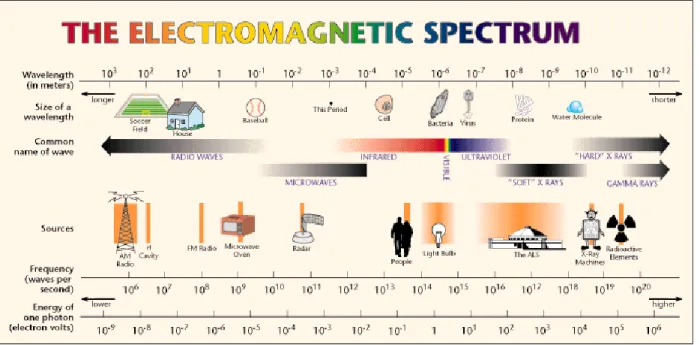
What is the electromagnetic spectrum? The electromagnetic spectrum is the way that forms of energy are grouped based on their wavelength. Look at the display of Electromagnetic Spectrum below. Most people are surprised to learn that television waves, radio waves, microwaves, visible light and radar waves are actually all exactly the same thing. We can describe them by their wavelength, frequency, or energy, and they are different only by these numerical values. However, their properties are different because of these values. A television wave will pass through the walls of our house, whereas visible light will not. Visible light and radio waves pass through Earth's atmosphere, whereas x-rays do not.
Relationship between Wavelength, Frequency and Energy:
Wavelength is the distance from any point of one wave to the same point on the next wave. The frequency of waves is the number of waves that go past a fixed point in a period of time. Longer wavelengths produce lower frequencies because all electromagnetic radiation travels at the same speed. Types of electromagnetic
radiation with higher frequencies, and thus shorter wavelengths, deliver more energy when they strike an object.
The Electromagnetic Spectrum:
Diagram Source:
Lawrence Berkeley Lab website
Click on the link below for a very catchy song about the Electromagnetic Spectrum:
The Electromagnetic Spectrum Simulation
http://yr11physcdsc.blogspot.com/2008/03/electromagnetic-spectrum-song.html
Click on the link below to access the Electromagnetic Spectrum Simulation and then complete the activity that follows.
Component
parts of the Electromagnetic Spectrum
1. What are the seven listed types of electromagnetic radiation (EM radiation) illustrated in this applet? List them from left to right.
Develop a Mnemonic: (Optional)
A mnemonic is something that helps you to remember something. For example the order of colors of visible light can be remembered with the name ROY G. BIV (red, orange, yellow, green, blue, indigo, violet). Invent a mnemonic to remember the order of the electromagnetic spectrum: radio, microwaves, infrared, visible, ultraviolet, x-rays, gamma rays.
In this Electromagnetic Spectrum Simulation, you can click on the wavelength/frequency scale and change the wavelength and frequency by dragging the mouse around. You can also change the wavelength by using the arrow keys on your keyboard. Holding the shift key down while pressing the left or right arrow keys changes the wavelength by a factor of 10.
Note the appearance of a blue vertical line or position bar to indicate your position along the electromagnetic spectrum. The values of frequency, wavelength, and energy (with selected units) for that particular position are listed below the spectrum.
Wavelength range for Electromagnetic Waves
2. Click on the EM scale to move the blue position bar. What are the units of wavelength used in the applet program?
List them in the chart below:
The Electromagnetic Spectrum Java Applet:
3. Locate the vertical blue line and state what type of wave has a one meter wavelength ( x10o = 1.0 ).
______________________.
4.
Locate the following wavelengths and indicate the type of electromagnetic radiation associated
with these wavelengths. Convert the wavelengths to meters.
Wavelength in nanometers
Type of Electromagnetic Radiation
10,000,000,000 nanometers = 1.0 x 101 meters
10,000,000 nanometers = _______________meters
10,000 nanometers = ________________meters
600 nanometers = _________________meters
27 nanometers =
_________________meters
1 nanometer =
_________________meters
0.01 nanometer =
_________________meters
5. Which electromagnetic wave type has the longest wavelength? _________________________
6. Which electromagnetic wave type has the shortest wavelength? ________________________
Radio waves or x-rays? _________________
Infrared or Visible light? ____________________
Microwaves or Ultraviolet __________________
Gamma rays or x-rays? ____________________________
Frequency and Electromagnetic Waves
8.
Click on the EM scale and notice the frequency units. What are the two unit choices for
frequency? List them in the chart below:
**AM radio stations broadcast at a frequency of kilohertz and FM radio broadcast at a frequency of megahertz.
9. CJOB is a favourite Winnipeg AM radio station. The frequency of the station is 680 kilohertz with a wavelength of ________________meters.
10. Q94 is a favourite Winnipeg FM radio station. The frequency of the station is 94.3 megahertz with a wavelength of ______________ meters.
11. Which radio station has the longest wavelength? ______________ (AM or FM)
12. Are they both radio waves according to the Electromagnetic Spectrum Simulation? __________________
14. Click near the visible spectrum on the chart until the spectrum of colors appear. Which color has the longest wavelength? _________________ Highest frequency? __________________.
15. Which type of radiation: ultraviolet or infrared, has higher frequencies? ________________ Which type of radiation is more dangerous? _______________ What is the frequency range of UV light? _______________ Of Infrared light?___________________
16. Why do waves with frequencies higher than visible light hurt us while those with lower frequencies do not affect us?
Energy and Electromagnetic Waves
17. What are the two units of energy used in the Electromagnetic Spectrum Simulation?
List them in the
chart below.
18. Arrange the energy units from largest to smallest in value.
Largest = ___________________________
Smallest = __________________________
19. Click and drag the position bar across the electromagnetic spectrum simulation and determine where the most energetic waves are found. Which type of wave has the most energy? ____________
20. Which type of wave has the least energy? ______________________. Which visible color has the most amount of energy? _______________. Which color has the least amount of energy?
21. How does the energy of the different waves of the spectrum vary with frequency? ______________ With wavelength?________________
22.
What type of wave is it? From the following clues determine the wave type and circle one item
that relates to what this person is doing or being exposed to?
Wave Fact/Data Wave Type Person's Activity
(Select one for each row)
0.908 nm wavelength
(Dental Exam) (Watching TV) (Listening to radio) (Tanning) (Cooking)
32 GHz frequency
(Dental Exam) (Watching TV) (Listening to radio) (Tanning) (Cooking)
10.8 meters wavelength
(Dental Exam) (Watching TV) (Listening to radio) (Tanning) (Cooking)
6.28 x 10⁻¹⁸ joules of energy
(Dental Exam) (Watching TV) (Listening to radio) (Tanning) (Cooking)
23,808 GHz frequency
(Dental Exam) (Watching TV) (Listening to radio) (Tanning) (Cooking)
23. If you are use night-vision goggles, what part of the spectrum are you detecting? ________________