J . H u m . I n s . 2 0 1 8 ; 2 ( 2 ) : 8 9 - 9 8 |89
Journal of Humanities Insights 2(2): 89-98, 2018
Research Paper
Study of Strategic Thinking of Managers based on their
Mental Pattern
Fatemeh Ahmadi 1,a, Sanaz Alizadeh b
a Department of Management, Faculty of Humanities Science, Islamic Azad University Qeshm Branch, Iran b Department of Management, Faculty of Humanities Science, Islamic Azad University Central Branch, Iran
Received: 10 April 2018 Accepted: 13 May 2018 Published: 16 June 2018
Abstract
In recent years, many researchers have focused on the cognitive aspects and mental structures of the managers to identify the strategies. They claim that in order to become familiar with how strategies are formulated and developed, they should evaluate the mind of the strategists and somehow decode the black box. Therefore, the present study aimed to understand the managers’ strategic thinking process and to investigate the similarities in their thinking processes. Semi-structured interviews were conducted based on Zaltman metaphor elicitation technique (ZMET) interviews process. Interviews were conducted with 18 managers from two dairy industry companies. The data were analyzed based on emerging approach to grounded theory. The results of this study demonstrated that the managers of a company are using a shared mental model during strategic thinking. This similarity in their thinking process can be considered to be due to their communications and collaborative work experience. In addition, comparing the common mental model in the two companies, no significant similarity was found in their thinking process. But, there are some similarities between the mental structures of the managers of the two companies.
Keywords: Strategic Thinking; Manager; Mental Pattern; Company;
How to cite the article:
F. Ahmadi, S. Alizadeh, Study of Strategic Thinking of Managers based on their Mental Pattern, J. Hum. Ins. 2018; 2(2): 89-98, DOI: 10.22034/jhi.2018.65741
©2018 The Authors. This is an open access article under the CC By license
1. Introduction
Despite having good plans, many of the excellent corporate strategies are failing. If the mental models of managers as their source of thinking contradict these plans, they will not bring about successful outcomes. Managers can increase the likelihood of successful strategies by shaping their minds and exploring and developing their mental imagery (1). For Argyris and Schon (2), this results from difference between theoretical theory (what the managers say they believe in) and the practical theory (the belief that is the basis of their actions). They argue that the effective leaders use the combination of these two theories (3).
Having a proper understanding of how the organization reacts to its environment is dependent on understanding the mental model of key decision
1Corresponding author email: [email protected]
makers who need to interpret and understand this environment and ultimately make important strategic choices. In fact, the mental model of key decision makers shapes their perceptions and is effective in identifying strategic issues as opportunities and environmental threats. The mental model also affects the diversity of strategies and determines how the organization's dominant logic affects growth, diversification and business strategies (4).
90| J . H u m . I n s . 2 0 1 8 ; 2 ( 2 ) : 8 9 - 9 8
different. Also, as each person looks at events through separate perceptual filters, there are differences between what people perceive (5). Despite the differences in the mental model of individuals and the different thoughts and feelings that we see on surface levels, there are usually more common features at deeper levels. Part of the common thoughts and feelings that exist among humans are related to the common nervous and biological structures among human beings, and the other part is related to similar problems and concerns they face despite different context (6). Recently, many efforts by scientists interested in strategic cognition are focused on developing and evaluating cognitive mapping techniques in order to understand the nature and importance of mental representations of individuals about strategic issues. Cognitive mapping techniques are methods for evaluating the structure and content of mental models. These models show how one combines information of their surrounding environment in a graphical form. A mental model is similar to a roadmap that individuals use when they are about to make a new decision. In this research, we are looking for a subjective model or a common network of abstract perceptions of managers who think strategically. We also want to know how the mental models of managers who operate in a particular industry are similar to each other. Achieving the mental model of the individuals at the time of strategic thinking, helps us understand the thinking process of the strategic thinkers.
2. Literature review
2.1 Mental models
Cognitive structure implies that all representations are cognition or belief. However, the term mental model is broader and includes representations such as emotions, feelings, symbols, actions, goals, personal values, images and memories (7).
The mental model is a representation or simplification of the individual's understanding that can be an image or a simple image in his mind or, through a more closer understanding, a conceptual or abstract pattern. Mental models affect the perception of the world around the individual and also the perception of existing issues. These models are frameworks that control and direct the decision-making process of individuals (8). The mental model can be illustrated as an abstract concept by cognitive mapping. In fact, cognitive mapping provides an interpretation based on the researcher’s perception of the mental model of the person who uses that model. In other words, we can capture, analyze or compare mental models through cognitive mapping. Different researches have imposed restrictions on this concept by using different phrases. However, these two terms, i.e. the cognitive mapping and the mental
model, can be considered synonyms and the use of them and the synergy that they create, can be a way to increase the perception of organizational learning (9). In addition, mental models have been introduced as the main factor in learning organizations (10). These models are formed over time and based on managerial experiences and
include concepts, categories, and causal
relationships. Awareness of causal relationships helps managers make better decisions by taking into account the outcomes of their actions (11). Argyris and Schon consider double-loop learning as the re-examination of frameworks and values. According to them, the change that may occur in the mentality of managers can lead to changes in policy, culture, priorities, and practices of the organization (12).
2.2 Strategic thinking
The concerns of senior executives of organizations are increasing in the face of dynamic and changing environments. Detecting the change, following it, and the unpredictability of the consequences of change, have made the already-difficult-situation even harder. (13). In order for organizations to be successful and stable in such an environment and to respond to the needs of their core customers, they must create a vision for the future and have superior and distinctive strategies than their rivals. Having a competitive strategy requires strategic thinking of the managers of the organization; a thinking that is shaped by their mental models (14). Managers can respond to strategic questions through the mental models that are cognitive foundations of strategic thinking by way of a mechanism that this thinking provides to understand strategic environments and identify strategic insights. The purpose of strategic thinking is to find answers to these questions faster and better than competitors in order to create a clear and stable distance with competitors (15).
J . H u m . I n s . 2 0 1 8 ; 2 ( 2 ) : 8 9 - 9 8|91
greater priority to identify and understand or the issue needs to achieve the best possible results (18). By reviewing the literature of strategic thinking, there are many studies that have either focused on identifying and measuring the cognitive processes of strategic thinking or examined the content of it. For example, Pisapia has introduced three complementary cognitive processes which are related to system thinking: system thinking, reframing, and reflection (19). In addition to Pisapia, many researchers took the concept of strategic thinking and tried to make this concept transparent and understandable by introducing the main elements. For example, Liedtka considers this to be a kind of thinking that includes five main elements: a systems perspective, intently focused, thinking in
time, Hypothesis-driven and Intelligent
Opportunism (20).
While there are instruments provided to assess some of the dimensions of strategic thinking, such as creative thinking (Torrance Test of Creative Thinking) or critical thinking (Watson-Glaser Critical Thinking Appraisal Scale), or a more comprehensive tool, such as the Pisapia Strategic Leadership Questionnaire that is specific to strategic thinking (21), the existence of these tools does not help us understand the processes and content of strategic thinking, and only helps to confirm or evaluate one or more of the skills that managers of organizations need to have for this thinking. Therefore, in order to understand how the strategy is formed in the mind of a strategist, we must understand how he created his mental models. As Hough considers the methods of plotting mental models as a good way to portray content and the process of strategic thinking (22), we can draw on these methods.
Formation of strategies by cognitive processes in the subconscious Mental processes associated with strategy formation, such as visual perception, parallel processing of data, composition, and intuition, may be deeply embedded in our semi-conscious minds, i.e., most of our information may be implicit and we may know more than what we can say (23). In other words, at least 95% of all knowledge is formed outside and only 5% of it belongs to the conscious mind (24).
Strategic thinking, with a comprehensive look at the internal and external environment aimed at guiding actions, behaviors, decisions, and planning, is a cognitive complexion process (25). This cognitive process involves complex, subtle and unconscious elements of human thought (26), and since most of the cognizance occurs in the subconscious, we must examine the subconscious mind in order to understand the process of strategic thinking. Many of the techniques used in art-therapy and image-therapy are very effective in uncovering
subconscious thoughts (27). In addition, in various disciplines, different methods have been developed to examine subconscious ideas, including the Thematic Apperception Test (TAT) or Rorschach inkblots test. These tests help psychologists recognize the type of personality or emotional performance of individuals (28). There are other tests that use stimuli other than visual ones, such as sentence completion or word association tests, which use short answers rather than full image description (29).
Another interesting method used to examine the subconscious mind is the use of metaphor. Metaphors guide people's attention, affect their perceptions, enable them to make sense of what they are confronted with and affect their decisions and actions.
Metaphors give a much better understanding of the cognitive processes and important thoughts than verbal language. They are not stored in memory as words but as a network of abstract conceptions that form part of our mental imagery (30).
In this study, in order to extract the common network of abstract perceptions of the managers who think tragically, we use guided interviews instead of structured interviews, such as the work carried out by Zaltman in the his metaphor elicitation technique (ZMET) for accessing mental models and extracting deep insights, and unconscious minds of consumers through image and metaphor.
The ZMET technique uses visual techniques, one on one in-depth interviews, and a wide range of qualitative processing techniques such as storytelling, sorting, comparing data with the Kelly Grid Technique, and so on. The results obtained from this method are much more reliable than structured interviews (31). The mental model derived from this methodology is a set of interdependent thoughts that are created by the influence of neural fibers and used to process information about an abstract fact and to respond to it. According to Zaltman, the consensus map is a mental model used by different individuals in the same way or jointly exists between a group of individuals (32).
2.3 Strategic thinking modes
By reviewing the theoretical foundations of strategic thinking, we find different modes or tools that help managers to think strategically, including making scenarios or planning based on a scenario, storytelling or narrative thinking, metaphors, and dichotomies of strategic thinking.
92| J . H u m . I n s . 2 0 1 8 ; 2 ( 2 ) : 8 9 - 9 8
In this study, we used the matrix provided by Igor Ansoff. Ansoff examines the company's future strategies, taking into account the two factors of market and product.
As shown in Figure 1, in on the axis of the matrix, it is the market that divides the company's strategy into existing markets or presence in new markets, and the other axis of the matrix is product: one strategy is the continuation of the current product and the other one is the introduction of a new product. Four strategies are identified with these two market and product factors, each of these four strategies identifying an answer to the set of internal and external conditions, helping the decision makers to make a better decision by closer evaluation of them. These four strategies are (34):
• Market penetration: in this strategy, the
company tries to offer the current product to the current segment, thus increase its current market share.
• Market development: With this strategy, the
company offers the current product to new markets, i.e., in addition to developing its market, it maintains the previous product.
• Product development: The main product is
development strategy, i.e., it offers the new product to the previous market segment.
• Diversification: it is a risky strategy in which a
new product is introduced to a new segment of the market.
Figure 1. the market matrix- Ansoff product
The role of mental models in strategic thinking Managers have a limited ability to process large amounts of information, and in order to make strategic decisions in obscure and complex environments, they must develop their mental models; because the mental models of managers are their strategic thinking, and if they want to think about the future strategy of the organization, they use the simple mental models that are simplification of complicated realities.
Environmental changes provide incentives for
reforming existing strategies within the
organization in line with creating a sustainable
competitive advantage. The way managers understand these changes depends on their mental models. Through strategic thinking, a wide range of strategic choices are created and managers can choose a strategy that will lead to the organization's long-term success. Persons in charge of the development of the organization's strategies must be committed to thinking strategically. This commitment helps to activate their mental models based on past experiences and beliefs about strategy (35).
Mental models play a key role in all stages of strategic thinking, including goal formation, evaluation and analysis of the environment,
strategy formulation, and evaluation,
implementation and strategy control. In fact, all organizational decisions that managers take are processed through pre-formed mental models. In the decision-making process, mental models provide a framework for filtering and interpreting new information, and also offer an appropriate response to that information. Mental models including accurate scientific inferences, help decision makers to focus on the most important environmental signs, effectively encrypt and retrieve information and ultimately lead the problem-solving process in the best manner. Although having incomplete mental models is better than not having it, but full mental models help managers focus on relevant and significant information and make better strategic decisions (36).
2.4 Empirical research
In some researches, the consequences of an inappropriate mental model have been investigated. For example, in a research conducted by Menon and Yu (2017), it has been shown that inappropriate mental models can easily justify market outcomes by logical reasoning and affect the way a competitor company's learning. In addition, this learning process does not provoke companies towards having convergent choices. Finally, some situations were identified where a company having less precise subjective model outperformed the companies with a much more precise mental model. Another group of researchers believes that mental models have not always been well-formed. In some cases, there must be relationships between the structures of a mental model that don’t exist and, conversely, in some cases, there are relationships between the structures of the mental model that don’t really exist. Such mental models affect the learners' perceptions of the effectiveness of their choices (37).
J . H u m . I n s . 2 0 1 8 ; 2 ( 2 ) : 8 9 - 9 8|93
viewpoint with one of the ten viewpoints identified in this research. This research has shown that most of the managers' strategic beliefs are different, though there are not hundreds of different dimensions, nor these dimensions are as few as two or three dimensions. That is, when we look at the strategist's mind, we should not expect to find a complex structure of strategic beliefs, nor should we expect a simple structure of strategic beliefs that places all strategic thinking in one or two general paradigms (38).
Some compared in pairs the mapping techniques in the context of organizational strategy (39). Some researchers have investigated the use of mapping applications in different organizational contexts, especially in organizational change (40) and organizational learning (41).
Some researchers have studied the mental models of managers at the industry level (42) or the mental model of managers at different levels of an organization (24). The results of Hodkinson and Johnson's (1994) research show that there is a significant diversification in the content and structural complexity of the cognitive classification of managers, whether within an organization or among organizations within a particular sector of the industry. In Malan's (2010) research indicates that the successful strategic thinking requires a high level of agreement between strategic groups and among members of each strategy group. The results of this research show that although strategic thinking is conducted at all three levels of an organization, employees of each organizational
level collaborate differently in strategy
development. At the highest organizational level, the highest level of strategic thinking is needed and, according to the organizational level, the level of strategic thinking is also reduced.
In another study in which a framework has been introduced for the cognitive analysis derived from strategic thoughts, all the thoughts related to the future of the organization were identified, and after these thoughts were classified and prioritized, a precise analysis was carried out on the mapping so that objectives, issues of importance and choice Which should be focused on in the future. The results of this study showed that such a methodology helps senior managers of the organization create a common framework for strategic thinking, also get acquainted with each other's views and develop their mental models (32). A research on phenomenology associated with the experience of strategic thinking (33) has eventually extracted implicit knowledge in the organization through metaphors (21). From what has been said and based on the investigations, there has been no research on the implementation of the strategic thinking process. In the present study, using the
Zaltman metaphor elicitation technique, we address the implementation of mental models of managers at the time of strategic thinking.
3. Methodology of research
The methodology of this research is based on Saunders' research onion model (11) according to the interpretive paradigm and is applicable in terms of orientation. The research approach is inductive and has a qualitative tone. This research is descriptive in purpose and snowball sampling is used as the method. It is a field research and its strategy is grounded theory with Glaser's nascent approach. The method of data collection was conducted through deep and semi-structured interviews and according to the instructions of Zaltman’s metaphor elicitation technique; the method of data analysis is qualitative coding. In this research, the mental model of the managers of two dairy industry firms was studied in the process of strategic thinking. The dairy industry in Iran, due to its demand, the role of the government in pricing the primary substance of this industry, the lack of a suitable alternative to dairy products, and the important role that these products play in the health of community members, is recognized as a strategic industry and we are witnessing competition in different classes of this industry. The names of these two companies are not included in this research as required by respective managers, and instead of letters A and B are used.
A total of 18 usable interviews were conducted with the managers of the two companies A and B (10 interviews with company A managers and 8 interviews with the managers of company B). The duration of these 18 interviews was approximately 1020 minutes, with an average of approximately 56 minutes for each interview.
In Zaltman metaphor elicitation technique, before conducting well-directed, deep and one-on-one interviews, each participant is given explanations about the topic of the interview and they are asked to think about the topic before taking the interview and bring the pictures to the interview session which represent the meaning that this topic has for them. The interview consists of 10 steps that each step provides a new opportunity to extract new concepts or ideas. The steps involved in this technique are described in two papers by Zaltman (1997) and Kolter and Zaltman (1995).
94| J . H u m . I n s . 2 0 1 8 ; 2 ( 2 ) : 8 9 - 9 8
interviewer is given different opportunities to achieve new thoughts and concepts through each step. In addition, the participant helps to confirm the extracted concepts by reviewing their comments on the interview process and completing and further explaining them. Among the strategies that can be used to document the validity of studies, i.e. validation strategies, are triangulation across methods and external audiences. For this purpose, one of the experienced and knowledgeable managers in the dairy industry market was asked to evaluate the research results. After close examination of the research findings, he confirmed the results.
In order to assess the reliability of the research, an agreement strategy between the two coders was first used and another person was asked to codify the interview texts. After coding, the extent of matching and similarities were evaluated. Then the coding process was resumed by the researcher at a time interval and the extent of similarity was compared with the initial coding.
3.1 Interview Questions
Initially, managers were asked to explain their image of the company's present status in the form of metaphor and to express how their image of the company would change in the next two to five years. Subsequently, they were provided with an explanation on the Ansoff Matter, and they were asked to explain, by considering this matrix, what strategies each day would take on market
penetration, market development, product
development and diversity, and what they are doing. Each of these strategies was individually asked and they responded. We started with a strategy of market penetration. They were then asked to take into account the current market and product situation and to analyze competitors, suppliers, suppliers or customers, potential competitors and alternative products, as well as the image of the metaphor from competitors and customers. Then, with the pictures they described in the interview, the Zamzam interview process, that is, categorizing the images, extracting the structure, expanding the metaphor, selecting the most important image, sensory images, reversing images and constructing the scenario, was implemented. In the following, they were asked about the other three strategies of the Ansoff matrix and also asked how their image of the status of competitors and customers changes by adopting each of these three strategies.
3.2 Research Findings
By reviewing the text of the interviews, the concepts contained in the interview are assigned codes or labels. Then, the concepts derived from each interview are compared with the concepts derived from previous interviews and are classified
according to similarities and differences. In this process, some concepts and codes are deleted, added and merged or renamed. An example of the coding in Table 1 and 2 is given (Please refer to supplementary files). After encoding structures, the causal relationships between these structures are also encoded. In this way, the mental model of each interviewee is plotted. All coding and plotting of mental models are done using the NVivo10 software. constructs extracted using this technique are bipolar, meaning the positive side and the negative side of a concept get the same title and are not considered as two separate concepts. In fact, the positive and negative aspects of a construct are two extremes of a spectrum, and the opinion of the interviewees is somewhere between the two. For example, in the construct of "maintaining quality stability in product production", managers of company A believe that the quality of the company's products fluctuates and should address the quality problems that exist in product production, but the managers of company B believed that due to strict internal standards, the products of this company have a good quality compared to competitors.
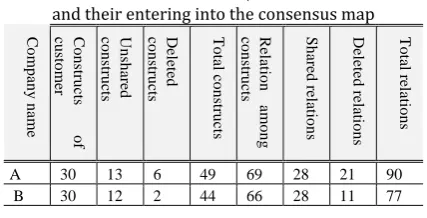
Table 3. The number constructs, the extracted relations and their entering into the consensus map
Total rela tio n s Deleted re latio n s Sh ared r elatio n s Relatio n am o n g co n stru cts Total co n stru cts Deleted co n stru cts Un sh ared co n stru cts Co n stru cts o f cu sto m er Co m p an y name 90 21 28 69 49 6 13 30 A 77 11 28 66 44 2 12 30 B
After analyzing the data on the two companies and extracting the concepts and relationships, we plot a consensus map for each company with the help of the concepts and relationships that were presented in one-third and one-quarter of the interviewed, respectively. The explanations related to the number of concepts and relationships in the consensus map of each company are given below in Table 3.
The consensus maps of companies A and B are shown in figure 2 and 3, respectively. In these two maps, the number of repetitions of each construct in interviews with N and the number of repetitions of each relationship between two constructs of zero and n are shown. To avoid the compactness of the consensus map of both companies, the relationships mentioned in the two interviews have not been numbered.
J . H u m . I n s . 2 0 1 8 ; 2 ( 2 ) : 8 9 - 9 8|95
is a leading company Also due to its long history and experience, the production of products according to the needs of consumers in the dairy industry, the high diversification of products, the presence in new markets, the penetration of current markets and the lack of challenges in providing raw materials.
The four key mechanisms of "gaining more market share than existing markets", "identifying and developing new markets", "creating diversification in products," and "introducing a new product to the new market" which are represented in the consensus map of both companies in a different ways (diamond), are indicative of the four strategies of the Ansoff Matrix. In addition, other constructs are seen in the consensus map of both companies, which are linked with many other constructs and are important.
In the consensus map of company A, the constructs of " production of products according to the needs of consumers", "using advertising and promotion", "innovation in the current product", and "forcing the competitors out or reducing their share", are significant due to having a relationship with other constructs.
As shown in consensus map of company B (Please refer to supplementary file), the company's managers believe that B is a growing company and is considered a leading company among competitors, as they are working to improve the company's processes and the customer's mentality towards the company. Also, to create diversification in their products, gaining more of market share and participate in new markets with new products or current products, the company is trying to have better conditions than the past. In addition, due to their reputation as well as having the experience in the dairy industry, they consider their company as a leader in this industry.
The key constructs in the consensus map of the company are "having experience in the industry", "the use of advertising and promotion," "consumer loyalty to the product", "improving consumer mentality of the brand," “product production according to the need of consumers" and "imitation of competitors from products and gaining market share”.
The similarities between the mental models of the managers of the two companies
30 constructs and 28 relations between constructs in the consensus map of the two companies are common, as shown in Figure 4 (Please refer to supplementary file).
4. Conclusion
Consensus maps derived from data analysis show managers' mental models in the process of strategic
thinking. These maps, which consist of constructs and relations, indicate the thinking process of the managers. In fact, the consensus map of each company is a mental model that is shared by its managers, or, in other words, managers use the same model in a similar way. One of the reasons for such close proximity to the mental models of different people is the interaction and communication between the managers of a company, as well as having shared goals and vision. A comparison between the consensus map of the two companies revealed 30 constructs and 28 relations in the consensus maps of both companies. Therefore, the mental models of these two companies are similar in terms of the existing constructs, but these two consensus maps differ in terms of the process of thinking or the set of relations and constructs.
The similarity in the constructs of the mental models of the managers of the two companies can be seen as the result of common issues facing the managers of both companies in the industry they are working, while the difference between them is the result of each company's different goals, strategies, and contexts. Among the differences noted in the consensus map of the two companies, there is a link between four strategies of market
penetration, product development, market
development and diversity that illustrates the growth strategy of each company. In Figure 5 (a) and 5 (b), respectively, the growth vector of Ansoff is plotted for both companies A and B.
Figure 5. Ansoff’s growth vector for companies A and B.
As shown in figure 5 A, company A operates in two ways for the development of its business. The first way is to go to a new market and expand its products in the new markets after gaining market penetration and significant share. Another way that the company uses is to first develop its products and then launch these new products into new markets.
96| J . H u m . I n s . 2 0 1 8 ; 2 ( 2 ) : 8 9 - 9 8
working on identifying and developing new markets by taking measures such as pricing appropriate for positioning and changing the diversity of dairy products. By identifying new markets, a product will be presented to the market that matches the needs of the consumer, and by creating product innovation, a variety of products will be created.
When a company is developing a market, it can consider the needs of consumers in the production and innovate in the current product to create diversity. Thus the company can, by following competitors and imitating their behavior, introduce this new product to the new market.
The company B, whose growth vector is shown in Fig. 5 (b), goes into new markets for the development of its business and also develops its products in new markets.
When a product from company B penetrates into the market and gains more market share, rivals try to imitate these products and take part in this market; as a result, the company begins to identify and develop new markets. Also, if a new market is identified, the company can develop the product through the production of a product that is tailored to the needs of consumers, which results in product innovations.
Finally, in comparing the results of this study with similar research and with reference to the study by Hadkinson and Johnson (1994) with the hypothesis that there is a high level of consensus among managers of organizations in a particular industry, they concluded that due to contextual situations and strategic management processes, there is no such consensus. Similarly, In this study, there was no significant similarity between the mental models of the managers or the strategic thinking process of the managers of the two companies. In a study by Malan (2010) to examine the mental models of strategic thinkers conducted at three organizational levels and three groups of each level, the high level of agreement between strategic groups and among members of each strategy group were found as the necessary elements of a successful strategic thinking. In this research, the mental model of the managers of a company was similar to each other. In another study by Ozen and Allengine (2007) to analyze diverse strategic thoughts in a firm, they found that cognitive mapping helps managers create a shared framework for strategic thinking, and managers can get acquainted with each other's perspectives and develop their mental models, which in this research also creates a consensus map for managers resulting from the same framework. Senior managers can somehow re-engineer the consensus map of their company and the thinking mode of managers, i.e. by asking themselves the following questions, thinking about changing the this map through changes in their constructs and
relations so that managers can better recognize opportunities and environmental threats than before, identify key success factors, and understand the company's position in a macro-system of business and value-creation. These questions are: • What structures should we remove from current managerial thinking? What are the issues that managers are overemphasizing and should be decentralized?
• Which structures should be emphasized more? Where the positive and negative aspects of the structures and their consequences examined? • What new structures should be created to differentiate ourselves from competitors, or which structures should be strengthened to remain distinctive?
• Which new structures should be associated with which of the previous structures?
• What should connections between structures be emphasized and strengthened? What new connections can be made between structures? Is there a direct relationship between structures or are they indirect?
• Which connections is better to be eliminated or weakened?
It is suggested that the story of a corporate strategy be explained through some of the steps in the ZMET technique, as the expression of strategy in the form of a story composed of various metaphors makes it credible among the members of an organization, and such a strategy adopted by the staff of an organization will be much more successful in implementation. For this purpose, as the work done in this research, metaphors should be considered for each of the key actors that include competitors, customers, resource suppliers, key partners, etc. These metaphors form a strategy in the context and in interaction with each other for a strategic issue.
References
[1] Ahlstrand, B., Lampel, J., & Mintzberg, H.
(2001). Strategy Safari: A Guided Tour Through the Wilds of Strategic Management. Simon and Schuster. (in Persian)
[2] Argyris, C. & Schon, D.A. (1978).
Organisational Learning. Reading MA: Addison-Wesley.
[3] Belk, R. W. (2007). You ought to be in Pictures.
In Review of Marketing Research (pp. 193-206). Emerald Group Publishing Limited.
[4] Christensen, G. L., & Olson, J. C. (2002).
Mapping consumers' mental models with ZMET. Psychology & Marketing, 19(6), 477-501.
[5] Coulter, R. H., & Zaltman, G. (1995). Seeing the
voice of the customer: Metaphorbased advertising research. Journal of advertising research, 35(4), 35-51.
[6] Daniels, K., De Chernatony, L., & Johnson, G.
J . H u m . I n s . 2 0 1 8 ; 2 ( 2 ) : 8 9 - 9 8|97
mental models of competitive industry structures. Human
[7] Relations, 48(9), 975-991.
[8] Doyle, J. R. & Sims, D. 2002. Enabling
metaphors in conversations: a technique of cognitive sculpting for explicating knowledge. In: Huff, A. S. and Jenkins, M. eds. Mapping Strategic Knowledge, Strategic Management & Business Policy, London: Sage, pp. 63-88.
[9] Gary, M. S., & Wood, R. E. (2008). Mental
Models, Decision Rules, Strategies and Performance Heterogeneity. Atlanta Competitive Advantage
Conference Paper. Available at SSRN:
https://ssrn.com/abstract=1095665.
[10] Hodgkinson, G. P., & Johnson, G. (1994).
Exploring the mental models of competitive strategists: The case for a processual approach. Journal of Management Studies, 31(4), 525-552.
[11] Hodgkinson, G. P., Maule, A. J., & Bown, N. J.
(2004). Causal cognitive mapping in the organizational strategy field: a comparison of alternative elicitation procedures. Organizational Research Methods, 7(1), 3-26.
[12] Kalargyrou, V., & Woods, R. H. (2011). Wanted:
training competencies for the twenty-first century. International Journal of Contemporary Hospitality Management, 23(3), 361-376.
[13] Kim, H. (2009). Qualitative mapping for
understanding the collective judgment building process: a study of the federal open market committee. State University of New York at Albany.
[14] Lakoff, G., & Johnson, M. (1999). Philosophy in
the flesh: The embodied mind and its challenge to western thought. Basic books.
[15] Liedtka, J. M. (1998). Strategic thinking: can it
be taught. Long range planning, 31(1), 120-129.
[16] Malan, R. (2010). The role of shared mental
models of strategic thinking in the development of organisational strategy. (Doctoral dissertation, University of Southern Queensland).
[17] Malan, R. (2011). Exploring the
interconnectedness among strategy development, shared mental models, organisational learning and organisational change. International Journal of Learning and Change, 5(3-4), 227-241.
[18] Malan, R., Erwee, R., & Rose, D. M. (2009,
December). The importance of individual mental models for strategic thinking in organisations. In Proceedings of the 23rd Australian and New Zealand Academy of
[19] Management Conference (ANZAM 2009) (pp.
1-17).
[20] Australian and New Zealand Academy of
Management. Martignoni, D., Menon, A., & Siggelkow, N. (2016). Consequences of misspecified
[21] mental models: Contrasting effects and the
role of cognitive fit. Strategic
[22] Menon, A. R., & Yao, D. A. (2017). Rationalizing
Outcomes: Mental-Model- Guided Learning in Competitive Markets.
[23] Meyer, R. J. H. (2007). Mapping the Mind of the
Strategist: A Quantitative Methodology for Measuring the Strategic Beliefs of Business Executives.
[24] ERIM Research Foundation, Rotterdam.
Mintzberg, H. (1994). The fall and rise of strategic planning. Harvard business review, 72(1), 107-114.
[25] Mintzberg, H. (2002). The strategy process:
Concepts, Context, Cases (4th Edition). Prentice Hall.
[26] Moezzi, M. A. (2012). Elicitation of clothing
consumers' mental Model who lives in Tehran by using ZMET. University of Tehran. (in Persian)
[27] Moore, D. L. (2014). The experience of
strategic thinking in a volatile, uncertain, complex, and ambiguous (VUCA) environment. (Doctoral dissertation, The George Washington University).
[28] Ozen, U., & Ulengin, F. (2007). Analyzing
strategic thoughts of corporations based on cognitive map. In Unpublished Paper (Conference Proceedings).
[29] Pisapia, J., Pang, N. S. K., Hee, T. F., Lin, Y., & Morris, J. D. (2009). A comparison of the use of strategic thinking skills of aspiring school leaders in Hong Kong, Malaysia, Shanghai, and the United States: An exploratory study. International Education Studies, 2(2), 46-58.
[30] Pisapia, J., Reyes-Guerra, D., & Coukos-Semmel,
E. (2005). Developing the leader’s strategic mindset: Establishing the measures. Leadership Review, 5(1), 41-68.
[31] Porac, J. F., & Thomas, H. (2002). Managing
cognition and strategy: issues, trends and future directions. Handbook of strategy and management, 165-181.
[32] Ritchie-Dunham, J. L., & Puente, L. M. (2008).
Strategic clarity: actions for identifying and correcting gaps in mental models. Long Range Planning, 41(5), 509-529.
[33] Saunders, M., Lewis, P., & Thornhill, A. (2011).
Research methods for business students, 5/e. Pearson Education India. Senge, P. M. (1992). Mental models. Planning review, 20(2), 4-44.
[34] Spicer, D. P. (1998). Linking mental models
and cognitive maps as an aid to organisational learning. Career Development International, 3(3), 125-132.
[35] Spicer, D. P. (2000). The Role of Mental Models
in Individual and Organisational Learning, Including, Consideration of Cognitive Style. Unpublished Ph. D.
[36] Thesis, University of Plymouth, United
Kingdom.
[37] Steptoe-Warren, G., Howat, D., & Hume, I.
98| J . H u m . I n s . 2 0 1 8 ; 2 ( 2 ) : 8 9 - 9 8
literature review. Journal of Strategy and Management, 4(3), 238- 250.
[38] Weiser, J. (1999). Phototherapy techniques:
Exploring the secrets of personal snapshots and family albums. Vancouver, BC: Photo Therapy Centre.
[39] Wilson, B. G. (2016). Exploration of mind
mapping as an organizational change tool. Pepperdine University.
[40] Wolters, H. M., Grome, A. P., & Hinds, R. M.
(2013). Exploring Strategic Thinking: Insights to
Assess, Develop, and Retain Strategic Thinkers. Applied Research Associates Inc Fairborn Oh.
[41] Zaltman, G. (1997). Rethinking market
research: Putting people back in. Journal of marketing Research, 34(4), 424-437.
[42] Zaltman, G. (2003). How Customers Think: