Setting future ethical standards for
ICT, Big Data, AI and robotics
The contribution of three European projects
Fernow, Josepine
Uppsala University, Centre for Research Ethics & Bioethics (CRB) de Miguel Beriain, Inigo
Universidad del País Vasco, Department of Public Law Brey, Philip
University of Twente, Department of Philosophy Stahl, Bernd
De Montfort University, Centre for Computing and Social Responsibility (CCSR)
Corresponding Author: Josepine Fernow, [email protected]
Keywords: Artificial Intelligence, Big Data, Information and Communication Technol-ogies, Data Sharing, Ethics, Law, Human Rights
Citation: The full citation information will be inserted here once the paper is accepted.
Introduction
It is difficult to predict the consequences of developing and using new technology. Poli-cymakers all over the world struggle to assess the ethical, legal and human rights impacts of IT systems in research, industry, and at home. Right now, three European projects are working together with stakeholders to improve ethical, human rights and legal frame-works for information and communication technologies (ICT), big data analytics, artifi-cial intelligence (AI) and robotics.
PANELFIT, SHERPA and SIENNA
PANELFIT (Participatory Approaches to a New Ethical and Legal Framework for ICT) SHERPA (Shaping the ethical dimensions of Smart Information Systems (SIS) – A European Perspective), and SIENNA (Stakeholder-informed ethics for new technologies with high socio- economic and human rights impact) all aim to improve existing ethical and legal frameworks in a structured way, and will deliver specific, and complementary guidance for software developers, industry, policy-makers, researchers and citizens. Funded by the European Union’s Horizon 2020 programme (Science With and For Socie-ty), the projects have a combined budget of € 10 million.
In this short paper, the authors (who are all members of the three projects), provide a short introduction to the projects and outline plans for collaboration with the aim to max-imise the impact of all three projects. We believe that it is important that PANELFIT. SHERPA and SIENNA are visible in the highly dynamic public discussion of ethics, hu-man rights and possible regulation of emerging digital technologies. The European Union aims to lead the approach to ethical technologies.Among its efforts to promote such an approach, the projects have a key role to play. This paper addresses researchers and poli-cymakers with a specific interest in emerging ICTs, and a broader audience that would like to better understand the nature of ethical and human rights issues and solutions to address these.
Different scopes, complementary outputs
PA-NELFIT, SHERPA and SIENNA will co-create outputs with policy-makers, stakeholders and end-users. This process will ensure that the different kinds of guidance produced will be relevant and useful, and help the projects achieve impact. Proactive collaboration be-tween the projects will also help prevent overlap, and ensure that the scope of each project, and guidance produced, is clear for its intended users and stakeholders engaging in the projects.
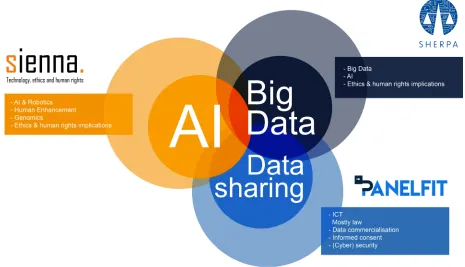
PANELFIT, SHERPA and SIENNA offer unique and complementary outputs. The projects address somewhat overlapping technological domains. PANELFIT has a broader focus on ICT, which to some extent covers the domains of both SHERPA and SIENNA. The SHERPA project is centered on smart information systems, and has a clear overlap with SIENNA’s focus on artificial intelligence. Finally, the SIENNA project offers syn-ergies for AI and robotics, and extends its scope to applications of different ICT technol-ogies for the purpose of enhancing humans.
Figure 1: Subject areas of the three projects
explores regulatory options, possible guidelines for researchers and developers, the pos-sibility of standardization and technical solutions, all of which will feed into an open
accessworkbook on responsible development of SIS, guidelines for research and
in-novation. The SIENNA project has a broader scope, covering three very different tech-nology domains: Artificial Intelligence and Robotics (which is where collaboration with PANELFIT and SHERPA is key), but also Human Enhancement and Human Genomics.. SIENNA will identify and assess ethical and socio-economic issues, carry out a large public opinion survey in 11 countries and citizen panels in five EU countries, assess the legal regulation and human rights implications of AI & robotics and produce a frame-work (for each of the domains covered by the project), forming the basis for developing research ethics protocols, professional ethical codes, and better ethical and legal
frameworks., SIENNA will also create added value by generalising outputs from the
project to make them useful for studying other new and emerging technological domains.
Moving forward: Science with and for society
In order for research to have a policy impact, it needs to be useful for industry, academia, and society. All three projects are developing outputs that can inform and advance Euro-pean research ethics policy in this field. They will support the EuroEuro-pean Union’s vision of Responsible Research and Innovation (RRI) as a means to foster the design of inclu-sive research and innovation. In order to support this vision, we believe that stakeholder involvement in the research process is key. All three projects work to actively engage stakeholders in a variety of ways, using a number of (different) strategies, includ-ing workshops, interviews, surveys, citizen panels and the Delphi technique.
The overlaps in scope and aim to co-create outputs with stakeholders makes it essential for the three projects to collaborate. The coordinators and communication leaders meet regularly to discuss how to ensure that we are clear about the differences and overlaps when communicating with our stakeholders. We strongly believe that working together will help all three projects achieve their objectives when co-creating outputs with experts and stakeholders. This means collaborating to ensure that expertise and experiences can be used in a mutually beneficial manner, to improve existing policy and the policy-making process for ICT, SIS, AI and Robotics. In addition, the three projects are building synergies to develop and optimise communication and dissemination strategies, which is essential to maximizing both conditions for research, and the societal impact.
Having outlined the synergies and planned collaboration between the three projects, we now provide some more detail on them individually:
Project PANELFIT – Participatory Approaches to a New Ethical and Legal
Framework for ICT
Duration 1 November 2018 – 31 October 2021 (36 months)
Logo
Description PANELFIT aims to promote innovation and market growth while still
ensur-ing an adequate level of privacy and security/cybersecurity for private indi-viduals.The main outcome will be guidelines on the Ethical and Legal Issues of ICT Research and Innovation. These Guidelines will serve as a complete handbook on ethics and law regarding research and innovation activities in the ICT field.
Complementary to the Guidelines, PANELFIT will:
- Suggest possible, concrete, improvements to current regulatory and governance structures, at the EU and national levels.
- Create mutual learning and support tools and promote networking among stakeholders and policy makers.
- Increase the quantity and quality of the information available to policy makers, professionals, researchers, journalists and the public.
More https://www.panelfit.eu/ and https://twitter.com/panelfit
Table 1: PANELFIT: timeline,project description and more information
Project SHERPA – Shaping the ethical dimensions of Smart Information
Sys-tems (SIS) – A European Perspective
Logo
Description The SHERPA project will identify and address the ethical dimensions of
in-formation and communication technologies by working with a broad range of stakeholders to clarify and represent ethical, human rights and security issues of smart information systems (SIS), i.e. the combination of artificial intelli-gence (AI) and big data analytics.
The project develops tools to better understand these issues, collects existing, and develops novel ways of responsibly addressing, evaluating and prioritis-ing these issues and communicatprioritis-ing and advocatprioritis-ing those solutions that are most socially acceptable, desirable and sustainable.
Among other outputs,SHERPA will develop and publish an open access workbook on responsible development of SIS. A living document, containing current suggestions and approaches, and proposing novel and additional ap-proaches. A set of notably guidelines for research and innovation in this field.
Research carried out in SHERPA is expected to have a number of societal impacts, including:
- Improving the public knowledge base and understanding of Smart In-formation Systems ethical and human rights challenges.
- Positively informing and influencing Smart Information Systems de-bates and practices through the development of guidelines and stan-dardisation activities.
- Supporting high ethics standards and promotion of RRI as a funda-mental principle of Research and & Innovation in the EU.
- Reconciling the SIS needs and values of society with the needs of sci-entists and innovators by considering them in the design of outputs and fostering dialogue with them.
More https://www.project-sherpa.eu/ and https://twitter.com/project_sherpa
Table 2: SHERPA: timeline,project description and more information
Project SIENNA – Stakeholder-informed ethics for new technologies with high
socio-economic and human rights impact
Duration 1 October 2017 – 30 April 2021 (42 months)
Logo
Description In collaboration with a variety of stakeholders, SIENNA will identify and
assess the ethical and socio-economic issues, public opinions, legal regulation and human rights implications of AI & robotics, human enhancement and human genomics. SIENNA will produce a framework for each technology that will form the basis for development of research ethics protocols, profes-sional ethical codes, and better ethical and legal frameworks. Before develop-ing their recommendations, partners will gather ethical views of experts and citizens towards the three technologies in four ways:
- A major survey of citizens in 11 countries within and outside the EU - Panels of citizens in 5 countries
- Interviews with experts and stakeholders
- Workshops with stakeholders including scientists, ethicists, research ethics committees, professional organisations, civil society organisa-tions, industry and policy makers.
deci-sion making by research ethics committees, scientific researchers and policy makers in all three domains. SIENNA will also create added value by gener-alising its methods for use in other emerging technological domains.
More http://www.sienna-project.eu/ and https://twitter.com/SiennaEthics/
Table 3: SIENNA: timeline,project description and more information
Conclusion
This paper has outlined the efforts planned and undertaken by three major investments into ethics and human rights of emerging digital technologies by the European Union. The EU is serious about developing its understanding and its policies on the basis of sound and rigorous empirical data and wide stakeholder consultation. PANELFIT, SHERPA and SIENNA are designed to operationalise this vision. These efforts can only be successful if supported by the relevant stakeholders and publics. We therefore hope that readers will feel inspired to engage with us and contribute to our work, to ensure that the outputs of all three projects are relevant and useful.
Funding:These projects/research received funding from the European Union’s Horizon
2020 Framework Programme for Research and Innovation under Grant Agreement No. 786641 (SHERPA), Agreement No.788039 (PANELFIT) and Agreement No. 741716 (SIENNA).
The opinions expressed in this document are of the authors and do not necessarily represent the position of the European Commission.