A STUDY ON TASK BEHAVIOR USING WORKFLOW AND PROCESS MINING
*,1
Aruna Devi, T. and
1
Department of Computers Science and Applications, Dayananda
2Principal, Vivekananda College for Women,
ARTICLE INFO ABSTRACT
In today’s business organizations the running logs of a business process has information about its executed and generated activity in the information system. In many situations a work
processes is developed, and it becomes vital to kno
analyzing the existing activity logs. The event logs keep record of information like who does what and when. The
the information system are extracted then analyzed and applied to improve the efficiencies of the business process execution. One of the techniques used to accomplish the process improvement is called process mining. Presently, process mining is a current resea
industries. Process mining aims to fill the gap between Business Process Management and Work Flow Management. The challenge is to turn rapids of event data into valuable insights related to process perform
incompetence, deviations and risks. In the changing environment the business world has to adjust their business process. Many tools are available to generate process
focuses on the task behavior, workflow analysis and business process mining in any organization.
Copyright © 2016, Aruna Devi and Sudhamani. This
unrestricted use, distribution, and reproduction in any medium, provided the original work is properly cited.
INTRODUCTION
Work Flow Management is a rapidly growing technology which is more being used by businesses in various organization. Workflow is a sequence of process of different industries or organization through which a piece of work passes from beginning to end. The workflow management refers to the field which focuses on the business process logistics. Now a day’s organizations or industries generally use information system to maintain the implementation of their business processes. The information systems used i organization are ERP, SAP, CRM, and PeopleSoft, etc., have adopted workflow technologies. Organizations that are unable to use big data in a smart way will not be able to carry on. It is required to relate data to process analysis.
business process in the organization is recorded as event logs in information systems. The event logs have information about which task has been executed, the order in which the tasks are performed by whom along with the time of execution. Now process mining technologies are used to discover new
*Corresponding author: Aruna Devi, T.
Department of Computers Science and Applications, Dayananda Sagar College, Bangalore, India.
ISSN: 0975-833X
Article History: Received 15th January, 2016 Received in revised form 18th February, 2016 Accepted 24th March, 2016 Published online 26th April, 2016
Key words:
Process Mining, Workflow, BPM, ProM.
Citation: Aruna Devi, T. and Dr. Sudhamani, S. 2016.
Research, 8, (04), 29482-29486
RESEARCH ARTICLE
A STUDY ON TASK BEHAVIOR USING WORKFLOW AND PROCESS MINING
Aruna Devi, T. and
2Dr. Sudhamani
Science and Applications, Dayananda Sagar College
Principal, Vivekananda College for Women, Bangalore, India
ABSTRACT
In today’s business organizations the running logs of a business process has information about its executed and generated activity in the information system. In many situations a work
processes is developed, and it becomes vital to know if such a model is actually being followed by analyzing the existing activity logs. The event logs keep record of information like who does what and when. The workflow mining is used for knowledge management and decision
nformation system are extracted then analyzed and applied to improve the efficiencies of the business process execution. One of the techniques used to accomplish the process improvement is called process mining. Presently, process mining is a current research area to analyze the process in organization or industries. Process mining aims to fill the gap between Business Process Management and Work Flow Management. The challenge is to turn rapids of event data into valuable insights related to process performance and compliance. Process mining output can be used to identify and understand holdups, incompetence, deviations and risks. In the changing environment the business world has to adjust their business process. Many tools are available to generate process models like ProM and Disco. This paper focuses on the task behavior, workflow analysis and business process mining in any organization.
This is an open access article distributed under the Creative Commons Att use, distribution, and reproduction in any medium, provided the original work is properly cited.
Work Flow Management is a rapidly growing technology which is more being used by businesses in various a sequence of process of different industries or organization through which a piece of work The workflow management refers to the field which focuses on the business process Now a day’s organizations or industries generally use information system to maintain the implementation of their business processes. The information systems used in the organization are ERP, SAP, CRM, and PeopleSoft, etc., have Organizations that are unable to use big data in a smart way will not be able to carry on. It is The execution of usiness process in the organization is recorded as event logs in information systems. The event logs have information about which task has been executed, the order in which the tasks are performed by whom along with the time of execution.
ess mining technologies are used to discover new
Department of Computers Science and Applications, Dayananda Sagar
knowledge on information hidden in event logs.
mining techniques has the ability to support automatically business process (re) design. Typically, these techniques discover a concrete workflow model and all possible processes registered in a given events log. Process mining can be applied to achieve insight in the real process in organization by checking all the transactions are executed in the exact manner of functioning. Process mining methods are used when no proper details of the process can be found. Workflow can be expressed as a sequence of repeatable operati
process. The process model can be used to analyze, understand and regain control over the task behavior.
work for further assessment the activity pattern is used for systematic organization of resources, investigation of operations. A workflow management system is a computer software system that controls and indicates a sequence of tasks to produce a final result within an organization. For different types of process various workflows are defined by workflow management system. Workflow is a set of business procedure according to the information or tasks which are passed from one member to another for action in whole or part which is automated in the information systems. The discovery of process is by extracting data from e
business process. By representing a business process and analyzing it using a model the
International Journal of Current Research Vol. 8, Issue, 04, pp.29482-29486, April, 2016
INTERNATIONAL
2016. “A study on task behavior using workflow and process minin
A STUDY ON TASK BEHAVIOR USING WORKFLOW AND PROCESS MINING
Sagar College, Bangalore, India
India
In today’s business organizations the running logs of a business process has information about its executed and generated activity in the information system. In many situations a work ow model of business w if such a model is actually being followed by analyzing the existing activity logs. The event logs keep record of information like who does what and workflow mining is used for knowledge management and decision-making support. The logs in nformation system are extracted then analyzed and applied to improve the efficiencies of the business process execution. One of the techniques used to accomplish the process improvement is called process rch area to analyze the process in organization or industries. Process mining aims to fill the gap between Business Process Management and Work Flow Management. The challenge is to turn rapids of event data into valuable insights related to process ance and compliance. Process mining output can be used to identify and understand holdups, incompetence, deviations and risks. In the changing environment the business world has to adjust their models like ProM and Disco. This paper focuses on the task behavior, workflow analysis and business process mining in any organization.
is an open access article distributed under the Creative Commons Attribution License, which permits
knowledge on information hidden in event logs. Process ues has the ability to support automatically design. Typically, these techniques discover a concrete workflow model and all possible processes registered in a given events log. Process mining can be applied real process in organization by checking all the transactions are executed in the exact manner of functioning. Process mining methods are used when no proper details of the process can be found. Workflow can be sequence of repeatable operations of a business process. The process model can be used to analyze, understand and regain control over the task behavior. To represent real work for further assessment the activity pattern is used for systematic organization of resources, investigation of A workflow management system is a computer software system that controls and indicates a sequence of tasks to produce a final result within an organization. For different types of process various workflows are defined by workflow stem. Workflow is a set of business procedure according to the information or tasks which are passed from one member to another for action in whole or part which is automated in the information systems. The discovery of process is by extracting data from event logs for analyzing the business process. By representing a business process and model the organization may get idea on
INTERNATIONAL JOURNAL OF CURRENT RESEARCH
how to reduce cost while improve service levels, and reduce flow time. To determine the process models or workflow of any organization requires process mining algorithms. ProM is an open source tool and Disco is a commercial tool. These tools have many process mining algorithms which help to generate process models to extract process information from the event logs record by a system.
Related work
Business tycoons have made various efforts to grow the business process for all industries or organization. A workflow mining algorithm is used to develop and/or design the existing workflows (Boleslaw Mikolajczak and Jian-Lun Chen, 2005). There have been several workflow mining related researches and developments in the workflow literature. Some of them have suggested the algorithms van der Aalst et al., 2003; Kim & Ellis, 2006; for workflow mining functionality and others have developed the workflow mining systems and tools. W.M.P. van der Aalst’s research group (Van der Aalst et al., 2003) through the paper suggested the fundamental definition and the use of workflow mining to support the design of workflows, and described the most challenging problems and some of the workflow mining approaches and algorithms.The idea of applying process mining in the context of work ow management was rst introduced in (Agrawal et al., 1998). A control flow perspective in manufacturing industry using process mining algorithm is developed to discover all general control flow structures (Aruna Devi and Sudhamani, 2013). The activities are observed and examined by execution of work ow performance for diagnosis of the process (Markus Hammori et al., 2005).
Workflow Management (WFM)
Work Flow Management is being used in business by various organizations or industries. The workflow management refers to the field which focuses on the business process of planning, execution, and controls the flow with storage of goods, services which are associated from the point of origin to point of consumption for the purpose of fulfilling client requirements. The various processes are computerized in today’s day to day activity interfacing human behavior and machine based actions. The aim of workflow management is to observer the task behavior, assist, and make sure that the proper activities are executed by the right people at the right time. Software systems like Enterprise Resource Planning (ERP), Customer Relationship Management (CRM), PeopleSoft, SAP software have implemented workflow technologies. Workflow is a set of business procedure according to the information or tasks which are passed on from one member to another for action in whole or part which is automated in the information systems (Hollingsworth, 1995). Workflow management mainly focuses on the automation of business processes. The workflow is able to redesign the process and support the diagnosis and design. The type of information focuses on how group of people work with the new system and where and why they deviate from the intended process. In the information systems most of the data is available as event logs so that the analysis time and cost is reduces. The workflow gives information regarding any system
in consideration because workflow logs are an independent idea of executed activities. It also allows proper authentication of workflow properties by simulating the process before executing.
The workflow supports multiple views of the same process. It allows the uncontrolled derivation of path from acyclic usual flow of the process each time it is required. The common techniques to understand work practice are interviews and observations of task behavior.
A. Implementation
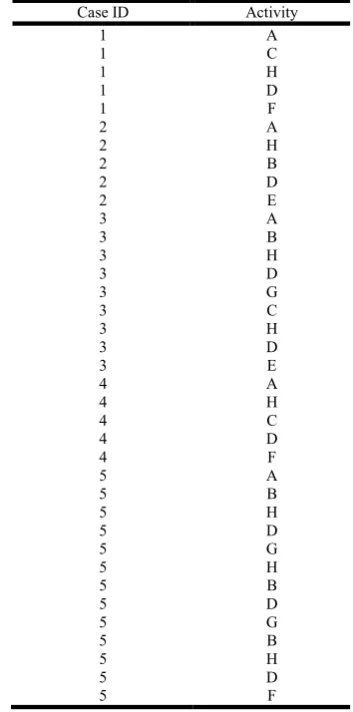
[image:2.595.342.519.311.668.2]One can organize the system to maintain the business processes. Instead of starting with a workflow design, it can be started by gathering information about the workflow processes as they happen. Suppose that it is possible to record events where every event is referred to a process, a case (i.e., a workflow instance), and events are recorded and ordered in succession.
Table 1. Workflow Log
Case ID Activity
1 A
1 C
1 H
1 D
1 F
2 A
2 H
2 B
2 D
2 E
3 A
3 B
3 H
3 D
3 G
3 C
3 H
3 D
3 E
4 A
4 H
4 C
4 D
4 F
5 A
5 B
5 H
5 D
5 G
5 H
5 B
5 D
5 G
5 B
5 H
5 D
5 F
This procedure uses process mining as a follow up to a first step in which transactional data are analysed and filtered to a set of potentially suspicious events which require further examination. The principle of process mining is demonstrated by using the work ow logs as shown in Table 1. The log shows that all case begins with the execution of task A and ends with the execution of task F or E. The log contains information about five different cases which is about workflow instance. Cases are 1, 2, 3, 4, 5 and tasks are A, B, C, D, E, F, G and H which has been executed. Case 1 has executed the task A, C, H, D, and F. Case 2 has executed the task A, H, B, D, and E. Then case 3 has executed the task initially A, then B, H, D, G, C, H, D, and E. The other case also follows their order. The workflow log is shown in Table1 and the corresponding process model is shown in Figure 1. The model is represented in terms of a Petri net. The Petri net begins with task A and ends with task F or E. The task behavior can be analyzed using the process model in Figure 1.
The tasks are represented by transitions. All the cases after execute task A and there is a choice (OR Split) between either execute task C or B or H. Then execute task D. Then a choice of executing task E or F or G. Finally all the cases end with the task E or F. The beginning events and end events can also be used to indicate the tasks take time. It is essential to know that such an approach only works if events are recorded at the time of their occurrence. For this example, it is easy to build a process model that is able to regenerate the workflow log. For larger workflow models it is more difficult.
Business Process Management (BPM)
[image:3.595.70.534.59.225.2]Knowledge from information technology and knowledge from management science together makes Business Process Management (BPM) and this is applied to operational business process. BPM intends to improve operational business processes.
Figure 1. Process model related to workflow log
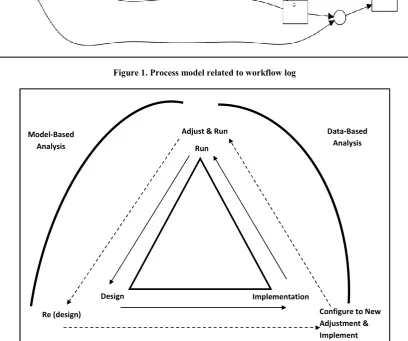
Figure 2. Lifecycle of BPM
Design Implementation
Re (design) Configure to New
Adjustment & Implement Run
Adjust & Run Model-Based
Analysis
[image:3.595.94.503.170.511.2]BPM can be considered as an extension of standard Workflow Management (WFM) systems and approaches (Van der Aalst, 2004). The modeling and analysis of workflow uses Petri nets. BPM procedures such as process mining can be used to discover and analyze emerging processes that are supported by systems that are not even “aware” of the processes they are used in. The life cycle of BPM in Figure 2 consists of two types of analysis which is model-based analysis and data-based analysis. These types of analysis are then classified as re (design) phase, implementation/configuration phase, run and adjust phase (Markus Hammori et al., 2005). In BPM project if we want to make the process better or efficient we start with re (design) phase and then to implementation/configuration and then run the process and finally adjust. Process mining typically focuses on data-based analysis i.e., learning process while they are running. The event data are collected while the systems are running. These data can be used to analyze running processes, e.g., discover bottlenecks, waste, and deviations. The roles of models in Business Process Mining/Work Flow Mining are process models used to reason about task behavior (redesign) that is to discover bottlenecks and to support decisions inside processes (planning and control). The process models may be used to discuss responsibilities, analyze compliance, predict performance using simulation, and configure a WFM/BPM system.
Process mining
Process mining is a field of analysis technique that focuses on mining behavioral aspects from log data. The idea of applying process mining in the context of workflow management was first introduced in (Agrawal et al., 1998). The objective of process mining is to extract information about processes from event logs or transaction logs (Van der Aalst and Weijters, 2003) to analyze the task behavior. The reason for using process mining tool is to nd out how people and/or procedures really work. For example processes supported by an ERP system like SAP (e.g., a procurement process or sales process). In the system logs all transactions does not implement an exact method of working, in such cases the process mining could be used to gain insight in the actual process. The output of a process mining algorithm is a model of a “process” that is a description of how to perform an operation. In a common perspective of business process, the observation is normally not feasible due to sequence of causes. The process model gives us an understanding of the task behavior. The information systems support to execute the process and these systems usually record all the operations that are performed in the organization in some log files. Process mining task is to discover, monitor and improve the process as they are recorded in the event logs. The mining types are 1) Discovery aims at construction of a model of the process; starting from the logs (a-priori model is not required) For example, using t he well-known alpha algorithm (Van der Aalst et al., 2004) a Petri net model can be constructed which describes the behavior observed in the event log. To reveal the process of manufacturing industry (Aruna Devi and Sudhamani, 2013) is from the information system. 2) Conformance analysis starting from an a-priori model, conformance algorithms makes an effort to check the observations of the actual performed process in the original model and vice versa. For example, to check the recorded
patient’s event log conforms to the model. 3) Extension of a model, with a new aspect or perspective or include information on the decision points or on the performance of the activities. The event logs are taken from the information system of an organization. The process mining technology is used to gain insight in the actual process of organization or industry.
Conclusion
The research paper provides an analysis and comparison of key research efforts relating to workflow analysis and business process-mining. All process models are constructed and presented in workflow systems as graphical representation, so that it is clearly understood by all stakeholders. The business process is controlled by workflow management. The management of workflow deals with the automated coordination control and work as required by satisfying workflow processes. Generating a work ow design is a difficult time-consuming process and in general there are discrepancies between the actual work ow processes and the processes as perceived by the management. Process mining is extremely useful tool for managers and system administrators, who want to get an overview of task behavior and monitor the progress. The process models can be analyzed to gain insight into reality. Process mining techniques help to understand what is actually going on in reality and if it is what is actually desired. Current paper depicts the concepts of workflow management with the help of workflow log utilizing the process model, show casing exciting analytical results for workflow processes. The workflow cannot create the analyzed model with good fitness, so process mining tools are used to give a better overview of the business process for complicated workflow logs. Hence process mining concepts and tools are successful technological tools to aid in business process applications.
REFERENCES
Agrawal R., D. Gunopulos, and F. Leymann, 1998. “Mining Process Models from Workflow Logs”, In Sixth International Conference on Extending Database Technology Valencia, Spain, March 23–27 pages 469-483, Proceedings.
Aruna Devi, Sudhamani, 2013. “Application Of Business Process Mining Using Control Flow Perspective In Manufacturing Unit”, IJETTCS, Volume 2, Issue 5, ISSN 22786856, September-October.
Boleslaw Mikolajczak, Jian-Lun Chen, 2005. “Workflow Mining Alpha Algorithm –AComplexity Study”, Intelligent Information Processing and Web Mining Advances in Soft Computing, 451-.
Hollingsworth D, 1995. “The workflow reference model”, Document No. WfMC-TC-1003, Workflow Management Coalition.
Markus Hammori, Joachim Herbst, Niko Kleiner, 2005. “Interactive work ow mining – requirements, concepts and implementation”, Elsevier, 22 February.
Van der Aalst M.P., W. M. P., van Dongen, B. F., Herbst, J., Maruster, L., Schimm, G., &Weijters, A. J. M. M. 2003. Workflow Mining: A survey of issues and approaches.
Van der Aalst W. M. P., Fei, Weijters, Maruster. L, “Workflow Mining: Discovering Process Models from Event Logs”, IEEE, Transactions on Knowledge and Data Engineering, Vol.16 (9), pp.1128-1142, 2004.
Van der Aalst W.M.P., A.J.M.M. Weijters, 2003. “Process mining: a research agenda”, In Computers in Industry, Elsevier B.V.
Van der Aalst, W. M. P. 2004. “Business process management demystified: a tutorial on models, systems and standards for workflow management, in Lectures on Concurrency and Petri Nets”, vol. 3098 of Lecture Notes in Computer Science, pp. 1–65, Springer-Verlag, Berlin, Germany.