RP-HPLC METHOD DEVELOPMENT AND VALIDATION FOR THE SIMULTANEOUS ESTIMATION OF
PRAZOCIN AND POLYTHIAZIDE IN BULK AND TABLET DOSAGE FORM
Ramakrishna, B., Supriya, P., Venkatalakshmi,
Department of Chemistry, S.V. University, Tirupati
ARTICLE INFO ABSTRACT
A simple, Accurate, precise method was developed for the simultaneous estimation of the Prazocin and Polythiazide
mm, 5
through column at a flow rate of 1 ml/min. Buffer used in this method was 0.1%
Temperature was maintained at 30°C. Optimized wavelength selected was 270.0 nm. Retention time of Prazocin and Polythiazide were found to be 2.316 min and 3.176. %RSD of the Prazocin and Polythiazide were found to be 0.5 and 0.7 respectively.
100.40% for Prazocin and Polythiazide respectively. LOD, LOQ values obtained from regression equations of Prazocin and Polythiazide were
equation of Prazocin is y =
times were decreased and run time was decreased, so the method developed was simple and economical that can be adopted in regular Quality control test in Industries.
Copyright © 2018, Setare Nassiri et al. This is an open distribution, and reproduction in any medium, provided
INTRODUCTION
Prazosin is a selective α-1-adrenergic receptor antagonist used
to treat hypertension. It has also been used to decrease urinary obstruction and relieve symptoms associated with symptomatic benign prostatic hyperplasia. α1-Receptors mediate contraction
and hypertrophic growth of smooth muscle cells. Antagonism of these receptors leads to smooth muscle relaxation in the peripheral vasculature and prostate gland. Prazosin has also been used in conjunction with cardiac glycosides and diuretics in the management of severe congestive hear
also been used alone or in combination with β
preoperative management of signs and symptoms of pheochromocytoma. A thiazide diuretic with actions and uses similar to those of hydrochlorothiazide. (From Martindale, The Extra Pharmacopoeia, 30th ed, p826)
MATERIALS AND METHODS
Chemicals and Reagents
Prazocin and Polythiazide pure drugs (API), Combination Prazocin and Polythiazide tablets (MINIZIDE 2),
water, Acetonitrile, Phosphate buffer, Methanol, Potassium dihydrogen ortho phosphate buffer, Ortho-phosphoric acid. All the above chemicals and solvents are from Rankem.
*Corresponding author: Naidu, N.V.S.,
Department of Chemistry, S.V. University, Tirupati India.
ISSN: 0975-833X
Article History:
Received 20th December, 2017 Received in revised form 10th January, 2018
Accepted 16th February, 2018 Published online 28th March, 2018
Citation: Ramakrishna, B., Supriya, P., Venkatalakshmi, V.
Simultaneous Estimation of Prazocin and Polythiazide in Bulk and Tablet Dosage Form Key words:
Prazocin, Polythiazide, HPLC.
RESEARCH ARTICLE
HPLC METHOD DEVELOPMENT AND VALIDATION FOR THE SIMULTANEOUS ESTIMATION OF
PRAZOCIN AND POLYTHIAZIDE IN BULK AND TABLET DOSAGE FORM
B., Supriya, P., Venkatalakshmi, V. and
*Naidu,
Department of Chemistry, S.V. University, Tirupati-517 502, A.P, India
ABSTRACT
A simple, Accurate, precise method was developed for the simultaneous estimation of the Prazocin and Polythiazide in Tablet dosage form. Chromatogram was run through Std Discovery C18 150 x 4.6 . Mobile phase containing Buffer 0.1%OPA: Acetonitrile taken in the ratio 60:40 was pumped through column at a flow rate of 1 ml/min. Buffer used in this method was 0.1%
Temperature was maintained at 30°C. Optimized wavelength selected was 270.0 nm. Retention time of Prazocin and Polythiazide were found to be 2.316 min and 3.176. %RSD of the Prazocin and Polythiazide were found to be 0.5 and 0.7 respectively. %Recovery was obtained as 100.49% and 100.40% for Prazocin and Polythiazide respectively. LOD, LOQ values obtained from regression equations of Prazocin and Polythiazide were 0.079, 0.240 and 0.03, 0.08 respectively. Regression equation of Prazocin is y = 50050.x + 7773 and of Polythiazide was y = 95434.x + 6175. Retention times were decreased and run time was decreased, so the method developed was simple and economical that can be adopted in regular Quality control test in Industries.
access article distributed under the Creative Commons Attribution the original work is properly cited.
adrenergic receptor antagonist used to treat hypertension. It has also been used to decrease urinary obstruction and relieve symptoms associated with symptomatic Receptors mediate contraction oth muscle cells. Antagonism of these receptors leads to smooth muscle relaxation in the peripheral vasculature and prostate gland. Prazosin has also been used in conjunction with cardiac glycosides and diuretics in the management of severe congestive heart failure. It has also been used alone or in combination with β-blockers in the preoperative management of signs and symptoms of A thiazide diuretic with actions and uses similar to those of hydrochlorothiazide. (From Martindale, The
Prazocin and Polythiazide pure drugs (API), Combination (MINIZIDE 2), Distilled water, Acetonitrile, Phosphate buffer, Methanol, Potassium phosphoric acid. All the above chemicals and solvents are from Rankem.
Department of Chemistry, S.V. University, Tirupati-517 502, A.P,
Instruments and Chromatographic
Electronics Balance-Denver, pH Ultrasonicator-BVK enterprises
SYSTEM equipped with quaternary pumps, Photo Diode Array detector and Auto sampler integrated with Empower 2 Software. UV-VIS spectrophotometer PG Instruments T60 with special bandwidth of 2 mm and 10mm and matched quartz cells integrated with UV win 6 Software was used for measuring absorbances of Prazocin and Polythiazide solutions. The mobile phase used was
Acetonitrile in the ratio of 60:40 run Discovary 150 x 4.6 mm, 5, column at a rate of 1 ml/min. for 6 min
30°C and Optimized wavelength was 270nm at the injection volume of 10L.
Preparation of Solvents and Solution
Diluent
Based up on the solubility of the drugs, diluent was selected. Acetonitrile and Water taken in the ratio of 50:50.
Preparation of buffer
Preparation of 0.1% Ortho phosphoric acid Buffer
0.1%OPA Buffer: 1ml of ortho phosphoric acid was diluted
to 1000ml with HPLC grade water.
International Journal of Current Research
Vol. 10, Issue, 03, pp.66228-66235, March, 2018
B., Supriya, P., Venkatalakshmi, V. and Naidu, N.V.S. 2018. “RP-HPLC Method Development and Validation for the
Simultaneous Estimation of Prazocin and Polythiazide in Bulk and Tablet Dosage Form”, International Journal of Current Research
HPLC METHOD DEVELOPMENT AND VALIDATION FOR THE SIMULTANEOUS ESTIMATION OF
PRAZOCIN AND POLYTHIAZIDE IN BULK AND TABLET DOSAGE FORM
Naidu, N.V.S.
517 502, A.P, India
A simple, Accurate, precise method was developed for the simultaneous estimation of the Prazocin in Tablet dosage form. Chromatogram was run through Std Discovery C18 150 x 4.6 . Mobile phase containing Buffer 0.1%OPA: Acetonitrile taken in the ratio 60:40 was pumped through column at a flow rate of 1 ml/min. Buffer used in this method was 0.1% OPA buffer. Temperature was maintained at 30°C. Optimized wavelength selected was 270.0 nm. Retention time of Prazocin and Polythiazide were found to be 2.316 min and 3.176. %RSD of the Prazocin and %Recovery was obtained as 100.49% and 100.40% for Prazocin and Polythiazide respectively. LOD, LOQ values obtained from regression , 0.240 and 0.03, 0.08 respectively. Regression 50050.x + 7773 and of Polythiazide was y = 95434.x + 6175. Retention times were decreased and run time was decreased, so the method developed was simple and economical that can be adopted in regular Quality control test in Industries.
ribution License, which permits unrestricted use,
Instruments and Chromatographic Conditions
H
meter-BVK enterprises, India,
BVK enterprises, WATERS HPLC 2695 SYSTEM equipped with quaternary pumps, Photo Diode Array detector and Auto sampler integrated with Empower 2 VIS spectrophotometer PG Instruments T60 with special bandwidth of 2 mm and 10mm and matched with UV win 6 Software was used for measuring absorbances of Prazocin and Polythiazide solutions. The mobile phase used was 0.1% Ortho phosphoric: Acetonitrile in the ratio of 60:40 run Discovary 150 x 4.6 mm,
column at a rate of 1 ml/min. for 6 min at Temperature 30°C and Optimized wavelength was 270nm at the injection
Preparation of Solvents and Solution
Based up on the solubility of the drugs, diluent was selected. Acetonitrile and Water taken in the ratio of 50:50.
Preparation of 0.1% Ortho phosphoric acid Buffer
1ml of ortho phosphoric acid was diluted to 1000ml with HPLC grade water.
INTERNATIONAL JOURNAL OF CURRENT RESEARCH
HPLC Method Development and Validation for the
Preparation of Mobile Phase
Mobile phase was prepared my mixing 0.1% Ortho phosphoric: Acetonitrile in the ratio of 60:40 and sonicated using ultrasonic bath to degas and subjected to vacuum filtration with 0.45 Millipore Nylon filter.
Preparation of Standard stock solutions
Accurately weighed 10mg of Prazocin, 1mg of Polythiazide and transferred to 10ml and 10ml individual volumetric flasks and 3/4 th of diluents was added to this flask and sonicated for 10 minutes. Flask were made up with diluents and labeled as Standard stock solution. (400µg/ml of Prazocin and 100µg/ml Polythiazide)
Preparation of Standard working solutions (100% solution)
1ml from each stock solution was pipetted out and taken into a 10ml volumetric flask and made up with diluent. (40µg/ml of Prazocin and 10µg/ml of Polythiazide)
Preparation of Sample stock solutions
5 tablets were weighed and the average weight of each tablet was calculated, then the weight equivalent to 1 tablet was transferred into a 10ml volumetric flask, 5ml of diluents was added and sonicated for 25 min, further the volume was made up with diluent and filtered by HPLC filters (400µg/ml of Prazocin and 10µg/ml of Polythiazide).
Method Validation
As per ICH guidelines the method was validated and the parameters like Linearity, Specificity, Accuracy, Precision, Limit of Detection (LOD) and Limit of Quantitation (LOQ) were assessed.
Specificity
It is the ability of analytical method to measure the response of the analyte and have no interference from other extraneous components and well resolved peaks are obtained.
Linearity
25% Standard solution: 0.25ml each from two standard stock
solutions was pipetted out and made up to 10ml. (10µg/ml of Prazocin and 2.5µg/ml of Polythiazide).
50% Standard solution: 0.5ml each from two standard stock
solutions was pipetted out and made up to 10ml. (20µg/ml of Prazocin and 5µg/ml of Polythiazide).
75% Standard solution: 0.75ml each from two standard stock
solutions was pipetted out and made up to 10ml. (30µg/ml of Prazocin and 7.5µg/ml of Polythiazide).
100% Standard solution: 1.0ml each from two standard stock
solutions was pipetted out and made up to 10ml. 40µg/ml of Prazocin and 10µg/ml of Polythiazide).
125% Standard solution: 1.25ml each from two standard
stock solutions was pipetted out and made up to 10ml. (50µg/ml of Prazocin and 12.5µg/ml of Polythiazide).
150% Standard solution: 1.5ml each from two standard stock
solutions was pipettede out and made up to 10ml (60µg/ml of Prazocin and 15µg/ml of Polythiazide).
Accuracy
Preparation of Standard stock solutions: Accurately
weighed 10mg of Prazocin, 1mg of Polythiazide and transferred to 10ml and 10ml individual volumetric flasks and 3/4 th of diluents was added to these flask and sonicated for 10 minutes. Flask were made up with diluents and labelled as Standard stock solution. (400µg/ml of Prazocin and 100µg/ml Polythiazide).
Preparation of 50% Spiked: 5ml of sample stock solution
was taken into a 10ml volumetric flask, to that 1.0ml from each standard stock solution was pipetted out, and made up to the mark with diluent.
Preparation of 100% Spiked Solution: 1.0ml of sample
stock solution was taken into a 10ml volumetric flask, to that 1.0ml from each standard stock solution was pipetted out, and made up to the mark with diluent.
Preparation of 150% Spiked Solution: 1.5ml of sample
stock solution was taken into a 10ml volumetric flask, to that 1.0ml from each standard stock solution was pipetted out, and made up to the mark with diluent.
Acceptance Criteria
The % Recovery for each level should be between 98.0 to 102
Robustness: Small deliberate changes in method like Flow
rate, mobile phase ratio, and temperature are made but there were no recognized change in the result and are within range as per ICH Guide lines.
Robustness conditions like Flow minus (0.9ml/min), Flow plus (1.1ml/min), mobile phase minus, mobile phase plus, temperature minus (25°C) and temperature plus (35°C) was maintained and samples were injected in duplicate manner. System suitability parameters were not much affected and all the parameters were passed. %RSD was within the limit.
LOD sample Preparation: 0.25ml each from two standard
stock solutions was pipetted out and transferred to two separate 10ml volumetric flasks and made up with diluents. From the above solutions 0.1ml each of Prazocin, Polythiazide, solutions respectively were transferred to 10ml volumetric flasks and made up with the same diluents.
LOQ sample Preparation: 0.25ml each from two standard
stock solutions was pipetted out and transferred to two separate 10ml volumetric flask and made up with diluent. From the above solutions 0.3ml each of Prazocin, Polythiazide, solutions respectively were transferred to 10ml volumetric flasks and made up with the same diluent.
System Suitability: The system suitability parameters were
determined by preparing standard solutions of Prazocin (100ppm) and Polythiazide (25ppm) and the solutions were injected six times and the parameters like peak tailing,
resolution and USP plate count were determined. The % RSD for the area of six standard injections results should not be more than 2%.
Assay of Prazocin and Polythiazide
Prazocin and Polythiazide pure drugs (API), Combination Prazocin and Polythiazide tablets (MINIZIDE 2) equivalent to 2 mg and 0.5 mg of Prazocin and Polythiazide respectively was used to perform assay by utilizing the method developed and under the optimized chromatographic conditions. Sample solutions were injected in to the HPLC system and scanned at 270 nm from which the % of drug was estimated.
RESULTS AND DISCUSSION
Optimization of Chromatographic Conditions
Chromatographic conditions
Flow rate : 1 ml/min
Column : Discovary 150 x 4.6 mm, 5.
Detector wave length : 270nm
Column temperature : 30°C
Injection volume : 10L
Run time : 6 min
Diluent : Water: ACN (50:50)
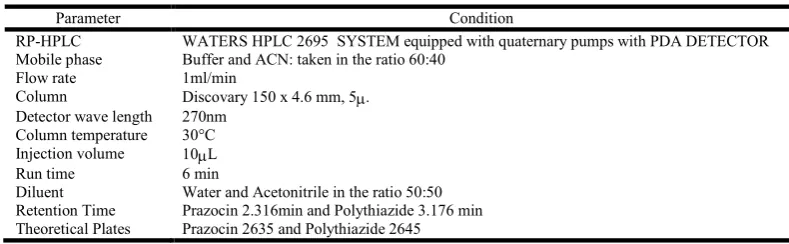
To develop and establish a suitable RP-HPLC method for simultaneous estimation of Prazocin and Polythiazide in bulk and Tablet dosage forms, different preliminary tests were performed and different chromatographic conditions were tested and optimized chromatographic conditions were developed which were given in Table 1.
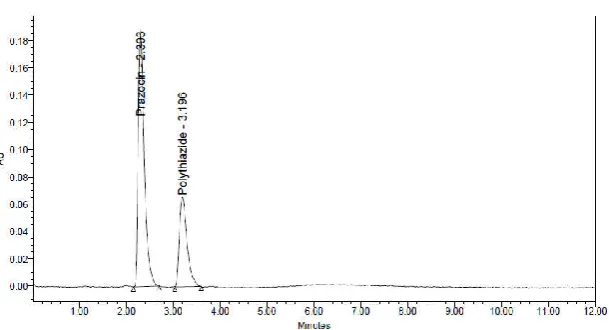
The final analysis was performed by using 60% Ortho phosphoric acid:40% Acetonitrile at a flow rate of 1ml/min. samples were analyzed at 270 nm detector wave length and at an injection volume of 10uLusing Discovery 150 x 4.6 mm, 5. Column with run time of 6 min. The proposed method was optimized to give sharp peak with good resolution and minimum tailing effect for Prazocin and Polythiazide, the optimized chromatogram was obtained as shown in (Figure-3).
Validation
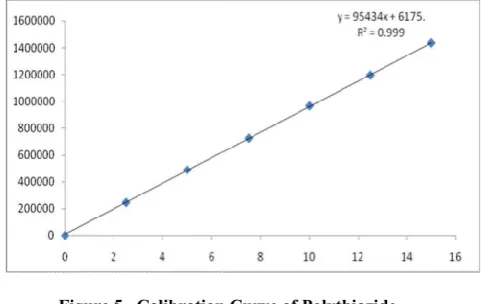
[image:3.595.97.492.472.594.2]Linearity was established for Prazocin (10-60µg/ml) and Polythiazide (2.5-15µg/ml) at six different concentrations each were injected in a duplicates and average areas were determined and linearity equations were obtained as Prazocin was y = 50050.x + 7773 and of Polythiazide was y = 95434.x + 6175 , Correlation coefficient (R2) was determined as 0.999 for the two drugs. The Linearity calibration curves were plotted as shown in (Figure-4&5) for Prazocin and Polythiazide respectively. Retention times of Prazocin and Polythiazide were 2.316 min and 3.176 min respectively. Where no interfering peaks in blank and placebo at retention times of these drugs were not found in this method. So this method holds its specificity.Three levels of Accuracy samples 50%, 100%, 150% were prepared and Triplicates of injections were given for each level of accuracy and mean %Recovery was obtained as 100.49% and 100.40% for Prazocin and Polythiazide respectively were shown in (Table-2).% RSD was calculated from the corresponding peaks obtained by injecting six times a known concentration of Prazocin and Polythiazide the repeatability was obtained as 0.5% and 0.7% respectively for Prazocin and Polythiazide and the % RSD for intermediate Precision was obtained as 1.2%, 1.0% for Prazocin and Polythiazide , Low % RSD values indicates that the method developed was precise as shown in (Table 3).
Table 1. Optimized Chromatographic Conditions
Parameter Condition
RP-HPLC WATERS HPLC 2695 SYSTEM equipped with quaternary pumps with PDA DETECTOR Mobile phase Buffer and ACN: taken in the ratio 60:40
Flow rate 1ml/min
Column Discovary 150 x 4.6 mm, 5. Detector wave length 270nm
Column temperature 30°C Injection volume 10L Run time 6 min
Diluent Water and Acetonitrile in the ratio 50:50 Retention Time Prazocin 2.316min and Polythiazide 3.176 min Theoretical Plates Prazocin 2635 and Polythiazide 2645
Table 2. Accuracy results of Prazocin and Polythiazide
Conc. Prazocin Polythiazide
Amount added (µg/ml)
Amount recovered (µg/ml) % Recovery Amount added (µg/ml)
Amount recovered (µg/ml)
% Recovery
50%
20 20.14206 100.71 5 4.967014 99.34
20 20.0584 100.29 5 5.005962 100.12
20 20.3218 101.61 5 4.981631 99.63
100%
40 40.64863 101.62 10 10.04037 100.40
40 40.0815 100.20 10 9.928464 99.28
40 39.97421 99.94 10 10.16522 101.65
150%
60 59.63608 99.39 15 15.04307 100.29
60 60.48839 100.81 15 15.14164 100.94
60 59.88657 99.81 15 15.28911 101.93
[image:3.595.76.529.622.747.2]The LOD and LOQ values were evaluated based on Relative standard deviation of response and slope of the calibration curve Prazocin and Polythiazide. The detection limit values were obtained as 0.079 and 0.03 and Quantitation limit were fund to be 0.240 and 0.08 for Prazocin and Polythiazide Respectively as given in (Table-4). Robustness conditions like Flow minus (0.9ml/min), Flow plus (1.1ml/min), mobile phase minus, mobile phase plus, temperature minus (25°C) and temperature plus (35°C) was maintained and samples were injected in duplicate manner. System suitability parameters were not much affected and all the parameters were passed. %RSD was within the limit as shown in (Table-5). The system suitability parameters like Retention time, Resolution, USP plate count and peak asymmetry or Tailing evaluated to check
[image:4.595.120.471.75.182.2]whether the results complies the prescribed limits and shown in (Table-6). Prazocin and Polythiazide pure drugs (API), Combination Prazocin and Polythiazide tablets (MINIZIDE 2) equivalent to 2 mg and 0.5 mg of Prazocin and Polythiazide respectively was used to perform assay and the Average % of
Figure 1. Chemical Structure of Prazocin Table 3. Precision Results of Prazocin and Polythiazide
S.No Repeatability Intermediate precision Area of Prazocin Area of Polythiazide Area of Prazocin Area of Polythiazide
1. 2112634 957098 2095436 942671
2. 2103746 960818 2034156 941779
3. 2132907 966473 2054551 955600
4. 2113514 974026 2041885 963678
5. 2105721 968735 2082974 962778
6. 2122924 955776 2041652 957855
Mean 2115241 963821 2058442 954060
S.D 10987.8 7131.1 25025.4 9652.1
%RSD 0.5 0.7 1.2 1.0
Table 4.LOD and LOQ values of Prazocin and Polythiazide
[image:4.595.134.454.293.363.2]Molecule LOD LOQ Prazocin 0.079 0.240 Polythiazide 0.03 0.08
Table 5. Robustness Data of Prazocin and Polythiazide
S.No. Condition %RSD of Prazocin %RSD of Polythiazide 1 Flow rate (-) 0.9ml/min 1.2 1.2 2 Flow rate (+) 1.0.3ml/min 1.1 1.1 3 Mobile phase (-) 35B:65A 0.7 1.7 4 Mobile phase (+) 45B:55A 0.7 0.7
5 Temperature (-) 25°C 0.9 1.3
[image:4.595.96.490.404.483.2]6 Temperature (+) 35°C 0.7 1.0
Table 6. System Suitability Parameters Results of Prazocin and Polythiazide
S no Prazocin Polythiazide
Inj RT(min) USP Plate Count Tailing RT(min) USP Plate Count Tailing Resolution
1 2.289 2607 1.41 3.142 2538 1.35 3.2
2 2.290 2398 1.43 3.145 2518 1.47 3.2
3 2.293 2590 1.38 3.145 2645 1.35 3.1
4 2.293 2612 1.56 3.147 2607 1.29 3.2
5 2.299 2425 1.46 3.147 2627 1.38 3.1
[image:4.595.114.475.521.627.2]6 2.316 2635 1.37 3.176 2530 1.30 3.3
Table 7. Assay Results of Prazocin and Polythiazide
S.No Prazocin Polythiazide
Standard Area Sample area % of Drug Standard Area Sample area % of Drug 1. 2113628 2112634 99.49 962165 957098 99.23 2. 2120349 2103746 99.07 967092 960818 99.62 3. 2101349 2132907 100.44 966193 966473 100.21 4. 2119999 2113514 99.53 957087 974026 100.99 5. 2124437 2105721 99.16 962518 968735 100.44 6. 2148889 2122924 99.97 966088 955776 99.10 Mean 2121442 2115241 99.61 963524 963821 99.93 S.D 15686.8 10987.8 0.52 3760.9 7131.1 0.74
%RSD 0.7 0.5 0.52 0.4 0.7 0.74
[image:4.595.359.509.709.788.2]drug was found to be 99.61 and 99.93% for Prazocin and Polythiazide respectively the results were shown in (Table and the chromatograms for Prazocin and Polythiazide standard drugs and ophthalmic solution dosage forms were shown in (Figure-6, 7) Respectively.
[image:5.595.136.474.186.256.2]Figure 2. Chemical Structure of Polythiazide
Figure 3. Optimized Chromatogram of Prazocin and Polythiazide
Figure 4. Linearity Curve of Prazocin
S.NO Degradation Condition 1
2 Alkali
3 Oxidation
4 Thermal
5
6 Water
S.NO Degradation Condition
1 Acid
2 Alkali
3 Oxidation
4 Thermal
5 UV
6 Water
drug was found to be 99.61 and 99.93% for Prazocin and respectively the results were shown in (Table-7) and the chromatograms for Prazocin and Polythiazide standard drugs and ophthalmic solution dosage forms were shown in
Chemical Structure of Polythiazide
Optimized Chromatogram of
Linearity Curve of Prazocin
Degradation Studies: Degradation studies were performed
[image:5.595.316.560.289.648.2]with the formulation and the degraded samples were injected. Assay of the injected samples was calculated and all the samples passed the limits of degradation.
Figure 5. Calibration Curve of Polythiazide
Figure 6. Standard Chromatogram of Prazocin and Polythiazide
[image:5.595.319.561.333.485.2]Figure 7. A Sample Chromatogram of Prazocin and Polythiazide Tablet Dosage Form
Table 8. Degradation Data of Prazocin
Degradation Condition % Drug Degraded Purity Angle Purity Threshold
Acid 3.49 0.540 0.741
Alkali 2.81 0.526 0.680
Oxidation 3.61 0.529 0.735
Thermal 4.57 0.422 0.590
UV 1.79 0.489 0.619
[image:5.595.75.268.354.424.2]Water 0.84 0.600 1.038
Table 9. Degradation Data of Polythiazide
Degradation Condition % Drug Degraded Purity Angle Purity Threshold
Acid 3.64 0.592 0.832
Alkali 1.88 0.566 0.752
Oxidation 2.90 0.529 0.735
Thermal 4.11 0.420 0.637
UV 2.44 0.493 0.704
Water 0.90 0.515 1.025
Degradation studies were performed with the formulation and the degraded samples were injected. Assay of the injected samples was calculated and all the samples passed the limits of degradation.
Calibration Curve of Polythiazide
Standard Chromatogram of Prazocin and Polythiazide
A Sample Chromatogram of Prazocin and Polythiazide Tablet Dosage Form
Threshold 0.741 0.680 0.735 0.590 0.619 1.038
[image:5.595.43.287.456.755.2] [image:5.595.315.557.506.625.2] [image:5.595.317.555.662.768.2]Fig. 8. Acid chromatogram of Prazocin and Polythiazide
[image:6.595.152.437.575.771.2]Fig. 9. Base chromatogram of Prazocin and Polythiazide
Fig. 10. Peroxide chromatogram of Prazocin and Polythiazide
Fig. 11. Thermal chromatogram of Prazocin and Polythiazide
Conclusion
A new Accurate, Precise, Simple and reliable method for the simultaneous estimation of the Prazocin and Polythiazide in Tablet Dosage Form has been developed. The method developed was validated and was found to be sensitive, accurate, precise and reliable for the analysis of Prazocin and Polythiazide in Bulk and Tablet dosage forms. The Results obtained were within the prescribed limits of ICH Guidelines and shown accuracy and preciseness of the method developed.As the Retention times were decreased and that run time was less the method can be effectively adopted in regular quality control testing in industries which is also economical too. Finally it can be concluded from the results that the method developed was simple and accurate with robust and reliability as added values to the method.
REFERENCES
Alankar Shrivastava* and Vipin B. Gupta Stability-Indicating RP-HPLC Method for the Simultaneous Determination of Prazosin, Terazosin, and Doxazosin in Pharmaceutical Formulations Scientia Pharmaceutica — Open Access
Journal Vol 4, Issue 3, 2012
Alankar shrivastava, 2vipin bihari gupta simultaneous determination of two alphaone adrenoreceptor blockers terazosin and prazosin using tamsulosin as internal standard International Journal of Pharmacy and Pharmaceutical Sciences
Bakshi M1, Ojha T, Singh S. 2004. Validated specific HPLC methods for determination of prazosin, terazosin and doxazosin in the presence of degradation products formed under ICH-recommended stress conditions. J Pharm
Biomed Anal., Jan 27;34(1):19-26
Dr. Tenjarla S. N., Tseggai, A. 1992. High-performance liquid chromatographic assay of prazosin for transdermal screening studies Journal of Clinical Pharmacy and
Therapeutics Volume17, Issue1 February Pages 37–42.
http://www.news-medical.net/health/Prazocin-Mechanism.aspx
http://www.rxlist.com/jardiance-drug/overdosage-contraindications.html
https://en.wikipedia.org/wiki/Prazocin
[image:7.595.122.483.284.473.2]Monika Bakshi Tina Ojh Saranjit SinghValidated specific HPLC methods for determination of prazosin, terazosin and doxazosin in the presence of degradation products formed under ICH-recommended stress conditions Journal of Pharmaceutical and Biomedica Analysis
Fig. 12. UV chromatogram of Prazocin and Polythiazide
Moskalyk RE, Locock RA, Chatten LG, Veltman AM, Bielech MF. 1975. Determination of polythiazide in pharmaceutical dosage forms by high-pressure liquid chromatography.. J Pharm Sci., Aug;64(8):1406-8.
William J. 1986. Bachman high performance liquid chromatographic determination of diuretic-antihypertensive combination products. i. Prazosin And Polythiazide
Journal Of Liquid Chromatography volume 9,- issue 5.