DEVELOPMENT OF STUDENT WORKSHEET BASED CURIOUS NOTE PROGRAM (CNP) LEARNING
MODEL TO IMPROVE SCIENCE PROCESS SKILLS OF SENIOR HIGH SCHOOL STUDENTS GRADE XI
IN CHAPTER EQUILIBRIUM
1*
Himawan
1
Graduate Student of Physics Education, Yogyakarta State University, Yogyakarta, Indonesia
2
Department of Physics Education, Yogyakarta State University, Yogyakarta, Indonesia
ARTICLE INFO ABSTRACT
This research aims were to:
process skills improvement. This was a development research by using 4D models (define, design, develop, and
students for limited test and 55 students for field test.
learning model developed for teaching physics in the chapter Equilibri order to improve science process skills of senior
validation result of 0.83 (very good) and the approval rate of 93.90% (reliabel). Almost students agreed to the worksheet w
(very good) for field test. (2) Science process skill improvement for limited test with presentation 13.84% and standard gain of 0.16 which is included in low category. Science proces improvement for field test with presentation 14.58% and standard gain of 0.18 which is included in low category.
Copyright © 2018, Himawan Putranta and Yusman Wiyatmo permits unrestricted use, distribution, and reproduction
INTRODUCTION
One sign of a country can be said to advance, if the aspect of education has become a primary need for people who
separated from their lives. Education is not only done in schools, but also can be done in the family environment, as well as educational institutions. One of the goals of the Indonesian nation embodied in the Preamble to the 1945 Constitution is to educate the nation. This goal is an encouragement for the community to play a role in the progress of education in Indonesia. Without a mature educational plan, the state of Indonesia will be left behind with other countries that who plan education well. Almost all subjects have a role to play in the advancement of education and technology. However, there is one of these subjects that pioneered the progress of education in Indonesia, the subject of physics. Physics is one subject of natural science that has a
role in advancing education in Indonesia and educate the nation, thus attracting the interest of educators to plan and implement physics education in a planned manner based on existing physics concepts. One efforts undertaken by the Indonesian government in improving the quality of education
*Corresponding author: Himawan Putranta,
Graduate Student of Physics Education, Yogyakarta State University, Yogyakarta, Indonesia.
ISSN: 0975-833X
Article History:
Received 22nd December, 2017
Received in revised form 09th January, 2018
Accepted 24th February, 2018
Published online 30th March, 2018
Citation: Himawan Putranta and Yusman Wiyatmo
improve science process skills of senior high school students grade xi in chapter equilibrium Research, 10, (03), 67000-67005.
Key words:
Student Worksheet, Curious Note Program, Science Process Skills.
RESEARCH ARTICLE
DEVELOPMENT OF STUDENT WORKSHEET BASED CURIOUS NOTE PROGRAM (CNP) LEARNING
MODEL TO IMPROVE SCIENCE PROCESS SKILLS OF SENIOR HIGH SCHOOL STUDENTS GRADE XI
IN CHAPTER EQUILIBRIUM AND ROTATIONAL DYNAMICS
Himawan Putranta and
2Yusman Wiyatmo
Graduate Student of Physics Education, Yogyakarta State University, Yogyakarta, Indonesia
Department of Physics Education, Yogyakarta State University, Yogyakarta, Indonesia
ABSTRACT
This research aims were to: (1) produce Curious Note Program worksheet and (2) know science process skills improvement. This was a development research by using 4D models (define, design, develop, and disseminate). The development product was tested in grade XI MAN Yogyakarta 2, 26 students for limited test and 55 students for field test. The research results: (1) worksheet based CNP learning model developed for teaching physics in the chapter Equilibri
order to improve science process skills of senior high school students grade
validation result of 0.83 (very good) and the approval rate of 93.90% (reliabel). Almost students agreed to the worksheet with CVI score of 0.33 (very good) for limited test and CVI score of 0.31 (very good) for field test. (2) Science process skill improvement for limited test with presentation 13.84% and standard gain of 0.16 which is included in low category. Science proces improvement for field test with presentation 14.58% and standard gain of 0.18 which is included in low category.
Wiyatmo. This is an open access article distributed under the Creative in any medium, provided the original work is properly cited.
One sign of a country can be said to advance, if the aspect of education has become a primary need for people who cannot be separated from their lives. Education is not only done in schools, but also can be done in the family environment, as well as educational institutions. One of the goals of the Indonesian nation embodied in the Preamble to the 1945 ucate the nation. This goal is an encouragement for the community to play a role in the progress Without a mature educational plan, the state of Indonesia will be left behind with other countries ost all subjects have a role to play in the advancement of education and technology. However, there is one of these subjects that pioneered the progress of education in Indonesia, the subject of physics. Physics is one subject of natural science that has an important role in advancing education in Indonesia and educate the nation, thus attracting the interest of educators to plan and implement physics education in a planned manner based on undertaken by the government in improving the quality of education
Graduate Student of Physics Education, Yogyakarta State University,
and achieving educational progress is by replacing and improving the deficiencies contained in Education Unit Level Curriculum (KTSP) 2006 into Curriculum 2013.
theoretical foundation in the Curriculum 2013 states that the Curriculum 2013 embraces: (Hake and Richard, 2012
by teachers in the form of a process developed in the form of learning activities in schools, classes, and communities; And (Kemendikbud, 2013) the student's direct learning experience corresponds to the students background, characteristics, and abilities (Kemendikbud, 2013: 6).
conducted by researchers at MAN Yogyakarta 2, implementation of physics learning activities in MAN Yogyakarta 2 looks still one way and the teacher is more dominant. Students tend to obtain information that is theoretical because of the delivery of teachers using the lecture method. Students are not required to practice information submitted by teachers directly, this makes the students science process skills in MAN Yogyakarta 2 low. The student worksheet used in MAN Yogyakarta 2
exercise questions only and has not led to the assessment of students science process skills. This can happen because teachers have difficulty when assessing the students
process skill. This certainly indicates that the learning a
of physics at MAN Yogyakarta 2 only focused on the material and physics concept.
International Journal of Current Research
Vol. 10, Issue, 03, pp.67000-67005, March, 2018
Wiyatmo, 2018. “Development of student worksheet based curious note
improve science process skills of senior high school students grade xi in chapter equilibrium and rotational dynamics
DEVELOPMENT OF STUDENT WORKSHEET BASED CURIOUS NOTE PROGRAM (CNP) LEARNING
MODEL TO IMPROVE SCIENCE PROCESS SKILLS OF SENIOR HIGH SCHOOL STUDENTS GRADE XI
ROTATIONAL DYNAMICS
Wiyatmo
Graduate Student of Physics Education, Yogyakarta State University, Yogyakarta, Indonesia
Department of Physics Education, Yogyakarta State University, Yogyakarta, Indonesia
Curious Note Program worksheet and (2) know science process skills improvement. This was a development research by using 4D models (define, design, disseminate). The development product was tested in grade XI MAN Yogyakarta 2, 26 The research results: (1) worksheet based CNP learning model developed for teaching physics in the chapter Equilibrium and Rotational Dynamics in students grade XI, from the CVI score of validation result of 0.83 (very good) and the approval rate of 93.90% (reliabel). Almost students ith CVI score of 0.33 (very good) for limited test and CVI score of 0.31 (very good) for field test. (2) Science process skill improvement for limited test with presentation 13.84% and standard gain of 0.16 which is included in low category. Science process skill improvement for field test with presentation 14.58% and standard gain of 0.18 which is included in
Creative Commons Attribution License, which
and achieving educational progress is by replacing and deficiencies contained in Education Unit Level Curriculum (KTSP) 2006 into Curriculum 2013. In general, the theoretical foundation in the Curriculum 2013 states that the Hake and Richard, 2012) learning f a process developed in the form of learning activities in schools, classes, and communities; And ) the student's direct learning experience corresponds to the students background, characteristics, and (Kemendikbud, 2013: 6). Based on a preliminary study conducted by researchers at MAN Yogyakarta 2, mplementation of physics learning activities in MAN Yogyakarta 2 looks still one way and the teacher is more Students tend to obtain information that is e of the delivery of teachers using the lecture method. Students are not required to practice information submitted by teachers directly, this makes the students science process skills in MAN Yogyakarta 2 low. The student worksheet used in MAN Yogyakarta 2 mostly contained exercise questions only and has not led to the assessment of science process skills. This can happen because teachers have difficulty when assessing the students science This certainly indicates that the learning activities of physics at MAN Yogyakarta 2 only focused on the material OF CURRENT RESEARCH
Therefore, this is contrary to the nature of physics as a process. Physics as a process is a process to find the concept and the material. Physical learning focused on the concept of physics is identical with many formulas, causing students to assume that physics is a subject that only studies the formula. This has an impact on the low interest of students to study physics. Therefore, by looking at the problems in physics learning at MAN 2 Yogyakarta and also matching it with the essence of physics and Curriculum 2013, physics learning will be better if done with the aim to improve the ability of the students science process. Learning based on students science process skills can provide a learning experience to students, so students have a variety of skills. Various research have been done to develop a learning model with the aim of improving students science process skills. One of them is the Curious Note Program (CNP) learning model developed by Jongseok Park, Yohan Hwang, Eunju Park, and Jaeheon Park. The CNP learning model is the result of the integration of various types of autonomic inquiry with Integrated Process Skills (IPS) and Science Writing Heuristic (SWH) to nurture creativity and scientific capabilities (Park et al., 2009: 1524). Referring to the development of curriculum in Indonesia, the Curriculum 2013 where learning activities focus on the ability of students in scientific thinking, then the physics learning must be done with scientific approach one of them is inquiry scientific (scientific inquiry).
Learning in scientific inquiry is a learning that can keep the ability to think, work, and be scientific students as an important aspect of life skills. Curriculum 2013 also refers that physics learning must improve the skills aspects of the students science process, it is necessary to apply learning models that support these activities. One of the learning models that emphasizes students science process skills is the Curious Note Program (CNP) learning model. The CNP learning model has been developed and implemented in Korea, for example KNU SEIGY (Science Education Institute for Gifted Youth). In this learning model, students do inquiry activities such as finding problems, designing experiments, formulating hypotheses, formulating theoretical basis, and carrying out experiments. There are six stages in CNP based learning, that is Introduction, Finding Out Question, Discussion and Determination, Study Related Theory, Inquiry Activity, and Conclusion (Park et al.,
2009: 1525). The six stages in this CNP based learning should arise in learning activities, so students science process skills can improve. Thus, the solution is to develop student worksheets based CNP learning model to improve students science process skills. The student worksheet developed takes chapter of physics senior high school students grade XI that is Equilibrium and Rotational Dynamics.
MATERIALS AND METHODS
Research Design
The research method used in this research is Research and Development (R & D) research method. Sugiyono (2015: 407) states, R & D research method is a research method used to produce a specific product and test the feasibility of the product. Therefore, researchers use R & D research methods specifically aimed at determining the pattern of discussion in predicting products in the future. This development study was carried out with a design adapted from the 4D model by Thiagarajan and Semmel (1974). The 4D development model consists of 4 main stages that is: define; design; develop; and
Disseminate. Developed student worksheets based Curious
Note Program (CNP) learning model on chapter of Equilibrium and Rotational Dynamics.
Time and Place of the Research
This research was conducted at MAN Yogyakarta 2 in the even semester of academic year 2016/2017 June 2016 until January 2017.
Research Ssubjects
The subjects of the study were students of class XI MAN Yogyakarta 2. Students in class XI IPA 1 amounted to 28 students, class XI MIPA 2 amounted to 26 students, and class XI MIPA 3 amounted to 27 students. The subjects for limited test were 26 students of XI MIPA 2 and field test were 55 students of XI MIPA 1 and XI MIPA 3.
Procedure
1. Define
This stage aims to define and define the terms of learning. This step consisted of five basic steps:
First Analysis
The aim was to determine the basic problems encountered in physics learning in senior high school.
Students Analysis
Analysis of student characteristics that include academic ability, learning motivation, cognitive developmental level, and students science process skills.
Assignment Analysis
The aim was to determine the content in the learning unit that refers to the Core Competency and Basic Competence in accordance with the Curriculum 2013.
Concept Analysis
Identification of basic concepts to be taught, systematically arranging, detailing concepts, and linking concepts to one another to form concept maps.
Learning Aims Specification
This step was to formulate learning aims based on Core Competences, Basic Competences, and Indicators which listed in the syllabus.
2. Design
This stage aims to develop research instruments and initial draft of lesson plan and student worksheets based CNP learning model and its learning tools. This step consisted of four basic steps:
Arranging the Research Instrument
This stage is done to develop research instrument in the form of instrument of learning device and instrument of data.
Choosing Media
Selected learning media must be in accordance with the learning objectives of the chapter equilibrium and Dynamics Rotation subtopic Torque and Center of Gravity.
Choosing Format
The format selection is adapted to the lesson plan format and student worksheets based CNP learning model.
The Initial Design of Lesson Plan and Student Worksheets
The developed lesson plan and student worksheets are focused on activities in the phase of Finding Out Questions, Discussion and Determination, Study Related Theory, and Inquiry Activity in the CNP learning model related to students science process skills.
3. Develop
This stage aims to produce RPP, LKPD based Curious Note Program (CNP) learning model, as well as pretest and posttest questions that have been validated and revised based on the comments, suggestions, as well as the assessment of experts and practitioners validator, the implementation of limited test, and field test. This step consisted of five basic steps:
Lecturer and Teacher Validation
This stage aims to validate the initial draft of lesson plan, student worksheets based Curious Note Program (CNP) learning model, as well as pretest and posttest science process skills.
The First Revision
The first revision aims to improve the product after being validated based on corrections or suggestion from the validator which then produces the revised product I and will be tested on a limited basis.
Limited Test
Limited test is performed to get corrections or suggestions to improve the revised product I, if there are any mistakes or weaknesses.
The Second Revision
Revision II is done after the revised product I is tested in a limited way. Errors and weaknesses in the limited test are fixed in the second revision. The revised product II is a ready to tested product in MAN Yogyakarta 2.
Field Test
Field test aims to know the results of student worksheet work based CNP learning model, pretest and posttest of science process skills, students response to the CNP based learning model, and the attainment of RPP based CNP learning model.
4. Disseminate
This stage aims to use products that have been developed on a wider scale, such as other classes, other teachers, and other schools.
Data, Instruments, and Technic of Collecting Data
Instruments which used in this research were learning instruments and data collecting instruments.
1. Learning Instruments
Lesson Plan
The lesson plan contains guidance for teachers to teach, which consists of introduction activities, core activities, and closing activities of the learning. The lesson plan is expected to support the learning activities with the CNP learning model, so that the expected learning outcomes can be achieved optimally.
Student Worksheets Based CNP Learning Model
This student worksheet was used for improving the students science process skill. This student worksheet was arranging based to the learning objectives and developed in accordance with the format of the CNP learning model.
2. Data Collecting Instruments
Validation Questionnaire
The questionnaire was used to obtain the initial design score of lesson plan, student worksheet based CNP learning model, and pretest and posttest of science process skill.
Student Response Questionnaire
This questionnaire student response is aimed to obtain student data as an evaluation to student worksheets based CNP learning model.
Observation Sheet of Lesson Plan
This observation sheet aims to determine the feasibility of lesson plan based CNP learning model in terms of achieving lesson plan in learning activities using student worksheets based CNP learning model.
Pretest and posttest
This instruments were used to measure students science process skills after and before using student worksheets based CNP learning model.
The data analyzed include lesson plan feasibility data basedCNP learning model, student worksheets feasibility basedCNP learning model, feasibility about pretest and posttest of science process skill, and improvement of students science process skill.The feasibility of lesson plan basedCNP learning model in terms of validation score by lecturer and teacher validator and percentage of lesson plan. To analyze the validity of lesson plan based CNP learning model using Content Validity Ratio (CVR) equation as follows.
= (1)
In this case is the number of validators that approve and N
the total number of validators. After each item in the questionnaire is identified using CVR, then calculate instrument validity index used Content Validity Index (CVI) with equation as follows.
= (2)
The result range of CVR and CVI values is -1 <0 <1. The numbers are categorized as follows.
-1 < x < 0 = bad 0 = good 0 < x < 1 = very good
The analysis of the achievement of lesson plan based CNP learning model in terms of the score of observation sheet by observer then analyzed by calculating the Interjudge Agreement (IJA) using the following equation.
= × 100%(3)
teacher, level of reliability based on assessors approval, and student response results. Stage to analyze the validity of student worksheets basedCNP learning model is done the same as lesson plan validity analysis basedCNP learning model, using Content Validity Ratio (CVR) equation and Content Validity Index (CVI).The level approval of the assessors on the student worksheets based on the developed CNP learning model was obtained from the students work result and analyzed using the Percentage of Agreement (PA) equation as follows.
PA = 1 − × 100 %(4)
Based on the PA score, the level of approval of the student worksheets based CNP learning model can be said reliable, provided that the percentage agreement value ≥ 75%, with A is the total higher assessor score and B is the lower total score of the assessor.Data in the form of student responses to student worksheets based CNP learning model were analyzed using Content Validity Ratio (CVR) and Content Validity Index (CVI). This analysis is like the analysis of lesson plan validity and student worksheets based CNP learning model.The feasibility of pretest and posttest of science process skills is reviewed based on lecturer and physics teacher validation scores and reliability level based on the assessor agreement. As for analyzing the validity pretest and posttest of science process skill is done the same as lesson plan validity analysis and student worksheet based CNP learning model, using Content Validity Ratio (CVR) equation and Content Validity Index (CVI).The assessor approval level to the pretest and posttest of the science process skills is derived from the student work score and analyzed using the Percentage of Agreement (PA).Improvement of students science process skills can be obtained from work of pretest and posttest of science process skill analyzed using standard gain equation as follows.
< > = (5)
Interpretation of standard gain values is found in several criteria as in Table 1 as follows.
Table 1. Standard Gain Value Criteria
Standard Gain Score ( ) Criteria
> 0.7 High
. < < 0.7 Medium
< 0.3 Low
RESULT AND DISCUSSION
Lesson Plan Validity Result
[image:4.595.335.531.550.609.2]Lesson plan based CNP learning model has a CVI score of 1 that belongs to very good category or valid. The summary of the results of lesson plan validation analysis based CNP learning model is as in Table 2.
Table 2. Lesson Plan Validity Result
No. Assessment Item CVR Category
A. Subject Identity 1 Very Good
B. Indicators Formulation 1 Very Good
C. Learning Objectives Formulation
1 Very Good
D. Teaching Materials Selection 1 Very Good
E. Learning Resources Selection 1 Very Good
F. Learning MediaSelection 1 Very Good
G. Learning model 1 Very Good
H. Learning Scenarios 1 Very Good
I. Assessment 1 Very Good
CVI 1 Very Good
Worksheets Validity Result
Validity result was used to know the worksheet feasibility. Based on the results of the analysis, the student worksheets in the form of Finding Out Question has CVI scores of 0.83, Discussion and Determination has CVI score of 0.83, Study Related Theory 1 has CVI score of 0.83, Study Related Theory 2 has CVI score of 0.83, and Inquiry Activity has CVI score of 0.83.
Meanwhile, the student worksheet in the form of Finding Out Question are included in the very good category, Discussion and Determination are included in very good category, Study Related Theory 1 is included in the very good category, Study Related Theory 2 is included in category is very good, and Inquiry Activity included in very good category.
Pretest and Posttest Validity Results
Pretest and posttest of science process skills have CVI score of 0,94 and included in the very good category.
Limited Test Result
Worksheets Reliability
Reliability results of the work sheet Finding Out Question is 97.01% included in the category reliabel, Discussion and Determination is 89.16% included in the category reliabel, Study Related Theory 1 is 93.33% included in the category reliabel , Study Related Theory 2 is 98.55% included in the category reliabel, and Inquiry Activity is 96.16% included in the reliable category.
Pretest and Posttest Reliability
Reliability results of pretest and posttest of science process skills are respectively 93.79% and 96.27% which are both included in the reliable category.
Lesson Plan Achievement Result
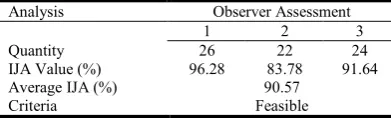
The lesson plan achievement result based CNP learning model observed by three observers in the limited test are presented in Table 3.
Table 3. Lesson Plan Achievement Result
Analysis Observer Assessment
1 2 3
Quantity 26 22 24 IJA Value (%) 96.28 83.78 91.64 Average IJA (%) 90.57
Criteria Feasible
Student Response Analysis
Student response analysis result to the students work sheet Finding Out Question with CVI score of 0.44 which is included in the category is very good, Discussion and Determination with CVI score of 0.46 which is included in the category is very good, Study Related Theory 1 with CVI score of 0.22 are included in the category very good, Study Related Theory 2 with CVI score of 0.22 are included in the category very good, and Inquiry Activity with CVI score of 0.30 which is included in the category very good.
Student Worksheets Result
Student worksheets result based CNP learning model in the Limited Test presented in Table 4.
[image:4.595.55.270.670.798.2]Table 4. Student Worksheets Result
Score FOQ DD SRT 1
Maximum 8.00 6.00 11.0
Minimum 3.00 1.50 8.00
Average 6.10 4.00 17.76
Standard deviation 1.25 1.54 8.69
Achievement (%) 76.21 9.84 32.42
Category Enough Very Bad Very Bad
The description in Table 4 are FOQ shows the description of the student worksheet in the form of Finding Out Question, DD shows the description of student worksheet in the form of Discussion and Determination, SRT 1 shows the description of student worksheet in the form of Study Related Theory 1, SRT 2 shows the description of student worksheet in the form of Study Related Theory 2, and IA shows the student worksheet in the form of Inquiry Activity.
[image:5.595.310.558.123.191.2] Improvement Results of Students Science Process Skills Improvement result of the students science process skills in the limited test class can be explained through achievement percentage of pretest and posttest result of science process skill as in Figure 1.
Figure 1.Comparison of Percentage Achievement Pretest and Posttest Science Process Skills on Limited
The description of the aspects science process skills (KPS) in Figure 1 were KPS 1 shows the skill of preparing hypothesis, KPS 2 shows the skills of identifying the variables, KPS 3 shows the skills of interpreting the first data, KPS 4 shows the skills of interpreting the second data, and the KPS 5 shows skills of exposing conclusion. Based on Figure 1, the average pretest achievement of 9%, posttest of 22.84% with an improvement of 13.84%, and an overall gain standard score of 0.16 which fall into the low category.
Field Test Result
Worksheets Reliability
Reliability results of the work sheet Finding Out Question is 93.87% included in the category reliabel, Discussion and Determination is 92.43% included in the category reliabel, Study Related Theory 1 is 91.29% included in the category reliabel, Study Related Theory 2 is 95.59% included in the category reliabel, and Inquiry Activity is 96.2% included in the reliable category.
Pretest and Posttest Reliability
Reliability results of pretest and posttest of science process skills are respectively 97.15% and 96.59% which are both included in the reliable category.
Table 4. Student Worksheets Result
SRT 2 IA
7.50 13.40
5.00 9.50
6.41 12.18
1.02 1.44
80.05 76.09
Very Bad Good Enough
The description in Table 4 are FOQ shows the description of the student worksheet in the form of Finding Out Question, DD shows the description of student worksheet in the form of Determination, SRT 1 shows the description of student worksheet in the form of Study Related Theory 1, SRT 2 shows the description of student worksheet in the form of Study Related Theory 2, and IA shows the student worksheet in
Improvement Results of Students Science Process Skills Improvement result of the students science process skills in the limited test class can be explained through achievement percentage of pretest and posttest result of science process
Achievement Pretest and Limited Test
The description of the aspects science process skills (KPS) in Figure 1 were KPS 1 shows the skill of preparing hypothesis, shows the skills of identifying the variables, KPS 3 shows the skills of interpreting the first data, KPS 4 shows the skills of interpreting the second data, and the KPS 5 shows Based on Figure 1, the average ent of 9%, posttest of 22.84% with an improvement of 13.84%, and an overall gain standard score of
Reliability results of the work sheet Finding Out Question d in the category reliabel, Discussion and Determination is 92.43% included in the category reliabel, Study Related Theory 1 is 91.29% included in the category reliabel, Study Related Theory 2 is 95.59% included in the ty is 96.2% included in
Reliability results of pretest and posttest of science process skills are respectively 97.15% and 96.59% which are both
Lesson Plan Achievement Result
The lesson plan achievement result based CNP learning model observed by three observers in the field test are presented in Table 5.
Table 5. Lesson Plan Achievement Result
Analysis
Observer assessment ( XI MIPA 1)
1 2
Quantity 26 22
IJA Valu (%) 96.28 80.99 Average IJA (%)
Criteria
Student Response Analysis
Student response analysis result to the students work sheet Finding Out Question with CVI
good, Discussion and Determination with CVI score of 0.29 which is included in the category is very good, Study Related Theory 1 with CVI score of 0.40 are included in the category very good, Study Related Theory 2 with CVI score of 0.40 areincluded in the category very good, and Inquiry Activity with CVI score of 0.21 which is included in the category very good.
Student Worksheets Result
[image:5.595.43.284.310.484.2]Student worksheets result based CNP learning model in the filed test presented in Table 6.
Table 6. Student Worksheets Result
Score FOQ DD
Maximum 8.00 17.50
Minimum 3.50 4.00
Average 6.04 9.40
Standard deviation 1.38 4.81
Achievement (%) 75.46 23.02
Category Enough Very Bad
The description in Table 6 are FOQ shows the description of the student worksheet in the form of Finding Out Question, DD shows the description of student worksheet in the form of Discussion and Determination, SRT 1 shows the description of student worksheet in the form of Study Related Theory 1, SRT 2 shows the description of student worksheet in the form of Study Related Theory 2, and IA shows the student worksheet in the form of Inquiry Activity.
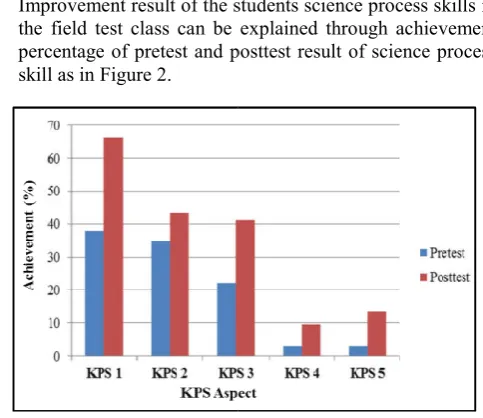
Improvement Results of Students Science Process Skills Improvement result of the students science process skills in the field test class can be explained through achievement percentage of pretest and posttest result of science process skill as in Figure 2.
Figure 2.Comparison of Percentage
Posttest Science Process Skills on Field Test
nt Result
The lesson plan achievement result based CNP learning model observed by three observers in the field test are
Table 5. Lesson Plan Achievement Result
Observer assessment ( XI MIPA 1)
Observer assessment( XI MIPA 3)
3 1 2 3
24 21 23 24
89.85 80.26 87.85 91.61
87.81 Feasible
Student response analysis result to the students work sheet Finding Out Question with CVI score of 0.22 which is very good, Discussion and Determination with CVI score of 0.29 which is included in the category is very good, Study Related Theory 1 with CVI score of 0.40 are included in the category very good, Study Related Theory 2 with CVI e of 0.40 areincluded in the category very good, and Inquiry Activity with CVI score of 0.21 which is included
Student worksheets result based CNP learning model in the filed test presented in Table 6.
. Student Worksheets Result
DD SRT 1 SRT 2 IA
17.50 41.00 8.00 15.50
4.00 5.50 3.00 9.50
9.40 20.22 5.97 13.09
4.81 10.77 1.78 1.94
23.02 37.81 74.55 81.77
Very Bad Very Bad Enough Good
The description in Table 6 are FOQ shows the description of the student worksheet in the form of Finding Out Question, DD shows the description of student worksheet in the form of Discussion and Determination, SRT 1 shows the description of et in the form of Study Related Theory 1, SRT 2 shows the description of student worksheet in the form of Related Theory 2, and IA shows the student worksheet in
Improvement Results of Students Science Process Skills Improvement result of the students science process skills in the field test class can be explained through achievement percentage of pretest and posttest result of science process
[image:5.595.309.561.371.439.2] [image:5.595.311.553.565.774.2]The description of the aspects science process skills (KPS) in Figure 2 were KPS 1 shows the skill of preparing hypothesis, KPS 2 shows the skills of identifying the variables, KPS 3 shows the skills of interpreting the first data, KPS 4 shows the skills of interpreting the second data, and the KPS 5 shows skills of exposing conclusion. Based on Figure 1, the average pretest achievement of 20.18%, posttest of 34.77% with an improvement of 14.59%, and an overall gain standard score of 0.19 which fall into the low category.
Conclusion
Based on results and discussion, it can be concluded that
The student worksheet based CNP learning model developed is feasible to be used in physics learning on Equilibrium and Rotational Dynamics chapter obtained from validation results with CVI score of 0.83 (very good) and the assessor approval rate of 93.90% (reliable). Almost students agreed to the worksheet with CVI score of 0.33 (very good) for limited test and CVI score of 0.31 (very good) for field test.
Science process skill improvement for limited test with presentation 13.84% and standard gain of 0.16 which is included in the category of low. Science process skill improvement for field test with presentation 14.58% and standard gain of 0.18 which is included in low category.
REFERENCES
Hake and Richard, 2012. /Analyzing Change/ Gain Scores. Diakesdariwww.physics.indiana.edu/∽sdi/Analyzingchang e-Gain.pdf pada 24 Desember 2014, pukul 22.00 WIB. Kemendikbud. 2013. Peraturan Menteri Pendidikandan
Kebudayaan Nomor 69 Tahun 2013 tentang Kerangka Dasardan Struktur Kurikulum Sekolah Menengah Atas/Madrasah Aliyah.
Park, et al. 2009. Development and Application of Curious Note Program Teaching-Learning Model (CNP Model) for Enhancing The Creativity of Scientifically Gifted Students. Disajikandalam International Science Education
Conference (ISEC) di National Institute of
Singaporepadatanggal 24 – 26 November 2009.
Sugiyono.2015. Metode Penelitian Pendidikan. Bandung: Alfabeta.
Thiagarajan, S., Semmel, D.S. and Semmel, M. I. 1974.
Instructional Development for Training Teachers of Exiceptional Children: A Sourcebook. Indiana: Indiana University.