Research on User Permission Isolation for Multi-Users
Service-Oriented Program
Li Yu1,2,3, Jiang Wei1,2,3*, Lin Li1, Zhan Jing1,4, Liang Peng1, Yingxu Lai1, Shupo Bu5
1College of Computer Science and Technology, Beijing University of Technology, Beijing, China 2State Key Laboratory of Information Security, Institute of Software, Chinese Academy of Sciences, Beijing, China 3Key Laboratory of Information and Network Security, 3rd Research Institute, Ministry of Public Security, Shanghai, China
4Key Lab of Network Security and Cryptology, Fujian Normal University, Fuzhou, China 5Department of Electronic Engineering, Suzhou Insititue of Industrial Technology, Suzhou, China
Email: *[email protected]
Received November 30, 2011; revised January 14, 2012; accepted January 26,2012
ABSTRACT
For the super user privilege control problem in system services, a user permission isolation method is proposed. Based on virtualization technology, the permission limited environments are constructed for different users. According to privilege sets, the users, mapping relations are built among users, isolated domains and program modules. Besides, we give an algorithm for division of program permissions based on Concept Lattices. And the security strategies are de-signed for different isolated domains. Finally, we propose the implications of least privilege, and prove that the method eliminates the potential privileged users in system services.
Keywords: Least Privilege; Virtualization; Isolation; Privileged User; Domain; System Service
1. Introduction
Currently, most of the operating systems (OSs) use iden-tity-based authorization mechanism, and super user has all the permissions of the whole OS [1]. Once intruders get the identity of super user, they will get complete con-trol of OS [2,3]. For example, a flaw in SENDMAIL prohibits the setuid operation, which results in the revo-cation of root privileges fails and intruders may use the flaw [3].
In OS, users access resources through processes. However, the system services have the specificity of running in the privileged kernel space. Once there are security vulnerabilities in service programs, the guest users will gain access to the privileged kernel space through system services. As a result, guest users will be able to access all system resources. In this case, guest becomes a potential super user. According to statistics, there will be a vulnerability at least per thousand lines of codes, so the potential super user is inevitable .
For potential super user problem, a user permission isolation method is proposed in the paper. The permis-sion limited environments are constructed for users with different permissions. Then we give a formal security policies and an algorithm for division of program per-missions. Finally, we propose the implications of least
privilege, and prove that the method eliminates the po-tential super users in system services.
The rest of the paper is organized as follows. Section 2 introduces the basic definition of the system. Section 3 presents user space isolation model (USIM), designs se-curity policies and the algorithm for division of program permissions. Section 4 analyzes the proposed method. Section 5 describes related work. Finally, conclusions and future work are presented in the last section.
2. Basic Definitions
The basic formal definitions are as follows.
Definition 1 A system M is composed of
a set S of states, with an initial state s0.
a set U of users, with an user is not only the OS user,
but also the application’s user. For example, Samba, Remote Desktop, etc. The super user is denoted as
R
U , while guest user is denoted as UR.
a set P of processes. a set A of actions. a set O of objects.
together with the functions host and pri:
host: host
, if P, then the parentproc-ess of is or user starts process . If
O
, then the owner of is .
pri: prisp
,
A, said in state s, from the viewof the process p P , the subject has the permission
A to access the object O. The set of permis-sions for processes is denoted as pri p
, while the user’s is denoted as pri u
.Together with the relation:
f f
host p host p
P
denote the permission inheritance relation:
, ,
pri u pri p U
pri q pri P
p , i, iU
,
u u q p q
When a user u starts a process p, p inherits the permis-sions from u. When a process q forks a child process p, p
inherits the permissions from parent process q.
Definition 2 ,
M , ,
s
space pri a O
In state s, from the view of M, space represent set of objects which subject has non-empty permissions to access. We call it permission space (PS). In the classical Windows or Linux OS, PS can be divided into two cate-gories, one is privileged space SP R
cf ACE
cf U, which users and processes have all privileges to access all system resources, the other is non-privileged user-space SPACER, where the permission is limited and privileged operations are forbidden.
Definition 3 U, , .
classify
We classify the users U into several sets according to the rule . If 1 pri cf
cf
2
pri cf cf
, we call cf2 domi-nates cf1, denoted as 2 1.
Definition 4 The inclusion relation :
If pri
pri
, then space
space
,o. That is, the permission space must satisfy the inclusion relation if two subjects meet the inheritance relation. Ob-viously, the permissions of a process must inherit from the parent process or the user who starts it.
Theorem 1If u satisfies p s
pri u , ,
0host p u u0UR, then space
P R
pri p
u SPACE .
Proof: According to permission inheritance relation,
, since 0
0 0hos pt u pri u
u UR, then pri U
R pri
p , since Definition 4, we have
R Rspace p spac
sp
e U
ace u SPACE
s p space
(1) Since Definition , we have
,
p
pri u o p
(2)Hence, we get space u P SPACER u
u u
. The proof is completed.
The theorem indicates that if user has access to a program which runs in privileged space, elevates the privileges of his own. In this case, if is a guest user, he will become a potential super user. The theorem proved that the potential super user does exist. Similarly, a guest user who has less permissions can get more authority from the guest user which has more permissions through penetration into the program.
In proof of theorem 1, if u0UR does not hold, the
conclusion will not hold. Hence, we get a new idea that we can create a copy of the program which runs in un-privileged space. And the user access to the program will be redirected to the copy; the potential super user prob-lem will be solved. That is the core idea of this paper.
3. User Isolation Method
Multi-user remote logon procedure in Linux OS is as follows. First, login process authenticates users’ identity. Then, login process creates the shell for different users. Based on remote login procedure, this section gives the user space separation model (USIM).
3.1. User Space Separation Model
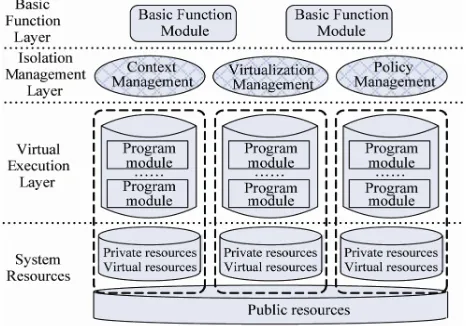
As shown in Figure 1, USIM is divided into three layers:
basic function layer, isolation management layer, virtual execution layer.
As the basis of division of the system program, USIM
constructs isolated domains for different categories of users and provides security management functions. The functions of three layers in USIM are as follows.
1) Basic function layer
Basic function layer processes the access request first, for example, the user identity authentication. Then, encap- sulate the layer-related security context information. At last, send the information to isolation management layer.
2) Isolation management layer
This layer is responsible for context management, vir-tualization management and policy management. It is mainly to address how to construct user isolated domains which does not interfere each other, and to ensure the user’s permissions are restricted in the domain.
Context Management
[image:2.595.307.540.555.718.2]Context Management maintains current context in- formation about active users, manages the mapping rela-tion between the users and isolated domains. Moreover,
it encapsulates the necessary security context again, and sends to the virtualization layer.
Virtualization Management
Virtualization Management is responsible for manag-ing the virtual environment. In a virtual environment, three main aspects should be considered, including the executive program virtualization management, network connectivity reconstruction management and resources management. The three mechanisms are discussed in another paper, which are not the focus of the paper.
Policy Management
Policy Management is responsible for policy formula-tion and configuraformula-tion, including the permission set of users and programs, the communication policy and secu-rity policy adjustment.
3) Virtual execution layer
It constructs the executive subject for the isolated do-main. Each domain is corresponding to an active process in OS. It realizes the users’ rights isolation through the isolated processes.
We give the formal definition of the isolated domain as follows.
Definition 5 A user isolated domain is
com-posed of
DOM
ID is the unique identifier of a domain,
a set CONTEXT of security context information,
in-cluding user credentials, sessions, etc.
a set PRI of permissions, which denotes
,pri DOM
a set C of program modules,
a set RES of resources in the domain.
together with the function communicate: communicate
function denotes the communication among different
DOMs. Communicate (SourceDOM, TargetDOM) = {TRUE,
FALSE} indicates whether the two domains communica-tion is permitted.
Before constructing a DOM, in the actual application process, we classify the users to several sets according to user categories. For example, we do
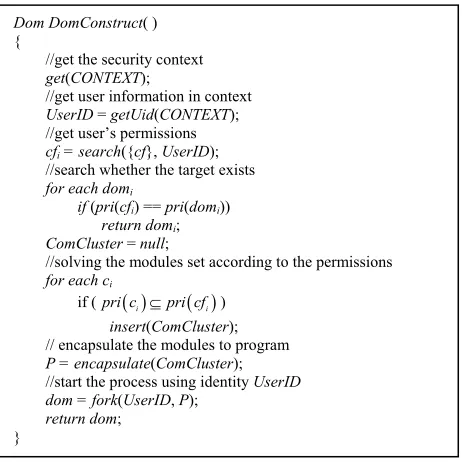
operation to classify the users in accordance with user role. We give the algorithm for constructing a DOM as shown in Figure 2.
,
classify U R cf
3.2. Security Policy
Information flow among domains may elevate the privi-leges. However, normal information flow does exist to complete the task. This section gives the security policies to prevent the privilege elevation.
Rule 1 Inter-domain communication rule
1, 2
dom dom DOM
1
1pri dom cf pri d
, , if , 1 , Then 2
dom dom
om2
cf2
1 21 2
, if ,
, else
TRUE cf cf
communicate dom dom
FALSE
Dom DomConstruct( ) {
//get the security context
get(CONTEXT);
//get user information in context
UserID = getUid(CONTEXT); //get user’s permissions
cfi = search({cf}, UserID); //search whether the target exists
for each domi
if (pri(cfi) == pri(domi))
return domi;
ComCluster = null;
//solving the modules set according to the permissions
for each ci
if (pri c i pri cf i )
insert(ComCluster); // encapsulate the modules to program
P = encapsulate(ComCluster); //start the process using identity UserID dom = fork(UserID, P);
[image:3.595.309.540.83.314.2]return dom; }
Figure 2. DOM constructing algorithm.
Inter-domain communication is permitted only if the source DOM’s permission set dominate the target set. The communication initiated by target DOM which is dominated, may result in the privilege elevation, so must be forbidden.
Rule 2 Communication rule between DOM and
unre-lated process
If C dom , Cp, C p, p p,
Cdom, then communicate dom
,dom
FALSE. That is, communication between DOM and unrelated process should be prohibited.Rule 3 Access rule to DOM dom DOM
, if u U, u satisfies
,dom s
pri u o , then u do m CONTEXT. .
The rule limits the users’ access range in the corre-sponding DOM. In addition, inverse negative proposition shows that, except the users in DOM, other users are prohibited from access to DOM.
Definition 6 Resources in a DOM are
DOM PUB PRI CALL
RES RES RES RES
a set RESPUB of public resources, which are
ac-cessed by all DOMs in service program, such as files corresponding to FTP program.
a set RESPRI of private resources, which are created
in running process, such as temporary files, etc.
a set RESCALL of resources, which are called in host
OS during the run-time, such as dynamic link librar-ies in Windows OS.
Rule 4 Resource access control rules
1) If C dom , C p, res RES PUB,
PUB
RES RESdom , p P and p p , p′ satisfies
p res,
M s
Public resources PUB only can be accessed by the
corresponding process, while other processes are refused.
RES
2) dom dom, DOM , dom dom ,
PRI RES
res , RESPRI
dom res,
domRES , res satisfies
P s
pri .
Only users in DOM can access the private resources
PRI
RES in the same DOM.
3) es
RESPUBRESPRIRESCALL
,dom C. p
P
s pri dom
r ,
, dom satisfies
dom
,res
.Except public resources, private resources and called resources, any resource can be accessed by the corre-sponding DOM.
3.3. Module Partition Based on Concept Lattice
Information flow among domains may elevate the privi-leges. However, normal information flow does exist to complete the task. This section gives the security policies to prevent the privilege elevation.
A few existing researches have provided some meth-ods for constructing an environment to prevent privilege elevation. For example, Price [4] used the way that di-rectly running a copy of the program in the virtual envi-ronment. However, the above method is not suitable to multi-user services programs, such as FTP. First, each user runs the same program; some users will get more permissions than necessary. Second, several copies of the program run simultaneously will result in performance lost in OS. Hence, the paper proposes the division method for program permissions based on Concept Lat-tice. It is the premise of building a virtual environment.
Concept lattice is a conceptual hierarchy according to binary relation between objects and properties. We de-fine a program fragment as the object in concept lattice, the property as permission. By looking for the same per-missions in program fragments, we achieve the division aim. The basic concepts of concept lattice are as follows [5].
Definition 7 Permission context is a triple
I PRI R, ,
. I is the set of program fragments which are composed of one or more functions. R is the relation between Iand PRI .
I
pri pri PRI i I i pri, ,
R
.
is the public permissions set in fragments.
PRI
i i I pri PRI i pri, ,
R
.
is the public program fragments set in permissions.
Definition 8 If
I PRI and
PRI
I doesnot hold, then C
I PRI,
is called a concept. denotes the top concept, and denotes the bottom concept.
Partial order relation between concepts:
, ,
1 2 1 2 2 1
2 2,
1 1, 1
c I PRI c
I PRI2
c c I I PRI PRI c
. 1 is called sub-con- cept, 2 is called parent concept.
c
cchild c is the function seeking the sub-concept, and cparent c
is the function seeking the parent concept.L:
C,
is called a concept lattice.Definition 9 If c1
I PR1, I1
, c2
I P2, RI2
,…,
,
n n n c I PRI
1
n
j j
, they satisfy I I
, and
j kI I j k D
, the set of C is called a Concept Di-vision .
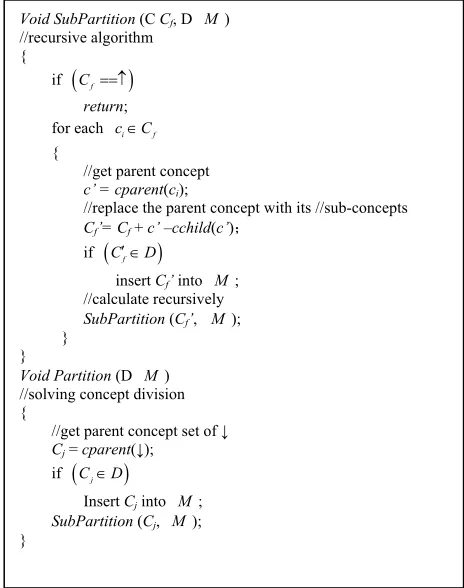
A concept corresponds to a program module which is composed of fragments. Hence, concept division is also bound to the corresponding to module partition. There-fore, to achieve a reasonable program partition, we should just find the concept division. Algorithm for module partition is as shown in Figure 3.
The solution based on the above algorithm is often not unique. Each concept division corresponds to a module partition. Reference [6] gives a method to distinguish which partition method is more targeted, and we will not go further on this issue.
4. Security Analysis
[image:4.595.306.538.422.716.2]Buyens [6] gives a standard to test whether a program design meets the principle of least privilege (PLP), that is if and only if each component meets PLP. DOM is the
Figure 3. Algorithm for module partition. Void SubPartition (C Cf, D M)
//recursive algorithm {
if
Cf
return; for each ciCf {//get parent concept
c’ = cparent(ci);
//replace the parent concept with its //sub-concepts
Cf’= Cf+ c’ –cchild(c’); if
C f D
insert Cf’ into M; //calculate recursively
SubPartition (Cf’, M); }
}
Void Partition (D M) //solving concept division {
ent conc
//get par ept set of ↓ Cj = cparent(↓); if
CjD
Insert Cj into M;
basic unit of service programs, so we think it should in-clude three aspects in PLP.
1) Isolation Requirements. Users complete their task in an isolated environment, and the information exchange between internal and external environment must be con-trolled.
2) Permissions Limited. The users’ permissions are necessary, and there are no more authorizations than necessary.
3) Resource Access Restricted. Resources in isolated environment should be protected to prohibit external ac-cess. In addition, users in isolated environment can not access resources outside to prevent privilege elevation.
For isolation requirements, any two different DOMs belong to two different processes, so OS realizes the iso-lation of DOM. Communication between different DOMs relies on rules 1 and rule 2 to prevent external interfer-ence. Therefore, USIM achieves the isolation require-ments.
For permissions limited, USIM realizes program parti-tion based on concept lattice. First, c C, C dom ,
c satisfies , hence the set C must sat-isfy . Second, the permissions of a user u in DOM satisfy
i pri c pri cf
C pri cf
i pri
u cfi
pri
.C u
pri dom
. Third, in DOM, , according to inheritance relation we
get
, hencedom pri u host
pri upri dom
i f.
Since , holds.
Therefore, users, DOMs and program modules are inter-connected by the set of permissions cfi. As a result, USIM
just gives the user the appropriate permissions, and it achieves the Permissions Limited requirement.
u pri cf
i pripri
dom
pri c
For Resource Access Restricted requirement, security policies prohibit external users accessing resources in
DOM. Besides, rules 3 and rule 4 ensure that users in
DOM can only access resources corresponding to DOM. Therefore, USIM meets the resource access restricted requirement.
Finally, USIM meets the requirements of PLP, and therefore can eliminate the potential super users in a ser-vice program.
However, in order to realize the program partition, we have to clear the source codes of the program, which is a limitation of USIM.
5. Related Work
Least privilege is the classic method to achieve permis-sions restriction [7,8]. Chen proposed a check method for against PLP [9]. It achieves policy compliance checks by intercepting system call. However, in OS, the user in process context is the one who starts the process. For the case multiple users process a system service, it is impos-sible to distinguish the different users through users’ identity.
Privilege separation is a privilege restricted method by partitioning the program into several modules [10]. Douglas proposed an idea that partitioning an application into two parts [11], a privilege server and the main ap-plication without privilege respectively. However, it is difficult to develop appropriate partitioning strategy. Da- vid inherited the idea, and partitioned the program into the privilege monitor and slave without privilege [12].
Virtualization provides each user a runtime environ-ment by virtualization technology. Jail [13,14] provides an operating system virtualization layer technology for FreeBSD. The access is limited to Jail, and the informa-tion flow inside and outside of Jail is forbidden. However, it is a full-virtualization technology, for each Jail must have a copy of system resources. It reduces the efficiency of the OS. Similarly, Solaris Zone [4] took this idea. FVM [15] is a feather-weight Windows based virtual machine. It achieves the isolation by the namespace vir-tualization. However, these studies can not solve users’ permissions isolation in the same program problem.
6. Conclusion and Future Work
For potential super user problem, the paper introduces a user permission isolation method. Based on Concept Lat-tices, the algorithm for division of program permissions is proposed. Using virtualization technology, USIM con-structs the permission limited environments for different users. Besides, we develop security strategies for USIM. Finally, we prove that USIM meet the principle of least privilege, and the method eliminates the potential privi-leged users in system services.
7. Acknowledgements
REFERENCES
[1] R. Stevens, “Advanced Programming in the UNIX Envi-ronment,” Addison-Wesley Publishing Company, 1992. [2] H. Chen, D. Wagner and D. Dean, “Setuid Demystified,”
Proceedings of the 11th USENIX Security Symposium, San Francisco, 05-09 August 2002, pp. 171-190.
[3] Sendmail Inc. Sendmail Workaround for Linux Capabili-ties Bug, 2009.
http://www.Sendmail.org/Sendmail.8.10.1.LINUX-SECU RITY.txt
[4] D. Price and A. Tucker, “Solaris Zones: Operating Sys-tem Support for Consolidating Commercial Workloads,”
USENIX 18th Large Installation System Administration Conference (LISA’04), Atlanta, 14-19 November 2004, pp. 241-254.
[5] C. Lindig and G. Snelting, “Assessing Modular Structure of Legacy Code Based on Mathematical Concept Analy-sis,” Proceedings of the 19th International Conference on Software Engineering, Boston, May 1997, pp. 349-359. [6] K. Buyens, B. D. Win, and W. Joosen, “Resolving Least
Privilege Violations in Software Architectures,” Pro-ceedings of the 5th International Workshop on Software Engineering for Secure Systems, Vancouver, 19 May 2009, pp. 9-16.
[7] T. E. Levin, C. E. Irvine and T. D. Nguyen, “A Least Privilege Model for Static Separation Kernels,” Technical Report NPS-CS-05-003, Center of Information Systems Security Studies and Research, Naval Postgraduate School, October 2004.
[8] J. H. Saltzer and M. D. Schroeder, “The Protection of Information in Computer Systems,” Proceedings of the
IEEE, Vol. 63, No. 9, 1975, pp. 1278-1308. doi:10.1109/PROC.1975.9939
[9] S. Chen, J. Dunagan, C. Verbowski and Y.-M. Wang, “A Black-Box Tracing Technique to Identify Causes of Least-Privilege Incompatibilities,” Proceedings of Net-work and Distributed System Security Symposium, San Diego, 3-4 February 2005, pp. 42-53.
[10] K. Buyens, R. Scandariato and W. Joosen, “Composition of Least Privilege Analysis Results in Software Architec-tures,” Proceeding of the 7th International Workshop on Software Engineering for Secure Systems, Waikiki, 22 May 2011, pp. 29-35.
[11] D. Kilpatrick, “Privman: A Library for Partitioning Ap-plications,” Proceedings of Freenix, San Antonio, 12-14 June 2003, pp. 273-284.
[12] D. Brumley and D. Song, “Privtrans: Automatically Parti-tioning Programs for Privilege Separation,” Proceedings of the 13th conference on USENIX Security Symposium, San Diego, 9-13 August 2004, p. 5.
[13] P. H. Kamp and R. N. Watson, “Jails: Confining the Om-nipotent Root,” 2nd International System Administration and Network Engineering Conference (SANE’00), Maas-tricht, 2000, pp. 1-15.
[14] S. Evan, “Securing FreeBSD Using Jail,” System Admini- stration, Vol. 10, No. 5, 2001, pp. 31-37.