RESEARCH ARTICLE
CREDENTIALS OF ENERGY EFFICIENT TECHNOLOGIES AND SOLAR PASSIVE FEATURES TO
TRIM DOWN CO2
EMANATION OF AN EDIFICE
*,1
Rajesh Kumar and
2Aggarwal, R. K.
1
Department of Physics, Shoolini University, Bajhol, Solan (HP) 173 212, India
2
Department of Environmental Science, Dr Y S Parmar University of Horticulture & Forestry, Nauni (Solan),
173230, India
ARTICLE INFO ABSTRACT
Energy conservation can be achieved by trimming down the energy consumption of the edifices. Six storey edifice of Shoolini University at Bhajol, Solan, Himachal Pradesh (India) is taken as a case study in this work. Energy load of the edifice during winter months is 165.27 MWh, whereas during summer months is 110.99 MWh, and thus annual load is 276.26 MWh. The total energy load of the edifice has been met out by using conventional sources of energy. The emission of CO2by using
fossil fuels has been estimated and worked out 1.11 tonne per annum. Adoption of solar passive features (viz. insulation to north wall and the roof, increasing glazing at south wall, double glazing at north wall) and energy efficient technologies like light emitting diode in the building can reduce the energy consumption by 36.61% besides resulting reduction in CO2emission by 36.94%. The fuel bill
of the building will also be reduced by 36.67%. All the suggested energy efficient features require Rs 34.0 lac investments with a payback period of four years.
Copyright © 2016, Dr. Rajesh Kumar. This is an open access article distributed under the Creative Commons Attribution License, which permits unrestricted use, distribution, and reproduction in any medium, provided the original work is properly cited.
INTRODUCTION
The quickly growing world energy use has already raised concerns over supply difficulties, exhaustion of energy resources and heavy environmental influences (ozone layer depletion, global warming, climate change, etc.). The International Energy Agency has gathered frightening data on energy consumption trends. Globally, renewable energy has made a positive impact on energy supply. Renewable energy in even the most remote areas is ensuring that more of the world’s people are gaining access to basic energy services, including lighting and communications, cooking, heating, cooling and water pumping, while also boosting economic growth. In developing countries, energy efficiency can enable, in addition to alleviate the financial burden of oil imports, decrease energy investment requirement and make the best use of existing supply capacities to improve the access to energy. Energy efficiency improvements refer to a reduction in the energy employed to a given service (heating, lighting, etc.) or level of activity. The reduction in energy consumption is
*Corresponding author: Dr. Rajesh Kumar,
Department of Physics, Shoolini University, Bajhol, Solan (HP) 173 212, India.
usually but not always associated with technological changes and advancements, since it can also result from better organisation and management or behavioural changes.
India
India today stands among the top five countries in the world in terms of renewable energy capacity. National action plan on climate change mandates an increase in the share of renewable power in the electricity mix to 15 percent by the year 2020. India has set up a target of around 55 GW of renewable power by 2017. In addition, a large number of decentralized renewable energy systems for meeting lighting, cooking and productive needs have also been planned. Jawaharlal Nehru National Solar Mission (JNNSM) aims at an increase in the installed photovoltaic through attractive feed-in tariffs and a clear application and administration processes. Phase-I of the Jawaharlal Nehru National Solar Mission targeted additions of 500 MW of grid-tied and 200 MW of off-grid PV capacity by 2013. By the end of Phase-II in 2022, India plans to have 10,000 MW of grid-tied and 2,000 MW of off-grid PV. Jawaharlal Nehru National Solar Mission reaches beyond installed capacity to also target the growth of India’s indigenous photovoltaic industry.
ISSN: 0975-833X
International Journal of Current Research Vol. 8, Issue, 05, pp.30414-30422, May, 2016
INTERNATIONAL JOURNAL OF CURRENT RESEARCH
Article History:
Received 05thFebruary, 2016 Received in revised form 07thMarch, 2016 Accepted 26thApril, 2016 Published online 10thMay, 2016
Key words:
Heat load, CO2Emission, Solar Passive Features,
Energy Efficient Technologies etc.
Citation: Dr. Rajesh Kumar. 2016.“Credentials of energy efficient technologies and solar passive features to trim down co2emanation of an edifice”,
International Journal of Current Research, 8, (05), 30414-30422.
RESEARCH ARTICLE
CREDENTIALS OF ENERGY EFFICIENT TECHNOLOGIES AND SOLAR PASSIVE FEATURES TO
TRIM DOWN CO2
EMANATION OF AN EDIFICE
*,1
Rajesh Kumar and
2Aggarwal, R. K.
1
Department of Physics, Shoolini University, Bajhol, Solan (HP) 173 212, India
2
Department of Environmental Science, Dr Y S Parmar University of Horticulture & Forestry, Nauni (Solan),
173230, India
ARTICLE INFO ABSTRACT
Energy conservation can be achieved by trimming down the energy consumption of the edifices. Six storey edifice of Shoolini University at Bhajol, Solan, Himachal Pradesh (India) is taken as a case study in this work. Energy load of the edifice during winter months is 165.27 MWh, whereas during summer months is 110.99 MWh, and thus annual load is 276.26 MWh. The total energy load of the edifice has been met out by using conventional sources of energy. The emission of CO2by using
fossil fuels has been estimated and worked out 1.11 tonne per annum. Adoption of solar passive features (viz. insulation to north wall and the roof, increasing glazing at south wall, double glazing at north wall) and energy efficient technologies like light emitting diode in the building can reduce the energy consumption by 36.61% besides resulting reduction in CO2emission by 36.94%. The fuel bill
of the building will also be reduced by 36.67%. All the suggested energy efficient features require Rs 34.0 lac investments with a payback period of four years.
Copyright © 2016, Dr. Rajesh Kumar. This is an open access article distributed under the Creative Commons Attribution License, which permits unrestricted use, distribution, and reproduction in any medium, provided the original work is properly cited.
INTRODUCTION
The quickly growing world energy use has already raised concerns over supply difficulties, exhaustion of energy resources and heavy environmental influences (ozone layer depletion, global warming, climate change, etc.). The International Energy Agency has gathered frightening data on energy consumption trends. Globally, renewable energy has made a positive impact on energy supply. Renewable energy in even the most remote areas is ensuring that more of the world’s people are gaining access to basic energy services, including lighting and communications, cooking, heating, cooling and water pumping, while also boosting economic growth. In developing countries, energy efficiency can enable, in addition to alleviate the financial burden of oil imports, decrease energy investment requirement and make the best use of existing supply capacities to improve the access to energy. Energy efficiency improvements refer to a reduction in the energy employed to a given service (heating, lighting, etc.) or level of activity. The reduction in energy consumption is
*Corresponding author: Dr. Rajesh Kumar,
Department of Physics, Shoolini University, Bajhol, Solan (HP) 173 212, India.
usually but not always associated with technological changes and advancements, since it can also result from better organisation and management or behavioural changes.
India
India today stands among the top five countries in the world in terms of renewable energy capacity. National action plan on climate change mandates an increase in the share of renewable power in the electricity mix to 15 percent by the year 2020. India has set up a target of around 55 GW of renewable power by 2017. In addition, a large number of decentralized renewable energy systems for meeting lighting, cooking and productive needs have also been planned. Jawaharlal Nehru National Solar Mission (JNNSM) aims at an increase in the installed photovoltaic through attractive feed-in tariffs and a clear application and administration processes. Phase-I of the Jawaharlal Nehru National Solar Mission targeted additions of 500 MW of grid-tied and 200 MW of off-grid PV capacity by 2013. By the end of Phase-II in 2022, India plans to have 10,000 MW of grid-tied and 2,000 MW of off-grid PV. Jawaharlal Nehru National Solar Mission reaches beyond installed capacity to also target the growth of India’s indigenous photovoltaic industry.
ISSN: 0975-833X
International Journal of Current Research Vol. 8, Issue, 05, pp.30414-30422, May, 2016
INTERNATIONAL JOURNAL OF CURRENT RESEARCH
Article History:
Received 05thFebruary, 2016 Received in revised form 07thMarch, 2016 Accepted 26thApril, 2016 Published online 10thMay, 2016
Key words:
Heat load, CO2Emission, Solar Passive Features,
Energy Efficient Technologies etc.
Citation: Dr. Rajesh Kumar. 2016.“Credentials of energy efficient technologies and solar passive features to trim down co2emanation of an edifice”,
International Journal of Current Research, 8, (05), 30414-30422.
RESEARCH ARTICLE
CREDENTIALS OF ENERGY EFFICIENT TECHNOLOGIES AND SOLAR PASSIVE FEATURES TO
TRIM DOWN CO2
EMANATION OF AN EDIFICE
*,1
Rajesh Kumar and
2Aggarwal, R. K.
1
Department of Physics, Shoolini University, Bajhol, Solan (HP) 173 212, India
2
Department of Environmental Science, Dr Y S Parmar University of Horticulture & Forestry, Nauni (Solan),
173230, India
ARTICLE INFO ABSTRACT
Energy conservation can be achieved by trimming down the energy consumption of the edifices. Six storey edifice of Shoolini University at Bhajol, Solan, Himachal Pradesh (India) is taken as a case study in this work. Energy load of the edifice during winter months is 165.27 MWh, whereas during summer months is 110.99 MWh, and thus annual load is 276.26 MWh. The total energy load of the edifice has been met out by using conventional sources of energy. The emission of CO2by using
fossil fuels has been estimated and worked out 1.11 tonne per annum. Adoption of solar passive features (viz. insulation to north wall and the roof, increasing glazing at south wall, double glazing at north wall) and energy efficient technologies like light emitting diode in the building can reduce the energy consumption by 36.61% besides resulting reduction in CO2emission by 36.94%. The fuel bill
of the building will also be reduced by 36.67%. All the suggested energy efficient features require Rs 34.0 lac investments with a payback period of four years.
Copyright © 2016, Dr. Rajesh Kumar. This is an open access article distributed under the Creative Commons Attribution License, which permits unrestricted use, distribution, and reproduction in any medium, provided the original work is properly cited.
INTRODUCTION
The quickly growing world energy use has already raised concerns over supply difficulties, exhaustion of energy resources and heavy environmental influences (ozone layer depletion, global warming, climate change, etc.). The International Energy Agency has gathered frightening data on energy consumption trends. Globally, renewable energy has made a positive impact on energy supply. Renewable energy in even the most remote areas is ensuring that more of the world’s people are gaining access to basic energy services, including lighting and communications, cooking, heating, cooling and water pumping, while also boosting economic growth. In developing countries, energy efficiency can enable, in addition to alleviate the financial burden of oil imports, decrease energy investment requirement and make the best use of existing supply capacities to improve the access to energy. Energy efficiency improvements refer to a reduction in the energy employed to a given service (heating, lighting, etc.) or level of activity. The reduction in energy consumption is
*Corresponding author: Dr. Rajesh Kumar,
Department of Physics, Shoolini University, Bajhol, Solan (HP) 173 212, India.
usually but not always associated with technological changes and advancements, since it can also result from better organisation and management or behavioural changes.
India
India today stands among the top five countries in the world in terms of renewable energy capacity. National action plan on climate change mandates an increase in the share of renewable power in the electricity mix to 15 percent by the year 2020. India has set up a target of around 55 GW of renewable power by 2017. In addition, a large number of decentralized renewable energy systems for meeting lighting, cooking and productive needs have also been planned. Jawaharlal Nehru National Solar Mission (JNNSM) aims at an increase in the installed photovoltaic through attractive feed-in tariffs and a clear application and administration processes. Phase-I of the Jawaharlal Nehru National Solar Mission targeted additions of 500 MW of grid-tied and 200 MW of off-grid PV capacity by 2013. By the end of Phase-II in 2022, India plans to have 10,000 MW of grid-tied and 2,000 MW of off-grid PV. Jawaharlal Nehru National Solar Mission reaches beyond installed capacity to also target the growth of India’s indigenous photovoltaic industry.
ISSN: 0975-833X
International Journal of Current Research Vol. 8, Issue, 05, pp.30414-30422, May, 2016
INTERNATIONAL JOURNAL OF CURRENT RESEARCH
Article History:
Received 05thFebruary, 2016 Received in revised form 07thMarch, 2016 Accepted 26thApril, 2016 Published online 10thMay, 2016
Key words:
Heat load, CO2Emission, Solar Passive Features,
Energy Efficient Technologies etc.
Citation: Dr. Rajesh Kumar. 2016.“Credentials of energy efficient technologies and solar passive features to trim down co2emanation of an edifice”,
Himachal Pradesh
The energy dependence of Himachal Pradesh is mainly on the hydro power projects functioning on different locations and on different rivers and rivulets. It has a capacity of 21,000 MW from hydro power. The people in the state experience severe winters during November to March requiring space heating which is met by using fire wood in rural areas and coal, kerosene, LPG and electricity in urban areas. The state government provides wood on highly subsidized rates to tribal and remote areas by importing from lower belts. This necessitates the use of solar passive heating features in buildings. The Himachal Pradesh State Council for Science, Technology & Environment is coordinating the solar passive house technology programme in the state. Keeping in view of the cold climatic conditions in the state, the Government of Himachal Pradesh has made it mandatory to incorporate passive solar features in all the new government/semi-government buildings (Chandel, 2006). As per the recent decision taken in the year 2009, the solar passive features have been included in the building byelaws by the Town & Country Planning Department of the state and are to be incorporated in all the future buildings to be constructed by government/semi-government buildings & commercial buildings (Chandel, 2009). This decision will take the state towards energy efficient buildings if implemented strictly. The solar passive features, if incorporated at the time of construction, may increase the initial cost marginally by about 5% to10% but this increase is set off by the benefits and savings in direct recurring cost involved in heating of the buildings (Chandel et al., 2008). The state government is planning to harness alternate energy to meet our energy demand of the people so that the electricity can be exported for income generation and to become carbon neutral.
Identification of Energy Efficient Technologies
American Society of Heating, Refrigerating and Air-Conditioning Engineers (ASHRAE) present the Standard in the US (ASHRAE, 2007). Energy efficient measures for new and existing buildings have been given by many researchers (Lam et al., 2008; Wan et al., 2011; Yildiz & Arsan, 2011). Many countries have their own building energy standards and design guidelines specifically developed to suit the local climates as well as the prevailing architectural designs and construction practices e.g. Energy Performance of Buildings Directive (EPBD) which requires all new buildings to be nearly zero energy buildings by the end of 2020 in European Union (EU) (Danny et al., 2013). They have significant influence on energy consumption in buildings:
Building Envelopes
Many researchers had developed various criteria to evaluate the thermal performance of building envelopes e.g. overall thermal transfer value (OTTV) for subtropical climates, evaluation on energy and thermal performance (EETP) in hot summer and cold winter zone (Lam et al., 1995; Lam et al., 2005; Yu et al., 2009). Different climates would have different requirements in the building envelope designs to cater for the local prevailing climatic conditions (Yang et al., 2008). The
envelope thermal transfer value (ETTV) in the tropics and the bioclimatic approach using passive design strategies for different climate zones were also studied (Chua and Chou, 2010; Lam et al., 2006). The aim was to limit the amount of summer heat gain and winter heat loss through the building envelope, so that the corresponding heating and cooling requirements would not be extreme. Key issues concerning the energy efficient measures of the building envelope are elaborated as follows:
Thermal Insulation
More insulation means less conduction heat gain/loss and hence better energy efficiency. When a building envelope is over insulated, reduction in heat loss during cooling tends to increase the cooling requirement and could result in an overall increase in energy use for space conditioning (Lam et al., 1996; Masoso and Grobler, 2008). The optimum insulation thickness based on easy economic cost analysis was also determined (Yu et al., 2009; Daouas, 2011). The more complex life-cycle energy and CO2 emissions analysis was done (Mahlia and Iqbal, 2010).
Thermal Mass
A number of designers and researchers designed techniques based on thermal mass have been adopted to lower the indoor daytime temperature (Givoni, 1998). More recently, the merits of thermal mass were systematically evaluated using sensitivity analysis (Henze et al., 2007). It is generally believed that thermal mass should be integrated with night-time ventilation to utilize the full energy saving potential. Such design strategy has proved to be effective in avoiding summer overheating and reduce cooling requirements (Jentsch et al., 2008; Artmann et al., 2007).
Windows/Glazing
Both numerical and experimental works have indicated great energy saving potential of day lighting schemes especially in cooling dominated buildings due to the dual savings in electricity use for artificial lighting and air conditioning (Lam et al., 2007; Yu and Chow, 2007; Loutzenhiser et al., 2007). Different design aspects in terms of the thermal, acoustic, visual and solar performance of the window/glazing system should be considered together during the initial, conceptual design stage. Generalized energy rating systems have been developed for different glazing, buildings and climates. These rating systems are valuable design tools conducive to more environment-friendly and sustainable building development (Singh and Garg, 2009; Tian et al., 2010).
Reflective/Green Roofs
capacities (Akbari et al., 1999). Likewise, greening of roof tops in humid, tropical/subtropical climates has good thermal performance due to greater latent heat dissipation and can prevent most of the solar heat from being conducted into the building (Tsang and Jim, 2011).
Trombe Wall
Trombe walls are commonly used to absorb heat during sunlit hours of winter then slowly release the heat over night. The essential idea was first explored by Edward S. Morse and patented by him in 1881. In the 1960s it was fully developed as an architectural element by French engineer Félix Trombe and architect Jacques Michel Mazria (Edward, 1979; Anthony, 2013). A simplistic rule of thumb that is often used when designing dense masonry walls is that heat will be absorbed
and lost at around an inch per 2 hours. i.e a 4 inch (100 mm) thick masonry wall will absorb and shed its heat load in around 8 hours and a 8 inch (200 mm) thick wall in around 16 hours.
Solar Chimney
The passive model system, shown in Figure 1, consists of two solar air heaters with natural flow (solar chimneys or ventilators), one placed on the roof and the other placed on the ground. The roof air heater acts as an exhaust fan, sucking the room air and venting it out during sunshine hours. The bottom collector is used alternatively as a conventional air heater during winter and as an evaporative cooler during summer, with some minor modifications. A metal duct of rectangular cross section is kept inside the trough. One end of the duct is connected to the room and the other end is open to the atmosphere.
The top of the duct is painted black. During winter, the trough is emptied of water and is fitted with a glazing so that the unit acts like a solar air heater. During summer, the glazing is removed and a shadow is provided above the trough to prevent radiation absorption. Water is filled in the trough so that the metallic duct is completely immersed in it. The operation of the complete system for winter and for summer operation is shown in Figure 1 (a) and 1 (b), respectively. The connecting points between the collectors and the room are provided with wooden doors so that the room is completely insulated, as would be necessary for winter nights. At an early stage of the work, it was decided to retrofit an existing single room structure so as to modify it to the solar passive system. Before proceeding with the incorporation of solar collectors, it was considered important to reduce the thermal conditioning load on the passive system, by proper insulation of the building (Raman et al., 2000) as has been shown in Figure 1.
Internal Conditions
A recent review on the impact of climate change on building energy use found that measures addressing the indoor design conditions and lighting load density could have great energy-saving and mitigation potential (Li et al., 2012). As the majority is existing buildings and it will take decades to gradually replace them. Key issues related to the indoor conditions and internal heat loads are elaborated as follows:
Indoor Design Conditions
The raising and lowering the thermostat settings during the hot summer months and in winter can greatly reduce the cooling and heating requirements (Shipworth et al., 2010). On the cooling side, a 6% reduction in energy use for heating, ventilating and air conditioning for every 100C increase in the summer set point temperature (SST) was reported for air-conditioned office buildings in Sydney and a 69% reduction in peak demand (SST from 23.900C to 26.900C) for residential buildings in Las Vegas (Roussac et al., 2011; Sadineni and Boehm, 2012). It is generally agreed that a wider temperature range tends to consume less energy than a narrow one. It has been argued that, in the long run, this may prove unsustainable as early results indicate “much colder” and “much warmer” thermal sensation in some green buildings adopting the adaptive approach (Halawa and van Hoof, 2012).
Internal Heat Loads
It has been estimated that a reduction in 100C summer overheating can be achieved by lowering the internal heat loads by 10 W/m2 (Camilleri et al., 2001). This helps to avoid the need for cooling in naturally ventilated buildings and reduce the cooling energy requirements in air-conditioned premises (Kumar et al., 2012). More recently, the advance in lighting technologies e.g. dimmable electronic ballasts, digital controls and light-emitting diodes has generated a lot of interest in promoting the practice of more energy efficient lighting designs (Li et al., 2010; Han et al., 2010; Sperber et al., 2012).
Building Services Systems
Among the building services installations, heating, ventilating & air conditioning (HVAC) and electric lighting are the two
major energy consuming items in buildings (especially cooling dominated non-residential buildings) accounting for 40-60% and 20-30% of the total energy consumption, respectively (Lam et al., 2004). It is necessary to consider the dynamic interactions between the different design variables of the building envelope and the building services systems as well as the indoor conditions and the prevailing outdoor climates to fully assess the effectiveness of both individual and multiple energy efficient measures (Chidiac et al., 2011).
Renewable Energy and Other Technologies
Even adopting the best energy efficient measures available, energy will still be required to power the day-to-day running of a building. For zero energy buildings, this is achieved through the use of renewable energy and other technologies (Lund et al., 2011; Nielsen and Moller, 2012). The major technologies commonly adopted are:
PV (Photovoltaic) and BIPV (building-integrated photovoltaic)
PV is one of the most promising renewable energy technologies in achieving sustainable development (Tiwari et al., 2011; Sharma and Tiwari, 2012). In urban and sub urban areas, PV modules/arrays are often mounted on roof tops of houses as well as non- residential buildings (e.g. offices, hotels, schools). To maximize the number of PV modules installed and hence the electrical power generated, other front walls of the building envelope are sometimes utilized. Such system is termed building-integrated photovoltaic. Building-integrated photovoltaic helps to increase the power generated per unit floor area of the building, making solar energy more viable as an alternative and/or supplement to the electricity grid.
This has restricted view affecting natural daylight penetration. Another recent development to increase the energy efficiency of PV is the hybrid photovoltaic thermal system. A hybrid photovoltaic thermal system makes use of thermoelectric cooling modules to reduce the solar cell temperature and takes advantage of the hot water produced by the waste heat generation. Hybrid photovoltaic thermal system thus generates both electrical and thermal energy (Cheng et al., 2011). The output power and system efficiency of a PV system vary during different times of the day and different seasons of the year subject to the prevailing local climatic conditions in general and the amount of solar radiation available in particular. A recent study on large-scale integration of PVs in cities had shown that PV systems can cater for 35% of the total electricity consumption (Strzalka et al., 2012). This alleviates the burden on fossil fuels and helps to reduce the associated CO2emissions.
Wind Turbines
year. This has led to the development of hybrid PV- wind power generation systems both at utility scale as well as small autonomous systems (Nandi and Ghosh, 2010). Reliable wind power forecasting plays an important role in the design and analysis of wind turbine systems and is crucial in dealing with the challenges of balancing the supply and demand in any electricity system (Foley et al., 2012).
Solar Thermal/Solar Water Heaters (SWHs)
A solar water heater was developed by using a solar water pump, where the pump was powered by the steam produced from a flat plate collector and the overall cost was comparable to a conventional solar water heater (Roonprasang et al., 2008). The recent advances in solar water heaters which include: a two-phrase thermo syphon solar water heater, the best charge efficiency of the system is 82% which is higher than conventional solar water heaters (Chien et al., 2011). A solar water heater using stationary V-trough collector with promising results in both optical efficiency of the reflector and the overall thermal performance of the system (Chong et al., 2012); and a solar combisystem that simultaneously fulfils domestic hot water and space heating requirements (Bornatico et al.,2012).
Heat Pumps
In heating-dominated buildings in colder climates, ground-source heat pumps may cause a thermal heat depletion of the ground (Bakirci, 2010). This will progressively decrease the working fluid temperature and hence lower the system efficiency. Many researchers adopted the common approach by using hybrid ground-source heat pumps with solar collectors, which recharges the ground through the borehole thus avoiding the heat depletion of the ground (Ozgener, 2010; Kjellsson et al., 2010). Recent progress in heat pump technologies focuses on advanced cycle designs for both heat and work actuated systems. There have been a number of studies on the development of ground-source heat pumps to cover peak load without the need for supplementary plants (Yang et al., 2010). Improved energy performance of air-source heat pumps by integrating with solar collectors so that energy can be supplied to the evaporator at a temperature higher than the ambient outdoor air with increasing capacity and higher coefficient of performance (Kong et al., 2011).
District Heating and Cooling
District heating and cooling helps to replace less efficient equipment in individual buildings with a more efficient central heating/cooling system for space conditioning. District heating and cooling can contribute to reducing climate change and other energy-related environmental concerns such as air pollution, ozone depletion and acid precipitation (Rezaie and Rosen, 2012). Gebremmedhin studied district heating in Denmark and Norway and had shown a substantial reduction in fuel demands, CO2 emissions and operating cost can be achieved by converting to district heating (Gebremmedhin, 2012). Besides, excess heat from zero energy buildings (via solar thermal collectors and/or heat pumps) can meet some of the overall heating demand within the network and thus benefit
the district heating systems by lowering its fuel consumption (Nielsen and Moller, 2012).
Solar Stills
Many researchers did detailed review on active solar distillation (Sampathkumar et al., 2010). A comprehensive review of types of solar stills and efforts were made (Arjunan et al., 2009; Kaushal, 2010). The effects of different parameters such as water-glass temperature difference, glass angle, depth of water etc. on solar still performance were studied (Velmurugan et al., 2011). The estimates of water costs from these solar stills are provided (Kabeel et al., 2010).
Solar Cookers
Cooking energy dissemination in India with an objective of understanding the underlying socioeconomic factors governing the utilization of various fuels/energy carriers in cooking and also the policy interventions required for better dissemination of renewable energy based devices has been discussed (Pohekara et al., 2005). The thermal performance of a prototype solar cooker based on an evacuated tube solar collector with phase change material (PCM) storage unit was investigated (Sharma et al., 2005). It was computed that the utility of parabolic solar cooker in India with respect to eight prevalent cooking devices by knowing users’ preferences and expert opinion on thirty different criteria using the additive multi-attribute utility theory model for evaluation (Pohekara and Ramachandran, 2006). Researchers investigated a finned cooking vessel in order to increase the efficiency of solar cookers and to reduce cooking time (Harmim et al., 2008). The experimental procedures to be used to calculate the parameters which determine the thermal performance of solar cookers and also suggested a simplified procedure based on energy balance equations for the design of solar cookers (Schwarzer and Vieira da Silva, 2008).
MATERIALS AND METHODS
present conventional energy consumption and CO2emission of the building, various energy efficient features viz: thermal insulation, windows/glazing, internal conditions etc. and renewable energy technologies viz: solar water heaters etc. have been identified. The installation of these systems has been worked out and amount of energy saved with CO2 emission reduction has been determined. The installation of recommended energy efficient features and renewable energy technologies will enhance construction cost to a very small extent as compared to the reduction in CO2emission and fuel bill savings.
RESULTS AND DISCUSSION
CO2Emission During Winter
[image:6.595.159.435.191.531.2] [image:6.595.46.279.715.749.2]The study revealed that the total heating load of the existing building was 165.27 MWh thus; heating is required to meet out this energy demand. If the electricity is used it will produce 0.66 tonne CO2 during winter months and the cost of electricity used will be Rs 4.96 lac, as has been depicted in Table 1.
Table 1. CO2emission and cost of fuel during winter
Fuel CO2Emission per
kWh (g)
Total CO2 Emission (kg)
Total cost (lac)
Electricity 4 661.08 4.96
The above result necessitates the use of solar passive technologies to meet out this energy requirement during winter thereby reducing the CO2emission. The total heat load of the building after using various solar passive features and energy efficient technologies was 91.18 MWh. The use of electricity will produce 3.52 tonne CO2during winter months and the cost of electricity used will be Rs 2.74 lac, as has been depicted in Table 2.Table 2 CO2emission and cost of fuel during winter after using solar passive features and energy efficient technologies.
The emission of CO2during winter for heating of the building using solar passive features and energy efficient technologies has been reduced by 44.83 % whereas total cost has been reduced by 44.76%.
Table 2. CO2emission and cost of fuel during winter after using
solar passive features and energy efficient technologies
Fuel CO2Emission
per kWh (g)
Total CO2Emission (kg)
Total cost (lac)
Electricity 4 364.72 2.74
CO2Emission During Summer for Cooling the Building
The study revealed that the total cooling load of the building during summer months was 110.99 MWh.
Thus, cooling is required to meet this energy demand. If we use electricity it will produce 0.44 tonne CO2during summer and the cost of electricity used will be Rs 3.33 lac and is depicted in Table 3.
Table 3. CO2emission and cost of the fuel during summer
Fuel CO2Emission
per kWh (g)
Total CO2Emission (kg)
Total cost (lac)
Electricity 4 443.96 3.33
In order to reduce the emission of CO2, solar passive features and energy efficient technologies will have to be used to meet out this energy requirement during the summer. The total cooling load of the building using solar passive features and energy efficient technologies was 83.93 MWh. If we use electricity it will produce 0.34 tonne CO2 during summer period and the cost of electricity used will be Rs 2.52 lac and is depicted in Table 4.
Table 4. CO2emission and cost of fuel during summer in the
building using solar passive features and energy efficient technologies
Fuel CO2Emission
per kWh (g)
Total CO2Emission (kg)
Total cost (lac)
Electricity 4 335.72 2.52
Table 4 CO2emission and cost of fuel during summer in the building using solar passive features and energy efficient technologies. The emission of CO2during summer for heating of the building using solar passive features and energy efficient technologies has been reduced by 24.38 % whereas total cost has been reduced by 24.32%.
Total CO2Emission
The study revealed that the total energy load of the building was 276.26 MWh. Thus, heating in winter and cooling in summer is required to meet out this demand for energy. If we use electricity it will produce 1.11 tonne CO2per annum and the cost of electricity used will be Rs 8.29 lac and is presented in Table 5.
Table 5. Total CO2emission and cost of the fuel
Fuel CO2Emission
per kWh (g)
Total CO2Emission (kg)
Total cost (lac)
Electricity 4 1,105.04 8.29
The above results necessitate the use of solar passive features and energy efficient technologies to meet this energy requirement during winter and summer and to reduce the consumption of conventional fuels and CO2 emission. The total energy load in the building using energy efficient features was 175.11 MWh. If we use electricity it will produce 0.7 tonne CO2per annum and the cost of electricity used will be Rs 5.25 lac and is depicted in Table 6. Hence it was found that using recommended energy efficient features CO2 emission can be reduced by 36.94% whereas cost can be reduced by 36.67%.
Table 6. CO2emission and cost of the fuel after using energy
efficient features
Fuel CO2Emission
per kWh (g)
Total CO2Emission (kg)
Total cost (lac)
Electricity 4 700.44 5.25
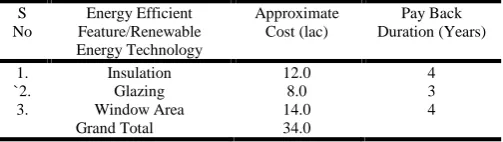
[image:7.595.308.560.253.324.2]Approximate expenditure to reduce energy use and CO2 emission by using energy efficient features and different renewable energy technologies has given in Table 7. Table 7 Approximate expenditure to reduce energy use and CO2 emission by using solar passive features and different renewable energy technologies.
Table 7. Approximate expenditure to reduce energy use and CO2
emission by using solar passive features and different renewable energy technologies
S No
Energy Efficient Feature/Renewable Energy Technology
Approximate Cost (lac)
Pay Back Duration (Years)
1. Insulation 12.0 4
`2. Glazing 8.0 3
3. Window Area 14.0 4
Grand Total 34.0
Conclusion
It was found that the energy load of the building during the winter months was 165.27 MWh, whereas during summer months was 110.99 MWh, and thus annual load of the building under study was 276.26 MWh. The annual CO2emission was estimated to be 1.11 tonne as the conventional fuels are being used to meet out energy demand of the building which can be reduced by 36.94% by adopting other energy efficient technologies. The suggested technologies should be included before designing the building so that cost of these features will not increase the budget of the building. The reduction in annual fuel bill to meet out the energy demand in the building was estimated to be 36.67%.
REFERENCES
Akbari, H., Konopacki, S. and Pomerantz, M. 1999. Cooling energy savings potential of reflective roofs for residential and commercial buildings in the United States. Energy., 24:391-407.
Anthony D. 2013. The Solar House: Pioneering Sustainable Design. Rizzoli.; ISBN 978-0847840052.
Arjunan, T.V., Aybar, H.S. and Nedunchezhian, N. 2009. Status of solar desalination in India. Renewable and Sustainable Energy Reviews; 13(9):2408–18.
Artmann, N., Manz, H. and Heiselberg, P. 2007. Climatic potential for passive cooling of buildings by night-time ventilation in Europe. Appl Energy; 84:187-201.
ASHRAE Standard 90.1. Energy standard for buildings except low-rise residential buildings. SI edition. Atlanta: American Society of Heating, Refrigerating and Air-Conditioning Engineers 2007.
exchanger) in the cold climate region. Energy 2010; 35:3088-96.
Bornatico, R., Pfeiffer, M., Witzig, A. and Guzzella, L. 2012. Optimal sizing of a solar thermal building installation using particle swarm optimization. Energy; 41:31-7.
Camilleri, M., Jaques, R. and Isaacs, N. Impacts of climate change on building performance in New Zealand. Build Res Inform. 2001; 29:440-50.
Chandel, S.S. 2009. Strategy for Passive Heating of Buildings in Cold Regions of India, Renewables: Helping Rural Development, Proceedings of International Congress on Renewable Energy; 77-82.
Chandel, S.S. Aggarwal, R.K. 2008. Performance Evaluation of a Passive Solar Building in Western Himalayas, Renewable Energy; 33:2166-2173.
Chandel, S.S. Strategy for the Promotion of Passive Solar Housing Technology in Western Himalayas, International Energy Journal 2006; 7(4):273-277.
Cheng, T.C., Cheng, C.H., Huang, Z.Z. and Liao, G.C. Development of an energy-saving module via combination of solar cells and thermoelectric coolers for green building applications. Energy 2011; 36:133-40.
Chidiac, S.E., Catania, E.J.C., Morofsky, E. and Foo, S. 2011. Effectiveness of single and multiple energy retrofit measures on the energy consumption of office buildings. Energy; 36:5037-52.
Chien, C.C., Kung, C.K., Chang, C.C., Lee, W.S., Jwo, C.S. and Chen, S.L. 2011. Theoretical and experimental investigations of a two-phase thermosyphon solar water heater. Energy; 36:415-23.
Chong, K.K., Chay, K.G. and Chin, K.H. 2012. Study of a solar water heater using stationary V- trough collector. Renew Energy; 39:207-15.
Chua, K.J. and Chou, S.K. 2010. Energy performance of residential buildings in Singapore. Energy; 35:667-78. Danny, H.W.L., Yang, L. and Lam, J.C. 2013. Zero energy
buildings and sustainable development implications - A review, Energy; 54:1-10.
Daouas, N. 2011. A study on optimum insulation thickness in walls and energy savings in Turisian buildings based on analytical calculation of cooling and heating transmission loads. Appl Energy; 88:156-64.
Edward, M. The Passive Solar Energy Book. 1979; Emmaus, PA: Rodale Press. ISBN 0-87857-237-6.
Foley, A.M., Leahy, P.G., Marvuglia, A., McKeogh, E.J. 2012. Current methods and advances in forecasting of wind power generation. Renew Energy; 37:1-8.
Gebremmedhin, A. 2012. Introducing district heating in a Norwegian town e potential for reduced local and global emissions. Appl Energy; 95:300-4.
Givoni, B. 1998. Effectiveness of mass and night ventilation in lowering the indoor daytime temperatures. Part I: 1993 experimental periods. Energy Build; 28:25-32.
Halawa, E. and van Hoof J. 2012. The adaptive approach to thermal comfort: a critical review. Energy Build; 51:101-10.
Han, H.J., Jeon, Y.I., Lim, S.H., Kim, W.W. and Chen, K. 2010. New development in illumination, heating and cooling technologies. Energy; 35:2647-53.
Harmim A, Boukar M, Amar M. Experimental study of a double exposure solar cooker with finned cooking vessel. Solar Energy 2008; 82:287–9.
Henze, G.P., Le, T.H., Florita, A.R., Felsmann, C. 2007. Sensitivity analysis of optimal building thermal mass control. J Sol Energy Eng; 129:473-85.
Jentsch, M.F., Bahaj, A.S., James, P.A.B. 2008. Climate change future proofing of buildings generation and assessment of building simulation weather files. Energy Build; 40:2148-68.
Kabeel, A.E., Hamed, A.M. and El-Agouz, S.A. 2010. Cost analysis of different solar still configurations. Energy; 35(7):2901–8.
Kaushal, A., Varun. 2010. Solar stills: a review. Renewable and Sustainable Energy Reviews; 14(1):446–53.
Kjellsson, E., Hellstrom, G. and Peters, B. 2010. Optimization of systems with the combination of ground-source heat pump and solar collectors in dwellings. Energy; 35:2667-73.
Kong, X.Q., Zhang, D., Li, D., Y, Yang Q.M. 2011. Thermal performance analysis of a direct expansion solar-assisted heat pump water heater. Energy; 36:6830-8.
Kumar Rajesh, Aggarwal RK, Sharma JD and Pathania Sunil,
“Predicting energy requirement for cooling the building
using artificial neural network”,J. Technol. Innov. Renew. Energy, 1 (2), 113-121, 2012. New Journal
Lam, J.C. 1995. Building envelope loads and commercial sector electricity use in Hong Kong. Energy; 20:189-94. Lam, J.C., Hui, S.C.M. 1996. Sensitivity analysis of energy
performance of office buildings. Build Environ; 31:27-39. Lam, J.C., Tsang, C.L., Li, D.H.W. and Cheung, S.O. 2005.
Residential building envelope heat gain and cooling requirements. Energy; 30:933-51.
Lam, J.C., Wan, K.K.W. and Yang, L. 2008. Solar radiation modeling using ANNs for different climates in China. Energy Convers Manage; 49: 1080–1090.
Lam, J.C., Wan, K.K.W., Tsang, C.L. and Yang, L. 2007. Building energy efficiency in different climates. Energy Convers Manag; 49:2354-66.
Lam, J.C., Yang, L. and Liu, L. 2006. Development of passive design zones in China using bioclimatic approach. Energy Convers Manag; 47:746-62.
Lam, JC.., Chan, R.Y.C., Tsang, C.L. and Li, D.H.W. Electricity use characteristics of purpose- built office buildings in subtropical climates. Energy Convers Manag 2004; 45:829- 44.
Li, D.H.W., Cheung, K.L., Wong, S.L., Lam, T.N.T. 2010. An analysis of energy-efficient light fittings and lighting controls. Appl Energy; 87:558-67.
Li, D.H.W., Yang, L. and Lam, J.C. Impact of climate change on energy use in the built environment in different climate zones e a review. Energy 2012; 42:103-12.
Liu, W., Lund, H. and Mathiesen, B.V. Large scale integration of wind power into the existing Chinese energy system. Renew Energy 2011; 36:4753-60.
Lund, H., Ostergaard, P.A. and Stadler, I. 2011. Towards 100% renewable energy systems. Appl Energy 2011; 88:419–21.
Mahlia, T.M.I. and Iqbal, A. 2010. Cost benefit analysis and emission reductions of optimum thickness and air gaps for selected insulation materials for building walls in Maldives. Energy; 35:2242-50.
Masoso, O.T., Grobler, L.J. 2008. A new and innovative look at anti-insulation behaviour in building energy consumption. Energy Build; 40:1889-94.
Nandi, S.K., Ghosh, H.R. 2010. Prospect of wind-PV-battery hybrid power system as an alternative to grid extension in Bangladesh. Energy; 35:3040-7.
Nielsen, S., Moller, B. 2012. Excess heat production of future net zero energy buildings within district heating areas in Denmark. Energy; 48:23-31.
Ozgener, O. 2010. Use of solar assisted geothermal heat pump and small wind turbine systems for heating agricultural and residential buildings. Energy; 35:262-8.
Pohekara, S.D., Kumara, D. and Ramachandran, M. 2005. Dissemination of cooking energy alternatives in India-a review. Renewable and Sustainable Energy Reviews; 9:379–93.
Pohekara, S.D., Ramachandran, M. 2006. Multi-criteria evaluation of cooking devices with special reference to utility of parabolic solar cooker (PSC) in India. Energy; 31:1215–27.
Raman, P., Mande, S. and Kishore, V.V.N. 2000. A passive solar system for thermal comfort conditioning of buildings in composite climates. Solar Energy 70(4):319-329. Rezaie, B. and Rosen, M.A. 2012. District heating and cooling:
review of technology and potential enhancements. Appl Energy; 93:2-10.
Roonprasang, N., Namprakai, P. and Pratinthon, N. 2008. Experimental studies of a new solar water heater system using a solar water pump. Energy; 33:639-46.
Roussac, A.C., Steinfeld, J., de Dear, R. 2011. A preliminary evaluation of two strategies for raising indoor air temperature set points in office buildings. Archit Sci Rev; 54:148-56.
Sadineni, S.B., Boehm, R.F. 2012. Measurements and simulations for peak electrical load reduction in cooling dominated climate. Energy; 37:689-97.
Sampathkumar, K., Arjunan, T.V., Pitchandi, P. and Senthilkumar, P. 2010. Active solar distillation-a detailed review. Renewable and Sustainable Energy Reviews 14 (6):1503–26.
Schwarzer, K., Vieira da Silva, M.E. 2008. Characterisation and design methods of solar cookers. Solar Energy; 82:157–63.
Sharma, R. and Tiwari, G.N. 2012. Technical performance evaluation of stand-alone photovoltaic array for outdoor field conditions of New Delhi. Appl Energy; 92:644-52. Sharma, S.D., Iwata, T., Kitano, H. and Sagara, K. 2005.
Thermal performance of a solar cooker based on an evacuated tube solar collector with a PCM storage unit. Solar Energy; 78:416–26.
Singh, M.C., Garg, S.N. 2009. Energy rating of different glazings for Indian climates. Energy; 34:1986-92.
Sperber, A.N., Elmore, A.C., Crow, M.L. and Cawlfield, J.D. 2012. Performance evaluation of energy efficient lighting associated with renewable energy applications. Renew Energy; 44:423-30.
Strzalka, A., Alam, N., Duminil, E., Coors, V. and Eicker, U. 2012. Large scale integration of photovoltaics in cities. Appl Energy; 93:413-21.
Tian, C., Chen, T., Yang, H. and Chung, T.M. A generalized window energy rating system for typical office buildings. Sol Energy 2010; 84:1232-43.
Tiwari, G.N., Mishra, R.K. and Solanki, S.C. 2011. Photovoltaic modules and their applications: a review on thermal modelling. Appl Energy; 88:2287-304.
Tsang, S.W., Jim, C.Y. 2011. Theoretical evaluation of thermal and energy performance of tropical green roofs. Energy; 36:3590-8.
Velmurugan, V., Srithar, K. 2011. Performance analysis of solar stills based on various factors affecting the productivity-a review. Renewable and Sustainable Energy Reviews; 15(2):1294–304.
Wan, K.K.W., Li, D.H.W. and Lam, J.C. 2011. Assessment of climate change impact on building energy use and mitigation measures in subtropical climates. Energy; 36:1404- 14.
Yang, H., Cu, P. and Fang, Z. 2010. Vertical-borehole ground-coupled heat pumps: a review of models and systems. Appl Energy; 87:16-27.
Yang, L., Lam, J.C. and Tsan, C.L. 2008. Energy performance of building envelopes in different climate zones in China. Appl Energy., 85:800-17.
Yildiz, Y. and Arsan, Z.D. 2011. Identification of the building parameters that influence heating and cooling energy loads for apartment buildings in hot-humid climates. Energy; 36:4287-96.
Yu, J., Yang, C., Tian, L. and Liao, D. 2009. Evaluation on energy and thermal performance for residential envelopes in hot summer and cold winter zone of China. Appl Energy 86:1970-85.
Yu, P.C.H. and Chow, W.K. A discussion on potential of saving energy use for commercial buildings in Hong Kong. Energy 2007; 32:83-94.