Identification of AFLP Markers Linked to Leaf
Rust Resistance Genes Using Near Isogenic Lines
of Wheat
Navjot Kaur Dhillon1*, Harcharan Singh Dhaliwal2
1
Department of Plant Breeding and Genetics, Punjab Agricultural University, Ludhiana, India; 2 Akal School of Biotechnology, Baru Sahib, Himachal Pradesh, India.
Email: *[email protected]
Received August 20th, 2011; revised October 12th, 2011; accepted October 30th, 2011.
ABSTRACT
The present investigation was undertaken to find molecular markers linked to leaf rust resistance genes, Lr9 and Khar-chia local mutant KLM4-3B. Preliminary AFLP analysis was carried out with different stocks, a survey of primer com-binations with different selective nucleotide indicated that for each primer combination, the number of scorable loci ranged from 34 to 123. Only a limited primer combination used in the set of parental and near isogenic lines showed a high level of polymorphism for AFLP marker. Putative AFLP marker were found to be linked to Lr9, Lr19 and KLM4- 3B. The alien genes were readily identified.
Keywords: AFLP, Leaf Rust, Wheat, Lr9, Isogenic Lines
1. Introduction
Wheat exceeds every other grain crop in acreage and production and is, therefore, the most important cereal of the world. With the introduction of semi-dwarf, photoin- sensitive, fertilizer responsive and the high yielding va- rieties of wheat, the wheat production in India has in- creased from 12 million tonnes in 1966 to 85 million tonnes in the recent years. It is imperative to stabilize the wheat production by reducing the losses due to various diseases including leaf rust, stem rust, yellow rust, Kar- nal bunt etc. Among the diseases, leaf rust caused by
Puccinia recondita Roberage ex. Desmaz f.sp. tritici is one of the most important and devastating foliar diseases of wheat which cause significant yield losses all over the world [1-8]. Breeding for resistance against leaf rust is an economical, efficient and environmentally safe con- trol measure to reduce these losses [9]. Development of disease resistant varieties is one of the most economical methods of control of diseases like leaf rust. However, growing of rust resistant varieties having single gene for resistance results in rapid evolution of virulent biotypes of the pathogen, and thereby makes the resistance gene ineffective and the variety susceptible to rust. One of the ways to develop varieties with durable rust resistance is to pyramid the genes for resistance in a single variety
[10]. It is difficult to pyramid two or more disease resis- tance genes through conventional means, particularly where the resistance genes in question are effective against all the prevalent pathotypes. However, recent advances in molecular biology has made it possible to pyramid seve- ral genes in single line using marker assisted selection (MAS) and tagging of genes with molecular markers is pre-requisite for MAS [11].
A number of rust resistance genes, including leaf rust, have been transferred from wild relatives of wheat into cultivated wheats [12,13]. In India, from the analyses of 2630 samples collected from 17 states, one union terri- tory and Nepal from 2005 to 2008, 31 races were identi-fied among which eight were new [14]. Most of which could not be exploited because of extensive linkage drag. One of the leaf rust resistance genes, Lr9 transferred from Aegilops umbellulata [15] located on chromosome 6BL, has no undesirable effect associated with it [16]. This gene is effective against all the races of leaf rust cu- rrently prevalent in northern India. Similarly, another leaf rust resistance gene identified in (Kharchia local mu- tant KLM4-3B) is also effective against all the prevalent leaf rust pathotypes in northern India.
Identification of AFLP Markers Linked to Leaf Rust Resistance Genes Using Near Isogenic Lines of Wheat 684
KLM4-3B as these genes provide resistance against most of the leaf rust pathotypes of the Indian subcontinent.
2. Materials and Methods
2.1. Plant Material
Near-isogenic lines carrying the leaf rust resistance genes
Lr9, Lr19and the leaf rust resistantgene of KLM4-3B in the background of WL711 developed at the School of Biotechnology were used along with the donor and the recurrent parents for identifying AFLP markers linked to the two genes.
2.2. Genomic DNA Isolation
Approximately 5 g fresh weight of young leaves were harvested from plants grown in the field and DNA was extracted as per the method of Dellaporta [17].
2.3. Amplified Fragment Length Polymorphism (AFLP) Analysis
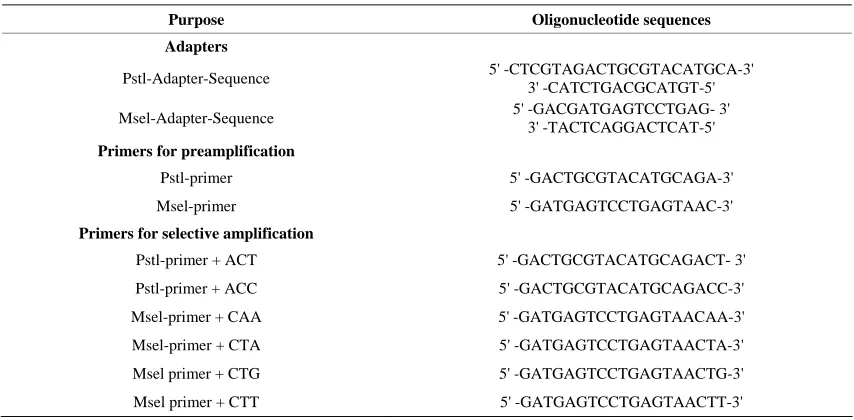
AFLP analysis was carried out according to procedures of Vos et al. (1995) [18] with minor modifications. The genomic DNA was restricted with two enzymes, a 6-base (rare) cutter Pstl and a 4-base (frequent) cutter Mse1 at 37˚C. The Pst1 and Mse1adapters were ligated to the fragment ends; amplifying a subset of Msel-Pstl frag- ments with primers that match the adapter and contain additional selective nucleotide at the 3' end; and separat-ing the fragments on denaturseparat-ing polyacrylamide gel (6%). Sequence of adapters and the primers used for AFLP analysis are given in Table 1. To achieve selective am- plification of a subset of these fragments, 10 cycles of PCR amplification under following parameters. Thirty seconds denaturation at 94˚C, thirty seconds primer an
nealing at 65˚C and decreasing one degree temperature in every subsequent cycles and one minute primer exten-tion at 72˚C.
2.4. Separation of Amplified Fragments on Denaturing Polyacrylamide Gel
An equal volume of formamide loading buffer (96% for- mamide, 10 mM EDTA pH 8.0, % 0.1 fuchsin) was added to the samples and denatured at 94˚C at 1.5 min. A 25 cm, 8% denaturing polyacrylamide gel (Long Ranger) was prepared and preheated for 20 min. 1.0 _L of each samples was loaded on to the gel and electrophoresis was conducted in 1 x Long Run TBE buffer at 1.500 V, 40 W, 40 mA and 50˚C using a Li-Cor DNA Gene Readir 4200 (MWG Biotech. Ebersberg/Germany).
3. Results and Discussion
AFLP Analysis
Preliminary AFLP analysis was carried out with different stocks including recurrent parent WL711, Thatcher + Lr9 and LrKLM4-3B and isogenic lines i.e. WL 711 + Lr9
and WL 711 + Lr KLM4-3B. KLM4-3B, along with these stocks, analysis of HD 2329, Agatha (Lrl9) and isogenic line WL 711. A survey of primer combinations with dif-ferent selective nucleotide indicated that for each primer combination, the number of scorable loci ranged from 34 to 123 (Table 2). Total number of marker loci scored with different primer combination were 682 for WL 711, 629 for HD 2329, 611 for Thatcher+Lr9, 515 for Agatha (Lr19),582 for Lr KLM4-3B, 629 for WL 711 + Lr9, 516 for WL 711 + Lr19 and 599 for WL 711 + Lr
[image:2.595.84.511.509.719.2]KLM4-3B (Table 2). So, minimum number of marker loci (515) amplified were from Agatha (Lr19)stock and
Table 1. Sequence of the adapters and primers used for pre-amplification and selective amplification.
Purpose Oligonucleotide sequences
Adapters
Pstl-Adapter-Sequence 5' -CTCGTAGACTGCGTACATGCA-3' 3' -CATCTGACGCATGT-5'
Msel-Adapter-Sequence 5' -GACGATGAGTCCTGAG- 3' 3' -TACTCAGGACTCAT-5' Primers for preamplification
Pstl-primer 5' -GACTGCGTACATGCAGA-3'
Msel-primer 5' -GATGAGTCCTGAGTAAC-3'
Primers for selective amplification
Pstl-primer + ACT 5' -GACTGCGTACATGCAGACT- 3'
Pstl-primer + ACC 5' -GACTGCGTACATGCAGACC-3'
Msel-primer + CAA 5' -GATGAGTCCTGAGTAACAA-3'
Msel-primer + CTA 5' -GATGAGTCCTGAGTAACTA-3'
Msel primer + CTG 5' -GATGAGTCCTGAGTAACTG-3'
Table 2. Number of AFLP loci scored in different stocks using different primer combinations.
Primer combination T. aestivum
WL 711
T. aestivum
HD 2329
Thatcher + Lr9
Agatha
(Lr19) KML 4-3B
WL711 +
Lr9
WL711 +
Lr19
WL711 +
LrKLM4-3B
Pst1 + ACC/Mse1 + CTB 110 98 107 70 104 111 78 110
Pst1 + ACC/Mse1 + CTA 119 123 98 98 121 100 103 108
Pst1 + ACC/Mse1 + CAA 98 51 96 34 49 97 40 50
Pst1 + ACC/Mse1 + CTG 67 67 43 59 52 49 49 63
Pst1 + ACC/Mse1 + CTA 79 82 75 94 71 79 89 77
Pst1 + ACC/Mse1 + CTT 108 110 92 84 91 94 82 85
Pst1 + ACC/Mse1 + CTA 101 98 100 76 94 99 75 96
Total number of loci 682 629 611 515 582 629 616 599
maximum (682) in case of WL 711.
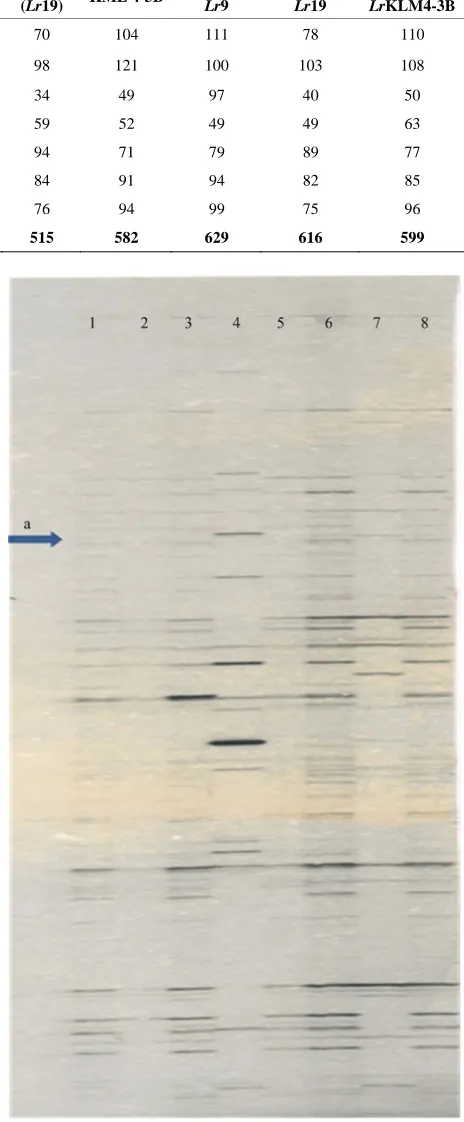
Number of conserved sequence markers were scored separately for different primer combination and it was found that primer Pstl + ACC/Mse1+CTG amplified 35 sequences common to all the used, whereas Pstl + ACC/ Mse1 + CTG amplified 56, Pstl + ACT/Mse1 + CAA amplified 24, Pstl + ACT/Mse1+ CTG amplified 26 and Pstl + ACTI Msel + CTA amplified 32 common se- quences. Out of 110 scorable markers (Figure 1) ampli- fied by Pstl + ACC/Mse1+ CTG, only one marker ( Fig-ure 1(a)) was found to be specific in LrKLM4-3B and WL 711 + LrKLM4-3B and were not amplified in any of the other stocks. Further, it was seen that primer combi- nation Pstl + ACT/Msel + CTT amplified three markers (Figures 2(b)-(d)) which were specifically amplified in Agatha (Lr19)and in isogenic line, WL 711 + Lr19and were not amplified in any of the other stocks (Figure 2).Only a limited primer combination used in the set of parental and near isogenic lines showed a high level of polymorphism for AFLP marker as compared to RAPD [19]. Putative AFLP marker linked to Lr9 and Lr19,the alien genes were readily identified. These primer combi- nations need to be tried on the relevant F2 population or RILs for estimation of extent of association before de-velopment of STS primers for MAS.
This technique was utilized to clone and map variety specific rice genomic DNA sequence [20]. Many other workers has used this technique in the past for detecting polymorphism, DNA fingerprinting, molecular typing [21,22], genome mapping [19,23], gene tagging [24], ge- netic diversity analysis [25] and gene expression analysis [26]. AFLP technique for classification of rice germ- plasm by fingerprinting cytoplasmic male sterile lines of rice was performed and found that the banding pattern of AFLP markers were remarkably consistent [27]. The duplicated CMS lines shared every AFLP band and were thus confirmed as identical genotypes. Thus AFLP ana- lysis conducted in the present study were found to be useful tools in identification of putatively linked markers
Identification of AFLP Markers Linked to Leaf Rust Resistance Genes Using Near Isogenic Lines of Wheat 686
Figure 2. AFLP markers amplified by primer combination Pst1 + ACT/Mse1 + CTT. Lanes 1-8: WL711, HD2329, Thatcher +Lr9, Agatha (Lr19), LrKLM4-3B, WL711 + Lr9, WL711 + Lr19, WL711 + LrKLM4-3B.
to different leaf rust resistant genes. This high reproduce- bility, rapid generation and high frequency of identifiable AFLP polymorphic bands makes AFLP analysis an at-tractive approach for molecular analysis in different or-ganisms.
REFERENCES
[1] M. G. Eversmeyer and L. E. Browder, “Effect of Leaf
and Stem Rust on 1973 Kansaswheat Yields,” Plant Dis-ease Reporter, Vol.58, No. 5, 1974, pp. 469-471. [2] R. G. Saini and A. K. Gupta, “Genes for Resistance to
Brown Rust Puccinia recondita) in Wheat. II. Lr Genes in Frontana, WG138 and E6360,” Cereal Research Communications,Vol.7, 1979, pp. 289-291.
[3] D. Anand, R. G. Saini and A. K. Gupta, “Slow Leaf Rust Development Due to Combination of Some Genes in Wheat,” Plant Disease Reporter, Vol.3, 1988, p. 97. [4] M. Seck, A. P. Roelfs and P. S. Teng , “Effect of Leaf
Rust Puccinia recondite Triticii on Yield of Four Isog-enic Wheat Lines,” Crop Protection, Vol.7, No. 1, 1988, pp. 39-43. doi:10.1016/0261-2194(88)90036-1
[5] K. V. S. Rao, J. P. Snow and G. T. Berggren, “Effect or Growth Stage and Initial Inoculum Level on Leaf Rust Development and Yield Loss Caused by Puccinia recon-dita f. sp. tritici,” Journal of Phytopathology, Vol.127, No. 3, 1989, pp. 200-210.
doi:10.1111/j.1439-0434.1989.tb01130.x
[6] R. P. Singh, J. Huerta-Espino, W. Pfeiffer and P. F. Lo-pez, “Occurrence and Impact of a New Leaf Rust Race on Durum Wheat in Northwestern Mexico from 2001 to 2003,” Plant Disease, Vol. 88, No. 7, 2004, pp. 703-708.
doi:10.1094/PDIS.2004.88.7.703
[7] J. A. Appel, E. DeWolf, W. W. Bockus and T. Todd, “Kansas Cooperative Plant Disease Survey Report Pre-liminary Kansas Wheat Disease Loss Estimates,” August 11, 2009. http:// www.ksda.gov/includes/document cen-ter/plant_protection/Plant%20Disease20Reports/2009KS WheatDiseaseLossEstimates.pdf. Accessed 29 November 2010.
[8] G. V. Volkova, T. P. Alekseeva, L. K. Anpilogova, M. V. Dobryanskaya, O. F. Vaganova and D. A. Kol’bin, “Phy-topathological Characteristics of Leaf Rust Resistance of New Winter Wheat Varieties,” Russian Agricultural Sci-ences, Vol. 35, No. 3, 2009, pp. 168-171.
doi:10.3103/S1068367409030112
[9] J. H. Espino, R. P. Singh, S. Germa’n, B. D. McCallum, R. F. Park, Q. W. S. Chen, C. Bhardwaj and H. Goyeau, “Global Status of Wheat Leaf Rust Caused by Puccinia triticina,” Euphytica, Vol. 179, No. 1, 2011, pp. 143-160.
doi:10.1007/s10681-011-0361-x
[10] I. Lowe, D. Cantu and J. Dubcovsky, “Durable Resis-tance to the Wheat Rusts: Integrating Systems Biology and Traditional Phenotype-Based Research Methods to Guide the Deployment of Resistance Genes,” Euphytica, Vol. 179, No. 1, 2011, pp. 69-79.
doi:10.1007/s10681-010-0311-z
[11] L. Huang, L. Q. Zhang, B. L. Liu, Z. H. Yan, B. Zhang, H. G. Y. L Zhang and D. C. Liu, “Molecular Tagging of a Stripe Rust Resistance Gene in Aegilops Tauschii,”
Euphytica, Vol. 179, No. 2, 2011, pp. 313-318.
doi:10.1007/s10681-010-0330-9
[12] M. Baum, E. S. Laguadah and R. Appels, “Wide Crosses in Cereals,” Annual Review of Plant Physiology and Plant Molecular Biology, Vol. 43, 1992, pp. 117-143.
[13] Z. A. Pretorius and C. M. Bender, “First Report of Viru-lence for the Wheat Leaf Rust (Puccinia triticina) Resis-tance Gene Lr32 in South Africa,” Plant Disease, Vol. 94, No. 3, 2010, pp. 381.
doi:10.1094/PDIS-94-3-0381A
[14] S. C. Bhardwaj, M. Prashar, S. K. Jain, S. Kumar, Y. P. Sharma, “Physiologic Specialization of Puccinia Triticina on Wheat (Triticum Species) in India,” Indian Journal of Agricultural Sciences, Vol. 80, 2010, pp. 805-881. [15] E. R. Sears, “The Transfer of Leaf Rust Resistance from
Aegilops umbellulata into Wheat,” Brookhaven Symposia in Biology, Vol. 9, 1956, pp. 1-21.
[16] A. S. Soliman, E. Y. Heyne and C. O. Johnston, “Resis-tance to Leaf Rust in Wheat Derived from Chinese Ae-gilops umbellulata Translocation Lines,” Crop Science, Vol. 3, 1963, pp. 254-256.
doi:10.2135/cropsci1963.0011183X000300030025x
[17] S. L. Dellaporta, J. Wood and J. B. Hicks, “A Plant DNA Mini Preparation. Version 11,” Plant Molecular Biology Reporter, Vol. 1, No. 4, 1983, pp. 19-21.
doi:10.1007/BF02712670
[18] P. Vos, R. Hogers, M. Bleeker, M. Reijans, T. V. D. Lee, M. Hornes, A. Frijters, J. Pot, J. Peleman, M. Kuiper and M. Zabeau, “AFLP: A New Technique for DNA Finger-printing” Nucleic Acids Research,Vol. 23, No. 21, 1995, pp. 4407-4414. doi:10.1093/nar/23.21.4407
[19] D. J. Mackill, Z. Zang, E. D. Redona and P. M. Colowit, “Level of Polymorphism and Genetic Mapping of AFLP Markers in Rice,” Genome, Vol. 39, No. 5, 1996, pp. 967-977. doi:10.1139/g96-121
[20] Y. Cho, M. Blair, O. Panaud and S. R. McCouch, “Clon-ing and Mapp“Clon-ing of Variety-Specific Rice Genomic Se-quences: Amplified Fragment Length Polymorphism (AFLP) from Silver-Staired Polyacrylamide Gels,” Ge-nome, Vol. 40, 1996, pp. 84-91.
[21] J. J. Lin, J. Kuo and J. Ma, “A PCR-Based DNA Finger-printing Technique: AFLP for Molecular Typing of
Bac-teria,” Nucleic Acids Research,Vol. 4, No. 18, 1996, pp. 3649- 3650. doi:10.1093/nar/24.18.3649
[22] M. Maheswaran, P. K. Subudhi, S. Nandi, J. C. Xu, A. Parco, D. C. Yang and N. Huang, “Polymorphism, Dis-tribution and Segregation of AFLP Markers in a Double Haploid Rice Population,” Theoretical and Applied Ge-netics,Vol. 94, No. 1, 1996, pp. 39-45.
doi:10.1007/s001220050379
[23] J. Becker, P. Vos, M. Kuiper, F. Salamini and M. Heun, “Combined Mapping of AFLP and RFLP Markers in Bar-ley,” Molecular and General Genetics, Vol. 249, No. 1, 1995, pp. 65-73. doi:10.1007/BF00290237
[24] C. M. Thomas, P. Vos, M. Zabeau, D. A. Jones, K. A. Norcott, B. P. Chadwick and J. D. G. Jones, “Identifica-tion of Amplified Restric“Identifica-tion Fragment Polymorphism (AFLP) Markers Tightly Linked to the Tomato Cf-9 Gene for Resistance to Cladosporium fulvum,” Plant Journal, Vol. 8, No. 5, 1995, pp. 785-794.
doi:10.1046/j.1365-313X.1995.08050785.x
[25] E. D. Redona, L. R. Hipotita, R. A. Caldo and L. S. Sebastian, “Utilization of AFLPs for Genetic Diversity Analysis. The Case for Progenitor Cultivars of Modern Philippine Rice Varieties,” Asian Rice Biotechnology Network Course on AFLPs for Rice Improvement, Philip-pine Rice Research Institute (Phil Rice)m Maligaya, Nunoz, Nueva Ecija 3119, IRRI, 1996.
[26] C. Bachem, W. B. Hoeven, R. S. Vander, S. M. Bruijn, D. Vrueugdenkil, M. Zabeau and R. G. F. Visser, “Visuali-zation of Differential Gene Expression Using a Novel Method of RNA Fingerprinting Based on AFLP : Analy-sis of Gene Expression during Potato Tuber Develop-ment,” Plant Journal,Vol.9, No. 5, 1996, pp. 745-753.
doi:10.1046/j.1365-313X.1996.9050745.x