doi:10.4236/am.2011.22023 Published Online February 2011 (http://www.SciRP.org/journal/am)
Alienor Method for Nonlinear Multi-Objective
Optimization
Mahamat Maimos1, Balira O. Konfe2, Souleymane Koussoube2, Blaise Some3
1Laboratoire LANIBIO
, UFR-SEA, Université de Ouagadougou, Ouagadougou, Burkina Faso 2Laboratoire LAIMA
, Institut Africain d’Informatique, Libreville, Gabon 3Laboratoire LANIBIO
, Université de Ouagadougou, Ouagadougou, Burkina Faso
E-mail: [email protected], [email protected], [email protected], [email protected] Received August 13, 2010; revised November 28, 2010; accepted December 3, 2010
Abstract
This paper deals with the Alienor method to tackle multiobjective nonlinear optimization problems. In this approach, the multiple criteria of the optimization problem are aggregated into a single one using weighted sums. Then, the resulting single objective nonlinear optimization problem is solved using the Alienor method associated with the Optimization Preserving Operators
O P O. .
technique which has proved to be suitable for (nonlinear) optimization problems with a large number of variables (see [1]). The proposed approach is evaluated through test problems. The results show that the approach provides good approximations of the Pareto front while requiring small computational time, even for large instances.Keywords:Nonlineal Multiobjective Problems, Weighted Sum, Alienor Method,
O P O. .
Technique1. Introduction
These last years, the field of multicriteria optimization have experienced some significant evolutions. This have allowed the development of several solutions methods or approaches. This multiplicity of multiobjective optimiza- tion methods is perceived like one of the wealth of this field. This high number of approaches is explained by the diversity of the problems and the existence of various possible and legitimate solutions to these problems. However, this phenomenon reveals also some weak- nesses.
As in monoobjective optimization, the optimization algorithms used to solve multiobjective optimization pro- blem (MOP) can be classified into exact and approxi- mate algorithms. In the literature on exact algorithms, more attention has been devoted to bicriteria optimi- zation problems by using exact methods such as branch and bound algorithms, A algorithm and dynamic pro- gramming. These methods are effective for small size problems. But, for problems with more than two criteria, there aren’t many effective exact procedures, given the simultaneous difficulties coming from the NP-hard com- plexity of problems and the multicriteria framework of the problems [2].
To tackle these difficulties, we propose a determinist
approach called Alienor method to solve multiobjective optimization. This approach is based on concepts such as Aggregation Method (weighted sum), Penalized method (for constrained problem) and Alienor method associated to the O P O. . ’s technique. It can be used in various multicriteria situations. In [3], Maimos et al. proposed to solve multiojective linear programming (MOLP) pro- blems by using Alienor method associated to the
. .
O P O
’s technique.
This paper aims at extending the Alienor method ap- proach to multiobjective nonlinear programming (MONLP) problems. The Alienor method associated to the O P O. . ’s technique would then appear like a unique determinist method to solve efficiently linear or non-linear multi- ojective programming.
Let’s consider the following MONLP problem:
1
, 2 , ,
"min" F x f x f x f xk
x
(1)
where k2 is the number of objectives, x=
x1,,xn
is the vector representing the decision variables and D represents the set of feasible solutions associated with equality and inequality constraints and explicit bounds.
=
1
, 2 , , k
The problem to solve is:
Find a good one or several compromises in a subset of n
.
The aggregation method is one of the first and most used methods to generate Pareto optimal solutions. It consists in using an aggregation function to transform the MONLP (1) into a monoobjective problem using a con- vex combination of the objective functions fi into a
single function S1 as follows:
1
=1
, = ,
k
i i i
S F
f (2)where
=1
= 1, 0.
k
i i i
i
are the weights that reflect the relative importance of each criteria.
Now, the problem (1) becomes:
1( ) min
. S x x
(3)
Let us notice that some Pareto optimal solutions may be obtained by the resolution of the mathematical pro- gram (3) for various values of the weight vector . Such solutions are known as supported solutions [2].
The complexity of MONLP is equivalent to the one of the subjacent monoobjective optimization problem. If the subjacent optimization problems are polynomial, it will be relatively easy to generate the supported solutions. Nevertheless, there exists other Pareto optimal solutions that cannot be obtained by the resolution of a mathe- ma- tical program (3). Indeed, these solutions, known as non- supported solutions, are dominated by convex combina- tions of supported solutions.
The obtained results in the resolution of the problem (3) depend strongly on the parameters chosen for the weight vector . In this paper, we use the “priori mul- tiple weights” strategy [2] which consists in generating various weight vectors. The problem (3) is solved in pa- rallel and independent ways for the different vector wei- ghts. Various weights may provide different supported solutions. However, the same solution can be generated by using different weights [2].
The remainder of this paper is organized as follows: Section 2 presents the penalization technique used to transform a constrained optimization problem into an un- constrained one. Section 3 is devoted to the Alienor me- thod and the O P O. . *’s technique. Section 4 presents the main algorithm to solve the MOP problem. To illustrate our approach, computational results and an automatic way to generate the weight vectors are presented in Sec- tion 5.
2. The Penalized Problem
The approach using the Alienor method that we are pro- posing here requires the resolution of a contrained opti- mization problem. The main idea to solve the constr- ained optimization problem is to transform this pro- blem into an unconstrained one. The classic way to achieve such transformation uses the Lagrangian parameters.
In this section we use a transformation proposed by Konfé et al. [4]:
Definition 1 Let’s denote by L the continuous func- tion mapping I into and defined by:
1
=1
= .
m
i i i
L x S x K
l x l x (4)where
I is a subset of n. )
(x
li are the functions mapping n into defi- ning the set of constraints .
|
.
|
is the absolute value in and K is a real positive number sufficiently large.We can define the unconstrained global optimization problem associated to (3) by:
.min ( )
n
Glob L x x
(5) Indeed, we have the following theorem:
Theorem 1 [1]
Let x, be the global minimizer of L x
; then x, is the global minimizer of S x1
: In other words,
1
= .
min min
subject to:
0, = 1, ,
n n
x x
i n
Glob L x Glob S x
l x i m
x
(6)
The complete proof for this theorem is given in Konfé et al. [4].
3. Alienor Method Associated to O.P.O
*Technique
3.1. Alienor’s Method
The Alienor reducing transformation method is based on a simple idea consisting in approximating an n vari- ables function by a single variable function by using
dense
curves. These curves have the property of fil- ling the space [5]. More precisely, consider a continuous
n variables function:
1, 2, , n
L x x x
219
ting:
= , > 0 = 1, ,
i i
x h i n.
where is a real variable and the hi are regular fun- ctions generally Cdefining an dense curve. There- fore, the n variables function L x x
1, 2,,xn
beco- mes:
=
1
, 2 , , n
L L h h h .
First we recall the following definition [6,7]:
Definition 2 Given a positive number a, a continuous function
: n
h I D is said to be dense in D if: 1. h I
D2. For any PD, there exists such that:
,
,d P h
where d is the euclidian distance in n. Let us now consider the following problem:
1
, , K 1
. min , , n ,
x xn
Glob L x x
(7)
where
L
is a continuous function and where is a compact of n . Then, using any dense curve
=
1
, 2 , , n
H h h h of allows to tran- sform (6) into the following global optimization problem:
.min
Glob L
I
(8)
where I= 0 ,
max
and
=
1
, 2 , , n
L L h h h Note that max
only depends on the compact set . It is possible to assert that if is a solution of (7), then
h1 ,h2 ,,hn
is an approximation of (6). Moreover there exists a solution x of (6) such that (see [6,7]):
,
<
,d x H є
(9)
where є
0 as 0. About the choice of the reducing transformation, the smaller the length of the curve is, the smaller the calculation time gets. Several works [5-8] have been devoted to find dense curves with a minimal length and a good precision (small co- efficient ).For instance we can cite the Mora transformation [5], the Cherruault-Konfé-Benneouala transformation [5, 8] or the Cherruault transformation [9].
The transformation:
=
, = 1, , ,i i i
x cos i n
where
i and
i are slowly increasing se- quences densifies = [ 1,1] n. The densificationparameter is given by:
1
= 2 1 n , > 0,
n
r n r
where
r
is a real number.Remark 1 This curve is dense in = [ 1,1] . n . It is easy to extend this curve to
=1
=
ni [ , ]a bi i .
It is sufficient to set:
1
= ,
2
i i i i i i
x b a h b a
where hi( ) is -dense in
= 1,1 .n
and with:
0, max
,
where max depends on the reducing transformation;
this will be precised later.
Theorem 2 The transformation:
= ,
i i
x h
where:
1
= ,
2
i i i i i i
h b a h b a
i i and
i i being slowly increasing sequences, isdense
in .
Practical applications of this reducing technique show that the obtained function L is, in most cases, a multi- modal function involving a long calculation-time to find a global minimum. That’s why a new concept to solve a multimodal function optimization problem was develo- ped by Mora et al. [10].
3.2. Optimization Preserving Operators* (O.P.O*)
Konfé et al. [11] have proposed a new type of O P O. .
called O P O. . : The O P O. . is defined as follows [5, 11] :
Definition 3 Let L be an objective function mapp- ing into : We assume that L is a lipschitzian function having a globally convex property. Let 0 be an arbitrary element of :
The operator T:FC
notedL
T where F
is a subset of continuous functions; defined by:
0
0 ( )1 =
2
L
T L L L L
is an Optimization-Preserving-Operator*
(O.P.O*). The globally convex property means that:
( )
L
T
as
.
jective function, 0 is an arbitrary element of I. Let
S be the set of the solutions of:
= 0.L
T (10)
If = , then min = .
I
S Glob L L
In other words, if S contains a unique element, it is the solution of the global minimization problem.
The complete proof for this theorem is given in [11]. To solve the global optimization problem (7), we use the O.P.O* to find a unique 0 such that:
= 0.
L
T
4. Algorithm
Now, we fully describe the algorithm we propose to solve our initial problem (1).
The MOP problem to solve is:
1
, 2 , ,
"min" F x f x f x f xk
x
(11)
Step 1: Use the weighted sum to aggregate the di- fferent functions and therefore obtain the following ob- jective function:
1 =1 = . k i i iS x
f x (12)where
=1
= 1, 0.
k
i i i
Step 2: If the problem (1) is constrained, use the penalization technique to define the multidimensional function L x
as in (13):
1
=1
= ,
m
i i i
L x S x K
l x l x (13)given that D=
xnl xi
0, i= 1,,m
; other- wise, set L x
=S x1
.Step 3: Use Alienor method to convert the multi- dimensional function L x
into a one variable function
L
by setting:
= ,
i i
x h
where:
1
= ,
2
i i i i i i i
h b a cos b a
0, 2
.
Step 4: O.P.O* 1) Initialization.
*Take an arbitrary initial point 0 in . Use OPO*:
0
0 0=
2
L
L L L L
T
to eliminate all local minima, i.e. solve
0
= 0.L
T
2) *Now let Si be the set of solutions defined by:
( )
= : L = 0
i i
S T
If =
i
S
then stop: is a global minimizer of
F
; go toStep 3 *otherwise go to 3. 3) *update TF.
*Choose
j Si
*then go to 2. Step 5:Find:
1
= , = 1, ,
2
i i i i i i
x b a h b a i n
wherehi = cos wii , = 1,i ,n
calculateF .
5. Computational Results
Computing environment:
We implemented the algorithm in Maple12 software on an Intel Core2Duo CPU T5850 @2.16GHz computer with 4 GB RAM using a windows vista Service patch 2, operating system.
In order to have graphical representations, we have only considered bi-criteria problems with a large number of variables.
5.1. Example 1: Zitzler’s Test Function
For the first example, we solve the well known Zitzler’s test function. Note that this example is an unconstrained MONLP problem, it has been solved in [12] and the true Pareto fronts is found when g X
= 1:
1 1 1 2 "min" g 1f X x
f X
f X X
g X where
1
= 2 9
= 1 , = , , 1
n
i n
i
g X x X x x
n
221
n is the number of variables of the decision vector X. In our example, we set n= 30.
With our approach, we obtain the result (see Table 1) with a computational time of 411.09 s.
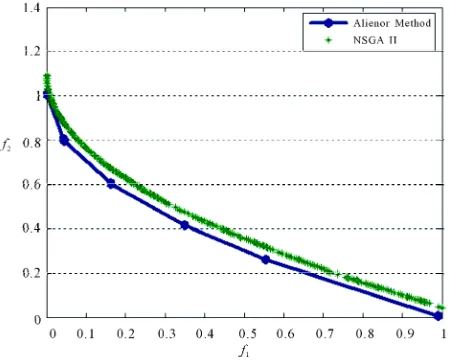
The Pareto optimal front is represented by Figure 1. Using Matlab 7.01, we plot together our result and Pareto curve obtained using NSGA II. It is clear that Alienor method shows a better efficiency, compared to NSGA II which is the most used algorithm nowadays (see Figure 2).
5.2. Example 2: Test Function 2
This second problem is a constrained MONLP. It has been proposed and solved in [13].
2
1 1
2 2
2 1 1 2
1 "min"
4 5
f x x
f x x x x
s.t
2 2
1 4 1 2 5 3.5
x x x
1 0, 2 0. x x
Our algorithm obtain the result (see Table 2) with a computational time of 17.971 s.
The Pareto optimal front is represented by Figure 3.
5.3. Example 3: BINH and KORN Problem
Another constrained MONLP is solved here. Let us con- sider the BINH and KORN problem define as:
2 2
1 1 2
2 2
2 1 2
4 4
"min"
5 5
f x x
f x x
[image:5.595.309.538.88.504.2]
Table 1. Zitzler’s test function results.
1
2 f1 f2 g X
0 1 0.9895962710 0.00727777585 1.004099073
0.1 0.9 0.9895962710 0.00727777585 1.004099073
0.2 0.8 0.9895962710 0.00727777585 1.004099073
0.3 0.7 0.5550921215 0.2582018882 1.005170626
0.4 0.6 0.3482051119 0.4138490867 1.005583140
0.5 0.5 0.1677741466 0.5951394153 1.005960807
0.6 0.4 0.04451568665 0.7947088139 1.006366816
0.7 0.3 0.04183878110 0.8019512260 1.006835654
0.8 0.2 0.00001179260 1.003389902 1.007235154
0.9 0.1 9
[image:5.595.308.539.90.524.2]2.200000000 10 1.027937178 1.027984734
Table 2. Test function 2 results.
1
2 f1 f2
0 1.0 2.249936783 1.000260889
0.1 0.9 2.249936783 1.000260889
0.2 0.8 2.249936783 1.000260889
0.3 0.7 1.994514416 1.075514962
0.4 0.6 1.994514416 1.075514962
0.5 0.5 1.897817760 1.150115890
0.6 0.4 1.666328758 1.446575427
0.7 0.3 1.503077479 1.772426491
0.8 0.2 1.258651445 2.527075404
0.9 0.1 1.101403269 3.371648047
[image:5.595.311.536.531.711.2]1 0 1.091958615 3.489179030
Figure 1. The Pareto curve of Zitzler’s test function T1.
[image:5.595.60.285.536.727.2]Figure 3. The Pareto curve of test function 2.
2 2
1 1 2
2 2
2 1 2
1 2
. 5 25
8 3 7.7
and 0, 5 , 0, 3 .
s t c x x x
c x x x
x x
This problem has been solved in [14]. With our appr- oach, we have the result (see Table 3) with a computa- tional time of 12.667 s.
The Pareto optimal front is represented by Figure 4.
5.4. Example 4: Osyczka and Kundu Problem
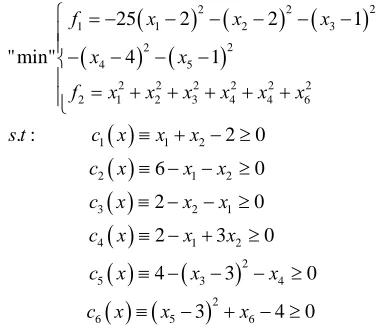
For the last two objectives test function, we consider the following Osyczka and Kundu problem which has been solved in [14].
2
2 2
1 1 2 3
2 2
4 5
2 2 2 2 2 2 2 1 2 3 4 4 6
1 1 2
2 1 2
3 2 1
4 1 2
2
5 3 4
2
6 5 6
25 2 2 1
"min" 4 1
. : 2 0
6 0
2 0
2 3 0
4 3 0
3 4 0
f x x x
x x
f x x x x x x
s t c x x x
c x x x
c x x x
c x x x
c x x x
c x x x
and x x x1, 2, 6
0,10 ;
x x3, 5
1, 5 ; x4
0, 6 . [image:6.595.308.538.83.524.2]Alienor method with OPO* technique give the re- sult in 286.761 s (see Table 4).
Table 3. Binh and Korn problem results.
1
2 f1 f2
0 1 135.9995500 4.000075000
0.1 0.9 79.40217891 6.913583013
0.2 0.8 47.10895519 13.25083286
0.3 0.7 28.52832998 19.42671728
0.4 0.6 15.98878694 25.76765326
0.5 0.5 8.195583414 31.81004556
0.6 0.4 3.999314138 36.86265913
0.7 0.3 1.337259144 42.50299851
0.8 0.2 0.7192930295 44.20812605
0.9 0.1 0.2258427468 46.70712606
1 0 8
[image:6.595.75.269.516.683.2]2.339494930 10 49.99923040
Figure 4. The Pareto curve for BINH and KORN problem.
The Pareto optimal front is represented by Figure 5.
5.5. Example 5: Tamaki Test Problem
In this section, we propose a three objective test func- tions: The Tamaki test problem defined by:
1 1 2 2 3 3
2 2 2
1 1 2 3
1 2 3
"max"
. :
0 and , , , 0, 4
f x
f x
f x
s t
c x x x x
x x x
223
This problem has been solve in [15]. Alienor method associated to the OPO* technique give the following results. To generate the weight vector, we use the follow- ing maple software code which can be easily extended to more than three objective functions.
compteur := 1: for i from 0 to 10 do
for j from 0 to 10 - i do
lambdai[compteur] := [i, j,10 - i - j]; compteur := compteur +1;
od : od :
kas := [seq(lambdai[i] / 10.0, i = 1..compteur -1)];
The Pareto optimal front is represented by Figure 6. With this example we show that our method allows us to solve the MOP with more than two objective functions. The only difficulty was to find a procedure to generate the weight vectors in this case. This difficulty was over- comed with the preceding code. However, we observed the great calculation time due to the number of optimi- zation problems to solve. For instance, with three obje- ctive functions we have to solve 66 optimization prob- lems and 286 with 4 objective functions. In further works, our interest is in the resolution of the calculation time problem and the combinatory multiobjective optimiza- tion problem using the Alienor method associated with
*
[image:7.595.312.536.72.290.2]OPO technique.
Table 4. Osyczka and Kundu problem results.
1
2 f1 f2
0 1 –20.16899675 5.660266584
0.1 0.9 –56.16791081 7.547854107
0.2 0.8 –194.7566171 25.71891365
0.3 0.7 –194.7566171 25.71891365
0.4 0.6 –194.7566171 25.71891365
0.5 0.5 –194.7566171 25.71891365
0.6 0.4 –194.7566171 25.71891365
0.7 0.3 –194.7566171 25.71891365
0.8 0.2 –234.0825312 142.5275348
0.9 0.1 –234.0825312 142.5275348
[image:7.595.311.537.327.474.2]0 1 –234.0825312 142.5275348
Figure 5. The Pareto curve for Osyczka and Kundu problem.
Figure 6. The Pareto curve for Tamaki test problem.
6. Conclusions
[image:7.595.55.287.468.724.2]7. Acknowledgements
The authors would like to thank Prof. Berthold Ulungu and Dr. P. M. Takouda for their helpful comments.
8. References
[1] B. O. Konf, “Nouvelles Mthodes Mathmatiques Alienor et Adomian, pour la Biomdecine,” Thse de l’Universit de Ouagadougou, Ouagadougou, 2005.
[2] T. El-Ghazali, “Metaheuristics: From Design to Imple- mentation,” John Wiley & Sons, Inc., Hoboken, 2009. [3] M. Maimos, Y. Cherruault, B. Konf and N. A. Massamba,
“Alienor Method to Solve Multi-Objective Linear Pro- gramming,” Kybernetes, Vol. 36, No. 5, 2009, pp. 789- 799. doi:10.1108/03684920910962678
[4] B. O. Konf, Y. Cherruault and B. Som, “Solving Con- strained Global Optimization Problems without Penalty Parameters,” Kybernetes, Vol. 34, No. 7-8, 2005, pp. 1090-1103. doi:10.1108/03684920510605902
[5] Y. Cherruault and G. Mora, “Optimisation Globale: Thorie des Courbes α-Denses,” Economica, Paris, 2005.
[6] Y. Cherruault, “Optimisation: Methodes Locales et Glo- bales,” Presses Universitaires de France (P. U. F), Paris, 1999.
[7] Y. Cherruault, “Modles et Mthodes Mathmatiques pour les Sciences du Vivant,” Presses Universitaires de France (P. U. F), Paris, 1998.
[8] B. O. Konf, Y. Cherruault and T. Benneouala, “A Global Optimization Method for Large Number of Variables (Variant of Alienor Method),” Kybernetes, Vol. 34, No. 7-8, 2005, pp. 1070-1083.
doi:10.1108/03684920510605885
[9] T. Benneouala and Y. Cherruault, “Alienor Method for Global Optimization with a Large Number of Variables,”
Kybernetes, Vol. 34, No. 7-8, 2005, pp. 1104-1111. doi: 10.1108/03684920510605911
[10] G. Mora, Y. Cherruault and A. Benabidallah, “Global Optimization-Preserving Operators,” Kybernetes, Vol. 32, No. 9-10, pp. 1473-1480.
[11] B. O. Konf, Y. Cherruault, B. Som and T. Benneouala, “A New ‘Optimization-Preserving-Operateur’ Applied to Global Optimization,” Kybernetes, Vol. 34, No. 7-8, 2005, pp. 1112-1124. doi:10.1108/03684920510605920 [12] S. Elaoud, T. Loukil and J. Teghem, “The Pareto Fitness
Genetic Algorithm: Test Function Study,” European Journal of Opertional Research, Vol. 177, No. 3, 2007, pp. 1703- 1719. doi:10.1016/j.ejor.2005.10.018
[13] V. Barichard, M. Ehrgott, X. Gandibleu, V. T’kindt, “Multiobjective Programming and Goal Programming,” Springer, Berlin, 2009. doi:10.1007/978-3-540-85646-7 [14] V. Barichard, “Approches Hybrides pour les Problmes
Multiobjectifs,” Thse de l’Universit d’Angers, Angers, 2003.