https://www.scirp.org/journal/msce ISSN Online: 2327-6053 ISSN Print: 2327-6045
DOI: 10.4236/msce.2019.79001 Sep. 27, 2019 1 Journal of Materials Science and Chemical Engineering
Research and Advances of Silicate Plugging
Agent in the Oilfields
Juan Zhao
1,2*, Jian Zhang
1,21State Key Laboratory of Offshore Oil Exploitation, Beijing, China
2CNOOC Research Institute Co., Ltd., Beijing, China
Abstract
The paper overviews the research and application of silicate plugging agent, according to the different mechanisms and application forms, the plugging agent is divided into silicate gel, silicate precipitation, silicate/polymer, sili-cate/surfactant, silicate gel/foam and so on. This paper chiefly introduces the conception, mechanism and development tendency of the different systems mentioned above. The development tendency manifests as fully utilize per-sonal properties and cooperate with other plugging agents or technologies, including the study of reaction mechanism, combination of plugging agent, grasping water flood timing, developing deep profile control and water shu-toff technology, combining with other measures (chemicals huff and puff), in order to play the role of such blocking agents, further enhance oil recovery.
Keywords
Silicate Plugging Agent, Silicate Gel, Silicate Precipitation, Silicate/Polymer, Silicate/Surfactant, Silicate Gel/Foam, Development Tendency
1. Introduction
Currently, most oil fields in China have entered the late stage of development, and profile control and water plugging has become an important technical measure in domestic and international high water-content oilfield to improve water flooding effect. Simultaneously more and more oil formation, higher and higher temperature, more and more reservoir water salinity. Research of tem-perature-resistance and salt-tolerance plugging agent becomes more and more important. Most of the existing relative temperature-resistance and salt-tolerance cross-linked polymer plugging agent is based on low-temperature gel, and it on-ly applies to the following reservoirs: temperature is below 120˚C and salinity is
How to cite this paper: Zhao, J. and Zhang, J. (2019) Research and Advances of Silicate Plugging Agent in the Oilfields. Journal of Materials Science and Chemical Engineering, 7, 1-10.
https://doi.org/10.4236/msce.2019.79001
Received: July 30, 2019 Accepted: September 24, 2019 Published: September 27, 2019 Copyright © 2019 by author(s) and Scientific Research Publishing Inc. This work is licensed under the Creative Commons Attribution International License (CC BY 4.0).
http://creativecommons.org/licenses/by/4.0/
DOI: 10.4236/msce.2019.79001 2 Journal of Materials Science and Chemical Engineering temperature tolerant, salt-tolerant, good injectivity, selective plugging, environ-ment-friendly, non-biodegradation, and so on. In recent years, more and more the plugging agent based on silicate is applied in high-temperature and high-salinity reservoirs.
Profile control is a problem in high-temperature and high-salinity reservoirs
[6], and silicate plugging agent was extensively applied in water plugging, profile control, inhibition gas coning, stability of reservoir rock and clay [7]-[12]. Sili-cate can be divided into many types in accordance with plugging mechanism. This paper summarized the application of silicate plugging agent in the oilfields.
1.1. Silicate Gel
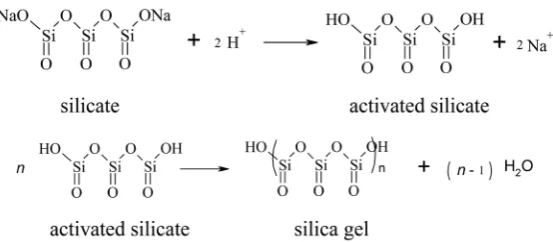
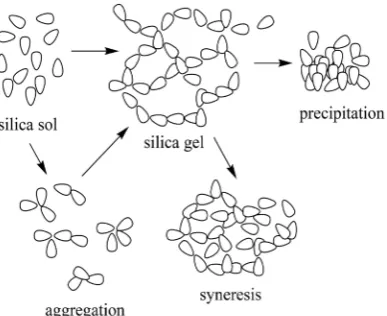
Early in the 1920s, Hills [13] has recognized the silicate gel can be used to im-prove heterogeneity of formation, and Hurd [14] further studies of acid silica gel system. Silica gel is formed by the silicate solution added the activator (ammo-nium sulfate, HCl, formaldehyde, etc.), and first it forms monomeric silicic acid, then forms multsiilicic acid through condensation polymerization, finally forms network structure. The jellous silicic acid can plug watering place and water producer, and the forming process follows as Figure 1.
Two silica gels can be prepared according to the adding sequence of activator, and one is acid silica gel, adding the silicate solution into activator, the other is alkalic silica gel, adding the activator into silicate solution. Its low cost allows economical treatment of 1.5 to 3 m radially around wellbore. It invades small formation pores and is stable at high temperatures. The drawback is short gel time.
WU Jia-Zhong [15] developed the system of fluosilicic acid-silicate, the me-chanism of reaction ut infra. 1) The reaction of fluoride acid and formation brine:
2 6 2 6
H SiO +2NaCl=Na SiF ↓ +2HCl, H SiF2 6+CaCl2=CaSiF6↓ +2HCl;
2) The reaction of silicate and fluoride acid:
(
)
2 6 2 2 2 2 6 2 2
H SiO +Na O⋅mSiO +nH O=Na SiF +mSiO ⋅ n+1 H O↓; 3) The reaction of silicate and sodium fluosilicate:
(
2 2)
2 6(
)
2DOI: 10.4236/msce.2019.79001 3 Journal of Materials Science and Chemical Engineering
Figure 1. The forming process of silica gel.
LU Xiang-Qun [16] have recommended using two delay activators marked as YHJ-1 and YHJ-2, and they have been successfully used as blocking and divert-ing agents to treat injection and production wells in Henan Oilfield. Reservoirs in Tarim Basin, NW China, were geologically developed in marine environment with high temperature and high salinity. To address the problem in Tarim Basin
[17], profile control agent with abio-gel coating (WJSTP) is developed by taking advantage of the multi-valence cations concentrated in both the formation and injection water and injects a compounded silicate to react with the cations to form abio-gel with the same density as water. The method was tested successful-ly in LN203 well in March 2006. The average injection pressure boosted, and in-jection profile obviously improved.
A. H. Kabir [18] proposed a simple system for use in sandstone formations is prepared by slowly adding a sodium silicate solution to a 15% HCl acid solution and then pumped into the well. This solution solidifies in a few hours, depend-ing on the temperature. U.S. Pat.5351757 [19] disclosed a method for emplacing a silicate gel to improve the sweep efficiency through controlling quantities of a silicate solution and either a gas or a gas and an organic acid are injected into a well to infiltrate and generate a controlled amount of a silicate gel of a controlled SiO2 concentration in the high-permeability thief zones, to reduce the
permea-bility thereof. The Bashkir oilfield of Russia used gel precipitation and its ad-vanced formula to treat injection well, alternating injecting silicate and slurry, then formed gel and precipitation in stream path, thereby decreased the per-meability of high capacity channel.
A silicate system activated by urea-formaldehyde [20] was raised. The urea reacts with OH− in silicate solution, reducing the pH value of the system, and
DOI: 10.4236/msce.2019.79001 4 Journal of Materials Science and Chemical Engineering It can generate precipitation when the silicate met calcium and magnesium ions in high temperature conditions, and reaction is shown in Figure 3. Two-fluid method can be used in the precipitation reaction for the purpose of blocking layers.
Silicate-calcium/magnesium chloride system is commonly used as silicate pre-cipitation system, the working fluid easier entering into thief zone, so the system is usually used to block high permeable layer. Alternately injecting silicate and calcium/magnesium chloride into selective zone, isolated by clear water, then the two solutions mixed in the pore and yield the water insoluble precipitation:
2 2 2 2
CaCl +Na O⋅mSiO =CaO⋅mSiO ↓ +2NaCl
2 2 2 2
MgCl +Na O⋅mSiO =MgO⋅mSiO ↓ +2NaCl
The traditional silicate-calcium chloride system reacts quickly and play little role on the aim lay, alkali silicic acid gel has week strength, poor high-tempera- ture-resistance, non-selectivity. On the base of tradition silicate system, PEI Lixia
[21] developed the LS water blocking system, which is composed of calcium chloride and silicate as principal ingredient, complex, activator and LS as acces-sory ingredient. The complex can delayed gel time by controlling the concentra-tion of Ca2+, because the Ca2+ can react with the complex follows as Figure 4.
The effect of LS is concealing the Ca2+ and enhancing the gel strength. The LS
system does not only keep the outstanding characteristic of the former system, but also has advantage such as high-temperature resistance, salt resistance, strong intensity, dominant selectivity, controllable reaction time, non-corrosion, non-solid, deep blocking, etc.
[image:4.595.271.475.74.139.2]DOI: 10.4236/msce.2019.79001 5 Journal of Materials Science and Chemical Engineering
Figure 3. The role of calcium and magnesium ions on the sol.
Figure 4. Reaction of Ca2+ and complex.
1.3. Silicate/Polymer Multisystem
In recent years, the system that adding the polymer solution into the silicate so-lution has new development in plugging the thief zone [28]. The multisystem has better sealing capacity, greater strength and longer gel time than single sys-tem. The polymer’ network and silicate gel simultaneous proceed, and the net-work limit the move of the large silica gel, at the same time the silica gel increas-es the mobile rincreas-esistance of network. This synergistic effect makincreas-es the plugging agent has good elasticity and high strength.
1.4. Silicate/Surfactant Multisystem
Highly conductive zones in subterranean formations are treated with aqueous fluids containing gel-forming amounts of water-soluble lignosulfonate and sili-cate [29]. With the increase of surfactant concentration, the viscosity of silica gel greatly improved and played a role in profile control. The lignosulfonate can reduce the interfacial tension and played a role in improving displacement effi-ciency. The multisystem enhanced not only the sweep efficiency but also the dis-placement efficiency. Suitable water-soluble lignosulfonates and silicates are com-mercially available as aqueous solutions or as powders.
[image:5.595.271.477.263.345.2]DOI: 10.4236/msce.2019.79001 6 Journal of Materials Science and Chemical Engineering value of the system, and the calcium ions have accelerating effect. Under the ac-tion of the foam agent, gas is coated by the sodium silicate gel, then forming the gel foam system. This gel foam system has smaller diameter, more concentrated distribution, better stability than the gel foam based polymer. The application of the system can solve the environmental pollution, but also improve the effect of water injection and enhance oil recovery, so its economic and social benefits are very obvious. U.S. patent 2,402,588 by Anderson [32] of Essex Royalty Corp. and 3,285,338 by Boston [33] both of Mobil discuss the use of sodium silicate solu-tions containing from 1 to 15 weight percent SiO2. The silicate reacts with
in-jected CO2 from an EOR miscible flood to form a gel at some distance in the
re-servoir. The CO2 dissolved in the water phase as carbonic acid (H2CO3) acts as the
gelling agent by neutralizing the alkalinity. Buffer slugs of natural gas or air may be used to isolate the silicate so that deeper penetration is achieved prior to gela-tion. Formation of gel zones then improves the sweep ofthe CO2 miscible flood.
2. Development Tendency
At present, the plugging agent has been divided into various series, but plug-ging agent with special functions is still a shortage. Making full use of the cheap sili-cate plugging agent not only reduces the production cost but also solves water problems and environmental pollution. According to China’s exploitation cha-racteristics of the reservoir and status of oil exploration, we put forward the fol-lowing views:
1) Strengthen research the microscopic mechanism of silicate plugging agent. We should regard the physical-chemical effect, existing form and flow behavior when silicate gel in oil layer. Make full use of the properties such as temperature sensitive, salt sensitive, Ca-Mg sensitive and so on, and generate precipitation in high temperature and salinity reservoirs. Put the silicate plugging agents of dif-ferent application forms into the optimum formation.
We can also combine the plugging agents according to drawdown curve, and the strong agent can seal immediate vicinity of wellbore and the weak agent can seal the deep formation. Reasonable combination of blocking agent can take ad-vantage of blocking agent and lower cost.
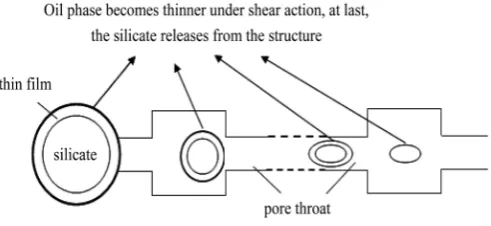
DOI: 10.4236/msce.2019.79001 7 Journal of Materials Science and Chemical Engineering formation. We can make use of microcapsules method and coat silicate through thin film, then the silicate can migrate into the deep formation. The technology will be used in the two-fluid method for profile control, dispersing one reaction solution and coating films, then spread to another reaction solution.
The plugging agent will become deformed when it passes the pore, so the film is liquid. We can use the method which prepared W1/O/W2 multiple emulsions
to generate the film. Multiple emulsions are developed as a W1/O/W2 new
sys-tem for water flooding reservoirs, and the silicate takes the action after running through two-layer coats, thereby delay release velocity of the agent. The reaction time can be controlled through adjusting the thickness and strength of coating. When the silicate migrates in the pore throat, the coating will be sheared thinner and thinner as shown in Figure 5.
[image:7.595.251.497.397.510.2]3) Combine with other measures. For instance, the chemicals huff and puff technique combined with water shutoff in oil well. First inject different huff and puff agent such as high effective oil displacement agent, viscosity reducer, de-mulsifier, inhibiter, scale inhibitor and so on, and the huff and puff agent prefe-rential access to high-permeability layers. Then inject plugging agent to oil well, and handle the huff and puff agent storage in high permeability layer. When put back on production, the water along the high permeability layers flows into the low permeability layer because of plugging agent, and the water will also bring the huff and puff agent into the low permeability layer follows as Figure 6.
DOI: 10.4236/msce.2019.79001 8 Journal of Materials Science and Chemical Engineering
Figure 6. The huff and puff technique combined with water shutoff in oil well.
[image:8.595.244.502.548.707.2]DOI: 10.4236/msce.2019.79001 9 Journal of Materials Science and Chemical Engineering 4) Grasp injection time. The blocking agents have different ability of increas-ing oil at different injection time. Some scholars proposed that when the oil yield started to decline, it is the best time to injecting blocking agent follows as Figure 7.
Conflicts of Interest
The authors declare no conflicts of interest regarding the publication of this pa-per.
References
[1] Lu, X.-G., Wang, W., Su, Y.-C., etal. (2005) An Experimental Study on Performance Properties of Swellable Granular Precrosslinked Polymer. OilfieldChemistry, 22, 324-327.
[2] Castelijins, H.J., Pel, L., Huinink, H.P. andJose Zitha, P.L. (2006) Mass Transfer and Gelation in Sandstone Cores of a Novel Water Shutoff Chemical. SPE99684-MS.
https://doi.org/10.2118/99684-MS
[3] Prado, M., Palencia, J., Reyna, M., etal. (2005) Two Different Water Shutoff Ap-plications in a Poorly Consolidated Sandstone Reservoir with Strong Waterdrive. SPE93060-MS.https://doi.org/10.2118/93060-MS
[4] Yuan, M., Yin, W.-J. (2003) Industrial Application in Large-Scale Multiple Water Plugging and Profiling Technology. Petroleum Exploration and Development, 30, 88-90.
[5] Cao, J.-K., Yang, S.-Z., Zhang, H.-Q., etal. (2002) A Research for Water Shutoff in the Bottom Water Reservoir. Petroleum Exploration and Development, 29, 80-81+88. [6] Han, D.-K. (1995) An Approach to Deep Development of High Water-Cut Oil Field
to Improve Oil Recovery. Petroleum Exploration and Development, 22, 7-55. [7] Smith, L.R., Fast, C.R. and Wagner, O.R. (1969) Development and Field Testing of
Large Volume Remedial Treatments for Gross Water Channeling. Journal of Petro-leum Technology, 21, 1015-1025.https://doi.org/10.2118/2217-PA
[8] Hering, G.D., Milloway, J.T. and Wilson, W.N. (1984) Selective Gas Shut-Off Using Sodium Silicate in the Prudoe Bay Field, AK. SPE12473, Bakersfield, CA.
[9] Vinot, B., Schechter, R.S. and Lake, L.W. (1989) Formation on Water/Soluble Sili-cate Gels by the Hydrolysis of a Diester of Dicarboxylic Acid Solublized as Micro-emulsions. SPE Reservoir Engineering, 4, 391.https://doi.org/10.2118/14236-PA
[10] Islam, M.R. and Farouq Ali, S.M. (1993) Use of Silica Gel for Improving Water-flooding Performance of Bottom-Water Reservoir. Journal of Petroleum Science and Engineering, 8, 303-313. https://doi.org/10.1016/0920-4105(93)90007-2
[11] Creel, P. and Crook, R. (1997) Gels, Monomer Solutions Fix Pinhole Casing Leaks. Oil & Gas Journal, 13, 44-46.
[12] Boreng, R. and Svendsen, O.B. (1997) Successful Water Shut-Off. A Case Study from the Strafjord Field. SPE37466, Oklahoma, OK.
https://doi.org/10.2118/37466-MS
[13] Mills, R.V.A. (1922)Process of Excluding Water from Oil and Gas Wells. US Patent No. 1421706.
[14] Hurd, C.B. (1938) Theories for Mechanism of the Setting of Silica Acid Gels. Chemi-cal Reviews, 22, 403-422. https://doi.org/10.1021/cr60073a001
DOI: 10.4236/msce.2019.79001 10 Journal of Materials Science and Chemical Engineering
[20] Nasar-El-Din, H.A., Bitar, G.E., Bou-Khamsin, F.I., Al-Mulhim, A.K. and Hsu, J. (1998) Field Application of Gelling Polymers in Saudi Arabia. SPE 39615, Tulsa, Oklahema, OK. https://doi.org/10.2118/39615-MS
[21] Pei, L.-X. (2001) Study and Application of New Inorganic Gel. Southwest Petroleum Institute, Nanchong.
[22] Bernard, G.C. and California L.M. (1970) Method for Water Flooding Heterogene-ous Petroleum Reservoirs. US Patent No. 3530937.
[23] Schmidt, A.W. and Treeman, R.B. (1975) Fluid-Powered Crimping Press. US Patent No. 3883938.
[24] Sarem, A.M. and Linda, Y. (1974) Mobility-Controlled Caustic Flood. US Patent No. 3805893.
[25] Sydansk, R.D. and Colo, L. (1981) Process for Improving Conformance and Flow Profiles in a Subterranean Formation. US Patent No. 4304301.
[26] King, J.A. and Fallgatter, W.S. (1956)Method of Increasing Oil Recovery. US Patent No. 2747670.
[27] King, J.A. and Fallgatter, W.S. (1967) Method of Increasing Oil Recovery. US Patent No. 3342262.
[28] Sandiford, B.B. (1976) Placentia Calif. Selectively Controlling the Flow of Fluids through Subterranean Formations. US Patent No. 4009755.
[29] Lawrence, D.D. and Felber, B.J. (1981) Formation Treatment with Silicate Activated Lignosulfonate Gel. US Patent No. 4257813.
[30] Zhong, Q., Zang, W. and Lu, X.-G. (2008) Performance Evaluation of Phosphorus Si-licate and Polymer Combination System. Petroleum Geology and Recovery Efficiency, 15, 63-65.
[31] Zhao, R.-B., Yue, X.-A., Xu, R.-X., etal. (2005) Properties of Water-Glass-Gel En-hanced Foam System. Journal of Jilin University (Engineering and Technology Edi-tion), 35, 572-575.