At the beginning of a new century, both the owners and managers of all organisations must be aware of the fact that, in the years to follow, all business units will be influenced by globalisation and European re-gionalisation. There is no doubt that these subjects will be fully integrated into the process of the world scientific progress which significantly influences the development of modern technologies. It is necessary to realize, that all forms of business activities will be confronted with the consequences of global competi-tion; this can be seen already now when considering the advent of foreign companies and their international expansionisms. Within the framework of the European Union, it will be necessary to take into account the impact of decision-making of supranational compa-nies, international organisations and supranational groups. Those investors who behave in a fully rational manner will look for such geographical business
environments where they will be offered important competitive advantages and safety guarantees. Such an approach will certainly result in significant changes in allocation of all resources including the human ones. It is possible that some sensitive managerial souls can be upset when speaking about Man as a “source” but – when reconsidering this approach – they can find also many positive features in it. The aim of this paper is to discuss the current progressive changes in management, importance of human resources, necessary skills and capabilities to integrate theoreti-cal principles of scientific knowledge with principles of general management and individual trends in real time and organisational environment. This means that management of human resources and knowledge management are integral parts of general manage-ment and for that reason these issues are discussed using the allegory of Bonsai management.
The Bonsai management
Teorie manažerské bonsaje
P. TOMŠÍK
Mendel University of Agriculture and Forestry, Brno, Czech Republic
Abstract: Management can be understood as a “bonsai” integrating its roots in long-term bases with the trunk of general management growing from it supporting a cultivated treetop branching out in the real time. Managers need to develop a new understanding of the management process that will respond to global trends in the world’s economy. More precisely it needs to create more progressive management styles. Management will be successful if it is based upon people’s own knowledge and their development. In addition it has to look beyond the confines of the company and even of the country and to take into account the on-going and permanent development of technology. With particular regard to technology, man should be seen as a bearer of knowledge, regarded as an investment and seen as a source of long-term profit.
Key words: management bonsai, human resources, knowledge
Abstrakt: Management přirovnáváme k „bonsaji“ neboť Manažerská bonsaj dlouhodobě integruje své kořeny a tak i rámec, kmen všeobecného managementu a na něm rozvíjenou korunu větvení v reálném čase. Management jako vědní disciplí-na musí rozvíjet nové madisciplí-nažerské premisy, které reagují disciplí-na globalizační trendy světové ekonomiky resp. k nim vytvářet progresivnější. Management bude úspěšný, když svůj rozvoj postaví na znalostech lidí a jejich rozvoji. Musí však překročit hranice podniku a dokonce i státu a vzít do úvahy i nepřetržitý vývoj technologií. Ve vztahu k technologiím chápe člověka jako nositele znalostí, chová se k němu jako k investici neboť si uvědomuje, že je zdrojem dlouhodobých zisků.
Klíčová slova: manažerská bonsaj, lidské zdroje, znalosti
MATERIAL AND METHODS
This paper is based on data published by the author earlier in several scientific journals and on results of some other authors who investigated various aspects of modern management in its complexity. Works of these authors contributed to the creation of a scien-tific framework for managerial activities and it can be said that the application of these methods under practical conditions represents de facto a certain form of art and/or creative activities that is associ-ated with the manager’s personality and dependent on his or her talent and capabilities. As examples of such methodological approaches, it is possible to mention for example the following authors: Gozora (2004), Hron (2004), Tichá (2005), Tomšík (2006), Magretta (2004), Krnínská (2002) and, especially, Drucker (2000). The methodological approach of the authors mentioned above as well as of many others can be used not only when looking for the perfec-tion in management (Peters, Waterman 1993) and solving managerial conflicts (Višňovský, Korenková 2004) but also in the field of its development as a scientific discipline.
RESULTS AND DISCUSSION
General management
Under the conditions of the contemporary turbulent world when the fact that everything is changing is the only certainty, the managers of all economic subjects must be aware of the basic idea that all managerial processes (i.e. the management per se) represent a very specialised activity that is indispensable for any well-organised entity. It can be expected that all business subjects strive to be well-organised; this concerns not only established units with a specific and routine system of operation but also new compa-nies, businesses and organisational units in general. The necessity of performing managerial activities is perceived and apprehended not only in agricul-tural enterprises, food processing units, industrial works etc. but also in hospitals, schools, museums, theatres, design studios and many other organisa-tions. The need of managerial activities is as old as the organised human society itself. Management is necessary for all groups of people who strive to reach a common goal.
The origins of management as a scientific disci-pline can be traced back to the beginning of the 20th
century when the practitioners began to define and lay down its first foundations. Though, in those days
management was perceived more as an art than as a rational, scientific discipline and its successful ap-plication was usually associated with talent, intuition, personal authority and/or charisma.
Today, however, marketing is an established inter-disciplinary scientific discipline, which uses specific methods and terminology. Today’s management uses and takes over the knowledge and ideas of many other sciences (e.g. mathematics, psychology. sociology, law, economics etc.) and transforms them into its own theory. Management does not want to replace, substitute or take over the role of other sciences. It ex-ists independently and its further development results from the activities of practical managers, professional consultants, researchers and academicians.
Regarding the aforementioned facts, it can be there-fore stated that organizing and creating of knowledge framework of management is a science and that its application under practical conditions of businesses and enterprises is an art that is directly linked up with people, i.e. with managers. This means that manag-ers are professionals who implement the managerial science, who perform managerial functions and who carry out the resulting duties.
The concept of the management development can be broadly illustrated by the means and on the base of the following seven permissions formulated by Peter Drucker (2000):
1. Management represents a specific and charac-teristic tool of each organisation. Earlier, it was understood only as the company management and this approach still survives. For that reason, it is necessary to claim that this is not true and that such an idea is wrong.
2. Instead of search for only one “right” organisa-tion, the managers must learn how to search for, develop and test organisation systems that meet the present requirements.
3. The technology and its final application is not a base for the formulation of managerial strate-gies; quite on the contrary – it is a “limitation”! This strategy must be formulated on the base of customer’s values and their decisions about the allocation of disposable resources; on the side of a company this can be formulated as follows: “All we do is controlled by you!“
in a different way in the legislature of individual national states
5. At present, limits of management and borders of national states are not identical. The sphere and the scope of management cannot be defined from the political point of view. On the contrary, this must be done from the viewpoint of division of labour. The frontiers are important above all as a limiting factor.
6. Results obtained by an institution represent the mission and the main objective of management. Management is a tool that must enable an organisa-tion to apply its results in its macroenvironment. To fulfil this task, it is necessary to organise the available resources in such a way that the set up results will be achieved.
7. People should not be controlled, people must be guided and coached: that is the task of manage-ment.
The quality and style of managerial work show a decisive influence on the formation of attitudes of employees. If the manager’s effect is positive, the employees are willing and motivated to reach the strategic objectives of the company. As far as the style of decision-making is concerned, the following styles of leadership are distinguished in the contemporary managerial practice:
(a) Authoritative style of leadership – only the manager makes decisions and sets the tasks and assigns the jobs among his/her subordinates;
(b) Democratic style of leadership – the manager involves his/her subordinates into the process of decision-making. He/she asks them for proposals how to solve individual problems, respects his/her subordinates and makes decisions on the base of an evaluation and analysis of presented proposals (problems are solved jointly and individual opin-ions are respected and taken into account); (c) Liberal style of leadership – the manager tries to
avoid decision-making whenever it is possible (and if it is possible) and lets his/her subordinates to decide independently; however, he/she does not require subordinates to cooperate and/or influence each other when making decisions (such decisions are only a little influenced by the manager and/or colleagues).
(d) Opportune style of leadership – under the present turbulent conditions, it can be optimal if the manag-er changes his/hmanag-er style of leadmanag-ership in accordance with the momentary situation within the company (they are capable of choosing such of leadership that corresponds with the current situation within the firm/company on the one hand and responses also on effects of external factors).
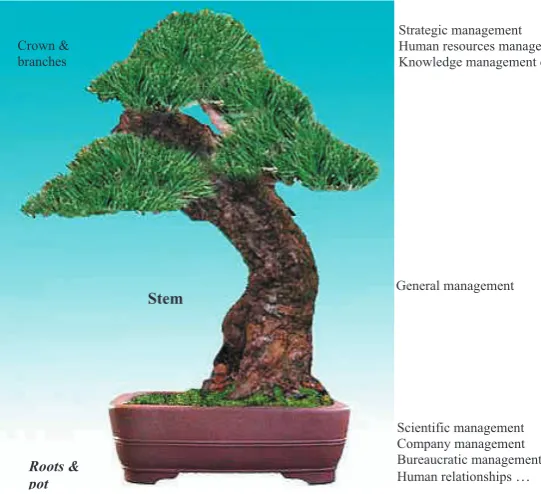
From the viewpoint of premises that are related to the management of people and take advantage of their knowledge and skills on the one hand and ex-ploit available company’s resources on the other, it is important to pay great attention to the development of human resources management (see the Crown on managerial bonsai in Figure 2).
However, if managers want to perform the functions that are mentioned in the following text, it should be mentioned that they should master the basic manage-rial skills. These involve technical skills (i.e. a good knowledge of tasks and activities of their subordi-nates), human (i.e. mental and physical) qualities, and organisational capabilities (i.e. ability to work and to deal with people, to cultivate group efforts, to support teamwork, and to create such an environ-ment, in which people feel themselves to be free and safe and are not afraid to express their personal view and opinions).
As the managers should be also visionaries, they also should be able to see problems in their general context and to think in a conceptual way. This re-quires a capability both to distinguish among indi-vidual elements of a given situation and, at the same time, to understand their mutual correlations and relationships. This conceptual capability must be introduced into the managerial practice by managers themselves because they must be able to understand mutual relationships among and the importance of individual elements under conditions of market economy (because it is an opened system, i.e. a sys-tem that really is opened to everybody). And last but not least, they also must also be able to project, i.e. to foresee and to solve problems in such a way that is beneficiary for the company and enables to reach the determined goals.
In addition to these skills, which can be mastered also by people who are not in a managerial position, a good manager must also carry out certain func-tions that enable him/her to reach the preset goals of the company. This concerns those functions that create a process. A responsible manager must be able (and not only on the level of an enterprise) to plan, organise, lead, control and deal with people in such a way that all company’s resources will be used for the sake of the fulfilment of set up goals. Together with managerial functions, these skills should enable to talented managers to carry out things in a right way and to perform their managerial tasks efficiently.
economy with it numerous links, connections, and relations that all must be taken into account. His/her business is not an island that is separated from the neighbouring world; quite on the contrary, it has many relationships and links to the market of goods and services, of capital and of labour and it is necessary to communicate with this “rest of the world” in such a way that he/she must be able to do right things and to correct his/her behaviour.
If the company’s management finds the right mar-ket opportunity (i.e. such an opportunity that can bring about the success in business activities), it is appropriate to remind some factors that character-ise prosperous companies, viz. activity, closeness to customers, autonomity and spirit of enterprise, orientation to people, efforts to increase productivity, support of activities creating company’s values and enabling its further development, simple organisation, low numbers of employees and the art to integrate management on the base of the principle of “short and long bridle” (Peters, Waterman 1993).
However, it must be remembered that human re-sources are the most critical factor of success in all forms of entrepreneurship. Only a proper choice of people and the establishment of an adequate or-ganisational structure enable to be successful when implementing any selected business strategy. Such a team is capable to accomplish permanently all set-up strategic goals and to become a long-term and the most valuable company’s resource.
Human resources management
In a company, people are performers of labour, which consists of time spent in production and/or provid-ing services. Labour activities of human resources consist of thousands and thousands of tasks, jobs, and duties that are performed at all organisational levels. In developed economies, human labour repre-sents the most common but at the same time also the most important input. As demonstrated in numerous research studies, economic results of companies are
influenced by material and human resources and the ratio between them is usually 60% : 40%. Human resources demarcate the possibilities of a company and limit the degree of utilisation of material re-sources. Human resources are of creative nature because they get material resources moving and in addition perform also some other activities such as planning, supervision, innovation, creation of new strategies etc.). Economic results of a company are determined not only by the number of employees but also by their skills and knowledge, motivation, willingness to cooperate (i.e. to use their tacit and explicit knowledge to the company’s benefit), mu-tual communication, wages and salaries, work/job satisfaction and social securities). Human resources are expensive but this expensiveness is relative and has several aspects. Unfortunately, until now the opinion that human resources are only a source of expenses/cost still predominates; the result of such approach is a tendency to neglect their importance for and contribution to company’s (productive and economic) results and this shows a significant effect on the sphere of their management. For that reason, the deciding on investments usually differs from the classical approach to the evaluation of investments. It is true that a reduction of the numbers of employ-ees improves financial results (because of reduced costs) but, on the other side, it also has a negative impact because there are for example no innovations, no marketing studies etc. Due to this neglection of negative consequences, many decisions concerning human resources may be wrong. Today it is suitable to minimise our traditional approach, according to which the employees represent only a source of ex-penses and to create conditions for such an opinion that the staff would be considered to be a source, the utilisation of which must be optimised. This non-traditional approach can be linked up with that conception of the development of human resources, which regards men and women as a source, which must be activated and developed and which also requires further investments. In this way the human factor will become the most fundamental company’s resource
Low level of knowledge & skills
Low revenues Use of obsolete
& wages technologies
Low productivity of labour
and its development will be oriented to the following three goals: (1) adequacy, which means that human resources will be appropriate to real and future needs both quantitatively and qualitatively; (2) integration, which means that the requirements of profitability will be harmonised with goals of the human factor development and (3) optimization, which means that the performance and productive capacity of human resources will be optimized in such a way that they will participate in both overall and partial objectives of a given company.
The relationships existing among the company’s performance and its human resources are illustrated in Figure 1.
This requires to change the technology and, at the same time, to increase the level of knowledge and skills, which will result in their more productive utilisation and e.g. in higher company’s incomes and wages & salaries of employees so that the interest of potential employees to work for the company will be increased as well as the concern of the existing staff to be trained and instructed. This means that the knowledge management is the base of future company’s success.
The knowledge management links up with earlier developmental stages of modern management, espe-cially with relationships:
Man × Machine;
Man × Resources and (at present) Man × Knowledge.
The objective of the last of the above relationship is to increase the productivity of talented (knowledge-able) employees and to consider them as an asset extending company’s wealth instead of perceiving the employees only as a source of costs/expenses.
The content of knowledge management involves: (a) Systematic efforts to improve the knowledge of
employees (both explicit and tacit);
(b) Thanks to these efforts, the organisation can obtain a unique competitive advantage not only as far as the numbers but also the quality (i.e. the standard of the knowledge) of experienced and “talented” employees are concerned.
(c) This care about the knowledgeable employees supports the capabilities of knowledgeable em-ployees to go beyond traditional limits of problem solutions, which can be illustrated on the example of the brain teaser called nine-point circle (Ma-gretta 2004). The task is to link up at one stroke 9 points with 4 straight lines. The traditional way of thinking tempts the majority of people to solve this problem inside a square, which is delimited by the four utmost (extreme) points. However, the correct solution requires that three of these
four straight lines must go beyond the limits of the given frame and it is just this metaphor of “thinking outside the frame”, which should be implemented by know-ledgeable employees and the task of companies is to look for ways how to motivate people with this “untraditional” thinking and how to retain them in the organisation. In this context, it should be mentioned that con-ceptional, analytical and Harvard case studies are methods enabling to develop the knowledge of people and to look for non-traditional solutions of mana-gerial problems. Case studies, as a research and/or pedagogical tool, indicate that, in its essence, the management is the art to perform and help to ap-proximate to and also to explain the multiple nature of managerial work.
CONCLUSIONS
The progressive concept of management can be illustrated by the “Bonsai Management” (Figure 2).
It means that – both at present and in the future – it is necessary return to the “roots of management”, i.e. to its classical schools. These solid, by the time checked solid roots create the basis for the existence of general management. In the managerial environment, these roots, together with a solid stem, enable either to support or limit the development of other branches of management (e.g. operative, strategic, informative, knowledge and human resources management) and to shape them, with a full respect to environmental conditions, in a right direction and into the correct form so that they can help to meet the goals of each organisation. The knowledge obtained in the course of the process of training of new branches of Bonsai Management can then reinforce the stem of general management and to find new connections with the roots. The general management, as the stem of this bonsai, can be thereafter strengthened and boosted by suitably applied premises which resulted from the response to the environment, in which the Bonsai Management exists.
When further developing the science of manage-ment, we can apply above all the method of case studies. Further, it is also possible to use some other tools, e. g. dissertation theses, grant projects, pub-lishing of scientific papers in international scientific journals, organisation of international scientific conferences and workshops and, last but not least, to support the transfer of new tendencies and trends
into the practice, i.e. to apply it both external and internal environment of business subjects and all other organisations.
REFERENCES
Drucker P.F. (2000): Výzvy managementu pro 21. sto-letí (Management Challenges for the 21st Century).
Management Press, Praha; ISBN 80-7261-021-X. Gozora V. (2004): Social and economic differentiation
of the agri-entrepreneurial subjects and regions of the Slovak Republic. Firma a konkurenční prostředí 2004. PEF MZLU, Brno, pp. 128–136; ISBN 80-7302-075-0.
Hron J. (2004): Diagnosis of business health. Agricul-tural Economics – Czech, 50 (12): 535–542. Krnínská R. (2002): Řízení lidských zdrojů v dimenzi
třetího tisíciletí (Human resources management in the dimension of the third Millennium). SPU, Nitra; ISBN 80-8069-105-3.
Magretta J. (2004): Co je to management (What man-agement is. How it works and why it is everyone’s business). Management Press, Praha; ISBN 80-7261-106-2.
Peters T.J., Waterman Jr. R.H. (1993): Hledání dokona-losti (In Search of Excellence). Svoboda-Libertas, Praha; 25-020-93, 01/17.
Tichá I. (2005): Učící se organizace (Learning Organi-sation). Alfa Publishing, Praha; ISBN 80-86851-19-2.
Strategic management Human resources management Knowledge management etc. Crown &
branches
Stem
Roots & pot
General management
Scientific management Company management Bureaucratic management
[image:6.595.66.337.68.315.2]Tomšík P. (2006): Progresivní změny v managementu (Progressive changes in management). In: Pro-gresivní změny v systémech řízení výkonnosti. Oeconomica, VŠE Praha, pp. 285–302; ISBN 80-245-1070-7.
Višňovský J., Korenková M. (2004): Možné prístupy k riešeniu konfliktních situácií v manažerskej praxi (Potential approaches to the solution of conflict situations in the managerial practice). Agricultural Economics – Czech, 50 (8): 342–344.
Arrived on 11th May 2007
Contact address: