warwick.ac.uk/lib-publications
A Thesis Submitted for the Degree of PhD at the University of Warwick
Permanent WRAP URL:
http://wrap.warwick.ac.uk/79562
Copyright and reuse:
This thesis is made available online and is protected by original copyright. Please scroll down to view the document itself.
Please refer to the repository record for this item for information to help you to cite it. Our policy information is available from the repository home page.
i
Agency Issues in Share Repurchase Programmes
by
Waqar Ahmed
Thesis
Submitted to the University of Warwick
for the degree of
Doctor of Philosophy in Finance
Warwick Business School
i
Contents
Contents ... i
List of Tables ... iii
List of Figures ... iv
Acknowledgements ... v
Declaration ... vii
Abstract ... viii
Abbreviations ... xi
Chapter 1 Introduction ... 1
1.1 Background and introduction ... 1
1.2 Executive compensation and repurchases ... 6
1.3 Language of buyback announcements ... 11
1.4 Insider trading and repurchase announcements ... 14
Chapter 2 Executive Compensation and Open Market Share Repurchases ... 20
2.1 Introduction and motivation ... 20
2.2 Background and hypotheses ... 27
2.2.1 Buyback announcements as a market signal ... 28
2.2.2 Executive compensation and buyback announcements ... 30
2.2.3 Longer-term returns and actual repurchases ... 36
2.3 Data and methodology ... 39
2.3.1 Measuring managerial incentives ... 41
2.3.2 Variables definitions ... 43
2.4 Results ... 45
2.4.1 Descriptive statistics ... 45
2.4.2 Univariate results ... 46
2.4.3 Multivariate results ... 48
2.4.4 Further tests ... 51
2.4.5 Actual repurchases ... 54
2.4.6 Investment decisions and operating performance ... 55
2.5 Conclusion ... 55
Chapter 3 How Informative is the Language of Buyback Announcements? ... 69
3.1 Introduction ... 69
3.2 Related literature ... 73
ii
3.3.1 Variables definitions ... 85
3.3.2 Summary statistics ... 90
3.4 Results ... 91
3.4.1 Firm characteristics, disclosure tone and returns ... 94
3.4.2 Tone and short term returns ... 96
3.4.3 Tone and long term returns ... 99
3.4.4 Tone and actual repurchases ... 100
3.5 Conclusion ... 101
Chapter 4 Insider Trading and Open Market Share Repurchases ... 114
4.1 Introduction ... 114
4.2 Background ... 120
4.3 Data and summary statistics ... 123
4.4 Results ... 128
4.4.1 Pre-announcement trades and short-term returns ... 128
4.4.2 Post-announcement insider trades... 131
4.5 Conclusion ... 139
Chapter 5 Conclusion ... 152
5.1 Concluding Remarks ... 152
5.2 Further work ... 155
Appendix ... 157
Appendix I ... 157
Appendix II ... 159
iii
List of Tables
Table 2.1: Sample selection ... 58
Table 2.2: Descriptive statistics of share repurchasing firms ... 58
Table 2.3: Descriptive statistics of returns, CEO wealth sensitivity measures and firm characteristic ... 59
Table 2.4: Correlation Analysis of announcement returns and the executive compensation sensitivity measures. ... 61
Table 2.5: Mean short-term and longer-term returns by vega and delta quintiles ... 62
Table 2.6: Effect of executive compensation on short-term returns ... 63
Table 2.7: Effect of executive compensation on long-term returns ... 64
Table 2.8: Effect of executive compensation arrangements on short-term returns ... 65
Table 2.9: The effect of executive compensation on longer-term returns calculated using Carhart’s 4-factor model ... 66
Table 2.10: Effect of executive compensation on actual share repurchases. ... 67
Table 2.11: Effect of executive compensation on post-announcement investments and operating performance ... 68
Table 3.1: Descriptive statistics of share buyback announcements ... 104
Table 3.2: Summary statistics ... 105
Table 3.3: Stated Motives, their relative frequency and returns ... 107
Table 3.4: Announcement and long-run returns by other news type ... 108
Table 3.5: Determinants of buyback announcement returns... 109
Table 3.6: Effect of disclosure tone on short-term returns ... 110
Table 3.7: Determinants of long-term returns ... 112
Table 3.8: Actual repurchases tobit regressions ... 113
Table 4.1: Distribution of repurchase announcements by year and industry ... 141
Table 4.2: Summary statistics of key variables ... 143
Table 4.3: Pre-announcement net insider sales and returns ... 145
Table 4.4: Announcement returns and pre-announcement insider trades ... 146
Table 4.5: Difference between pre- and post-announcement insider trades ... 147
Table 4.6: Post-announcement insider trades in subsamples ... 148
Table 4.7: Two-way sorted subsamples for repurchase announcing firms ... 149
iv
List of Figures
v
Acknowledgements
It is a great pleasure for me to thank all those who supported me during my
doctoral training and in the completion of my Ph.D. thesis. It has been a
demanding and an intellectual endeavour that tested my nerves, patience and
perseverance. Let me begin by thanking my creator for His countless blessings
and enabling me to earn my doctorate degree in the given time. Here, I heartily
thank my Ph.D. supervisors; Professor Richard Taffler and Professor Alok
Kumar, whose guidance, encouragement and constant support made it possible
for me to complete this academic and personal journey of learning and
development. I am especially indebted to Professor Taffler for his
overwhelming support and encouragement. He extended advice, compassion
and hope in times when most needed.
I am extremely grateful to my parents and siblings for their constant
moral support and prayers. Whatever I am today is because of my loving
parents. My every accomplishment in life is because of their constant support
and confidence in me. I owe everything to them. During my Ph.D., I got
married to my wonderful wife whose support, love and companionship was a
source of comfort throughout the Ph.D. programme. Almost a year and half
ago, our beloved son, Arham Arshman Ahmed, joined us. He made our lives
more meaningful and joyous.
I am thankful to Warwick Business School for providing me with the
opportunity to teach at the undergraduate and postgraduate levels. I developed
my teaching skills by following great examples set by Dr. Peter Corvi, Dr.
April Klein and my supervisors as exceptional and passionate teachers.
Learning from their experience has not only helped me with my teaching roles
at Warwick as a postgraduate tutor but also paved the way in securing a full
vi
I am also grateful to finance and accounting group faculty members for
their support and helpful suggestions on my research. I especially want to
thank Dr. Alessandro Palandari, Dr. Jana Fidrmuc, Dr. April Klein, Dr. Onur
Tosun, Dr. Olga Lebedeva and Dr. Zulfiqar Shah for stimulating discussions
and guidance. I would like to thank conference participants, at the 2015 FMA
European doctoral consortium in Venice, FMA annual meeting in Orlando,
corporate finance conferences at Manchester and Oxford and few others where
I presented my research, for their constructive comments. Here, I especially
want to acknowledge helpful comments from Professor Stephen Brown (New
York University), Professor Sheridan Titman (University of Texas), Professor
Steve Young (Lancaster University), Professor David Oesch (University of
Zurich) and Dr. Asad Kausar (Nanyang Business School)
I gratefully acknowledge financial support for my Ph.D. from Warwick
Business School. The scholarship has supported me throughout the duration of
my doctoral studies. Professor Michael Moore has also provided generous
financial support for conference presentations. I thank doctoral office, finance
group office and IT services team for making things work smoothly for
doctoral students. I am thankful to my colleagues for making my Warwick
experience more joyous; especial thanks to my office-mates with whom I have
shared some unforgettable moments. Lastly, I am extremely grateful to my
Ph.D. thesis examiners; Professor Edward Lee and Dr. Chendi Zhang, for their
detailed discussion and helpful comments on my doctoral thesis.
vii
Declaration
I declare that this thesis is my own work and any material from this thesis has
not been submitted for the award of any other degree to any University. I have
presented Chapter two of this thesis titled “Executive compensation and open
market share repurchases” in different national and international conferences
and received many helpful comments. The paper has particularly benefitted
from insightful comments from Dr. Steve Young (Lancaster University, UK)
and Dr. Timothy Burch (University of Miami, USA). Professor Richard Taffler
has spent countless hours with me to polish the work presented in this thesis.
List of conferences where I presented my research from this thesis is provided
below
2015 FMA Annual Meeting, Orlando, USA (Oct. 2015)
IFABS 2015 Oxford Conference, Said Business School, UK (Sep. 2015)
4th Annual Corporate Finance Conference, Manchester, UK (Sep. 2015)
PhD Conference in Monetary and Financial Economics, Bristol, UK (Jun. 2015)
Young Finance Scholars’ Conference, University of Sussex, UK (Jun. 2015)
PG Conference in applied linguistics, University of Warwick, UK (Jun. 2015)
June 10-12, 2015. FMA European doctoral consortium, Venice, Italy (Jun. 2015)
Annual British Accounting and Finance Association (BAFA) Conference, Manchester, UK (Mar. 2015)
XI NIPE Summer School, Universidade do Minho, Braga, Portugal (Jul. 2014)
Young Finance Scholars’ Conference, University of Sussex, Brighton, UK (May. 2014)
viii
Abstract
The corporate finance literature generally views open market share repurchase
announcements as a signal of equity undervaluation. Managers also frequently
cite undervaluation as a rationale for their decision to repurchase firm equity.
However, such an announcement cannot necessarily be viewed as a strong
signal of firm undervaluation as it lacks characteristics of a credible signal.
Firstly, managers are increasingly relying on share repurchases as a mechanism
for distributing cash to shareholders. Secondly, open market buyback
announcements are not binding obligation on the part of firm management to
complete. In addition, such programmes have a positive effect on executive
compensation, so managers can also employ these opportunistically to
accumulate personal wealth at the expense of shareholders. Thus, buyback
announcements can be either value signalling or agency driven. Since these
two theories (agency vs signalling) are not mutually exclusive and a pure ex
ante measure of managerial intent does not exist, the challenge is to distinguish
value signalling announcements from “cosmetic” ones.
My thesis consists of three papers (chapters 2-4). In my first paper, I
test whether the market distinguishes between agency driven and value
signalling open market share buybacks by observing the underlying managerial
wealth and repurchase incentives. In theory, better convergence between the
executive and shareholder wealth interests and risk preferences should lower
agency costs thus increasing the “perceived” credibility of managements’
buyback announcements (signals). My results suggest that executive
compensation arrangements play an important role in explaining the market
reaction to, and actual share repurchase decisions of, firms that announce
buyback programmes. This study makes an original contribution to the
literature by demonstrating that investors approximate the value signalling
effect of a buyback announcement by observing the underlying managerial
ix
My second paper addresses the open market buyback announcement
credibility issue directly by capitalising on the soft information conveyed in
such announcements. This is novel to the literature on share buybacks. Recent
studies show that news disclosure tone affects investor reaction to an
information event. In my study, I demonstrate that the disclosure tone of
buyback press releases contains value relevant information and has significant
explanatory power for short term announcement returns. The hand collected
data I use in this chapter also allows me to explore other aspects of buyback
announcements where the extant literature is limited.
In my third paper, I analyse insider trading behaviour around buyback
announcements. The key insight of this paper is to infer insiders’ private
information about firm value by observing their trading behaviour around the
repurchase announcement event. Insiders add credibility to the (repurchase)
undervaluation signal by trading parallel to their signal (i.e., purchasing more
or selling fewer shares in advance of the repurchase announcement). However,
insiders seeking to time the market (cash out at a higher price) will sell more
shares post-announcement. My analysis shows that, consistent with the
undervaluation signalling argument, investors respond more positively to
buyback announcements where insiders buy more or sell less equity before the
announcement event. However, I also document that insiders sell more shares
(time the market) in the first 3-months post-announcement. This is especially
true for firms that are less (more) likely to be undervalued (overvalued) and for
smaller firms that present the greatest potential for gain through insider trading.
My results suggest that net insider sales are significantly positively related to
repurchase announcement returns. Finally, I show that higher
post-announcement net insider sales are slightly negatively related to longer-term
returns suggesting such firms do not out perform in the long-run.
My research adds significantly to the literature on share buybacks by
x
finds that the market is conscious of the managerial incentives attached to
repurchase programmes and the potential for their opportunistic use. Investor
reaction to repurchase programme announcements is sensitive to executive
compensation arrangements, the information content and disclosure tone of
buyback announcement press releases and insider trading behaviour. This study
seeks to add to our understanding of share buybacks and how the market treats
and reacts to these announcements. The market realises that managements’
promises to spend billions of dollars on share repurchases may not necessarily
add to shareholders’ wealth. Repurchase announcements cannot be uniformly
viewed as a signal of equity undervaluation; insiders also use such programmes
for personal gains. In summary, my research highlights novel factors that
xi
Abbreviations
AR Abnormal Return
B/M Book-to-Market ratio
BHAAR Buy and Hold Annual Abnormal Return
BHAR Buy and Hold Abnormal Return
CA Current Assets
CAPEX Capital Expenditures
CAR Cumulative Abnormal Return
CEO Chief Executive Officer
CF Cash Flows
Coeff. Coefficient
CRSP Center for Research in Stock Prices
DA Discretionary Accruals
DIV Dividends
DJNS Dow Jones News Service
EPS Earnings Per Share
FLS Forward Looking Statement
HML High Minus Low
KZ Kaplan and Zingales financial constraints index
Lev Leverage
M&A Mergers and Acquisitions
MD&A Management Discussion and Analysis
MV Market Value
NDA Non Discretionary Accruals
OMSR Open Market Share Repurchase
OMSRs Open Market Share Repurchase programmes
Rmt - Rft Market return minus Risk free rate
ROA Return on Assets
xii
S.D Standard deviation
SDC Security Data Company
SEC Security and Exchange Commission
SMB Small Minus Big
TA Total Assets
Tobin's Q Market value to book value ratio
UMD Up Minus Down
1
Chapter 1
Introduction
1.1
Background and introduction
An ideal market provides resource allocation signals and investors can choose
among securities that represent ownership of firms’ activities. Thus capital
markets have the key role of resource allocation and distribution of firms’
ownership rights in an economy (Fama (1970)). So an efficient capital market,
in which prices reflect fundamental values, will by implication result in
efficient resource allocation in an economy (Ahmed (2010)). However,
information asymmetry among market participants can cause stock prices to
deviate from fundamental value. Managers are particularly sensitive to stock
undervaluation and often try to correct it by sending “credible” signals to the
market.
The last couple of decades have witnessed a remarkable increase in
stock repurchase programmes. Managers are increasingly relying on share
repurchase announcements which are generally viewed as a signal of equity
undervaluation and/or managerial optimism about firm prospects. According to
Ikenberry et al. (1995) corporations now distribute a greater portion of their
earnings to shareholders by repurchasing their own stock (see also Grullon and
Michaely (2002)).1 As a result of increasing popularity of repurchase
programmes and the amount of money involved in these, the topic has attracted
enormous attention from academic researchers and business analysts alike.
Let us begin with the definition of share repurchases and share
repurchase announcements followed by a discussion of what these actually
represent.
1 “Corporate buybacks have been surging since the financial crisis, with S&P 500 companies
2
Stock buyback or share repurchaseis an act of a company to purchase
its own shares from the market either by tender offer, Dutch auction or by open
market operation.
Share repurchases result in reduction of outstanding share capital by
distributing cash to selling equity holders. Thus, share repurchases can be seen
as the reverse of (secondary) equity issues – where companies issue shares and
raise capital. Out of the three repurchase methods, open market share buybacks
is the most common method of repurchasing shares (Grullon and Ikenberry
(2000)). Such repurchase programmes provide managers with the greatest
flexibility and hence are preferred by executives.2 As a result I focus on open
market repurchase programmes.
Share repurchase (buyback) announcements represent simple
authorizations by the company’s board to its management to repurchase a
certain amount of the firm’s outstanding equity from the market over a given
time period.3
Thus repurchase announcements represent managerial intention to
repurchase shares and not actual repurchases. Generally, the market reacts
positively to such repurchase announcements and announcing firms experience
significant positive abnormal returns around the announcement date. In the
academic literature as well as in actual share repurchase announcements
several reasons are mentioned as to why firms may engage in share repurchase
activity. Most of the academic research on buybacks has focused on identifying
2 More than ninety percent of all repurchase programmes rely on open market operations for
their implementation.
3
For example, Applied Material, on April 26, 2015, issued the following press release about its share repurchase intentions.
“Applied Materials, Inc. (NASDAQ: AMAT) today announced that its Board of Directors has approved a new share repurchase program authorizing up to $3 billion in repurchases over the next three years beginning in the third quarter of fiscal 2015.
3
the source(s) of gain in firm value as a result of share repurchase
announcements.
The corporate finance literature regards repurchase announcements as a
managerial signal of equity undervaluation assuming managers will only
repurchase shares when they believe their stock to be trading below its fair
value. Brav et al. (2005) document that the primary reason cited by US
corporate executives for their decision to repurchase shares is, in fact, stock
undervaluation.4 Vermaelen (1981) and Comment and Jarrell (1991) explain
positive abnormal returns associated with share repurchase announcement as a
market response to executives’ undervaluation signals. Ikenberry et al. (1995),
Ikenberry et al. (2000) and Peyer and Vermaelen (2009) further show that
undervalued firms that announce a repurchase programme earn significant
abnormal returns on announcement and also outperform in the long-run.
However, recent data shows that managers may not necessarily use
repurchases to take advantage of low stock prices. Waggoner (2015) claims
that companies are not particularly good at timing the market. He highlights
that firms repurchased the highest number of shares in 2007 when the market
was at its peak, and the least number of shares were purchased in 2009 when
the market was bearish. Thus, undervaluation is not the sole reason behind
managements’ decision to initiate a repurchase programme. Repurchases can
be initiated for several other reasons. For example, as an alternative to
dividends and a tax efficient way of distributing cash to shareholder (Allen et
al. (2000); Fatemi and Bildik (2012); Grullon and Michaely (2002)), to alter
capital structure (Masulis (1980); Skinner (2008)), to manage earnings (Hribar
et al. (2006); Gong et al. (2008); Young and Yang (2011)), to prevent dilution
4“Time Warner may favor a share repurchase rather than an increase of its dividend because
the stock is “a bargain”…..”by Rabil (2009, Feb. 3) in Bloomberg
4
and/or fund employee stock grants and options (Jolls (1998); Kahle (2002);
Bens et al. (2003)).
More recent studies have focused on the credibility of open market
repurchase announcements as a managerial signal of stock undervaluation.
Open market repurchase announcements are simple authorizations and not
binding obligations on firms’ management and hence do not send a strong
signal of equity undervaluation. Stephens and Weisbach (1998) show that not
all firms complete their announced repurchase programmes. In fact, some firms
do not repurchase a single share post-announcement. Chan et al. (2010) argue
that minimum regulatory and disclosure requirements in the US around actual
buybacks also facilitate mimicking behaviour from other firms. US presidential
candidate Hillary Clinton has also recently called for more timely disclosure on
share repurchases (Whitehouse (2015, Oct. 16)). Vermaelen (1981) compares
the relative signalling power of repurchase tender offers, Dutch auctions and
open market repurchases and concludes that the latter is considered to be the
least effective tool to signal undervaluation.
Fried (2001) theoretically argues that open market repurchase
announcements serve managerial interests and presents his alternative
hypothesis of “managerial opportunism”. He argues that managers use
repurchase programmes to maximise their personal wealth instead of signaling
value to investors. Executive compensation is often linked to firms’ earnings
per share and stock price performance, which are positively affected by share
buybacks.5 Fenn and Liang (2001), Massa et al. (2007), Louis and White
(2007) and Chan et al. (2010) provide evidence that repurchase programmes
are used opportunistically or at least “cosmetically” by managers to mislead
investors. Thus buyback announcements can be value signalling or agency
5“Executives are compensated [based] on EPS, the primary reason they do buybacks.”
by Murphy and Kester (2014, Oct. 29) in The Wall Street Journal
5
driven. So, how credibly a share buyback announcement signals firm
undervaluation represents an empirical question.
Open market share repurchase announcements thus represent a special
case that can either be viewed as value signalling or misleading (agency
driven). This thesis studies open market repurchase announcements in the
context of agency issues associated with such announcements. It is important to
note that in this thesis I refer to agency issues as in the traditional agency
theory where a conflict of interest results from separation of ownership and
control. By agency driven repurchases I mean repurchase programmes initiated
by firm management in their self-interests rather than creating value for
shareholders. This differs from agency theory of free cash flows where a
repurchase programme announcement is, in fact, a positive news for
shareholders. Shareholders of cash rich firms with poor investment
opportunities benefit from repurchase activity as it reduces the amount of cash
available to managers for empire building and other unproductive uses.
Specifically, in chapter 2 and 3, I explore factors that can influence
investors’ perception about the strength of repurchase announcement as a value
signalling mechanism and more importantly if these factors can explain
differences in market reaction to the share buyback “signal”. In chapter 4, by
analyzing insider trades around the repurchase announcement event, I
empirically explore the possibility of managers timing the market by exploiting
share repurchase announcements. My final chapter, chapter 5 concludes the
thesis and highlights areas of further research/work.
Each of my empirical chapter employs US data and is compiled from
different data sources. Chapter 2 covers repurchase announcements of S&P
1500 firms between 1992 and 2008. Executive compensation data is available
from 1992 onwards. The data period ends in 2008 to allow calculation of
long-term returns up to 4 years post-announcement. In chapter 3, I work with sample
6
study requires hand collected data and is run on a relatively small data sample
due to the nature of data collection process and the time constraints of WBS
doctoral programme. I will significantly increase the sample size to make it
consistent with existing literature when revising chapter 3 for publication.
Chapter 4 is my final empirical chapter of this thesis and thus includes more
recent data on repurchase announcement as well. This chapter includes
repurchase programmes announced between 1990 and 2012. The next
subsections summarise each chapter of this thesis.
1.2
Executive compensation and repurchases
In chapter 2, I investigate the relationship between executive compensation
arrangements and stock market reaction to repurchase announcements and also
their impact on actual repurchases post-announcement. In theory, an efficient
market should be able to differentiate between value signalling and “cosmetic”
repurchase announcements. However, since an ex-ante measure of managerial
intent does not exist, investors have to rely on noisy proxies to approximate the
credibility of a buyback announcement as value signalling. In this chapter, I
explore how investors view and react to an open market share repurchase
announcement given executive compensation arrangements. Specifically, I test
whether the market distinguishes between value signalling and agency driven
or “cosmetic” repurchase announcements by observing the underlying
managerial wealth and repurchase incentives. I expect that differences in
degree of agency issues (incentive alignment between the executive and
shareholders) among repurchasing firms can explain variations in stock price
reaction to firms’ repurchase announcements and also actual repurchase
decisions post-announcement.
I conjecture that if the executive compensation package is structured in
a way that reduces agency issues then a repurchase announcement from such
7
interests diverge, such firm announcements may provide less value relevant
information and outside investors may become increasingly suspicious of
these. Thus, the market reaction to repurchase announcements will be stronger
for firms with better incentive alignment between executives and shareholders.
My study focuses on share-based compensation component of the
CEO’s remuneration package as this is argued to be highly effective in
reducing agency issues (e.g., Jensen and Meckling (1976)). To estimate
managerial wealth incentives and risk preferences, I use delta and vega
measures following Core and Guay (2001) and Coles et al. (2006). Delta
represents sensitivity of CEO wealth to share price. Chava and Purnanandam
(2010) argue that in equilibrium an optimal level of delta aligns executive
wealth incentives with those of shareholders as managers share gains and
losses with shareholders. So, higher delta values should reduce agency costs
and any signal by such a manager should be considered as value signalling in
relative terms. Percentage of CEO firm equity ownership is also used to
capture the immediate effect of repurchase announcement on CEO wealth.6
Vega measures sensitivity of CEO wealth to stock return volatility.
Executives with higher vega have an incentive to increase firm risk, whereas
shareholders are regarded as risk neutral in theory. Although shareholders may
not necessarily dislike risk as long as firm value increases, excessive risk can
result in lower firm value due to the higher discount rate used in evaluating
expected cash flows. On the other hand, in theory, managers have nothing to
lose, and in fact all to gain, as the value of their stock options increases with
higher stock return volatility. So, the market should respond more
circumspectly to an announcement made by an executive with higher vega.
Nonetheless, endogeneity of compensation schemes can be of some
concern. If compensation contracts were perfectly designed then delta and vega
measures might be of little use in estimating the severity of agency problems. If
6
8
this were the case then the coefficients on these variables would be
insignificantly different from zero in empirical tests. However, my empirical
tests show that this is not the case. Literature on executive compensation
arrangements also suggests that compensation contracts are less than perfectly
designed (see e.g. Morck et al. (1988); Crystal (1991) and Jensen (1993)).7
Lastly, to alleviate some of the endogeneity concerns I use lagged values of
compensation arrangement variables in all of my regression model
specifications.
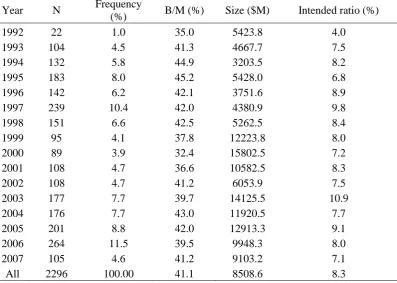
I test my predictions using a sample of 2,296 unique share repurchase
announcements made by Standard and Poor’s (S&P) 1500 firms between 1992
and 2008. My results show that a novel relationship exists between executive
compensation arrangements and the “perceived” credibility of share buyback
announcements as value signalling. The market approximates the credibility of
a buyback announcement (as value signalling) by observing the underlying
managerial wealth and repurchase incentives. In particular, I find that the
executive compensation arrangements can explain both the market reaction to,
and actual repurchase decisions of, firms after the repurchase announcement.
Short-term repurchase announcement returns are significantly positively
(negatively) related to percentage of CEO equity holdings (vega). Longer-term
annual buy-and-hold returns are also significantly positively (negatively)
related to sensitivity of CEO wealth to stock price (volatility).
Mean three day return (-1, 1) around the share buyback announcement
is 2.14% for firms in the lowest vega quintile (1) compared with only 0.86%
for firms in the highest vega quintile (5). Similarly, average annual
buy-and-hold abnormal return for firms in quintile 1 is 5.47% as compared with only
2.82% for firms in quintile 5. This univariate result suggests that the market
does respond more circumspectly to buyback announcements where CEO
7 Core et al. (2003) provide an excellent review of the executive compensation literature.
9
wealth increases with increase in firm risk. However, a parallel return pattern is
not so obvious in delta sorted quintiles.
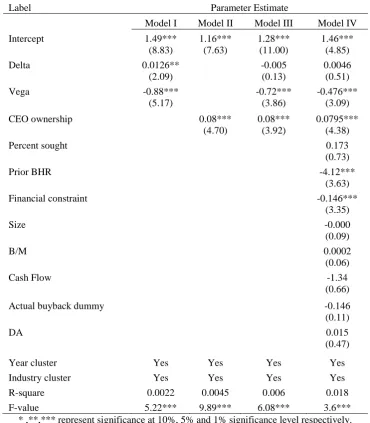
Multivariate regression results also indicate that short-term
announcement returns are significantly negatively (positively) related to CEO
wealth sensitivity to stock return volatility (percentage of CEO equity
ownership). In further tests, I show that short-term returns are positively related
to a compensation dummy variable that represents better incentive alignment
and/or lower agency concerns.8 The relationship between compensation
dummy variable and short-term announcement returns is positive and highly
significant suggesting that the market reacts more favourably to repurchase
announcements where executive wealth incentives are better aligned with those
of shareholders. The coefficients on the separate interactions of compensation
dummy with proxies of information asymmetry and undervaluation are more
positive and highly significant. This indicates that investors react more strongly
to buyback announcements from CEOs with better incentive alignment when
the firm is more likely to be undervalued or when firms suffer from higher
information asymmetry
Consistent with Ikenberry et al. (1995) and Peyer and Vermaelen
(2009) I find that the market under reacts to the repurchase signal and such
firms earn abnormal returns over the next three years. Longer-term returns of
repurchase announcing firms are also positively (negatively) related to CEO
wealth sensitivity to stock price (volatility). However, incentive alignment
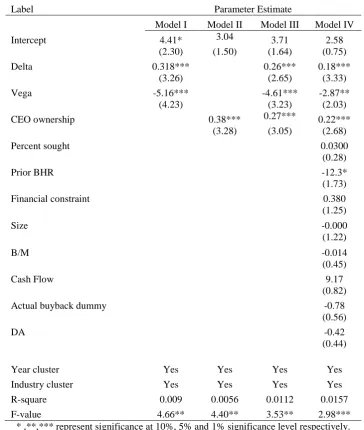
variables have opposite signs when regressed against actual repurchases as a
dependant variable. Firms that initiate repurchase programmes for
undervaluation reasons will have a lower incentive to repurchase shares when
announcement returns are high and mispricing is eliminated. Higher
post-announcement returns also make actual repurchases more costly and thus can
justify the positive (negative) relationship between repurchase rates and CEO
8 The compensation dummy represents a combination of three incentive alignment variables,
10
wealth sensitivity to volatility (stock price). Executives with higher wealth
sensitivity to volatility are also more likely to repurchase a greater number of
shares due to the fact that actual repurchases increase firm risk.
As a further test, I explore the relationship between executive
compensation arrangements and firm investment behaviour and operating
performance. Coles et al. (2006) show that managerial compensation
arrangements affect firms’ investment policy. Higher CEO wealth sensitivity to
volatility encourages managers to cut capital expenditure and invest in more
risky projects resulting in lower operating returns. CEOs with higher equity
ownership tend to invest more in capital expenditure and deliver better
operating performance. Consistent with this, I find that higher sensitivity of
CEO wealth to stock volatility is negatively related to average annual capital
expenditure and post-announcement operating performance. However,
percentage of CEO share ownership is positively related to investment
decisions and operating returns. These findings are also in line with prior
literature on executive compensation and firm policy and provide further
evidence on why firms with higher CEO wealth sensitivity to stock price
(volatility) should earn higher (lower) abnormal returns and repurchase fewer
(more) shares post-announcement.
The chapter contributes to the growing literature addressing the
credibility of open market share repurchase announcements as a signal of firm
undervaluation. For example, Chan et al. (2010) use earnings quality as a
measure of managerial propensity to mislead investors using share repurchase
announcements. Chang et al. (2010) and Bonaimé (2012) show that investors
draw upon their prior experience of firm repurchases while reacting to their
subsequent share repurchase announcements. Chen and Wang (2012) show that
the market reacts more sceptically to repurchase announcements of financially
constrained firms as they are more likely to under invest and become less
11
The empirical research study described in this chapter makes an
original contribution to the literature on share buybacks and executive
compensation. It establishes a link between executive compensation
arrangements and the “perceived” credibility of share buyback announcement
as a signal of equity undervaluation. My analysis suggests that not all buyback
announcements are regarded “as equal”. Executive compensation arrangements
play an important role in determining how the market perceives and reacts to a
share buyback announcement. Thus, executive compensation arrangements is
value relevant information and can explain short-term and longer-term returns
as well as actual repurchase rates of firms that announce a repurchase
programme. Executives make investment and operating choices based on their
compensation/incentives which affect firm risk and performance. The market
appears to understand underlying managerial wealth and repurchase incentives
and acts accordingly.
1.3
Language of buyback announcements
Corporations disclose material information to investors through a variety of
methods including corporate announcements. One such announcement is about
the firm’s intention to repurchase shares through open market operations. In
chapter 3, I analyse actual repurchase announcements to explore if the narrative
disclosure tone of repurchase announcement press releases can help in
explaining investor reaction to the repurchase announcement.
A number of recent studies highlight the importance of qualitative data
in enhancing our understanding of financial markets. For example, Tetlock et
al. (2008) suggest that linguistic media content captures otherwise
hard-to-quantify aspects of firm fundamentals. They show that simple quantitative
measures of language derived from firm-specific news can predict firms’
earnings and stock returns. The objective here is to lever qualitative
disclosures of share repurchase announcements to analyse if these are value
12
Here, I conjuncture that managers with real good news may use more
optimistic (positive) language to distinguish themselves from others.9 By
resorting to more positive disclosure tone managers expose themselves to
higher litigation risk (see for example, Francis et al. (1994); Rogers et al.
(2011)). The additional litigation risk may add credibility to their repurchase
announcement as value signaling. Using a content analysis approach, I
investigate if the language of share repurchase announcement news is value
relevant information for investors. More specifically, I examine the effect of
share repurchase announcement disclosure tone on short-term announcement
returns, longer-term returns and actual repurchase decisions of firms that
announce a repurchase programme.
The data for the study is hand collected and allows me to investigate
several interesting aspects of share repurchase programmes. Peyer and
Vermaelen (2009) and Bonaimé (2012) show that the stated motive of
repurchase programmes is value relevant information for investors. Thus I
classify repurchase announcements according to their stated motive(s). In
addition, I collect information on any other material information that may
accompany a repurchase announcement such as earnings, mergers and
acquisitions or recent stock performance news etc. I broadly classify these
either as good news or bad news.
This chapter contributes to the existing literature in several ways. First,
it introduces a qualitative perspective into the literature on share repurchases. It
is the first research study to the best of my knowledge that analyses disclosure
tone of repurchase announcements. My results suggest that the narrative
disclosure tone of repurchase announcements is significantly positively related
to short-term announcement returns. Thus, the market reacts more favourably
to repurchase announcements with more optimistic disclosure tone. Mean three
day (-1, 1) difference in returns of firms in the highest and the lowest ranked
9
13
groups by disclosure tone is 1.71% and is highly significant at the 1% level.
This suggests that investors regard positive repurchase announcement
disclosure tone as a proxy for managerial optimism about their firm’s prospects
and react more strongly.
New information (signals) might be more value relevant for firms
suffering a higher degree of information asymmetry. Following Bonaimé
(2012), I measure degree of information asymmetry by firm size and find that
the impact of positive tone is more pronounced for small firms. Initial market
reaction to positive tone is also stronger for firms with more growth
opportunities (low Book-to-Market ratio) as compared to value firms. Mercer
(2004) shows that the presence of numeric terms and numeric precision
increases the credibility of management disclosure. The impact of positive tone
of buyback announcement news is further enhanced by the presence of a higher
number of numeric terms in the repurchase announcement. However, I observe
no link between narrative disclosure tone and actual repurchases
post-announcement and the longer-term abnormal returns of firms that announce a
share repurchase programme.
Second, chapter 3 contributes to the existing literature by allowing a
better understanding of the stated objectives of repurchase programmes, their
relative frequency, the market reaction to such repurchase announcements and
also in terms of their actual completion rates and long-run performance. As
expected, the initial announcement return is highest for firms that announce
repurchase programmes citing stock undervaluation as the motive. Mean 3-day
cumulative abnormal return around the repurchase announcement event is
1.11% significant at the 5% level. However, the announcement return is
negative for firms that repurchase for legal reasons. More interestingly, firms
that do not state any reason in their repurchase announcement earn positive
abnormal returns both in the short term and long term which are significant at
conventional levels as compared to firms that repurchase for reasons other than
14
why do these latter firms state a reason for their repurchase programme when
this is associated with under-performance compared to those who simply
announce a repurchase programme without mentioning any reason for their
intention to repurchase stock? This study highlights the importance of
discretionary disclosure options for managers in relation to share repurchases
and their impact on firm valuation.
Finally, my hand collected data allows me to analyse other aspects of
share repurchase announcements. For example, I analyse the relative frequency
of other news mentioned in share repurchase announcements, its nature and
impact on the market reaction to the buyback announcement event. Descriptive
statistical analysis is provided in the chapter.
1.4
Insider trading and repurchase announcements
Chapter 4 tests if insiders employ repurchase programmes for their own
personal benefit by looking at insider trades taking place around repurchase
announcements. Specifically, I test the relationship between pre- and
post-announcement insider trades and returns of firms that announce a repurchase
programme. Open market share repurchase announcements do not send a very
strong signal of firm under-pricing for reasons mentioned earlier in this
chapter. Investors may also discount the open market repurchase
announcement “signal” as managers’ personal wealth incentives may lead them
to announce such programmes. In fact, in this context, Fried (2001; 2005) also
claims that open market repurchase announcements reflect opportunistic
managerial behaviour rather than serving as a signal of equity undervaluation.
Consistent with this, Edmans et al. (2014) show that managers strategically
time the disclosure of positive news (in months in which their equity vests), so
that they can cash out at a higher stock price.
In this chapter I analyse insider trades around open market repurchase
announcements to infer insiders’ private information about firm value. The
15
announcement will be a more credible signal of undervaluation when it is
supported by insiders actions. Insiders who buy more (or sell less) stock in
their firm, in advance of the repurchase announcement, signal that they believe
their stock to be under-priced. Holding additional own firm equity is costly and
exposes already undiversified insiders to considerable risk. This is particularly
true if the stock is overpriced. So, investors should take into account
pre-announcement insider trades in evaluating repurchase pre-announcements and
respond accordingly. Second, there is also a possibility that insiders announce a
repurchase programme to cash out at a higher price rather than to signal equity
undervaluation (Fried (2005)).10 Such insiders are more likely to sell after the
repurchase announcement is made. Post-announcement sales will be
particularly beneficial for insiders when announcement returns are high. So,
post-announcement insider sales will be higher when repurchase announcement
returns are high.
Seyhun (1998) and Lakonishok and Lee (2001) show that insiders can
predict long-run price performance in the case of small firms for up to two
years. They show that smaller firms are more likely to be mispriced and
insiders can profitably trade in smaller firms as these present the greatest
potential of gains from insider trading. Finally, insiders will sell more of the
stock they own in their firm when they believe it to be either over-priced or at
least not significantly under-priced. Thus such post-announcement insider sales
also signal insiders private information about the firm’s true value. So, firms
where insiders sell more shares post-announcement should not outperform or
underperform in the long-run as compared to other repurchase announcing
firms. Therefore, I expect post-announcement net insider sales to be either
unrelated or negatively related to long-term firm performance.
10 Fried (2001) suggests that repurchase announcements can be used as a false signalling device
16
I test these predictions using a sample of 8,945 open market repurchase
programmes announced between 1990 and 2012. I find that the market reacts
more positively to repurchase announcements where insiders’ net sales are
lower (buy more or sell less) in the pre-announcement period. Firms with lower
net insider sales earn an average 3-day buy-and-hold abnormal return of 2.4
percent, 0.80 percent greater than firms where insider net sales are higher
before the repurchase announcement, with difference highly significant at
conventional levels. However, pre-announcement trades affect only short-term
announcement returns; I find that the difference in longer-term returns of the
two groups is not statistically significant.
In line with the insider signalling argument, regression results suggest
that short-term repurchase announcement returns are significantly positively
(negatively) related to insider purchases (sales). Similar to earlier studies (such
as Ikenberry et al. (1995) and Peyer and Vermaelen (2009)), I find
announcement returns are higher for undervalued and smaller firms that suffer
from higher information asymmetry and are thus more likely to be mispriced.
Similar to the empirical evidence on the value relevance of insider trading (see
for example, Lakonishok and Lee (2001), Ofek and Yermack (2000) and Jin
(2002)), I find that insider purchases have a stronger positive effect on
announcement returns while insider sales are only weakly negatively related. I
also find that 3-month pre-announcement insider trading has a stronger effect
on announcement returns as compared to insider trades 6-months before the
announcement.11
Next, I investigate the relationship between post-announcement insider
trades and repurchase announcement returns. Consistent with Fried’s (2005)
theoretical argument that managers may announce repurchase programmes to
sell their shares at a higher price, I find that insiders sell more shares in the
3-month window post-announcement than in the pre-announcement 3-3-month
11
17
window. However there is no significant difference in insider purchases during
the two periods. Similar to Huddart et al. (2007) and Agrawal and Nasser
(2012), I find that insiders trade more cautiously in the 6-month (-3, 3) window
centred on the repurchase announcement date as compared to the 12-month (-6,
6) window.
My analysis suggests that insiders sell (purchase) more (less) shares
when their firm’s stock is less likely to be undervalued such as firms with
lower book-to-market value ratios, firms with more negative runup returns and
firms with higher net insider sales (lower purchases) in the pre-announcement
period. In line with Fried (2005), I also document that insiders sell more shares
post-announcement, especially when announcement returns are high, allowing
them to cash out at higher stock prices. My analysis further indicates that
controlling for announcement returns, insiders sell more when a firm is less
likely to be under-priced (low book-to-market value) and more likely to be
mispriced with potential gains to exploiting insider trades (small firms).
Finally, I explore the relationship between post-announcement insider
trades and repurchase announcement returns; and the signalling effect of
post-announcement insider trades on the longer-term returns of firms that announce
a repurchase programme. I find that insider sales (purchases) are significantly
positively (negatively) related to short-term announcement returns suggesting
that insiders sell a greater number of shares when repurchase announcement
returns are high. This is consistent with Fried (2001; 2005) who posits that
insiders announce repurchase programmes to sell their equity at higher
post-announcement stock prices. This is the first paper (to the best of my
knowledge) that empirically documents that insiders sell more equity
post-announcement especially when post-announcement returns are high. However, I
find mixed results for the signalling argument in the case of the association
between post-announcement insider sales and the longer-term returns of
repurchase announcing firms. Higher post-announcement insider sales signal
18
significantly undervalued. Consistent with this, regression results of 1-month
net insider sales on longer-term returns show that insider sales are not related
to first year buy-and-hold abnormal returns (BHAR) and only weakly
negatively related to second year BHAR. However, regression results of
3-month net insider sales post-announcement show that this is positively related
to first year BHAR but weakly related to second year BHAR of share
repurchasing firms.12
This chapter of my thesis, in particular, contributes to the growing
literature addressing the credibility of the share repurchase programme
announcement as a signal of equity undervaluation and also to the corporate
payout policy literature, more generally. Vermaelen (1981) and Comment and
Jarrell (1991) evaluate the relative market reaction to repurchase tender offers,
Dutch auctions and open market share repurchases and find that the latter is
considered to be the least effective signalling tool with lowest announcement
returns as compared to other methods. Fried (2001; 2005) theoretically and
Chan et al. (2010) empirically show that repurchase announcements are used
by managers in their self-interest rather than to convey value relevant
information to the market. Fenn and Liang (2001) show that managers with a
higher number of stock options use repurchase announcements to artificially
increase stock prices. I add to the literature by showing that insiders, in fact,
take advantage of higher post-announcement stock prices and sell more shares.
Post-announcement insider sales also signal insiders’ private information to
investors regarding firm value.
The paper also adds to literature on insider trading. Seyhun (1998),
Lakonishok and Lee (2001) and Agrawal and Nasser (2012) show that insider
trading contains value relevant information for market participants. My
research also sheds light on the trading behaviour of insiders around buyback
announcements and their investment horizon. I contribute to the literature on
12 The unexpected positive relationship of 3-month net insider sales with first year BHAR
19
insider trading by demonstrating that insider trades both before and after the
repurchase announcement provide value relevant information to investors in
evaluating share buyback signal.
My final chapter in this thesis, chapter 5, summarises my findings and
the overall contribution of my study to the share buyback literature. I also
20
Chapter 2
Executive Compensation and Open Market Share
Repurchases
2.1
Introduction and motivation
The last couple of decades have witnessed a tremendous surge in the use of
share repurchase programmes. The corporate finance literature regards these
repurchase announcements as managerial signal of firm undervaluation. Brav
et al. (2005) document that stock undervaluation is in fact the most cited reason
by managers for their decision to repurchase shares.13 Vermaelen (1981) and
Comment and Jarrell (1991) explain the positive abnormal returns associated
with share repurchase announcement as a market response to executive’s
undervaluation signal in the form of share repurchase announcement. Ikenberry
et al. (1995); Ikenberry et al. (2000) and Peyer and Vermaelen (2009) further
show that undervalued firms that make a repurchase announcement
significantly outperform in the long-run.
However undervaluation is not the sole reason for managements’
decision to initiate a repurchase programme. Corporate America is increasingly
relying on share repurchases to distribute cash to shareholders.14 Though
distribution of excess cash should increase firm value by reducing agency costs
of free cash flows for firms suffering from overinvestment problem, excessive
repurchase activity can also result in underinvestment problems for firms with
good investment opportunities. In addition, open market repurchase
13“Time Warner may favor a share repurchase rather than an increase of its dividend because
the stock is “a bargain”…..” by Rabil (2009, Feb. 3)
“Charlie [Warren Buffet’s partner] and I favour repurchases when two conditions are met; first, a company has ample funds to take care of the operational and liquidity needs of its business; second, its stock is selling at a material discount to the company’s intrinsic business value, conservatively calculated.” - Rotblut (2012, Feb. 3)
14
21
announcements are simple authorizations and not binding obligations on the
firm management and hence do not send a strong signal of equity
undervaluation. Vermaelen (1981) compares the relative signalling power of
repurchase tender offers and open market share repurchases and finds that the
latter is considered to be less effective tool as a signal firm undervaluation.
More recent studies have focused on the credibility of open market
repurchase announcement and have challenged the traditional view that
repurchase announcements represent managerial signal of stock
undervaluation. Fried (2001) theoretically argues that open market repurchase
announcements serve managerial interests and presents his alternative
hypothesis of “managerial opportunism”. He suggests that buybacks positively
affect executive wealth as executive compensation is often linked to the firm’s
earnings per share and stock price performance which are positively affected
by share buybacks.15 Fenn and Liang (2001), Massa et al. (2007), Louis and
White (2007) and Chan et al. (2010) provide evidence that repurchase
programmes are used opportunistically or at least “cosmetically” by managers
to mislead investors. Thus buyback announcements can be value signalling or
agency driven. So, how credibly a share buyback announcement signals firm
undervaluation represents an empirical question.
In theory, the market should be able to differentiate between value
signalling repurchase announcements from “cosmetic” ones. However, since an
ex-ante measure of managerial intent does not exist, investors have to rely on
noisy proxies to approximate the credibility of a buyback announcement as
value signalling. This chapter addresses how investors view an open market
share repurchase announcement by drawing upon executive compensation
literature. Specifically, I test whether the market distinguishes between the two
motives (value signalling vs agency driven) by observing the underlying
15“Executives are compensated [based] on EPS, the primary reason they do buybacks.” by
Murphy and Kester (2014, Oct. 29) in The Wall Street Journal.
22
managerial wealth and repurchase incentives. I expect that differences in
degree of agency issues among repurchasing firms can explain the variation in
stock price reaction to firms’ repurchase announcements.
I conjecture that if executive compensation package is structured in a
way that reduces agency issues then managers’ repurchase announcement should reflect “inside” information on firm value and hence be regarded as a
more credible signal of equity undervaluation by the market. In cases where
shareholders’ and executives’ interests diverge, such firm announcements may
provide less value relevant information and outside investors may become
increasingly suspicious of these. Thus, the market reaction to repurchase
announcements will be stronger for firms with better incentive alignment
between the executive and shareholders.
Ikenberry et al. (1995) and Peyer and Vermaelen (2009) show that
undervalued firms earn higher abnormal returns on repurchase announcement.
Thus, I expect a stronger and more positive market reaction to firm’s
repurchase announcements where agency issues are lower (better incentive
alignment) and firm is more likely to be undervalued. Similarly, for firms that
suffer from higher degree of information asymmetry, any signal (new
information) to market is more important though also more difficult to verify.
So, investors’ reaction to repurchase announcement signal will be stronger for
firms that have higher degree of information asymmetry and where better
incentive alignment between the executive and shareholders adds credibility to
their buyback signal.
This study, in particular, focuses on the share-based compensation
component of the CEO’s remuneration package as this is argued to be highly
effective in reducing agency issues (e.g., Jensen and Meckling (1976)). To
measure managerial wealth incentives and risk preferences, I use delta and
vega measures following Core and Guay (2001) and Coles et al. (2006). Delta
23
Purnanandam (2010) argue that in equilibrium an optimal level of delta aligns
executive wealth incentives with those of shareholders as managers share gains
and losses with shareholders. So, higher delta values should reduce agency
costs and any signal by such a manager should be considered as value
signalling in relative terms. Percentage of CEO firm equity ownership is also
used to capture the immediate effect of repurchase announcement on CEO
wealth. Percentage of CEO equity ownership represents the proportional stake
of the executive in firm value. A signal from an executive that owns a larger
portion of firm value is more likely to be regarded as value signalling by the
market.
Vega measures managerial wealth sensitivity to stock return volatility.
Managers with higher vega have an incentive to increase firm risk, whereas
shareholders are regarded as risk neutral in theory. Although shareholders may
not necessarily dislike risk as long as firm value increases, excessive risk can
result in lower firm value due to higher discount rate used in evaluating
expected cash flows. On the other hand, in theory, managers have nothing to
lose, and in fact all to gain, as their stock options become more valuable with
increase in stock volatility. So, the market should respond more circumspectly
to an announcement made by an executive with higher vega.
Here, endogeneity of compensation schemes can be of some concern. If
compensation contracts were perfectly designed then measures of delta and
vega might be of little use in measuring the severity of agency problems.
However, if this were the case then the coefficient on these variables would
have been insignificantly different from zero in empirical tests. However, my
empirical results suggest that this is not the case. Literature on executive
compensation arrangements also suggests that compensation contracts are less