COMMENTARY
Within-individual behavioural variability and division of labour
in social insects
Raphaël Jeanson*
ABSTRACT
Division of labour, whereby individuals divide the workload in a group, is a recurrent property of social living. The current conceptual framework for division of labour in social insects is provided by the response-threshold model. This model posits that the differences between individuals (i.e. between-individual variability) in responsiveness to task-associated stimuli is a key feature for task specialisation. The consistency of individual behaviours (i.e. within-individual variability) in task performance represents an additional but little-considered component driving robust patterns of division of labour. On the one hand, the presence of workers with a high level of within-individual variability presumably allows colonies to rapidly adapt to external fluctuations. On the other hand, a reduced degree of within-individual variability promotes a stricter specialisation in task performance, thereby limiting the costs of task switching. The ideal balance between flexibility and canalisation probably varies depending on the developmental stage of the colony to satisfy its changing needs. Here, I introduce the main sources of within-individual variability in behaviours in social insects and I review neural correlates accompanying the changes in behavioural flexibility. I propose the hypothesis that the positive scaling between group size and the intensity of task specialisation, a relationship consistently reported both within and between taxa, may rely on reduced within-individual variability via self-organised processes linked to the quality of brood care. Overall, I emphasise the need for a more comprehensive characterisation of the response dynamics of individuals to better understand the mechanisms shaping division of labour in social insects.
KEY WORDS: Ant, Group size, Task specialisation, Ontogeny, Plasticity
Introduction
Across biological scales, variability in phenotypic traits has long been considered as noise, but it is now recognised as beneficial, particularly to produce adaptive responses in fluctuating environments (Kussell and Leibler, 2005). An increasing number of studies are now directed at deciphering the mechanisms that generate and maintain variability in biological systems (Wolf et al., 2015). In social groups, the variability among individuals gives rise to division of labour, which can be broadly defined as the existence of individuals performing different functions from others (Michener, 1974; Jeanne, 2016). This common feature of social living has been documented across many taxa of invertebrates and vertebrates for several activities, such as nest building or hunting (Stander, 1992; Duffy et al., 2002; Holbrook et al., 2014). The highest expression of division of labour is
found in eusocial species where a reproductive caste, the queen(s), monopolises reproduction and is assisted by a caste of sterile workers performing non-reproductive tasks. Division of labour is a colony trait, whereas task specialisation is an individual attribute (Pasquaretta and Jeanson, 2018). The degree of task specialisation shows considerable variation within colonies, as some workers perform one (or a few) task(s) at the exclusion of others, while their nestmates can be engaged in more tasks. The intensity of division of labour also varies greatly both within and across taxa, and group size represents one key component explaining this trend (Jeanson et al., 2007).
The most widely accepted conceptual framework to explain division of labour is provided by the response-threshold model. This model, which was introduced a few decades ago, postulates that workers in a colony differ intrinsically in the stimulus level at which they begin to perform any task (Wilson, 1976; Robinson, 1987; Calabi, 1988; Robinson and Page, 1989; reviewed in Beshers and Fewell, 2001). Individuals with a relatively low threshold for a given task tend to respond to lower stimulus intensities, while individuals with higher thresholds start performing at higher stimulus intensities (Bonabeau et al., 1996). Task allocation based on differences among individuals’response thresholds (i.e. between-individual variability) allows colonies to provide a robust and flexible collective response to handle environmental fluctuations and satisfy colony requirements. In social insects, a worker is usually not committed for life to a given task; workers typically display age polyethism, whereby they progress through a series of different activities, and this is generally accompanied by maturational changes.
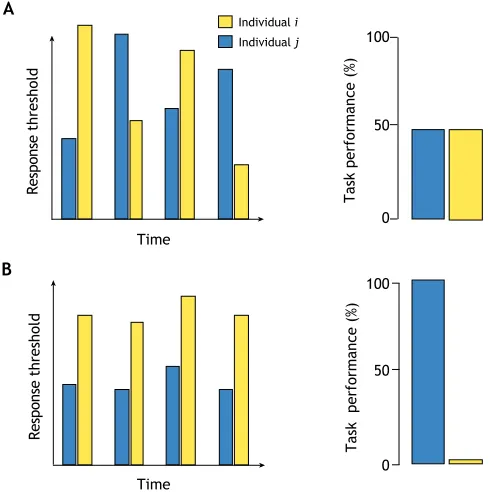
Considering only between-individual variability in response thresholds provides an incomplete picture of the ingredients required for the production of robust patterns of task allocation (Jeanson and Weidenmüller, 2014). Variation among group members is a necessary but not sufficient component, and it is also critical that the individuals perform the same activities for a certain amount of time to grant colonies the full benefits of task specialisation. Indeed, a minimal level of behavioural consistency is needed to limit the costs associated with task switching that are possibly detrimental for colony homeostasis (Fig. 1; see also below). Therefore, within-individual variability in behaviours represents another fundamental but still little-explored facet of specialisation and task allocation in social groups.
This Commentary aims first at examining the sources of within-individual behavioural variability in the context of division of labour in social insects, leaving aside the sources of between-individual variation (e.g. genetic, morphological or physiological) that have been reviewed extensively elsewhere (Jandt et al., 2014; Jeanson and Weidenmüller, 2014; Wright et al., 2019). I then ask whether differences in behavioural flexibility can explain, at least partly, the differences in the level of task specialisation. Finally, I propose a testable hypothesis to explain the positive scaling between the intensity of division of labour and group size reported consistently within and across taxa.
Centre de Recherches sur la Cognition Animale, Centre de Biologie Intégrative, Universitéde Toulouse, CNRS, UPS, 31062 Toulouse Cedex 9, France. *Author for correspondence ([email protected])
R.J., 0000-0002-6811-8123
Journal
of
Experimental
Within-individual versus between-individual behavioural variation
In social groups, the existence of stable patterns of task allocation implies that individuals behave consistently, i.e. that they exhibit a relatively limited within-individual variability. Hereafter, I use the terms ‘within-individual behavioural variability’ and ‘behavioural flexibility’interchangeably to refer to any behavioural change as function of time. Within-individual variability is preferred over other terms with similar meaning (e.g. temporal plasticity; Stamps, 2016), to echo the classical use of the term‘between-individual variation’in the context of division of labour. Also, here, within-individual variability does not imply that observed variations are stochastic or unpredictable (Stamps et al., 2012). Importantly, within-individual variability is not restricted to age polyethism, but also includes any change in behaviour that occurs at shorter time scales (e.g. minutes or hours), the expression of which involves learning or a response to environmental changes, as described below.
The influence of within-individual variability on task allocation needs to be considered with respect to the range of between-individual variability. Indeed, within-individual fluctuations are not necessarily detrimental for the stability of task allocation patterns, provided that there is no overlap in the response thresholds between individuals (Fig. 2). It is important to note that the characterisation of absolute variations in individuals’ response thresholds to understand task allocation is of limited interest if no information is provided on the distribution of response thresholds within colonies.
A trade-off between within-individual variability and consistency
Costs associated with task switching are increasingly recognised as important drivers of division of labour (Goldsby et al., 2012).
Shifting between tasks can generate substantial costs resulting, for example, from transient inefficiency at the new task (Chittka and Muller, 2009), from delays required to change tasks or locations within the nest (Jeanson and Lachaud, 2015; Leighton et al., 2017) or from the time required for relevant physiological adaptations (Johnson, 2005). A low level of behavioural flexibility favours task specialisation, and this possibly improves colony homeostasis via a reduction in task-switching costs and an increase in the efficiency of task performance (e.g. Jeanne, 1986; Trumbo and Robinson, 1997; but see Dornhaus, 2008). By contrast, a high degree of flexibility allows societies to buffer environmental perturbations by reallocating the workforce in response to sudden and unpredictable fluctuations in task needs. Task-switching costs do not necessarily scale linearly with colony size, and the benefits of behavioural flexibility might vary between colonies of different developmental stages (Jeanson and Lachaud, 2015). Colonies thus face a tension between behavioural flexibility and behavioural canalisation, and the optimal trade-off probably differs as a function of life-history traits and ecological constraints.
Different degrees of behavioural flexibility
The main virtue of the response-threshold model is that it explains how colonies can maintain homeostasis by reallocating the workforce as a function of demand. This model posits that if the need for a given task is excessively high, following a major disturbance, for instance, workers are recruited to perform this task as the current level of the stimulus exceeds their threshold. Several studies have manipulated colony demography to determine to what extent colonies show flexibility to maintain homeostasis in response to external perturbations. In the ant Pogonomyrmex barbatus, increasing the task need for patrolling or foraging induces workers engaged in nest maintenance to switch tasks (Gordon, 1989). In the antTemnothorax rugatulus, the removal of the most active individuals is compensated for by the recruitment of workers from the reserve pool of inactive individuals (Charbonneau et al., 2007). In species with age polyethism, removing part of the foraging workforce aims at testing the ability of younger workers to accelerate their maturation to take over foraging, whereas a reduction in the number of nurses aims at determining whether foragers can reverse their development to perform brood-tending tasks. Such approaches yield mixed results. In the lower termite Reticulitermes fukienensis, young individuals modify their
R
e
sp
o
n
se
threshold
Time
R
e
sp
o
n
se
threshold
Time
Task performance (%)
0 100
50
Task performance (%)
0 100
50 Individual i
Individual j A
[image:2.612.320.557.58.172.2]B
Fig. 1. Within-individual variation in response thresholds.(A) Fluctuating and (B) stable response thresholds over time for a single hypothetical task and two individualsiandj. In A, the range of within-individual variation in response threshold produces no specialisation, the task being performed equally by individualsiandj. In B, the existence of stable response thresholds generates task specialisation, with individualjbeing the specialist (because of its consistently lower response threshold for the task).
R
e
sponse threshold
Time Time
B
A Individual i
Individual j
Individual i
[image:2.612.53.298.59.305.2]Individual j
Fig. 2. Within-individual versus between-individual variability.(A,B) Each individual (iorj) shows the same temporal variation in its response threshold in the two panels for a single hypothetical task. The black dashed line represents the stimulus level. In A, the amplitude of within-individual variation in response threshold does not overlap between individuals. In the framework of the response-threshold model, only individualjperforms the task in A (because its response threshold is always lower than the stimulus level). In B, the task is performed by both individuals.
Journal
of
Experimental
behaviours to compensate for the absence of larger and older workers (Crosland et al., 1997). In the ant Temnothorax longispinosus, old workers can revert to brood care after the removal of younger individuals, but young workers fail to accelerate their development to compensate for the removal of foragers (Kohlmeier et al., 2018). In honeybees, a reduction in the number of foragers induces precocious foraging in young bees, and nurse depletion triggers the behavioural reversion from foraging to brood tending, with the associated physiological changes (e.g. decline in juvenile hormone) (Huang and Robinson, 1996). It was proposed that task switching was more likely to involve tasks that need no physiological differentiation (Johnson, 2005). If task performance is coupled to physiological differentiation, individuals can be locked in a behavioural state until the perception of environmental changes triggers the required endocrinal cascade that accompanies the reversion (Johnson, 2003, 2005).
The reallocation of workers to satisfy colony requirements in response to changes in external conditions does not seem to be a universal rule. In wasps, the removal of water foragers does not increase task switching but rather increases the foraging rate of the remaining water foragers (O’Donnell, 1998). In the seed-harvester antPogonomyrmex badius, the removal of 50% of foragers is not compensated for by a transition from inside workers to foraging (Kwapich and Tschinkel, 2013). Similarly, the addition of larvae to enhance the workload for brood-tending individuals induces no behavioural reversion from foraging to nursing at the expense of brood survival (Kwapich and Tschinkel, 2016). This suggests that P. badius has a unidirectional progression with no possible behavioural reversion. It has been argued that a lack of behavioural flexibility might actually be optimal to allow colonies to cope with environmental seasonality and that the intensity of the experimental demographic disturbance might be of little ecological relevance (Kwapich and Tschinkel, 2016). This nevertheless invites questions about the mechanisms underlying behavioural flexibility.
Sources of within-individual variability in task performance In the framework of response-threshold models, two categories of mechanisms can explain how individuals switch between tasks. First, the perception of large fluctuations in the intensity of task-associated stimuli can stimulate individuals to change tasks without any (substantial) change in their response threshold. Second, individuals can exhibit internal changes in their responsiveness to stimuli, and these fluctuations can elicit task switching even under stable environmental conditions. In the latter case, the variations in response threshold can operate at time scales differing by orders of magnitude, from minutes to weeks or more. The temporal window over which these behavioural variations occur has potentially important consequences for task allocation: gradual changes in response threshold are less detrimental to the stability of task allocation than sudden deviations.
There are two non-mutually exclusive sources of variation in response threshold that can account for within-individual variability in responsiveness to task-associated stimuli. (1) The variability can arise stochastically through internal noise in sensory perception or motor execution (Faisal et al., 2008). (2) Three main classes of mechanism can contribute to the modulation of individuals’ responsiveness: learning, maturation and environmental changes (as outlined below).
Learning
Learning is an important source of within-individual variability (Jeanson and Weidenmüller, 2014). Repeated exposure to a given
stimulus or context can modulate an individual’s responsiveness and subsequent behaviours. In the clonal antOoceraea(formerly Cerapachys)biroi, for instance, a successful foraging experience increases the likelihood of engaging in that task again (Ravary et al., 2007). Also, bumblebees that repeatedly fan their wings to cool down hives show a reduced response threshold for temperature, but individuals return to higher thresholds after prolonged interruption of their fanning behaviour (Weidenmüller, 2004; Westhus et al., 2013). Interestingly, individual variation in learning ability plays a substantial role in the development of between-individual variability. In honeybees, the responsiveness to sucrose influences the foraging role, with pollen foragers having lower response thresholds than workers collecting nectar (Page et al., 1998). In an appetitive associative learning paradigm, honeybees with high sucrose responsiveness (i.e. low response threshold for sucrose) are better learners than individuals with low sucrose responsiveness, because they give a higher value to the solution used as a reward (Scheiner et al., 2005).
Maturation
Maturation represents a second cause of within-individual variability, with potentially long-lasting effects. In social insects, ageing workers usually move from intranidal duties (typically brood tending) to external tasks (typically foraging) (wasps: Naug and Gadagkar, 1998; honeybees: Seeley, 1995; termites: Hinze and Leuthold, 1999; ants: Hölldobler and Wilson, 1990). When present, age polyethism involves several regulatory networks linked to nutritional and reproductive signalling pathways (Smith et al., 2008). For instance, foragers in social insects typically have lower lipid amounts than nurses, and the depletion of lipids in workers triggers the transition to foraging in honeybees (Toth et al., 2005) and wasps (Daugherty et al., 2011). Foragers also have more elevated levels of circulating juvenile hormones, and topical application of an analogue of juvenile hormone reduces the sucrose response threshold (Pankiw and Page, 2000). The transition from nursing to foraging in honeybees correlates with an upregulation of the foraginggene (which codes for a protein kinase) that modulates phototaxis (Ben-Shahar et al., 2003) and gustatory responsiveness (Thamm and Scheiner, 2014). The transition to foraging has also been associated with downregulation of thevitellogeningene (which codes for an egg yolk protein and modulates the response threshold for sucrose) in honeybees (Amdam et al., 2006) or a decrease in the responsiveness to cues emitted by brood in ants (Kohlmeier et al., 2018). A worker’s behaviour can also depend on the acquisition or loss of physical abilities. The growth of cephalic musculature influences the likelihood of carrying loads in the ant Pheidole dentata (Muscedere et al., 2011), and the perception of mandibular wear presumably prompts workers to shift from cutting to carrying leaves in the leaf-cutter antAtta cephalotes(Schofield et al., 2011).
Environmental changes
The perception of environmental changes, particularly in the social context, can play an additional role in the modulation of individual behaviours. For instance, honeybees exposed to queen mandibular pheromones or brood pheromones show increased responsiveness to sucrose (Pankiw and Page, 2000, 2001). In bumble bees, workers in colonies deprived of a queen show increased ovarian development and a higher sucrose responsiveness than brood-tenders from colonies with a queen (Evans et al., 2016). In halictine bees, individuals have a reduced response threshold for excavation after they experience the presence of nestmates (Jeanson et al.,
Journal
of
Experimental
2008). In the antTemnothorax albipennis, the removal of diligent workers incites previously indolent individuals to become active, but the removed ants do not resume their prior activity levels when returned to the colony (Pinter-Wollman et al., 2012). This suggests the existence of long-lasting changes in response thresholds following a modification of the social context. The current social context experienced by individuals plays an important role in responsiveness; for example, in honeybees the probability of fanning depends on the composition of the social group (Kaspar et al., 2018). Recently, Garrison et al. (2018) assessed the fanning response of bumblebees tested alone or in groups. Interestingly, they found that the presence of conspecifics reduces the responsiveness to temperature, and that the threshold measured in a non-social context is a poor predictor of the threshold observed in a social context. These results are of particular importance when considering that the vast majority of studies quantifying response thresholds involve workers in a solitary context.
Brain plasticity in social insects
Across taxa, the mechanisms underlying the expression of behavioural plasticity have received considerable attention over recent decades (Kolb and Whishaw, 1998). Brain plasticity plays a crucial role in the ability of organisms to process external cues and to produce adaptive behaviours in a dynamic environment. The modulation of the efficacy of synaptic connections and the rearrangement of neuronal circuits are important mechanisms underlying brain plasticity that accompanies learning, maturation and environmental changes, and that participates in the expression of within-individual behavioural variability. In social insects, developmental variation in biogenic amines (e.g. dopamine, serotonin, octopamine), which act as neurotransmitters or neuromodulators, is involved in the modulation of the responsiveness to task-associated stimuli (Scheiner et al., 2006; Kamhi and Traniello, 2013). For instance, the transition from nursing to foraging is accompanied by an increase in tyramine titre in honeybees, and workers treated with tyramine show increased gustatory responsiveness to sucrose (Scheiner et al., 2017). Several studies in social insects have reported modification of brain connectivity along with behavioural changes. The modifications in brain architecture particularly concern the mushroom bodies, a region involved in multisensory integration and high-order cognitive processing (Menzel, 2014). In social insects, variation in behavioural flexibility is associated with changes in the architecture of mushroom bodies. The expansion of mushroom bodies has two components: one that does not depend on experience but prepares individuals leaving the nest to experience new stimuli (experience-expectant plasticity) and one that does depend on learning (experience-dependent plasticity) (Fahrbach et al., 1998). For example, long-term memories formed after olfactory associative learning are accompanied by structural synaptic rearrangements in the mushroom bodies (Hourcade et al., 2010). The transition from nursing to foraging coincides with an increase in the volume of the mushroom bodies (Withers et al., 1993; Gronenberg et al., 1996). The social environment experienced early in life also affects both the number of synaptic boutons in the mushroom bodies and the ability to learn complex tasks (e.g. olfactory reversal learning) in honeybees (Cabirol et al. 2018). In the ant Pheidole dentata, as workers age, they show a substantial expansion of their behavioural repertoire and they experience synaptic remodelling in the mushroom bodies and changes in amine titre (Seid et al., 2005; Seid and Traniello, 2006; Giraldo et al., 2016). This presumably reflects a need for increased sensorial integration and processing as
individuals leave the nest and experience a larger breadth of environmental stimuli (O’Donnell et al., 2004; Muscedere and Traniello, 2012). A comparative study between different species of the antPheidolereported that workers with the highest degree of specialisation have smaller mushroom bodies than workers with a broader task repertoire and a higher behavioural flexibility (Muscedere and Traniello, 2012). In theEcitonarmy ant, soldiers, which have a narrow task repertoire, show reduced investment in mushroom bodies compared with that of more generalist workers (O’Donnell et al., 2018). It is thus now relatively well documented that differences in behavioural flexibility correlate with changes in brain connectivity, but further efforts are still needed to establish a firm causal relationship.
Increased specialisation with group size
From multicellular organisms to human organisations, a general rule is that the size of the system dictates the degree of specialisation. Such positive scaling has also been found repeatedly both within and between taxa in social insects (Darchen, 1964; Thomas and Elgar 2003; Jeanson et al., 2007; Holbrook et al., 2011; Ulrich et al., 2018). These empirical reports suggest that variations in colony size over ontogeny are associated with changes in the level of within-individual behavioural variability. As colonies grow, individuals tend to be less flexible and more canalised. In the antP. barbatus, workers engaged in nest maintenance switch tasks more easily in small than in large colonies (Gordon, 1989). In the waspPolybia occidentalis, increased specialisation results from a reduction in the frequency of transition between tasks (Jeanne, 1986). From an evolutionary perspective, a lower level of specialisation in small societies is expected to be beneficial, because colonies have to maintain homeostasis with a reduced number of workers that may need to rapidly adapt to environmental changes (Moritz and Page, 1999). We still do not know, however, what mechanisms drive the scaling between individual specialisation and colony size.
One hypothesis is that increased specialisation can arise as a by-product of increased colony size without requiring any change at the individual level. Indeed, group size is a powerful driver of collective dynamics, which can incidentally influence the probabilities of engaging in a subset of tasks. For instance, colony size can modify the rate of workers’interactions or it can impact nest architecture and the spatial distribution of workers, which are then exposed to different stimuli (Buhl et al., 2004; Gordon and Mehdiabadi, 1999). An alternative and non-mutually exclusive hypothesis involves the modulation of developmental and physiological processes in response to variation in colony size. In this case, the expression of a stricter division of labour in larger societies probably relies on a combination of increased between-individual variability and/or reduced within-individual variability in task performance.
Across species, the workforce in large colonies usually shows a greater heterogeneity of response thresholds than that in small societies due to increased genetic diversity (Oldroyd and Fewell, 2007). In many species of ants, individuals in incipient societies are usually similarly sized and only colonies above a critical size produce workers that differ in size or physical attributes and that tend to specialise on different tasks (Tschinkel, 1988; Wetterer, 1994; Fjerdingstad and Crozier, 2006). However, little is known about the neuro-physiological correlates of the observed decline in behavioural variability with colony size, although a comparison between different monomorphic species of fungus-growing ants with different colony sizes at maturity revealed a negative correlation between colony size and brain size (Riveros et al., 2012). Thus far, only one study has investigated the interplay
Journal
of
Experimental
between colony size and brain changes in the species, thereby limiting the confounding factors inherent to interspecific comparisons. In the ant Pseudomyrmex spinicola, it was shown that increased behavioural specialisation in large colonies correlates with a task-dependent reduction in subregions of the mushroom bodies (Amador-Vargas et al., 2015).
Linking colony size, self-organisation and behavioural flexibility
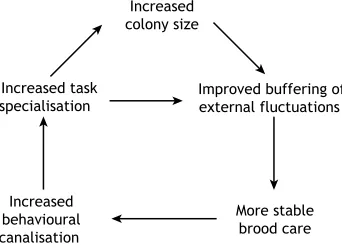
In addition to the study of the neuronal and behavioural correlates of increased canalisation, it is necessary to understand how changes in colony size are perceived and integrated to modulate the expression of behavioural flexibility. I propose that the variations in the range of an individual’s behavioural flexibility over a colony lifetime can arise automatically via self-organisation (Fig. 3). Self-organisation is a process in which global patterns emerge from interactions among the lower-level components of the system, using local information with no reference to the global pattern (Camazine et al., 2001). Many collective behaviours in animal groups benefit from self-organisation, including the formation of trail networks, nest construction or decision making. I hypothesise that fluctuations in the social environment experienced during colony ontogeny might shape the extent of behavioural variability at adulthood. Changes in the preimaginal (i.e. prior to the adult stage) environment can affect the developmental trajectories of the brood with important consequences later in life. Such developmental plasticity might be adaptive, as the environment experienced early in life can provide information on future conditions (Nettle and Bateson, 2015).
In social insects, small colonies tend to be less efficient in buffering external fluctuations than large colonies, which offer more stable conditions for the developing brood (e.g. Kleineidam and Roces, 2000). Also, the size of colonies might affect the frequency and stability of brood care. Indeed, the per-capita productivity (defined as the total number of workers and sexuals produced by a colony divided by colony size) in social insects often declines with increases in colony size. In ants, colonies typically display a peak in per-capita productivity, which is followed by a decline at colony sizes much smaller than the species-specific average (Kramer et al., 2014). A major consequence of this relationship is that the brood-to-worker ratio (number of brood items divided by brood-to-worker number) decreases during colony ontogeny. We can speculate that incipient societies endure more variation in brood care than large colonies and
that fluctuations in brood attendance translate into increased within-individual behavioural variability at adulthood. This effect might be further reinforced by the fact that young workers, which are in the majority in incipient colonies, are less efficient brood tenders than old workers (Muscedere et al., 2009).
Despite the massive internal changes accompanying metamorphosis in social insects, preimaginal experience nevertheless has long-lasting consequences for a suite of traits in insects, including habitat choice, host selection or feeding behaviours at adulthood (Amat et al., 2018). For instance, honeybees exposed to a high-aggression environment during early development behave more aggressively in adulthood than bees that experience low-aggression environments (Rittschof et al., 2015). In ants, the temperature experienced by developing pupae affects the thermal response of adult brood-tending workers (Weidenmüller et al., 2009). The hypothesis that fluctuating preimaginal conditions result in increased within-individual variability in behaviours awaits empirical investigation.
In providing more steady conditions, a larger workforce in growing colonies might promote a reduction in behavioural flexibility, thus favouring increased specialisation. An increase in specialisation supports the expression of a more efficient division of labour that further reinforces stability. A reduction in behavioural plasticity in workers reared from large colonies might allow better canalisation, granting colonies the full benefits of specialisation. Moreover, a more optimal pattern of task allocation might promote the existence of a pool of inactive workers acting as a reserve that can be recruited in response to unexpected external perturbations, which further supports colony homeostasis. Therefore, a positive feedback loop involving colony size, behavioural flexibility and colony homeostasis might account for increased division of labour over a colony lifetime. We can speculate that this developmental plasticity is adaptive for incipient colonies in preparing workers to show variability in task performance at adulthood. This idea could also explain differences in the intensity of division of labour documented across species. Evaluating this hypothesis requires us to manipulate the brood-to-worker ratio in experimental colonies and to test adult workers in a series of behavioural assays (e.g. activity test, quantification of response thresholds) to assess their degree of flexibility. In addition, we should determine whether variation in behavioural plasticity translates into differences in specialisation in task performance and how this impacts the patterns of division of labour.
Overall, ontogenic or seasonal changes in worker-to-brood ratio could represent a simple but efficient mechanism that, without any explicit coding, could shape behavioural diversity and allow colonies to produce optimal patterns of division of labour.
Future research directions
Most of our knowledge on the proximate mechanisms of division of labour in social insects, including its physiological basis, originates from work on honeybees. These studies were of prime importance and opened avenues for research in other taxa. However, we should ask to what extent the mechanisms identified in honeybees are valid in other taxa and in less-derived societies, particularly in the context of the influence of colony size on task specialisation. In honeybees, colony size can vary between 5000 and 50,000 individuals depending on the phase of the colony’s annual cycle (Free and Racey, 1968; Russell et al., 2013). Many species of ants, wasps or termites show much more dramatic variations in size during their ontogeny: societies founded by a single queen can comprise hundreds of thousands of workers at maturity. Surprisingly, Increased
colony size
Increased behavioural canalisation
Increased task specialisation
Improved buffering of external fluctuations
[image:5.612.88.259.542.666.2]More stable brood care
Fig. 3. Hypothetical interactions between colony size, within-individual variability and division of labour.A larger size buffers colonies against external perturbations and offers stable conditions to the brood. This might result in a reduction in within-individual variability and increased behavioural canalisation and task specialisation. Possible negative feedback (e.g. limitation in resource availability, competition) stabilising colony growth is not
represented for clarity.
Journal
of
Experimental
however, little is known about how the changes in colony size experienced by workers during colony ontogeny influence division of labour. One reason lies in the technical challenge of monitoring an individual’s performance over time, but recent advances in automatic tracking alleviate this concern and offer promising perspectives (Ulrich et al., 2018).
A complete description of division of labour should not only incorporate the values of response thresholds (Weidenmüller, 2004); in this Commentary, I have argued that the contribution of within-individual variability to the expression of division of labour deserves further attention. However, an important question will be to determine which facet(s) of an individual’s response can vary. Indeed, we can easily think of individuals that start performing a task at a similar stimulus intensity but that show considerable variation in other components of their response, such as the duration or intensity of behaviours. Considering only individual responsiveness can thus lead to an inaccurate estimation of behavioural consistency. This emphasises the need for a more thorough characterisation of an individual’s response, including its efficiency in task completion. In the context of division of labour, what mechanism(s) would support the expression of behavioural consistency: the maintenance of response thresholds over time and/or a longer duration of task performance? Both theoretical and experimental studies should thus now attempt to integrate response dynamics to provide a more comprehensive picture of the variations in behavioural patterns both within and between individuals.
Concluding remarks
The current framework to approach division of labour is provided by the response threshold model, which posits that between-individual variation in responsiveness to stimuli is necessary for task specialisation. In an ecological setting, the heterogeneity in response thresholds among individuals grants colonies both flexibility and robustness when environmental conditions fluctuate. This simple and appealing paradigm has garnered theoretical and empirical support and its explicative potential has largely contributed to its wide acceptance. However, response threshold models may not be sufficient to capture all facets of task allocation in social insects. If we accept the idea that individuals start engaging in a task when the intensity of the associated stimulus exceeds the individual’s internal threshold, how can we then justify that, at least in some species, a task can be left unattended after the partial loss of the workforce? In seed-harvester ants, for instance, how can we explain that in-nest workers are not recruited to compensate for the removal of foragers and that this even occurs at the expense of brood survival? Shall we assume that workers have (near-) infinite thresholds for some tasks? If so, this might call into question the significance of the paradigm of response thresholds. At the minimum, this indicates that the flexibility of workers has been exaggerated. This observation also encourages a revision of the overly simplistic view of virtually unlimited behavioural plasticity allowing individuals to shift tasks and colonies to adapt to any changes in their environment. We thus have to develop a more comprehensive approach in which the role of within-individual variability occupies a central position to understand how the balance between flexibility and canalisation can lead to optimal patterns of task allocation.
Acknowledgements
I am grateful to Sara Arganda Carreras, Iago Sanmartin Villar and Anja
Weidenmüller for fruitful discussions. I also thank Charlotte Rutledge and three
anonymous referees for their helpful comments on the manuscript.
Competing interests
The author declares no competing or financial interests.
References
Amador-Vargas, S., Gronenberg, W., Wcislo, W. T. and Mueller, U.(2015). Specialization and group size: brain and behavioural correlates of colony size in
ants lacking morphological castes.Proc. R. Soc. B282, 2014502. doi:10.1098/
rspb.2014.2502
Amat, I., Desouhant, E., Gomes, E., Moreau, J. and Monceau, K.(2018). Insect
personality: what can we learn from metamorphosis?Curr. Opin. Insect. Sci.27,
46-51. doi:10.1016/j.cois.2018.02.014
Amdam, G. V., Norberg, K., Page, R. E., Erber, J. and Scheiner, R.(2006).
Downregulation of vitellogenin gene activity increases the gustatory
responsiveness of honey bee workers (Apis mellifera).Behav. Brain Res.169,
201-205. doi:10.1016/j.bbr.2006.01.006
Ben-Shahar, Y., Leung, H. T., Pak, W. L., Sokolowski, M. B. and Robinson, G. E. (2003). cGMP-dependent changes in phototaxis: a possible role for the foraging
gene in honey bee division of labor.J. Exp. Biol.206, 2507-2515. doi:10.1242/jeb.
00442
Beshers, S. N. and Fewell, J. H.(2001). Models of division of labor in social insects. Annu. Rev. Entomol.46, 413-440. doi:10.1146/annurev.ento.46.1.413 Bonabeau, E., Theraulaz, G. and Deneubourg, J.-L.(1996). Quantitative study of
the fixed threshold model for the regulation of division of labour in insect societies. Proc. R Soc. B263, 1565-1569. doi:10.1098/rspb.1996.0229
Buhl, J., Gautrais, J., Deneubourg, J.-L. and Theraulaz, G. (2004). Nest excavation in ants: group size effects on the size and structure of tunneling
networks.Naturwissenschaften91, 602-606. doi:10.1007/s00114-004-0577-x
Cabirol, A., Cope, A. J., Barron, A. B. and Devaud, J.-M.(2018). Relationship
between brain plasticity, learning and foraging performance in honey bees.PLOS
ONE13, e0196749.
Calabi, P.(1988). Behavioral flexibility in Hymenoptera: a re-examination of the
concept of caste. InAdvances in Myrmecology(ed. J. C. Trager), pp. 237-258.
New York: E. J. Brill.
Camazine, S., Deneubourg, J. L., Franks, N. R., Sneyd, J., Theraulaz, G. and Bonabeau, E. (2001). Self-Organization in Biological Systems. Princeton: Princeton University Press.
Charbonneau, D., Sasaki, T. and Dornhaus, A.(2017). Who needs‘lazy’workers?
Inactive workers act as a‘reserve’labor force replacing active workers, but inactive
workers are not replaced when they are removed.PLoS ONE12, e0184074.
doi:10.1371/journal.pone.0184074
Chittka, L. and Muller, H.(2009). Learning, specialization, efficiency and task
allocation in social insects. Commun. Integr. Biol.2, 151-154. doi:10.4161/
cib.7600
Crosland, M. W. J., Lok, C. M., Wong, T. C., Shakarad, M. and Traniello, J. F. A. (1997). Division of labour in a lower termite: the majority of tasks are performed by
older workers.Anim. Behav.54, 999-1012. doi:10.1006/anbe.1997.0509
Darchen, R. (1964). Biologie des Vespa orientalis. Les premiers stades de
développement.Insect. Soc.2, 141-158. doi:10.1007/BF02222934
Daugherty, T. H. F., Toth, A. L. and Robinson, G. E.(2011). Nutrition and division
of labor: Effects on foraging and brain gene expression in the paper waspPolistes
metricus.Mol. Ecol.20, 5337-5347. doi:10.1111/j.1365-294X.2011.05344.x Dornhaus, A.(2008). Specialization does not predict individual efficiency in an ant.
PLoS Biol.6, e285. doi:10.1371/journal.pbio.0060285
Duffy, J. E., Morrison, C. L. and Macdonald, K. S.(2002). Colony defense and
behavioral differentiation in the eusocial shrimpSynalpheus regalis.Behav. Ecol.
Sociobiol.51, 488-495. doi:10.1007/s00265-002-0455-5
Evans, L. J., Raine, N. E. and Leadbeater, E.(2016). Reproductive environment
affects learning performance in bumble bees. Behav. Ecol. Sociobiol. 70,
2053-2060. doi:10.1007/s00265-016-2209-9
Fahrbach, S. E., Moore, D., Capaldi, E. A., Farris, S. M. and Robinson, G. E. (1998). Experience-expectant plasticity in the mushroom bodies of the honeybee. Learn. Mem.5, 115-123.
Faisal, A. A., Selen, L. P. J. and Wolpert, D. M.(2008). Noise in the nervous
system.Nature9, 292-303. doi:10.1038/nrn2258
Fjerdingstad, E. J. and Crozier, R. H.(2006). The evolution of worker caste
diversity in social insects.Am. Nat.167, 390-400. doi:10.1086/499545
Free, J. B. and Racey, P. A.(1968). The effect of the size of honeybee colonies on food consumption, brood rearing and the longevity of the bees during winter. Entomol. Exp. Appl.11, 241-249. doi:10.1111/j.1570-7458.1968.tb02048.x Garrison, L. K., Kleineidam, C. J. and Weidenmüller, A.(2018). Behavioral
flexibility promotes collective consistency in a social insect.Sc. Rep.8, 15836.
doi:10.1038/s41598-018-33917-7
Giraldo, Y. M., Kamhi, J. F., Fourcassié, V., Moreau, M., Robson, S. K. A., Rusakov, A., Wimberly, L., Diloreto, A., Kordek, A. and Traniello, J. F. A.
(2016). Lifespan behavioural and neural resilience in a social insect.Proc. R. Soc.
B283, 20152603. doi:10.1098/rspb.2015.2603
Goldsby, H. J., Dornhaus, A., Kerr, B. and Ofria, C.(2012). Task-switching costs
promote the evolution of division of labor and shifts in individuality.Proc. Natl.
Acad. Sci. USA109, 13686-13691. doi:10.1073/pnas.1202233109
Journal
of
Experimental
Gordon, D. M.(1989). Dynamics of task switching in harvester ants.Anim. Behav.
38, 194-204. doi:10.1016/S0003-3472(89)80082-X
Gordon, D. M. and Mehdiabadi, N. J.(1999). Encounter rate and task allocation in
harvester ants.Behav. Ecol. Sociobiol.45, 370-377. doi:10.1007/s002650050573
Gronenberg, W., Heeren, S. and Hölldobler, B.(1996). Age-dependent and task-related morphological changes in the brain and the mushroom bodies of the ant Camponotus floridanus.J. Exp. Biol.199, 2011-2019.
Hinze, B. and Leuthold, R. H.(1999). Age related polyethism and activity rhythms
in the nest of the termiteMacrotermes bellicosus(Isoptera, Termitidae).Insect.
Soc.46, 392-397. doi:10.1007/s000400050162
Holbrook, C. T., Barden, P. M. and Fewell, J. H.(2011). Division of labor increases
with colony size in the harvester antPogonomyrmex californicus.Behav. Ecol.22,
960-966. doi:10.1093/beheco/arr075
Holbrook, C. T., Wright, C. M. and Pruitt, J. N.(2014). Individual differences in personality and behavioural plasticity facilitate division of labour in social spider
colonies.Anim. Behav.97, 177-183. doi:10.1016/j.anbehav.2014.09.015
Hölldobler, B. and Wilson, E. O.(1990).The Ants. Cambridge, Massachusetts: Belknap Press of Harvard University Press.
Hourcade, B., Muenz, T. S., Sandoz, J.-C., Rössler, W. and Devaud, J.-M.(2010). Long-term memory leads to synaptic reorganization in the mushroom bodies: a
memory trace in the insect brain? J. Neurosc. 30, 6461-6465. doi:10.1523/
JNEUROSCI.0841-10.2010
Huang, Z.-Y. and Robinson, G. E.(1996). Regulation of honey bee division of labor
by colony age demography.Behav. Ecol. Sociobiol.39, 147-158. doi:10.1007/
s002650050276
Jandt, J. M., Bengston, S., Pinter-Wollman, N., Pruitt, J. N., Raine, N. E., Dornhaus, A. and Sih, A.(2014). Behavioural syndromes and social insects:
personality at multiple levels.Biol. Rev.89, 48-67. doi:10.1111/brv.12042
Jeanne, R. L.(1986). The organization of work inPolybia occidentalis: costs and
benefits of specialization in a social wasp.Behav. Ecol. Sociobiol.19, 333-341.
doi:10.1007/BF00295706
Jeanne, R. L.(2016). Division of labor is not a process or a misleading concept. Behav. Ecol. Sociobiol.70, 1109-1112. doi:10.1007/s00265-016-2146-7 Johnson, B. R.(2003). Organization of work in the honeybee: a compromise
between division of labour and behavioural flexibility. Proc. R. Soc. B 270,
147-152. doi:10.1098/rspb.2002.2207
Johnson, B. R.(2005). Limited flexibility in the temporal caste system of the honey bee.Behav. Ecol. Sociobiol.58, 219-226. doi:10.1007/s00265-005-0949-z Jeanson, R. and Lachaud, J.-P.(2015). Influence of task switching costs on colony
homeostasis.Sci. Nat.102, 36-40. doi:10.1007/s00114-015-1287-2
Jeanson, R. and Weidenmüller, A. (2014). Interindividual variability in social
insects–proximate causes and ultimate consequences.Biol. Rev.89, 671-687.
doi:10.1111/brv.12074
Jeanson, R., Fewell, J. H., Gorelick, R. and Bertram, S. M.(2007). Emergence of
division of labor as a function of group size.Behav. Ecol. Sociobiol.62, 289-298.
doi:10.1007/s00265-007-0464-5
Jeanson, R., Clark, R. M., Holbrook, C. T., Bertram, S. M., Fewell, J. H. and Kukuk, P. F.(2008). Division of labour and socially induced changes in response
thresholds in associations of solitary halictine bees.Anim. Behav.76, 593-602.
doi:10.1016/j.anbehav.2008.04.007
Kamhi, J. F. and Traniello, J. F. A. (2013). Biogenic amines and collective organization in a superorganism: Neuromodulation of social behavior in ants. Brain Behav. Evolut.82, 220-236. doi:10.1159/000356091
Kaspar, R. E., Cook, C. N. and Breed, M. D.(2018). Experienced individuals
influence the thermoregulatory fanning behaviour in honey bee colonies.Anim.
Behav.142, 69-76. doi:10.1016/j.anbehav.2018.06.004
Kleineidam, C. and Roces, F.(2000). Carbon dioxide concentrations and nest
ventilation in nests of the leaf-cutting ant Atta vollenweideri.Insect. Soc. 47,
241-248. doi:10.1007/PL00001710
Kohlmeier, P., Feldmeyer, B. and Foitzik, S. (2018). Vitellogenin-like
A–associated shifts in social cue responsiveness regulate behavioral task
specialization in an ant. PLoS Biol. 16, e2005747. doi:10.1371/journal.pbio.
2005747
Kolb, B. and Whishaw, I. Q.(1998). Brain plasticity and behaviour.Annu. Rev. Psychol.49, 43-64. doi:10.1146/annurev.psych.49.1.43
Kramer, B. H., Scharf, I. and Foitzik, S.(2014). The role of per-capita productivity in
the evolution of small colony sizes in ants.Behav. Ecol. Sociobiol.68, 41-53.
doi:10.1007/s00265-013-1620-8
Kussell, E. and Leibler, S.(2005). Phenotypic diversity, population growth, and
information in fluctuating environments.Science309, 2075-2078. doi:10.1126/
science.1114383
Kwapich, C. L. and Tschinkel, W. R.(2013). Demography, demand, death, and the
seasonal allocation of labor in the Florida harvester ant (Pogonomyrmex badius).
Behav. Ecol. Sociobiol.67, 2011-2027. doi:10.1007/s00265-013-1611-9 Kwapich, C. L. and Tschinkel, W. R. (2016). Limited flexibility and unusual
longevity shape forager allocation in the Florida harvester ant (Pogonomyrmex
badius).Behav. Ecol. Sociobiol.70, 221-235. doi:10.1007/s00265-015-2039-1 Leighton, G. M., Charbonneau, D. and Dornhaus, A.(2017). Task switching is
associated with temporal delays inTemnothorax rugatulusants.Behav. Ecol.28,
319-327. doi:10.1093/beheco/arw162
Menzel, R.(2014). The insect mushroom body, an experience-dependent recoding
device.J. Physiol.108, 84-95. doi:10.1016/j.jphysparis.2014.07.004
Michener, C. D.(1974).The Social Behavior of the Bees. A Comparative Study. Cambridge, Massachusetts: Belknap Press of Harvard university Press. Moritz, R. A. and Page, R., Jr.(1999). Behavioral threshold variability: costs
and benefits in insect societies. InInformation Processing in Social Insects
(ed. C. Detrain, J. Deneubourg and J. Pasteels), pp. 203-215. Birkhauser Basel. Muscedere, M. L. and Traniello, J. F. A. (2012). Division of labor in the
hyperdiverse ant genusPheidoleis associated with distinct subcaste- and
age-related patterns of worker brain organization.PLoS ONE7, e31618. doi:10.1371/
journal.pone.0031618
Muscedere, M. L., Willey, T. A. and Traniello, J. F. A.(2009). Age and task
efficiency in the antPheidole dentata: young minor workers are not specialist
nurses.Anim. Behav.77, 911-918. doi:10.1016/j.anbehav.2008.12.018
Muscedere, M. L., Traniello, J. F. A. and Gronenberg, W.(2011). Coming of age in an ant colony: cephalic muscle maturation accompanies behavioral development inPheidole dentata.Naturwissenschaften98, 783-793. doi:10.1007/s00114-011-0828-6
Naug, D. and Gadagkar, R.(1998). Division of labor among a cohort of young
individuals in a primitively eusocial wasp.Insect. Soc.45, 247-254. doi:10.1007/
s000400050085
Nettle, D. and Bateson, M.(2015). Adaptive developmental plasticity: what is it,
how can we recognize it and when can it evolve?Proc. R. Soc. B Biol. Sci.282,
20151005. doi:10.1098/rspb.2015.1005
O’Donnell, S.(1998). Effects of experimental forager removals on division of labour
in the primitively eusocial waspPolistes instabilis(Hymenoptera : Vespidae).
Behaviour135, 173-193. doi:10.1163/156853998793066348
O’Donnell, S., Donlan, N. A. and Jones, T. A.(2004). Mushroom body structural
change is associated with division of labor in eusocial wasp workers (Polybia
aequatorialis, Hymenoptera: Vespidae). Neurosci. Lett.356, 159-162. doi:10. 1016/j.neulet.2003.11.053
O’Donnell, S., Bulova, S., Barrett, M. and von Beeren, C.(2018). Brain investment
under colony-level selection: soldier specialization in Eciton army ants
(Formicidae: Dorylinae).BMC Zool.3, 3. doi:10.1186/s40850-018-0028-3
Oldroyd, B. P. and Fewell, J. H.(2007). Genetic diversity promotes homeostasis in
insect colonies.Trends Ecol. Evol.22, 408-413. doi:10.1016/j.tree.2007.06.001
Page, R. E., Jr., Erber, J. and Fondrk, M. K.(1998). The effect of genotype on
response thresholds to sucrose and foraging behavior of honey bees (Apis
melliferaL.).J. Comp. Physiol. A.182, 489-500. doi:10.1007/s003590050196 Pankiw, T. and Page, R. E., Jr.(2000). Response thresholds to sucrose predict
foraging division of labor in honeybees.Behav. Ecol. Sociobiol.47, 265-267.
doi:10.1007/s002650050664
Pankiw, T. and Page, R. E.(2001). Genotype and colony environment affect
honeybee (Apis melliferaL.) development and foraging behavior.Behav. Ecol.
Sociobiol.51, 87-94. doi:10.1007/s002650100408
Pasquaretta, C. and Jeanson, R.(2018). Division of labor as a bipartite network. Behav. Ecol.29, 342-352. doi:10.1093/beheco/arx170
Pinter-Wollman, N., Hubler, J., Holley, J.-A., Franks, N. and Dornhaus, A.
(2012). How is activity distributed among and within tasks inTemnothoraxants?
Behav. Ecol. Sociobiol.66, 1407-1420. doi:10.1007/s00265-012-1396-2 Ravary, F., Lecoutey, E., Kaminski, G., Chaline, N. and Jaisson, P.(2007).
Individual experience alone can generate lasting division of labor in ants.Curr.
Biol.17, 1308-1312. doi:10.1016/j.cub.2007.06.047
Rittschof, C. C., Coombs, C. B., Frazier, M., Grozinger, C. M. and Robinson, G. E.(2015). Early-life experience affects honey bee aggression and resilience to
immune challenge.Sci. Rep.5, 15572. doi:10.1038/srep15572
Riveros, A. J., Seid, M. A. and Wcislo, W. T.(2012). Evolution of brain size in
class-based societies of fungus-growing ants (Attini).Anim. Behav.83, 1043-1049.
doi:10.1016/j.anbehav.2012.01.032
Robinson, G. E.(1987). Regulation of honey bee age polyethism by juvenile
hormone.Behav. Ecol. Sociobiol.20, 329-338. doi:10.1007/BF00300679
Robinson, G. and Page, J.(1989). Genetic basis for division of labor in an insect
society. InThe Genetics of Social Evolution(ed. M. Breed and J. Page), pp. 61-80.
Boulder, Colorado: Westview Press.
Russell, S., Barron, A. B. and Harris, D.(2013). Dynamic modelling of honey bee (Apis mellifera) colony growth and failure.Ecolog. Model.265, 158-169. doi:10. 1016/j.ecolmodel.2013.06.005
Scheiner, R., Kuritz-Kaiser, A., Menzel, R. and Erber, J. (2005). Sensory responsiveness and the effects of equal subjective rewards on tactile learning and
memory of honeybees.Learn. Mem.12, 626-635. doi:10.1101/lm.98105
Scheiner, R., Baumann, A. and Blenau, W. (2006). Aminergic control and
modulation of honeybee behaviour.Curr. Neuropharmacol.4, 259-276. doi:10.
2174/157015906778520791
Scheiner, R., Reim, T., Søvik, E., Entler, B. V., Barron, A. B. and Thamm, M. (2017). Learning, gustatory responsiveness and tyramine differences across
nurse and forager honeybees.J. Exp. Biol.220, 1443-1450. doi:10.1242/jeb.
152496
Schofield, R. M. S., Emmett, K. D., Niedbala, J. C. and Nesson, M. H.(2011).
Leaf-cutter ants with worn mandibles cut half as fast, spend twice the energy, and
Journal
of
Experimental
tend to carry instead of cut.Behav. Ecol. Sociobiol.65, 969-982. doi:10.1007/ s00265-010-1098-6
Seeley, T. D.(1995).The Wisdom of the Hive: the Social Physiology of Honey Bee. Cambridge, Massachusetts: Harvard University Press.
Seid, M. A. and Traniello, J. F. A.(2006). Age-related repertoire expansion and
division of labor in Pheidole dentata (Hymenoptera: Formicidae): a new
perspective on temporal polyethism and behavioral plasticity in ants. Behav.
Ecol. Sociobiol.60, 631-644. doi:10.1007/s00265-006-0207-z
Seid, M. A., Harris, K. M. and Traniello, J. F. A.(2005). Age-related changes in the number and structure of synapses in the lip region of the mushroom bodies in the antPheidole dentata.J. Comp. Neurol.488, 269-277. doi:10.1002/cne.20545 Smith, C. R., Toth, A. L., Suarez, A. V. and Robinson, G. E.(2008). Genetic and
genomic analyses of the division of labour in insect societies.Nat. Rev. Genet.9,
735-748. doi:10.1038/nrg2429
Stamps, J. A.(2016). Individual differences in behavioural plasticities.Biol. Rev.91, 534-567. doi:10.1111/brv.12186
Stamps, J. A., Briffa, M. and Biro, P. A.(2012). Unpredictable animals: individual
differences in intraindividual variability (IIV).Anim. Behav.83, 1325-1334. doi:10.
1016/j.anbehav.2012.02.017
Stander, P. E.(1992). Cooperative hunting in lions: the role of the individual.Behav. Ecol. Sociobiol.29, 445-454. doi:10.1007/BF00170175
Thamm, M. and Scheiner, R.(2014). PKG in honey bees: spatial expression,Amfor
gene expression, sucrose responsiveness, and division of labor.J. Comp. Neurol.
522, 1786-1799. doi:10.1002/cne.23500
Thomas, M. L. and Elgar, M. A.(2003). Colony size affects division of labour in the
ponerine antRhytidoponera metallica.Naturwissenschaften,90, 88-92.
Toth, A. L., Kantarovich, S., Meisel, A. F. and Robinson, G. E.(2005). Nutritional
status influences socially regulated foraging ontogeny in honey bees.J. Exp. Biol.
208, 4641-4649. doi:10.1242/jeb.01956
Trumbo, S. T. and Robinson, G. E.(1997). Learning and task interference by
corpse-removal specialists in honey bee colonies.Ethology103, 966-975. doi:10.
1111/j.1439-0310.1997.tb00138.x
Tschinkel, W. R.(1988). Colony growth and the ontogeny of worker polymorphism
in the fire ant,Solenopsis invicta.Behav. Ecol. Sociobiol.22, 103-115. doi:10.
1007/BF00303545
Ulrich, Y., Saragosti, J., Tokita, C. K., Tarnita, C. E. and Kronauer, D. J. C. (2018). Fitness benefits and emergent division of labour at the onset of group
living.Nature560, 635-638. doi:10.1038/s41586-018-0422-6
Weidenmüller, A. (2004). The control of nest climate in bumblebee (Bombus terrestris) colonies: interindividual variability and self-reinforcement in fanning
response.Behav. Ecol.15, 120-128. doi:10.1093/beheco/arg101
Weidenmüller, A., Mayr, C., Kleineidam, C. J. and Roces, F.(2009). Preimaginal
and adult experience modulates the thermal response behavior of ants.Curr. Biol.
19, 1897-1902. doi:10.1016/j.cub.2009.08.059
Westhus, C., Kleineidam, C. J., Roces, F. and Weidenmüller, A. (2013). Behavioural plasticity in the fanning response of bumblebee workers: impact of
experience and rate of temperature change.Anim. Behav.85, 27-34. doi:10.1016/
j.anbehav.2012.10.003
Wetterer, J. K.(1994). Ontogenetic changes in forager polymorphism and foraging
ecology in the leaf-cutting antAtta cephalotes.Oecologia98, 235-238. doi:10.
1007/BF00341478
Wilson, E. O.(1976). Behavioral discretization and number of castes in an ant
species.Behav. Ecol. Sociobiol.1, 141-154. doi:10.1007/BF00299195
Withers, G. S., Fahrbach, S. E. and Robinson, G. E. (1993). Selective
neuroanatomical plasticity and division of labour in the honeybee.Nature364,
238-240. doi:10.1038/364238a0
Wolf, L., Silander, O. K. and van Nimwegen, E. (2015). Expression noise
facilitates the evolution of gene regulation.eLife4, e05856. doi:10.7554/eLife.
05856
Wright, C. M., Lichtenstein, J. L. L., Doering, G. N., Pretorius, J., Meunier, J. and Pruitt, J. N. (2019). Collective personalities: present knowledge and new
frontiers.Behav. Ecol. Sociobiol.73, 31. doi:10.1007/s00265-019-2639-2