Original citation:
Akerlof, Robert J. and Holden, Richard. (2016) Movers and shakers. The Quarterly Journal of Economics . 10.1093/qje/qjw021
Permanent WRAP URL:
http://wrap.warwick.ac.uk/80966
Copyright and reuse:
The Warwick Research Archive Portal (WRAP) makes this work by researchers of the University of Warwick available open access under the following conditions. Copyright © and all moral rights to the version of the paper presented here belong to the individual author(s) and/or other copyright owners. To the extent reasonable and practicable the material made available in WRAP has been checked for eligibility before being made available.
Copies of full items can be used for personal research or study, educational, or not-for profit purposes without prior permission or charge. Provided that the authors, title and full bibliographic details are credited, a hyperlink and/or URL is given for the original metadata page and the content is not changed in any way.
Publisher’s statement:
This is a pre-copyedited, author-produced PDF of an article accepted for publication in The Quarterly Journal of Economics following peer review. The version of record The Quarterly Journal of Economics (2016) doi: 10.1093/qje/qjw021 is available online at:
http://dx.doi.org/10.1093/qje/qjw021 .
A note on versions:
The version presented here may differ from the published version or, version of record, if you wish to cite this item you are advised to consult the publisher’s version. Please see the ‘permanent WRAP url’ above for details on accessing the published version and note that access may require a subscription.
Accepted Manuscript
Movers and Shakers
Robert Akerlof and Richard Holden
∗February 9, 2016
Abstract
Most projects, in most walks of life, require the participation of multiple parties. While it is difficult to unite individuals in a common endeavor, some people, who
we call “movers and shakers,” seem able to do it. The paper specifically examines moving and shaking of an investment project, whose return depends both on its quality and the total capital invested in it. We analyze a model with two types of
agents: managers and investors. Managers and investors initially form social con-nections. Managers then bid to buy control of the project and the winning bidder
puts effort into making investors aware of it. Finally, a subset of aware investors are given the chance to invest and they decide whether to do so after receiving private signals of the project’s quality. We first show that connections are valuable since
they make it easier for a manager to “move and shake” the project (i.e., obtain capi-tal from investors). When we endogenize the network, we find that, while managers
are identicalex ante, a single manager emerges as most connected; he consequently earns a rent. In extensions, we move away from the assumption ofex anteidentical
managers to highlight forces that lead one manager or another to become a mover and shaker. Our theory sheds light on a range of topics including: entrepreneurship, venture capital, and anchor investments.
∗Akerlof: University of Warwick. email: [email protected]. Holden: UNSW Australia
Busi-ness School. email: [email protected]. We are grateful to George Akerlof, Wouter Dessein, Rosalind Dixon, Bhaskar Dutta, Bob Gibbons, Oliver Hart, Bengt Holmstrom, Johannes Horner, Rachel Kranton, Hongyi Li, Barry Nalebuff, Michael Powell and especially Andrea Prat for helpful discussions, and to seminar participants at: ANU, the Spring 2015 NBER Organizational Economics meetings, MIT, LMU Munich, Oxford University, Paris 2e, QUT, UMass Amherst, UNSW, and Yale. Holden acknowl-edges support from the Australian Research Council (ARC) Future Fellowship FT130101159.
The Quarterly Journal of Economics Advance Access published July 12, 2016
by guest on August 11, 2016
http://qje.oxfordjournals.org/
1
Introduction
Most projects – in business, politics, sports, and academia – require the participation
of multiple parties. In business, they usually involve, among other things, raising
cap-ital from disparate sources. Many projects fail – or do not even get off the ground – because of the difficulty of bringing together the relevant parties. While it is not easy to unite individuals in a common endeavor, some people – often called ”movers and shakers” – seem able to do it. This paper develops an equilibrium theory regarding who these movers and shakers will be and why they receive outsize compensation for their endeavors.
Skill, of course, helps in obtaining participation since people are more inclined to par-ticipate in skillfully run projects. But another attribute – social connectedness – can also make someone a mover and shaker. Someone who is well-connected can increase par-ticipation not only by making agents aware of a project but, even more importantly, by making agents aware thatothers are awareand are considering participating. Expressed differently, connections help both in raising awareness and in making that awareness
common knowledge.
In our baseline model, there are a number of potential managers of a project – all equally skilled – and a number of potential investors. Initially, there are no connections between managers and investors. The model has four stages. In stage 1, investors form connections with managers. For simplicity, we assume each investor can link to one manager. In stage 2, managers bid to buy an asset. The asset is necessary for undertaking the project and entitles the owner to the project’s return. For instance, if the project were the construction of a shopping mall, the asset might be the plot of land on which the mall is to be built. In stage 3, the winning bidder puts effort into raising awareness of the project among investors and gives a subset of the aware investors the chance to invest. In stage 4, investors given the chance to invest decide whether to do so after receiving private signals of the project’s quality.
We first analyze the model taking the social network between managers and in-vestors as exogenous (i.e., we exclude stage 1). Connections increase a manager’s valu-ation of the asset: since they make it easier to raise capital for the project. Consequently, in equilibrium, the manager – or one of the managers – who is most connected wins
by guest on August 11, 2016
http://qje.oxfordjournals.org/
the auction and puts effort into moving and shaking the project. Furthermore, provided the auction winner is strictly more connected than other managers, he receives a higher expected payoff.
When we endogenize the social network (i.e., add stage 1), we find that all investors link to one particular manager, whom we may refer to as M. Therefore, even though managers are identicalex ante, one manager (M) emerges as most connected. M wins the auction, moves and shakes the project, and earns a higher payoff than other managers. Investors link to the same manager in equilibrium because they have a preference to link to whichever manager is most connected. The most connected manager ends up controlling the project; unless an investor connects to the manager who controls the project, he will not have an opportunity to invest.
We later extend the model by making managers heterogeneous along several dimen-sions: (1) their skill at running the project; (2) their talent at communicating with in-vestors; and (3) how much capital they have personally. We assume that managers can use their personal capital as “seed money” for the project. Taking the social network as exogenous, we find that these characteristics affect how much managers value the project and which one of them becomes mover and shaker. When we endogenize the network, we find that these characteristics are also predictive of who emerges as most connected.
It is useful, in thinking about movers and shakers, to have a concrete example in mind. To that end, consider William Zeckendorf, who was, in the 1950s and 60s, the United States’ preeminent real estate developer. He undertook a variety of ambitious projects including Mile High Center in downtown Denver, Place Ville-Marie in Mon-treal, and L’Enfant Plaza in Washington, D.C. He was also famous for his role in bring-ing the United Nations to New York.1 Key to Zeckendorf’s success (and his ability to
move and shake) were his social connections, as he recognized himself: “the greater the number of...groups...one could interconnect...the greater the profit.”2 He knew all the important real estate brokers, bankers, and insurance agents; he served on numerous
1Upon learning of the United Nations’ difficulty finding a suitable New York site – and their intention,
in consequence, to locate in Philadelphia – he realized he could help. He offered them a site he had assembled on the East River for a large development.
2Zeckendorf and McCreary (1970), p. 42.
by guest on August 11, 2016
http://qje.oxfordjournals.org/
corporate boards; and he was a fixture of New York society. Zeckendorf also owned a nightclub, the Monte Carlo, where he would hold court several nights a week, enter-taining friends and business acquaintances.
His Montreal project, Place Ville-Marie, provides an excellent example of his talents as a mover and shaker. Since the 1920s, the Canadian National Railway (CNR) had been attempting, without success, to develop a 22-acre site in downtown Montreal, adjacent to the main train station: “a great, soot-stained, angry-looking, open cut where railway tracks ran out of a three-mile tunnel.”3 While the site had enormous potential, Cana-dian developers shied away, considering the challenges too daunting. Desperate, CNR approached Zeckendorf in 1955. He was immediately enthusiastic, appreciating that: “a sort of Rockefeller Center-cum-Grand Central Station could create a new center of gravity and focal point for the city.”4 But, making this vision a reality would require
the participation of two constituencies. First, he would need to raise large sums from investors: one hundred million dollars for the tower he proposed to build as the site’s centerpiece. Second, and even more vexing, was the challenge of leasing office space. Every major company had its offices on St. James Street. “The very idea of a shift to center-town offices struck many as dangerously radical.”5 Zeckendorf initially faced a
freeze, unable to get anyone to lease space. As he put it, “nobody...believed we would ever put up a project as big as we said we would.”6 But, through his tireless efforts, the freeze began to thaw. The first crack came when he convinced the Royal Bank of Canada to move into the new building and become its prime tenant. He had been introduced to the CEO, James Muir, by his friend John McCloy, chairman of Chase; Zeckendorf set out to woo Muir, making him his Canadian banker. With RBC lined up, he managed, with considerable pressing, to obtain a fifty million dollar loan from Met Life – half of what was needed. Also with considerable pressing, he lined up a second big tenant: Aluminium Limited. At that point, it became clear to all that the project would indeed become a reality. Other companies – which had previously turned him down – agreed to take space, and he was able to obtain the additional capital he needed.
Our theory sheds light on a range of topics, one of which is entrepreneurship.
Found-3Ibid., p. 167. 4Ibid., p. 170. 5Ibid., p. 174. 6Ibid., p. 174.
by guest on August 11, 2016
http://qje.oxfordjournals.org/
ing a business often requires moving and shaking. One can think of real estate develop-ers such as Zeckendorf as a type of entrepreneur. A number of ideas have been advanced regarding entrepreneurs’ function. Schumpeter (1934), for instance, stresses their role as innovators involved in “creative destruction”; Knight (1921) sees them primarily as risk-takers; Rajan and Zingales (1998) highlight their role in regulating access to resources. Others, such as Baumol (2010), bemoan that, despite economists’ longstanding interest, “[entrepreneurs] are almost entirely excluded from our standard theoretical models.”7
Our theory offers a new perspective on their role. The aspect of entrepreneurship cap-tured by our model is new to economics, but it is related to theoretical perspectives in sociology. Ronald Burt, for instance, argues that entrepreneurs exploit network position. In his terminology, they bridge “structural holes.” He writes that “bringing together separate pieces [of a network] is the essence of entrepreneurship.”8
Our theory also speaks to the role of venture capitalists. According to Kaplan and Schoar (2005), venture capital funds, on average, yield roughly the same return, net of fees, as the S&P 500; however, certain fund managers consistently outperform the mar-ket, achieving higher risk-adjusted returns. The standard interpretation of this finding is that these fund managers are particularly skilled at originating investment ideas. While this is a possibility, the model suggests a novel explanation. Such fund managers may instead earn high returns by moving and shaking. Such VC firms take an equity stake in a startup; then, they move and shake on the company’s behalf (in particular, helping the startup find additional investors). For example, Andreessen Horowitz, one of the preeminent Silicon Valley VC firms, “maintains a network of twenty thousand contacts and brings two thousand established companies a year to its executive briefing center to meet its startups.” According to Marc Andreessen, “we give our founders...networking superpower.”9,10
7Baumol (2010), p. 2. 8Burt (2001), p. 210.
9Friend, Tad, ”Tomorrow’s Advance Man,”The New Yorker 18 May 2015, Retrieved fromhttp://
www.newyorker.com.
10In line with this view, Hochberg et al. (2007) find that venture capitalists with superior network
posi-tions earn higher returns. It is not a matter of indifference to a startup, of course, which VC firm invests. A startup would rather take money from a VC who is better at moving and shaking. Lower-ranked VCs, in consequence, find it hard to compete. Andreesen puts it this way: “Deal flow is everything...If you’re a second-tier firm, you never get a chance at that great company.” (Friend, Tad, ”Tomorrow’s Advance Man,”The New Yorker18 May 2015, Retrieved fromhttp://www.newyorker.com)
by guest on August 11, 2016
http://qje.oxfordjournals.org/
Additionally, seeding of projects – or, “anchor investments” – seems to be empirically important. Movers and shakers are often independently wealthy and use their own funds to seed projects. In other instances, a mover and shaker might obtain help in seeding a project from a large investor. Our model speaks to this topic as well, and we discuss this briefly in the conclusion.
Our paper relates to a number of different literatures. At a formal level, the problem we analyze is a global game and thus relates to the now large literature pioneered by Carlsson and van Damme (1993) and Morris and Shin (1998).
The model we analyze also relates to large theoretical and empirical literatures in finance. A natural benchmark for thinking about investments and returns is, of course, Q-theory.11 Investors, in Q-theory, earn the same rate of return whether they invest one dollar or one million. By contrast, investment is lumpy in our model. Agents invest in projects; projects yield a poor rate of return unless they are well capitalized. An impor-tant consequence is that the rate of return to a project/asset depends upon the social network that exists among agents. We predict, moreover, that agents with a privileged position in the network will earn outsize returns, because they can move and shake contributions from others.12 Our model is, to the best of our knowledge, the first to emphasize the importance of network structure for investment.
Our paper connects to the economic literature on networks – particularly work on network formation. In the endogenous network version of our model, investors have a preference to link to the most important manager. This feature of our model is referred to as “preferential attachment.” Two classic papers, Jackson and Wolinksy (1996) and Bala and Goyal (2000), show that this force will, in general, lead to the emergence of a
11A host of papers have documented departures from Q-theory and highlighted the implications of
such departures. Liquidity constraints are important (see, among others, Fazzari et al. (1988), Hoshi et al. (1991), Blanchard et al. (1994), Kashyap et al. (1994), Sharpe (1994), Chevalier (1995), Kaplan and Zingales (1997), Lamont (1997), Peek and Rosengren (1997), Almeida et al. (2004), and Bertrand and Schoar (2006)) as are short-term biases (Stein (1988, 1989)). Moreover, there is compelling evidence that there are real consequences of such inefficiencies (see, for instance, Morck et al. (1988) and the large ensuing literature on the equity channel of investment).
12Another, quite distinct, form of ”lumpiness” has been well studied: adjustment costs (see Uzawa
(1969), Lucas and Prescott (1971), Hayashi (1982), and for a recent dynamic analysis, Miao and Wang (2014)). It is well known that such lumpiness can have significant macroeconomic implications (see, for instance, Lucas (1967), Prescott (1986), and Caballero et al. (1995)).
by guest on August 11, 2016
http://qje.oxfordjournals.org/
star network.13
While our focus is an investment setting, our model also relates to a literature on attention within organizations (see especially Dessein (2002), Dessein and Santos (2006), Alonso et al. (2008), Rantakari (2008), Calvo-Armengol et al. (2014), Dessein and Santos (2014), and Dessein et al. (2014)). Agents in these models, as in our own, wish to coordi-nate their actions. In Calvo-Armengol et al. (2014), agents decide whom to pay attention to; attention is dispersed in equilibrium, in contrast to our model in which attention is concentrated on a mover and shaker.14 Dessein and Santos (2014) and Dessein et al. (2014) consider a setting in which a principal decides the allocation of attention. They find that it is optimal for there to be some concentration of attention, since it aids coor-dination. Attention is also concentrated in our model, but it is not necessarily optimally placed. In particular, we obtain equilibria in which the mover and shaker is more or less skilled, resulting respectively in a more or less efficient outcome.15 Another related paper, Hellwig and Veldkamp (2009), examines attention in a trading rather than an or-ganizational setting. Somewhat analogous to the coordination of attention in our setting, they find traders may coordinate attention on one piece of information or another.
Our model relates to the economic literature on leadership since a mover and shaker is arguably a type of leader. It particularly relates to work examining how leaders per-suade followers. Several papers consider signaling by leaders as a means of persuasion (see, for instance, Prendergast and Stole (1996), Hermalin (1998), and Majumdar and Mukand (2004)). There is also work on leaders creating cascades to influence followers (see Caillaud and Tirole (2007)). In our paper, the mover and shaker persuades investors by publicizing the project. This feature of our model bears some relation to Dewan and Myatt (2007, 2008), who have explored how public speeches by politicians can influence
13Other papers that predict the emergence of star networks include Galeotti et al. (2006), Goyal and
Vega-Redondo (2007), Feri (2007), Hojman and Szeidl (2007), Bloch and Dutta (2009) and Galeotti and Goyal (2010). A recent paper that is particularly relevant is Herskovic and Ramos (2015).
14In Calvo-Armengol et al. (2014), agents’ attention is dispersed in equilibrium because there are neither
increasing costs nor decreasing benefits of listening to multiple agents.
15Intuitively, investors coordinate on linking to a particular manager, whose skill may be higher or
lower. This finding suggests the possibility of constructing a mover-and-shaker model, similar to our own, in which there are persistent performance differences across firms. Some firms get stuck paying attention to the wrong people. Persistent performance differences have been shown to be ubiquitous (see Gibbons and Henderson (2012)). There is considerable interest in understanding what drives these productivity differences (see Gibbons (2006), Chassang (2010), and Ellison and Holden (2014)).
by guest on August 11, 2016
http://qje.oxfordjournals.org/
followers. Chwe (2001) also emphasizes the role of public announcements in acting as coordination devices in a variety of settings such as advertising. In addition, there is work on the use of authority by leaders in settings where agents, as in our model, have a desire to coordinate. For instance, Bolton et al. (2013) argue that resoluteness is an im-portant quality in a leader because a leader who is overly responsive to new information can undermine coordination.
The paper proceeds as follows. Section 2 contains the setup of our model and the analysis of equilibrium. We first take the network structure as exogenous; subsequently, we endogenize it. In Section 3 we consider a number of extensions of the basic model analyzed in Section 2. Section 4 concludes. Proofs of all formal results are contained in the Appendix.
2
The model
2.1
Statement of the problem
Consider a setting with an investment project and two types of agents: managers and investors. Managers have skills needed to run the project; investors each have one unit of capital they can contribute to the project. We assume there are at least two managers; the total number of managers and investors is finite. LetNM denote the set of managers
andNI denote the set of investors.
A network g exists between agents. gij = 1 if agent i and agent j are connected;
gij = 0otherwise. For now, we take the network as exogenous; we will endogenize it in
Section 2.4.
The model has four periods. All choices made by agents are observable. In the first period, managers bid in a second-price auction for an asset A. The asset is needed to undertake the project and entitles the owner to the project’s return. The asset might, for instance, be a parcel of land; the project might be the construction of a building on that parcel. The project yields a return R at the end of the game that depends both upon the project’s underlying quality (θ) and the amount of capital raised for the project (K). More specifically,R =θ+v ·K, wherev >1parameterizes the return to raising capital
by guest on August 11, 2016
http://qje.oxfordjournals.org/
(i.e., the return to ”moving and shaking”). The agents have a common prior that θ is distributedN(µ, τ2), withµ, τ > 0. Let bi denote manageri’s bid in the auction, let b(2) denote the second highest bid, and let M denote the winning bidder. In the event of a tie in the auction, the manager of lowest index wins. We assume managers do not following bidding strategies that are weakly dominated.
In the second period, the auction winner,M, decides how much effort eM ∈[0,1]to
exert to make investors aware of the project. An investor’s chance of becoming aware of the project depends uponeM and upon his degree of separation fromM. Specifically,
investorjbecomes aware with probabilityδ(length pathj→M)−1·e
M, where(length pathj →
M) denotes the length of the shortest path between investor j and M that does not include other managers, (length pathj → M) = ∞when no such path exists, andδ ∈
(0,1). We assume mutual independence of investors’ awareness of the project. The cost toM of exerting effort isc(eM), wherec0(0) = 0andc0(e)>0fore >0. Letndenote the
number of investors who become aware of the project.
In the third period,M can offer aware investors equity in the project in exchange for contributing their capital. M chooses how much equity, βM, to offer and the number,
m ≤ n, of equity offers he will make. The m investors who receive equity offers are randomly drawn from the pool of aware investors. Let S denote the set of investors who receive equity offers. S, once drawn, is commonly known to investors in setS.
Investors in set S then receive private signals of the project’s quality: xj = θ +εj,
where theεj’s are distributed iidN(0, σ2). We will focus on the case whereσ→0as this
results in closed-form solutions.
In the final period, investors who received equity offers decide whether to take them. Letaj ∈ {0,1}denote investorj’s decision. Observe that the total capital raised for the
project isK =P
j∈Saj.
The project is then undertaken, yields returnR = θ+v·K, and players receive the shares of the return due to them. We can write players’ payoffs at the end of the game as follows. Investors receive a payoff ofβMR if they invest in the project and1otherwise.
The auction winner receives a payoff of(1−βMK)R−c(eM)−b(2)while other managers receive0.
It is useful to summarize the timing: (1) managers simultaneously place bids (bi)
by guest on August 11, 2016
http://qje.oxfordjournals.org/
for asset A and the winning bidder (M) acquires the asset; (2) the auction winner (M) decides how much effort to exert (eM) to make investors aware of the project; (3) M offers
equity shares (βM) to m ≤ n of the aware investors; (4) investors who receive equity
offers then acquire private signals of the project’s quality and simultaneously decide whether to invest (ai), after which the project is undertaken, its returnRis realized, and
players receive the share of the return due to them.
2.2
Discussion of the model
We now pause briefly to discuss a number of the modeling choices we have made.
First, our game has four periods and, at first inspection, might seem complicated in this respect. In fact, this is the simplest formulation that captures all the economics we wish to convey. It is important to us to highlight that, in equilibrium, more connected players value asset A more than less connected players. The simplest way to demon-strate this is through the auction we consider at time 1. Similarly, the effort choice is indispensable to our story since this is what moving and shakingis– hence time 2. Fi-nally, we need two periods to address investment since it necessarily involves the equity offer and the choice of whether to invest.
Second, we model the project’s return as increasing in the amount of capital invested. This results in strategic complementarities and captures our basic story about the im-portance of participation. Note that it is important thatR is increasing inK over some range; it is not important thatRis increasing inK indefinitely; we have only made this assumption for simplicity.
Third, the set S is commonly known to investors in setS. This assumption reflects the idea that the mover and shaker not only raises awareness of the project; he also makes the existence of a pool of potential investors common knowledge.
Fourth, we assume the marginal cost of effort is equal to zero at eM = 0(c0(0) = 0).
This ensures that it is optimal forM to exert positive effort when he has social connec-tions and the returns to moving and shaking, v, are large. More importantly, it means that more connected managers value asset A strictly – rather than weakly – more than less connected managers whenv is large.
by guest on August 11, 2016
http://qje.oxfordjournals.org/
Fifth, we consider a particular form of financial contracting: equity. The benefit of fo-cusing on equity contracting is that it results in closed-form solutions; but this is not the most general contracting space one could consider, to be sure. However, we conjecture that our main results hold in a more general contracting space. 16
Sixth, we adopt a common assumption regarding how information diffuses within the network.17 Under this assumption, a manager’s ability to raise awareness depends
upon how many connections he has of each degree.18
Seventh, we assume that S, the set of investors who receive equity offers, once drawn, is commonly known. If one assumes that this information can only be con-veyed by M then the issue of strategic information transmission may arise. We have sidestepped this issue by assuming that the information is simply observable. An al-ternative approach would be to assume that M conveys the information, but that it is “hard” information.
Finally, one could imagine modeling movers and shakers in a different way. Imagine an investment game with a good equilibrium (with a high level of investment) and a bad equilibrium (with a low level of investment). The mover and shaker might serve as a coordination device that makes the good equilibrium focal. While it is certainly plausible that movers and shakers play such a role, there are three reasons it is not so appealing to model them in this way. First, Schelling-type focal points are interesting but not micro-founded and raise more questions than they answer. Second, the global games approach was developed precisely to provide more rigorous answers to the mul-tiple equilibrium problem. Perhaps most importantly, the global games approach is more fruitful in generating predictions. It yields the prediction that social connections matter for moving and shaking. It also allows us, in extensions to the baseline model, to describe characteristics associated with movers and shakers.
16For instance, we believe our results hold when the project is debt financed rather than equity financed. 17For instance, Jackson and Wolinksy (1996) make a similar assumption.
18Depending upon how information diffuses within a network, different network properties are
impor-tant. For a discussion, see Banerjee et al. (2013). Banerjee et al. (2013) provide empirical evidence that an agent’s ”diffusion centrality” is an important determinant of ability to diffuse information (a concept that nests degree centrality, eigenvector centrality, and Katz-Bonacich centrality).
by guest on August 11, 2016
http://qje.oxfordjournals.org/
2.3
Equilibrium
Our focus will be on pure-strategy Perfect Bayesian Equilibria, which henceforth, we will refer to simply as the equilibria of the game.
Some notation will be useful for characterizing the equilibria. Letdk
i denote the
num-ber of connections of degreek that managerihas to investors.19 Letd
idenote the
corre-sponding vector: di = (dki)
∞
k=1. We will define a partial ordering over thedi’s as follows.
Definition 1. We will say that:
(1) Manager i is weakly more connected than manager j (di ≥dj) if:
Pl
k=1d
k i ≥
Pl
k=1d
k
j for alll.
(2) Manager i is strictly more connected than manager j (di >dj) if:
Pl
k=1dki ≥
Pl
k=1dkj for allland
Pl
k=1dki >
Pl
k=1dkj for somel.
Notice that di > dj when managerihas more connections of every degree (dki > dkj
for all k). In addition, di > dj when managersi and j have the same total number of
connections buti’s connections are all direct while some ofj’s are not.
Proposition 1 characterizes the equilibria of the game. The proof is discussed in detail below.
Proposition 1. In equilibrium:
(1) Managers bid their valuations of asset A in the auction: bi =Vi.
(2) Manageri’s valuation of asset A is a function of his social connections:Vi =V(di).
(3) V(di)is weakly increasing indi.
(4) There existsvˆsuch that, whenever the returns to moving and shaking exceedvˆ(v >vˆ): (i) V(di)is strictly increasing indi.
(ii) Provided the manager who wins the auction has some social connections (dM > 0),
he exerts positive effort (eM >0).
19By ”a connection of degreek,” we mean an investorjfor whom length pathj →i=k. We will also
refer to connections of degree1as ”direct connections.”
by guest on August 11, 2016
http://qje.oxfordjournals.org/
According to the proposition, more connected managers value the project more than less connected managers. Provided the returns to moving and shaking are large (v >ˆv), they value the project strictlymore. The formal proof is given below, but the intuition is straightforward: more connected managers value the project more because they are more able to move and shake the project (i.e., raise capital).
Proposition 1 implies that, if the returns to moving and shaking exceed vˆand one manager is more connected than his peers, he becomes the project’s mover and shaker and earns a positive rent from control of the project. This is stated below as a corollary.
Corollary 1. Provided the returns to moving and shaking are sufficiently large (v >vˆ): if one of the managers is strictly more connected than other managers, he wins the auction, exerts positive effort to move and shake the project, and earns a higher expected payoff than his peers.
Let us now consider the proof of Proposition 1.
Proof of Proposition 1.
We can use backward induction to solve for the equilibria of the game. First, consider time 4. The time 4 game is a global game. As is standard in such games, in equilibrium, investors invest if and only if their private signals exceed a cutoff: xj > κ. Lemma 1, the
proof of which is given in the Appendix, characterizes the cutoff κ for the case where
σ →0.
Lemma 1. Asσ→0, the cutoffκ→ 1
βM −v(
m+1 2 ).
According to Lemma 1, investors are more inclined to invest (κ is lower) when: (1) they are offered more equity (βM is higher); and (2) there are more investors who receive
equity offers (mis higher). It is intuitive that investors are more inclined to invest when they are offered more equity. They are more inclined to invest whenmis higher because they expect greater total investment in the project, leading to a higher overall returnR.
Turning to time 3, we can write the auction winner’s expected payoff asΠM(m, βM)−
c(eM)−b(2), whereΠM(m, βM)denotesM’s expected share of the project’s return when
m investors are offered equity shares of size βM. M will choose βM to maximizeΠM:
βM∗ (m) = arg maxβΠM(m, β). M will also choose m to maximize ΠM subject to the
by guest on August 11, 2016
http://qje.oxfordjournals.org/
constraint that m is less than or equal to the number of aware investors (n): m∗(n) = arg maxm≤nΠM(m, βM∗ (m)). We will denote by Π∗M(n)the value of ΠM(m, βM)when m
andβM are chosen optimally.
Π∗M(n)must be weakly increasing innsince, asnincreases, M is less constrained in his choice ofm.
We can also show thatΠ∗M(n)is strictly increasing innprovided the returns to mov-ing and shakmov-ing,v, are large. Observe that, asσ→0, investors who receive equity offers invest with probability 1 when θ > κ and with probability zero when θ < κ. Conse-quently, K = mwith probability 1when θ > κ; K = 0with probability 1whenθ < κ. This allows us to write an explicit formula forΠM(m, βM):
ΠM(m, βM) =E[(1−βMK)R]
=E[(1−βMK)·(θ+vK)]
=E[θ] +E[vK·(1−βMK)]−E[βMKθ]
=µ+v·m(1−βMm)·Pr(θ > κ)−βMm·E(θ|θ > κ)·Pr(θ > κ),
whereκ = 1
βM
−v
m+ 1 2
.
From this formula for ΠM, we can show that ΠM(m, βM∗ (m))is strictly increasing in m
(provided v is sufficiently large). The formal proof is given in the Appendix as part of the proof of Lemma 2 but the intuition is straightforward. The larger is m, the easier it is for the auction winner to raise capital. It is easier because there are more potential investors; it is also easier because any given investor’s willingness to invest is increasing inm. It follows that, ifv is large – so that it is particularly valuable toM to raise capital – an increase inmunambiguously raisesM’s payoff.
Notice that ifΠM(m, βM∗ (m))is strictly increasing in m, it is optimal forM to make
equity offers to all aware investors (m∗(n) = n). Furthermore, M’s expected payoff (Π∗M(n)) will be strictly increasing inn. Lemma 2, stated below, summarizes.20
Lemma 2.
20We can show that whenvis small, there are, in fact, cases where not all aware investors receive equity
offers (m∗(n)< n).
by guest on August 11, 2016
http://qje.oxfordjournals.org/
(1) Π∗M(n)is weakly increasing inn.
(2) There existsvˆsuch that, wheneverv >vˆ: (i) m∗(n) = n.
(ii) Π∗M(n)is strictly increasing inn.
Now, consider time 2. Let us denote byG(dM, eM)the distribution from whichn, the
number of aware investors, is drawn whenM exerts efforteM and has connectionsdM.
M’s expected payoff when he exerts efforteM is: E[Π∗M(n)|n ∼G(dM, eM)]−c(eM)−b(2).
M will choose the level of effort,e∗M(dM), that maximizes this expression. We can write
M’s resulting payoff as:V(dM)−b(2).
Lemma 3, the formal proof of which is given in the Appendix, follows almost im-mediately from Lemma 2 and from the observation thatG(dM, eM)is increasing – in a
first-order stochastic dominance sense – in bothdM andeM.
Lemma 3.
(1) V(dM)is weakly increasing indM.
(2) Providedv >ˆv:
(i) V(dM)is strictly increasing indM.
(ii) e∗M(dM)>0wheneverdM >0.
Finally, let us turn back to time 1. Observe that the value of asset A to manageriis
V(di). Consequently, manageri will bidbi = V(di)in the auction. This completes the
proof of Proposition 1.
Distributions ofK andR.
We showed, as part of the proof of Proposition 1, thatK =mwith probability1when
θ > κ;K = 0with probability 1 whenθ < κ. Consequently,
K =m∗(n)·1{θ>κ∗(n)} almost surely, (1)
by guest on August 11, 2016
http://qje.oxfordjournals.org/
whereκ∗(n) = β∗ 1
M(m∗(n))
−vm∗(n2)+1. We can also writeRas follows:
R=θ+v ·K
=θ+v ·m∗(n)·1{θ>κ∗(n)} almost surely.
(2)
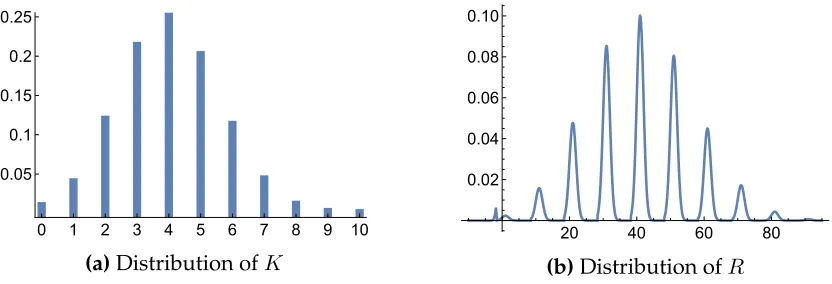
Observe that (1) and (2) expressKandRas functions ofθandn. θandnare independent random variables, distributedN(µ, τ2)andG(dM, e∗(dM))respectively. Hence, from (1)
[image:17.612.95.511.211.353.2]and (2), we can derive the distributions ofKandR(for more details, see the Appendix). Figure 1 plots these distributions for a particular numerical example.
0 1 2 3 4 5 6 7 8 9 10 0.05
0.1 0.15 0.2 0.25
(a)Distribution ofK
20 40 60 80
0.02 0.04 0.06 0.08 0.10
(b)Distribution ofR
Figure 1–Figure 1 plots the distributions ofK andRfor a numerical example. The para-metric assumptions are as follows:µ= 1,τ = 1,v= 10,c(e) = (10e)2, and the auction
win-ner is directly connected to10investors and has no indirect connections (dM = (10,0,0, ...)). Note that the distribution ofKis discrete while the distribution ofRis continuous.
2.4
Endogenizing the Network
Thus far, we have taken the network,g, between agents as exogenous. We can endoge-nize the network by adding an initial period to the game. Assume there are initially no connections between agents. In period 0, each investor chooses one manager to whom he will link. Proposition 2 characterizes the equilibria of this game. The proof is given in the Appendix.
Proposition 2. Suppose there are at least three investors (card(NI) ≥ 3) and the returns to
moving and shaking are large (v >ˆv). All equilibria have the following properties, and moreover, such equilibria exist:
by guest on August 11, 2016
http://qje.oxfordjournals.org/
(1) In period 0, all investors link to one particular manager: Y. Y can be any manager. (2) Subsequently,Y wins the auction (Y =M) and exerts positive effort (eY >0).
(3) Y receives a higher expected payoff than other managers.
According to Proposition 2, even though managers are identicalex ante, one emerges as most connected in equilibrium. In fact, all investors link to the same manager. This manager consequently wins the auction, moves and shakes the project, and earns a higher payoff than his peers.
While the proof is left for the Appendix, the intuition is as follows. Investors strictly prefer to link to the most connected manager. They prefer to do so because the most connected manager wins the auction; unless an investor links to the auction winner, he has no opportunity to invest in the project. Since investors strictly prefer to link to the most connected manager, all investors end up linking to the same manager in equilibrium.
Note that Proposition 2 assumesv > vˆbecause it ensures the auction winner exerts positive effort (eM > 0). If the auction winner exerts zero effort (eM = 0), investors are
indifferent over whom to link to, since whomever they choose to link to, there is zero chance of having an opportunity to invest in the project.
3
Extensions
We can extend the baseline model by making managers heterogeneous along several dimensions: (1) their skill at running the project; (2) their talent at communicating with investors; and (3) how much capital they have.
Taking the social network as exogenous, we find that these characteristics affect how much managers value the project and which one of them becomes mover and shaker. When we endogenize the network, we find that these characteristics are also predictive of who emerges as most connected.
Skill at running the project. In the baseline model, managers were equally skilled at running the project. We now assume that, if manageriruns the project, it yields a return
by guest on August 11, 2016
http://qje.oxfordjournals.org/
R=θ+v ·K+αi, whereαidenotes the skill of manageri. We assumeαi ≥0.21
Ability to communicate. Managers had the same ability to communicate in the base-line model (i.e., the same ability to raise awareness of the project among social connec-tions). We now assume the cost of effort for manager i is c(ei
γi), with γi > 0. One can
think ofγias manageri’s ability to communicate with investors.
Seed money. Managers had no capital of their own in the baseline model. We now assume manager i has an amount ki ≥ 0. The auction winner, M, can use his capital
as ”seed money” for the project. Specifically, at time 2, before investors decide whether to contribute capital, M chooses sM ≤ kM: the amount of capital he will put into the
project. The auction winner receives a payoff(1−βM ·Pj∈Saj)R−sM −c( eM
γM)−b(2),
whereK =sM +Pj∈Saj. Managers who do not win the auction receive a payoff of0.
3.1
Exogenous Network
When we take the network g between agents as exogenous, we obtain the following analog of Proposition 1.
Proposition 3. In equilibrium:
(1) Managers bid their valuations of asset A in the auction: bi =Vi.
(2) Manager i’s valuation of asset A is a function of his social connections, skill at running the project, communication ability, and capital: Vi =V(di, αi, γi, ki).
(3) V(di, αi, γi, ki)is weakly increasing indi,γi, andki, and strictly increasing inαi.
(4) There existsvˆsuch that, wheneverv >vˆ:
(i) V(di, αi, γi, ki)is strictly increasing in di, αi, and ki, and strictly increasing inγi
provideddi >0.
21In some instances, a manager may be able to contract with another party to compensate for lack of
skill. To give a concrete example, a manager might be able to hire a consultant. Our definition of skill concerns those aspects for which it is not possible to compensate.
by guest on August 11, 2016
http://qje.oxfordjournals.org/
(ii) Provided the manager who wins the auction has some social connections (dM > 0),
he exerts positive effort (eM >0).
(iii) The auction winner uses his capital to seed the project (sM =kM).
According to Proposition 3, the auction winner will be the manager who values the project most. As in the baseline model, managers value the project more when they are more connected. Managers also value the project more when they are more skilled at running the project, when they are more able communicators, and when they have more capital.
Additionally, Proposition 3 says that, provided the returns to moving and shaking are large (v > vˆ), the auction winner uses his capital to seed the project (sM = kM).
Furthermore, managers’ valuations of the project are strictly increasing in the amount of seed capital (ki) they have.
The formal proof is left for the Appendix, but the logic is as follows. Managers value the project more when they have more seed capital because seeding is worthwhile. Seeding is worthwhile for two reasons. First, it directly contributes an amountsi to the
project. Second, and more importantly, seeding indirectly contributes to the project by increasing investors’ willingness to provide capital.
3.2
Endogenous Network
We can endogenize the network g in the same manner as in Section 2.4: by assuming there are initially no connections between agents and that each investor, in period 0, chooses one manager to whom he will link. Proposition 4 characterizes the equilibria of this game.
Proposition 4. Suppose there are at least three investors (card(NI) ≥ 3) and the returns to
moving and shaking are large (v >ˆv).
(1) All equilibria have the following properties, and moreover, such equilibria exist:
(i) In period 0, all investors link to one particular manager:Y.
(ii) Subsequently,Y wins the auction (Y =M), exerts positive effort (eY >0), and uses
his capital to seed the project (sY =kY).
by guest on August 11, 2016
http://qje.oxfordjournals.org/
(iii) Y receives a higher expected payoff than other managers.
(2) An equilibrium does not exist in which manageri=Y if(αi, γi, ki)is small. Specifically,
an equilibrium does not exist if:
V(dmax, αi, γi, ki)<maxj∈NM V(0, αj, γj, kj), wheredmaxdenotes the case where a
man-ager is directly connected to all investors.
(3) An equilibrium exists in which manager i = Y if (αi, γi, ki) is large. Specifically, an
equilibrium exists if:
V(dmax −dˆ, αi, γi, ki) > maxj∈NM V(ˆd, αj, γj, kj), where dˆ = (1,0,0, ...) denotes the
case where a manager has one direct connection and no indirect connections.
Proposition 4 closely mirrors Proposition 2. Once again, we find that all investors link to one particular managerY;Y subsequently wins the auction, exerts effort to move and shake the project, and earns a higher expected payoff than his peers. However, in Proposition 2, any manager could emerge as most connected and as the project’s mover and shaker. In this case, we find that a manager must be sufficiently able and have sufficient capital in order to do so (that is,(αi, γi, ki)must be sufficiently large).
Specifically, an equilibrium does not exist in which manageri=Y if:
V(dmax, αi, γi, si)< max j∈NM
V(0, αj, γj, sj),
wheredmax denotes the case where a manager is directly connected to all investors. In
this case, even if manageri is socially connected (di = dmax) and his peers are not, he
will be outbid in the auction. Since investors have a preference to link to the eventual auction winner, managericannot be socially connected in equilibrium.22
Proposition 4 rules out manager i becoming mover and shaker if (αi, γi, ki)is
suffi-ciently low. However, managerican potentially become mover and shaker even if he is less skilled at running the project than some other managerj, has lower communication 22Note that, if investors are more willing to link to some managers than others, this would also affect
who can emerge as mover and shaker. We could model this by assuming a cost to investors,li, of linking
to manageri. A high linking cost does not directly affect a manager’s valuation of asset A; but it could indirectly affect it since it might prevent investors from connecting to him.
by guest on August 11, 2016
http://qje.oxfordjournals.org/
ability, and has less capital. Furthermore, if manager i emerges as mover and shaker rather thanj, he receives a strictly higher expected payoff.
Movers and shakers are good from an efficiency point of view – in the sense that there would be no investment without the mover and shaker’s effort; but the outcome will be more or less efficient depending upon which manager emerges as mover and shaker. Intuitively, investors may coordinate on a manager who is more or less suited to run the project.
4
Concluding remarks
We have analyzed a model with two types of agents – managers and investors – and an investment project, whose return is a function both of its underlying quality and aggregate investment. Managers and investors form social connections. Managers then bid to buy control of the project and the winning bidder puts effort into making investors aware of it. Finally, a subset of aware investors are given the chance to invest and they decide whether to do so after receiving private signals of the project’s quality.
We first analyze the model taking the social network as exogenous. Connections increase a manager’s ability to raise capital. Consequently, the most connected manager wins the auction, exerts effort to move and shake the project, and, provided he is strictly most connected, earns a positive rent. When we endogenize the network, we find that all investors link to one particular manager. Therefore, even though all managers are
ex ante identical, one emerges as most connected in equilibrium, becomes the project’s
mover and shaker, and receives a higher expected payoff than his peers.
We also extend our baseline model by making managers heterogeneous along several dimensions: (1) their skill at running the project; (2) their talent at communicating with investors; and (3) how much capital they have. These characteristics affect how much managers value the project. Consequently, when we take the network as exogenous, they affect who emerges as mover and shaker. When we endogenize the network, these characteristics are also predictive of who emerges as most connected.
There are a number of implications of our theory and potential avenues for future work. Here, we briefly sketch five.
by guest on August 11, 2016
http://qje.oxfordjournals.org/
One notable feature of our model is that rents earned by managers do not correspond to their “marginal product” – at least not in the conventional usage of that term. In our setting, rents are derived from social position. The mover and shaker is socially useful, to be sure, but can derive “outsize” rewards. Furthermore, the model suggests that it is easy to misattribute a mover and shaker’s success to his skill at running the project. In fact, a mover and shaker may succeed in spite of – rather than because of – his skill. The broad debate about rising inequality (see Piketty (2014) for a notable recent contribution) has focused to a large degree on returns to capital versus labor, but relatively little on what might be termed “returns to social position.” Our theory differs from existing accounts of the drivers of inequality because technological factors play a secondary role. Empirical tests of the relative importance of network position versus marginal product may be informed by the structure of our model.
Second, our model suggests that having capital to seed projects can be valuable. This raises the possibility that, in the absence of having such capital oneself, one may wish to contract with a large investor to play such a role. In serving as anchor investors for projects they may earn higher rates of return than small investors. In other words, such investors may receive compensation not just for the capital they personally provide to projects but also for the additional capital their investments help attract.23 To give an
example, when Blackstone was raising its first private equity fund its cofounders, Steve Schwarzman and Pete Peterson, found it enormously challenging to raise money.24 Pru-dential became an anchor investor, putting in $100 million, but extracted very positive terms. According to Carey and Morris (2010):
23We should mention that there is an existing literature on anchor stores. For instance, Gould et al.
(2005) demonstrate empirically that shopping mall store contracts are written to take account of the pos-itive externality that “national brand” stores generate in driving traffic to smaller stores. Bernstein and Winter (2012) derive the structure of the optimal contract in the presence of heterogeneous externalities. Our theory, adapted to such a setting, suggests that anchor stores may receive preferable terms, but for rather different reasons than given in this strand of literature, which typically assumes that only the an-chor store imposes (positive) externalities on other stores. By contrast, our model (as applied to stores), involves all stores imposing externalities on one another; these externalities being proportional to size. The argument in, say, Gould et al. (2005) or Bernstein and Winter (2012) as to why there should be a better rental rate for a large store does not apply in our environment. Our theory nonetheless suggests that an-chor stores might obtain a better rate: the reason being that their participation helps to secure other stores’ participation.
24The Blackstone Group now has around $30 billion in funds under management and more than 1500
employees.
by guest on August 11, 2016
http://qje.oxfordjournals.org/
“Prudential insisted that Blackstone not collect a dime of the profits until Prudential and other investors had earned a 9 percent compounded annual return on every dollar they’d pledged to the fund...Prudential also insisted that Blackstone pay investors in the fund 25 percent on the net revenue...from its M&A advisor work, even on deals not connected to the fund...In the end, these were small prices to pay for the credibility the Pru’s backing would give Blackstone.”
Third, political campaigns have many of the features of our model. They are “projects”; people make contributions (financial and non-financial); and there are strong comple-mentarities. Moreover, beliefs about what others will do seem to matter a lot. Donors often worry about what other donors are contributing, and it is common wisdom that voters typically like to vote for winning candidates. The strong momentum effects in, for example, US Presidential Primaries (see Knight and Schiff (2010) for persuasive em-pirical evidence) may be explained, in part, by considerations present in our theory.
Fourth, there is a burgeoning literature on ”persistent performance differences” in or-ganizations. Most models seeking to rationalize differences among otherwise identical organizations involve some kind of equilibrium theory whereex anteidentical organiza-tions end up in different posiorganiza-tions ex post. In, for example, Chassang (2010) and Ellison and Holden (2014) this wedge is due to dynamics. Our model suggests an alternative ex-planation for persistent performance differences that does not involve dynamics. In our theory, agents/investors focus their attention on one particular manager; that manager may be more or less skilled.
Finally, one might be tempted to take a benign view of moving and shaking, given the coordinating role of movers and shakers. It is worth remembering there may be externalities associated with the outcomes they effect. For instance, the heads of or-ganized crime syndicates may be movers and shakers; so, too, lobbyists for nefarious special interests. To draw appropriate welfare conclusions it is necessary to take these externalities into account.
by guest on August 11, 2016
http://qje.oxfordjournals.org/
References
Almeida, Heitor, Murillo Campello, and Michael S. Weisbach, “The Cash Flow Sensi-tivity of Cash,”Journal of Finance, 2004,59(4), 1777–1804.
Alonso, Ricardo, Wouter Dessein, and Niko Matouschek, “When Does Coordination Require Centralization?,”American Economic Review, March 2008,98(1), 145–179.
Bala, Venkatesh and Sanjeev Goyal, “A Noncooperative Model of Network Forma-tion,”Econometrica, September 2000,5, 1181–1229.
Banerjee, Abhijit, Arun G. Chandrasekhar, Esther Duflo, and Matthew O. Jackson, “The diffusion of microfinance,”Science, 2013,341, 363–370.
Baumol, William J, The microtheory of innovative entrepreneurship, Princeton University Press, 2010.
Bernstein, Shai and Eyal Winter, “Contracting with Heterogeneous Externalities,”
American Economic Journal: Microeconomics, 2012,4(2), 50–76.
Bertrand, Marianne and Antoinette Schoar, “The Role of Family in Family Firms,” Jour-nal of Economic Perspectives, 2006,20(2), 73–96.
Blanchard, Olivier, Florencio Lopez de Silanes, and Andrei Shleifer, “What do firms do with cash windfalls?,”Journal of Financial Economics, 1994,36(3), 337–360.
Bloch, Francis and Bhaskar Dutta, “Communication networks with endogenous link strength,”Games and Economic Behavior, 2009,66(1), 39–56.
Bolton, Patrick, Markus Brunnermeier, and Laura Veldkamp, “Leadership, Coordi-nation and Mission-Driven Management,” Review of Economic Studies, 2013, 80 (2), 512–537.
Burt, Ronald S., “Structural Holes versus Network Closure as Social Capital,” in Nan Li, Karen S. Cook, and Ronald S. Burt, eds.,Social Capital: Theory and Research, Aldine de Gruyter, 2001, pp. 31–56.
by guest on August 11, 2016
http://qje.oxfordjournals.org/
Caballero, Ricardo J., Eduardo M. R. A. Engel, and John C. Haltiwanger, “Plant-Level Adjustment and Aggregate Investment Dynamics,”Brookings Papers on Economic Ac-tivity, 1995,1995(2), 1–54.
Caillaud, Bernard and Jean Tirole, “Consensus Building: How to Persuade a Group,”
American Economic Review, 2007,97(5), 1877–1900.
Calvo-Armengol, Antoni, Joan de Marti, and Andrea Prat, “Communication and Influ-ence,”Theoretical Economics, 2014,forthcoming.
Carey, David and John E. Morris,King of Capital, Crown, 2010.
Carlsson, Hans and Eric van Damme, “Global Games and Equilibrium Selection,”
Econometrica, 1993,61(5), 989–1013.
Chassang, Sylvain, “Building routines: Learning, cooperation, and the dynamics of incomplete relational contracts,”American Economic Review, 2010,100(1), 448–465.
Chevalier, Judith A., “Do LBO Supermarkets Charge More? An Empirical Analysis of the Effects of LBOs on Supermarket Pricing,”Journal of Finance, 1995,50(4), 1095–1112.
Chwe, Michael Suk-Young, Rational Ritual, Oxfordshire, U.K.: Princeton University Press, 2001.
Dessein, Wouter, “Authority and communication in organizations,”Review of Economic Studies, 2002,69(4), 811–838.
and Tano Santos, “Adaptive Organizations,” Journal of Political Economy, 2006, 114
(5), 956–995.
and , “Managerial Style and Attention,”Working paper, 2014.
, Andrea Galeotti, and Tano Santos, “Rational Inattention and Organizational Focus,”
Working paper, 2014.
Dewan, Torun and David Myatt, “Scandal, Protection, and Recovery in the Cabinet,”
American Political Science Review, 2007,101(1), 63–77.
by guest on August 11, 2016
http://qje.oxfordjournals.org/
and , “The Qualities of Leadership: Direction, Communication, and Obfuscation,”
American Political Science Review, 2008,102(3), 351–368.
Ellison, Glenn and Richard Holden, “A Theory of Rule Development,”Journal of Law Economics and Organization, 2014,30(4), 649–682.
Fazzari, Steven, R. Glenn Hubbard, and Bruce C. Petersen, “Financing Constraints and Corporate Investment,”Brookings Papers on Economic Activity, 1988,1988(1), 141–195.
Feri, Francesco, “Stochastic Stability in Networks with Decay,”Journal of Economic The-ory, 2007,135, 442–457.
Galeotti, Andrea and Sanjeev Goyal, “The Law of the Few,”American Economic Review, 2010,100(4), 1468–1492.
, , and Jurjen Kamphorst, “Network formation with heterogeneous players,”Games and Economic Behavior, 2006,54(2), 353–372.
Gibbons, Robert, “What the Folk Theorem Doesn’t Tell Us,” Industrial and Corporate Change, 2006,15, 381–386.
and Rebecca Henderson, “What Do Managers Do?,” in Robert Gibbons and John Roberts, eds., The Handbook of Organizational Economics, Princeton University Press, 2012.
Gould, Eric D., B. Peter Pashigian, and Canice J. Prendergast, “Contracts, Externalities, and Incentives in Shopping Malls,”Review of Economics and Statistics, 2005,87(3), 411– 422.
Goyal, Sanjeev and Fernando Vega-Redondo, “Structural holes in social networks,”
Journal of Economic Theory, 2007,137(1), 460–492.
Hayashi, Fumio, “Tobin’s Marginal q and Average q: A Neoclassical Interpretation,”
Econometrica, 1982,50(1), 213–224.
Hellwig, Christian and Laura Veldkamp, “Knowing what others know: Coordination motives in information acquisition,”The Review of Economic Studies, 2009,76(1), 223– 251.
by guest on August 11, 2016
http://qje.oxfordjournals.org/
Hermalin, Benjamin E., “Toward an economic theory of leadership: Leading by exam-ple,”American Economic Review, 1998,88(5), 1188–1206.
Herskovic, Bernard and Joao Ramos, “Acquiring Information Through Peers,”Working Paper, 2015.
Hochberg, Yael, Alexander Ljungqvist, and Yang Lu, “Whom you know matters: Ven-ture capital networks and investment performance,” The Journal of Finance, 2007, 62
(1), 251–301.
Hojman, Daniel and Adam Szeidl, “Core and Periphery in Networks,” Journal of Eco-nomic Theory, 2007,139(1), 295–309.
Hoshi, Takeo, Anil Kashyap, and David Scharfstein, “Corporate Structure, Liquidity and Investment: Evidence from Japanese Industrial Groups,”Quarterly Journal of Eco-nomics, 1991,106(1), 33–60.
Jackson, Matthew O. and Asher Wolinksy, “A Strategic Model of Social and Economic Networks,”Journal of Economic Theory, 1996,71(1), 44–74.
Kaplan, Steven N. and Antoinette Schoar, “Private Equity Performance: Returns, Per-sistence, and Capital Flows,”Journal of Finance, August 2005,LX(4), 1791–1823.
and Luigi Zingales, “Do Investment-Cash Flow Sensitivities Provide Useful Mea-sures of Financing Constraints?,”Quarterly Journal of Economics, 1997,112(1), 169–215.
Kashyap, Anil K., Owen A. Lamont, and Jeremy C. Stein, “Credit Conditions and the Cyclical Behavior of Inventories,” The Quarterly Journal of Economics (1994) 109 (3): 565-59, 1994,109(3), 565–592.
Knight, Brian and Nathan Schiff, “Momentum and Social Learning in Presidential Pri-maries,”Journal of Political Economy, October 2010,118(6), 1110–1150.
Knight, Frank H.,Risk, uncertainty and profit, New York, NY: Hart, Schaffner and Marx, 1921.
Lamont, Owen A., “Cash Flows and Investment: Evidence from Internal Capital Mar-kets,”Journal of Finance, 1997,51(1), 83–109.
by guest on August 11, 2016
http://qje.oxfordjournals.org/
Lucas, Robert E., “Adjustment Costs and the Theory of Supply,”Journal of Political Econ-omy, 1967,75(4), 321–334.
and Edward C. Prescott, “Investment Under Uncertainty,”Econometrica, 1971,39(5), 659–681.
Majumdar, Sumon and Sharun W. Mukand, “Policy gambles,” American Economic Re-view, 2004, pp. 1207–1222.
Miao, Jianjun and Pengfei Wang, “A Q-Theory Model with Lumpy Investment,” Eco-nomic Theory, 2014,57, 133–159.
Morck, Randall, Andrei Shleifer, and Robert W. Vishny, “Management ownership and market valuation: An empirical analysis,”Journal of Financial Economics, 1988,20, 293–315.
Morris, Stephen and Hyun Song Shin, “Unique Equilibrium in a Model of Self-Fulfilling Currency Attacks,”American Economic Review, 1998,88(3), 587–597.
and , “Global Games: Theory and Applications,” in M. Dewatripont, L. Hansen, and S. Turnovsky, eds.,Advances in Economics and Econometrics (Proceedings of the Eighth
World Congress of the Econometric Society), Cambridge University Press, 2003, pp. 56–
114.
Peek, Joe and Eric Rosengren, “The International Transmission of Financial Shocks,”
American Economic Review, 1997,87(4), 495–505.
Piketty, Thomas,Capital in the Twenty-First Century, Cambridge, MA: Harvard Univer-sity Press, 2014.
Prendergast, Canice and Lars Stole, “Impetuous youngsters and jaded old-timers: Ac-quiring a reputation for learning,”Journal of Political Economy, 1996, pp. 1105–1134.
Prescott, Edward C., “Theory ahead of business cycle measurement,”Quarterly Review, Federal Reserve Bank of Minneapolis, 1986, pp. 9–22.
Rajan, Raghuram G. and Luigi Zingales, “Power in a Theory of the Firm,”The Quarterly Journal of Economics, 1998,113(2), 387–432.
by guest on August 11, 2016
http://qje.oxfordjournals.org/
Rantakari, Heikki, “Governing Adaptation,”Review of Economic Studies, 2008,75, 1257– 1285.
Schumpeter, Joseph A.,The theory of economic development: An inquiry into profits, capital, credit, interest, and the business cycle, Cambridge, MA: Harvard University Press, 1934.
Sharpe, Steven A., “Financial Market Imperfections, Firm Leverage, and the Cyclicality of Employment,”American Economic Review, 1994,84(4), 1060–1074.
Stein, Jeremy C., “Takeover Threats and Managerial Myopia,”Journal of Political Econ-omy, 1988,96(1), 61–80.
, “Efficient Capital Markets, Inefficient Firms: A Model of Myopic Corporate Behav-ior,”Quarterly Journal of Economics, 1989,104, 655–669.
Uzawa, H., “Time Preference and the Penrose Effect in a Two-Class Model of Economic Growth,”Journal of Political Economy, 1969,77(4), 628–652.
Zeckendorf, William and Edward A. McCreary,The Autobiography of William Zeckendorf:
With Edward McCreary, Holt McDougal, 1970.
by guest on August 11, 2016
http://qje.oxfordjournals.org/