warwick.ac.uk/lib-publications
A Thesis Submitted for the Degree of PhD at the University of Warwick
Permanent WRAP URL:
http://wrap.warwick.ac.uk/97940
Copyright and reuse:
This thesis is made available online and is protected by original copyright.
Please scroll down to view the document itself.
Please refer to the repository record for this item for information to help you to cite it.
Our policy information is available from the repository home page.
Some spatial statistical
techniques with applications to
cellular imaging data
Thomas Honnor
A thesis presented in fulfilment of the requirements for
the degree of
Doctor of Philosophy in Statistics
Department of Statistics
University of Warwick
Contents
List of Figures iv
List of Tables vi
Acknowledgements vii
Declarations viii
Abstract ix
1 Introduction 1
1.1 Biological background . . . 1
1.2 Biological questions of interest . . . 2
1.2.1 Localisation of TACC3 and EB3 . . . 3
1.2.2 Impact of TACC3 on K-fiber structure . . . 3
1.2.3 Mitotic spindle structure modelling . . . 4
1.3 Thesis outline . . . 5
1.4 Novel contributions . . . 6
2 Background 7 2.1 Point processes . . . 7
2.1.1 Definition . . . 7
2.1.2 Properties . . . 9
2.1.3 Summary statistics . . . 11
2.1.4 Poisson point process model . . . 17
2.1.5 Point process density . . . 19
2.1.6 Alternative point process models . . . 20
2.2 Comparison between pairs of spatial processes . . . 22
2.2.1 Colocalisation analysis . . . 22
2.2.2 Metrics between probability distributions . . . 25
2.2.4 Common component models . . . 27
2.2.5 Object tracking techniques . . . 29
2.3 Hypothesis testing . . . 29
2.3.1 Statistical test . . . 29
2.3.2 Bootstrap test . . . 30
2.3.3 Permutation test . . . 32
2.3.4 Multiple hypothesis testing . . . 33
2.3.5 Effect size . . . 33
3 Differences between collections of point patterns 35 3.1 Introduction . . . 35
3.1.1 Mathematical representation of data . . . 36
3.1.2 Statistical problem . . . 37
3.2 Quantification of differences in point pattern structure . . . 38
3.2.1 Summary statistics . . . 38
3.2.2 Test statistics . . . 42
3.2.3 Significance quantification . . . 45
3.3 Validation study . . . 46
3.3.1 Simulation description . . . 46
3.3.2 Study design . . . 47
3.3.3 Study results . . . 50
3.4 Investigation of changes in K-fiber microtubule organisation following TACC3 overexpression . . . 54
3.4.1 Biological background . . . 54
3.4.2 Observed data features . . . 57
3.4.3 Assumption checking . . . 58
3.4.4 Exploratory data analysis . . . 59
3.4.5 Permutation testing results . . . 63
3.4.6 Sensitivity analysis . . . 66
3.5 Conclusions . . . 67
3.5.1 Statistical methodology . . . 67
3.5.2 Biological conclusions . . . 69
4 Dependency between estimated local bulk movement patterns 71 4.1 Introduction . . . 71
4.1.1 Mathematical representation of data and statistical problem . 72 4.2 Estimating movement patterns and a test for dependence . . . 73
4.2.1 Approximation of movement . . . 73
4.2.3 Summary statistic comparison . . . 77
4.2.4 Combination of summary statistic comparisons . . . 78
4.2.5 Significance quantification . . . 79
4.2.6 Computational considerations . . . 83
4.3 Validation study . . . 84
4.3.1 Simulation description . . . 84
4.3.2 Study results . . . 87
4.4 Investigation of EB3 and TACC3 data . . . 97
4.4.1 Biological background . . . 97
4.4.2 Exploratory data analysis . . . 99
4.4.3 Permutation testing results . . . 101
4.5 Conclusions . . . 104
4.5.1 Statistical methodology . . . 104
4.5.2 Biological conclusions . . . 105
5 Mitotic spindle modelling and comparison 106 5.1 Introduction . . . 106
5.1.1 Mathematical representation of data . . . 107
5.2 Model formulation and comparison of model fit . . . 108
5.2.1 Spheroid model . . . 108
5.2.2 Data alignment . . . 109
5.2.3 Model direction . . . 109
5.2.4 Imaging correction . . . 111
5.2.5 Model comparison . . . 111
5.3 Investigation of spindle data . . . 113
5.3.1 Exploratory analysis . . . 113
5.3.2 Model comparison results . . . 116
5.4 Conclusions . . . 119
6 Discussion 120 6.1 Overview . . . 120
6.2 Possible extensions . . . 121
List of Figures
1.1 Diagram of the intermediate stages of mitosis . . . 2
3.1 Diagrams of simulated point pattern realisations . . . 49
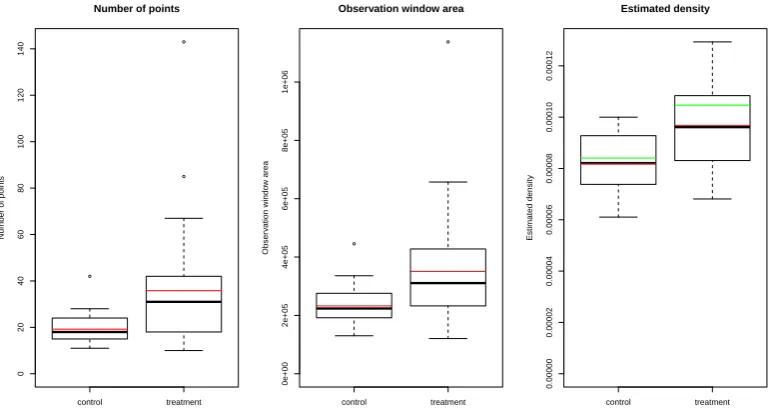
3.2 Diagram of some observed point patterns . . . 55
3.3 Diagram of an observed marked point pattern . . . 56
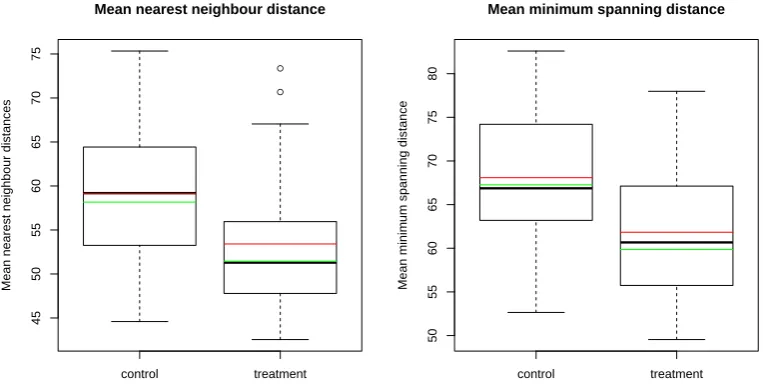
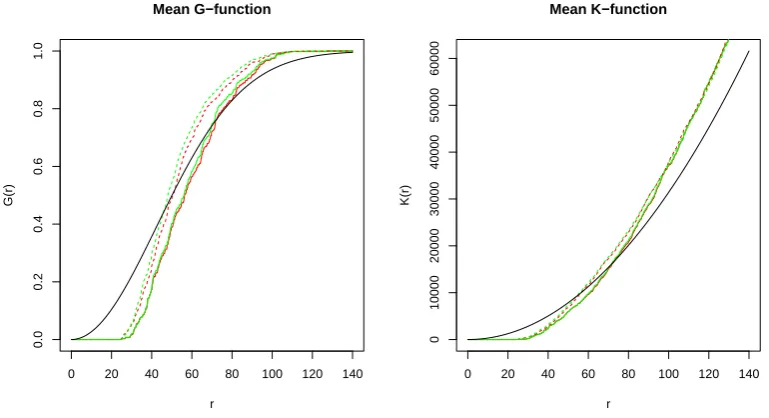
3.4 Plots of first order point pattern summary statistics for observed data 60 3.5 Plots of point separation distance summary statistics for observed data 61 3.6 Plots of second order summary functions for observed data . . . 62
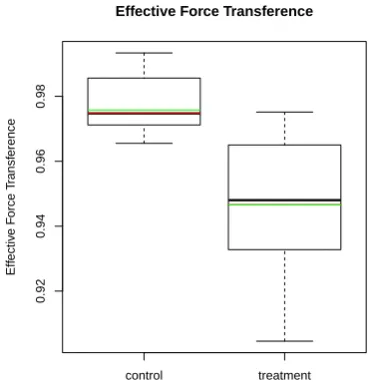
3.7 Plot of marked point pattern summary statistics for observed data . 63 4.1 Diagram illustrating the temporal evolution of a simulated spatio-temporal process and the resulting summary statistic . . . 76
4.2 Diagram illustrating transformations permittable under the symme-tric null hypothesis and the resulting equivalence classes of subregions 82 4.3 Images of spatio-temporal process simulations . . . 88
4.4 Diagrams of true and estimated movement patterns for a simulated spatio-temporal process . . . 89
4.5 Images of observed spatio-temporal processes across five consecutive time points for three samples . . . 98
4.6 Plot of colocalisation between observed data as measured by Pearson’s correlation coefficient . . . 100
4.7 Plots of temporal variation in subregion intensity for observed data . 101 5.1 Diagram of proposed transformation of observed line pattern data to a standardised coordiante system . . . 110
5.2 Diagram of discrepancy between mitotic spindle model and observed data directions . . . 112
5.3 Diagram of observed data for a sample with good model fit . . . 114
5.5 Plot of smoothed, normalised density estimates of angles between
List of Tables
3.1 Summary of validation study results for point patterns . . . 52
3.2 Summary of validation study results for marked point patterns . . . 53
3.3 Test results for observed (marked) point pattern data . . . 63
3.4 Treatment effect sizes for observed (marked) point pattern data . . . 65
3.5 Summary of sensitivity analysis results for (marked) point pattern data 68
4.1 Summary of test results for independent spatio-temporal simulations
under a variety of null hypotheses . . . 92
4.2 Summary of test results for dependent spatio-temporal simulations
under the most appropriate null hypothesis . . . 94
4.3 Summary of test results for dependent isotropic spatio-temporal
si-mulations tested under a number of suitable null hypotheses . . . 96
4.4 Summary of test results for observed data . . . 103
5.1 Mitotic spindle model fit comparison scores between observed data
Acknowledgements
I would like to thank my supervisors, Dr. Julia Brettschneider and Dr. Adam
Johansen; collaborators, Dr. Stephen Royle and his research group; department
colleagues; friends and family for all of their help and support over the course of my
studies. This thesis would not have been possible without you.
Particular thanks go to Dr. Stephen Royle and his research group within the
Centre for Mechanochemical Cell Biology at the University of Warwick for
discussi-ons of the biological and statistical problems of interest to them and for providing
the data that serves to illustrate the ability of the methodologies proposed within
this thesis.
I would also like to thank the Engineering and Physical Sciences Research
Coun-cil for funding these studies through Doctoral Training Grants EP/K503204/1,
Declarations
This thesis is submitted to the University of Warwick in support of my application
for the degree of Doctor of Philosophy. It has been composed by myself and has not
been submitted in any previous application for any degree.
The work presented was carried out by the author, with real biological data
made available by Dr. Stephen Royle, Department of Mechanochemical Cell Biology,
University of Warwick.
Material from Chapters 3 and 4 respectively has been made available by the
author as working papers:
Thomas R. Honnor, Julia A. Brettschneider, Adam M. Johansen,
Differen-ces in spatial point patterns with application to subcellular biological structures,CRiSM Working Paper 17-01.
Thomas R. Honnor, Adam M. Johansen, Julia A. Brettschneider, A
non-parametric test for dependency between estimated local bulk movement patterns,CRiSM Working Paper 17-03.
Material from Chapter 5 has been published by the author in the following paper:
F. M. Nixon, T. R. Honnor, N. I. Clarke, G. P. Starling, A. J. Beckett, A. M. Johansen, J. A. Brettschneider, I. A. Prior, and S. J. Royle. Microtubule
or-ganization within mitotic spindles revealed by serial block face scanning electron
microscopy and image analysis. Journal of Cell Science, 130(10):1845-1855, April
Abstract
The aim of this thesis is to provide techniques for the analysis of a variety of types of
spatial data, each corresponding to one of three biological questions on the function
of the protein TACC3 during mitosis. A starting point in each investigation is
the interpretation of the biological question and understanding of the form of the
available data, from which a mathematical representation of data and corresponding
statistical problem are developed.
The thesis begins with description of a methodology for application to two
col-lections of (marked) point patterns to determine the significance of differences in
their structure, achieved through comparison of summary statistics and
quantifica-tion of the significance of such differences by permutaquantifica-tion tests. A methodology is
then proposed for application to a pair spatio-temporal processes to estimate their
individual temporal evolutions, including ideas from optimal transportation theory,
and a test of dependence between such estimators. The thesis concludes with a
proposed model for line data, designed to approximate the mitotic spindle structure
using trajectories on the surface of spheroids, and a comparison score to compare
model fit between models and/or observations.
The results of methodologies when applied to simulated data are presented as
part of investigations into their validity and power. Application to biological data
indicates that TACC3 influences microtubule structure during mitosis at a range of
scales, supporting and extending previous investigations.
Each of the methodologies is designed to require minimal assumptions and
num-bers of parameters, resulting in techniques which may be applied more widely to
Chapter 1
Introduction
State of the art microscope technology allows the collection of large numbers of
high resolution images. Specialised preparation of biological samples and choice of
imaging approach can lead to the identification of subcellular structures and the
localisation of biomolecular species within such images. The purpose of collecting
such images may be observational, to ascertain the typical behaviour within the cell,
or experimental, to ascertain the impact on the cell of applied external conditions.
It is commonly the case that images are collected from multiple samples, the
ana-lysis of which may be improved in terms of accuracy and reliability by statistical
techniques. This thesis combines three investigations of spatial data arising from
images of biological samples during mitosis and formulates statistical methodologies
for their analysis to answer related biological questions of interest.
1.1
Biological background
Mitosis is the procedure through which eukaryote cells (those within fungi, plants
and animals) replicate, with one cell dividing into two. Chromosomes encode the
genetic material within cells and during mitosis the collection of chromosome pairs
are divided such that one chromosome from each pair makes its way into each of the
two resulting cells. Errors in the division of chromosome pairs can result in the death
of resulting cells or mutations that may be harmful to the organism (Holland and
Cleveland, 2009). A key research topic for cell biologists is therefore the process of
mitosis, the action of biomolecular species during mitosis and the impact of applied
external conditions on the process.
Division of chromosome pairs during mitosis is effectively a mechanical process.
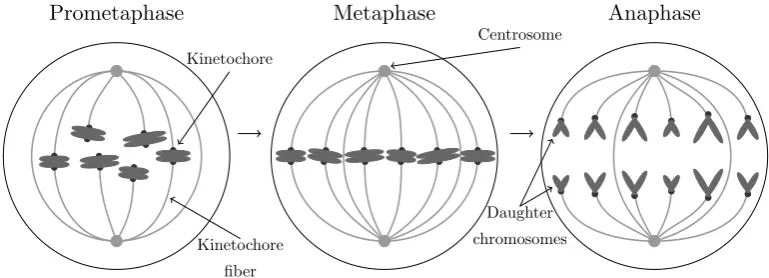
During the prometaphase of mitosis connecting fibers, kinetochore fibers or K-fibers,
grow to connect two anchor points within the cell, centrosomes, to connection points
Prometaphase Metaphase Anaphase
Kinetochore
fiber Kinetochore
Daughter
[image:13.595.117.502.90.229.2]chromosomes Centrosome
Figure 1.1: Diagram of the intermediate stages of mitosis.
structures, microtubules, which are believed to be held together by a mesh-like
structure (Booth et al., 2011). Prometaphase is followed by metaphase during which
chromosome pairs are pulled into alignment along the metaphase plate by the action
of the K-fibers. Following this, during the anaphase, chromosome pairs are pulled
apart into different halves of the cell before the cell divides. An illustration of
this process may be seen in Figure 1.1. The structure of those microtubules which
separate chromosomes during mitosis is referred to in combination as the mitotic
spindle.
1.2
Biological questions of interest
Three related biological questions of interest are considered as part of this thesis,
with each providing different types of spatial data and resulting in the development
of corresponding statistical techniques. The theme linking the three problems is
the action of TACC3 (Transforming Acidic Coiled-coil Containing protein 3) during
mitosis.
Investigations are carried out using imaging data at differing scales to investigate
different influences on the mitotic spindle structure. We refer to the micro scale as
that which considers microtubules within a single K-fiber. The macro scale on
the other hand considers microtubules within the entire mitotic spindle structure.
Differentiation is necessary because different imaging techniques are used — it is not
possible to determine every microtubule within a K-fiber from macro scale images,
similarly the field of view of micro scale images is not large enough to make inference
1.2.1 Localisation of TACC3 and EB3
EB3 (End Binding protein 3) is a protein known to localise on the tips of growing
microtubules during mitosis (Akhmanova and Steinmetz, 2010). There is some
evi-dence that TACC3 also localises on the tips of microtubules (Gutierrez-Caballero
et al., 2015). As a key purpose of microtubules is the division of chromosome pairs
during mitosis, localisation of TACC3 at the tip of microtubules may be used as
important evidence that TACC3 has some function during mitosis. We propose to
investigate data provided by Dr. Stephen Royle (previously investigated as part of
work by Gutierrez-Caballero et al. (2015)) comprised of images displaying
localisa-tion of both TACC3 and EB3, with evidence of dependence between the localisalocalisa-tion
patterns further supporting the belief that TACC3 is localised on the tips of
micro-tubules and that it may have a function during mitosis.
The data available for this analysis is fluorescence microscopy images of both
TACC3 and EB3 captured for multiple cells across a number of time points. The
two proteins are each tagged with a fluorophore which emits light at a specific range
of wavelengths when excited by incident light of particular wavelengths. Provided
emission wavelengths are suitably distinct, the emitted light may be filtered and
recorded by a camera to result in a pair of images for each sample at each time point.
Variation of light intensity within each image may be interpreted as a surrogate for
the spatial distribution of each biomolecular species. Examples of such images may
be seen in Figure 4.5 in Chapter 4.
An existing technique for the comparison of localisation between two images is
colocalisation analysis, described in more detail in Chapter 2. Due to dissatisfaction
with existing approaches and the additional information contained within time series
of images an alternative methodology for analysis is presented in Chapter 4. We
consider time series of images to be representative observations of a spatio-temporal
process, give a methodology for approximation of the temporal evolution of such
processes and provide a test for dependence between temporal evolutions. This
methodology is presented in detail in Chapter 4.
1.2.2 Impact of TACC3 on K-fiber structure
Given the evidence from Gutierrez-Caballero et al. (2015) and our investigations
(Honnor et al., 2017b), that TACC3 is located at the tip of microtubules, and the
results of investigations by Booth et al. (2011) and Nixon et al. (2015) it is proposed
that TACC3 impacts the structure of microtubules within K-fibers. Interpreting
mitosis as a mechanical process, on a micro scale differences in the structure of
and achieve accurate separation. We propose to investigate data provided by Dr.
Stephen Royle (previously investigated as part of work by Nixon et al. (2015))
comprised of microtubule locations within K-fibers under control conditions and
conditions where TACC3 is overexpressed, with evidence of significant differences
supporting the belief that TACC3 has an impact on microtubule structure within
K-fibers.
The data available for this analysis is obtained by electron microscopy of
indi-vidual K-fibers within multiple cells under both experimental conditions — control
and TACC3 overexpression. K-fiber cross-section images are obtained from parallel
imaging planes approximately perpendicular to what is assumed to be the K-fiber
axis, within which microtubules are distinguishable as dark circles. In some cases
only single images are taken from each sample, from which microtubule centre
loca-tions are reported which we choose to model as point patterns. In other cases two
images are taken from slices through a single sample at different distances along a
K-fiber, from each of which microtubule centre locations are reported. Additional
information is also provided on how microtubule centre locations, one from each
image frame, are paired as ends of a common microtubule. We choose to model
pai-red centre locations as paipai-red point patterns, which we then re-express as a marked
point pattern. Diagrams of both types of pattern may be seen in Figures 3.2 and
3.3 in Chapter 3.
There exists a large literature on the theory and application of point processes, an
introduction to which is provided in this thesis in Chapter 2. We approach the
pro-blem by considering a number of summary statistics of the (marked) point patterns
and comparing summary statistics between experimental groups, with permutation
testing used to obtain a significance level for the difference. This methodology is
presented in detail in Chapter 3.
1.2.3 Mitotic spindle structure modelling
Investigation of the previous problem is carried out at the micro scale, that of
mi-crotubules within individual K-fibers. There may be an extension of this or an
additional impact of TACC3 visible on the macro scale of the whole mitotic spindle,
irregularities in the structure of which may reduce its capability to separate
chro-mosome pairs. We propose to investigate data provided by Dr. Stephen Royle
comprised of microtubule endpoint pair locations under combinations of two
tem-perature levels and three levels of TACC3 expression, with evidence of differences
in microtubule structure indicating that TACC3 and/or temperature changes result
in structural differences of the mitotic spindle.
obtained by serial block face scanning electron microscopy through multiple cells
under a variety of experimental conditions, a detailed discussion of which is given
by Nixon et al. (2017). Additionally, for each sample a pair of points are provided
as an approximation to the centrosomes or poles of the mitotic spindle to permit
orientation of the structure. We choose to investigate the data through the collection
of straight lines connecting microtubule endpoints. Illustrations of resulting sets of
lines may be seen in Figures 5.3 and 5.4 in Chapter 5.
We make an exploratory approach to modelling the mitotic spindle using
ide-alised microtubules trajectories on the surface of a spheroid proposed based upon
arguments of symmetry and parsimony, to which the deviation of observed lines
may be determined. We then suggest a formula for comparison of model deviations
between two models and/or samples to quantify the difference in the degree to which
they deviate from the model. This methodology is presented in detail in Chapter 5.
1.3
Thesis outline
This chapter has provided a summary of three questions of interest arising from
cellular imaging studies, statistical methodologies to investigate which are the focus
of this thesis, alongside an overview of the biological knowledge necessary to put
the problems in context. Chapter 2 introduces the background theory necessary to
illuminate the methodologies presented in further chapter, including current
appro-aches that have been applied to similar problems and others which we make use
of.
Chapters 3 to 5 each present methodologies for the questions introduced in this
chapter. Chapter 3 introduces a methodology for assessing the significance of the
difference between collections of (marked) point patterns. The methodology is first
applied to simulated (marked) point patterns, before application to patterns arising
from real subcellular images. Chapter 4 introduces a methodology for estimating
local bulk movement patterns and quantifying the significance of the dependence
between pairs of such patterns. The methodology is applied to simulated image
data, before application to real cellular images. Chapter 5 proposes an exploratory
model for the mitotic spindle and statistic for the comparison of model fit between
two models and/or samples. The methodology is applied to line patterns arising
from real cellular images.
The final chapter of this thesis, Chapter 6, provides an overview of the
conclu-sions of each of the previous chapters after which some directions in which each of
1.4
Novel contributions
This thesis brings together theory from statistics, mathematics and physics in order
to develop statistical techniques for the analysis of a particular range of biological
data, but which are designed with application to more general data sets in mind.
The novel contributions of this thesis are the statistic summarising the degree to
which a collection of lines are oriented in the same direction, the effective force
transference, introduced in Chapter 3; the methodology of estimating the temporal
evolution of a spatio-temporal process by methods of optimal transportation and the
procedure for testing for dependence between two such spatio-temporal processes,
introduced in Chapter 4; and the mathematical model for microtubule direction in
the mitotic spindle and a corresponding model fit comparison score, introduced in
Chapter 5. Application to biological data sets is either completely novel, Chapters
4 and 5, or expands significantly on previous analysis of the same data set, Chapter
Chapter 2
Background
2.1
Point processes
A summary of the evolution of the study of point processes including state of the art
approaches may be found in works by Møller (2003), Gaetan and Guyon (2009) and
Diggle (2013). This section defines some of the terms and notation used in reference
to point processes in the rest of this thesis, including a description of the Poisson
point process, the foundational tractable point process model. Point processes are
denoted by underlined capital letters X, Y , . . ., point patterns by underlined lower
case letters x, y, . . ., while lower case letters with subscripts xj, xk, . . . are used to
denote points in patterns and lower case letters without subscripts x, y, . . .are used
to denote points in the general spaceRd.
2.1.1 Definition
A spatial point process X is a random countable subset of a space S. The focus
of this thesis is point processes on subsets of R2 and marked point processes on
subsets of R2×R2, but the theory of spatial point processes is introduced in this
and the following sections in the more general case ofS⊆Rd. In practice the entire processX is typically not visible, rather we observe X restricted to some bounded
observation window W ⊆S.
For any subset x ⊂S, letn(x) denote the cardinality of x, with n(x) =∞ ifx
is not finite. Denote by xB =x∩B the restriction of a point configurationx toB.
The setxis then said to be locally finite ifn(xB)<∞whenever B ⊆S is bounded.
The majority of the literature on point patterns and our investigations are restricted
to point processes X whose realisations are locally finite subsets ofS.
As with the notationxB,XBwill be used to denote the restriction of the random
the space Nlf defined by
Nlf ={x⊆S:n(xB)<∞ for all boundedB ⊆S}.
Elements of Nlf are referred to as locally finite point configurations. The empty
point configuration is denoted by ∅.
For a point process X on S the count function is the random variable given by
N(B) =n(XB).
2.1.1.1 Marked point processes
Consider X, a point process on T ⊆ Rd. Given some space V, if a random mark
vi ∈V is assigned to each point xi ∈X, thenY ={(xi, vi) :xi ∈X} ⊂S =T ×V
is called a marked point process with points inT and mark spaceV. Typically, the
mark spaceV is a finite set or a subset of Rp, p≥1.
A disc process is an example of a marked point process with mark space V =
(0,∞), for which the marked point (xi, vi) is understood to represent the disc with
centrexiand radiusvi(Stoyan and Penttinen, 2000). A marked point process of this
type may be produced in the case where X models a forest, with vi recording the
radius of the tree located atxi. Association of point processes with geometric objects
which can be identified with points inRp, for example ellipses or line segments, may
be more broadly classified as germ-grain models (Heinrich, 1992) in which xi, the
germ, specifies the location ofvi, the grain.
A further example of a marked point process is the multitype point process,
where the discrete marks,V ={1,2, . . . , k}, specifykdifferent types of points
(Lot-wick and Silverman, 1982). One of the most studied multitype point process data
sets is the amacrine cell data (Diggle, 1986) which records the locations of different
light detecting cells within the eyes of a rabbit. Multitype point processes with k
types of points may alternatively be considered ask-dimensional multivariate point
process, that is a tuple (X1, X2, . . . , Xk) of point processes X1, X2, . . . , Xk
corre-sponding to kdifferent types of points. Multitype and multivariate point processes
are equivalent, with the preferred choice of specification potentially dependent upon
the application.
2.1.1.2 Formal treatment of spatial point processes
In the previous section marked point processes onS =T×V with points inT ⊆Rd were distinguished from point processes on S ⊆ Rd. However, it is possible to
formalise discussion of both of these types of point processes and point processes on
non-Euclidean spaces through a unified measure theoretic framework, where S is a
More formal treatment requires the specification of σ-algebras for the space S
and the set of locally finite point patternsNlf. As the focus of this thesis is on point
patterns on spaces S ⊆Rd and not on proving theorems related to point patterns,
the treatment of point patterns will be less formal, with B ⊆ S used instead of
the statement that B is a member of a σ-algebra over S, F ⊆ Nlf used instead
of the statement that F is a member of a σ-algebra over Nlf and all sets assumed
measurable with respect to the appropriate Borel σ-algebra.
2.1.2 Properties
2.1.2.1 Stationarity and isotropy
A point process X on Rd is defined to be stationary if its distribution is invariant
under translations. In other words, the distribution of X+x= {xi+x :xi ∈X}
must be the same of that of X for any x∈Rd.
A point processX on Rdis defined to be isotropic if its distribution is invariant
under rotations about the origin. In other words, the distribution of RX ={Rxi :
xi ∈X} is the same as that ofX under the action of any matrixRfrom the special
orthogonal group of dimensiond,R∈SO(d).
2.1.2.2 First order properties
The first order properties of the random count variables N(B) for B ⊆S are
des-cribed by the intensity measure. The intensity measure µon Rd is given by
µ(B) =EN(B) B ⊆Rd.
If the intensity measure µcan be written as
µ(B) =
Z
B
ρ(x)dx B ⊆Rd,
for some functionρ:S →[0,∞), then ρ is referred to as the intensity function.
If ρ(x) = ρ is constant over x ∈ S, then X is said to be homogeneous or first
order stationary with intensity ρ. (A process X may be first order stationary or
homogeneous, but not stationary as in the description of the previous section if
Var(N(B)) varies with the location of B.) The intensity ρ of a homogeneous point
process may then be interpreted as the mean number of points per unit volume.
If ρ(x) is not constant over x∈S, then X is said to be inhomogeneous. In the
inhomogeneous case,ρ(x)dxmay be thought of as the probability of the occurrence
2.1.2.3 Second order properties
The second order properties of the random count variables N(B) for B ⊆ S are
described by the second order factorial moment measure. The second order factorial
moment measureα(2) on S×S is given by
α(2)(C) =E
X
xi6=xj∈X
1[(xi, xj)∈C] C ⊆S×S,
where the sum is taken over all distinct pairs of pointsxi and xj.
The intensity measureµand the second order factorial moment measureα(2)
to-gether determine the second order moments of the random count variableN(B), B⊆
Rd through
E[N(B1)N(B2)] =E
X
xi∈X
1{xi∈B1} ×
X
xj∈X
1{xj ∈B2}
=E X
xi6=xj∈X
1{xi∈B1}1{xj ∈B2}
+ X
xi=xj∈X
1{xi∈B1}1{xj ∈B2}
=E X
xi6=xj∈X
1{xi∈B1}1{xj ∈B2]
+E
X
xi∈X
1{xi∈B1∩B2}
=α(2)(B1×B2) +µ(B1∩B2) B1, B2 ⊆Rd,
where the second summation term over all pairs of equal pointsxi =xj withxi∈B1
and xj ∈B2 reduces to the sum over the individual points inB1∩B2.
If the second order factorial moment measure α(2) can be written as
α(2)(C) =
Z Z
1{(x, y)∈C}ρ(2)(x, y)dxdy C⊆Rd×Rd,
where ρ(2) is a non-negative function then ρ(2) is called the second order product
density. Intuitively, ρ(2)(x, y)dxdy is the probability of observing a pair of points
from X occurring jointly in each of the two infinitesimally small balls with centres
x, y and volumesdx, dy.
2.1.2.4 Complete spatial randomness
A point processXonSsatisfies the independent scattering property, also referred to
as complete spatial randomness, ifXB(1), XB(2), . . .are independent for disjoint sets
the second order product density is simply the product of the intensity functions at
the corresponding locations
ρ(2)(x, y) =ρ(x)ρ(y) x, y∈S.
The concept of complete spatial randomness is important as a baseline for point
processes to be compared to. Violation of complete spatial randomness may be
caused by interactions between points which lead to clustering or regularity of point
locations via attraction or repulsion respectively.
The only stationary point process on S ⊆ Rd which satisfies the property of
complete spatial randomness is the homogeneous Poisson point process. Formal
definition of the Poisson point process and discussion of its properties are introduced
later in Section 2.1.4.
2.1.3 Summary statistics
Exploratory analysis for spatial point patterns and the validation of fitted models is
often based upon the nonparametric estimation of summary statistics. These
sum-mary statistics provide information on the distribution of observed points and may
be compared between observations and to theoretical reference values to illustrate
how these distributions differ.
First and second order summary statistics are described in the following
secti-ons. Higher order summary statistics can also be considered, but the corresponding
nonparametric estimators may be less stable if the number of points observed is not
sufficiently large.
2.1.3.1 First order summary statistics
For x a realisation of a homogeneous point process X on the observation window
W, obtained by first fixing W and then reporting all point locations within W, a
natural unbiased estimator of the intensity ρ is given by
ˆ
ρ= n(x) |W|,
where|W|denotes the volume of the observation windowW.
In the case of inhomogeneous point processes x observed on the window W, a
nonparametric kernel estimator of the intensity function is given by
ˆ ρb(x) =
X
xi∈x
kb(x−xi) cW,b(xi)
x∈W. (2.1)
In this expression kb is a kernel with bandwidth b > 0, i.e. kb(x) = k(x/b)/bd
cW,b(xi), is an edge correction factor introduced by Diggle (1985) taking the value
cW,b(xi) =
Z
W
kb(x−xi)dx. (2.2)
Nonparametric kernel estimators of the form presented in (2.1) are usually
sen-sitive to the choice of bandwidth, b, while the choice of kernel, k, is less important
(Diggle, 1985). Regardless of the choice of kernel and bandwidth, it can be shown
thatR
W ρˆb(x)dxis an unbiased estimator ofµ(W) (Møller and Waagepetersen, 2003).
2.1.3.2 Pair correlation function
If both the intensity, ρ, and second order product density,ρ(2), exist then the pair
correlation function, g, is defined by
g(x, y) = ρ
(2)(x, y)
ρ(x)ρ(y) x, y∈S,
where it is taken thatg(x, y) = 0 if either or both ofρ(x) andρ(y) equal zero (Diggle,
2013).
The pair correlation function compares the joint probability of observing a pair
of points to the marginal probabilities of observing each point in the pair. For a
homogeneous Poisson point process the pair correlation function is equal to one for
all x, y ∈ S due to satisfaction of the property of complete spatial randomness.
Values ofg(x, y)>1 indicate that pairs of points are more likely to occur jointly at
the locationsx, y than for a homogeneous Poisson point process and the converse is
true for g(x, y)<1.
If the point processX is stationary then g becomes translation invariant. Ifgis
both stationary and isotropic, that isg(x, y) =g(||x−y||) =g(r), then at least for
small values ofr,g(r)>1 indicates aggregation or clustering at distances ofr while
g(r)<1 indicates regularity at distances ofr. Over larger values ofrthe conclusion
to be drawn is less clear as there may be a mixture of aggregation and clustering on
scales less thanr.
Under the assumption that the pair correlation function is stationary and
iso-tropic, g can be estimated from another summary statistic, the K-function, which
is introduced alongside a description of the estimating procedure in the following
section. An edge corrected kernel estimate of the pair correlation function is also
2.1.3.3 K-function
The K-function for a stationary point process X on the space S is given by
K(r) = 1 ρE
1 N(S)
X
xi6=xj∈X
1{||xi−xj||< r}
. (2.3)
In this case ρK(r) is the expected number of further points within a distance of r
from a randomly selected point in X (Diggle, 2013). For this reason, and to aid
future understanding, we refer to theK-function as the scaled neighbourhood count
function.
For a homogeneous Poisson point process X on S ⊆ R2 with intensity ρ and
xi ∈X we have that
µ(b(xi, r)) =
Z
b(xi,r)
ρdx
=ρ|b(xi, r)|
=ρπr2,
for b(xi, r) the two-dimensional ball of radius r centred at xi. As such, the scaled
neighbourhood count function forX is given by K(r) =πr2. Values ofK(r)> πr2
are evidence for aggregation of points within X at distances of less than r. Values
ofK(r)< πr2 are evidence of regularity of points withinX at distances of less than
r.
The transformation of the scaled neighbourhood count function named the L
-function, and given by
L(r) =
K(r) π
1/2
,
in the case of S ⊆R2, is commonly considered as an alternative to theK-function
as the transformation is variance stabilising when estimated for stationary point
processes using nonparametric methods (Møller and Waagepetersen, 2003). For a
homogeneous Poisson point process X with intensity ρ we have L(r) =r and as a
result when plotting the L-function, plots of L(r)−r are often considered. Values
of L(r)−r >0 are evidence for aggregation of points within X at distances of less
than r. Values of L(r)−r < 0 are evidence for regularity of points within X at
distances of less thanr.
The K- and L-functions are cumulative functions and therefore summarise
in-formation across distances of less than or equal to r. As such, care must be taken
when making inferences based upon K(r) at a single distance of r. In cases where
in this section may be caused by inhomogeneous intensity rather than specific
inte-raction between points. Furthermore, similarity inK- and L-functions for different
point processes is not necessarily an indication that they are identical as very
diffe-rent point process models can share the sameK-function (Baddeley and Silverman,
1984).
Realisations of point processes,x, are typically restricted to observation windows
W ⊂ S and as such modification to the form of (2.3) is necessary to account for
edge corrections. For example, an edge corrector estimator in the case where x is
assumed to be a realisation of a stationary point process is given by
ˆ
Kecf(r) = 1
ˆ ρ
X
xi6=xj∈x
1{||xi−xj||< r} ˆ
ρ|W ∩Wxj−xi|
,
where ˆρ is an estimator of the intensity andWx ={x+y:y∈W} is a translation
of the observation window W by x ∈ Rd. The term |W ∩Wxj−xi| is then an edge
correction factor (Møller and Waagepetersen, 2003).
An alternative edge correction is given by minus sampling as
ˆ
Krs(r) = 1 ˆ ρ2|W
r|
X
xi6=xj,xi∈x,xj∈x∩W r
1{||xi−xj||< r},
whereW r={x∈W :b(x, r)⊆W}is the set of points inW whose distance to the
boundary of W is greater thanr. This is known as the simple border correction or
reduced sample estimator of theK-function (Møller and Waagepetersen, 2003).
There is a loss of information in the reduced sample estimate as some pairs of
points are excluded from the sum, while the edge correction factor estimate sums
over all pairs of observed points. On the other hand, if the number of observed
points is sufficiently large then ignoring some pairings for large values of r may be
more acceptable than the potential for very large weights 1/|W∩Wxj−xi|in the edge
correction factor estimation.
If the pair correlation function g is isotropic, depending only upon r=||x−y||,
then it can be related to the derivative of the K function by
g(r) = K
0(r)
2πr ,
in the case when S ⊆R2, where the prime denotes differentiation of K(r) with
re-spect tor. However, estimators ˆKofKare typically the sums of indicator functions,
making it problematic to estimate K0 from ˆK.
2.1.3.4 Empty space function
If the point process X on S is stationary then the empty space function, denoted
nearest point inX (Diggle, 2013).
F(r) =P(X∩b(x, r)6=∅),
for x any point in S. The empty space function is also referred to as the spherical
contact distribution function.
As in the case of the scaled neighbourhood count function, K, the empty space
function may be estimated using a reduced sampling estimator based upon minus
sampling. Define by d(x, B) = inf{||x−y|| : y ∈ B} the shortest distance from
a point x ∈ Rd to the set B ⊂ Rd. Further, let I ⊂ W denote a finite regular
grid of points chosen independently of X and #Ir denote the number of elements
in the set Ir = I ∩W r for r > 0, where W r has previously been defined as
W r ={x∈W :b(x, r)⊆W}.
An unbiased, reduced sampling estimator of F is then given by
ˆ
FRS(r) = 1 #Ir
X
x∈Ir
1{d(x, x)≤r},
for #Ir>0.
A more efficient estimator ofF is given by the Kaplan-Meier estimate (Baddeley
and Gill, 1997)
ˆ
FKM(r) = 1−
Y
s≤r
1−#{x∈I :d(x, x) =s, d(x, x)≤d(x, ∂W)} #{x∈I :d(x, x)≥s, d(x, ∂W)≥s}
,
for values ofr >0, where ∂W denotes the boundary of the observation set W and
the convention 0/0 = 0 is used.
2.1.3.5 Nearest neighbour function
The nearest neighbour function, G, for a stationary point processX with intensity
ρ is given by
G(r) = 1 ρ|A|E
X
xi∈X∩A
1{(X\xi)∩b(xi, r)6=∅}
r >0,
for an arbitrary setA⊂Rdwith 0<|A|<∞. AsXis assumed to be stationary, the
nearest neighbour function does not depend upon the chosen setA. TheG-function
may be interpreted as the distribution function of the distance from a typical point
inX to its nearest neighbour in X.
A combination of the empty space function and nearest neighbour function is
theJ-function, given by
for values ofF(r)<1. TheJ-function is the ratio of the probability of observing a
point xj ∈X within a distance of r of any pointx∈S to that of observing a point
xj ∈X within a distance ofr of a randomly selected point xi ∈X\xj. For a point
process satisfying the property of complete spatial randomness, given xi ∈ X the
distribution of X\xi on S\xi is unchanged. As a result, for such point processes
theJ-function satisfies J(r) = 1 forr >0.
Both the spherical contact distribution function and nearest neighbour function
are cumulative functions and thus care should be given to their interpretation at
single values ofr, but in generalF(r)< G(r) and correspondinglyJ(r)<1 indicates
clustering whileF(r)> G(r) and correspondinglyJ(r)>1 indicates regularity.
Similarly to the case of the empty space function, an estimate of G can be
obtained through a reduced sampling estimator
ˆ
GRS(r) = 1 ˆ ρ|W r|
X
xi∈x∩W r
1{d(xi, x\xi)≤r}
over the range of values of r for which |W r|>0.
A Kaplan-Meier estimate of Gis given by
ˆ
GKM(r) = 1−
Y
s≤r
1−#{xi∈x:d(xi, x\xi) =s, d(xi, x\xi)≤d(xi, ∂W)} #{xi∈x:d(xi, x\xi)≥s, d(xi, ∂W)≥s}
for values ofr >0.
Estimates of J may be produced as the ratio of estimators ofF and G.
2.1.3.6 Comparison of nonparametric summary statistic estimates
Estimates of the nonparametric summary statistics presented in this section, for
example K(r), may be bounded by confidence intervals for each value of r.
Confi-dence intervals allow the comparison of nonparametric summary statistic estimates
and the testing of null hypothesesH0 under which it is possible to simulate X.
Confidence intervals for the estimator ˆK may be obtained via a bootstrapping
simulation procedure underH0, provided that it is possible to simulate realisations
of point patterns X under H0 (Davison and Hinkley, 1997). For a given distance
r > 0 define by T0(r) = T(x, r) the estimate of the scaled neighbourhood count
function for the observed point pattern x on the observation window W. Further,
let Ti(r) = T(Xi, r), i ∈ {1,2, . . . , n} be the estimates of K(r) for independent
and identically distributed simulations X1, X2, . . . , Xn under H0. The empirical
distribution of T1(r), T2(r), . . . , Tn(r) can then be used to estimate any quantile of
the distribution of T0(r) under H0, where the precision of the estimator is limited
Although the Ti(r) are independent of each other, vectors (T1(r), . . . , Tn(r)) are
dependent for different values of r > 0. Caution should therefore be taken when
comparing to confidence intervals across different values ofr.
2.1.4 Poisson point process model
The homogeneous Poisson point processes has previously been introduced in Section
2.1.2.4 as the only stationary point process on S ⊆Rd satisfying the requirements for complete spatial randomness. In this section a formal definition of the Poisson
point process is given and in the following sections its properties are explored in
more detail.
Letf be a density function on a setB ⊆S and letn∈N={1,2,3, . . .}. A point
process consisting of nindependent and identically distributed points with density
f is called a binomial point process of n points in B with density f, denoted by
X∼binomial(B, n, f).
A point process X on S is defined to be a Poisson point process with intensity
function ρ(x) if the following properties are satisfied (Møller and Waagepetersen,
2003):
1. For any B ⊆S with µ(B) = E(N(B))< ∞, N(B) ∼ po(µ(B)), the Poisson
distribution with meanµ(B).
2. For any n ∈ N and B ⊆ S with 0 < µ(B) < ∞, conditional on N(B) = n, XB∼binomial(B, n, f) withf(x) =ρ(x)/µ(B).
We then writeX ∼Poisson(S, ρ).
The process Poisson(S, ρ) is called a homogeneous Poisson point process on S
with rate or intensity ρ if ρ is constant. For ρ(x) which varies as a function of
x ∈ S the process Poisson(S, ρ) is called an inhomogeneous Poisson point process
on S. The homogeneous Poisson point process on S with constant unit intensity,
Poisson(S,1), is referred to as the standard or unit rate Poisson point process.
For all further discussion we restrict attention to Poisson point processes defined
on spaces S ⊆Rd, with locally integrable intensity functions ρ:S→[0,∞), that is
R
Bρ(x)dx <∞for all boundedB ⊆S. Under this restriction, the intensity measure is locally finite, that isµ(B)<∞for boundedB ⊆Sand diffuse, that isµ({x}) = 0
forx∈S.
2.1.4.1 Superposition
A union∪∞
i=1Xi of independent point processesX1, X2, . . .is called a superposition.
and the intensity function ρ=P
ρi is locally integrable, then with probability one,
point locations inX=∪∞
i=1Xi are unique, andX∼Poisson(S, ρ) (Kingman, 1993).
2.1.4.2 Independent thinning
Let p : S → [0,1] be a function and X be a point process on a space S. The
point process Xthin ⊆ X obtained by independently including each point xi ∈ X
in Xthin with probability p(xi), is said to be an independent thinning of X with
retention probabilities p(x), x ∈ S. Furthermore, if X ∼ Poisson(S, ρ) is subject
to independent thinning with retention probabilities p(x), x ∈ S, and we define
ρthin(x) =ρ(x)p(x), x∈ S then Xthin and X\Xthin are independent Poisson
pro-cesses with intensity functions ρthin and ρ−ρthin respectively (Møller and
Waage-petersen, 2003).
2.1.4.3 Independent, random displacement
Consider the point processX onT ⊆Rd. LetY ={(xi, vi) :xi ∈X}be the marked
point process with points in T ⊆ Rd and mark space V ⊆
Rd. In the case that,
conditional onX, the marksvi are independent and each distributed according to a
densityfxionR
dwhich does not depend uponX\xi, we may define the point pattern
X∗obtained by independent, random displacements ofXasX∗={xi+vi:xi∈X}.
If X is a homogeneous Poisson point process with constant intensity ρ and the
distribution of marksfxiis independent of locationxithenX
∗is also a homogeneous
Poisson point process with intensityρ∗=ρ, identical to that ofX (Kingman, 1993).
2.1.4.4 Simulation
Taken in combination, the definition of Poisson point processes as binomial point
processes and the independent thinning property of Poisson point processes provide
a straightforward method for simulating Poisson point processes on bounded sets
B ⊂Rd.
To simulate a homogeneous Poisson point process X on the bounded set B ⊂
S ⊆ Rd with constant intensity ρ(x) = ρ
0 the procedure begins by determining a
boxB0= [−a1, a1]×[−a2, a2]×. . .×[−ad, ad] containingB,B ⊆B0. The number
of points inB0,N(B0)∼po(ρ02da1a2. . . ad), may then be sampled from the
appro-priate Poisson distribution. The location of the points are then sampled uniformly
overB0 by sampling eachithcoordinate uniformly over the appropriate box
dimen-sion, Uniform[−ai, ai]. The realisation ofXB is then obtained by disregarding those
points whose locations lie outside B in the set B0\B.
with intensity ρ(x) bounded above by a constant ρ0 ≥ ρ(x),∀x ∈ B with ρ0 > 0
it is convenient to first simulate Y, the homogeneous Poisson process on B with
constant intensity ρ0. The independent thinning of Y with retention probabilities
p(yi) =ρ(yi)/ρ0 is then a realisation of X by the independent thinning property.
2.1.4.5 Summary statistics
For xa realisation of a homogeneous Poisson point pattern with constant intensity
ρ on the observation windowW, the estimator
ˆ
ρ= n(x) |W|,
is both unbiased and the maximum likelihood estimator ofρ.
Simply due to the fact that the homogeneous Poisson point process satisfies the
property of complete spatial randomness, we obtain the previously stated results
that
g(x, y) = 1
K(r) =πr2
L(r) =r
J(r) = 1,
forX a homogeneous Poisson point process on S⊆Rd.
The empty space function and nearest neighbour function are both given by
F(r) =P(n(b(0, r)∩X)>0)
= 1−P(n(b(0, r)∩X) = 0) = 1−exp(−ρπr2)
⇒G(r) = 1−exp(−ρπr2),
forX a homogeneous Poisson point process with intensity ρ on S⊆Rd.
The tractability of summary statistics for the homogeneous Poisson process and
their relative ease of simulation makes them a common reference process when
stu-dying summary statistics. Summary statistics for more advanced point process
models are typically intractable.
2.1.5 Point process density
IfX1 and X2 are two point processes defined on the same spaceS, then the
distri-bution of X1 is said to be absolutely continuous with respect to the distribution of
X2 if there exists a function f :Nlf →[0,∞] such that
Should such a function f exist, it is referred to as the density of X1 with respect
toX2. Poisson processes are not always absolutely continuous with respect to each
other, but they are always absolutely continuous with respect to the standard (unit
rate) Poisson point process in cases whereSis bounded (Møller and Waagepetersen,
2003)
The Papangelou conditional intensity for a point processX onS with densityf
with respect to the standard Poisson point process is defined by
λ∗(x, x) = f(x∪x)
f(x) x∈Nf, x∈S\x,
where Nf ={x⊂S :n(x)<∞} is the set of finite point configurations contained
within S and it is taken thata/0 = 0 fora≥0 (Gaetan and Guyon, 2009).
Heuris-tically, λ∗(x, x)dx may be interpreted as the conditional probability ofX having a
point in an infinitesimal region containingx and of sizedxgiven that the rest of X
is x.
For a Poisson point process with intensityρthe Papangelou conditional intensity
is given by λ∗(x, x) = ρ(x), which is independent of x. For each of the other
Markov point processes introduced in Section 2.1.6.2, the density f is known only
up to proportionality through h ∝ f with h : Nlf → [0,∞). The Papangelou
conditional intensity is therefore a particularly useful method of describing a point
process because its particular formulation does not depend upon the normalising
constant of f.
2.1.6 Alternative point process models
A single observation of a point process may indicate deviation from homogeneity,
visible by an uneven distribution of points and detectable by the form of previously
mentioned summary statistics or more straightforwardly via quadrat counts
(Dig-gle, 2013). However, with the evidence of a single point pattern it is impossible
to determine whether deviation from homogeneity is caused by an inhomogeneous
underlying intensity or dependencies between point locations. Stronger evidence
for a particular conclusion may be obtained by analysing replicated point patterns,
repeated samples of the same process, but this data is not always available or the
results conclusive.
The following sections introduce Cox processes, for which deviation from
homo-geneity is caused by inhomogeneous intensity, and Markov point processes, for which
2.1.6.1 Cox processes
Poisson point process models may be too simplistic for real data, but can form a
foundation for the construction of more flexible model classes. Cox processes (Cox,
1955) are a natural extension of the Poisson point process, obtained by considering
the intensity function to be the realisation of a random field.
Consider a point processXon the spaceSand suppose thatZ ={Z(x) :x∈S}
is a non-negative random field, that is Z(x) is a non-negative random variable for
all x∈S, such that with probability one,x→Z(x) is a locally integrable function.
If the conditional distribution ofX givenZ is a Poisson process onS with intensity
functionZ, thenX is defined to be a Cox process driven byZ. In the case whereZ
is deterministic,X simply becomes a Poisson process with intensity functionρ=Z.
Further generalisations of the Cox process are given by Neyman-Scott processes
(Neyman and Scott, 1958), log-Gaussian Cox processes (Møller et al., 1998) and
shot noise Cox processes (Møller, 2003).
2.1.6.2 Markov point processes
Markov point processes form another large class of alternatives to the Poisson point
process and are typically used to model interactions between points (van Lieshout,
2000). These interactions are incorporated through the specification of densities
with respect to the standard Poisson point process, under conditions which ensure
the Markov property. The Markov property requires that the conditional intensity
λ∗(x, x) is dependent only upon x∩b(x, R), those points in x which are within a
distance of R of x, for some constant R. A focus on locally finite point processes
means that they are often used to model repulsive behaviour, but it is also possible
to model attraction through Markov point processes.
Pairwise interaction point processes (Ripley, 1977) form an introduction to the
class of Markov point processes and are specified through their density with respect
to the standard Poisson process
f(x)∝ Y
xi∈x
φ(xi) Y
{xi,xj}⊆x
φ({xi, xj}),
where φ is an interaction function, that is a non-negative function for which f is
integrable with respect to the standard Poisson point process.
The range of interaction of the pairwise interaction point process is defined by
R= inf{r >0 :∀{x, y} ⊂S, φ({x, y}) = 1 if ||x−y||> r}.
The Poisson point process with intensity ρ(x) is equivalent to the pairwise
is no interaction between points. The range of interaction for the Poisson point
process is therefore R = 0. Pairwise interaction point processes modelling point
processes which are not Poisson are analytically intractable because of the unknown
normalising constant.
Strauss processes (Strauss, 1975) are pairwise interaction point processes for
which φ(x) = β > 0 is constant and φ2({x, y}) = φ2(||x −y||) = γ1{||x−y||≤R}
for 0≤γ ≤1. The parameter γ is the interaction parameter, with the strength of
repulsion between points increasing asγ decreases. The extreme case in whichγ = 0
is referred to as a hard core process with hard core R, as under this formulation
points are prohibited from being closer than a distance of R. The other extreme
case in whichγ = 1 is simply the homogeneous Poisson point process with intensity
β.
2.2
Comparison between pairs of spatial processes
2.2.1 Colocalisation analysis
Colocalisation analysis is a widely used technique for the analysis of fluorescence
microscopy images (Adler and Parmryd, 2012). A number of colocalisation statistics
have been proposed, formulated to quantify the degree to which biomolecules are
deemed to interact based upon similarities in their location and evaluated using a
pair of images, one for each biomolecular species. Although a commonly used term,
colocalisation is poorly defined and may be used by different authors to refer to
both co-occupation and correlation (Adler and Parmryd, 2012). Co-occupation is
deemed to occur when sufficiently high intensity is observed in the same places for
both images, while correlation occurs when there is a linear relationship between
intensity values paired at the same locations.
Given pixel intensity values m0(x) and m1(x) across locationsx within a region
of interest χ∗, a subset of the image spaceχ∗ ⊆χ ={1,2, . . . , n1} × {1,2, . . . , n2},
a number of the most commonly used colocalisation statistics are as follows:
Definition 1. Pearson’s correlation coefficient (Pearson, 1895) is given by
rρ=
P
x∈χ∗(m0(x)−m¯0)(m1(x)−m¯1)
q P
x∈χ∗(m0(x)−m¯0)2
q P
x∈χ∗(m1(x)−m¯1)2
∈[−1,1],
where
¯
m0= 1
|χ∗|
X
x∈χ∗
m0(x) m¯1= 1
|χ∗|
X
x∈χ∗
m1(x).
As a measure of colocalisation, Pearson’s correlation coefficient is clearly a
highlight the implication of values ofm(x) = 0 indicating absence of the biomolecule
atx and m(x)>0 indicating presence of the biomolecule at x, is Manders’ overlap
coefficient.
Definition 2. Manders’ overlap coefficient (Manders et al., 1993) is given by
r=
P
x∈χ∗m0(x)m1(x)
r
P
x∈χ∗m0(x)2
P
x∈χ∗m1(x)2
∈[0,1],
which in turn leads to the specification of the split overlap coefficients
k0 =
P
x∈χ∗m0(x)m1(x)
P
x∈χ∗m0(x)2
k1=
P
x∈χ∗m0(x)m1(x)
P
x∈χ2m1(x)2
,
such thatr =√k0k1.
The split overlap coefficients quantify the degree of colocalisation using a pair
of statistics, withk0 quantifying the degree to which m0 is colocalised withm1 and
k1 quantifying the degree to which m1 is colocalised with m0. Such a distinction
may be useful in cases where a biomolecular species is located everywhere that the
species for comparison is located, while also being located in other regions. In such
cases a single split overlap coefficient may be large enough to indicate a need for
further investigation even if the overlap coefficient is not exceptionally large.
Manders’ overlap coefficient quantifies a combination of co-occupation and
cor-relation in unclear proportions, leading some to recommend against its use in favour
of alternative statistics (Adler and Parmryd, 2010). For example, Manders’
coloca-lisation coefficients which quantify colocacoloca-lisation solely through co-occupation.
Definition 3. Manders’ colocalisation coefficients (Manders et al., 1993) are given by
M0=
P
x∈χ∗m0(x)1{m1(x)>0}
P
x∈χ∗m0(x)
M1=
P
x∈χ∗m1(x)1{m0(x)>0}
P
x∈χ∗m1(x)
∈[0,1].
A development of Manders’ colocalisation coefficients which sets an automatic
threshold, t > 0, to reduce the impact of background noise is given by Costes’
approach.
Definition 4. Costes’ approach (Costes et al., 2004) suggests coefficients
˜ M0=
P
x∈χ∗m0(x)1{m0(x)> t, m1(x)> at+b}
P
x∈χ∗m0(x)
∈[0,1]
˜ M1=
P
x∈χ∗m1(x)1{m0(x)> t, m1(x)> at+b}
P
x∈χ∗m1(x)
based upon a threshold value oft. The values ofaandbare determined as the
inter-cept and slope respectively of the orthogonal regression ofm1(x) onm0(x),x∈χ∗.
Where orthogonal regression minimises the sum of the squares of the perpendicular
distances to the regression line, in comparison to linear regression where the sum of
the squares of the vertical distances to the regression line is minimised. The
thres-hold is reduced from max{m0(x),(m1(x)−b)/a} to a critical value t at which the
correlation of {(m0(x), m1(x)), x:m0(x)< t orm1(x)< at+b} is zero.
Costes’ approach thresholds to ignore from statistic calculations those points x
at which m0(x) < torm1(x) < at+b, across which the correlation between m0
and m1 is zero. A correlation of zero is deemed appropriate to consider at least one
of the intensities at such locations to be representative only of noise and therefore
contributing no evidence of colocalisation. Orthogonal regression is used to result
in thresholds which are independent of the labelling of m0 and m1.
Differences in the quantity being measured between colocalisation statistics make
them difficult to interpret and compare between experiments where different
statis-tics have been used. Co-occupation based measures are typically easier to interpret
as the proportion of each biomolecular species observed at shared locations, but
ignore the fact that interacting biomolecules require a fixed number of biomolecules
of each species and thus a linear relationship between intensities. As an alternative,
correlation based measures do take into account the relationship between intensity
values.
In the commonly expected presence of background noise co-occupation may be
recorded at every pixel location, an issue which Costes’ approach attempts to resolve
through thresholding. Background noise may also impact correlation statistics, for
which specification of a region of interestχ∗ containing large numbers of pixels with
intensity levels consistent with noise alone may mask the strength of any linear
relationship between intensity values.
The majority of the presented colocalisation statistics take values in the range
[0,1], with zero indicating absence of colocalisation and one indicating complete
colo-calisation. Pearson’s correlation coefficient differs, taking values in the range [-1,1],
with zero indicating absence of colocalisation and one indicating strong
colocalisa-tion. Negative values of Pearson’s correlation coefficient are difficult to interpret
in the biological context, although well understood in a statistical context. Fixed
ranges of values provide some ability to interpret the strength of colocalisation, but
there is no convincing method of analysing the significance of obtained
colocalisa-tion statistics. Instead, colocalisacolocalisa-tion statistic values may be classified into one of
five categories from very weak to very strong based upon crude threshold values
The biggest criticism of each of the proposed and often used colocalisation
statis-tics is their ignorance of the spatial nature of the data within the region of interest
χ∗. Techniques from other statistical fields which do take the spatial nature of the
data into account are described in the following sections as potential inspirations for
measures alternative to colocalisation.
In cases where a single pair of images are compared to analyse colocalisation, it
is difficult to distinguish between coincidental co-occupation of biomolecular species
and true interaction. When a sequence of images is collected over time,
colocalisa-tion may be quantified at each time point to provide a more reliable indicator of
interaction. We approach the problem of determining interaction by estimating and
comparing movement patterns between consecutive time points, on the basis that
chance similar movements are less likely to occur than chance similar localisations.
On an experimental level FRET, Fluorescence (or F¨orster) resonance energy
transfer (Clegg, 1995), is an alternative methodology which may more accurately
determine interaction between biomolecular species. However, false negatives may
be recorded by FRET due to the requirement that fluorophores be very closely
se-parated, which may not be the case even for interacting biomolecules, and false
positives may be recorded as a result of cross-talk or bleed-through between
fluorop-hore colours (Piston and Kremers, 2007).
2.2.2 Metrics between probability distributions
In cases where observed spatial processes are non-negative and finite, observations
may be normalised to be considered as probability densities over space,
µ0(x) = m
0(x)
P
y∈χm0(y)
µ1(x) = m
1(x)
P
y∈χm1(y)
.
which evolve over time. Similar to colocalisation statistics presented in the previous
section, there are a number of methods for quantifying the distance between
proba-bility distributions including total variation distance and Hellinger distance, see for
example the summary by Gibbs and Su (2002). A distance of particular interest is
the Wasserstein metric (Givens and Shortt, 1984).
Definition 5. Let (χ, d) be a metric space. The Wasserstein metric betweenµ0 and µ1 on (χ, d) is W(µ0, µ1) = infE[d(X, Y)], taken over joint distributions of X and
Y with marginals µ0 and µ1 respectively.
Importantly for our analysis, the Wasserstein metric takes into account the space
on which the probability measures are defined, through d, in a manner that
![Table 3.1: Validation study results from testing for differences between simulated point patterns for a number of different simulation types,simulation parameters and test statistics.Proportion of p-values in the range [0, 0.05], † indicates non-uniformity of p-values under theKolmogorov-Smirnov test at the Bonferroni corrected (Dunn, 1961) 5/13 = 0.38 (Homogeneous intensity) or 5/12 = 0.42 (Inhomogeneousintensity, Disjoint cluster, Cluster variance) percent significance level.](https://thumb-us.123doks.com/thumbv2/123dok_us/9456744.452628/63.595.80.740.175.377/validation-dierences-proportion-thekolmogorov-bonferroni-homogeneous-inhomogeneousintensity-signicance.webp)
![Table 3.2: Validation study results from testing for differences between markedpoint patterns for a number of different simulation parameters and test statistics.2under the Kolmogorov-Smirnov test at the Bonferroni corrected (Dunn, 1961) 5Proportion of p-values in the range [0, 0.05], † indicates non-uniformity of p-values/2 =.5 percent significance level.](https://thumb-us.123doks.com/thumbv2/123dok_us/9456744.452628/64.595.212.414.86.202/validation-dierences-markedpoint-kolmogorov-bonferroni-proportion-uniformity-signicance.webp)