SHORT COMMUNICATION
Predatory posture and performance in a precocious larval fish
targeting evasive copepods
Mary C. Fashingbauer1, Lillian J. Tuttle1,*, H. Eve Robinson1,2, J. Rudi Strickler3,4, Daniel K. Hartline1 and Petra H. Lenz1
ABSTRACT
Predatory fishes avoid detection by prey through a stealthy approach, followed by a rapid and precise fast-start strike. Although many first-feeding fish larvae strike at non-evasive prey using an S-start, the clownfish Amphiprion ocellaris feeds on highly evasive calanoid copepods from a J-shaped position, beginning 1 day post-hatch (dph). We quantified this unique strike posture by observing successful predatory interactions between larval clownfish (1 to 14 dph) and three developmental stages of the calanoid copepod Bestiolina similis. The J-shaped posture of clownfish became less tightly curled (more L-shaped) during larval development. Larvae were also less tightly curled when targeting adult copepods, which are more evasive than younger copepod stages. Strike performance measured as time to capture and as peak speed improved only slightly with larval age. Therefore, the J-posture may allow first-feeding larvae to minimize disturbance during their approach of sensitive prey, and may represent an alternative predatory strategy to the prototypical S-start.
KEY WORDS: Fast-start, Predation, Evasive prey, S-start, Kinematics
INTRODUCTION
Fast-starts in fishes, the rapid acceleration from a near motionless state to one of high speed, are eitherC-starts orS-starts, where the former is used in escape reactions and the latter in predatory strikes (Domenici and Blake, 1997; Harper and Blake, 1991; Webb and Skadsen, 1980). In setting up for a predatory strike, the fish bends into an‘S’shape with its head and caudal fin pointing in opposite directions, then rapidly straightens its body toward the prey (Domenici and Blake, 1997; Harper and Blake, 1991). Predatory strikes withS-starts are best described in juvenile and adult fishes, but they have also been documented for some larval fishes, including herring, anchovy and zebrafish (Fig. S1; Borla et al., 2012; Hunter, 1972; McClenahan et al., 2012; Rosenthal, 1969), which have served as the basis for our understanding of feeding in larval fish. However, it is unlikely that all larval fishes useS-starts to strike at their prey. Leis and Carson-Ewart (1998) presented the first
in situobservations of pelagic larvae of coral-reef fishes and noted
that‘the classic“S”or“C”pre-strike posture…was not evident’in 30 observations of 21 species from nine families. Their study did not
include a description of the strike posture other than stating that larvae used‘feeding behaviours similar to those of adults’.
During fish larvae’s transition to exogenous feeding (‘ first-feeding’), S-starts can lack precision and have maximum speeds below 100 mm s−1with time to capture >10 ms (China et al., 2017;
Hunter, 1972; McClenahan et al., 2012; Rosenthal, 1969; Rosenthal and Hempel, 1970). As a result, some first-feeding larvae have difficulty capturing evasive prey and target non-evasive prey instead. For example, larval cod (Gadus morhua) prefer non-evasive protozoa until 4 to 5 days after first-feeding (9 days post-hatch, dph), at which time they begin to target early stages of evasive copepods (von Herbing and Gallager, 2000). However, many other first-feeding larvae successfully capture calanoid copepods as demonstrated in both laboratory studies (Jackson and Lenz, 2016; Robinson et al., 2019) and gut-content analyses of wild-caught larvae (Llopiz and Cowen, 2009; Østergaard et al., 2005). What is the fast-start posture of these precocious fish larvae and does it differ from that of larval fish that target non-evasive prey?
Our goal was to resolve the apparent paradox between the expected fast-start (S-start) predatory strike and the observed feeding behaviour of some fish larvae (e.g. Leis and Carson-Ewart, 1998). Here, we describe the pre-strike posture and changes in body form during the strike of a first-feeding fish that captures evasive copepods, and assess whether its strike posture changes during ontogeny. Additionally, we varied the developmental stage of the copepod prey to determine whether larval predators adjust their feeding behaviour accordingly. In so doing, we characterize a previously undescribed posture that a stealthy larval fish assumes before initiating a rapid and accurate strike toward its prey.
MATERIALS AND METHODS
Our experimental design set three larval fish age classes of the clownfishAmphiprion ocellarisCuvier 1830 (early: 1 to 5 dph; mid: 6 to 9 dph; and late: 11 to 14 dph) against three developmental stages of the copepod preyBestiolina similis(Sewell 1914) (nauplii: NIII– NIV stages; copepodites: CII–CIII stages; and adults: CVI stage). The choice of developmental stages provided a range in prey
size (length: ∼100 to 500 µm; McKinnon et al., 2003),
mechanosensitivity and escape performance (Bradley et al., 2013; Buskey et al., 2017). We designed the experiment to quantify how strike posture changed through larval development (size:∼4 to 8 mm total length; Jackson and Lenz, 2016), while also assessing the effect of a prey’s stage on its predator’s posture. Animal husbandry and experimental protocols followed institutional guidelines and were approved by the University of Hawai’i Institutional Animal Care & Use Committee (IACUC protocol number 2099).
Larval fish-rearing conditions
The experiments used larval clownfish laboratory-reared over their 2-week planktonic phase. The rearing of fish, culturing of copepod Received 27 August 2018; Accepted 16 April 2019
1Pacific Biosciences Research Center, Honolulu, HI 96822, USA.2Department of
Biological Sciences, Humboldt State University, Arcata, CA 95521, USA.
3Department of Biological Sciences, University of Wisconsin-Milwaukee,
Milwaukee, WI 53204, USA.4Marine Science Institute, University of Texas at Austin,
Port Aransas, TX 78373, USA.
*Author for correspondence ([email protected])
L.J.T., 5009-8080; J.R.S., 0000-0003-1183-2710; P.H.L., 0000-0002-2460-5464
Journal
of
Experimental
prey, experimental apparatus and protocols, and high-speed video recording and analysis software have been described previously (Robinson et al., 2019). Briefly, up to 200 recently hatched larvae were raised in a 30-l seawater aquarium kept at 24–26°C on a 12 h:12 h light:dark light cycle. They were fed twice daily on a mixed diet of rotifers (Brachionus plicatilis) and different developmental stages of another calanoid copepod (Parvocalanus
crassirostris). Different prey were used for daily feeding than for
experiments so that fish were exposed to a novel prey type during their trial, thus avoiding complications arising from learned feeding behaviour and laboratory acclimation.
Behavioural observations and video set-up
For the experiments, two larvae that had been kept without food for 4 to 6 h were placed into a circular observation chamber of 20 cm diameter, filled with seawater to a depth of 2 cm containing copepods at a density of 0.2 to 0.7 individuals ml−1. Experimental
trials lasted for 1 h or less and no fish larvae were used in more than one trial. Interactions between fish larvae and copepods were recorded at 500 frames s−1using a Photron FastCAM SA4 video
camera mounted above the observation chamber with dark-field illumination. The field-of-view of the camera was 35×35 mm with an image resolution of 1024×1024 pixels. To produce Fig. 1, we used Adobe Photoshop to make the following adjustments to each image: we inverted black and white, applied a level with settings 200/0.8/245, and cropped to the same scale across time and fish age. For ease of visual comparison, we also rotated and flipped each image such that the fish faced up with its tail bent to the right (originally bent to left:n=18; to right:n=19). We did not add to, alter, enhance, obscure, move or remove any specific feature of an image.
Data analysis
Our goal was to quantify the final pre-strike postures of a larval fish and any changes in body form during its attack on a highly evasive prey. We analysed 37 instances in which a fish larva successfully captured a copepod by digitizing the body shape of the fish as it completed its final approach phase and thereafter its strike phase, as defined by Robinson et al. (2019). Briefly, the final approach phase began when the fish stopped beating its caudal fin and began to bend the fin to the left or right and ended at the moment just before the fish initiated its strike. The strike phase began when the fish opened its mouth, which was followed by a lunge toward the prey. Time zero (t0) was the moment (i.e. frame) when the fish reached its final pre-strike posture just prior to opening its mouth (Longo et al., 2016), thus makingt0a temporal reference that separated the slow final approach and the high-speed strike phases (Fig. S2).
Twenty-five frames, i.e.t0and 12 frames before and 12 frames aftert0, were then extracted and the posture of the fish larva was characterized frame-by-frame. Twelve frames (24 ms) before t0, labelled ast−24, was chosen as a standardized culminating interval
of the final approach phase, which ranged in total duration from 28 to 1130 ms precedingt0. This 24-ms interval captured the final pre-strike posture (Fig. S2; Robinson et al., 2019), which was our goal. Twelve frames aftert0, labelled ast+24, was chosen as a standardized strike interval as it always included peak strike speed, copepod capture and the initial deceleration of the fish. Starting witht−24and
continuing every other frame up to and includingt+24, we digitized thex,ycoordinates of 12 points along the central axis of the larva, using the Fiji software package built on ImageJ (v1.51) (Schindelin et al., 2012). Because its position with respect to the fish did not change, we used a small pigment spot located at the narrowest point
between the eyes as a spatial reference for each frame (origin atx=0,
y=0). The position of the copepod in each frame was also digitized to obtain the change in distance over time between fish and copepod.
Final approach speeds were at least two orders of magnitude lower than strike speeds (see Fig. S2 for example), indicating that all motion involved in the acceleration of the strike occurred aftert0. Therefore, we quantified the relative curvature of the body and caudal fin during the larva’s initial lunge, frame-by-frame fromt0to
t+8(8 ms, i.e. 4 frames aftert0), the time interval representing the greatest change in posture (Fig. S2). To do so, we used the oval tool in Fiji to place a circle within the curl of the tail. The‘fit circle’and
‘measure’commands were then used to calculate the area (A) of the circle. From the circle’s area, we derived the reciprocal radius,
r−1=√(π/A), as a metric of relative curvature of the larva’s caudal
fin, with greater values indicating more curvature and lesser values indicating less curvature (Cauchy, 1826). The measurement of reciprocal radius became less reliable as an estimate of curvature aftert+8because the tails of most fish began to curve in the opposing direction, making the inscribed circle too large to measure. We therefore employed another relative measure of curvature, the straight-line distance between the tip of the tail and the narrowest point between the eyes (chord length), divided by the length of the fish when its body was straight (fish length), also measured between the tip of the tail and origin/pigment. These normalized distances (chord length-to-fish length ratio, or CVF) approached 1 when the fish was straight and were decreasing fractions of 1 when the fish was increasingly bent into aJ-like posture. To measure speed of the fish during its predatory lunge (in mm s−1), we tracked the changing
position of the pigment between its eyes fromt−4(4 ms, i.e. 2 frames
beforet0) to t+20(20 ms, i.e. 10 frames after t0) and divided the frame-by-frame distance travelled by the time elapsed between frames. In addition, the distance from the spot between the eyes and the tip of the mouth was measured att0and t+8to determine the contribution of jaw extension to prey capture.
All statistical tests were conducted in R software v3.4.1 (https:// www.r-project.org/). To compare curvature in terms of CVF, a continuous and proportional index with inherent heteroskedasticity, we used beta regression (R package betareg, v3.2) as set forth by Cribari-Neto and Zeileis (2010). To determine whether the fish’s body curvature changed in response to both its age and targeted prey type, we fitted the following model: CVF∼prey stage+fish age in dph+interaction between prey stage and fish age (Table S1). We conducted a similar analysis within the late age class of fish (11– 14 dph), but without the interaction term owing to the relatively small sample size (n=12) of this data subset (Table S1). We also used multiple linear regression to model how the log of peak strike speed was affected by distance between fish and copepod att0(i.e.
‘strike distance’), fish age class and prey stage (Table S1). We assessed assumptions of regression models using residual plots. For comparisons of responses by fish age class only, we used the non-parametric Wilcoxon rank-sum test, with pairwise P-values corrected using the Benjamini–Hochberg method for multiple comparisons. The original images and dataset from which these analyses were based are publicly available at the Biological and Chemical Oceanography Data Management Office (Lenz and Hartline, 2018).
RESULTS AND DISCUSSION
Similar to S-starts, the predatory fast-start of clownfish (A.
ocellaris) larvae had three phases: the final approach phase that
culminated in setting up the strike posture, the propulsive stroke or
Journal
of
Experimental
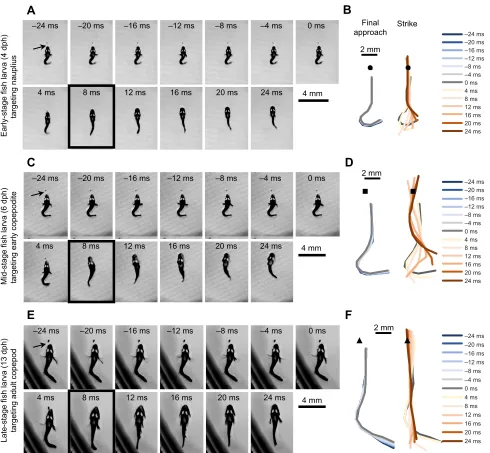
strike, and the return to swimming (Robinson et al., 2019). At 394± 38 ms prior to the strike (mean±s.e.m.; range: 28 to 1130 ms), the larval fish stopped beating its caudal fin and started flexing its body into the strike posture while slowly positioning itself closer to the prey, at a distance of 0.9±0.1 mm att0(mean±s.e.m.; range: 0.3 to 2.1 mm). During the strike, the larva propelled itself with a rapid extension of its tail from aJ-shaped, or‘fish hook’, posture (Fig. 1, Movie 1). After the strike, it resumed normal forward swimming. To describe the predatory posture of a precocious larval fish, we quantify only those final approaches and rapid strikes that led to capture without alerting the copepod prey,B. similis.
At 24 ms before the strike (t−24), the larva was already close to the
prey and approaching the final strike posture, as shown in Fig. 1 using examples from three different age classes of larvae. During
their final approach, the two younger larvae made slight adjustments to the curl in their caudal fins (Fig. 1B,D), but this movement was minimal compared with that of the older larva, which continued to bend its tail into its final posture (Fig. 1F). Betweent−24and t0,
larval swimming was limited to sculling slowly with alternating strokes of the pectoral fins. Over this 24 ms time interval, the median distance moved (measured as the change in thex,ycoordinates of spot between the eyes) was 69 µm (interquartile range: 35 to 77 µm), small in comparison with the distance to the copepod at t0. The copepod remained immobile up to the strike and often through capture. In the final strike posture att0, the fish’s body had two flexures in opposing directions, which were more evident in early-and mid-stage larvae (0 ms; Fig. 1A,C) than in late-stage larvae (0 ms; Fig. 1E). Although double flexure is also characteristic of the
–24 ms –20 ms –16 ms –12 ms –8 ms –4 ms 0 ms 4 ms 8 ms 12 ms 16 ms 20 ms 24 ms
–24 ms –20 ms –16 ms –12 ms –8 ms –4 ms 0 ms 4 ms 8 ms 12 ms 16 ms 20 ms 24 ms
–24 ms –20 ms –16 ms –12 ms –8 ms –4 ms 0 ms 4 ms 8 ms 12 ms 16 ms 20 ms 24 ms
D
F
2 mm
2 mm
2 mm Final approach
Strike
Late-stage fish larva (13 dph)
targeting adult copepod
4 ms 8 ms 12 ms 16 ms 20 ms 24 ms
–24 ms –20 ms –16 ms –12 ms –8 ms –4 ms 0 ms Mid-stage fish larva (6 dph) targeting early copepodite
4 ms 8 ms 12 ms 16 ms 20 ms 24 ms
–24 ms –20 ms –16 ms –12 ms –8 ms –4 ms 0 ms
Early-stage fish larva (4 dph)
targeting nauplius
4 ms 8 ms 12 ms 16 ms 20 ms 24 ms 4 mm –24 ms –20 ms –16 ms –12 ms –8 ms –4 ms 0 ms
4 mm 4 mm
C
A
B
[image:3.612.64.554.55.508.2]E
Fig. 1. Exemplar feeding sequences of larval clownfish in 4 ms intervals (every other frame at 500 frames s−1).(A,C,E) Frames showing the position of the
fish during the approach, att0, and during the propulsive strike and recovery. The black arrow points to the copepod and the black box surrounds the time at which the copepod was engulfed. (B,D,F) The midlines of the fish shown in A, C and E, respectively. The left lines represent the fish’s midline during the final approach (t−24tot0). The right lines represent the fish’s midline through the strike (t0tot+24). The position of the nauplius, copepodite and adult copepod are indicated with a circle, square and triangle, respectively. Unique scales are provided for each panel.
Journal
of
Experimental
S-start posture, what is unusual about the clownfish is the extreme hook-like bend with the tail pointing either forward or perpendicular to the orientation of the fish. In contrast, the head and tail point in opposite directions in the S-start postures of larval herring and anchovy (Hunter, 1972; Rosenthal, 1969).
The movement of the pectoral fins during the final approach by the clownfish differed from that described in other fish larvae. Setting up for the S-shape, anchovy larvae continue propelling themselves with tail-beats while their pectoral fins primarily stabilize and steer (Hunter, 1972). Re-orientation of those larvae can occur just prior to the strike, in response to movement by the prey (ca. 500 µm in fig. 5 in Hunter, 1972). Thus, the pectoral fins are involved in stabilization so as to prevent counter-rotation or backward creep during a tail-bend, as well as assistance with J-turns, which reorient the fish towards the prey during its initial approach, as shown in detail in zebrafish (McClenahan et al., 2012). During the zebrafish’s predatory approach, their pectoral fins moved in and out of phase at slow swim speeds <25 mm s−1(ca. <5 BL s−1
in fig. 6 in McClenahan et al., 2012) with a pectoral fin-beat frequency of ca. 20 Hz. Clownfish, which target immobile but highly mechanosensitive prey, maintain a stable orientation. Their pectoral fins beat 180 deg out-of-phase during the slow approach, which is similar to the alternating pattern described in slowly swimming (<4 BL s−1) juvenile reef fishes with pectoral fin-beat
frequencies of ca. 15 Hz (Hale et al., 2006). InA. ocellarislarvae, this swim gait is already present at 1 dph, suggesting that it is an important component of the predatory fast-start in this species.
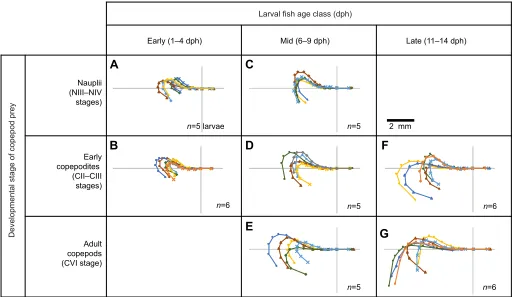
Larval fish in the various age classes in our experiments avoided certain developmental stages of prey (Fig. 2). Only the mid-stage
fish larvae attacked all three stages. The youngest larvae attacked nauplii and copepodites, whereas the oldest larvae preyed on copepodites and adults. Accompanying these changes, the strike posture at the moment preceding the attack,t0, changed with both larval age class and prey stage (Fig. 2). Att0, the bodies of early-stage larvae were consistently in a J-shaped,‘fish hook’posture (Fig. 2A,B). In contrast, late-stage larvae usually executed an L-shaped,‘hockey stick’posture, especially when targeting adult copepods (Fig. 2G). Fish that attacked adult copepods were significantly less tightly curled (had greater CVF) than those that attacked either copepodites [beta regression (βreg): P=0.03] or nauplii (P=0.02), after accounting for fish age (Table S1).
Ontogenetic changes in attack strategy are likely due, at least in part, to the larvae’s neurodevelopment.Amphiprion ocellarishave fully functional musculoskeletal linkages of their feeding apparatus and ossification of their neurocranium by 7 dph (Wittenrich and Turingan, 2011). We thus made comparisons within the late-stage larval group (11–14 dph,n=12), which allowed us to assess how prey stage affected strike posture in these well-developed larvae. Prey stage and larval age jointly affected the curvature (CVF) of late-stage larvae att0. Late-stage larvae that targeted adult copepods were 87% less curved (had greater CVF) than those that targeted copepodites (95% CI 23–184%, βreg: P=0.003; Table S1). Concurrently, for each day between 11 and 14 dph, the curvature of the fish’s body att0decreased by 36% (95% CI 0.4–83%,βreg:
P=0.05; Table S1).
During the strike, forward movement was produced with the rapid extension of the tail (Fig. 1; 0 to 24 ms). From fully bent att0, the tail remained slightly bent att+4but had straightened byt+8when the
A
B
C
D
E
F
G
2 mm n=5
n=5
n=5
n=6
n=6 n=5 larvae
n=6
Larval fish age class (dph)
Early (1–4 dph) Mid (6–9 dph) Late (11–14 dph)
Developmental stage of copepod prey
Nauplii (NIII–NIV stages)
Early copepodites (CII–CIII stages)
[image:4.612.49.563.57.354.2]Adult copepods (CVI stage)
Fig. 2. Postures of larval clownfish just before successful strikes.Each line represents an individual larva’s midline att0, grouped by predator–prey category (n=7 categories based on larval age class and copepod developmental stage, with sample sizes within each group shown in A–G). Thex,yorigin for each individual is a pigment spot between its eyes. The point representing the leading edge of a fish’s mouth extends to the right, along thex-axis. Postures have been rotated and flipped to show curvature in the same direction, for ease of comparison. The scale bar is shown in the top right, and is the same for all plots within the figure.
Journal
of
Experimental
prey was captured (Fig. 1A,C,E). The strikes, which were directed at the prey, were either straight ahead along the line of the final approach orientation, or slightly offset (Robinson et al., 2019). Strike distances (distance between fish and copepod at t0) were typically less than 1 mm and were significantly smaller for early-stage larvae preying on nauplii and copepodites than for late-early-stage larvae preying on copepodites and adults [mean=0.7 versus 1.0 mm; pairwise Wilcoxon rank-sum test (RS):P=0.03]. The larval strike included both body and jaw ram to minimize time to capture (from
t0). Jaw extension, measured betweent0andt+8, increased from ca. 0.25 to 0.5 mm between the early- and late-stage larvae. This corresponded to an increasing contribution of jaw ram to the forward lunge from 40% for early-stage larvae to 60% for late-stage larvae.
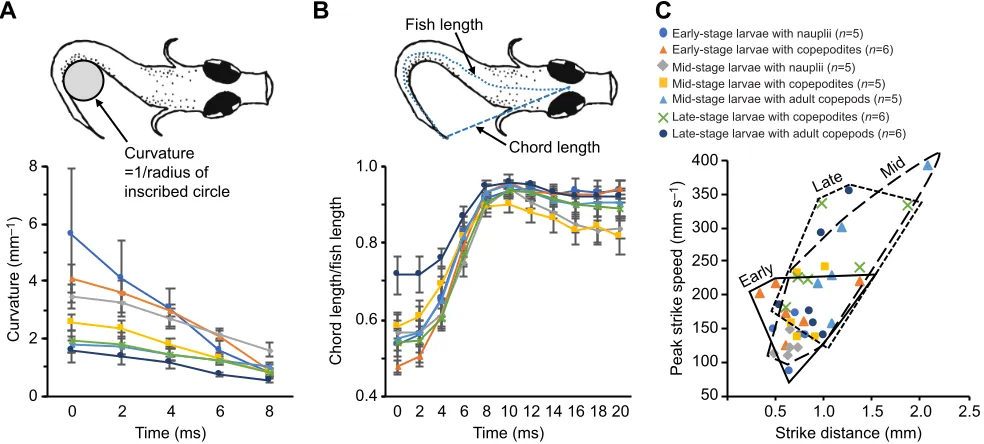
The predatory strike was limited to a single tail-beat cycle, which is similar to the Type I S-start described by Harper and Blake (1991). In the early- and mid-stage larvae, the uncurling of the tail was followed by a tail beat in the opposite direction (Fig. 1A–D). In the late-stage clownfish larvae, however, the tail straightened during the lunge (Fig. 1E,F), as shown quantitatively in the time course of change in body shape during the strike (Fig. 3). During the strike, the body straightened very quickly, becoming nearly linear byt+8in all predator–prey categories (CVF between 0.9 and 1; Fig. 3B). Thereafter, the body remained relatively straight in the older larvae, whereas in the younger larvae, CVF decreased as the body undulated through a full tail-beat cycle (Fig. 3B).
Measurements of strike performance included time to capture (fromt0) and peak strike speed during the strike. Between early- and late-stage larvae, mean time to capture decreased from 9 to 7 ms (RS:P=0.03). Mean peak speed increased from 160 to 240 mm s−1
between early- and late-stage larvae, but this change was not significant [multiple linear regression (MLR): P>0.1] after accounting for strike distance and prey stage (Fig. 3C, Table S1). A 1 mm increase in strike distance corresponded with a 64%
increase in peak strike speed (95% CI 27–112%, MLR:P<0.001; Fig. 3C, Table S1). Concurrently, peak strike speeds of larvae on copepodites and adult copepods were 35% (95% CI 10–67%; MLR:
P=0.006) and 34% (95% CI 3–74%; MLR:P=0.03) greater than those on nauplii, respectively (Table S1; see also Robinson et al., 2019). Although there was evidence of improved performance in older larvae, these changes were modest in comparison with the large increases in size and development of the jaw, gape size, and digestive and feeding systems (Green and McCormick, 2001; Jackson and Lenz, 2016; Wittenrich and Turingan, 2011). Ontogenetic overlap in strike performance suggests that larval clownfish are competent predators at first-feeding, in contrast with many other larval fishes.
To be successful hunters, larval fishes must first locate a prey and then use optimal kinematics to approach and capture it (Voesenek et al., 2018). Which strategy is ‘optimal’ depends on the prey’s behaviour, especially its ability to detect and escape from the predator (Tuttle et al., 2019). Our current understanding of larval feeding kinematics is limited to fish that useS-starts to target non-evasive prey (for a review, see Voesenek et al., 2018), which is distinct from the highly modified and previously unrecognized fast-start described for the clownfish. The combination of the clownfish’s extremeJ-shaped posture and alternate sculling of its pectoral fins likely minimizes disturbance during its predatory approach while precisely aligning it with the prey. Although early fish larvae are similar morphologically, clownfishes are precocious in their development and predatory prowess when compared with other species (Green and McCormick, 2001; Kavanagh and Alford, 2003; Wittenrich and Turingan, 2011; Kavanagh and Frédérich, 2016). Furthermore, diets of larval fishes are diverse, and specialized diets likely require different predatory strategies. Thus, the modified strike posture of the clownfish may be just one example of an alternate fast-start that has evolved in larval fishes. Future studies should explore the relationship between prey
Early-stage larvae with nauplii (n=5) Early-stage larvae with copepodites (n=6) Mid-stage larvae with nauplii (n=5) Mid-stage larvae with copepodites (n=5) Mid-stage larvae with adult copepods (n=5) Late-stage larvae with copepodites (n=6) Late-stage larvae with adult copepods (n=6)
Chord length
0
0 2 4 6 8 0 2 4 6 8 10 12 14 16 18 20 0.5 1.0
Strike distance (mm) Time (ms)
Time (ms)
1.5 2.0 2.5 0.4
0.6 0.8 1.0
A
B
C
50 100 150 200 250 300 350
Early
Late Mid
400
2 4 6 8
Curvature (mm
–1
)
Chord length/fish length
Peak strike speed (mm s
–1
)
Fish length
[image:5.612.61.553.453.675.2]Curvature =1/radius of inscribed circle
Fig. 3. Fish larvae’s relative curvature and performance as a function of strike distance, shown by predator–prey category (n=7 categories based on larval age class and copepod developmental stage).(A) Curvature derived from the reciprocal radius of a circle inscribed within the tail of each fish, as shown in drawing, and averaged within predator–prey category during the initial lunge. (B) Curvature normalized by dividing the chord length by the fish length for each fish, as shown in drawing, and averaging within predator–prey category. Data in A and B are means±s.e.m. (C) Peak velocity during each larva’s strike, plotted versus distance between the edge of the fish’s mouth and the rostrum of the copepod att0(i.e. strike distance). Polygons enclose individual points by
larval age class. Sample sizes indicated in C.
Journal
of
Experimental
behaviour and predatory strategies of larval fishes during their first, critical stage of life.
Acknowledgements
We thank T. Cabalar, B. Coffey, Y. Niimi and J. Suitos for their assistance with culturing and larval rearing, and Karen Brittain for providing clownfish eggs and rotifers. This is SOEST contribution number 10683.
Competing interests
The authors declare no competing or financial interests.
Author contributions
Conceptualization: H.E.R., D.K.H., P.H.L.; Methodology: L.J.T., H.E.R., J.R.S., D.K.H., P.H.L.; Formal analysis: M.C.F., L.J.T.; Investigation: M.C.F., L.J.T., H.E.R.; Data curation: L.J.T.; Writing - original draft: M.C.F., L.J.T., P.H.L.; Writing - review & editing: M.C.F., L.J.T., H.E.R., J.R.S., D.K.H., P.H.L.; Visualization: M.C.F., L.J.T., P.H.L.; Supervision: L.J.T., D.K.H., P.H.L.; Project administration: P.H.L.; Funding acquisition: D.K.H., P.H.L.
Funding
Financial support was provided by the National Science Foundation (OCE 12-35549 to P.H.L. and D.K.H.). The views expressed herein are those of the authors and do not reflect the views of NSF or any of its sub-agencies.
Data availability
The original images on which the analyses were based are publicly available from the Biological and Chemical Oceanography Data Management Office (BCO-DMO): http://lod.bco-dmo.org/id/dataset/747926
Supplementary information
Supplementary information available online at
http://jeb.biologists.org/lookup/doi/10.1242/jeb.191411.supplemental
References
Borla, M. A., Palecek, B., Budick, S. and O’Malley, D. M.(2012). Prey capture by larval zebrafish: evidence for fine axial motor control.Brain Behav. Evol.60, 207-229. doi:10.1159/000066699
Bradley, C. J., Strickler, J. R., Buskey, E. J. and Lenz, P. H.(2013). Swimming and escape behavior in two species of calanoid copepods from nauplius to adult. J. Plankton Res.35, 49-65. doi:10.1093/plankt/fbs088
Buskey, E. J., Strickler, J. R., Bradley, C. J., Hartline, D. K. and Lenz, P. H. (2017). Escapes in copepods: comparison between myelinate and amyelinate species.J. Exp. Biol.220, 754-758. doi:10.1242/jeb.148304
Cauchy, A. L.(1826).Leçons sur les applications du calcul infinitésimal àla géomeétrie. Paris: Imprimérie Royale.
China, V., Levy, L., Liberzon, A., Elmaliach, T. and Holzman, R. (2017). Hydrodynamic regime determines the feeding success of larval fish through the modulation of strike kinematics.Proc. R. Soc. B Biol. Sci.284, 20170235. doi:10. 1098/rspb.2017.0235
Cribari-Neto, F. and Zeileis, A.(2010). Beta regression in R.J. Stat. Softw.34, 1-24. doi:10.18637/jss.v034.i02
Domenici, P. and Blake, R. W.(1997). The kinematics and performance of fish fast-start swimming.J. Exp. Biol.200, 1165-1178.
Green, B. S. and McCormick, M. I.(2001). Ontogeny of the digestive and feeding systems in the anemonefishAmphiprion melanopus.Environ. Biol. Fishes61, 73-83. doi:10.1023/A:1011044919990
Hale, M. E., Day, R. D., Thorssen, D. H. and Westneat, M. W.(2006). Pectoral fin coordination and gait transitions in steadily swimming juvenile reef fishes.J. Exp.
Biol.209, 3708-3718. doi:10.1242/jeb.02449
Harper, D. G. and Blake, R. W.(1991). Prey capture and the fast-start performance of northern pikeEsox lucius.J. Exp. Biol.155, 175-192.
Hunter, J. R.(1972). Swimming and feeding behavior of larval anchovyEngraulis mordax.Fish. Bull.70, 821-838.
Jackson, J. M. and Lenz, P. H.(2016). Predator-prey interactions in the plankton: larval fish feeding on evasive copepods. Sci. Rep. 6, 33585. doi:10.1038/ srep33585
Kavanagh, K. D. and Alford, R. A.(2003). Sensory and skeletal development and growth in relation to the duration of the embryonic and larval stages in damselfishes (Pomacentridae).Biol. J. Linn. Soc.80, 187-206. doi:10.1046/j. 1095-8312.2003.00229.x
Kavanagh, K. D. and Frédérich, B.(2016). Ontogeny and early life stages of damselfishes. InBiology of Damselfishes(ed. B. Frédérich and E. Parmentier), pp. 168-182. Boca Raton, FL: CRC Press.
Leis, J. M. and Carson-Ewart, B. M.(1998). Complex behaviour by coral-reef fish larvae in open-water and near-reef pelagic environments.Environ. Biol. Fishes 53, 259-266. doi:10.1023/A:1007424719764
Lenz, P. H. and Hartline, D. K.(2018). Data from: High-speed videos of larval clownfish,Amphiprion ocellaris, predators and copepod prey. Biological and Chemical Oceanography Data Management Office (BCO-DMO). http://lod.bco-dmo.org/id/dataset/747926.
Llopiz, J. K. and Cowen, R. K.(2009). Variability in the trophic role of coral reef fish larvae in the oceanic plankton.Mar. Ecol. Prog. Ser.381, 259-272. doi:10.3354/ meps07957
Longo, S. J., McGee, M. D., Oufiero, C. E., Waltzek, T. B. and Wainwright, P. C. (2016). Body ram, not suction, is the primary axis of suction-feeding diversity in spiny-rayed fishes.J. Exp. Biol.219, 119-128. doi:10.1242/jeb.129015 McClenahan, P., Troup, M. and Scott, E. K.(2012). Fin-tail coordination during
escape and predatory behavior in larval zebrafish.PLoS ONE7, e32295. doi:10. 1371/journal.pone.0032295
McKinnon, A. D., Duggan, S., Nichols, P. D., Rimmer, M. A., Semmens, G. and Robino, B.(2003). The potential of tropical paracalanid copepods as live feeds in aquaculture.Aquaculture223, 89-106. doi:10.1016/S0044-8486(03)00161-3 Østergaard, P., Munk, P. and Janekarn, V.(2005). Contrasting feeding patterns
among species of fish larvae from the tropical Andaman Sea.Mar. Biol.146, 595-606. doi:10.1007/s00227-004-1458-8
Robinson, H. E., Strickler, J. R., Henderson, M. J., Hartline, D. K. and Lenz, P. H. (2019). Predation strategies of larval fish capturing evasive copepod prey.Mar.
Ecol. Prog. Ser.614, 125-146. doi:10.3354/meps12888
Rosenthal, H.(1969). Untersuchungen über das Beutefangverhalten bei Larven des HeringsClupea harengus.Mar. Biol.3, 208-221. doi:10.1007/BF00360953 Rosenthal, H. and Hempel, G.(1970). Experimental studies in feeding and food
requirements of herring larvae (Clupea harengusL.). InMarine Food Chains(ed. J. H. Steele), pp. 344-364. Berkeley and Los Angeles: University of California Press.
Schindelin, J., Arganda-Carreras, I., Frise, E., Kaynig, V., Longair, M., Pietzsch, T., Preibisch, S., Rueden, C., Saalfeld, S., Schmid, B. et al.(2012). Fiji: an open-source platform for biological-image analysis.Nat. Methods9, 676-682. doi:10.1038/nmeth.2019
Tuttle, L. J., Robinson, H. E., Takagi, D., Strickler, J. R., Lenz, P. H. Hartline, D. K.(2019). Going with the flow: hydrodynamic cues trigger directed escapes from a stalking predator.J. R. Soc. Interface16, 20180776. doi:10.1098/rsif.2018. 0776
Voesenek, C. J., Muijres, F. T. and van Leeuwen, J. L.(2018). Biomechanics of swimming in developing larval fish.J. Exp. Biol.221, jeb149583. doi:10.1242/jeb. 149583
von Herbing, I. H. and Gallager, S. M.(2000). Foraging behavior in early Atlantic cod larvae (Gadus morhua) feeding on a protozoan (Balanionsp.) and a copepod nauplius (Pseudodiaptomus sp.). Mar. Biol. 136, 591-602. doi:10.1007/ s002270050719
Webb, P. W. and Skadsen, J. M.(1980). Strike tactics ofEsox.Can. J. Zool.58, 1462-1469. doi:10.1139/z80-201
Wittenrich, M. L. and Turingan, R. G.(2011). Linking functional morphology and feeding performance in larvae of two coral-reef fishes.Environ. Biol. Fishes92, 295-312. doi:10.1007/s10641-011-9840-0