453
COMPUTERIZED SIMULATION OF THE FUNCTIONING
OF CONVEYOR BELTS AUTOMATED SYSTEM CONTROL
IN A COMPOUND FEED FACTORY
CRISTIAN VASILE
Faculty of Agronomy, University of Craiova, Romania
Keywords: conveyor belts, simulation, automation, sensor, compound feed
ABSTRACT
In order to ensure a leading position on a competitive market with a very diversified demand and offer, every compound feed factory aims to obtain top-quality final products at a low production cost. Therefore, the technological flow activities must be carried out at optimal parameters, avoiding any loss of materials or time.
One very important activity in this technological flow is the transport of raw materials from the bunkers to the installations for grinding, then for mixing according to the needed recipe and then at the installations for granulation.
To avoid the loss of raw materials on the route or the blockage of conveyor belting, this article presents experimental research done for the computerized simulation in view of the implementation of automatized control devices, based on rotative magnetic sensors which transmit stop signals to the transporting system in case of modification of the normal functioning rythm of that conveyor belt.
INTRODUCTION
It can be said that the zootechnics are the "continuous fire branch" of agriculture and at the same time being a true indicator of the population's standard of living, which is reflected in the consumption of products from the livestock sector. The growth of worldwide population has also caused to an increase of the need for consumer products, of which a very important weight has the ones from the livestock sector. [2, 3]
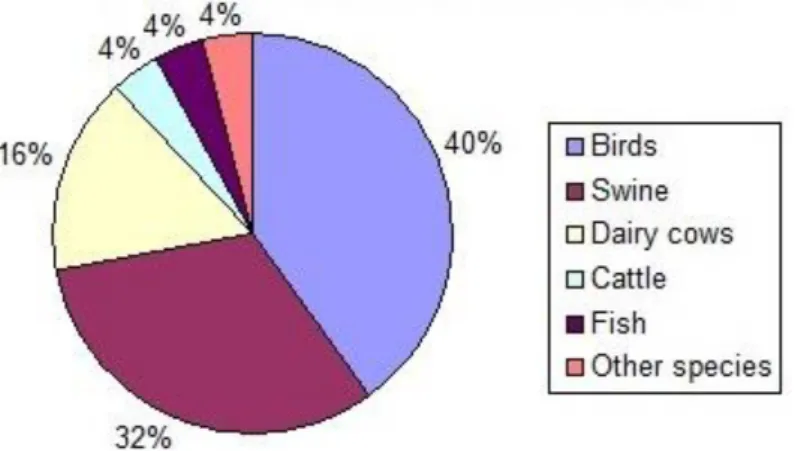
Thus, the production of compound feed is an activity of great interest, because they are an important source of feed for animals from the ranches and represents an important factor in obtaining large and profitable productions in this field. Also, it needs to be known that there are different recipes of compound feed, depending on the race and the age of the animals. In the figure 1 it is shown the distribution of compound feed consumption at a worldwide scale on various animal species. [5, 6]
Figure 1: Distribution of compound feed consumption on animal species
454
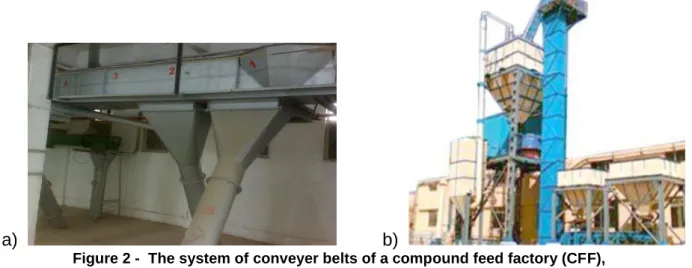
cereal beans, will be transported through a system of horizontal conveyor belts to the base of the vertical elevator, and from there they will be distributed to the supply containers of the compound feed production installations (figure 2). [7]
a) b)
Figure 2 - The system of conveyer belts of a compound feed factory (CFF), consisting of horizontal conveyer belts (a) and vertical elevator belts (b)
MATERIAL AND METHOD
At the combined fodders factory where have been performed the experimental researches, transport of raw materials of the input silos to production installions of combined fodders recipes its make with two successive horizontal belts and a vertical elevator-belt on which are mounted, at equal distances, transportation cups (figure 3). [6]
Figure 3: The conveyor belts system in CFF
A critical point from technological flow of the compound feed production is transport of raw materials with conveyor belts, especially at the vertical elevator, because must be avoided blocking them during the work, fact what would lead to the deterioration or their breaking. The causes of lock of the conveyor belts are diverse: overloading with raw materials, broken functioning of the motors what acting this belts, etc.
The malfunction of the transport system leads to stagnation of the production system because breaking or damaging the rubber conveyor belt requires a complex repair activity lasting more than 24 hours. Also, it have to know that a new conveyor belt cost a few tens of thousand euros.
455
Figure 4: The electrical drive scheme of the conveyor belts system C_Ev The engine contactor which action the vertical elevator Ev C_Tr1 The engine contactor which action the first horizontal conveyor Tr1 C_Tr2 The engine contactor which action the second horizontal conveyor Tr2
The functioning of the conveyor belts must be safe, that is to avoid being blocked by raw materials and therefore the main condition is that at startup to respect rigorously the following order: first of all the vertical elevator (Ev) will start, then the second horizontal conveyor belt (Tr2) and in the end the first horizontal conveyor (Tr1) will start. Instead, in the stopping phase of the transport system of raw materials, the correct operation requires an inverse order: first the horizontal conveyor (Tr1) will stop, then the second horizontal conveyor (Tr2) will stop and in the end the vertical elevator (Ev) will stop.
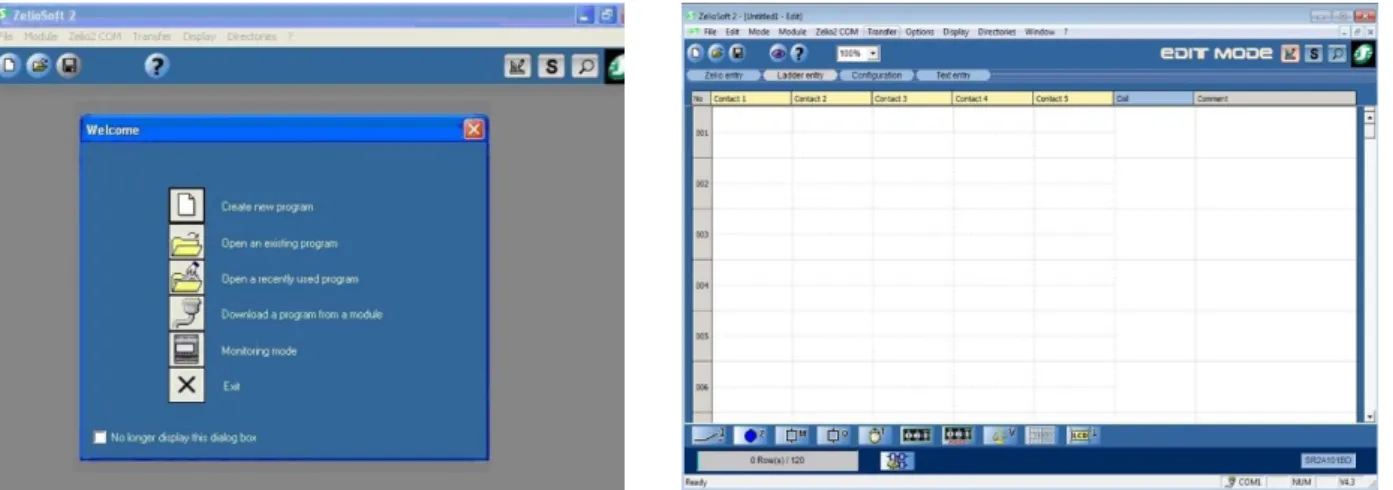
For simulating the operation of the automated monitoring device of the conveyor belts system it was used the software ZelioSoft (figure 5), which was used to design a simulation program of that automated control electronic system.
Figure 5: Initial interface and the working interface of the ZelioSoft program
456
screen and allows, at execution, the simulation of the electrical scheme functioning thus implemented.
THE OBTAINED RESULTS
The controll of the functioning of conveyor belts can be done manually and automatically with the help of sensors. In this paper is verified the correct operation of the rotation sensors that can be used to the implementation of the automated electric control scheme of the conveyor belts from a compound feed factory.
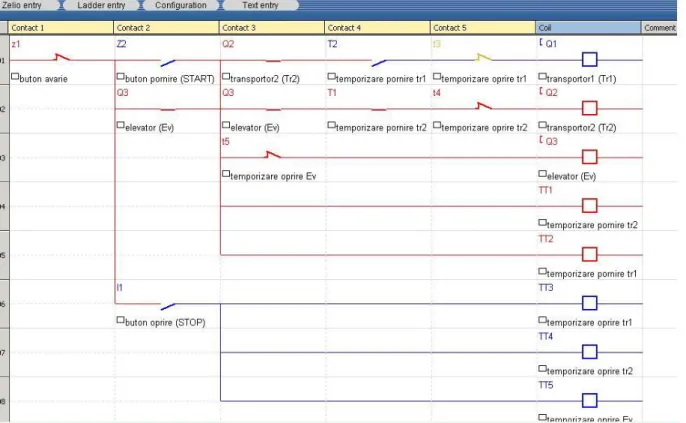
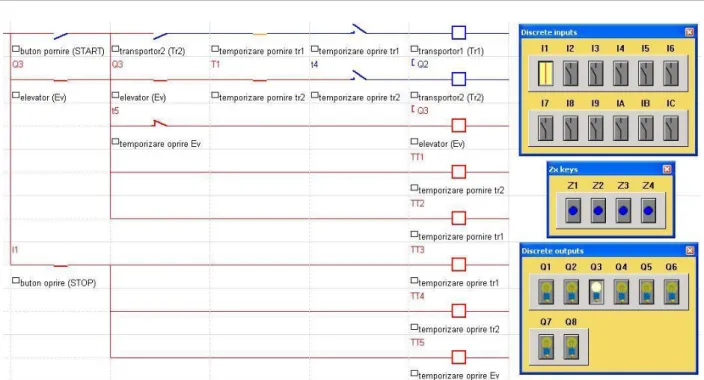
With the help of ZelioSoft program it was implemented a computer application which simulates the electrical scheme that corresponds to the automated monitoring and control system of the functioning for the two horizontal transporting belts and the vertical elevator (figure 6). In the composition of the electrical simulation scheme of automatic monitoring for the functioning of the conveyor belts had been used:
- two "touch" buttons (after pressing are released immediately) used for total stop in case of failure (Z1), respectively for the initial start of the transporting system (Z2=START); - a button of type “push” (it keep pressed as long as it is desired to be active) used for stopping the chain of conveyor belts (I1 =STOP);
- three contactors which indicates the functioning or not of the horizontal conveyor belts (Q1, Q2), respectively of the vertical elevator (Q3);
- five temporizers used for delaying the signal such that to make possible to monitoring the starting of the horizontal conveyor belts (T1,T2) respectively the stoping off the horizontal conveyor belts (t3,t4) and the vertical elevator (t5).
Figure 6: Electrical scheme of the automated monitoring device of the horizontal conveyor belts and vertical elevator
457
first it starts the vertical elevator (Q3), then starts the second horizontal conveyor band (Q2) and finally the first horizontal conveyor (Q1), as shown in figure 7.
Figure 7: The simulation of start-up and operation of the automated control system of horizontal conveyor belts and vertical elevator
If is desired the stoping of the conveyors chain must keep pressed the STOP button (I1), which will cause the activation of the circuit containing the 3 temporizers of stop (figure 8). In this case it can be observed, by withdrawing the red color, the mode and the order in which they stop: first stops the first horizontal conveyor belt (Q1), then stops the second horizontal conveyor belt (Q2) and finally it will stop the vertical elevator (Ev).
458
Figure 8: Simulation the moment when is desired the automatic stop of the conveyors
For a more clearer observation of the input and output variables needed for automatic monitoring the horizontal conveyors and the vertical elevator, at the simulation of their functioning can be activated on the screen special windows in wich will be showed the moment in which the buttons, contactors and temporizers come in operation or are closed (figure 8). For example, at startup of the horizontal belts or the vertical elevator will turn on a LED corresponding to that contactor in „Discrete outputs” window and when the belts stops LED will turn off.
To implement the automated control device of conveyor belts have been done tests on respond time for more speed sensors (table 1). During the experimental tests is noticed that most speed sensors provides a reaction time of less than 2 seconds, considered acceptable. Analyzing the operating parameters and the price, at the final design of the electric circuit was used XSA-V11373 speed sensor manufactured by TELEMECANIQUE.
Table 1 Response time of the analyzed rotation sensors
Speed sensor type NXP KMI15 ATS 653 XSA-V11373 SM351LT
Response time [s] 0,7 1,2 0,7 1,1
CONCLUSIONS
The conveyor belts chain represents a critical point of the technological flow from a compound feed factory, because them blocking can cause the loss of materials, time and implicitly financial losses.
For dealing with the competition on the profile market, but also for the compliance with the european rules regarding emissions of pollutants and of dust in the environment, the large majority of the compound feed factories have purchased the highest performing installations with high degree of mechanisation, automation and computerization.
Based on these considerations, there were made experimental researches for implementing some devices to control automatically the speed of rotation for the drums that acts the horizontal and vertical conveyor belts.
459
BIBLIOGRAPHY
1. Brîndușa, P., ș.a., 2006 – Mesures electriques et transducteurs, Matrix Rom Publishing
House, Romania, pag. 25-29.
2. Căproiu Magdalena, ş.a., 1982 – Maşini şi instalaţii zootehnice, Editura Didactică şi
Pedagogică, Bucureşti, pag. 65-68.
3. Popa C. Ion, 1996 - Exploatarea maşinilor şi instalaţiilor zootehnice, Editura Brumar, Timişoara, pag. 43-52.
4. Popescu S., ş.a. , 1986 – Automatizarea maşinilor şi instalaţiilor folosite în agricultură,
Editura Scrisul Românesc, Craiova, pag. 19-26.
5. Ţucu, D., 2007 – Sisteme tehnologice integrate pentru morărit şi panificaţie, Editura
Orizonturi Universitare, Timişoara, pag. 71-82.
6. Vasile C., 2013 -The Implementation of a Programmed Control System for the Transportation of Raw Materials in a FNC, Annals of the University of Craiova – Agriculture, Montanology, Cadastre Series, Vol.43, No.2, ISSN: 1841-8317, pag. 241-247.