Explorative research on challenging factors
encountered by SMEs operating in developing
countries deploying an IT transaction platform
Author: Steffan Hakkers
University of Twente P.O. Box 217, 7500AE Enschede
The Netherlands
ABSTRACT
The IT platform phenomenon and its impact on business and strategy for SMEs in developing countries specifically, is a topic that has not been researched and is yet important to know because the rise of IT and IT platforms opens up a lot of business and research opportunities. In this paper, the challenges encountered by SMEs operating in the Base Of the Pyramid (BoP) deploying an IT transaction platform have been identified. The main focus of this research is to identify the most important challenges in the following five categories: Human Capital, Research & Development, Technologies, National policy and Regulatory environment and Market Information. With the help of an online distributed survey which posed statements to the respondents, a ranking of the challenges has been made, giving quantitative insight into what challenges are most prevalent for SMEs operating in the BoP deploying an IT transaction platform. Furthermore, qualitative data in the form of answers to open questions posed to these SMEs have been gathered to identify additional challenges and gain deeper insights into challenges faced by these SMEs. A selection of the most relevant challenges have been further investigated with help of secondary data to give a more reliable and in depth analytical insight. The ranking and qualitative identification of the challenges faced by SMEs in the BoP deploying an IT transaction platform helps businesses to base strategy on and researchers to identify relevant challenges to do in depth research on.
Graduation Committee members:
Dr. R.P.A. Loohuis MBA
Drs. P. Bliek
Keywords
Bop, IT transaction platforms, SME, IT, Business, Developing countries
This is an open access article under the terms of the Creative Commons Attribution License, which permits use, distribution and reproduction in any medium, provided
1.
INTRODUCTION
1.1
Topic Relevance
In the current business climate, the use of Information Technology (IT) platforms, is a source of competitive advantage. “Digital industry platforms are fueling the next wave of breakthrough innovation and disruptive growth. Increasingly, platform-based companies are capturing more of the digital economy’s opportunities for strong growth and profitability ... platform-based ecosystems are the new plane of competition” (Accenture 2015 p. 50). Which gives rise to research opportunities on the topic to better understand this platform phenomenon and its impact on business and strategy. (Wan, X. et al., 2017). Right now, academic research which focuses on business strategies for IT platforms, specifically within a Base of the Pyramid (BoP) context is limited. So there is still a substantial knowledge gap to fill to increase understanding of this emerging platform economy, especially within the BoP context. Research in this area could possibly help businesses operating within a BoP context to increase their competitiveness within the globalized economy and help themselves to alleviate the poverty several people in developing countries suffer from by better connecting supply and demand with help of IT platforms. Also research could help for businesses in developed nations to better find opportunities for deploying IT platforms at the BoP.
1.2
The objective of the research
The objective in this research is to investigate which challenges Small & Medium-sized Enterprises (SMEs) operating in the BoP face when deploying an IT transaction platform, to find out how and if IT platforms can be more effectively deployed by exploring the challenges faced by these SMEs.
All of this boils down to answering the following research question:
Which challenges do SMEs operating in the BoP face when deploying an IT transaction platform?
In Table 1. below an oversight of the definitions of the concepts used in the research question is given to give a quick insight what the main concepts being researched in this paper entail.
Table1. Research question concepts and definitions
Concept Definition Sources
Business in BoP
‘This strand of literature seeks to enhance understanding of how working with the BOP can generate mutual value for both BOP ventures and their partners such as producers and sub-contractors’
(London. Et al.,2010 N.Sinkovic. et al., 2014)
Base of the Pyramid (BoP)
‘BOP is a population of more than 4 billion people living on less than $2 per day ‘
(Prahalad, 2012).
IT transaction platform
‘A technology, product or service that acts as a conduit (or intermediary) facilitating exchange or transactions between different users, buyers or suppliers.’
(Evans. Et al. 2016)
Concept Definition Sources
SME an enterprise with a staff headcount below 250, Net Turnover of equal or below 50 million USD or balance sheet total of below or equal 43 million USD.
European Commission (2003)
1.3
The structure of the thesis
This paper consists of 10 chapters. After having stated the relevance and objective of the research in the introduction, the theoretical background of this research will be introduced to clarify and introduce relevant concepts and theories used as the backbone of this paper. After that, the methodology and justification of the research method will be specified. Followed by an analysis of the results of the data, followed by the theoretical and practical implications in chapter 5. After that, in chapter 6 the limitations of the research and future research opportunities will be given, followed in chapter 7 by the conclusions of the research . Chapters 8 to 10 contain the acknowledgements, list of references and the appendix of the paper.
2.
THEORETICAL BACKGROUND
In this chapter the theoretical background on which this research is based on, is established. Firstly, the concept of the Base Of the Pyramid will be elaborated on, because this is an important concept which this paper revolves around. Secondly, digitization in the developing world will be elaborated on, to make the context in which this paper is set in more clear and review some of the research already done in this area. After that, the concept of IT platforms, and its impact on business will be elaborated on. And finally, the research that has been done related to the challenges of deploying an IT innovation will be described.
2.1
Business at the Base Of the Pyramid
The focus of this research paper will revolve around the concept of the Base of the Pyramid, which is a term first used by Prahalad in 1999, a definition of this concept being used in this paper can be found in the table of the introduction. BoP initiatives are meant to see the position of people in the developing world in the value network not only as consumers but also as entrepreneurs (Karnani, 2009). So with this in the back of the mind, objects of research on this topic also includes businesses in the developed world working in or working with businesses and people in the BoP.The concept of BoP is a concept which had first been introduced to a bigger academic audience by a working paper by Prahalad and Hart (1999). In this paper, the authors called on multinational enterprises (MNEs) to do business with the poor, which would help grow the MNEs’ profits and alleviate some of the poverty of this group of people. According to a systematic literature review of the concept of BoP by Kolk et al. (2014) (which includes papers on BoP over the course of the year 2000 to 2009) the role of MNEs within BOP initiatives is not just limited to MNEs, but that small and domestic companies, and not-for-profit organization also play an important role. Which shows that the concept of BOP initiative has involved over time and is most likely still evolving.
2.2
Digitization in developing world
with developing countries and vice versa. (Savrul.et al., 2014). A consequence thereof is the increase in availability of information technology in developing countries, according to the World Economic Forum (2014), each additional 10% of internet penetration can lead to a 1.2% increase in per capita Gross Domestic Product (GDP) growth in emerging economies. As a consequence of GDP growth, market efficiency and creation increases, social and economic inclusion also get increased according to the World Bank (2016). This increase in internet penetration, per capita GDP growth and market efficiency and creation, can be seen as a potential business and research opportunity with regard to the deployment of digital services in emerging economies.
Besides the positive effect digitization is predicted to have in the future, there are several IT bottlenecks where businesses operating in a BoP environment come across. This includes: low rate of current technological adoption, which is usually a consequence of a poorly functioning digital infrastructure like low availability of electricity and general poverty, especially for population living in rural or remote areas (Shenglin et al. 2017). A big percentage of 54,8% of the households in the world do not have access to the internet (Economist Intelligence Unit, 2019). Another related issue mentioned by Shenglin (2017) and also by West (2015) is that network services, devices and applications are not affordable for a big part of the population in the developing world, which hinders the people from accessing IT capabilities in developing countries. Furthermore, there is also a need for digital skills which are needed to create or add value. (West, 2015) Digital literacy and education is key to enable people and businesses to be able to effectively integrate digital technologies into their lives, but this takes time and the tools to do this are not readily available.
2.3
IT platforms
The term platform is a term that has been in use for a very long time and originally denotes ’A raised level surface on which people or things can stand’ according to the Oxford English Dictionary (Stevenson, 2010). Which is a fitting definition to what an IT platform is to its core, being on an IT platform increases your visibility for the millions of people that make use of digital devices and services. Which enables the users of IT platforms to find what they are looking for and present what they have to offer, therefore IT platforms can be used as a tool to connect supply and demand.
2.3.1 IT PLATFORM TYPOLOGY
To make a distinction between the different kinds of existing IT platforms, the platform typology of Evans & Gawer (2016) will be used. To provide a quick idea of what platforms are included per type according to this typology, well know platforms will be mentioned per type. The main focus within the context of this paper will be on transaction platform, this type will be defined more in depth in the paper.
The typology makes a distinction between the following four kinds of IT platforms: transaction platforms (Airbnb, Paypal, Uber, Tencent), innovation platforms (Microsoft, SAP, Orcale), integrated platforms (Google, Amazon, Facebook) and investment platforms (SoftBank, Priceline, Naspers). Transaction platforms is literally defined by Evans & Gawer (2016) as: “… a technology, product or service that acts as a conduit (or intermediary) facilitating exchange or transactions between different users, buyers and suppliers.”. So basically, a transaction platform is an online market place connecting buyers and suppliers.
2.3.2 NETWORK EFFECT
In this section the term network effect will be introduced shortly, because this concept is essential for a transaction platform to be successful. According to a paper by Van Alstyne (2016), the chief assets of platform businesses are interaction and information. Which, combined, form the source of competitive advantage and value for the business. The value increases when there are more participants connected to the supply and demand side of the transaction platform, like on a market place, strengthening the so called “network effects” (Van Alstyne, 2016). This research focusses around transaction platforms in developing countries, leveraging the network effect in the BoP context is possibly harder, because less people have access to technology and sufficient IT infrastructure. Which is a topic that has not been researched yet.
2.4
Challenges Deployment IT Transaction
Platform for SMEs in BoP
Research on challenges of deploying IT transaction platform, for SMEs operating in developing andeven in the developed world is lacking. Therefore, a research by Farsi et al. (2014), which investigates the main challenges SMEs in Iran encounter when exploiting innovative opportunities identified five challenges will be used as a starting point for investigating IT transaction platforms deployed by SMEs in the BoP.
These factors include (in order of importance): “…Managerial & human resources, research & development (R&D), technologies, national policy & regulatory environment and lack of market information” (Farsi et al., 2014). Innovation entails the implementation of new ideas that create value, according to Linder et al. (2003). And innovative opportunity is defined as “the possibility to realize a potential economic value inherent in a new combination of resources and market needs, emerging from changes in the scientific or technological knowledge base, customer preferences, or the interrelationships between economic actors” by Magnus et al. (2007). Because deploying an IT transaction platform can be seen as exploitation of an innovative opportunity, and Iran is a developing country, analyzing the factors found by Farsi et al. is a good starting point to exploring the above mentioned challenges in the context of deploying an IT transaction platform for SMEs in BoP. Below the factors will be further introduced.
Managerial and human resource (Human Capital)
Having human capital within a SME that has the right organizational IT capabilities and technical knowledge is very important (Mehrtens et al. (2001). Human capital is defined as“… the stock of skills that the labor force possesses” by Goldin (2016). The definition of human capital by Goldin is the definition used for this paper.
Research & Development
To be able to deploy a successful product, investment capital is crucial to be able to develop a good working product to bring on the market and invest in R&D, lack of investment and access to credit can be a limiting factor in exploiting innovative opportunities (Farsi et al., 2014). In this paper, R&D will be defined as “(…) creative and systematic work undertaken in order to increase the stock of knowledge – including knowledge of humankind, culture and society – and to devise new applications of available knowledge.” (OECD, 2015).
Technologies
worth investigating. In this paper, technologies focusses on the digital infrastructure (which entails access to electricity and internet for the target customer segment in the region your business operates in). And also the availability of electronical devices (smartphones, computers) the IT platform can be accessed on for the target customer segment.
National policy and regulatory environment
For a SME to be successful or grow, it can benefit from investment or good IT policy of the government, it could also be that the government hinder progress of the SME (Farsi et al., 2014). In this paper, the focus of national policy and regulatory environment include taxation and legal policies and any other influence the government has on the business environment the company operates in.
Lack of market information
Especially in rural or less developed countries, market information to base managerial decisions on is less readily available (Farsi et al., 2014), making it a possible hindering factor in deploying an IT transaction platform within the BoP. In this paper, the focus will be both on the availability of market information, but also on the capability of the management to analyze and interpret market information.
2.5
Summary Theoretical Framework
The paper will revolve around challenges SMEs encounter when deploying an IT transaction platforms (as defined by Evans and Gawer, (2016)) in regions that belong to the BoP (as defined by Prahalad, (2012)). The challenges being investigated in this research are challenging factors that have been defined by Farsi et al. (2014). These challenging factors include: Managerial & human resources, research & development (R&D), technologies, national policy & regulatory environment and lack of market information.
3.
METHODOLOGY
The theoretical framework in this paper gave clarity on which concepts and theories this research is based on. And acts as a stepping stone for the research to follow, embodying the context for the research methodology of this paper. Research on challenges of deploying IT transaction platforms for SMEs in developed nations and in a BoP context is scarce. To gain explorative insight into the business landscape SMEs deploying IT transaction platforms find themselves in, a combination of an exploratory quantitative and qualitative research design was chosen. This data will be gathered from three different kind methodological sources, therefore conducting a form of methodological triangulation (Denzin, 2006). The first and second empirical data source will be gathered in the form of an online distributed survey. This survey contains statements to be answered by the respondents on a rating scale (quantitative) and open questions containing free space to be used by the respondent to give their answer in writing (qualitative). The third methodological source used in this paper is quantitative data gathered by the World Bank, OpenSignal and Statista.
3.1
Units Of Analysis
The units of analysis will be SMEs operating in a BoP context which have deployed an IT transaction platform. An SME is defined by the European Commission (2003) as an enterprise with a staff headcount below 250, Net Turnover of equal or below 50 million USD or balance sheet total of below or equal 43 million USD. Businesses operating in a BoP context investigated in this research are the countries that are specified as developing countries by the International Statistical Institute (2019) based on data gathered by the World Bank. And the definition of IT transaction platform is the definition by Evans & Gawer mentioned in this paper.
3.2
Data Collection
As mentioned in the intro of this chapter, data analyzed in this research will be gathered by distributing a web-based survey. The tool used to make the survey is Google Forms, which had been distributed to companies that fit the requirements set for the units of analysis via email and/or Facebook Messenger. This data had been collected in line with EU General Data Protection Regulation (GDPR) and the Code of Conduct for the use of personal data in Scientific Research by VSNU (the Association of Universities in the Netherlands).
The questions will revolve around five topics, inspired by the paper of (Farsi et al., 2014), mentioned in chapter 2.4 of this paper. For every topic two statements are given to the respondent, asking them to give an answer which ranges from strongly agree to strongly disagree with the statement, with the option of ‘no comment’ if the respondent is unable to react to the statement. Furthermore, for every topic the respondent had the optional opportunity to give an open, qualitative answer, to the question what other kind of challenges they encounter within the context of the topic. This option is added to make the research more explorative by getting more in depth insight into the situation these companies find themselves in regarding the topic, and also to give the respondents the opportunity to elaborate on their answer if they feel like it. In addition, it gives insight to challenges that might be missing in the survey, which might be worth investigating or are relevant enough to take into account for this research. As mentioned in the introduction of this chapter, secondary data will be gathered from the World Bank, OpenSignal and Statista to make the conclusions of the data more reliable.
3.3
Data Analysis
To analyze the data, a Kolmogorov-Smirnov ranking is used. The outcome of the survey has been coded ranging from 1 to 5, with completely disagree coded as 1 and completely agree as 5. If the response is ‘No comment’, this response will not be coded and will be excluded from the ranking. This gives a clear picture of what the mean value is of the respondents’ answers and allows the data to be ranked accordingly. This gives insight into what statements the respondents generally agreed, disagreed or were neutral in. Based on those insights, conclusions can be drawn in what aspects or topics the challenges lie for the respondents in the context of the research topic. The qualitative data gathered from the open questions present in the survey, will be analyzed and categorized. Furthermore, secondary data will be used to make more valid and reliable conclusions based on data. The survey used for data analysis, which had been distributed to the companies, can be found in figure A1. in the appendix.
4.
RESULTS
In this chapter, results which have been gathered with help of the distributed survey will be analyzed. First off, the respondents and characteristics of the respondents will be analyzed, followed by an analysis of the validity and reliability of the data gathered. After that, the outcome of the primary quantitative data will be presented and analyzed per topic. This analysis will be followed up by the analysis of the primary qualitative data gathered. After that five of the ten statements will be analyzed more in depth with secondary data. This chapter concludes with a summary of the findings of the results.
4.1
Respondents & characteristics of
respondents
with headquarters in 22 different countries had been contacted. The 22 respondents represent 6 out of these 22 different countries, countries include: Germany, Nigeria, South Africa, United Kingdom, United States and Zambia.
[image:5.595.309.543.72.132.2]A summary of the characteristics of the respondents can be found in table 2. below.
Table 2. Summary of the characteristics of the respondents
Characteristics Freq. %
Headquarter based in Developing country
17 73.9 Developed
country
5 21.7
Total 22 100.0
Country Germany 2 8.7
Nigeria 7 30.4
South Africa 7 30.4 United Kingdom 2 8.7 United States 1 4.3
Zambia 3 13.0
Total 22 100.0
4.2
Validity and reliability of data
As mentioned in the previous paragraph, the response rate is 9.32% with 22 individual responses. Which is a low response rate giving rise to non-response bias. This can influence the data’s reliability negatively, by disproportionally representing characteristics of certain companies that did respond to companies that chose not to respond. Another factor influencing the reliability of the data, is that the survey had been distributed via email and/or via social media. The role the respondents has in the company has not been recorded, due to privacy and time restraints. Also, the questionnaire is short and cannot be used to calculate the internal consistency of the responses.
4.3
Outcome primary data
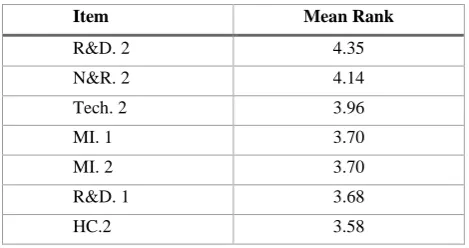
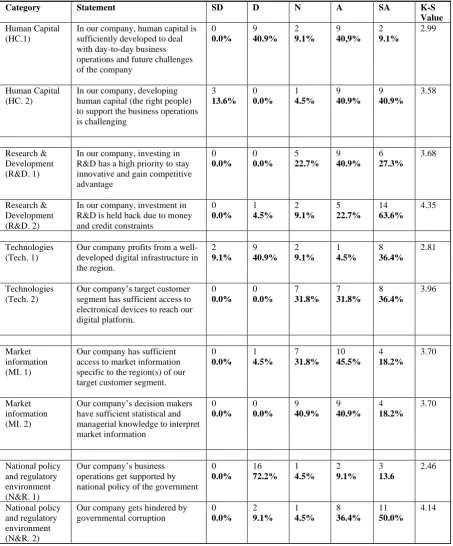
[image:5.595.53.287.156.345.2]In this paragraph the outcome of the primary data will be presented in a table indicating its mean rank according to the Kolmogorov-Smirnoff ranking technique. This gives a clear overview of the challenges the responding companies agreed or disagreed most with when they were presented the statements. In chapter 4.4 the implications of this data will be analyzed further. The results of the quantitative primary data indicating the answers the respondents gave in percentages, can be found in table A1 in the appendix. Below in table 3., a condensed ranking (from high mean rank to low) of the outcome of the survey can be found.
Table 3. Mean ranking of items per statement
Item Mean Rank
R&D. 2 4.35
N&R. 2 4.14
Tech. 2 3.96
MI. 1 3.70
MI. 2 3.70
R&D. 1 3.68
HC.2 3.58
Item Mean Rank
HC.1 2.99
Tech. 1 2.81
N&R. 1 2.46
4.4
Findings primary data
In this chapter, the implications of the outcome of the primary data presented in chapter 4.3 and appendix table A1. will be analyzed per statement in the following order: Human Capital, Research & Development, Technologies, Market Information and National policy and Regulatory environment.
4.4.1 Human Capital statement 1 (HC. 1)
The first statement on the topic of Human Capital posed to the respondents is: In our company, human capital is sufficiently developed to deal with day-to-day business operations and future challenges of the company. Which got a mean response of 2.99, with most notably 40.9% of the respondents disagreeing and another 40.9% agreeing with this statement. Indicating that the responses are dispersed and that the respondents are not on one line regarding this statement. So no conclusion can be made for this statement based on the given data.
4.4.2 Human Capital statement 2 (HC. 2)
The second statement on the topic of Human Capital posed to the respondents is: In our company, developing human capital (the right people) to support the business operations is challenging. This statement got a mean response of 3.58, indicating that the mean of the respondents are neutral or agreeing with this statement on average. But when looking more in depth into the responses, 40.9% agree and another 40.9% strongly agree with this statement, but 13.6% strongly disagree. Indicating developing human capital is challenging for most respondents.
4.4.3 Research and Development statement 1 (R&D1)
The first statement for the Research & Development topic posed to the respondents is: In our company, investing in R&D has a high priority to stay innovative and gain competitive advantage.
The response on the statement gave a mean score of 3.68, with 40.9% of the respondents agreeing with this statement and the rest respond with either neutral (22.7%) or strongly agree (27.3%) to the statement. For this statement it should be noted that 2 of the 22 respondents responded with ‘no comment’, meaning that the outcome of this statement is less reliable than the rest of the statements. Either way, most of the respondents responded positively to this statement, indicating that investing in R&D has a high priority to the respondents.
4.4.4 Research and Development statement 2 (R&D. 2)
The second statement for the Research & Development topic posed to the respondents is: In our company, investment in R&D is held back due to money and credit constraints. With a mean score of 4.36, a large portion (22.7%) of the respondents agreed with the statement and more than the majority of the respondents (63.6%) strongly agreed with this statement. Which could indicate that the SMEs that deploy IT transaction platforms operating in Sub Saharan Africa have a lack of access to capital.
4.4.5 Technologies statement 1 (Tech. 1)
[image:5.595.53.288.638.762.2]the digital infrastructure is subpar. However, 36.4% respond with strongly agree on the statement, indicating that a large share of the respondents feel like the digital infrastructure in their region is more than sufficient. This is likely because in the sample there are also companies based in developed countries present, and developed countries have a more developed digital infrastructure.
4.4.6 Technologies statement 2 (Tech. 2)
The second statement for the technologies topic posed to the respondents is: Our company’s target customer segment has
sufficient access to electronical devices to reach our digital platform. With a mean score of 3.96, the mean outcome of this statement is that the respondents roughly agree with this statement. For this statement, 36.4% of the respondents strongly agreed and 31.8% of the respondents were neutral and another 31.8% agreed with this statement. Based on this data, the target customer of the units of analysis has sufficient access to digital devices, which are needed to access the SMEs’ digital platform.
4.4.7 Market Information statement 1 (MI. 1)
The first statement for the Market Information topic posed to the respondents is: Our company has sufficient access to market information specific to the region(s) of our target customer segment. With a mean score of 3.70 for this statement, most respondents (45.5%) agreed with this statement, another big portion of the respondents (31.8%) were neutral on this statement. Indicating that the access to market information is sufficient for the SMEs operating in a developing country.
4.4.8 Market Information statement 2 (MI. 2)
The second statement for the Market Information topic posed to the respondents is: Our company’s decision makers have
sufficient statistical and managerial knowledge to interpret market information. This statement also got a mean score of 3.70 from the respondents, the same mean outcome as the first statement about Market Information. However, the outcome of the response is not the same on this statement as the previous mentioned statement. More respondents agreed (40.9%) with the second statement on Market Information and 40.9% were neutral on the statement and no respondents (strongly) disagreed with this statement. Indicating that the decision makers in the SMEs in question, are sufficiently equipped to interpret market information and is able to use it to base managerial decisions on
4.4.9 National policy and Regulatory environment statement (N&R. 1)
The first statement posed to the respondents for the N&R topic is: Our company’s business operations get supported by national
policy of the government. The mean response to this statement was 2.46, indicating that the mean of the respondents disagreed with this statement, which is certainly the case with 72.2% disagreeing with the statement. Indicating that the respondents do not feel they are supported by national policy of the government.
4.4.10 National policy and Regulatory environment statement 2 (N&R. 2)
The second statement for the National policy and Regulatory environment topic posed to the respondents is: Our company gets hindered by governmental corruption. With a mean score of 4.14, a big portion of the respondents (36.4%) agreed with the statement and half of the respondents (50.0%) strongly agreed with this statement. Which could indicate that governmental corruption is a challenge for the analyzed SMEs operating in a developing country.
4.5
Analysis primary qualitative data
Ten respondents supplemented an answer to the open question option in the distributed survey, providing additional qualitative
responses useful for additional analysis. In this section, the primary qualitative data from the survey will be analyzed to get more insight into additional challenges the units of analysis face. Some of the answers to the open questions were too vague and unspecific to base conclusions on, this analysis will focus on the responses where this is not the case. The structure of the open questions posed to the respondents is the same for the five topics, the following structure for the question was used: “Which other challenge(s) does your firm encounter regarding (topic)?”. With (topic) indicating one of the five topics this research focusses on.
4.5.1 Human Capital
In this section, the qualitative data on human capital will be analyzed, two additional challenges for the units of analysis were identified for this topic. A respondent based in South-Africa commented on this topic: “We believe that personality is what makes a great worker. It may be difficult to find someone with the right personality to be a cultural fit”. Which indicates that finding human capital containing the right personality traits to fit to the company’s culture is a challenge. A respondent based in Zambia mentioned something similar as a challenge: “Finding people who share the same vision and drive as the founders themselves to make the company successful”. A responded from the U.S.A. responded with: “ Working through the remote lifestyle and balancing different personalities and culture.” Indicating personality and its fit to culture is also a challenge for them. An additional challenge mentioned is working through the remote lifestyle, which is possibly a challenge for new tech companies focusing on IT platform development.
4.5.2 Research & Development
In this section, the qualitative data on research & development will be analyzed, two additional challenges for the units of analysis were identified for this topic. A respondent from the United Kingdom noted on this topic that “funding.” is a challenge for R&D and a respondent from South Africa noted on constraints in R&D “Mostly just the cost. Sometimes it's putting a spin on something already in existence. Over saturation makes it tricky”. Indicating that cost and lack of funds is a challenge to R&D according to the respondents, which resonates with the outcome of the Tech. 2 statement of chapter 4.4. Two other challenges mentioned by the respondent based in South Africa is that the oversaturation of the (IT platform) market is tricky, and that differentiating yourself in the IT platform market is also challenging. According to a respondent from Zambia, a challenge with regard to R&D is “Finding people with the required skillset”, indicating the possibility that R&D gets hindered by the fact that people with the right skillset and/ or education in the region the units of analysis operate in is hard to find.
4.5.3 Technologies
In this section, the qualitative data on technologies will be analyzed, two additional challenges for the units of analysis were identified for this topic. When analysing the data, a respondent from Nigeria mentioned regarding digital infrastructure that: “The cost of internet access is too high, and speeds are too slow and unreliable.”. Indicating that reliability and affordability of digital infrastructure is a challenge for respondents.
4.5.4 Market Information
No additional responses to the open question were given by the respondent for the market information topic.
4.5.5 National policy and Regulatory environment
possible challenge for the units of analysis is financial infrastructure. With financial infrastructure define as: “..the underlying foundation for a country's financial system. It includes all institutions, information, technologies, rules and standards that enable financial intermediation “ (Worldbank, 2009). According to the respondents, safety issues are also a challenging factor. For example, a company based in South Africa mentioned: “Due to safety issues in South Africa, services in industries such as transportation, may have their growth hindered.” and a respondent based in Zambia: “ The crime levels in the country are high, which lead to stolen equipment and damage to employees.”. Which makes high levels of crime a challenge for SMEs operating in developing countries.
4.5.6 Additional challenges summary
In this section, a summary will be given of eight additional challenges the units of analysis encounter according to the qualitative data gathered from the survey in table 4. below. Table 4. Additional challenges encountered by units of analysis
Challenge Category
Finding human capital containing the right personality traits to fit to the company’s culture
Human Capital
Working through the remote lifestyle
Human Capital
R&D gets hindered by the fact that people with the right skillset and/ or education in the region the units of analysis operate in is hard to find
Research & Development
Unreliability of digital infrastructure is a challenge
Technologies
Unaffordability of digital infrastructure is a challenge
Technologies
Unreliable and underdeveloped financial infrastructure is a challenge
Financial infrastructure
High levels of crime is a challenge
National policy and Regulatory environment/ public safety
4.6
Analysis combined with secondary data
As a consequence of the low response rate, five of the statements the respondents most agreed and disagreed with will be analyzed more in depth with secondary data. So, the second statement of Research & Development (R&D.2), National policy and Regulatory environment (N&R.2) and Technology (Tech.2) will be analyzed more in depth. And two statements the respondents agreed the least with will be analyzed, which include the first statement of Technology (Tech.1) and National policy and Regulatory environment (N&R.1). For every one of these statements a hypothesis will be formed and analyzed more in depth with secondary data. Before starting the in depth analysis of the five statements, the focus of the analysis will be narrowed down to the three countries most respondents were received and most countries have operations in: Nigeria, South Africa and Zambia. Because these three countries are all part of the Sub Saharan Africa region, and because the other respondents with headquarters in developed nations also operate in the Sub Saharan Africa region, the focus of the secondary data analysis will be on Sub Saharan Africa. Which is categorized in table 5. [image:7.595.349.508.224.317.2]below. Because this secondary data is not as specifically targeted at SMEs deploying IT platforms in developing countries, the outcome of this analysis is not scientifically as reliable as a high response rate with responses of the right units of analysis. But this data is meant to give extra insight into the challenges of the units of analysis of this research and give more data to base conclusion on. The secondary data used in this research is more macro and less specific than the data gathered from the survey. This data also takes into account the rural, less technologically developed, areas of Sub Saharan Africa which will likely differ from the situation the units of analysis find themselves in, because most of the business operations of the units of analysis are based in the urban region.
Table 5. Categorization regions of analysis
Country Nigeria South
Africa
Zambia
Income group
Lower middle income
Higher middle income
Lower middle income
Region Sub
Saharan Africa
Sub Saharan Africa
Sub Saharan Africa
4.6.1 Research & Development statement 2 (R&D.2)
According to the analysis with primary data of R&D.2 made in chapter 4.4.4, the conclusion was made that lack of capital and access to credit is a challenge to R&D according to the primary data of the survey and the mean outcome of the survey was 4.35. To analyze this hypothesis, the focus will be access to credit to the private sector. The indicator called, domestic credit to private sector (% of GDP) of Sub Saharan Africa, gathered by the World Bank in 2018. Defined as: “(…) financial resources provided to the private sector by financial corporations, such as through loans, purchases of nonequity securities, and trade credits and other accounts receivable, that establish a claim for repayment. For some countries these claims include credit to public enterprises.”(World Bank, 2018). Private markets are the engine of productivity growth, according to the World Bank, used for financing production, consumption and capital formation. In table 6. below the mean indicator for Sub Saharan Africa and the World can be found.
Table 6. Domestic credit to private sector in percentage of GDP (World Bank, 2018)
Region Indicator
Sub-Saharan Africa 16.9
World 129.2
This indicator shows an enormous discrepancy of 112.3 percentage points between Sub-Saharan Africa and the world, indicating that Sub-Saharan Africa has very little access to credit. This indicator backs the outcome of the primary data gathered by the survey that lack of capital and access to credit is a challenge to R&D for the units of analysis.
4.6.2 Technologies statement 1 (Tech. 1)
[image:7.595.54.288.280.543.2]megabytes per seconds (MB/s) and is presented in table 7. below. This gives both an indication of the speed internet speed of the countries, but also tells something how developed the internet infrastructure is in the countries.
Table 7. Average connection speed (OpenSignal, 2019)
According to the above data, with a discrepancy of 7.2 MB/s the average internet speed is a lot lower than the global average, which supports the conclusion made with the primary data that the development of the digital infrastructure of the region the units of analysis operate in is sup par.
4.6.3 Technologies statement 2 (Tech. 2)
According to the analysis with primary data on Technologies statement 2, the target customer of the units of analysis has sufficient access to digital devices, which are needed to access the SMEs’ digital platform. This statement got a mean score of 3.96. To investigate this more in depth, data gathered for the year 2018 regarding smartphone penetration will be used. This data indicates the share of smartphone users in a population in percentages and can be found in table 8.
Table 8. Smartphone penetration (Statista, 2019)
Country Smartphone penetration
2018 [%]
Nigeria 13.0
South Africa 35.5
Average Nigeria & South Africa
24.25
World 38
According to the data presented in the table 7, with a discrepancy of 13.75 percent points, the secondary data does not support the primary data and therefore does not support the conclusion that customer of the units of analysis has sufficient access to digital devices, which are needed to access the SMEs’ digital platform.
4.6.4 National policy and Regulatory environment statement 1 (N&R. 1)
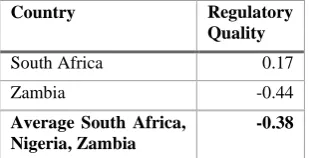
[image:8.595.310.544.653.760.2]According to the analysis with primary data on N&R statement 1, lack of support by national policy of the government is a challenge for SMEs operating in developing countries with a mean response of 2.46 to the statement. The hypothesis to investigate this will be: The national policy set in place by the government in the region the units of analysis operate in does not support the units of analysis. To further analyze this statement the regulatory quality index will be used, defined as: “Regulatory Quality captures perceptions of the ability of the government to formulate and implement sound policies and regulations that permit and promote private sector development. Estimate gives the country's score on the aggregate indicator, in units of a standard normal distribution, i.e. ranging from approximately -2.5 to -2.5”. (World Bank, 2019). The data on this indicator can be found in table 9. below.
Table 9. Regulatory quality index (World Bank, 2019)
Country Regulatory
Quality
All countries (average) -0.15
Nigeria -0.88
Country Regulatory
Quality
South Africa 0.17
Zambia -0.44
Average South Africa, Nigeria, Zambia
-0.38
The data above indicates a discrepancy of 0.23 points, indicating that the countries the units of analysis have operations in, suffer from low regulatory quality of the government. This supports the findings from the primary data that lack of national policy of the government is a challenge for the units of analysis.
4.6.5 National policy and Regulatory environment statement 2 (N&R. 2)
According to the analysis with primary data on N&R statement 2, governmental corruption is a challenge for the units of analysis and the mean outcome of the survey was 4.14. To analyze this with secondary data, the “control of corruption index” of 2018 investigated by the World Bank will be used. The definition of the control of corruption index is: “Perceptions of the extent to which public power is exercised for private gain, including both petty and grand forms of corruption, as well as "capture" of the state by elites and private interests.” (Kaufmann, Et al. 2005). Giving an indication of the perception of corruption within the analyzed countries, which gives more information if governmental corruption is indeed a challenging factor for the units of analysis. The control of corruption index is a point system with a value between -2.5 and 2.5 and can be found in table 10. below.
Table 10. Control of Corruption Median (World Bank, 2018)
Country Control of
Corruption points
All countries (average) -0.04
South Africa -0.02
Nigeria -1.04
Zambia -0.66
Average South Africa, Nigeria, Zambia
-0.57
The data indicates a discrepancy of the control of corruption indicator of 0.53 when compared the average of the three specified countries with the world median. Which supports the outcome of the primary data that governmental corruption is a challenging factor for the units of analysis.
4.7
Summary of the Results
Below in table 11. a summary of the conclusions drawn from the results of the data analysis and on what data the results are based on can be found. The data based on both primary and secondary data have more validity compared to the data that has only been analyzed with only primary data.
Table 11. Summary of the results
Statement Conclusion Based on
HC.1 Response data is too dispersed to
draw a conclusion.
Primary data
HC.2 It is challenging to develop human
capital and obtaining the right people for the job to support business operation sufficiently for SMEs deploying an IT platform in developing countries (from here
Primary data
Country Avg. connection speed
(MB/s)
Sub Saharan Africa
7.2
[image:8.595.55.212.706.763.2]Statement Conclusion Based on
on referred to as the units of analysis).
R&D.1 Investing in R&D to stay innovative and gain competitive advantage has a high priority to the units of analysis.
Primary data
R&D.2 Lack of capital and access to credit holds back R&D activities for the units of analysis
Primary & secondary data
Tech.1 The digital infrastructure of the region the units of analysis operate in is below average
Primary & secondary data
Tech.2 Response data is too dispersed to
draw a conclusion.
Primary & secondary data
MI.1 Access to market information
specific to the region of the target customer segment is sufficient for the units of analysis.
Primary data
MI.2 The decision makers of the units
of analysis are sufficiently equipped to interpret market information and is able to use it to base managerial decisions on.
Primary data
N&R.1 The national policy set in place by the government in the region the units of analysis operate in does not support their business operations
Primary & secondary data
N&R.2 Governmental corruption is a challenge for the units of analysis and hinders company operations
Primary & secondary data
5.
DISCUSSION
The research done in this paper has helped to better understand what challenges SMEs operating in the BoP deploying an IT transaction platform come across, giving a clear oversight and ranking of challenges this particular group of SMEs come across in the BoP environment. In this section, the results of this research and its implications for theory and practice will be discussed.
5.1
Theoretical implications
This paper gave an explorative insight into the challenges businesses operating in the BoP have when deploying an IT platform. The oversight of challenges developed in this research can be used to inspire future research on this topic, by highlighting the deployment and use of IT platforms in the BoP. It provides a starting point and possibly more interest for this area of research, which is currently underrepresented in the research literature. Furthermore, the challenges identified in this research has the potential to aid future researchers for developing strategy for deploying IT transaction platform in the BoP.
The framework of this research can also be used by other researchers, with the addition of the seven additional challenges presented in table 4., identified with help of the qualitative data gathered from the survey, to get a more reliable insights in the platform phenomenon in the BoP. This framework could
additionally be extended to enterprises deploying IT transaction platforms in developed countries, to also increase understanding of challenges of platform deployment in these types of regions. An interesting finding from this research is that, the respondents as recorded in the primary data, felt that their target customer segment has sufficient access to electronical devices to reach their platforms. However, when crosschecking this with secondary data by investigating smartphone penetration rate in selected countries, smartphone penetration seems to be lacking severely in the countries these businesses operating in. Possibly indicating that the target customer segment of these businesses is solely the urban areas which have a higher smartphone penetration rate and that the rural areas get left out of the digital platform services these companies offer.
5.2
Practical Implications
Businesses in the BoP, or planning to do business in the BoP deploying an IT transaction platform can take note of the challenges identified in this research and use this information for decision making and strategizing in their company. These businesses most notably need to take note of the lack of access to credit, governmental corruption and the digital infrastructure which is below average in the BoP.
Also, the challenges identified can be used by (governmental) organizations to identify the most relevant challenges and bottlenecks SMEs in developing countries face when deploying an IT transaction platforms and help provide support to make these challenges less of a hindering factor for the SMEs. Most notably the challenges indicating that governmental corruption and lack of national policy hinders the operations of the units of analysis Working to alleviate these challenges, could help accelerate the adoption and correct use of IT platforms in BoP regions, enabling developing nations to catch up with the level of platform adoption digitization of developed countries. Which in turn could help these low income regions to more efficiently make use of digital resources, like digital platforms, to help themselves to alleviate poverty.
The fact that the growth rate of digitization and connectedness is especially high in developing countries, makes this research relevant for businesses making use of the early mover advantage in this young and developing market for deploying an IT transaction platform. Considering this research topic has not been investigated yet.
Finally, this paper will also add insights to the project initiated by the University of Twente "Collaborative Business Model Innovation for Inclusive Business." Because IT transaction platforms deployed in the BoP engages this group of people with a lower income into the value chain, by connecting this group of people’s needs and services to solutions for these needs and demand for these services. More effectively connecting supply and demand for these needs and services. This research offers a tool in the form of an oversight of challenges that can potentially aid businesses, researches and other organizations in strategizing and identifying the needs and requirements to deploy an IT transaction platform in the BoP.
6.
LIMITATIONS & FUTURE
RESEARCH
In this section, the limitations of the research and recommendations on future research will be given.
6.1
Limitations
secondary data was not utilized for all challenges researched in this paper, making the conclusions identified for those challenges less reliable. The additional seven challenges identified with help of the qualitative primary data collection, helped identify topics for future research, but the weight or relevance for these additional challenges have not been further investigated in this research. Making the weight or relevance of these challenges unknown. Other limitations include that this research was focused on SMEs operating in developing countries and the findings can therefore not be extended to SMEs or large enterprises in developed countries. Also, 21.7% of the respondents were businesses based in a developed country, operating in a developing country, which could possibly influence the response data. Furthermore, the research was focused on IT transaction platforms and the findings cannot be extended to the other kinds of IT platforms identified in the platform typology by Evans & Gawer (2017) not used in this research.
6.2
Future Research
For future research, the challenges identified in this paper as significant challenges or challenges found via the quantitative analysis can be researched more in depth separately for SMEs in developing countries. Research on challenges encountered when deploying IT transaction platform could also be extended to large enterprises operating in the BoP. Furthermore, the challenges of deploying the challenges encountered by SMEs deploying the remaining three kind of platforms identified by Evans & Gawer, innovation platforms, integrated platforms and investment platforms could be researched to get a more complete picture of the challenges encountered by SMEs in the IT platform landscape .
The research of these challenges could also be extended to the deployment of IT transaction platforms in developed countries and a comparative study between the challenges of deployment of IT transaction platforms in developing and developed countries could be done. The framework used in my research, including the additional challenges identified with the qualitative analysis, could be used as a starting point for this research. This framework can also be used in the future to gather more data on these challenges for more specific regions or countries, to get a more specific and reliable picture of the challenges faced by enterprises for this particular topic.
Moreover, future research could be focused on the discrepancy of access to smartphone penetration and therefore access to digital platforms, between rural and urban areas in developing countries and the impact this has on SMEs deploying IT platforms in the BoP. Future research could also focus itself on the influence of the low availability of electronic devices on the network effect in BoP regions with low smartphone penetration and how this influences the challenges encountered and the strategy for businesses deploying the IT platforms in those regions.
7.
CONCLUSION
This research aimed to answer the following research question: Which challenges do SMEs operating in the BoP face when deploying an IT transaction platform? This research question has been answered with a explorative research design. Ten challenges divided over five topics have been identified and ranked according to the mean score of the responses on the questionnaire. Furthermore, additional challenges faced by the units of analysis have been identified. The identification of these challenges provides pioneering insights into challenges faced by SMEs operating in the BoP deploying an IT transaction platform.
The research is providing a starting point for future research on this topic and insights useful for strategy and business development for SMEs deploying an IT transaction platform in the BoP.
8.
ACKNOWLEDGEMENTS
First and foremost, I would like to thank my father and mother, but also my friends and family, for their love, support and believe in me during the process of making my Bachelor’s thesis. Furthermore, I would like to thank Tamara Oukes for inspiring me to do research on business at the BoP, which is a topic I had little knowledge on before starting this research. Last but not least, I would like to thank Raymond Loohuis for his guidance and supervising approach that have enabled me to develop myself as an individual and responsible researcher.
9.
LIST OF REFERENCES
1) Commission Recommendation of 6 May 2003 concerning the definition of micro, small and medium-sized enterprises (Text with EEA relevance) (notified under document number C(2003) 1422)
2) Denzin, N. (2006). Sociological Methods: A Sourcebook. Aldine Transaction. ISBN 978-0-202-30840-1. (5th edition). 3) Developing Countries Population. (2019-10-16). Retrieved
2019-10-19,from
http://worldpopulationreview.com/countries/developing-countries/
4) Goldin C. (2016) Human Capital. Handbook of Cliometrics. Heidelberg, Germany: Springer Verlag.
5) Holmén, M., Magnusson, M., & McKelvey, M. (2007). What are innovative opportunities?. Industry and innovation, 14(1), 27-45.
6) Karnani, A. (2009). Romanticizing the poor harms the poor. Journal of International Development, 21(1), 76-86.
7) Kaufmann, Daniel; Kraay, Aart; Mastruzzi, Massimo. 2005. Governance matters IV : governance indicators for 1996-2004 (English). Policy, Research working paper ; no. WPS 3630.
Washington, DC: World Bank.
http://documents.worldbank.org/curated/en/60206146831375 0126/Governance-matters-IV-governance-indicators-for-1996-2004
8) Kenney, M., Zysman, J. “The Rise of the Platform Economy.” Issues in Science and Technology 32, no. 3 (2016).
9) Kolk, A., Rivera-Santos, M., & Rufín, C. (2014). Reviewing a Decade of Research on the “Base/Bottom of the Pyramid” (BOP) Concept. Business & Society, 53(3), 338–377. https://doi.org/10.1177/0007650312474928
10) Linder, J. C., Jarvenpaa, S., & Davenport, T. H. (2003). Toward an innovation sourcing strategy. MIT Sloan Management Review, 44(4), 43.
11) Mehrtens, J., Cragg, P. B., & Mills, A. M. (2001). A model of Internet adoption by SMEs. Information & management, 39(3), 165-176.
12) OECD (2015), "Concepts and definitions for identifying R&D", in Frascati Manual 2015: Guidelines for Collecting and Reporting Data on Research and Experimental Development,
OECD Publishing, Paris,
https://doi.org/10.1787/9789264239012-4-en.
13) OpenSignal (2019), The state of mobile network experience. Retrieved from https://www.opensignal.com/sites/opensignal-
14) Prahalad, C. K. (2012). Bottom of the pyramid as a source of breakthrough innovations. Journal of Product Innovation Management, 29(1), 6-12.
15) Prahalad, C.K. and Hart, S.L., 1999. Strategies for the bottom of the pyramid: creating sustainable development. Ann Arbor, 1001, p.48109.
16) Savrul, M., Incekarab, A., Senerb, S. (2014). "The Potential of E-commerce for SMEs in a Globalizing Business Environment." Social and Behavioral Science 150.
17) Shenglin, B., Simonelly, F., Ruidong, Z., Bosc, R. Wenwei, L. (2017). "Digital Infrastructure: Overcoming the digital divide in emerging economies." CEPS Special Report. 18) Simanis, E., & Hart, S. L. (2009). Innovation from the inside
out. MIT Sloan Management Review, 50(4), 77-86.
19) Statista. (October 25, 2019). Global smartphone penetration rate as share of population from 2016 to 2020 In Statista.
Retrieved, from
https://www-statista- com.ezproxy2.utwente.nl/statistics/203734/global-smartphone-penetration-per-capita-since-2005/
20) Stevenson, A. (Ed.), (2010). Oxford Dictionary of English. : Oxford University Press. Retrieved 17 Oct. 2019, from https://www.oxfordreference.com/view/10.1093/acref/97801 99571123.001.0001/acref-9780199571123.
21) Sun, R., Gregor, S., Keating, B. (2015). "Information Technology Platforms: Definition and Research Directions." Conference: The 26th Australasian Conference on Information Systems.
22) The Economist Intelligence Unit (2019). "The Inclusive Internet Index 2019: Executive summary."
23) The World Bank (2009). Financial Infrastructure: Building Access Trough Transparent and Stable Financial Systems.
Retrieved from
http://siteresources.worldbank.org/FINANCIALSECTOR/Re
sources/282044-1252596846652/FinancialInfrastructureReport.pdf
24) The World Bank (2019). Regulatory Quality: Estimate. Retrieved from https://datacatalog.worldbank.org/regulatory-quality-estimate-0
25 The World Bank Group. (2016). World Development Report: Digital Dividends.
26) The World Bank. (2018). World Development Indicators: Financial access, stability and efficiency. Retrieved from http://wdi.worldbank.org/table/5.5#
27) Van Alstyne, M. W., Parker, G. G., & Choudary, S. P. (2016). Pipelines, platforms, and the new rules of strategy. Harvard business review, 94(4), 54-62.
28) Wan, X., Cenamor, J., Parker, G., Van Alstyne, M. (2017). "Unraveling Platform Strategies: A Review from an Organizational Ambidexterity Perspective." Sustainability 9(5).
29) West, D. M. (2015). Digital divide: Improving Internet access in the developing world through affordable services and diverse content. Brookings Institution.
30) World Economic Forum, The Boston Consultancy Group (2014). Delivering Digital Infrastructure Advancing the Internet Economy.
10.
APPENDIX
Survey on IT platform SMEs in developing countries
My name is Steffan Hakkers, Bachelor student at the University of Twente, the Netherlands and I am doing an explorative research on challenges encountered by small medium enterprises in various sectors and countries in deploying IT platforms.
I hope that you will consider to fill in this survey. It will take only around 5 minutes of your time. The topics in this survey are: Human Capital, Research & Development, Technologies, Market information and National policy & regulatory environment. For every topic 2 statements are given which ranges from strongly agree to strongly disagree (with the statement). The option 'no comment' can be chosen in case you cannot answer the statement.
All data gathered will be treated strictly anonymous and cannot be traced back to you or your company. Your data is handled in accordance to the EU General Data Protection Regulation (GDPR) and the Code of Conduct for the use of personal data in Scientific Research by VSNU (the Association of Universities in the Netherlands). The link below leads to the survey. The survey is valid until Saturday 6 November
Contact me in case you have any questions [email protected] Many thanks in advance for partaking in this survey.
Best whishes Steffan Hakkers
Main body of questions
Human Capital
Intro
In the context of this survey, human capital is defined as the stock of skills that the labor force possesses. Includes sufficient level of education and (e.g. managerial or IT ) capabilities of the labor force. Questions
- In our company, human capital is sufficiently developed to deal with day-to-day business operations and future challenges of the company
- In our company, developing human capital (the right people) to support the business operations is challenging
- (Optional) What is particularly challenging in developing human capital?
Research & Development Intro
R&D refers to creative work undertaken on a systematic basis in order to increase the stock of knowledge and the use of this knowledge to devise new applications, or improving existing services or products
Questions
- In our company, investing in R&D has a high priority to stay innovative and gain competitive advantage
Figure A1. Questionnaire used for data collection
Technologies
Intro
Technologies in context of this research focusses on the digital infrastructure (which entails access to electricity and internet for the target customer segment in the region your business operates in). And also the availability of electronical devices (smartphones, computers) the IT platform can be accessed on for your target customer segment.
Questions
- Our company profits from a well-developed digital infrastructure in the region.
- Our company’s target customer segment has sufficient access to electronical devices to reach our digital platform.
- (Optional) which other challenge(s) does your firm encounter regarding technologies?
Market information Intro
Market information is information to base managerial decisions on, which can be accessed in national and international databases or gathered by your own company.
Questions
- Our company has sufficient access to market information specific to the region(s) of our target customer segment.
- Our company’s decision makers have sufficient statistical and managerial knowledge to interpret market information
- (Optional) which other challenge(s) does your firm encounter regarding market information?
National policy and regulatory environment
Intro
National policy and regulatory environment include taxation and legal policies and any other influence the government has on the business environment the company operates in.
Questions
- Our company’s business operations get supported by national policy of the government - Our company gets hindered by governmental corruption
- (Optional) which other challenge(s) does your firm encounter regarding national policy and regulatory environment?
(To conclude)
Challenges worth mentioning (Optional)
This is the end of the main part of the survey, if you feel like an important challenging factor is missing, Feel free to specify it in the box below.
If not, I would like to thank you for your cooperation. Questions or comments about my research can be sent to [email protected]
Table A1. Results of the quantitative primary data in percentages.
Category Statement SD D N A SA K-S
Value Human Capital
(HC.1)
In our company, human capital is sufficiently developed to deal with day-to-day business operations and future challenges of the company
0 0.0% 9 40.9% 2 9.1% 9 40,9% 2 9.1% 2.99 Human Capital (HC. 2)
In our company, developing human capital (the right people) to support the business operations is challenging 3 13.6% 0 0.0% 1 4.5% 9 40.9% 9 40.9% 3.58 Research & Development (R&D. 1)
In our company, investing in R&D has a high priority to stay innovative and gain competitive advantage 0 0.0% 0 0.0% 5 22.7% 9 40.9% 6 27.3% 3.68 Research & Development (R&D. 2)
In our company, investment in R&D is held back due to money and credit constraints
0 0.0% 1 4.5% 2 9.1% 5 22.7% 14 63.6% 4.35 Technologies (Tech. 1)
Our company profits from a well-developed digital infrastructure in the region. 2 9.1% 9 40.9% 2 9.1% 1 4.5% 8 36.4% 2.81 Technologies (Tech. 2)
Our company’s target customer segment has sufficient access to electronical devices to reach our digital platform. 0 0.0% 0 0.0% 7 31.8% 7 31.8% 8 36.4% 3.96 Market information (MI. 1)
Our company has sufficient access to market information specific to the region(s) of our target customer segment.
0 0.0% 1 4.5% 7 31.8% 10 45.5% 4 18.2% 3.70 Market information (MI. 2)
Our company’s decision makers have sufficient statistical and managerial knowledge to interpret market information 0 0.0% 0 0.0% 9 40.9% 9 40.9% 4 18.2% 3.70 National policy and regulatory environment (N&R. 1)
Our company’s business operations get supported by national policy of the government
0 0.0% 16 72.2% 1 4.5% 2 9.1% 3 13.6 2.46 National policy and regulatory environment (N&R. 2)