http://wrap.warwick.ac.uk/
Original citation:LHCb Collaboration (Including: Back, John J., Dossett, D., Gershon, Harrison, P. F., Timothy J., Kreps, Michal, Latham, Thomas, Pilar, T., Poluektov, Anton, Reid, Matthew M., Silva Coutinho, R., Whitehead, M. (Mark) and Williams, M. P.). (2012). First
observation of the decays B[over ¯]^{0}→D^{+}K^{-}π^{+}π^{-} and B^{-}→D^{0}K^{-}π^{+}π^{-}. Physical Review Letters, Vol.108 (No.16). p. 161801.
Permanent WRAP url:
http://wrap.warwick.ac.uk/49305
Copyright and reuse:
The Warwick Research Archive Portal (WRAP) makes this work of researchers of the University of Warwick available open access under the following conditions.
This article is made available under the Creative Commons Attribution- 3.0 Unported (CC BY 3.0) license and may be reused according to the conditions of the license. For more details seehttp://creativecommons.org/licenses/by/3.0/
A note on versions:
The version presented in WRAP is the published version, or, version of record, and may be cited as it appears here.
First Observation of the Decays
B
0!
D
þK
þand
B
!
D
0K
þR. Aaijet al.*
(LHCb collaboration)
(Received 24 January 2012; published 18 April 2012)
First observations of the Cabibbo-suppressed decaysB0!DþKþandB!D0Kþare
reported using35 pb1of data collected with the LHCb detector. Their branching fractions are measured
with respect to the corresponding Cabibbo-favored decays, from which we obtain BðB0! DþKþÞ=BðB0!DþþÞ ¼ ð5:91:10:5Þ102 and BðB!D0KþÞ=BðB! D0þÞ ¼ ð9:41:30:9Þ102, where the uncertainties are statistical and systematic,
respec-tively. TheB!D0Kþ decay is particularly interesting, as it can be used in a similar way to B!D0Kto measure the Cabibbo-Kobayashi-Maskawa phase.
DOI:10.1103/PhysRevLett.108.161801 PACS numbers: 13.25.Hw, 12.15.Hh
The standard model (SM) of particle physics provides a good description of nature up to the TeV scale, yet many
issues remain unresolved [1], including, but not limited to,
the hierarchy problem, the preponderance of matter over antimatter in the Universe, and the need to explain dark matter. One of the main objectives of the LHC is to search for new physics beyond the SM either through direct
detection or through interference effects in b- and
c-hadron decays. In the SM, the
Cabibbo-Kobayashi-Maskawa (CKM) matrix [2] governs the strength of weak
charged-current interactions and their corresponding phases. Precise measurements on the CKM matrix parame-ters may reveal deviations from the consistency that is expected in the SM, making study of these decays a unique laboratory in which to search for physics beyond the standard model.
The most poorly constrained of the CKM parameters is
the weak phaseargðVubVud
VcbVcdÞ. Its direct measurement
reaches a precision of 10–12 [3,4]. Two promising
methods of measuring this phase are through the
time-independent and time-dependent analyses of B !
D0K [5–7] and B0
s !DsK [8,9], respectively. Both
approaches can be extended to higher multiplicity modes,
such asB0!D0K0,B!D0Kþ [10] andB0
s !
DsKþ, which could provide a comparable level of
sensitivity. The last two decays have not previously been observed.
In this Letter, we report first observations of the
Cabibbo-suppressed (CS) B0 !DþKþ andB !
D0Kþ decays, where Dþ!Kþþ and D0 !
Kþ, where charge conjugation is implied throughout
this Letter. These signal decays are normalized with
respect to the topologically similar Cabibbo-favored (CF)
B0!Dþþ and B!D0þ decays,
re-spectively. For brevity, we use the notationXd to refer to
the recoilingþsystem in the CF decays andXsfor
theKþ system in the CS decays.
The analysis presented here is based on35 pb1 of data
collected with the LHCb detector in 2010. For these mea-surements, the most important parts of LHCb are the vertex detector (VELO), the charged particle tracking system, the ring imaging Cherenkov (RICH) detectors and the trigger. The VELO is instrumental in separating particles coming from heavy quark decays and those emerging directly from
pp interactions, by providing an impact parameter (IP)
resolution of about16mþ30m=pT (transverse
mo-mentum, pT in GeV=c). The tracking system measures
charged particles’ momenta with a resolution of p=p
0:4%ð0:6%Þ at 5 (100) GeV=c. The RICH detectors are
important to identify kaons and suppress the potentially large backgrounds from misidentified pions. Events are selected by a two-level trigger system. The first level is hardware based, and requires either a large transverse
energy deposition in the calorimeter system, or a high pT
muon or pair of muons detected in the muon system. The second level, the high-level trigger, uses simplified
ver-sions of the offline software to reconstruct decays ofband
c hadrons both inclusively and exclusively. Candidates
passing the trigger selections are saved and used for offline analysis. A more detailed description of the LHCb detector
can be found elsewhere [11].
In this analysis the signal and normalization modes are topologically identical, allowing loose trigger require-ments to be made with small associated uncertainty. In
particular, we exploit the fact thatbhadrons are produced
in pairs in pp collisions, and include events that were
triggered by the decay products of either the signal b
hadron or the otherbhadron in the event. This requirement
increases the efficiency of our trigger selection by about 80% compared to the trigger selections requiring the signal
bhadron to be responsible for triggering the event, as was
*Full author list given at the end of the article.
done in Ref. [12]. This sizeable increase in the trigger
efficiency is due to the large average pT of the
recon-structed signalB decay and the kinematic correlation (in
pT and pseudorapidity) between the twobhadrons in the
event.
The selection criteria used to reconstruct the B0 !
Dþþ andB!D0þ final states are
de-scribed in Ref. [12]. The Cabibbo suppression results in
about a factor of 20 lower rate. To improve the signal-to-background ratio in the CS decay modes, additional selec-tion requirements are imposed, and they are applied to both
the signal and normalization modes. TheBmeson
candi-date is required to havepT>4 GeV=c,IP<60mwith
respect to its associated primary vertex (PV), where the associated PV is the one having the smallest impact
pa-rameter2 with respect to the track. We also require the
flight distance 2>144, where the 2 is with respect to
the zero flight distance hypothesis, and the vertex
2=ndf<5, where ndf represents the number of degrees
of freedom in the fit. The last requirement is also applied to
the vertices associated with Xd and Xs. Three additional
criteria are applied only to the CS modes. First, to remove
the peaking backgrounds from B!DDs, Ds !
Kþ, we veto events where the invariant mass,
MðXsÞ, is within 20 MeV=c2 (2:5) of the Ds mass.
Information from the RICH detectors is critical to reduce background from the CF decay modes. This suppression is
accomplished by requiring the kaon in Xs to have p <
100 GeV=c(above which there is minimalK=separation from the RICH detectors), and the difference in log-likelihoods between the kaon and pion hypotheses to
sat-isfy lnLðKÞ>8. The latter requirement is
deter-mined by optimizing NS=
ffiffiffiffiffiffiffiffiffiffiffiffiffiffiffiffiffiffiffi NSþNB p
, where we assume
100 signal events (1=20of the CF decay yields) prior
to any particle identification (PID) selection requirement,
and the combinatorial background yield,NB, is taken from
the highB-mass sideband (5350–5580 MeV=c2). We also
make a loose PID requirement of lnLðKÞ<10on
the pions inXsandXd.
Selection and trigger efficiencies are determined from
simulation. Events are produced using PYTHIA [13] and
long-lived particles are decayed usingEVTGEN [14]. The
detector response is simulated with GEANT4 [15]. The
DKþ final states are assumed to include 50%
DK1ð1270Þ and 20%DK1ð1400Þ, with smaller
contri-butions from DK2ð1430Þ, DKð1680Þ, DKð892Þ0,
and D1ð2420ÞK. The resonances included in the
simulation of the Xd system are described in Ref. [12].
The relative efficiencies, including selection and
trigger, but not PID selection, are determined
to be B0!DþKþ=B0!Dþþ¼1:050:04 and
B!D0Kþ=B!D0þ¼0:940:04, where the
uncertainties are statistical only. The efficiencies have a small dependence on the contributing resonances and their daughters’ masses, and we therefore do not necessarily
expect the ratios to be equal to unity. Moreover, the addi-tional selections on the CS modes contribute to small differences between the signal and normalization modes’ efficiencies.
The PID efficiencies are determined in bins of track
momentum and pseudorapidity () using theD0daughters
fromD!sD0,D0 !Kþcalibration data, where
the particles are identified without RICH information using
the charge of the soft pion,s. The kinematics of the kaon
in theXssystem are taken from simulation after all offline
and trigger selections. Applying the PID efficiencies to the simulated decays, we determine the efficiencies for the
kaon to pass the lnLðKÞ>8 requirement to be
ð75:91:5Þ%forB0 !DþKþ andð79:21:5Þ%
forB!D0Kþ.
Invariant mass distributions for the normalization and
signal modes are shown in Fig.1. Signal yields are
deter-mined through unbinned maximum likelihood fits to the sum of signal and several background components. The signal distributions are parametrized as the sum of two Gaussian functions with common means, and shape
pa-rameters,core andfcorethat represent the width and area
fraction of the narrower (core) Gaussian portion, andrw
wide=core, which is the ratio of the wider to narrower
Gaussian width.
The CF modes are first fit withfcore andrwconstrained
to the values from simulation within their uncertainties,
while core is left as a free parameter since simulation
underestimates the mass resolution by10%. For the CF
decay mode fits, the background shapes are the same as
those described in Ref. [12]. The resulting signal shape
parameters from the CF decay fits are then fixed in
sub-sequent fits to the CS decay modes, except forcore, which
use the values from the CF decay mode fits, scaled by
0:95to account for the different kinematics of the CF and
CS decay modes.
For the CS decays, invariant mass shapes of specific
peaking backgrounds from otherb-hadron decays are
de-termined from MC simulation. The largest of these
back-grounds comes fromDðÞþ decays, where one of
the passes the lnLðKÞ>8requirement and is
misidentified as aK. To determine the fraction of events
in which this occurs, we use measured PID fake rates (
faking K) obtained from D calibration data [binned in
(p,)], and apply them to each inDþ
simu-lated events. A decay is considered a fake if either pion has p <100 GeV=c, and a randomly generated number in the interval from [0, 1] is less than that pion’s determined fake rate. The pion’s mass is then replaced by the kaon’s mass,
and the invariant mass of thebhadron is recomputed. The
resulting spectrum is then fitted using a Crystal Ball [16]
line shape and its parameters are fixed in fits to the data. Using this method, we find the same cross-feed
rate of ð4:40:7Þ% for both B0!Dþþ
and B!D0þ into B0 !DþKþ and
B!D0Kþ, respectively, where the uncertainty
includes both statistical and systematic sources. A similar
procedure is used to obtain theDþ background
yields and shapes. The background yields are obtained by multiplying the observed CF signal yields in the data by the cross-feed rates and the fraction of background in the
region of the mass fit (5040–5580 MeV=c2).
We also account for backgrounds from the decays
B!DDs,Ds !KKþ, where theKþ is
misidenti-fied as aþ. The yields of these decays are lower, but are
offset by a larger fake rate since the PID requirement on the particles assumed to be pions is significantly looser
( lnLðKÞ<10). Using the same technique as
de-scribed above, the fake rate is found to be ð242Þ%.
The fake yield from this source is then computed from
the product of the measured yield of B0!DþD
s in the
data [16114ðstatÞ], theKPID efficiency of 75.9%, and
the 24% fake rate. TheB !D0Ds yield was not directly
measured, but was determined from known branching
fractions [17] and efficiencies from simulation.
Additional uncertainty due to these extrapolations is
in-cluded in the estimatedB !D0D
s background yield.
The last sources of background, which do not contribute
to the signal regions, are fromDKþ, where the soft
pion or photon from theDis lost. The shapes of these low
mass backgrounds are taken from the fitted Dþ
shapes in the Dþ mass fits, and the yield ratios
NðDKþÞ=NðDKþÞ, are constrained to be
equal to the ratios obtained from CF mode fits with a 25% uncertainty.
The combinatorial background is assumed to have an exponential shape. A summary of the signal shape
parame-ters and the specificb-hadron backgrounds used in the CS
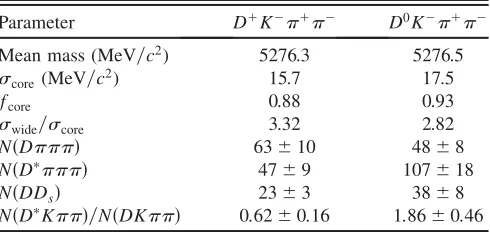
signal mode fits is given in TableI.
The fitted yields are212669 B0 !Dþþand
163057B!D0þevents. For the CS modes,
we find9016 B0!DþKþand13017B!
[image:4.612.149.463.49.342.2]D0Kþ signal decays. The CS decay signals have
TABLE I. Summary of parameters used in the CS mass fits. Values without uncertainties are fixed in the CS mode fits, and values with uncertainties are included with a Gaussian constraint with central values and widths as indicated.
Parameter DþKþ D0Kþ
Mean mass (MeV=c2) 5276.3 5276.5
core(MeV=c2) 15.7 17.5
fcore 0.88 0.93
wide=core 3.32 2.82
NðDÞ 6310 488
NðDÞ 479 10718
NðDDsÞ 233 388
NðDKÞ=NðDKÞ 0:620:16 1:860:46
) 2 Mass (MeV/c 5200 5400 ) 2
Candidates / (10 MeV/c
0 200 400
600 LHCb Data
Total Signal 0 B bkg π π π D* bkg π π DK Comb bkg (a) ) 2 Mass (MeV/c 5200 5400 ) 2
Candidates / (10 MeV/c
0 100 200 300
400 LHCb Data
Total Signal -B bkg π π π D* bkg π π DK Comb bkg (b) ) 2 Mass (MeV/c 5200 5400 ) 2
Candidates / (20 MeV/c
0 50
100 LHCb Data
Total Signal 0 B bkg π π D*K bkg -s D + D bkg π π π (*) D Comb bkg (c) ) 2 Mass (MeV/c 5200 5400 ) 2
Candidates / (20 MeV/c
[image:4.612.316.561.598.715.2]0 50 100 LHCb Data Total Signal -B bkg π π D*K bkg -s D 0 D bkg π π π (*) D Comb bkg (d)
FIG. 1. Invariant mass distributions for (a) B0!Dþþ, (b) B!D0þ, (c) B0!DþKþ, and
significances of 7.2 and 9.0, respectively, calculated asffiffiffiffiffiffiffiffiffiffiffiffiffiffiffiffiffiffiffiffiffiffiffiffiffiffiffiffiffiffiffiffiffi
2 lnðL0=Lmax
p
Þ, where Lmax and L0 are the fit
like-lihoods with the signal yields left free and fixed to zero, respectively. In evaluating these significances, we remove
the constraint onNðDKþÞ=NðDKþÞ, which
would otherwise bias the DKþ yield toward zero
and inflateL0. Varying the signal or background shapes or
normalizations within their uncertainties has only a minor impact on the significances. We therefore observe for the
first time theB0!DþKþandB!D0Kþ
decay modes.
The ratios of branching fractions are given by
BðHb!HcKþÞ
BðHb!HcþÞ
¼YCS
YCF rel tot;
where Hb¼ ðB;B0Þ,Hc¼ ðD0; DþÞ,YCF (YCS) are the
fitted yields in the CF (CS) decay modes, andrel
totare the
products of the relative selection and PID efficiencies discussed previously. The latter also includes a factor of 1.005 to account for the PID efficiency associated with the extra pion in the CF modes. The results for the branching fractions are
BðB0 !
DþKþÞ
BðB0!DþþÞ ¼ ð5:91:10:5Þ 10
2;
BðB!D0KþÞ
BðB!D0
þÞ¼ ð9:41:30:9Þ 10
2;
where the first uncertainties are statistical and the second are from the systematic sources discussed below.
Most systematic uncertainties cancel in the measured ratios of branching fractions; only those that do not are discussed below. One source of uncertainty comes from
modeling of the Kþ final state. In Ref. [12], we
compared thepandpT spectra of fromXd, and they
agreed well with simulation. We have an insufficiently large data sample to make such a comparison in the CS signal decay modes. The departure from unity of the efficiency ratios obtained from simulation are due to
dif-ferences in thepT spectra between theXddaughters in CF
decays and the Xs daughters in the CS decays. These
differences depend on the contributing resonances and the daughters’ masses. We take the full difference of the
relative efficiencies from unity (4.6% forB0and 6.1% for
B) as a systematic uncertainty. Possible uncertainties due
to the composition of theKþ final state have been
investigated; they are found to be sufficiently small and are covered by these uncertainties.
The kaon PID efficiency includes uncertainties from the limited size of the data set used for the efficiency determi-nation, the limited number of events in the MC sample over which we average, and possible systematic effects de-scribed below. The statistical precision is taken as the rms width of the kaon PID efficiency distribution obtained from pseudoexperiments, where in each one, the kaon PID
efficiencies in each (p, ) bin are fluctuated about their
nominal values within their uncertainties. This contributes 1.5% to the overall kaon PID efficiency uncertainty. We
also consider the systematic error in using the D data
sample to determine the PID efficiency. The procedure is tested by comparing the kaon PID efficiency using a MC-derived efficiency matrix with the efficiency obtained by
directly requiring lnLðKÞ>8on the kaon fromXs
in the signal MC calculations. The relative difference is
found to be ð3:61:9Þ%. We take the full difference of
3.6% as a potential systematic error. The total kaon PID uncertainty is 3.9%.
The fit model uncertainty includes 3% systematic
un-certainty in the yields from the normalization modes [12].
The uncertainties in the CS signal fits are obtained by varying each of the signal shape parameters within the uncertainty obtained from the CF mode data fits. The
signal shape parameter uncertainties are 2.7% for B0 and
2.5% forB. For the specificb-hadron background shapes,
we obtain the uncertainty by refitting the data 100 times, where each fit is performed with all background shapes fluctuated within their covariances and subsequently fixed in the fit to the data (1%). The uncertainties in the yields from the assumed exponential shape for the combinatorial background are estimated by taking the difference in yields between the nominal fit and one with a linear shape for the combinatorial background (2%). In total, the relative yields
are uncertain by 4.5% forB0 and 4.4% forB.
The limited number of MC events for determining the
relative efficiencies contributes 4.1% and 3.8% to the B0
andBbranching fraction ratio uncertainties, respectively.
Other sources of uncertainty are negligible. In total, the uncertainties on the ratio of branching fractions are 8.6%
forB0and 9.3% forB.
We have also looked at the substructures that contribute
to the CS final states. Because the B !D0Kþ
intermediate resonances are relevant to the
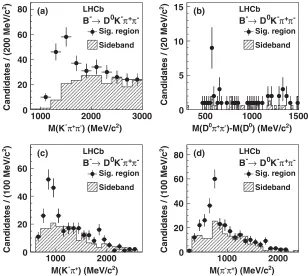
measure-ment, we focus on this decay. Figure2shows the observed
distributions of (a) Kþ invariant mass,
(b) MðD0þÞ MðD0Þ invariant mass difference,
(c) Kþ invariant mass, and (d)þ invariant mass
for B!D0Kþ. We show events in the B mass
signal region, defined to have an invariant mass from 5226–5326 MeV=c2, and events from the high-mass
side-band (5350–5550 MeV=c2), scaled by the ratio of
ex-pected background yields in the signal region relative to the sideband region. An excess of events is observed
predominantly in the low Kþ mass region near
1300–1400 MeV=c2, and the number of signal events
de-creases with increasing mass. In Fig.2(b)there appears to
be an excess of 10 events in the region around
550–600 MeV=c2, which suggests contributions from
D1ð2420Þ0orD2ð2460Þ0 meson decays. These decays can
also be used for measuring the weak phase [18]. This
yield, relative to the total, is similar to what was observed
inB!D0þ decays [12]. Figures2(c) and2(d)
show significant enhancements at theK0 and0 masses,
consistent with decays of excited strange states, such as the
K1ð1270Þ,K1ð1400Þ, andKð1410Þ. Similar
distribu-tions are observed for theB0!DþKþ, except that
no excess of events is observed near550–600 MeV=c2 in
theMðD0þÞ MðD0Þinvariant mass difference.
In summary, we report first observations of the
Cabibbo-suppressed decay modes B0!DþKþ and B !
D0Kþ and measurements of their branching
frac-tions relative to B0 !Dþþ and B !
D0þ. The B!D0Kþ decay is
particu-larly interesting because it can be used to measure the
weak phase using similar techniques as in B !
D0K andB0 !D0K0. LHCb has already collected 30
times more data in 2011, and with an expected doubling of that data set in 2012, we expect to be able to exploit these decay modes in the near future.
We express our gratitude to our colleagues in the CERN accelerator departments for the excellent performance of the LHC. We thank the technical and administrative staff at CERN and at the LHCb institutes, and acknowledge sup-port from the National Agencies: CAPES, CNPq, FAPERJ, and FINEP (Brazil); CERN; NSFC (China); CNRS/IN2P3 (France); BMBF, DFG, HGF, and MPG (Germany); SFI
(Ireland); INFN (Italy); FOM and NWO (The
Netherlands); SCSR (Poland); ANCS (Romania); MinES of Russia and Rosatom (Russia); MICINN, XuntaGal and
GENCAT (Spain); SNSF and SER (Switzerland); NAS Ukraine (Ukraine); STFC (United Kingdom); NSF (USA). We also acknowledge the support received from the ERC under FP7 and the Region Auvergne.
[1] C. Quigg,Annu. Rev. Nucl. Part. Sci.59, 505 (2009)
[2] N. Cabibbo, Phys. Rev. Lett. 10, 531 (1963); M. Kobayashi and T. Maskawa, Prog. Theor. Phys.49, 652 (1973).
[3] A. Bevan et al., Nucl. Phys. B, Proc. Suppl. 209, 109 (2010).
[4] J. Charleset al.,Phys. Rev. D84, 033005 (2011). [5] I. Dunietz, Phys. Lett. B270, 75 (1991); I. Dunietz, Z.
Phys. C56, 129 (1992); D. Atwood, G. Eilam, M. Gronau, and A. Soni,Phys. Lett. B341, 372 (1995); D. Atwood, I. Dunietz, and A. Soni,Phys. Rev. Lett.78, 3257 (1997). [6] M. Gronau and D. London,Phys. Lett. B253, 483 (1991);
M. Gronau and D. Wyler,Phys. Lett. B265, 172 (1991). [7] A. Giri, Y. Grossman, A. Soffer, and J. Zupan,Phys. Rev.
D68, 054018 (2003).
[8] R. Aleksan, I. Dunietz, and B. Kayser,Z. Phys. C54, 653 (1992).
[9] I. Dunietz,Phys. Rev. D52, 3048 (1995). [10] M. Gronau,Phys. Lett. B557, 198 (2003).
[11] A. A. Alves Jr. et al. (LHCb Collaboration), JINST 3, S08005 (2008).
[12] R. Aaij et al. (LHCb Collaboration),Phys. Rev. D 84, 092001 (2011).
) 2 ) (MeV/c -π + π -M(K
1000 2000 3000
)
2
Candidates / (200 MeV/c 0
20 40 60 80 Sig. region Sideband LHCb -π + π -K 0 D → -B (a) ) 2 ) (MeV/c 0 )-M(D -π + π 0 M(D
500 1000 1500
)
2
Candidates / (20 MeV/c
0 5 10 15 Sig. region Sideband LHCb -π + π -K 0 D → -B (b) ) 2 ) (MeV/c + π -M(K 1000 2000 ) 2
Candidates / (100 MeV/c 0
20 40
60 Sig. region
Sideband LHCb -π + π -K 0 D → -B (c) ) 2 ) (MeV/c + π -π M( 1000 2000 ) 2
Candidates / (100 MeV/c 0
[image:6.612.151.459.46.322.2]20 40 60 80 Sig. region Sideband LHCb -π + π -K 0 D → -B (d)
FIG. 2. Invariant masses within the B!D0Kþ system. Shown are (a) MðKþÞ, (b) MðDþÞ MðDÞ, (c)MðKþÞ, and (d)MðþÞ. The points with error bars correspond to the signal region, and the hatched histograms represent
[13] T. Sjo¨strand, S. Mrenna, and P. Z. Skands,J. High Energy Phys. 05 (2006) 026.
[14] D. J. Lange,Nucl. Instrum. Methods Phys. Res., Sect. A 462, 152 (2001).
[15] S. Agostinelli et al. (GEANT4 Collaboration), Nucl. Instrum. Methods Phys. Res., Sect. A506, 250 (2003).
[16] T. Skwarnicki, Ph.D. thesis, Institute of Nuclear Physics, Krakow, Poland, 1986.
[17] K. Nakamuraet al.(Particle Data Group),J. Phys. G37, 075021 (2010).
[18] N. Sinha,Phys. Rev. D70, 097501 (2004).
R. Aaij,23C. Abellan Beteta,35,aB. Adeva,36M. Adinolfi,42C. Adrover,6A. Affolder,48Z. Ajaltouni,5J. Albrecht,37
F. Alessio,37M. Alexander,47G. Alkhazov,29P. Alvarez Cartelle,36A. A. Alves, Jr.,22S. Amato,2Y. Amhis,38
J. Anderson,39R. B. Appleby,50O. Aquines Gutierrez,10F. Archilli,18,37L. Arrabito,53A. Artamonov,34
M. Artuso,52,37E. Aslanides,6G. Auriemma,22,bS. Bachmann,11J. J. Back,44D. S. Bailey,50V. Balagura,30,37
W. Baldini,16R. J. Barlow,50C. Barschel,37S. Barsuk,7W. Barter,43A. Bates,47C. Bauer,10Th. Bauer,23A. Bay,38
I. Bediaga,1S. Belogurov,30K. Belous,34I. Belyaev,30,37E. Ben-Haim,8M. Benayoun,8G. Bencivenni,18
S. Benson,46J. Benton,42R. Bernet,39M.-O. Bettler,17M. van Beuzekom,23A. Bien,11S. Bifani,12T. Bird,50
A. Bizzeti,17,cP. M. Bjørnstad,50T. Blake,37F. Blanc,38C. Blanks,49J. Blouw,11S. Blusk,52A. Bobrov,33V. Bocci,22
A. Bondar,33N. Bondar,29W. Bonivento,15S. Borghi,47,50A. Borgia,52T. J. V. Bowcock,48C. Bozzi,16T. Brambach,9
J. van den Brand,24J. Bressieux,38D. Brett,50M. Britsch,10T. Britton,52N. H. Brook,42H. Brown,48
A. Bu¨chler-Germann,39I. Burducea,28A. Bursche,39J. Buytaert,37S. Cadeddu,15O. Callot,7M. Calvi,20,d
M. Calvo Gomez,35,eA. Camboni,35P. Campana,18,37A. Carbone,14G. Carboni,21,fR. Cardinale,19,37,gA. Cardini,15
L. Carson,49K. Carvalho Akiba,2G. Casse,48M. Cattaneo,37Ch. Cauet,9M. Charles,51Ph. Charpentier,37
N. Chiapolini,39K. Ciba,37X. Cid Vidal,36G. Ciezarek,49P. E. L. Clarke,46,37M. Clemencic,37H. V. Cliff,43
J. Closier,37C. Coca,28V. Coco,23J. Cogan,6P. Collins,37A. Comerma-Montells,35F. Constantin,28A. Contu,51
A. Cook,42M. Coombes,42G. Corti,37G. A. Cowan,38R. Currie,46C. D’Ambrosio,37P. David,8P. N. Y. David,23
I. De Bonis,4S. De Capua,21,fM. De Cian,39F. De Lorenzi,12J. M. De Miranda,1L. De Paula,2P. De Simone,18
D. Decamp,4M. Deckenhoff,9H. Degaudenzi,38,37L. Del Buono,8C. Deplano,15D. Derkach,14,37O. Deschamps,5
F. Dettori,24J. Dickens,43H. Dijkstra,37P. Diniz Batista,1F. Domingo Bonal,35,eS. Donleavy,48F. Dordei,11
A. Dosil Sua´rez,36D. Dossett,44A. Dovbnya,40F. Dupertuis,38R. Dzhelyadin,34A. Dziurda,25S. Easo,45U. Egede,49
V. Egorychev,30S. Eidelman,33D. van Eijk,23F. Eisele,11S. Eisenhardt,46R. Ekelhof,9L. Eklund,47Ch. Elsasser,39
D. Elsby,55D. Esperante Pereira,36L. Este`ve,43A. Falabella,16,14,hE. Fanchini,20,dC. Fa¨rber,11G. Fardell,46
C. Farinelli,23S. Farry,12V. Fave,38V. Fernandez Albor,36M. Ferro-Luzzi,37S. Filippov,32C. Fitzpatrick,46
M. Fontana,10F. Fontanelli,19,gR. Forty,37M. Frank,37C. Frei,37M. Frosini,17,37,iS. Furcas,20A. Gallas Torreira,36
D. Galli,14,jM. Gandelman,2P. Gandini,51Y. Gao,3J-C. Garnier,37J. Garofoli,52J. Garra Tico,43L. Garrido,35
D. Gascon,35C. Gaspar,37N. Gauvin,38M. Gersabeck,37T. Gershon,44,37Ph. Ghez,4V. Gibson,43V. V. Gligorov,37
C. Go¨bel,54D. Golubkov,30A. Golutvin,49,30,37A. Gomes,2H. Gordon,51M. Grabalosa Ga´ndara,35
R. Graciani Diaz,35L. A. Granado Cardoso,37E. Grauge´s,35G. Graziani,17A. Grecu,28E. Greening,51S. Gregson,43
B. Gui,52E. Gushchin,32Yu. Guz,34T. Gys,37G. Haefeli,38C. Haen,37S. C. Haines,43T. Hampson,42
S. Hansmann-Menzemer,11R. Harji,49N. Harnew,51J. Harrison,50P. F. Harrison,44T. Hartmann,56J. He,7
V. Heijne,23K. Hennessy,48P. Henrard,5J. A. Hernando Morata,36E. van Herwijnen,37E. Hicks,48K. Holubyev,11
P. Hopchev,4W. Hulsbergen,23P. Hunt,51T. Huse,48R. S. Huston,12D. Hutchcroft,48D. Hynds,47V. Iakovenko,41
P. Ilten,12J. Imong,42R. Jacobsson,37A. Jaeger,11M. Jahjah Hussein,5E. Jans,23F. Jansen,23P. Jaton,38
B. Jean-Marie,7F. Jing,3M. John,51D. Johnson,51C. R. Jones,43B. Jost,37M. Kaballo,9S. Kandybei,40
M. Karacson,37T. M. Karbach,9J. Keaveney,12I. R. Kenyon,55U. Kerzel,37T. Ketel,24A. Keune,38B. Khanji,6
Y. M. Kim,46M. Knecht,38R. Koopman,24P. Koppenburg,23A. Kozlinskiy,23L. Kravchuk,32K. Kreplin,11
M. Kreps,44G. Krocker,11P. Krokovny,11F. Kruse,9K. Kruzelecki,37M. Kucharczyk,20,25,37,dT. Kvaratskheliya,30,37
V. N. La Thi,38D. Lacarrere,37G. Lafferty,50A. Lai,15D. Lambert,46R. W. Lambert,24E. Lanciotti,37
G. Lanfranchi,18C. Langenbruch,11T. Latham,44C. Lazzeroni,55R. Le Gac,6J. van Leerdam,23J.-P. Lees,4
R. Lefe`vre,5A. Leflat,31,37J. Lefranc¸ois,7O. Leroy,6T. Lesiak,25L. Li,3L. Li Gioi,5M. Lieng,9M. Liles,48
R. Lindner,37C. Linn,11B. Liu,3G. Liu,37J. von Loeben,20J. H. Lopes,2E. Lopez Asamar,35N. Lopez-March,38
H. Lu,38,3J. Luisier,38A. Mac Raighne,47F. Machefert,7I. V. Machikhiliyan,4,30F. Maciuc,10O. Maev,29,37
J. Magnin,1S. Malde,51R. M. D. Mamunur,37G. Manca,15,kG. Mancinelli,6N. Mangiafave,43U. Marconi,14
R. Ma¨rki,38J. Marks,11G. Martellotti,22A. Martens,8L. Martin,51A. Martı´n Sa´nchez,7D. Martinez Santos,37
A. Massafferri,1Z. Mathe,12C. Matteuzzi,20M. Matveev,29E. Maurice,6B. Maynard,52A. Mazurov,16,32,37
G. McGregor,50R. McNulty,12M. Meissner,11M. Merk,23J. Merkel,9R. Messi,21,fS. Miglioranzi,37
D. A. Milanes,13,37M.-N. Minard,4J. Molina Rodriguez,54S. Monteil,5D. Moran,12P. Morawski,25R. Mountain,52
I. Mous,23F. Muheim,46K. Mu¨ller,39R. Muresan,28,38B. Muryn,26B. Muster,38M. Musy,35J. Mylroie-Smith,48
P. Naik,42T. Nakada,38R. Nandakumar,45I. Nasteva,1M. Nedos,9M. Needham,46N. Neufeld,37C. Nguyen-Mau,38,l
M. Nicol,7V. Niess,5N. Nikitin,31A. Nomerotski,51A. Novoselov,34A. Oblakowska-Mucha,26V. Obraztsov,34
S. Oggero,23S. Ogilvy,47O. Okhrimenko,41R. Oldeman,15,kM. Orlandea,28J. M. Otalora Goicochea,2P. Owen,49
K. Pal,52J. Palacios,39A. Palano,13,mM. Palutan,18J. Panman,37A. Papanestis,45M. Pappagallo,47C. Parkes,50,37
C. J. Parkinson,49G. Passaleva,17G. D. Patel,48M. Patel,49S. K. Paterson,49G. N. Patrick,45C. Patrignani,19,g
C. Pavel-Nicorescu,28A. Pazos Alvarez,36A. Pellegrino,23G. Penso,22,nM. Pepe Altarelli,37S. Perazzini,14,j
D. L. Perego,20,dE. Perez Trigo,36A. Pe´rez-Calero Yzquierdo,35P. Perret,5M. Perrin-Terrin,6G. Pessina,20
A. Petrella,16,37A. Petrolini,19,gA. Phan,52E. Picatoste Olloqui,35B. Pie Valls,35B. Pietrzyk,4T. Pilarˇ,44D. Pinci,22
R. Plackett,47S. Playfer,46M. Plo Casasus,36G. Polok,25A. Poluektov,44,33E. Polycarpo,2D. Popov,10B. Popovici,28
C. Potterat,35A. Powell,51J. Prisciandaro,38V. Pugatch,41A. Puig Navarro,35W. Qian,52J. H. Rademacker,42
B. Rakotomiaramanana,38M. S. Rangel,2I. Raniuk,40G. Raven,24S. Redford,51M. M. Reid,44A. C. dos Reis,1
S. Ricciardi,45K. Rinnert,48D. A. Roa Romero,5P. Robbe,7E. Rodrigues,47,50F. Rodrigues,2P. Rodriguez Perez,36
G. J. Rogers,43S. Roiser,37V. Romanovsky,34M. Rosello,35,eJ. Rouvinet,38T. Ruf,37H. Ruiz,35G. Sabatino,21,f
J. J. Saborido Silva,36N. Sagidova,29P. Sail,47B. Saitta,15,kC. Salzmann,39M. Sannino,19,gR. Santacesaria,22
C. Santamarina Rios,36R. Santinelli,37E. Santovetti,21,fM. Sapunov,6A. Sarti,18,nC. Satriano,22,bA. Satta,21
M. Savrie,16,hD. Savrina,30P. Schaack,49M. Schiller,24S. Schleich,9M. Schlupp,9M. Schmelling,10B. Schmidt,37
O. Schneider,38A. Schopper,37M.-H. Schune,7R. Schwemmer,37B. Sciascia,18A. Sciubba,18,nM. Seco,36
A. Semennikov,30K. Senderowska,26I. Sepp,49N. Serra,39J. Serrano,6P. Seyfert,11M. Shapkin,34I. Shapoval,40,37
P. Shatalov,30Y. Shcheglov,29T. Shears,48L. Shekhtman,33O. Shevchenko,40V. Shevchenko,30A. Shires,49
R. Silva Coutinho,44T. Skwarnicki,52A. C. Smith,37N. A. Smith,48E. Smith,51,45K. Sobczak,5F. J. P. Soler,47
A. Solomin,42F. Soomro,18B. Souza De Paula,2B. Spaan,9A. Sparkes,46P. Spradlin,47F. Stagni,37S. Stahl,11
O. Steinkamp,39S. Stoica,28S. Stone,52,37B. Storaci,23M. Straticiuc,28U. Straumann,39V. K. Subbiah,37
S. Swientek,9M. Szczekowski,27P. Szczypka,38T. Szumlak,26S. T’Jampens,4E. Teodorescu,28F. Teubert,37
C. Thomas,51E. Thomas,37J. van Tilburg,11V. Tisserand,4M. Tobin,39S. Topp-Joergensen,51N. Torr,51
E. Tournefier,4,49M. T. Tran,38A. Tsaregorodtsev,6N. Tuning,23M. Ubeda Garcia,37A. Ukleja,27P. Urquijo,52
U. Uwer,11V. Vagnoni,14G. Valenti,14R. Vazquez Gomez,35P. Vazquez Regueiro,36S. Vecchi,16J. J. Velthuis,42
M. Veltri,17,aB. Viaud,7I. Videau,7X. Vilasis-Cardona,35,eJ. Visniakov,36A. Vollhardt,39D. Volyanskyy,10
D. Voong,42A. Vorobyev,29H. Voss,10S. Wandernoth,11J. Wang,52D. R. Ward,43N. K. Watson,55A. D. Webber,50
D. Websdale,49M. Whitehead,44D. Wiedner,11L. Wiggers,23G. Wilkinson,51M. P. Williams,44,45M. Williams,49
F. F. Wilson,45J. Wishahi,9M. Witek,25W. Witzeling,37S. A. Wotton,43K. Wyllie,37Y. Xie,46F. Xing,51Z. Xing,52
Z. Yang,3R. Young,46O. Yushchenko,34M. Zavertyaev,10,oF. Zhang,3L. Zhang,52W. C. Zhang,12Y. Zhang,3
A. Zhelezov,11L. Zhong,3E. Zverev,31and A. Zvyagin37
(LHCb collaboration)
1Centro Brasileiro de Pesquisas Fı´sicas (CBPF), Rio de Janeiro, Brazil 2Universidade Federal do Rio de Janeiro (UFRJ), Rio de Janeiro, Brazil
3Center for High Energy Physics, Tsinghua University, Beijing, China 4LAPP, Universite´ de Savoie, CNRS/IN2P3, Annecy-Le-Vieux, France
5Clermont Universite´, Universite´ Blaise Pascal, CNRS/IN2P3, LPC, Clermont-Ferrand, France 6CPPM, Aix-Marseille Universite´, CNRS/IN2P3, Marseille, France
7LAL, Universite´ Paris-Sud, CNRS/IN2P3, Orsay, France
8LPNHE, Universite´ Pierre et Marie Curie, Universite´ Paris Diderot, CNRS/IN2P3, Paris, France 9Fakulta¨t Physik, Technische Universita¨t Dortmund, Dortmund, Germany
10Max-Planck-Institut fu¨r Kernphysik (MPIK), Heidelberg, Germany
11Physikalisches Institut, Ruprecht-Karls-Universita¨t Heidelberg, Heidelberg, Germany 12
School of Physics, University College Dublin, Dublin, Ireland 13Sezione INFN di Bari, Bari, Italy
15Sezione INFN di Cagliari, Cagliari, Italy 16Sezione INFN di Ferrara, Ferrara, Italy
17Sezione INFN di Firenze, Firenze, Italy
18Laboratori Nazionali dell’INFN di Frascati, Frascati, Italy 19Sezione INFN di Genova, Genova, Italy
20Sezione INFN di Milano Bicocca, Milano, Italy 21Sezione INFN di Roma Tor Vergata, Roma, Italy 22Sezione INFN di Roma La Sapienza, Roma, Italy 23
Nikhef National Institute for Subatomic Physics, Amsterdam, The Netherlands
24Nikhef National Institute for Subatomic Physics and Vrije Universiteit, Amsterdam, The Netherlands 25Henryk Niewodniczanski Institute of Nuclear Physics Polish Academy of Sciences, Kraco´w, Poland
26AGH University of Science and Technology, Kraco´w, Poland 27Soltan Institute for Nuclear Studies, Warsaw, Poland
28Horia Hulubei National Institute of Physics and Nuclear Engineering, Bucharest-Magurele, Romania 29Petersburg Nuclear Physics Institute (PNPI), Gatchina, Russia
30Institute of Theoretical and Experimental Physics (ITEP), Moscow, Russia 31Institute of Nuclear Physics, Moscow State University (SINP MSU), Moscow, Russia 32Institute for Nuclear Research of the Russian Academy of Sciences (INR RAN), Moscow, Russia 33Budker Institute of Nuclear Physics (SB RAS) and Novosibirsk State University, Novosibirsk, Russia
34Institute for High Energy Physics (IHEP), Protvino, Russia 35Universitat de Barcelona, Barcelona, Spain
36Universidad de Santiago de Compostela, Santiago de Compostela, Spain 37European Organization for Nuclear Research (CERN), Geneva, Switzerland
38Ecole Polytechnique Fe´de´rale de Lausanne (EPFL), Lausanne, Switzerland 39
Physik-Institut, Universita¨t Zu¨rich, Zu¨rich, Switzerland
40NSC Kharkiv Institute of Physics and Technology (NSC KIPT), Kharkiv, Ukraine 41Institute for Nuclear Research of the National Academy of Sciences (KINR), Kyiv, Ukraine
42H. H. Wills Physics Laboratory, University of Bristol, Bristol, United Kingdom 43Cavendish Laboratory, University of Cambridge, Cambridge, United Kingdom
44Department of Physics, University of Warwick, Coventry, United Kingdom 45STFC Rutherford Appleton Laboratory, Didcot, United Kingdom
46School of Physics and Astronomy, University of Edinburgh, Edinburgh, United Kingdom 47School of Physics and Astronomy, University of Glasgow, Glasgow, United Kingdom
48Oliver Lodge Laboratory, University of Liverpool, Liverpool, United Kingdom 49Imperial College London, London, United Kingdom
50School of Physics and Astronomy, University of Manchester, Manchester, United Kingdom 51Department of Physics, University of Oxford, Oxford, United Kingdom
52Syracuse University, Syracuse, New York, USA 53CC-IN2P3, CNRS/IN2P3, Lyon-Villeurbanne, France
54Pontifı´cia Universidade Cato´lica do Rio de Janeiro (PUC-Rio), Rio de Janeiro, Brazil 55University of Birmingham, Birmingham, United Kingdom
56Physikalisches Institut, Universita¨t Rostock, Rostock, Germany
aAlso at Universita` di Urbino, Urbino, Italy. bAlso at Universita` della Basilicata, Potenza, Italy.
cAlso at Universita` di Modena e Reggio Emilia, Modena, Italy. dAlso at Universita` di Milano Bicocca, Milano, Italy.
e
Also at LIFAELS, La Salle, Universitat Ramon Llull, Barcelona, Spain.
fAlso at Universita` di Roma Tor Vergata, Roma, Italy. gAlso at Universita` di Genova, Genova, Italy.
hAlso at Universita` di Ferrara, Ferrara, Italy. iAlso at Universita` di Firenze, Firenze, Italy. jAlso at Universita` di Bologna, Bologna, Italy. kAlso at Universita` di Cagliari, Cagliari, Italy.
lAlso at Hanoi University of Science, Hanoi, Viet Nam. mAlso at Universita` di Bari, Bari, Italy.
nAlso at Universita` di Roma La Sapienza, Roma, Italy.
oAlso at P.N. Lebedev Physical Institute, Russian Academy of Science (LPI RAS), Moscow, Russia.