Comparison between Composite Column Using
Limestone and Basalt Concrete
Hamadallah Al-Baijat1*, Andrea Benedetti2
1Department of Civil Engineering, Tafila Technical University, Tafila, Jordan 2University of Bologna, Bologna, Italy
Email: *[email protected]
Received November 13, 2012; revised December 10, 2012; accepted December 26,2012
ABSTRACT
This research is conducted to study the experimental behavior of composite steel-concrete columns with basalt additives. Various percentages of basalt are added to the concrete mixes to investigate its effect on the total axial compressive capacity of the columns. Expected failure scenarios of the columns are: concrete compressive failure, buckling of steel section, and de-bonding between steel and concrete sections. A conventional limestone composite column was used as base mix. The results of the study indicate a significant improvement in structural behavior and strength of the columns by increasing the percentage of basalt content.
Keywords: Composite Column; Basalt Mix; Jordan
1. Introduction
Composite columns using limestone were widely used from early 1900s. However, none or very little research conducted for using basalt in composite columns. Viest in his 1960 review of research, notes that the important factor in composite actions is the bond between concrete and steel [1].
The steel-concrete composite column is a new compo- site member that can achieve constructability and econ- omy by filling the empty space in the steel H-flange with concrete. Composite columns are constructed with rolled or built-up steel section. The resulting members are able to support significantly higher loads than reinforced con- crete columns of the same sizes.
A structural member composed of two or more dissi- milar materials joined together (to act as a unit in which the resulting system) is stronger than the sum of its parts. An example in civil structures is the steel-concrete com- posite column in which a steel wide-flange shape (I or W shape) is filled with various percentages of basalt to be compared with base limestone concrete mix. Basalt is hard, dense volcanic igneous rock that can be found in most countries across the world.
Basaltic rocks are available in Jordan in many places especially in the Northeastern volcanic Plateau in Harrat Ash Shaam, Asi and Shalabi, 2005 [2]. Basalt is used in many countries especially in highway and airfields pave- ment construction (Rodsenbaum and Skene, 1995). Jor-
dan has also a number of quarries and crushers equipped with advanced technologies and machinery to crush ba- saltic rocks into construction size aggregates. In conven- tional concrete mixes used in the construction industry in Jordan; it is customary to use limestone aggregates which are also available in great abundance. Basaltic rock ag- gregates are similar to limestone aggregates in many as- pects [3]. Table 1 shows the key properties of limestone and basalt aggregates in Jordan. The basalt aggregates are higher in specific gravity, and lower in absorption and abrasion loss values [3]. Based on this comparison, it is clearly obvious that basalt is likely to be more suitable than limestone for use in concrete mixes and this re-search will investigate this matter. In order to accomplish this objective, the researcher has devised an elaborate laboratory testing program that included conventional limestone mixes with zero%, 25%, 50%, 75% and 100% basalt. For the purpose of comparison, samples from each mix were then tested in the laboratory to determine key mix properties.
2. Experimental Program
The basalt aggregates used in this research were tested for chemical composition at the Department of Chemis- try of the University of Jordan by using the X-Ray Fluo- rescence (XRF) test. The results of this test are summa- rized in Table 2. Also the mechanical properties of the basalt aggregate were conducted as shown in Table 3. The results of three specimens for each group were averaged
Table 1. Key properties of limestone and basalt aggregates used in Jordan (Courtesy of Dr. Zuhair Samarah and engi-neer Jamil Wrekat) [4].
Aggregate
Property Basalt (Fine) (Coarse) Basalt Limestone (Fine) Limestone(Coarse) (Apparent)
Specific Gravity 2.943 2.917 2.673 2.626 SSD
Specific Gravity 2.843 2.814 2.605 2.552 DRY
Specific Gravity 2.791 2.765 2.558 2.508
Absorption % 1.854 1.763 2.70 3.80
Abrasion % 25.9 24.4 35.0 34.8
Table 2. Chemical composition of basaltic aggregates as de- termined By X-Ray fluorescence test (X.R.S) % [4].
CO2 1.0
Na2O 2.97
MgO 8.56
Al2O3 14.3
SiO2 45.9
P2O5 0.372
SO3 0.0
Cl 0.0
K2O 0.861
CaO 11.1
TiO2 2.25
MnO 0.174
Fe2O3 1.22
SrO 0.0
because their graphs are almost identical. The average deflections and strains represent one curve for each group of three specimens.
It is obvious from Table 3 that the strength of the cubes increases gradually as the percentage of basalt in- creases. The dimensions of the cube were 150 mm × 150 mm × 150 mm.
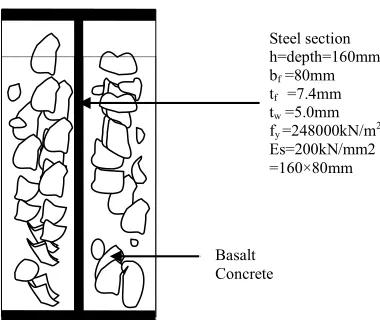
The first author conducted laboratory tests on 18 col- umns. The chart in Figure 1 shows the diagram of ex- perimental program in this investigation. Five design mixes were used including limestone as base mix, with 25%, 50%, 75%, and 100% basalt. Three steel columns were used as reference. Figure 1 shows percentages of basalt in the different mixes of composite columns. The cross section of all specimens was 80 mm × 160 mm, for the width and depth and their height was 1400 mm, as shown in Figure 2.
The geometry of the steel section was shown in Figure 2.
3. Laboratory Procedure
Five mixes were prepared; namely limestone (0% basalt as base mix), 25%, 50%, 75%, and 100% basalt. The composition of each mix is presented in Table 4 [4]. The
Table 3. Compressive strength (kN) versus percentage of basalt.
Breaking Load (kN)
Percentage of Basalt
Compressive Strength (MPa)
750 0 33.4
824 25 36.6
873 50 38.8
930 75 41.33
1325 100 58.9
Samples Used in Experimental
Program For 18 Composite
Columns
3 steel columns
(0.08m, 0.160m, 1.4m)
dimension
3 composite limestone
columns
3 composite 25% basalt
columns
3 composite 50% basalt
columns
3 composite 75% basalt
columns
3 composite 100% basalt
columns
Steel section h=depth=160mm
bf =80mm
tf =7.4mm
tw =5.0mm
fy =248000kN/m2
Es=200kN/mm2 =160×80mm
[image:3.595.76.266.85.245.2]Basalt Concrete
Figure 2. Typical composite cross section of the column. L = 1400 mm.
water cement ratio was 0.7 including 0.25 for hydration, and the cement was 350 kg per cubic meter of concrete.
4. Results
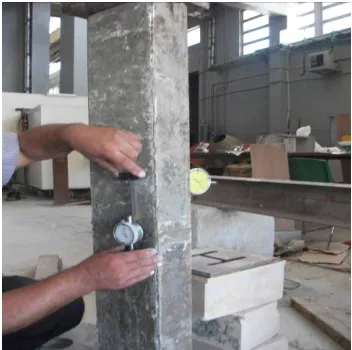
The center line of the composite columns were coincided with the centerline of the testing machine carefully to avoid any eccentricity and the two ends of the column were attached to the ground and to the testing machine by using rectangular steel (to avoid any horizontal move- ment). The mid height of the columns were marked at both sides and the dial gage (transducers) was attached to the level of marked line to measure the deflection of concentric composite columns. Similarly the other side of the column was marked, and two demic gages (trans- ducers) (ASTM426 strain gage and BS1881:206) were attached to the column 10 cm above and below the center line. In this case the vertical distance between the two gages were 20 cm. The strain and de- flection were taken from the two gages directly by using correction factor for the testing machine for both strain and deflection. The loads were applied gradually to the specimens till failure.
There was no cyclic loading applied.
After loading the column and prior to initiation of buckling, it was noted that the specimen starts to have hair horizontal cracks (parallel to the marked line). The cracks occurred in the tension region. No cracks noticed in the compression region. The load was applied gradu- ally to the specimen and the readings were taken at vari- ous stages of loading. For this test only ascending load- ing was used (no cyclic loading). Out-of-plane deforma- tion (buckling) was measured using only one dial gage since the column is short and the width is also small. The set-up of the specimen is shown in Figures 3 and 4 with strain and deflection gages attached. The strains versus loads are shown for various percentage of basalt in Table 5 and Figure 5. As the load increases; the strain of the column increases. Each curve represents the average value for three specimens for the same load and the same percentage of basalt. The standard deviations were 0.026 and 0.076 for both deflection and strain respectively.
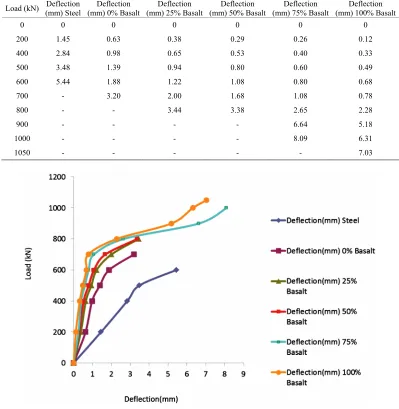
1) The three steel and limestone composite columns were taken in this experimental program as a base spe- cimen. It was noticed that, compared with steel columns for 500 kN load, the strain and buckling decreased by 13.5% and 60%, respectively for 0% basalt. The results are shown in Tables 5 and 6.
2) Now the composite columns are 25% basalt and 75% limestone, the test results show significant decrease (38% and 35%) for the strain and buckling at 600 kN load as illustrated in Tables 5 and 6.
3) In this case the three composite columns are 50% basalt and 50% limestone each, and the average results are shown in Table 6 and in Figure 6 for the deflection and the results were presented in Table 5 and Figure 5
for the strain. The strain and buckling decreased by 21.8% and 16%, respectively for the 700 kN load. Load carrying capacity increases as the percentage of basalt in composite section increases (Table 7 and Figure 7).
Table 4. Percentage of basalt in composite section in the different mixes.
Sieve % Limestone 0%
basalt
25% basalt
50% basalt
75% Basalt
100% basalt Passing No. 4
Sand Basalt sand (Fine)
20 20 40
20 20
20 20
20 20
20 20
20 20
Passing 3/8 retained on No.4 Medium
30 30 7.5 b 22.5 L 15 b 15 L 22.5 b 7.5 L 30 b Passing 1” retained on 3/8
Coarse
30 30 7.5 b 22.5 L 15 b 15 L 22.5 b 7.5 L 30 b b
[image:3.595.56.542.571.724.2]
Figure 3. Composite basalt column under concentric load with strain and buckling (deflection) gages (transducers).
Mid height of the column 20cm
140cm
Rectangular steel section around the cross section fixed with ground to prevent movement Top end fixed
with testing machine
Strain gages on one side and dial
[image:4.595.311.536.90.255.2]deflection gage on the other side
[image:4.595.54.536.309.723.2]Figure 4. Location of the strain gages on one side of the
Table 5. Load versus strain x10E−4 for various percentages of basalt.
Load (kN) Strain (1× 10E−4 0E−4) Strain (1 × 10E−4)
column for strain.
) Strain (1 × 10E−4) Strain (1 × 10E−4) Strain (1 × 10E−4) Strain (1 × 1
Steel 0% Basalt 25% Basalt 50% Basalt 75% Basalt 100% Basalt
0 0 0 0 0 0 0
2 2. 1 1.
1
1
1
1
00 3.9 64 1.7 1.5 .44 20
400 7.92 6.32 4 3.76 3.68 2.16
500 1.102 9.6 5.6 5.28 5.08 2.64
600 19.76 1.76 7.2 6.8 6.48 3.36
700 - 14.96 0.24 7.8 8.0 4.24
800 - - 24.26 10.8 0.40 5.20
900 - - - - 14.00 6.24
1000 - - - - 16.32 7.28
1050 - - - 13.44
Table 6. Load (
Load (kN) D (m lt (m lt (m lt (m lt (mm alt
kN) versus deflection (mm) for various percentages of basalt.
eflection Deflection Deflection Deflection Deflection Deflection (mm) Steel m) 0% Basa m) 25% Basa m) 50% Basa m) 75% Basa ) 100% Bas
0 0 0 0 0 0 0
200 1. 45 0. 0. 063 38 .29 0.26 0. 12
400 2.84 0.98 0.65 0.53 0.40 0.33
500 3.48 1.39 0.94 0.80 0.60 0.49
600 5.44 1.88 1.22 1.08 0.80 0.68
700 - 3.20 2.00 1.68 1.08 0.78
800 - - 3.44 3.38 2.65 2.28
900 - - - - 6.64 5.18
1000 - - - - 8.09 6.31
1050 - - - 7.03
Figure 6. Load kN versus deflection (mm).
Table 7. Failure load versus percentage of basalt in composite column.
Basalt Percentage Steel Section (Limestone) 25% 50% 75% 100%
Failure Load (kN) 635 771 840 867 1035 1075
0 200 400 600 800 1000 1200
0 25 50 75 100
Basalt Percentage in Composite Column
F
a
il
ur
e
Load
k
N steel
[image:5.595.97.496.103.512.2]limestone 25% basalt 50% basalt 75% basalt 100%basalt
Figure 7. Failure load kN versus percentage if basalt in composite columa.
[image:5.595.112.481.551.716.2]The strain gages we h
ite columns were tested with 75% ba
salt composite column, de- fle
(Table 7 and Figure 7) showed signifi- ca
t reduction in strain (54%, 65% and 71%, at
e composite basalt col- um
5. Analysis of the Results
his research project
al buckling conducted under axial concen ed
rsus load.
ous percentages of basalt. 650 kN
composite column),
ank the Tafilah Technical pport of this research pro-
nclusions and Recommendation for
Further Research
om- po ed better than limestone com-
[1] I. M. Viest, “ Composite Steel-
Concrete Con e Structural Divi-
idge Construction, Vol. II,” Ministry
ordan,” Jordan Journal of Civil Engineer-
nd Its Volcanotecto-
re attached to the specimen as 60% (compared with limestone s own in Figure 4.
4) Three compos
salt and 25% limestone. The average tests results for deflection are shown in Table 6 and in Figure 6. The strain and buckling averages were decreased by 20.5% and 40.1% respectively. The capacity of the composite basalt columns increased by 20.6% as basalt in the mix increased from 50% to 75%.
5) In the case of 100% ba
ction decreased by 22% (Table 6 and Figure 6), and strain also decreased by 55.3% at load 1000 kN (Table 5
and Figure 5). All the deflections results for six groups for various percentages of basalt are illustrated in Table 6 and Figure 6.
6) The results
nt increase in failure load as the percentage of basalt increased from 25%, 50%, 75% to 100% in composite column of about 9%, 12.5%, 34.2% and 39.4% respec- tively relative to the base mix (limestone). The failure load of the composite with 75% limestone and 25% ba- salt increased by 21% and 32% compared with steel sec- tion only.
7) Significan
200, 400 and 700 kN respectively) took place as the composite column changed from limestone to 100% ba- salt as in Table 5 and Figure 5.
8) Buckling (deflection) of th
ns decreased significantly (about 64%) compared with limestone composite columns. This reduction indicates that basalt composite columns are much stronger and more durable than those of limestone (Table 6 and Fig-ure 6).
The key properties investigated in t included:
1) Later trat- sion, ASCE, Vol. 86, No. ST6, 1960, pp. 1-21; Also Tran- sactions on ASCE, Partii, Vol. 126, 1961, pp. 1101-1123. [2] I. M. Asi, “Evaluating Skid Resistance of Different As-
phalt Concrete Mixes,” Building and Environment Jour-
load, three steel columns (0.08 m, 0.16 m, 1.4 m) and three composite columns for each mix percentage total of 15 columns.
2) Strain ve
3) Failure load for vari
As the load increased gradually from 200 kN to
nal
, the deflection at various percentages shows no signi- ficant difference, but when the load increased from 650 kN to 1050 kN, the deflection increased for the same percentage of basalt. At the same loading, the deflection decreases as the percentage of basalt increases. This in- dicates that the load bearing capacity of the specimens increased as the percentage of basalt increased [5] (Table 6 and Figure 6). The experimental results show that the deflection of the steel column at 500 kN decrease by
while decreased by 12%, 45%, 55%, and 69% as the per- centage of basalt increased (from 25%, 50%, 75% and 100%) respectively. The strains decreased by 40.7% when comparing steel column with limestone composite column. However, as the percentage of basalt in the composite column was increased by 25%, 50%, 75% and 100%, respectively for 600 kN, the strains were corre- spondingly decreased by 39%, 42%, 45%, and 71%. The failure loads increased by 17.6% when comparing steel beam with composite limestone. By increasing the per- centage of basalt by 25% at each stage, the failure load increased by 8.2%, 11%, 25% and 28%.
6. Acknowledgements
The author would like to th University for the financial su ject.
7. Co
It was noticed from the experimental work that the c site basalt column behav
posite column. This improvement is relevant only to concentric axial compressive load conditions. Thus using composite basalt column rather than limestone column is highly recommended. To avoid any slip problems be- tween steel and basalt concrete, the authors recommends future research on using mechanical stud connector to resist shear which may develop during bending. The stud should be attached to the web of the columnto keep the bondin the composite section.
REFERENCES
Review of Research on struction,” Journal of th
, 2005, in press.
[3] Ministry of Public Works and Housing, “Specifications for Highway and Br
of Public Works and Housing of Hashemite Kingdom of Jordan, 1991.
[4] H. M. O. Al-Baijat, “The Use of Basalt Aggregates in Con- crete Mixes in J
ing, Vol. 2, No. 1, 2008, pp. 63-70.
[5] K. Ibrahim, “The Geological Framework for the Harrat Ash-Shaam Basaltic Super-Group a