Munich Personal RePEc Archive
On the Estimation of Supply and
Demand Elasticities of Agricultural
Commodites
Santeramo, Fabio Gaetano
1 May 2014
Online at
https://mpra.ub.uni-muenchen.de/56126/
On the estimation of
supply and demand elasticities
of agricultural commodities
Fabio Gaetano Santeramo
Abstract
1The report provides a literature review on the topic of estimation of demand
and supply elasticities. To this end, it starts the discussion by summarizing
the main facets of production theory and consumer theory to introduce the
concept of elasticities, with examples of different types of elasticities most
utilized in the literature. Next, it discusses the identification problem in
es-timating elasticities, i.e. the issue of having to solve for unique values of the
parameters of the structural model from the values of the parameters of the
reduced form of the model. It summarizes various methodologies employed
in the literature to solve this problem and gives practical examples. These
solutions include, but are not limited to, using instrumental variables,
adopt-ing a recursive structure, holdadopt-ing demand constant, and imposadopt-ing inequality
constraints in order to restrict the domain of estimates.
1The research was supported by African Growth and Development
Contents
1 Production theory 4
1.1 On supply elasticities: theory and empirics . . . 5
2 Consumer theory 11
2.1 On demand elasticities: theory and empirics . . . 13
3 Identification 20
1
Production theory
A preliminary description of theory of production is necessary to introduce
the concept of elasticities.
The production function is the set of all possible production plans for the
current state of knowledge. Factors of production can be grouped in fixed
factors, which cannot be altered during a particular production period, and
variable factors, those factors of production which can be altered. In the
long-run all factors of production are variable2.
It is common to denote inputs by xi and outputs by yi. More precisely,
the set of inputs and outputs is defined as follows:
{x1, x2, . . . , xk−1, xk, y1, y2, . . . , yn−1, yn}.
Numerous assumptions are made in production theory in order to ensure
a well defined problem or to make the resolution of producers’ problem easier.
They are as follows: monotonicity (weak or strong), concavity (or
quasicon-cavity), essentiality (weak or strong). Moreover, we assume the production
function f(x) to be finite, non-negative, single valued and real valued for
x ∈ R+. Moreover f(x) is everywhere continuous and twice differentiable,
homogeneous of degree θ in x. Few implications of the above mentioned
as-sumptions are worth noting: the input set and the isoquant are convex sets;
the marginal rate of technical substitution is diminishing; the Hessian matrix
of second order partial derivatives is negative semi-definite3; Young’s
theo-2Unlike consumer theory, estimating production functions is significantly easier since
production is cardinal, unlike utility which is ordinal.
3From an empirical perspective, a simple rule to assess the negative semi-definiteness
rem implies that the Hessian matrix is symmetric. The producer problem
can be stated as follows:
(1) M axx p∗f(x)−w∗x
wherep is the output price vector, and wthe vector of input prices.
Commonly adopted production functions are the well-known Cobb-Douglas
(CD) 4, the Leontief5 and the Constant Elasticity of Substitution (CES)6.
1.1
On supply elasticities: theory and empirics
In production theory, we are interested in analyzing changes in production
function due to changes in input use. Those changes can be computed in
dis-crete or continuous time. The latter is the most commonly adopted approach
and relies on the use of derivatives (∂y/∂x), that is the infinitesimal changes
in the objective function due to the infinitesimal change in the variable7. The
elasticities of interest are the elasticity of output, and the elasticity of scale.
The substitutability among inputs is a further measure to be considered.
In analytical terms, the elasticity of output is defined as the (infinitesimal)
change in output due to the (infinitesimal) change in input use, evaluated at
4This is one of the most famous production functions, introduced by Charles W. Cobb
and Paul H. Douglas (1928), although anticipated by Knut Wicksell (1901: p.128, 1923) and, some have argued, by J.H. von Thunen (1863). For a review of theoretical and empirical literature on the Cobb-Douglas production function, see Douglas (1934, 1967), Nerlove (1965) and Samuelson (1979). The analytical formulation is as follows:
y=AQixαii , αi >0.
5This is also known asperfect complementsproduction function in that inputs’
substi-tutability is zero. The formulation is as follows: y=min{α1x1, α2x2, . . . , αnxn}.
6It has been introduced by Arrow, Chenery, Minhas and Solow (1961), and generalized
to the multiple factors case by Hirofumi Uzawa (1963) and Daniel McFadden (1963). The CES function, as its name reveals, shows a constant elasticity of inputs substitution throughout. Its formulation is as follows: y=β[α1x
σ−1 σ
1 +α2x
σ−1 σ
2 +· · ·+αnx
σ−1 σ n ]
σ σ−1.
7Elasticities are alocal concept in that they are measured at a specific point of interest:
a specific point. The measure is analytically obtained by the first derivative
of f(x) with respect to x, times the input over output ratio8. The formula
to compute the elasticity of output is as follows:
(2) εi,y =∂x∂fixyi
which can be rewritten asεi,y =M PAPii whereM Pi andAPi are, respectively,
the marginal product and the average product.
The elasticity of scale provides a measure of the impacts of changes in
inputs use on the scale of production. The elasticity of scale is computed as
follows:
(3) ǫ=∂ln(∂ln(f(λxλ)))|λ=1.
The value of ǫ characterize the return to scale (constant, increasing, or
decreasing), in that ǫ = 1 implies constant returns to scale, ǫ < 1 implies
diminishing returns to scale, and ǫ >1 implies increasing returns to scale.
As mentioned above, it is interesting to measure the substitutability of
inputs in production function.
Several elasticities can be computed. A standard measure of input
sub-stitutability is the Hicks elasticity of substitution (σi,j). Let fi =∂x∂fi be the
change in output due to a change in input xi, and let i, j = {1,2},{2,1}.
The Hicks elasticity of substitution is computed as follows (for the two inputs
case):
(4) σi,j =∂lnM RT S∂ln(xi/xj)ij = ∂∂ln(ln(xfii/x/fjj))
8It is a common procedure to evaluate elasticities at the mean: in this specific case we
where M RT Sij (marginal rate of technical substitution for goods i and
j) is the amount by which the quantity ofihas to be reduced when one extra
unit of the input j is used, such that the output remains constant9. In other
terms, the Hicks elasticity of substitution measures the relative changes in
output induced by (infinitesimal) changes in inputs i and j 10.
The direct elasticity of substitution (σD
i,j), or short run elasticity of
sub-stitution, is computed as follows:
(5) σD i,j =
∂ln(xi/xj)
∂ln(fi/fj)|xk = ¯xk
For the two inputs case, the direct elasticity is identical to the Hicks
elasticity in that it is assuming that the other factors in the production
function are fixed, thus can be ignored. Roy G.D. Allen (1938) proposed a
different measure. The Allen elasticity of substitution (σA
i,j), also known as
the partial elasticity of substitution, is defined as follows:
(6) σA i,j = P i xi xj fi fj Fj,i F
where Fi,j represents the cofactor of H with respect to fi,j, F is the
determinant of the bordered Hessian (H) of the production function.
It is easy to recognize that if the total number of factors is two, the
Allen elasticity of substitution11reduces to the direct elasticity of substitution
(σD
i,j =σi,jA.). A relevant property of the Allen elasticity of substitution is that
it is symmetric (i.e. σA
i,j =σj,iA.). In the case of two inputs, the Allen elasticity
of substitution allows to distinguish among complement and substitute inputs
9The concept is analogous to the marginal rate of substitution in consumer theory. 10The elasticity can be computed for more than two inputs, holding all but two inputs
constant.
in that σA
i,j <0 implies xi and xj are complements, while σi,jA >0 implies xi
and xj are substitutes.
The Morishima elasticity of substitution (Morishima, 1967) has the
seem-ingly unusual property of being asymmetric12 (σM
i,j 6=σj,iM.). The elasticity is
computed as follows:
(7) σM i,j = ∂fi ∂xi Fi,j F − ∂fi ∂xj Fi,j F .
As pointed by Blackorby and Russell (1981, 1989), the Morishima
elastic-ity of substitution should be natural for a multi-factor case. The Morishima
measure can be re-written in terms of the Allen measure as follows:
(8) σM i,j =
fj
fi
xj
xi
(σA
i,j−σj,jA)
In general, factors that are substitutes by the Allen measure, will be
sub-stitutes by the Morishima measure; but factors that are complements by the
Allen measure may still be substitutes by the Morishima measure. In other
terms, the Morishima measure has a bias towards treating inputs as
substi-tutes (or, alternatively, the Allen measure has a bias towards treating them
as complements). This seemingly paradoxical result reflects the fluidity of
the concept of elasticity of substitution in a multiple factor world (Blackorby
and Russell, 1981, 1989).
Nowadays a widely adopted functional forms to estimate supply
elas-ticities is the the translog function (also named transcendental logarithmic
function, Christiansen et al., 1971, 1973 ). It has been introduced by Kmenta
(1967), in order to approximate the CES function with a second order Taylor
12It is possible for two inputs to be Hicks/Allen substitutes while Morishima
expansion. Moreover, it nests the CD function for elasticity of substitution
close to the unitary value.
An example of a generalized translog cost function, for the one-output
and multi-input firm, is as follows:
(9) log(c) = α0+Piαilog(wi) +αylog(y) + 0.5Pi
P
jαijlog(wi)log(wj) +
P
iαiylog(wi)log(y) + 0.5αyy[log(y)]2
wherecis the cost function, yis the output level,wi is the input price for
good i. An advantage of the translog functions is their flexibility. Using
out-put(s) as dependent variables and inout-put(s) as regressors, we have the translog
production function. It consents the estimation of the Allen elasticities of
substitution, the estimation of the production frontier or the measurement
of the total factor productivity.
Acreage response to prices is a further information of great interest. A
simplified model `a la Nerlove may clarify how to proceed:
(10) A∗ =α+βP
t
(11) At−At−1 = (1−γ)(At−A∗t−1)
where equations (10) refers to the desired acreage and equation (11)
mod-els the actual acreage,respectively. Through substitution and simplifications
we can derive the following specification:
(12) At = (1−γ)α+ (1−γ)βPt+γAt−1
where At is the acreage (or land size), Pt is the grower price per pound.
their acreage when they realize that the desired acreage differs from the
acreage realized in the previous year. The adjustment coefficient (1 −γ)
indicates the rate of adjustment of actual acreage to desired acreage (Kmenta,
1986).
Finally, we may be interested in estimating the supply elasticity to prices.
A simple specification is to regress prices on output. Nerlove (1956) suggested
to regress logarithms of quantities on current and (or) lagged output and
input prices, also in logarithms13. A simple specification may be adopted:
(13) ln(Qt) =α+βln(Pt−1) +γln(Zt) +δln(Qt−1)
where β represents the price elasticity, Zt collects the control variables,
and Qt−1 allows to control for possible temporal correlation of production
14.
13Askari and Cummings (1977) provide an excellent survey.
14The model should provide an estimate for δless than |1|. Ifδ=|1| we should use a
2
Consumer theory
In analogy with the previous section, we will first review the theory and
afterward we will describe the empirics of demand estimation.
The problem faced by the consumer is to maximize its utility functionU(·)
subject to a budget constraint. The utility derives from consumption of the
goods that are included in the economy. It is assumed to be a strictly
quasi-concave, monotonic increasing function. The utility function is an ordinal
indicator of preferences over a given set ofn commodities. It is derived from
the following set of axioms: 1) reflexivity; 2) completeness; 3) transitivity;
4) continuity; 5) non-satiation; 6) convexity 15.
The (primal) problem of utility maximization is postulated as follows:
(14) M axq U(q)
s.t. Pkpkqk ≤x
qk≥0,∀k
The solution (qi) to the maximization problem provide the so called
Mar-shallian (uncompensated) demand functions (gi), x(P, M), where P and M
are respectively the vector of prices and the consumer’s income. Marshallian
demand functions satisfy the following properties: 1) adding-up; 2)
homo-geneity. Those properties are better known if expressed in elasticity form:
the Engel aggregation states that the uncompensated elasticities, weighted
by expenditure shares, sum to unity; the Euler aggregation states that the
15A detailed description of the axioms and their implications is beyond the scope of this
uncompensated cross-elasticities plus own-elasticity sum to zero; the Cournot
aggregation states that expenditure shares times the uncompensated
cross-elasticities plus the own expenditure share sum to zero. Analytically, the
properties are expressed as follows16:
i) Pkwkek = 1 ;
ii) Pkeik+ei = 0 ;
iii) Pkwkeki+wi = 0
where wk represent the budget shares, ek stand for the income (or
expendi-ture) elasticities for good k, andeik are the uncompensated cross-elasticities.
Those properties can be derived through direct differentiation of the first
order conditions (FOC) or through the use of duality theory.
The dual problem is postulated as follows:
(15) M inq p q
s.t. u=V(q)
where V(q) represents the indirect utility function. The solution to the
dual problem are the so called Hicksian (compensated) demand functions
(hi), which are functions of prices and utility. The Marshallian and Hicksian
demand functions are tightly linked in that the following identity holds17:
(16) qi =hi[U, p] =hi[ψ(M, p), p] =gi(M, p)
More intuitively, the fundamental difference between the Marshallian and
the Hicksian demand functions is that if we consider a change in the
Hick-sian demand at a price increase, the consumer will preserve the same utility
16The reader may refer to Deaton and Muellbauer (1980) for further details.
17Moreover, the Marshallian and Hicksian demand functions are linked through the
level before and after the price increase. In other terms we assume that the
consumer gets compensated for the price increase through a rise of income:
the income effect is disregarded so that only the substitution effect is left.
The opposite applies to the Marshallian demand, that is the income is held
constant while the utility level might change (Varian, 1992).
2.1
On demand elasticities: theory and empirics
In consumer theory we are interested in several elasticities, namely the
own-price elasticity, the income elasticity, the cross-own-price elasticity, the elasticity
of substitution, and the compensated and uncompensated elasticities. We
will review them in more detail.
The own-price elasticity (also called price elasticity) measures the
per-centage change in the demand at a perper-centage rise in the price of the good
itself. As the demand curves is downward sloping the own-price elasticity is
negative too: a price increase causes a decline in the quantity demanded (the
well known Law of Demand) (Marshall, 1890)18.
The own-price elasticity is given by the following formula:
(17) ǫp =∂q∂piipqii.
If|ǫp|= 1, the demand is defined as being unit elastic, while the demand
is defined as being elastic if |ǫp|>1 and inelastic if |ǫp|<1. If the demand is
inelastic, a price increase means that the decrease in the purchased quantity
will be relatively smaller than the increase in price in % terms. So the
18Probably worthy to recall that the negative slope of the demand curve is due to the
consumer’s total expense for the good in question increases. The opposite is
the case at a price increase of a good where the demand is elastic.
The income elasticity measures the percentage change in the demand for
a given good as a result of a percentage change in income:
(18) ǫM =∂q∂M qiMi
whereM is the income. Generally, the income elasticity for necessaries is
smaller than for luxury goods, that is a reduction in income will not reduce
the consumption of bread just as much as the consumption of exotic fruits.
Moreover, the so called Engel’s law states that consumers increase their
ex-penditures for food products (in % terms) less than their increases in income
(Timmer et al., 1983).
The cross-price elasticity shows the percentage change in demand for good
i as a result of a percentage change in the price of good j. The analytical
formulation is as follows:
(19) ǫik =∂q∂pipk
kqi
Cross-price elasticity for a good having a close substitution or
comple-mentarity would numerically be relatively big. If there is a close substitution
the cross-price elasticities will be positive as a price increase of good i (e.g.
wine) will make the consumers substitute towards demanding good j (e.g.
beer). If i and j are complementary goods (e.g. beer and pizza) the
cross-price elasticity will be negative. For goods that are neither close substitutes
nor complementary goods, the cross-price elasticity will be insignificant (e.g.
The elasticity of substitution measures the percentage change in the
rel-ative consumption of two goods as a consequence of a change in the relrel-ative
prices of the goods. Thus, an increase of 1% in the relation between the two
commodity prices will push the relation between the commodities φ % in
the direction of the commodity which has become relatively cheaper. The
elasticity of substitution is computed as follows:
(20) σij = - ∂M RS(∂qi/qjij)M RS(qi/qjij)
M RSindicates the marginal substitution relationship between goodiand
good j which corresponds to the slope of the indifference curve. At the
opti-mum bundle, the slope of the indifference curve is equal to the price relation
among the goods. The bigger the elasticity of substitution between good
i and good j the more substitutional the goods (e.g. wine and beer) are.
Opposite, if the elasticity of substitution approaches zero, the good i and j
will be complementary goods (e.g. beer and pizza). The size of the elasticity
of substitution determines the slope of the indifference curve: they converge
towards a straight line when the elasticity of substitution approaches infinity
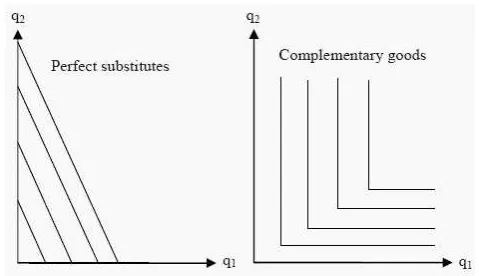
(and the goods are sad to beperfect substitutes), while the curve converges
to-wards making a 90 degree kink when the elasticity of substitution approaches
zero (and the goods are said perfect complements (Figure 1), while the IC
are said Leontief ).
The elasticity of substitution and the cross-price elasticity are closely
re-lated in that they allow to characterize the change in the demand function of
good i due to the price change of goodj. However, the cross-price elasticity
Figure 1: Perfect substitutes and perfect complements
been changed (say goodj), while the elasticity of substitution takes this into
account. Therefore, equal cross-price elasticities does not imply equal
elas-ticities of substitution 19. From an empirical point of view, a functional form
which implies a constant elasticity of substitution will have the advantage
that the percentage change in the relative consumption of the two goods is
independent of the level of prices and consumption. Furthermore, the
elas-ticity of substitution will be independent of the price development of other
goods. On the contrary, if the function does not have a constant elasticity
of substitution the elasticity has to be measured at a specific point on the
demand curve (usually it is computed at the mean or median value) 20.
We turn now to the empirical estimation of demand functions. The
sim-19A clarificatory example. Let the cross-price elasticity between goodxand goodz be
the same as between good y and good z, that is a price increase of good x, or good y, will have the same influence on the consumption of good z. If the price sensitivity for goodxis larger than for goody, the consumption of goodxwill decrease more than the consumption of goodywhen the price of the two goods increases. Therefore, the elasticity of substitution becomes bigger between goodxand goodzthan between goodyand good
z.
20The great advantage of the family of CES functions is that it is easy to switch from
plest model to estimate demand elasticities is the log-log single equation
model:
(21) log(qi) = αi+eilog(M) + n
X
k=1
eiklog(pk)
where qi represent per capita consumption, M is the per capita total
expen-diture, and p stand for prices21.
The model has been extensively used to estimate own-price and income
elasticities for individual when the systems of demand functions were not yet
developed. Nowadays the model is still applied for empirical analysis (Russo
et al.,2008) due to its advantages: the model is linear, assume a “nicely
shaped” demand function, and it is simple to be estimated. Furthermore,
the model interpretation is straightforward in that the coefficients for income
and prices are directly interpretable as elasticities.
A more structured model, thus more consistent with the theory, is the
Stone model (Stone, 1954). Its functional form is as follows:
(22) log(qi) =αi+eilog(M/P) +Pnk=1e∗iklog(pk/P)
whereP is the so called Stone index, a geometric price index22, andei is
the income elasticity, and e∗
ik represent the compensated elasticities.
A drawback of the Stone model is that there is no guarantee symmetry will
be satisfied. The Linear Expenditure System (LES) is able to overcome these
problems (Stone, 1954). The LES is derived from a linear demand functional
form (piqi =βiM+Piβikpk) by imposing the general restrictions of consumer
21The model is expressed in per capita terms in order to neutralize the effects of changes
in population. Therefore, the elasticities refer to the “representative” consumer.
22The Stone price index is defined as follows: log(P) = Pn
k=1wklog(pk), where wk is
behavior, namely homogeneity, adding-up property and symmetry23:
(23) piqi =piγi+βi(M −Pipkγk)
where γi is interpreted to be the minimum quantity demanded of
com-modityi, the first term on the RHS (piγi) is referred to as “committed
expen-diture” in that it represents expenditures on a fixed bundle of consumption.
The second term on the right-hand side (M −Pipkγk) of the equation is
referred to as “supernumerary income”: it represents expenditures above the
committed expenditures.
The number of parameters to estimate for the LES is rather limited. This
desirable characteristic is due to the restrictiveness of the linearity. However,
there is no free lunch. The LES suffers of several limitations: it does not
admit inferior goods; it implies that all goods must be net substitutes; it
imposes additivity restriction on the direct utility function; absolute values
of all uncompensated own-price elasticities are constrained to be less than
their income elasticities. On the contrary, a nice feature of the LES is that
both the Cobb-Douglas and Constant Elasticity of Demand functional forms
are special cases of the LES model.
The Rotterdam model (Theil, 1965; Barten, 1969) also deserves
partic-ular attention. The RM is the differential form of Stone’s model. However,
expressed in differential form the model is more general, in that restrictions
have to hold on deviations, not in level. The empirical formulation of the
Rotterdam model is as follows:
(24) wit∆logqit =bi∆logxt+Pkcik∆logpkt+ǫit
where ∆ is the first-order differential operator (i.e. ∆logqit = logqit −
logqit−1), wit= 0.5(wt−wt−1), and ∆logxt= ∆logxt−
P
kwkt∆logpkt. The
income and compensated price elasticities of the RM model can be obtained
by dividing estimated coefficients by the budget share of the good in question:
e∗
ik =cwiki. In turn, the Slutsky equation (e
∗
ik = eik +wkei) can be used to
estimate uncompensated price elasticities.
Nowadays the most commonly used form in demand analysis is the Almost
Ideal Demand System (AIDS) proposed by Deaton and Muellbauer (1980).
With more than three thousands citations, their paper has become a must
read reference in applied economics. The empirical formulation is as follows:
(25) wi =αi+Pkγkilog(pk) +βilog(M/P)
wherelogP =α0+Pkαklog(pk)+0.5PkPlγkilog(pk)log(pl). The AIDS
model has some nice properties: satisfies axioms of consumer choice exactly;
aggregates perfectly from a representative consumer; its estimate implies a
Engel curves consistent with household data; can be viewed as a first-order
approximation to arbitrary demand system; allow to test for homogeneity
and symmetry. In the AIDS model, the elasticities are obtained through the
3
Identification
Identification is a main issue in econometrics, the branch of economics that
aims to answer to empirical questions based on economic models.
Econo-metrics models are always based on some assumptions, sometimes testable,
sometimes not. In this framework, identification deals with the relationship
between the assumptions of an econometric model and the possibility of
an-swering or not, an empirical question using that model. More specifically,
the area of identification studies the necessary and sufficient conditions to
estimate (consistently) parameters of interest24.
From a different perspective, the identification problem in econometrics
is the issue of having to solve for unique values of the parameters of the
structural model from the values of the parameters of the reduced form of
the model (i.e. a single estimate of the structural parameters from the
re-duced form parameters for each structural equation, cf r. Maddala, 1992)
25. Therefore, if there are multiple solutions which make the reduced form
coefficients compatible with the structural coefficients, the model is
underi-dentified. Instead if there are no compatible solutions, the model is said to
be overidentified. Finally, if a solution exists and is unique, the model is said
to be just identified or exactly identified26.
24A formal, and simple, definition is provided by A. M. Shaikh. See
http://home.uchicago.edu/ amshaikh/webfiles/ident.pdf. We provide a shorter version. Let P denote the true distribution of the observed data X. Denote byP={Pθ:θ∈Θ} a model for the distribution of the observed data, assuming correctly specification, that is
P ∈P. We know thatθ ∈Θ0(P), where Θ0(P) ={θ∈Θ :Pθ=P} where Θ0(P) is the
identified set andθis identified if the identified set is a singleton for all P ∈P
25The reduced form of a model is the one in which the endogenous variables are expressed
as functions of the exogenous variables.
26In general, a linear system ofM equations, withM >1, cannot be identified from the
All in all, the identification problem can be viewed as the (unresolved)
dilemma of economists to make (correct) inference by reducing at most the
number and strength of (necessary) assumptions. A major criticism related
to this puzzle is the well known Law of Decreasing Credibility (Manski, 2003)
which states that “the credibility of inference decreases with the strength of
the assumptions maintained”. Let us provide a practical example of the
identification problem: the estimation of a system of demand and supply
equations (Koopmans, 1949).
Consider a linear model for the supply and demand: the former will
be upward sloping with respect to price and the latter is expected to be
downward sloping. We observe data on both the price (P) and the traded
quantity (Q) of this good for several years. Unfortunately this information
does not suffice to identify both demand and supply by using regression
analysis on observations of Q and P. In fact it is impossible to estimate a
downward slope and an upward slope with one linear regression line involving
only two variables. Indeed, additional variables solve this issue and help to
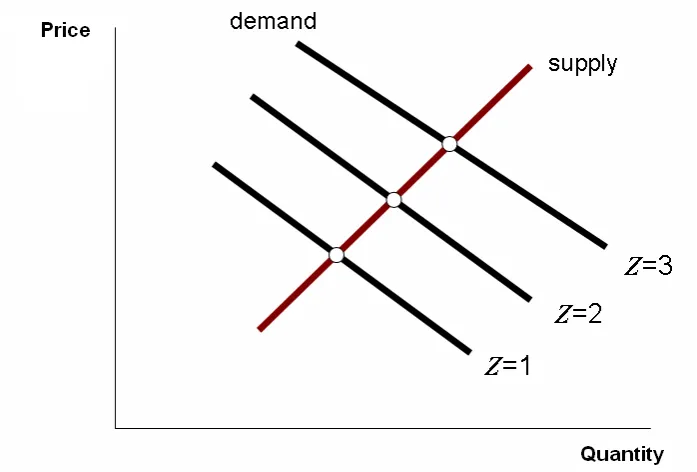
identify the individual relations. Figure 2 depicts the identification problem
in supply and demand and clarifies how the use of additional information can
solve the puzzle. In particular, the graph shows that by observing shifts in
the demand curve, due to an exogenous variable (Z) we are able to identify
the (positive) slope of the supply equation.
Figure 2: Identification of supply and demand
It should be also noted that the (negative) slope parameter of the
de-mand equation cannot be identified. More generally, we are able to identify
the parameters of the equation (in our case the supply) not affected by the
exogenous variable (Z). In order to identify both the supply and the demand
equation, we would need both a variable (or shifter) Z entering the demand
equation but not the supply equation27, and X entering the supply equation
but not the demand equation28:
demand: Q=a1+b1P +c1Z ; supply: Q=a2+b2P +c2X
with positiveb2 and negative b1. Here both equations are identified if c1 and
c2 are nonzero.
27In agricultural economics it is common to use weather variables. More details are
provided in subsequent sections.
28In agricultural economics a common approach is to introduce income as demand
Solving forP and Q we obtain the reduced-form equations:
Q= a1b2−a2b1
b2−b1 +
c1b2
b2−b1Z −
c2b1
b2−b1X Q= a1−a2
b2−b1 +
c1
b2−b1Z−
c2
b2−b1X
whereπ1 = a1bb2−a2b1
2−b1 , π2 =
c1b2
b2−b1 , etc. are the reduced-form parameters.
Suppose we observe Z, but not X. In this case we have two estimates for
b2, anda2: the supply is said over-identified; the demand is under-identified.
When we have unique estimates for the structural parameters, the equations
are said exactly identified; multiple estimates imply over-identification; no
estimates imply under-identification.
3.1
Solutions to the identification problem
As previously described, the identification problem arises when we try to
identify parameters using a reduced form. In the example of supply and
demand, we may solve the problem by using an instrumental variable. Few
points need to be recalled. More precisely, an instrument will be valid if the
variable is correlated with the endogenous regressor and uncorrelated with
the regression error.
Maddala (1977) pointed it is very difficult to have such kind of a
vari-able, and econometrics textbooks do not provide clear guidelines. Angrist
and Krueger (2001, p. 73) argue that “good instruments often come from
detailed knowledge of the economic mechanism and institutions
determin-ing the regressor of interest”. For example, a valid instrument shifts only
one “curve” (e.g. supply, but not demand). In agricultural markets, the
Wright (1928) has pioneered the use of instrumental variables. He
esti-mated they supply and demand for flaxseed and used prices of substituted
goods as instrumental variables for demand, and yield per acre as
instru-ments for supply. He averaged out the estimates obtained using different
instruments. Current researches have shown that a more efficient way to rely
on multiple instruments is to use a two-stage least squares (2SLS) procedure.
The method is described below.
First we provide a chronological review of the solutions have been
pro-posed to solve the identification problem.
A simple, probably too naive, solution is to ignore the problem. Indeed
this solution is not lacking of a theoretical justification. As Wright (1929)
pointed in JASA, ignoring the issue is a valid solution if “it may be assumed
that the dynamic forces will continue to operate thereafter in the same
man-ner as they have been operating during that period”.
Another solution is to adopt a recursive structure:
(i)pt=β1qt+uD ;
(ii) qt =β2pt−1+uS.
In this formulationpt−1 is exogenous in the supply equation, u
S is
uncor-related withuD (therefore there are no common shifters), andq
tis exogenous
in the demand equation with pt on the left hand side.
Frisch and Waugh (1933) have proposed another approach. They
sug-gested to hold demand constant. Given that the observed quantity demanded
differs from the true (or latent) demand, the approach consists of
example. Suppose that quantity is measured with error ǫt, that is:
(true/latent demand) q∗
t =βpt+γWt
(observed quantity) qt =qt∗+ǫt
where Wt represents all determinants of demand and ǫt is pure
indepen-dent measurement error. Solving for observed demand:
(observed demand) qt=βpt+γWt+ǫt
whereE(ptǫt) = 0. The approach suggested by Frisch and Waugh (1933)
is to adjust for the bias, given the “known” γ and Wt. In this case, as they
prove, OLS estimates are consistent.
Another approach is to use an instrumental variables (IV) regression. In
the case of a single equation, the Limited Information Maximum Likelihood
method (LIML) is a valid alternative. The method has been proposed by
Anderson and Rubin (1949), and has been popular until the introduction
of the 2SLS by Theil (1965). The LIML consists in minimizing the residual
sum of squares (RSS)to select the regressors. More precisely, the LIML
mini-mize the ratio of RSS under the restricted and unrestricted model (Maddala,
1992). The analogy with the 2SLS is very strong in that the latter
mini-mize the difference of RSS under the restricted and unrestricted model. As
a consequence, if the model is exactly identified the 2SLS and LIML
pro-vide identical. estimates. Sargan (1958) has extended the IV approach to
multiple instruments through the 2SLS method.
In a nutshell, the approach is as follows. In the first stage, each
regressed on all of the exogenous variables in the model (including both
ex-ogenous covariates in the equation of interest and the excluded instruments).
This first stage allows us to obtain the predicted values. In the second stage,
the regression of interest is estimated as usual, except that in this stage each
endogenous covariate is replaced with the predicted values from the first stage
(Wooldridge, 2002).
Empirically, the 2SLS is performed as follows. Let y be the dependent
variable, x1, ..., xk−1 the explanatory variables, xk the endogenous regressor,
z1, ..., zM the set of instruments.
(I) First stage: compute ˆxk regressing xk on regressors and instruments.
(26) xk=α+Pki=1−1βixi+PNj=1γjzj
(II) Second stage: estimate the model replacing xk with ˆxk.
(27) y=α+Pk−1
i=1 βixi+βkxˆk
From an empirical point of view, it is worth recalling the pitfalls of
instru-mental variables approach. The 2SLS provides consistent, but not unbiased
estimates, therefore researchers that use this approach should always aspire
to use large datasets. Moreover, an instrumental variable correlated with
omitted variables can lead to biased estimates that is much greater than the
bias in ordinary least squares estimates. However, the bias is proportional to
the degree of overidentification, hence using fewer instruments would reduce
the bias. Moreover, it is wise to test for the validity of instruments. Many
Berkowitz et al., 2012)29.
For the above mentioned approaches we have implicitly assumed to deal
only with a single equation. Special attention needs the case in which we
consider a simultaneous equation model. An efficient way to estimate a
full system of equations is to use Generalized Method of Moments (GMM)
estimation. Unfortunately, GMM is usually unfeasible, unless the system
covariance matrix (Σ) is known. Alternative approaches consist in estimating
the system by using a three stage least squares (3SLS) procedure, or by
adopting a full information maximum likelihood (FIML) estimator. The
former consists in estimating a 2SLS (or equation-by-equation) and then
using the residuals to compute Σ. Using Σ the estimation of the third stageb
will be consistent. Alternatively a FIML estimator can be adopted. The
estimator uses information about all the equations in the system, providing
consistent estimates. Although asymptotically equivalent, the FIML is not
equal to the continuously updated 3SLS estimator (unless the system is
just-identified). Empirically, the 3SLS estimator is much easier to be computed
than the FIML estimator (Davidson and MacKinnon, 2004).
Alternative approaches have been proposed. Leamer (1981) has suggested
to solve the identification problem by imposing inequality constraints in order
to restrict the domain of estimates. His words are self-explanatory: “when
the regression of quantity on price yields a positive estimate, we may assume
that this is an attenuated estimate of the supply curve and that the data
contain no useful information about the demand curve30. If the the estimate
29The FAR test, recently developed, does not overreject the null hypothesis when we
use half of the sample without replacement. The test is implemented in STATA.
is negative, th number may be treated as an attenuated estimate of the
demand slope, and we may assert that the data contain no useful information
about the supply curve” (Leamer, 1981, p. 321).
Rigobon (2003) exploits the intuition in Wright (1928) suggesting to
restrict the parametric space using the information provided by the
het-eroskedasticity in the data (e.g. due to crises, policy shifts, changes in
col-lecting the data, etc.). He provides necessary and sufficient conditions for
identification of a system of simultaneous equations. In particular, Rigobon
suggests to use the second moments to increase the number of relations
be-tween the parameters in the reduced and structural forms. An appealing
fea-ture of his approach is that it only requires the existence of heteroskedasticity
in that the direct modeling of the source of heteroskedasticity can be ignored
for the identification purpose. The approach is as follows. First, Rigobon
(2003) estimated a vector autoregressive model of interest rates (prices may
be used for agricultural markets); second, he defined subsamples according
to different volatility; finally he computed the covariances matrices that have
been used in the GMM estimation of contemporaneous shocks. Although the
intuition to use the variance of the shocks to reduce the bias in OLS
esti-mates has to be attributed to Wright (1928), Rigobon (2003) generalized the
intuition and provided the conditions to identify the system 31.
More recently, Roberts and Schlenker (2013) have revisited the problem
of identification of supply and demand for agricultural commodities. The
authors use theory of storage to derive the following empirical model:
in agricultural markets for the estimation of demand. Renuka Kalirajan (2002) applied the method to the demand for services.
(28) (Supply)log(st) =αs+βslog(E[pt|Ωt−1]) +γswt+f(t) +ut
(29) (Demand)log(ct) = αd+βdlog(pt) +g(t) +vt
and ct = st −zt (consumption, ct, is the difference of supply, st, and
storage, zt), αs and αd are intercepts for supply and demand, the Ω is the
information set,wtstands for the random weather-induced yield shocks,f(t)
and g(t) capture time trends in supply and demand, ut and vt are the error
terms. The rationale for (24) and (25) is that weather-induced shocks
(cur-rent and lagged) are expected to shift only the supply curve, and to leave
the demand unchanged. The model is solved in two stages. The first stage
consists in estimatinglog(pt) andlog(E[pt|Ωt−1]). The authors suggest to use
a distributed lag model of yield shocks and a polynomial time trend. The
reduced forms are as follows:
(30) log(pt) =πd0+PkK=1−1µdwt−k+f(t) +ǫdt
(31) log(E[pt|Ωt−1]) =πs0+
PK
k=1µswt−k+f(t) +ǫst
wheref(t) andg(t) represent the polynomial time trend functions,ǫdt and
ǫst are the error terms. In the second stage the lagged yield shocks are used
as instruments. In particular the supply is estimated as follows:
(32) log(st) =αs+βslog(E\[pt|Ωt−1]) +λs0γs0wt+f(t) +ut
and demand is obtained as follows:
The novelty of this approach is that Roberts and Schlenker (2013) have
considered simultaneously four commodities that are substitutes in supply
and demand. Using weather as natural instrument has returned to the
References and further readings
Anderson, T. W., Rubin, H. (1949). Estimation of the parameters of a single
equation in a complete system of stochastic equations. Annals of mathematical
statistics, 20(1)
Angrist, J. D., Krueger, A. B. (2001). Instrumental Variables and the Search
for Identification: From Supply and Demand to Natural Experiments. The Journal
of Economic Perspectives, 15(4), 69-85.
Askari, H., and Cummings, J. T. (1977). ”Estimating Agricultural Supply
Response with the Nerlove Model: A Survey” International Economic Review,
Vol. 18(2), pp. 257-292.
Barten, A. P. (1969). Maximum likelihood estimation of a complete system of
demand equations. European Economic Review, 1(1), 7-73.
Berkowitz, D., Caner, M., Fang Y. (2012). The validity of instruments
revis-ited. Journal of Econometrics 166, pp. 255-266.
Binswanger, H. P. (1974) “A Cost Function Approach to the Measurement of
Elasticities of Factor Demand and Elasticities of Substitution.” American Journal
of Agricultural Economics 56: 377-386.
Cassels, J. M. (1933) “The Nature of Statistical Curves.” Journal of Farm
Economics 15: 378-387.
Chambers, R. G. (1988) “Applied Production Analysis: A Dual Approach.”
New York: Cambridge University Press.
Christiansen L.R., Jorgensen D.W, Lau L.J. (1971), “Conjugate duality and
the transcendental logarithmic production function”, in Econometrica, vol. 39
Christiansen L.R., Jorgensen D.W, Lau L.J. (1973), “Transcendental
Colman, D. (1983) “A Review of the Arts of Supply Response Analysis.”
Re-view of Marketing and Agricultural Economics 51: 201-230.
Davidson, R., MacKinnon, J. G. (2004). ”Econometric theory and methods”.
New York: Oxford University Press.
Deaton, A. (1980) “Economics and consumer behaviour” Cambridge university
press.
Deaton, A. (1986) “Demand analysis” Handbook of Econometrics, in: Z.
Griliches†and M. D. Intriligator (ed.), Handbook of Econometrics, edition 1,
vol-ume 3, chapter 30, pages 1767-1839 Elsevier.
Deaton, A., Muellbauer, J. (1980). “An almost ideal demand system”. The
American economic review, 70(3), 312-326.
Dhar, T., Chavas, J. P., Gould, B. W. (2003). An empirical assessment of
en-dogeneity issues in demand analysis for differentiated products. American Journal
of Agricultural Economics, 85(3), 605-617.
Diewert, W. E., and T. J. Wales (1987): “Flexible Functional Forms and Global
Curvature Conditions.” Econometrica, 55(1), 43-68.
Fisher, B. (1982) “Rational Expectations in Agricultural Economics Research
and Policy Analysis.” American Journal of Agricultural Economics 64: 260-265.
Fisher, F. M. (1976). “The identification problem in econometrics”. RE
Krieger Publishing Company.
Friedman (1962) “Price theory: a provisional text” London, Frank Cass and
Company.
Frisch, R. and Waugh, F.V. (1933) “Partial time regression as compared with
individual trends” Econometrica 1, 221-223.
Koopmans, T. C. (1949). “Identification problems in economic model
Jarvis, L. S. (1974) “Cattle as Capital Goods and Ranchers as Portfolio
Man-agers: An Application to the Argentine Cattle Sector.” The Journal of Political
Economy 82: 489-520.
Just, R. E. (1993) “Discovering Production and Supply Relationships: Present
Status and Future Opportunities.” Review of Marketing and Agricultural
Eco-nomics 61: 11-40.
Key, N., R. N. Lubowski, and M. J. Roberts. (2005) “Farm-Level Production
Effects from Participation in Government Commodity Programs: Did the 1996
Federal Agricultural Improvement and Reform Act Make a Difference?” American
Journal of Agricultural Economics 87: 1211-1219.
Kim, H. Y. (2005) “Aggregation Over Firms and Flexible Functional Forms.”
The Economic Record, 81(252), 1929.
Kmenta J. (1967), “On Estimation of CES Production Function”, in
Interna-tional Economic Review.
Kmenta J. (1986), “ Elements of Econometrics”, Macmillan Pub. Co., New
York.
LaFrance, J. T., and R. D. Pope (2008) “Homogeneity and Supply.” American
Journal Of Agricultural Economics, 90, 606-612.
LaFrance, J. T., and R. D. Pope (2010) “Duality Theory for Variable Costs in
Joint Production.” American Journal of Agricultural Economics, 92(3), 755-762.
Leamer, E. E. (1981). “Is it a demand curve, or is it a supply curve?
Par-tial identification through inequality constraints” The Review of Economics and
Statistics, 63(3), 319-327.
L¨utkepohl, H., Netˇsunajev, A. (2013). Disentangling demand and supply
shocks in the crude oil market: How to check sign restrictions in structural VARs.
Maddala, G. S. (1977). Econometrics. New York: McGraw-Hill
Maddala, G. S. (1992). Introduction to Econometrics. New York: MacMillan
Publishing Company
Manski, C. F. (1995). Identification Problems in the Social Sciences.
Cam-bridge, MA: Harvard University Press.
Manski, C. F. (2003). Partial identification of probability distributions. Springer.
Marshall, A. (1890). Principles of Political Economy.
Mas-Colell, A., Whinston, M. D., and Green, J. R. (1995). Microeconomic
theory. New York: Oxford university press.
Moschini, G., and D. Moro (1994) “Autocorrelation Specification In Singular
Equation Systems.” Economics Letters, 46(4), 303-309.
Moschini, G. (1995). Units of measurement and the stone index in demand
system estimation. American Journal of Agricultural Economics, 77(1), 63-68.
Moschini, G. (1998). The semiflexible almost ideal demand system. European
Economic Review, 42(2), 349-364.
Mundlack, Y. (2001) Production and Supply. Vol. 1, chap. 1 in Handbook
of Agricultural Economics, edited by B. L. Gardner and G. C. Rausser, 3-85.
Amsterdam: Elsevier.
Nerlove, M. (1956) Estimates of the elasticities of supply of selected agricultural
commodities. Journal of Farm Economics 38(2), 496-509.
Nerlove, M., and D. A. Bessler. (2001) Expectations, Information, and
Dy-namics. Vol. 1, chap. 3 in Handbook of Agricultural Economics, edited by B. L.
Gardner and G. C. Rausser. Amsterdam: Elsevier.
O’Donnell, C. J. (2012) “Nonparametric Estimates of the Components of
Pro-ductivity and Profitability Change in U.S. Agriculture.” American Journal Of
Okumura, T. (2011). Nonparametric Estimation of Labor Supply and Demand
Factors. Journal of Business & Economic Statistics, 29(1), 174-185.
Renuka, M., Kalirajan, K. P. (2002). How IncomeElastic Is The Consumers
Demand For Services In Singapore?. International Economic Journal, 16(1),
95-104.
Rigobon, R. (2003), Identification through heteroskedasticity, The Review of
Economics and Statistics. 85, 777-792
Roberts M. J, Schlenker W. (2013). “Identifying Supply and Demand
Elas-ticities of Agricultural Commodities: Implications for the US Ethanol Mandate,”
American Economic Review, American Economic Association, vol. 103(6), pp.
2265-95
Rosen, S.,Murphy K. M., and Scheinkman J. A. (1994) “Cattle Cycles.” The
Journal of Political Economy 102: 468-492.
Russo, C., Green, R., and Howitt, R. E. (2008) “Estimation of supply and
demand elasticities of California commodities”. Available at SSRN 1151936.
Ryan, D. L., and T. J. Wales (1998): “A Simple Method for Imposing Local
Curvature in Some Flexible Consumer-Demand Systems,” Journal of Business and
Economic Statistics, 16, 331-338.
Sargan, J. D. (1958). The estimation of economic relationships using
instru-mental variables. Econometrica: Journal of the Econometric Society, 393-415.
Schultz, T. W. (1956) “Reflections on Agricultural Production Output and
Supply.” Journal of Farm Economics 38: 748-762.
Stone, R. (1954) “Linear expenditure systems and demand analysis: an
ap-plication to the pattern of British demand.” The Economic Journal, 64(255):
Theil, H. (1965). The information approach to demand analysis.
Economet-rica: Journal of the Econometric Society, 67-87.
Thurman, W. N., Wohlgenant, M. K. (1989). Consistent estimation of general
equilibrium welfare effects. American Journal of Agricultural Economics, 71(4),
1041-1045.
Timmer, C. P., Falcon, W. P., Pearson, S. R. (1983). Food policy Analysis.
Baltimore: Johns Hopkins University Press.
Varian, H. R. (1992) “Microeconomic analysis” New York: Norton.
Wohlgenant, Michael K. “Conceptual and Functional Form Issues In
Estimat-ing Demand Elasticities for Food,” American Journal of Agricultural Economics,
1984, 66(2):211-15
Wooldridge, J. M. (2002). “Econometric analysis of cross section and panel
data”. The MIT press.
Wright, P.G. (1928), The tariff on animal and vegetable oils, New York,
Macmil-lan.
Wright P.G. (1929) “Review of Schultz, ‘Statistical Laws of Demand and
Sup-ply” Journal of the American Statistical Association, vol. 24, pp. 207–15.