Characterizing Wyoming Ranching Operations: Natural
Resource Goals, Management Practices and Information
Sources
Emily Kachergis1, Justin Derner1, Leslie Roche2, Kenneth Tate2, Mark Lubell3, Rachel Mealor4, Jim Magagna5
1
Rangeland Resources Research Unit, US Department of Agriculture-Agricultural Research Service, Cheyenne, USA; 2Department of Plant Sciences, University of California, Davis, USA; 3Department of Environmental Science and Policy, University of California, Davis, USA; 4University of Wyoming, Laramie, USA; 5Wyoming Stock Growers Association, Cheyenne, USA.
Email: [email protected]
Received November 17th, 2012; revised December 24th, 2012; accepted January 19th, 2013
ABSTRACT
Spanning 12 million hectares, Wyoming rangelands produce food and provide other vital ecosystem services. However, the decision-making process of the ranchers who steward these lands is complex and poorly understood. In cooperation with the Wyoming Stock Growers Association (WSGA)—a predominant agricultural organization in the state—we asked WSGA producer members about their goals, ranching operation characteristics, and management practices via a mail survey. A total of 307 ranchers (50%) responded to the survey. Livestock production and forage production were the top management goals, with ecosystem characteristics that support these goals (e.g., soil health, water quality) tied for second. Survey respondents’ ranches had a median size of 4220 hectares, but ranged up to 185,000 hectares; 71% of operations included public land and 60% included private leased land. The majority of reporting operations grazed cow-calf pairs (91%), with a median of 260 pairs per ranch. Most survey respondents managed grazing by moving 1 - 5 herds of livestock (84%) among two or more pastures (92%) after three months of grazing or less (87%). Most opera- tions (74%) included other resource use activities, with extractive recreation (e.g., hunting; 55%), conventional energy development (23%), and other agricultural production (20%) most common. Survey respondents primarily got informa- tion about grazing management from other ranchers (97%), although they preferred to receive information through print publications (69%). Wyoming ranching operations are diverse, which may represent a challenge for policy makers de- signing programs and incentives to increase production of food and ecosystem services. However, efforts that focus on livestock and forage production and supporting ecosystem functions are likely to find synergies with ongoing manage- ment goals and strategies. A multi-pronged outreach and education approach using several different media sources may be most effective as new policies and management practices become available.
Keywords: Beef Production; Ecosystem Services; Forage; Grazing; Livestock; Rangeland
1. Introduction
Rangelands have traditionally been managed to produce food and fiber from grazing animals. However, society expects additional ecosystem services from rangelands whose economic values are more difficult to measure, including clean water, wildlife habitat, and recreational opportunities [1,2]. Producing multiple benefits from rangeland ecosystems, and potentially increasing those benefits over time due to increasing demand, is a key challenge facing rangeland managers and policy makers [3-5].
The state of Wyoming has 12 million hectares of rangelands spanning two of the most extensive rangeland
the process by which private ranches produce these goods and services is complex. In 2007, about 3900 different ranching operations with over one million cattle grazed rangelands to achieve their goals in Wyoming alone [10].
Increasing demand for food and ecosystem services suggests that Wyoming rangelands may be expected to increase provision of multiple benefits in the future [2, 11]. Land management represents one avenue for in- creasing livestock production and ecosystem service pro- vision. For example, ranchers and other land managers can use grazing and fire as tools to enhance wildlife habitat [12-14]. Policy is another key method of increas- ing the production of multiple benefits on rangelands. For example, US government programs such as the Con- servation Reserve Program provide funding for imple- mentation of management practices thought to provide conservation benefits, and development of new incentive programs is ongoing [15,16]. Education is a final means of increasing livestock production and ecosystem service provision. New information about practices and policies that promote these benefits can lead to management and policy actions [17].
Here, we describe the characteristics, goals, manage- ment practices, and information sources of Wyoming ranching operations in order to provide insight into pro- ducing livestock and providing ecosystem services on Wyoming rangelands. We conducted a mail survey of producer members of the Wyoming Stock Growers As- sociation, a predominant agricultural organization in the state. This summary of survey results highlights linkages among food production and conservation, people and ecosystems on Wyoming rangelands. Survey findings will inform ranchers, other land managers, and the public about how Wyoming ranches are managing their lands to produce current quantities of livestock and ecosystem services. They will enable policy makers to design future programs and incentives for Wyoming ranchers to en- hance rangeland benefits. Finally, they will guide educa- tors and agricultural extension agents in distributing new knowledge of practices and programs.
2. Methods
We conducted the Rangeland Decision-Making Survey in January-March 2012 with the Wyoming Stock Grow- ers Association (WSGA), the largest ranching organiza- tion in Wyoming. Mail surveys are a cost-effective way to obtain a large sample size, increasing the generaliza- bility of results. The survey included sections of ques- tions about “goals related to natural resource manage- ment,” “operation information,” “grazing practices on private land that is not irrigated,” “grazing management practices,” “personal history,” and “information sources”. As we aimed to learn about Wyoming ranchers, our sam- ple frame was all producer members of the WSGA, who
must be “growers of cattle, horses, mules or sheep.” Survey implementation followed the Dillman Tailored Design method [18], including several survey announce- ments in October 2011-January 2012, a questionnaire mailed in January 2012, a postcard reminder in early February 2012, a replacement questionnaire in late Feb- ruary 2012, and additional legitimacy-building efforts via email and local media. Out of 749 WSGA producer members who received the survey, 81 indicated they were not part of the sample frame (e.g., did not currently own livestock) and were screened out. In all, 307 ranch- ers partially completed questionnaires and 281 ranchers completed over 80% of the questionnaire for a response rate of 49.6%. Number of responses (N) for each ques- tion ranges from 244 - 307 and is noted throughout.
We report different types of summary statistics for different types of survey questions. For open-ended ques- tions (e.g., size of ranch and number of livestock), we report means, medians, and ranges. For multiple choice questions (e.g., other land management activities, infor- mation sources), we report the percentage of survey re- spondents who chose a particular answer. For the ques- tion about goals, where survey respondents were asked to rank a set of goals in order of the priorities of their op- eration, we report the average rank of each goal from 1 (highest priority) to 9 (lowest priority).
3. Results
3.1. Wyoming Ranch Characteristics and Natural Resource Context
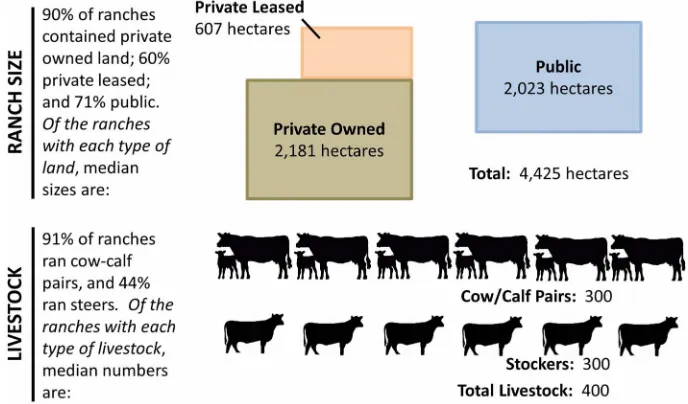
Ranching operations spanned multiple ecosystems and land ownership types (Table 1; Figures 1 and 2). A ma- jority of survey respondents grazed prairies/grasslands or sagebrush ecosystems, which are the major rangeland types in Wyoming (Figure 1). A smaller number grazed forests, mountain meadows, or riparian areas. Ranching operations most commonly included land owned by pri- vate individuals or groups (90%; N = 303). Over half of operations (71%; N = 303) also included land permitted or leased from the US government or the state of Wyo- ming, hereafter referred to as “public” land. Private leased land was also common (60%; N = 303). Public land grazing differed from private owned land grazing in sev- eral ways: a greater number of public lands contained grazing on sagebrush (66% vs. 54%; N = 272 and 214) and forest lands (27% vs. 11%), and grazing was con- centrated in the summer (88%; N = 214), whereas over a third of private owned land was grazed year-round (37%; N = 272).
Table 1. General characteristics of Wyoming ranches based on the Wyoming Rangeland Decision-Making Survey (this study) and the National Agricultural Census [10].
Rangeland decision-making survey (N = 304) Wyoming operations with beef cattle ranching and farminga [10] Characteristic
Mean Median Range Mean
Total size (ha) 11,120 4430 30 - 185,630 2280
Private owned (ha) 3910 1860 0 - 50,590 1730
Private leased (ha) 1270 140 0 - 40,470 -
Public (ha) 6030 690 0 - 141,640 -
Irrigated (ha) 390 20 0 - 42,610 90
Irrigated percentage 10% <1% 0% - 100% 4%
Total livestock 840 400 0 - 9000 -
Cow/calf pairs 390 260 0 - 9000 160b
Stockers 270 0 0 - 8000 -
Other cattle (non-dairy) - - - 110c
Sheep 170 0 0 - 6500 40
aThe agricultural operation category “beef cattle ranching and farming” is based on the predominant source of income and is part of the North American
Indus-try Classification System; bThe number of beef cows that had calved as of December 31, 2007, which is roughly equivalent to cow/calf pairs since most cows in
Wyoming calve soon after that date. This excludes heifers that had not calved, calves, steers, and bulls. This also excludes cows that summer in Wyoming but winter elsewhere; cOther cattle include heifers that had not calved, calves, steers, and bulls as of December 31, 2007, and exclude dairy cows and beef cows that had calved. While it is likely that a majority of these could be classified as “stockers”, this did not correspond directly to a question on the Wyoming Rangeland Decision-Making Survey.
A comparison of survey respondents and Wyoming livestock producers represented by the National Agricul- tural Census [6,10] helps put survey findings in context (Table 1). Survey respondents were located in every Wyoming county, with a minimum of 3 (1%; Uinta) and a maximum of 21 (8%; Albany) from each, similar to the relatively even distribution of agricultural operations throughout Wyoming according to the agricultural sur- vey [6]. Survey respondents had more land and livestock than beef cattle ranching and farming operations in the 2007 Wyoming agricultural census [10]; (Table 1). The many possible reasons for this include differences be- tween the survey methodologies (e.g., land leased on a per-AUM basis is not counted by [10]) and ranchers’ motivations for joining WSGA. Large operations (greater than 100 head) contribute almost 90% of the beef cattle inventory in Wyoming [6], highlighting the importance of WSGA producer members represented by this survey for managing Wyoming rangelands.
Figure 1. Percentage of Rangeland Decision-Making Survey respondents’ Wyoming ranches that included each vegeta- tion type (N = 304). Photo credits (top to bottom): Justin Derner; Kirk Davies; Kira Puntenney; Emily Kachergis;
Scott Bauer. 3.2. Management Goals
Livestock and forage production were survey respon- dents’ top two management goals, with average ranks of 1.8 and 2.0 (Figure 4; N = 284) out of nine possible goals listed on the survey. Ecosystem characteristics that can directly support forage and livestock production, in- cluding riparian and/or meadow health (rank 4.6), soil health (rank 4.7), invasive plants (rank 4.7), and water quality (rank 5.0), formed a second tier of closely ranked goals. Recreation (rank 6.8), carbon sequestration (rank mostly in addition to cow/calf pairs (41%). About one
tenth (12%; N = 291) ran sheep, also generally in addi- tion to pairs (12%). Five percent ran all three livestock types.
[image:3.595.57.285.363.558.2]Figure 2. Median ranch characteristics of survey respondents’ ranches. Medians are reported within ranches that have a particular type of land ownership or livestock.
Figure 3. Percentage of survey respondents’ ranches that include other activities affecting land management. Photo credits (top to bottom): Scott Bauer; Julie Reeves (USFWS); Jack Dykinga; David Augustine; Scott Bauer.
7.0), and wildlife (rank 7.3) trailed behind the others. Ranks varied from 1 - 9 for all goals except forage pro- duction and livestock production, which ranged from rank 1 - 8, and carbon sequestration, which ranged from 4 - 9.
3.3. Grazing and Natural Resource Management
[image:4.595.73.275.329.551.2]Most ranches had one to five herds of livestock (1: 29%; 2 - 5: 55%; 6 - 10: 8%; >10: 8%; N = 287), which were rotated to a different pasture after three months of graz-
Figure 4. Survey respondents’ management goals. Photo credits (top left to bottom right): Jack Dykinga; Emily Kachergis; Emily Kachergis; Emily Kachergis; Kira Pun- tenney; Jaepil Cho; Jack Dykinga; Julie Reeves (USFWS); Unknown (USDA-ARS).
Figure 5. Grazing management practices on survey re-spondents’ ranches. Most ranches had one to five herds of livestock which were rotated through multiple pastures after less than three months of grazing.
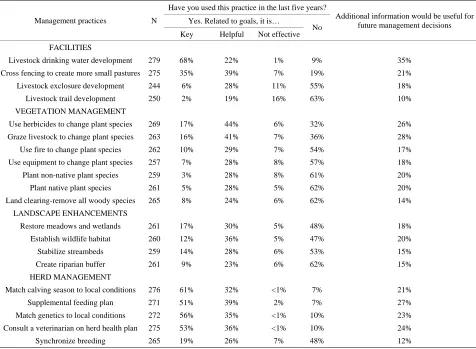
In addition to grazing management, survey respon- dents used a variety of practices to achieve their goals (Table 2; Figure 6). Over two-thirds of survey respon- dents used each of four broad categories of management practices: herd management (98%), facilities (96%), vege- tation management (90%), and landscape enhancements (69%; N = 279). Creating a supplemental feeding plan, matching genetics and calving season to local conditions, developing livestock drinking water, and consulting a veterinarian on a herd health plan were rated as the most key practices for achieving goals (Table 2; Figure 6). The most often-used vegetation management practices were grazing livestock and using herbicides to change plant species composition. The most often-used land- scape enhancement was restoring meadows and wet- lands.
A majority of survey respondents monitor vegetation (70% on private land, 60% on public or state land; N = 289 and 268), even without participating in programs that require monitoring. A smaller percentage monitor vege- tation as part of a program that requires monitoring (13% on private land; 18% on public land). About one-fifth do
Table 2. Management practices used to support natural resource goals on survey respondents’ ranches. Within each category (e.g., FACILITIES), practices are listed in descending order according to the proportion of ranchers who use them.
Have you used this practice in the last five years?
Yes. Related to goals, it is…
Management practices N
Key Helpful Not effective No
Additional information would be useful for future management decisions
FACILITIES
Livestock drinking water development 279 68% 22% 1% 9% 35%
Cross fencing to create more small pastures 275 35% 39% 7% 19% 21%
Livestock exclosure development 244 6% 28% 11% 55% 18%
Livestock trail development 250 2% 19% 16% 63% 10%
VEGETATION MANAGEMENT
Use herbicides to change plant species 269 17% 44% 6% 32% 26%
Graze livestock to change plant species 263 16% 41% 7% 36% 28%
Use fire to change plant species 262 10% 29% 7% 54% 17%
Use equipment to change plant species 257 7% 28% 8% 57% 18%
Plant non-native plant species 259 3% 28% 8% 61% 20%
Plant native plant species 261 5% 28% 5% 62% 20%
Land clearing-remove all woody species 265 8% 24% 6% 62% 14%
LANDSCAPE ENHANCEMENTS
Restore meadows and wetlands 261 17% 30% 5% 48% 18%
Establish wildlife habitat 260 12% 36% 5% 47% 20%
Stabilize streambeds 259 14% 28% 6% 53% 15%
Create riparian buffer 261 9% 23% 6% 62% 15%
HERD MANAGEMENT
Match calving season to local conditions 276 61% 32% <1% 7% 21%
Supplemental feeding plan 271 51% 39% 2% 7% 27%
Match genetics to local conditions 272 56% 35% <1% 10% 23%
Consult a veterinarian on herd health plan 275 53% 36% <1% 10% 24%
[image:5.595.60.536.387.736.2]Figure 6. Popular land management practices and the percentage of survey respondents who used them. Photo credits (top to bottom): Emily Kachergis; Scott Bauer; Brian Prechtel; Justin Derner; Stephen Ausmus; Emily Kachergis; Rachel Mealor; Stephen Ausmus; Jack Dykinga; John Likins; Michael MacNeil.
not monitor vegetation (17% on private land; 22% on public land).
3.4. Information Sources
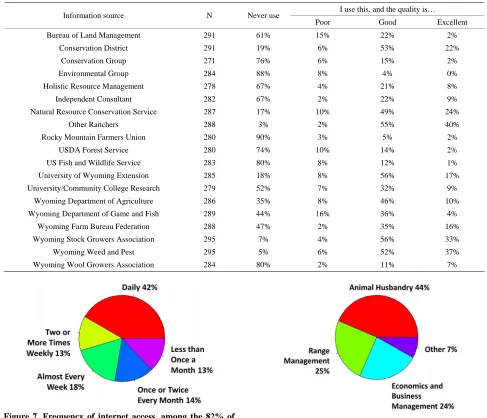
Other ranchers were the most often-used and highly rated source of information about ranching (Table 3), with Wyoming Weed and Pest and Wyoming Stock Growers Association next in line. Conservation Districts, Univer- sity of Wyoming Extension, and the Natural Resource Conservation Service also ranked highly.
Internet access is improving across Wyoming, and may represent a growing avenue for producers to receive information about ranching. A majority of survey re- spondents accessed the internet via high-speed connec- tions (75%; N = 304), with fewer connecting via smart- phone (9%) and dial-up (4%). About 18% did not have
internet access (N = 304). Frequency of internet access varied widely (Figure 7). The survey respondent was the primary user of the internet to access information related to ranching (56%; N = 267). Even though many of them had internet access, a majority of survey respondents preferred to receive information about ranching through print publications (69%; N = 303) rather than the internet (21%) or word of mouth (27%).
3.5. Socio-Economic Background
Table 3. Use and quality of different sources of information about ranching, according to survey respondents.
I use this, and the quality is…
Information source N Never use
Poor Good Excellent
Bureau of Land Management 291 61% 15% 22% 2%
Conservation District 291 19% 6% 53% 22%
Conservation Group 271 76% 6% 15% 2%
Environmental Group 284 88% 8% 4% 0%
Holistic Resource Management 278 67% 4% 21% 8%
Independent Consultant 282 67% 2% 22% 9%
Natural Resource Conservation Service 287 17% 10% 49% 24%
Other Ranchers 288 3% 2% 55% 40%
Rocky Mountain Farmers Union 280 90% 3% 5% 2%
USDA Forest Service 280 74% 10% 14% 2%
US Fish and Wildlife Service 283 80% 8% 12% 1%
University of Wyoming Extension 285 18% 8% 56% 17%
University/Community College Research 279 52% 7% 32% 9%
Wyoming Department of Agriculture 286 35% 8% 46% 10%
Wyoming Department of Game and Fish 289 44% 16% 36% 4%
Wyoming Farm Bureau Federation 288 47% 2% 35% 16%
Wyoming Stock Growers Association 295 7% 4% 56% 33%
Wyoming Weed and Pest 295 5% 6% 52% 37%
Wyoming Wool Growers Association 284 80% 2% 11% 7%
Figure 7. Frequency of internet access, among the 82% of survey respondents who had internet access (N = 261).
had some college education or beyond (83%; N = 302). The most interesting part of ranching to survey respon- dents was animal husbandry (Figure 8), with range man- agement and economics and business management fol- lowing behind that. Almost all ranches had some kind of off-ranch income (82%; N = 299), including off-ranch employment (31%), oil and gas development (24%), and stock market investments (24%).
[image:7.595.53.540.100.518.2]Almost half of survey respondents had a succession plan that identified a strategy for keeping their land in ranching in the future (47%; N = 282). Twenty-three percent of respondents were working on a plan, and 24% did not have a succession plan. The remainder either did not own private land (4%) or indicated that the status of their succession plan was not captured by these options (1%).
Figure 8. The most interesting part of ranching to survey respondents (N = 299).
4. Discussion: Balancing Livestock
Production and Provision of Ecosystem
Services on Wyoming Rangelands
land ownership types (including public land); 2) grazed cow-calf pairs; and 3) incorporated other activities that affect land management [19-22]. These general charac- teristics can guide future efforts to balance livestock production and provision of ecosystem services. For ex- ample, the diversity of land ownership and activities on individual ranches implies that partnerships among mul- tiple landowners, public land managers, and other stake- holders may be increasingly necessary for integrated pro- duction and conservation efforts [7,23].
Survey respondents manage natural resources with the goals of producing livestock and preserving the ecosys- tem characteristics that support livestock production, such as forage production and soil health. Similarly, ranchers in Utah and western Colorado said that livestock produc- tion and conservation of natural resources were their main goals influencing their decision-making [24,25]. Colorado ranchers also emphasized “the link between those goals” [25; p. 333]. Combined, these studies sug- gest that efforts to produce ecosystem services on range- lands that focus on livestock and forage production and supporting ecosystem functions are most likely to find synergies with ongoing management goals and strategies. For example, land managers and policy makers can choose livestock grazing in addition to other practices to try to enhance ecosystem services, as some ranchers and con-servation groups are doing [26]. Similarly, efforts to re-store the productivity of degraded ecosystems are con-sistent with ranchers’ goals.
Survey respondents’ grazing management and other land management practices emphasized livestock pro- duction but also included efforts to improve the condition of natural resources. As with operation characteristics, management practices were diverse, but we highlight several commonalities. Grazing management generally involved a less than three-month rotation through multi- ple pastures and incorporated rest (Figure 5), similar to other American and Australian ranching operations [19, 27,28]. Water development and fencing were additional important management practices that facilitate rotational grazing (Figure 6). In Australia, Ash and Stafford-Smith [29] noted an increase in the frequency of these practices and suggested that their precise use can increase live- stock production. Herd management practices related to animal health, also common in Utah and Australia [19,28], can also help improve livestock production. Two broad categories of natural resource management prac- tices, vegetation management and landscape enhance- ments, were used by over two-thirds of survey respon- dents. In a longitudinal survey of landowners of Califor- nia oak woodlands, Huntsinger etal. [22] found that use of oak woodland and wildlife habitat conservation prac-tices had increased over 19 years. Our survey results and trends in other rangeland regions of the western US sug-
gest that many ranchers use management practices to provide ecosystem services that are synergistic with live- stock production.
New information about managing rangelands for live- stock production and ecosystem services is constantly becoming available, and is especially important given the high turnover of ranch land ownership in Wyoming and the western US in recent years [30,31]. Other ranchers and several organizations, notably WSGA and Wyoming Weed and Pest, were often-used and highly-regarded sources of information about ranching. However, survey respondents preferred to receive information about ranch- ing from print publications rather than by word of mouth or over the internet. Even though the internet is not the preferred way of communicating, the fact that a majority of ranchers have internet access suggests that it will be an important avenue for sharing information about rangeland management in the future. A multi-pronged approach to outreach and education using several different media sources may be most effective [31].
5. Conclusion
The Wyoming Rangeland Decision-Making Survey de- scribed the characteristics, goals, management practices, and information sources of survey respondents’ ranching operations and provided several insights into balancing livestock production and provision of ecosystem services on Wyoming rangelands. First, Wyoming ranching op- erations are diverse in operation characteristics and man- agement practices, which may represent a challenge for policy makers who are designing programs and incen- tives to increase provision of ecosystem services. How- ever, the survey also identified several shared character- istics that can guide these efforts. Ranchers’ goals sug- gest that efforts that focus on livestock and forage pro- duction and supporting ecosystem functions are likely to complement ongoing management. Future research on the management practices that ranchers use should iden- tify the many synergies between livestock production and ecosystem service provisioning as well as the trade-offs, where acceptable [3]. As new policies and management practices become available, a multi-pronged outreach and education approach using several different media sources may be most effective.
6. Acknowledgements
REFERENCES
[1] K. M. Havstad, D. P. C. Peters, R. Skaggs, J. R. Brown, B. T. Bestelmeyer, E. L. Fredrickson, J. E. Herrick and J. Wright, “Ecological Services to and from Rangelands of the United States,” Ecological Economics, Vol. 64, No. 2, 2007, pp. 261-288.doi:10.1016/j.ecolecon.2007.08.005 [2] Millenium Ecosystem Assessment, “Ecosystems and
Human Well-Being: Synthesis,” World Resources Insti-tute, Washington DC, 2005.
[3] D. D. Briske, “Rangeland Conservation Effects Assess-ment Project Executive Summary: The Next Generation of Conservation Practice Standards,” Conservation Ef-fects Assessment Program Review, USDA Natural Re-sources Conservation Service, Washington DC, 2011.
[4] J. H. Goldstein, G. Caldarone, T. K. Duarte, D. Ennaanay, N. Hannahs, G. Mendoza, S. Polasky, S. Wolny and G. C. Daily, “Integrating Ecosystem-Service Tradeoffs into Land-Use Decisions,” Proceedings of the National
Acad-emy of Sciences of the United States of America, Vol. 109,
No. 19, 2012, pp. 7565-7570.
doi:10.1073/pnas.1201040109
[5] E. Nelson, G. Mendoza, J. Regetz, S. Polasky, H. Tallis, R. Cameron, K. M. Chan, G. C. Daily, J. Goldstein, P. M. Kareiva, E. Lonsdorf, R. Naidoo, T. H. Ricketts and R. Shaw, “Modeling Multiple Ecosystem Services, Biodi-versity Conservation, Commodity Production, and Trade-offs at Landscape Scales,” Frontiers in Ecology and the
Environment, Vol. 7, No. 1, 2009, pp. 4-11.
doi:10.1890/080023
[6] USDA NASS, “Wyoming 2012 Agicultural Statistics,” USDA National Agricultural Statistics Service, Cheyenne, 2012.
[7] M. W. Brunson and L. Huntsinger, “Ranching as a Con-servation Strategy: Can Old Ranchers Save the New West?” Rangeland Ecology & Management, Vol. 61, No. 2, 2008, pp. 137-147. doi:10.2111/07-063.1
[8] United States General Accounting Office, “Endangered Species Act: Information on Species Protection on Non-federal Lands,” 1994.
http://www.gpo.gov/fdsys/pkg/GAOREPORTS-RCED-9 5-16/pdf/GAOREPORTS-RCED-95-16.pdf
[9] J. D. Maestas, R. L. Knight and W. C. Gilgert, “Biodiver-sity across a Rural Land-Use Gradient,” Conservation
Bi-ology, Vol. 17, No. 5, 2003, pp. 1425-1434.
doi:10.1046/j.1523-1739.2003.02371.x
[10] USDA NASS, “Wyoming State and County Data, 2007 Census of Agriculture,” USDA National Agricultural Sta-tistics Service, Cheyenne, 2007.
[11] P. K. Thornton, “Livestock Production: Recent Trends, Future Prospects,” Philosophical Transactions of the
Royal Society of London: Series B, Biological Sciences,
Vol. 365, No. 1554, 2010, pp. 2853-2867. doi:10.1098/rstb.2010.0134
[12] J. D. Derner, W. K. Lauenroth, P. Stapp and D. J. Au- gustine, “Livestock as Ecosystem Engineers for Grass-land Bird Habitat in the Western Great Plains of North America,” Rangeland Ecology & Management, Vol. 62, No. 2, 2009, pp. 111-118. doi:10.2111/08-008.1
[13] D. J. Augustine and J. D. Derner, “Disturbance Regimes and Mountain Plover Habitat in Shortgrass Steppe: Large Herbivore Grazing Does Not Substitute for Prairie Dog Grazing or Fire,” The Journal of Wildlife Management, Vol. 76, No. 4, 2012, pp. 721-728.doi:10.1002/jwmg.334 [14] S. R. Archer, K. W. Davies, T. E. Fulbright, B. McDaniel,
B. Wilcox and K. I. Predick, “Brush Management as a Rangeland Conservation Strategy: A Critical Evaluation,” Conservation Effects Assessment Program Review, USDA Natural Resources Conservation Service, Washington DC, 2011.
[15] K. L. Olenick, U. P. Kreuter and J. R. Conner, “Texas Landowner Perceptions Regarding Ecosystem Services and Cost-Sharing Land Management Programs,”
Eco-logical Economics, Vol. 53, No. 2, 2005, pp. 247-260.
doi:10.1016/j.ecolecon.2004.09.016
[16] S. Engel, S. Pagiola and S. Wunder, “Designing Pay-ments for Environmental Services in Theory and Practice: An Overview of the Issues,” Ecological Economics, Vol. 65, No. 4, 2008, pp. 663-674.
doi:10.1016/j.ecolecon.2008.03.011
[17] P. Kristjanson, R. S. Reid, N. Dickson, W. C. Clark, D. Romney, R. Puskur, S. Macmillan and D. Grace, “Link-ing International Agricultural Research Knowledge with Action for Sustainable Development,” Proceedings of the National Academy of Sciences of the United States of
America, Vol. 106, No. 13, 2009, pp. 5047-5052.
doi:10.1073/pnas.0807414106
[18] D. A. Dillman, “Mail and Internet Surveys: The Tailored Design Method,” John Wiley & Sons, Hoboken, 2007.
[19] D. L. Coppock and A. H. Birkenfeld, “Use of Livestock and Range Management Practices in Utah,” Journal of
Range Management, Vol. 52, No. 1, 1999, pp. 7-18.
doi:10.2307/4003486
[20] D. L. Coppock, “Ranching and Multiyear Droughts in Utah: Production Impacts, Risk Perceptions, and Changes in Preparedness,” Rangeland Ecology & Management, Vol. 64, No. 6, 2011, pp. 607-618.
doi:10.2111/REM-D-10-00113.1
[21] R. C. Rowan and L. D. White, “Regional Differences among Texas Rangeland Operators,” Journal of Range
Management, Vol. 47, No. 5, 1994, pp. 338-343.
doi:10.2307/4002326
[22] L. Huntsinger, M. Johnson and M. Stafford, “A Resurvey of Oak Woodland Landowners: 1985, 1992, and 2004,”
Proceedings of the 6th Symposium on Oak Woodlands:
California’s Oaks, Today’s Challenges, Tomorrow’s Op-
portunities,” Rohnert Park, 9-12 October 2006, pp. 57-67.
[23] R. R. J. McAllister, N. Abel, C. J. Stokes and I. J. Gordon, “Australian Pastoralists in Time and Space: The Evolu-tion of a Complex Adaptive System,” Ecology and Soci-ety, Vol. 11, No. 2, 2006, p. 41.
[24] C. A. Kennedy and M. W. Brunson, “Creating a Culture of Innovation in Ranching: A Study of Outreach and Co-operation in West-Central Colorado,” Rangelands, Vol. 29, No. 3, 2007, pp. 35-40.
doi:10.2111/1551-501X(2007)29[35:CACOII]2.0.CO;2 [25] E. A. Didier and M. W. Brunson, “Adoption of Range
Ecology & Management, Vol. 57, No. 4, 2004, pp. 330- 336.
doi:10.2111/1551-5028(2004)057[0330:AORMIB]2.0.C O;2
[26] S. D. Fuhlendorf and D. M. Engle, “Application of the Fire-Grazing Interaction to Restore a Shifting Mosaic on Tallgrass Prairie,” Journal of Applied Ecology, Vol. 41, No. 4, 2004, pp. 604-614.
[27] C. W. Hanselka, A. McGinty, B. S. Rector, R. C. Rowan and L. D. White, “Grazing and Brush Management on Texas Rangelands: An Analysis of Management Deci-sions,” Texas Agricultural Extension Service, College Station, 1990.
[28] G. Bortolussi, J. G. McIvor, J. J. Hodgkinson, S. G. Cof-fey and C. R. Holmes, “The Northern Australia Beef In-dustry, a Snapshot. 4. Condition and Management of Natural Resources,” Australian Journal of Experimental
Agriculture, Vol. 45, No. 9, 2005, pp. 1109-1120.
doi:10.1071/EA03262
[29] A. J. Ash, and D. M. Stafford Smith, “Pastoralism in Tropical Rangelands: Seizing the Opportunity to Change,”
The Rangeland Journal, Vol. 25, No. 2, 2003, pp. 113-
127. doi:10.1071/RJ03010
[30] H. Gosnell, J. H. Haggerty and W. R. Travis, “Ranchland Ownership Change in the Greater Yellowstone Ecosystem, 1990-2001: Implications for Conservation,” Society &
Natural Resources, Vol. 19, No. 8, 2006, pp. 743-758.
doi:10.1080/08941920600801181
[31] R. D. Mealor, P. J. Meiman, A. L. Hild, D. T. Taylor and J. S. Thompson, “New Rangeland Residents in Wyoming? A Survey of Exurban Landowners,” Rangeland Ecology
& Management, Vol. 64, No. 5, 2011, pp. 479-487.
![Table 1. General characteristics of Wyoming ranches based on the Wyoming Rangeland Decision-Making Survey (this study) and the National Agricultural Census [10]](https://thumb-us.123doks.com/thumbv2/123dok_us/7746476.709024/3.595.57.285.363.558/general-characteristics-wyoming-wyoming-rangeland-decision-national-agricultural.webp)