Relativistic versus Newtonian Frames
J.-F. Pascual-Sánchez1, A. San Miguel2, F. Vicente2
1IMUVA and Departmento de Matemática Aplicada, E.I.I., Universidad de Valladolid, Valladolid, Spain; 2Departmento de
Matemática Aplicada, Facultad de Ciencias, Universidad de Valladolid, Valladolid, Spain. Email: [email protected]
Received November 28th, 2012; revised December 30th, 2012; accepted January 10th, 2013
ABSTRACT
Only a causal class among the 199 Lorentzian ones, which do not exists in the Newtonian space-time, is privileged to construct a generic, gravity free and immediate (non retarded) relativistic positioning system. This is the causal class of the null emission coordinates. Emission coordinates are defined and generated by four emitters broadcasting their proper times. The emission coordinates are covariant (frame independent) and hence valid for any user. Any observer can obtain the values of his (her) null emission coordinates from the emitters which provide him his (her) position and trajectory.
Keywords: Null Emission Coordinates; Location Systems; Causal Class; Relativistic Positioning System; Gravimetry
1. Introduction
Globally, the current situation in the Global Navigation Satellite Systems (GNSS) is almost analogous to the fol- lowing one imagine that a century after Kepler, the as- tronomers were still using Kepler’s laws as algorithms to correct the Ptolemaic epicycles by means of “Keplerian effects”. Similarly, a century after Einstein, one still uses the Newtonian theory and corrects it by “relativistic or Einsteinian effects” instead of starting with Einstein’s gravitational theory from the beginning.
To show this, we will focus on the essential differ- ences between an old Newtonian plus “relativistic cor- rections” coming from the post-Newtonian framework, as in the current operating systems which use only the usual class of Newtonian frames, and the new fully rela- tivistic framework which use a new class of relativistic frame: null emission coordinates. Note that there are not “relativistic corrections” in relativity, as they are not “newtonian corrections” in Newtonian theory.
At present the GNSS functioning as global positioning systems, are the GPS and the GLONASS. In general, the satellites (SVs) of the GNSS are affected by Relativity in three different ways: in the equations of motion, in the signal propagation and in the beat rate of the satellite clocks. We will only briefly comment on the clock ef- fects because they are only the measurable ones in the present GNSS and in the future Galileo.
Among the relativistic effects on the rate of the satel- lite clocks with a time accuracy of nanoseconds and 10−12 of frequency accuracy the most important ones (to first
post-Newtonian order 1 2
c ) are: the Einstein effect or
gravitational frequency blue shift of the atomic clocks of the satellites (Equivalence principle of General Relativity) with respect to Earth bound clocks due to their position in the Earth gravitational field, time dilation or Doppler shift of second order due to the speed of the satellites (Special Relativity) and the kinematical Sagnac effect due to the rotation of the Earth (Special Relativity), see [1-3] for reviews. If they were not corrected by imposing an offset, the GNSS would not be operative after few minutes. However, with the present and future more ac- curate clocks (picosecond and even femtosecond), it would be necessary in the Newtonian framework to con- sider other “relativistic corrections” at post-post-Newto- nian order as well as metric spatial curvature effects, tidal effects or delay effects of gravity in the light propa- gation as the Shapiro time delay.
In this situation, it can be wondered if it would not be more convenient to change the present Newtonian frame- work to an exact formulation in full General Relativity. This would imply to abandon the classical post-Newto- nian framework for the description of GNSS. The root of this radical change is the consideration of a new 4D proper relativistic frame (emission coordinates) instead of the usual Newtonian frame, which uses 3D spatial reference systems, such as the ECI (Earth Centered Iner- tial system) or the ECEF (Earth Centered Earth Fixed system), and a time reference (GPS time), separately.
nate system is necessary to introduce previously some new definitions, as such location systems or causal clas- sification of frames, and mathematical physics tools, mainly geometrical. These new definitions and tools pro- vide a clear way to understand the differences among the special subclass of Newtonian frames and the general class of relativistic frames.
2. Location Systems
Location systems are physical realizations of 4D coordi- nate systems. Hence there is a differentiation of a coor- dinate system as a mathematical object from its realiza- tion through physical objects and protocols. A location system is thus a precise protocol on a set of physical fields allowing to materialize a coordinate system. How- ever, different physical protocols, involving different physical fields, may be given for a unique mathematical coordinate system.
A location system must include the protocols for the physical construction of the coordinate lines, coordinate surfaces or coordinate hypersurfaces of specific causal orientations of the coordinate system that it realizes. Thus, for instance, these coordinate elements may be re- alized by means of clocks for time-like lines, laser pulses for null lines, synchronized inextensible threads for space-like lines, laser beams or inextensible threads for time like surfaces and light-front surfaces for null hyper- surfaces. The different protocols involved in the con- struction of location systems give rise to coordinate ele- ments (lines, surfaces and hypersurfaces) of different causal orientations, i.e., they realize coordinate systems
of different causal nature.
2.1. Reference Systems
Location systems are of two different types: reference systems and positioning systems. The first ones are 4D reference systems which allow one observer, considered at the origin, to assign four coordinates to the events of its neighborhood by means of electromagnetic signals. In relativity due to the finite speed of the transmission of information, this assignment is retarded with a time de- lay.
A paradigmatic reference system in relativity is the radar system which is based in the Poincaré protocol of synchronization which uses two-way light signals from the observer to the events to be coordinated. Unfortu- nately, the radar system suffers from the bad property of being constructed from a retarded protocol due to the finite speed of the transmission of information.
2.2. Positioning Systems
The second kind of location systems are 4D positioning systems, which allow to every event of a given domain to
know its proper coordinates in an immediate or instanta- neous way without delay. In addition to be immediate, the positioning systems must verify other two conditions, they must be generic and free of gravity. A positioning system is generic, if it can be constructed in any space- time and, it is free of gravity, if the knowledge of the gravitational field is not necessary to construct it. Refer- ence systems privilege one specific observer among all others, whereas in positioning systems no observers are necessary at all and hence there is no necessity of any synchronization procedure between different observers.
In relativity, a (retarded) reference system can be con- structed starting from an (immediate) positioning system, it is sufficient that each event sends its coordinates to the observer at the origin of the reference system, but not the other way around. In contrast, in Newtonian theory, 3D reference and positioning systems are interchangeable and as the velocity of transmission of information is infi- nite, the Newtonian reference systems are not retarded but immediate. The reference and positioning systems defined here are 4-dimensional objects, including time location.
3. Causal Classification of Frames
In the Lorentzian space-time of general relativity, direc- tions and planes or hyperplanes of directions at any event are said to be space-like, light-like (or null or isotropic) or time-like oriented if they are respectively exterior, tangent or secant to the light-cone of this event. These causal orientations can be extended in a natural way to vectors, covectors and volume forms on these sets of directions. Thus, every one of the vectors A of a frame
of the tangent space
e
eA c, has a particu- lar causal orientation .
1, , 4
A
A
However, the causal orientations AB of the
six different associated or adjoint planes
C AB
e eA,
B of the frame
eA are not determined by the specificcausal orientations A of the vectors of the frame. For
instance, the plane associated to two space-like vectors may have any causal orientation. So, in general, the causal characters A and AB are independent. More-
over, in order to give a complete description of the causal properties of the frames, one needs also to specify the causal orientations A of the four covectors or 1-forms
c
c
c C
A
giving the dual coframe
A ,i.e. A
eB BA.Following [5], the best way to visualize and characterize a space-time coordinate system is to start from four fami- lies of coordinate 3-surfaces, then their mutual intersec- tions give six families of coordinate 2-surfaces and four congruences of coordinate lines.
Alternatively, one can use the related covectors or 1- forms A, instead of the 3-surfaces, and the vectors of a
coordinate tangent frame
eA instead of four congru-The covector A is time-like (resp. space-like) iff the
3-plane
e e eB, ,C D
generated by the three vectors
B B A is space-like (resp. time-like). This applies forboth Newtonian and Lorentzian space-times. In addition, for the latter, the covector
e
A
is light-like (or null) iff the 3-plane generated by
B B A is light-like (or null).Thus, to specify the causal orientations of hyperplanes is not necessary because is redundant with the causal ori- entation of the covectors.
e
C C23
, ,In this way, for a specific domain of a Lorentzian or Newtonian space-time, each frame
is fully char- acterized by its causal class. The causal class of a frame is the set of all the frames that have same causal signa- ture, which is defined by a set of 14 causal characters:
A e
,1 2 12
c cc c3 4,C C13 14 C24C34,c c c c1 2 3 4
As notation for the causal characters, we will use lower case roman types s t l
S T, ,to represent the causal character of vectors (resp. space-like, time-like, light- like), and capital types and lower case italic
types
L
s t l, ,
x
c C
to denote the causal character of 2-planes and covectors, respectively.
3.1. Relativistic Frames
This new degree of freedom (light-like) in the causal character, which is proper of Lorentzian relativistic space-times but which does not exist in Newtonian space-times, allows to obtain (see [5,6]), as it has been commented in the abstract, the following theorem:
In a relativistic 4-dimensional Lorentzian space-time, there exists 199, and only 199, causal classes of frames.
These 199 causal classes have been completely classified. We shall see that among the 199 Lorentzian causal classes, only one is privileged to construct a generic, gravity free and immediate positioning system.
The notion of causal class extends naturally to the set of coordinate lines of the coordinate system and so, to the coordinate system itself. By definition, the causal class of a coordinate system
4 in a domain is the causal1
class , ,c of its associated natural frame at the
events of the domain. In relativity, a specific causal class, among the 199 ones, can be assigned to any of the dif- ferent coordinate systems used in all the solutions of the Einstein equations. However, for the same coordinate system and the same solution, the causal class can change depending on the region of the space-time con- sidered and the coordinate system in this case is said to be inhomogeneous.
In fact, see [7], in any space-time every coordinate x
plays two extreme roles: that of a hypersurface for every constant value x const, of gradient dx, and that of
a coordinate line of tangent vector , when the other
coordinates remain constant. This simple fact shows that, in spite of the historical custom of associating to a coor- dinate a causal orientation, saying that it is time-like,
light-like or space-like, this appellation is not generically coherent. Causal orientations are generically associated
with directions of geometric objects, but not with space- time coordinates associated to them. In the case of a co- ordinate x, this generic incoherence appears because
its two natural variations in the coordinate system, dx
and , have generically different causal orientations.
Only when both causal orientations coincide, it is possi-
ble to extend to the coordinate x itself the character of
the common causal orientation of its two mentioned variations.
3.2. Newtonian Frames
The differences in the geometric description of Lor- entzian and Newtonian frames come from the causal structure induced by the different metric descriptions of Lorentzian and Newtonian space-times. The main dif- ference comes essentially from the absence of the light- like character in the Newtonian case. In relativity, the space-time metric is non-degenerate and defines a one- to-one correspondence between vectors and covectors at the tangent and cotangent space of every event.
In contrast, in a Newtonian space-time no non-degen- erate metric structure exists and one has two different metrics, see [8]. This degenerate metric structure is given by a rank one covariant time metric and an
orthogonal rank three contravariant space metric
2
d
T t
. In the time metric appears t, which is an absolute time scale
and the hypersurfaces t = const, constitute the instanta-
neous or simultaneity spaces. A vector is space-like if it is instantaneous, i.e. if
e
dt e 0. Otherwise, it is time-
like. So, it is clear that a frame can have at most three space-like vectors so, there only exist four causal types of Newtonian frame bases, namely:
tsss ,
ttss ,
ttts ,
tttt .Correspondingly, a covector 0 is time-like if it has no instantaneous part with respect to the contravari- ant space metric , i.e. if and it is necessar-
ily of the form
0
d
N t
with , being future (resp. past) oriented if (resp. ). Otherwise, the
covector
0 0
N N
0
N
is space-like. Thus, attending to the causal orientation of their covectors, there only exist two causal types of Newtonian coframes bases:
tsss ,
ssss .In summary, it can be shown (see [7]) that one has the following implications valid only for Newtonian frames:
cA CAB,cA
, CAB cA .its causal class. This is related to the fact that, in Newto- nian space-time, any set of space-like vectors always generates a space-like subspace. As a consequence, the number of causally different Newtonian classes of frames is equal to the dimension of the space-time. Hence, see [7], in the 4-dimensional Newtonian space-time there exist four, and only four, causal classes of frames. They
are:
tsss,TTTSSS,tsss
,
ttss, TTTTTS,ssss
,
ttts,TTTTTT,ssss
and
tttt,TTTTTT,ssss
.4. Relativistic Positioning
4.1. Coll Positioning System
As it has been commented above, among the 199 Lor- entzian causal classes, in which the four Newtonian ones are included, only one is privileged to construct a generic (valid for a wide class of spacetimes), gravity free (the previous knowledge of the gravitational field is not nec- essary) and immediate relativistic positioning system.
This is the causal class {s s s s;S S S S S S; l l l l} of
the Coll homogeneous coordinate system [2,4,5]. In this causal class the null emission coordinates of the Coll positioning system are included. These emission coordi- nates have been also studied in [9-11] in the special case of a flat Minkowski space-time without gravity.
The coordinate system of this causal class is always homogeneous and it has associated four families of null 3-surfaces or equivalently a real non-orthogonal null co- frame, whose mutual intersections give six families of spacelike 2-surfaces and four congruences of space-like lines. Such a coordinate system does not exist in a New- tonian space-time where the light travels at infinite speed. One satellite clock broadcasting its proper time is de- scribed in the space-time by a time-like line A
A ,inwhich each event of proper time A is the vertex of a
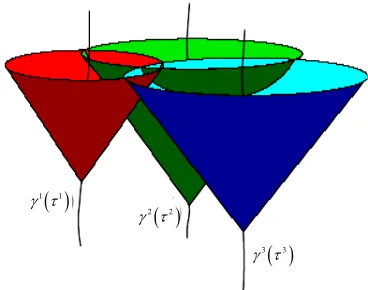
[image:4.595.331.515.85.230.2]future light cone. The set of these four light cones of an emitter constitutes a one-parameter (proper time) family of null hypersurfaces. So, four satellite clocks broadcast- ing their proper times determine four one-parameter families of lightlike 3-surfaces (future light cones), see
Figure 1. Thus, the Coll positioning system makes use of
the mathematical theorem that four future light cones generically intersect in an unique event, which is just the spacetime position of the receiver or user.
In this relativistic positioning system, any receiver or user at any event in a given spacetime region can know its proper coordinates. The four proper times of four sat- ellites read at an event by a receiver or user constitute the null (or light) proper emission co- ordinates or user positioning data of this event, with re- spect to four SVs, see Figure 2. These four numbers or
parameters can be understood as the “distances” between
A, 1; 2;3; 4A
2 2
1 1
3 3
[image:4.595.357.489.303.432.2]Figure 1. Relativistic emission coordinates: intersection of the four future light cones of the SVs with the past light cone of a receiver. In the Figure only 3 light cones of the SVs are drawn in a Lorentzian space-time of 1 + 2 dimen- sions.
Figure 2. Past light cone of an event in 3 dimensions, the proper time parameterized paths of 3 SVs (in violet) and the lightlike geodesics (in green) followed by the signal from each satellite to an event of the trajectory of a receiver.
the reception event and the four satellites. In a certain domain of R4 of the grid Ω of parameters A, any user
receiving continuously his null emission coordinates from four satellites may know his trajectory in the grid of parameters. If the observer has his own clock, with proper time denoted by then he can know his trajec- tory with proper time parametrization, AA
, andhis four-velocity, a
d A du .
For positioning out a GNSS constellation, i.e. for in-
terplanetary missions in the Solar system, a “pulsar” Coll relativistic positioning system can be conceived, see [12, 13], based on the X-ray signals of four properly selected stable millisecond pulsars and a conventional origin of the emission coordinates. On the other hand, a navigation project called XNAV (based in pulsars) is being devel- oped during the last years by DARPA and NASA but unfortunately, see [14], is based in the same Newtonian concepts that the GPS or Galileo. However, in this case, it is more complicated because post-post-Newtonian cor- rections must be implemented.
4.2. Contravariant Metric in Emission Coordinates
As the emission coordinates belong to the causal class {s s s s;S S S S S S; l l l l}, there is not a spacetime
asym-metry like in the standard Newtonian coframe (t s s s)
(one timelike “t” and three spacelike “s”). In emission
coordinates obtained from a general real null co-frame (l l l l) =
d1,d2,d3,d4
, which is neither orthogonalnor normalized, the contravariant spacetime metric is symmetric with null diagonal elements and it has the general expression, see [2,15]:
12 13 14
12 23 24
13 23 34
14 24 34 0
0 d d
0 0
AB A B
g g g
g g g
g
g g g
g g g
,
(2)
where AB 0 for
g AB
AB 0g
. Four null covectors can be linearly dependent although none of them is proportional to another. To ensure that the four null covectors are linearly independent and span a 4-dim space-time, it is sufficient that det . Finally, this metric has a Lorentzian signature (+, −, −, −) iff det
gAB 0.The expression (2) of the metric is observer inde- pendent and has six degrees of freedom. In the terminal- ogy of [9], the proper times A are
partial observables,
while the components of the metric AB
g are complete observables, i.e., gauge independent or invariant quanti-
ties under diffeomorphisms in the Lorentzian spacetime. A splitting of this metric can be considered, see [15], changing from the six independent components (ten components minus four gauge degrees of freedom of coordinate transformations) of AB
g to a more conven-
ient set, which neatly separates two shape parameters depending only on the direction of the covectors dA or
equivalently depending exclusively on the trajectories of the emitters, from other four scaling parameters depend- ing on the length of the covectors or depending on the proper time of each satellite.
4.3. SYPOR Project: Autolocated Positioning System
SYPOR project is the anagram (in French) of Relativistic Positioning System project. The basic idea of this project, that was conceived by Coll in [6] and also exposed in [2, 3], is the following one: A satellite constellation provided with clocks that interchange their proper time among them (interlinks) and with Earth receivers, is a fully rela- tivistic autonomous or autolocated positioning system. Note that, nowadays, this procedure of proper time auto navigation can be technically fulfilled.
[image:5.595.362.485.85.194.2]In the SYPOR, the segment of Control is in the con- stellation of satellites, see Figure 3. The function of this
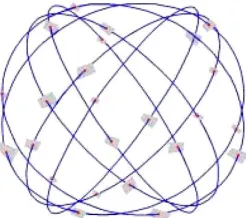
Figure 3. In the SYPOR, the Space and Control segments coincide with the constellation.
new Control segment is not to determine the ephemerides of the satellites with respect to geocentric coordinates as in the newtonian GNSS, but to determine the null emis- sion coordinates of the receivers with respect to the con- stellation of SVs. Therefore, the procedure used until now in the newtonian GNSS is inverted.
Let us define properly what means autonomous or autolocated. Four satellites emitting, without the neces- sity of a synchronization convention, not only their proper times A, but also the proper times AB of the
three close satellites received by the satellite A in A (in
total sixteen emitter positioning data
A, AB
; AB; ; 1, 2,3A B , 4), constitute an autolocated positioning
system.
In an autolocated positioning system, the receivers can know not only its spacetime path but also the trajectories of the four satellites in the grid of R4 of emission coordi-
nates.
5. Gravimetry and Positioning
In General Relativity, the gravitational field is described by the space-time metric. If this metric is exactly known a priori, the system just described will constitute an ideal positioning system. In practice, the actual space-time metric (i.e., the gravitational field) is not exactly known
(in the GPS it is supposed to be essentially the Sch- warzschild metric) and the satellite system itself has to be used to infer it. This problem arises when a satellite sys- tem is used for both positioning and gravimetry.
To solve this joint problem, the considered satellites should have more than one clock: they may carry an ac- celerometer providing information on the space-time connection. Of course, in first approximation the satel- lites are in free-fall and consequently have zero accelera- tion. However, we are considering here the realistic case where the acceleration is nonzero due, for instance, to a small drag in the high atmosphere and this is measured by the accelerometers. Also, the satellites may have a gra- diometer, this would give additional information on the metric (in fact, on the Riemann tensor of the space-time).
optimization procedure could be developed (see [16]) to obtain the best observational gravitational field acting actually on the constellation. The problem of obtaining the space-time metric is a kind of inverse problem since one wants to recover the spacetime metric from the ob- served data in the Coll positioning system.
5.1. Two Dimensional Cases
Coll positioning systems are yet now quite well devel- oped for two-dimensional space-times, see [11,17] where several results have been developed. For instance, the knowledge that the positioning system is stationary and that the space-time is created by a given mass, allows to know the accelerations of the emitters, their mutual radar distances and the space-time metric in null emission co- ordinates. The important point for gravimetry is that the Schwarzschild mass may be substituted by that of the acceleration of one of the emitters.
5.2. Realistic Four Dimensional Cases
For applications of an autolocated positioning system on or near the Earth’s surface, the primary emission coordi- nates should be related to some terrestrial secondary 4-dimensional Newtonian coordinate system. This prob- lem has been solved for a general configuration of the emitters in flat Minkowski space-time [18,19] and also for the case of a special configuration of the emitters in a Schwarzschild spacetime [20].
However, in general the known results for the flat and curved two dimensional spacetimes are not trivially generalizable for the realistic curved four dimensional one [15] and much work remains to be done in the future.
6. Acknowledgements
One of the authors (JFPS) is grateful to Bartolomé Coll by communications on this subject along several years. This work was partially supported by the Spanish Minis- terio de Educación y Ciencia, MEC-FEDER ESP2006- 01263 grant.
REFERENCES
[1] N. Ashby, “Relativity in the Global Positioning System,”
Living Reviews in Relativity,Vol. 6, 2003, p. 1.
[2] J.-F. Pascual-Sánchez, “Introducing Relativity in Global Navigation Satellite Systems,” Annalen der Physik, Vol.
16, No. 4, 2007, pp. 258-273. doi:10.1002/andp.200610229
[3] J.-F. Pascual-Sánchez, “The Relativistic Framework of Positioning Systems,” First Colloquium on Scientific and
Fundamental Aspects of the Galileo Program, 2007,
arXiv:0710.1282.
[4] B. Coll, “Reference Frames and Gravitomagnetism,” World Scientific, Singapore, 2001, p. 53.
[5] B. Coll and J. A. Morales, “199 Causal Classes of Space- Time Frames,” International Journal of Theoretical Phy- sics, Vol. 31, 1992, p. 1045.
[6] B. Coll, “Physical Relativistic Frames,” Proc. Jour. Sys.
Ref. Spat. Temp., Brussels, ed N. Capitaine, Observatoire
de Paris, 2001, p. 169.
[7] B. Coll, J. J. Ferrando and J. A. Morales, “Four Causal Classes of Newtonian Frames,” Foundations of Physics,
Vol. 39, 2009, p. 1280.
[8] A. Trautman, “Sur la Théorie Newtonienne de la Gra- vitation,” Comptes Rendus de l'Académie des Sciences,
Vol. 257, 1963, p. 617.
[9] C. Rovelli, “GPS Observables in General Relativity,”
Physical Review D, Vol. 65, No. 4, 2002, Article ID: 044
017. doi:10.1103/PhysRevD.65.044017
[10] M. Blagojevic, J. Garecki, F. W. Hehl and Yu. N. Obu- khov, “Real Null Coframes in General Relativity and GPS Type Coordinates,” Physical Review D, Vol. 65, No. 4,
2002, Article ID: 044018. doi:10.1103/PhysRevD.65.044018
[11] B. Coll, J. J. Ferrando and J. A. Morales, “Two-Dimen- sional Approach to Relativistic Positioning Systems,”
Physical Review D, Vol. 73, No. 8, 2006, Article ID: 084
017. doi:10.1103/PhysRevD.73.084017
[12] A. Tarantola and B. Coll, “Using Pulsars to Define Space- Time Coordinates,” 2009, arXiv:0905.4121.
[13] M. L. Ruggiero, E. Capolongo and A. Tartaglia, “Pulsars as Celestial Beacons to Detect the Motion of the Earth,”
International Journal of Modern Physics, Vol. 20, No. 6,
2011, pp. 1025-1038.
[14] P. Graven, et al., “XNAV for Deep Space Navigation,”
Proceedings of 31st Annual AAS Guidance and Control
Conference, AAS 08-054, 2008.
[15] B. Coll and J. M. Pozo, “Relativistic Positioning Systems: The Emission Coordinates,” Classical and Quantum Gra- vity, Vol. 23, No. 24, 2006, p. 7395.
doi:10.1088/0264-9381/23/24/012
[16] A. Tarantola, L. Klimes, J. M. Pozo and B. Coll, “Gravi- metry, Relativity, and the Global Navigation Satellite Systems,” 2009, arXiv:0905.3798.
[17] B. Coll, J. J. Ferrando and J. A. Morales, “Positioning with Stationary Emitters in a Two-Dimensional Space- Time,” Physical Review D, Vol. 74, No. 10, 2006, Article ID: 104003. doi:10.1103/PhysRevD.74.104003
[18] M. Lachièze-Rey, “The Covariance of GPS Coordinates and Frames,” Classical and Quantum Gravity, Vol. 23,
No. 10, 2006, p. 3531. doi:10.1088/0264-9381/23/10/019 [19] B. Coll, J. J. Ferrando and J. A. Morales-Lladosa,
“Positioning Systems in Minkowski Spacetime: From Emission to Inertial Coordinates,” Classical and Quan-
tum Gravity, Vol. 27, No. 6, 2010, Article ID: 065013.
doi:10.1088/0264-9381/27/6/065013
[20] D. Bini, A. Geralico, M. L. Ruggiero and A. Tartaglia, “Emission versus Fermi Coordinates: Applications to Re- lativistic Positioning Systems,” Classical and Quantum
Gravity, Vol. 25, No. 20, 2008, Article ID: 205011.