Limiting the impact of unreliable randomness
in deployed security protocols
Liliya Akhmetzyanova, Cas Cremers, Luke Garratt, Stanislav V. Smyshlyaev, and Nick Sullivan
v1.2, October 20191
Abstract
Many cryptographic mechanisms depend upon the availability of securely generated random numbers. In practice, the sources of random numbers can be unreliable for many reasons, including bugs, compromise or subversion of standards. While there exist ways to significantly reduce the impact of unreliable randomness, these typically do not work well with practical constraints, such as long-term keys stored in hardware security modules. In practice, even modern protocols like TLS 1.3 lack such mechanisms and are therefore highly vulnerable to unreliable randomness.
We propose a wrapper construction that reduces the impact of untrusted randomness, and which is is compatible with, and effective in, existing deployments of protocols such as TLS. We provide a security analysis of the construction and elaborate on design choices and practical interpretations. Our findings show that it is possible to effectively harden deployed protocols against unreliable randomness.
I. INTRODUCTION
Most key exchange protocols (e.g., TLS, SSH, and IKE) depend on the secure generation of random numbers. At the core of many of these protocols is a Diffie–Hellman key exchange of the following form: Alice generates a random number x, computesgx and sends it to Bob. Bob similarly generates random numbery, computes gy and sends it to Alice. Of course, each particular protocol has essential additional details such as certificates, signatures, key derivation, comparison of transcripts and so on, but at the heart of all these protocols is a session key computed using the random numbersxandy and further material that is typically public. Therefore, it is essential that these random numbers are generated as securely as possible.
In many operating systems, raw entropy comes in the form of events such as mouse movements or keystrokes. As large amounts of raw entropy is difficult to accumulate, Alice and Bob do not generate truly random numbersxand y for their key exchanges. Instead, they use the primitive of a cryptographically secure pseudorandom number generator (CSPRNG), which takes as input a seed, continually harvests more raw entropy and produces arbitrarily many pseudorandom numbers as required. Since CSPRNGs are used to provide the essential secrets for the derived key, their security is critical. However, the current problem we face is that all CSPRNGs depend on raw entropy in some form or another. Therefore, if the underlying randomness is not good, the derived key is not secure.
It may be tempting to think that random number generation is well-understood by now. Unfortunately, this is not the case. There are many real-world examples of poor random number generation. We mention a few examples:
• The Debian OpenSSL random number generator vulnerability [2], [24], in which the range of the produces randomness was effectively much smaller than expected;
• Predictable random numbers in Android’s Java OpenSSL [21] leading to theft of bitcoins;
• The Dual EC random number generator backdoor [5], by which observing produced random values could be used to infer the internal state of the generator for someone who knew the underlying relations, thereby making further values predictable. This caused several vulnerabilities including in TLS [7] and VPN routers [6];
• Random number generators on hardware that degrades over time;
• Servers with reliable long-term keys in HSMs that are deployed in settings where good randomness generation cannot be guaranteed, such as content delivery networks (CDNs) that deploy servers in remote locations to improve latency for local users;
• Internet of Things (IoT) devices that are deployed with potentially good (factory) keys, but have no access to good randomness generation mechanisms after deployment;
• Side channel attacks on random number generators to infer future states [8].
• Some AMD processors whose RDRAND stopped working after suspend resume – reported as early as 2014 [20] but only addressed in 2019 [1], [19];
Given this situation, one would expect that modern security protocols provide some protection mechanisms against randomness that becomes unreliable over time. However, this is rarely the case: widely used protocols such as SSH [25], IKE [11], [12], and even the newest version of TLS (TLS 1.3 [23]) are highly vulnerable to unreliable randomness.
For example, the most common use case of TLS 1.3 [23] is based on a Diffie-Hellman exchange, in which the client and server each generate a fresh random value (e.g.,xand y), and send each other the corresponding public key share (gx,gy) along with many other elements. The server signs its response, which includes its sharegy, using its long-term signing key; but bothgx andgy are visible to anyone who can observe the network traffic, such as ISPs, backbone providers, rogue wifi access points, or routers. Then, a complex key derivation is used to compute the symmetric session keys that will be used to encrypt payload messages, but the only secret input to this key derivation is gxy – all other inputs can be directly inferred from the network traffic. Hence, if an adversary knows or guesses eitherx(as generated by the client) ory (from the server), it can use the network traffic to computegxy and compute the session keys, and therefore to decrypt all subsequent TLS payloads or modify them.
The situation is similar for SSH [25], IKE [11], [12] (and therefore also IPSec [13]), and even for post-quantum proposals such as NewHope [3].
Related work
In the domain of key exchange protocols, at least since the MTI protocols [22] from 1986, there have been protocols that include both session-specific randomness and long-term keys into the computation of the session key. While this was not the objective of early protocols, an appropriate combination can strengthen the resilience of the resulting protocol against unreliable randomness. Such resilience has been considered, for example, in the extended analysis of the HMQV protocol [15]. The first time that unreliable randomness was explicitly considered in a Bellare-Rogaway-style security model for key exchange protocols, was in 2006 in [18]. In this work, the authors also proposed a variant of the Diffie-Hellman protocol called the NAXOS protocol, which is secure in their model. It relies on a construction sometimes referred to as the “NAXOS trick”. In the standard Diffie-Hellman protocol, pseudorandom numbersxandy are computed from raw entropy and used as private exponents, and then publicly exchanging the messagesgx and gy. Instead, the NAXOS protocol sends gH(x,skAˆ) and gH(y,skBˆ)
where H is a hash function, andskAˆand skBˆ are the long-term secret keys of Alice and Bob respectively. Intuitively we can
see that security of the private exponent in this case should now depend on the pairs (x,skAˆ)and (y,skBˆ)being unknown to
the adversary, as opposed to justxand y. Furthermore, a protocol that usesgH(x,skAˆ)can behave in exactly the same way as
one that usesgx. The main difference is thatH(x,sk ˆ
A)is harder to learn for the adversary than justx.
However, in the case of implementing cryptographic protocols in a hostile environment, often the long-term termskis stored in trusted hardware that does not provide direct access to computeH(x,sk). For many deployments that use hardware security modules (HSMs), this prevents the application of the NAXOS trick. Furthermore, it is generally undesirable to re-use signing keys as input to a hash function from a cryptographic design perspective.2
Contribution
Inspired by the NAXOS trick, we propose a “wrapper” function around existing pseudorandom number generators, in contexts that have access to a signing algorithm for the long-term key of a party. Our construction uses a signatureSig(sk,tag1)for
some fixed stringtag1 instead of using a secret keysk.
In contrast to the NAXOS trick, our design is more generic and applies outside of the Authenticated Key Exchange (AKE) domain, and we follow a much more conservative approach that enables the re-use of existing infrastructure. Our construction furthermore offers improved graceful degradation if it turns out that the output of the hash function reveals partial information about the input. The proposed construction is currently considered in IETF (CFRG), see [9] for details.
The construction aims to provide the following informal security properties:
1) If the CSPRNG works as expected, that is, in a certain security model the CSPRNG output is indistinguishable from a truly random sequence, then the output of the proposed construction is also indistinguishable from a truly random sequence in that security model.
2) If the CSPRNG is broken or controlled by the adversary, then the output of the proposed construction remains indistinguishable from random, provided that the private key remains unknown to the adversary.
3) An adversary with full control of a (potentially broken) CSPRNG that is also able to observe all outputs of the proposed construction, has no non-negligible advantage in leaking the secret key, modulo side channel attacks.
We define the formal security model regarding these three properties in terms of a game between a challenger and an adversary. We provide proofs that the proposed wrapper construction meets the precisely defined security guarantees under standard cryptographic assumptions.
Our construction can be transparently used with existing security protocols such as TLS, IKE, and SSH. Because it only requires local code changes at the interface between protocol and randomness source, it does not lead to externally visible changes. Our construction is therefore backwards compatible by design, and can be rolled out incrementally. Concretely, this
means that it is possible to update for example some TLS 1.3 servers with our construction and continue operation, without needing to modify the clients. This would already increase security guarantees for those servers as well as the unmodified clients communicating with them.
As we will show later, our construction requires the generation of one signature at startup time, and negligible cost during normal protocol operations.
Organization
In Section II we introduce our construction for randomness improvement. In Section III we define the security properties we will need for our primitives in our wrapper construction. In Section IV we define the security model for our wrapper construction and additionally provide a practical interpretation. In Section V we give a security theorem and formal game hopping security proof that our construction fulfils the claimed security properties. In Section VI we provide experimental results to assess the efficiency of our construction.
II. THE WRAPPER CONSTRUCTION
Our objective is to reduce the impact of bad randomness on security protocols. We assume that we are given a functionG, which is intended to be a CSPRNG, but for which we cannot be sure if it always produces good randomness, or if it was subverted. One way of reducing the impact, as used by the NAXOS protocol, is to ensure that (i) a party’s long-term private keyskmust be known in order to produce the final random values, and (ii) observing a random value cannot be used to predict the next value, even if the underlying CSPRNG might be vulnerable to state recovery.
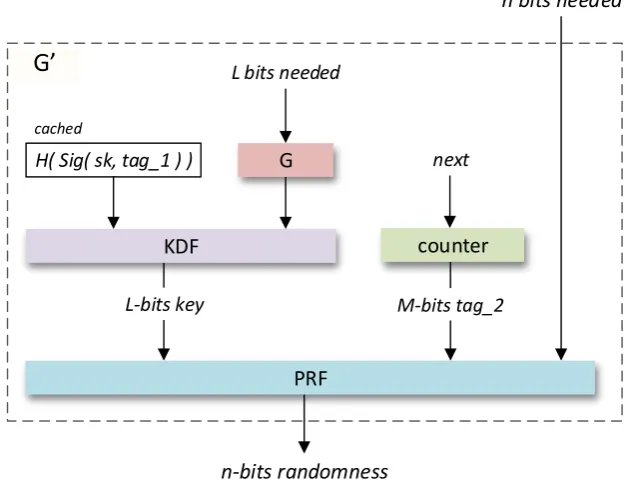
We first present our construction, and then discuss the design constraints. LetSig(sk, m)be a deterministic function that computes a signature of messagemgiven private key sk. LetHbe a cryptographic hash function that produces output of length M. LetKDF(x, y)be a key derivation function, which accepts a random keyxand a salty and produces a pseudorandom key of lengthL. Let PRF(k, c, n) be a variable-length output pseudorandom function, that takes as input a pseudorandom keyk of lengthL, info stringc, and output lengthn, and produces output of length n.
LetG(n)be an algorithm that generatesnrandom bits, i.e., the output of a CSPRNG. Instead of usingG(n)when randomness is needed, use an augmented CSPRNGG0(n), where
G0(n) =PRF(KDF(H(Sig(sk,tag1)), y),tag2, n),
and wherey=G(L),tag1 is a fixed, context-dependent string, and tag2 is a dynamically changing string (e.g., a counter
increased on each invocation) ofM bits. We require thatL≥n−M.
The wrapper construction is depicted graphically in Figure 1. In the figure, “next“ represents the wrapper instance invocation, which increases the value of the counter used fortag2.
H( Sig( sk, tag_1 ) )
KDF
PRF
counter
G’
n bits needed
n-bits randomness
L bits needed
next
cached
L-bits key
G
M-bits tag_2
Design choices
We give a brief overview of the reasons that lead to the specific design of the construction.
First, our goal is to provide security guarantees for vulnerable environments that are compatible with existing deployments. This leads to two requirements: (i) for compatibility and practical deployment, we would like to re-use existing long-term keys, and (ii) in vulnerable environments, long-term keys are likely to reside in trusted hardware. These requirements are typically incompatible with the NAXOS design, both for cryptographic separation as well as the limitations of trusted hardware APIs. We therefore need to be able to useskin some trusted hardware, which implies that we need to choose an operation and some data for this operation. In the vast majority of real-world systems, private keys are allowed to be used for digital signatures by the APIs of trusted hardware. Our wrapper therefore assumes from the context that there exists a signature keysk that can be used by the wrapper for signing.
Since signature operation is computationally expensive, we design our wrapper to avoid producing a signature per randomness request. To prevent collisions of wrapper outputs it is highly desirable to bind all information connected to the instance of the CSPRNG together as early as possible, i.e. right when using the key. For this reason, we sign a specific tagtag1, which is
a constant string bound to a specific device and protocol, incorporating all available information specific to the process and having the format that is not supported (or explicitly forbidden) by other applications using sk. Therefore, we have a signature over a unique-per-instance data, that can be used multiple times for all requests to the instance of the wrapper.
We requireSig to be a deterministic signature function or to use an independent entropy source, since broken randomness used in a randomized signature scheme can lead to the total compromise of the private key. This is explicitly something we need to avoid (property three). We also hash the signature output to have additional protection for the signature itself, and thus the private key sk. Another advantage of hashing is that there is no guarantee that the signature is uniformly distributed across the range ofSig. Moreover, after hashing we can obtain a shorter intermediate value, which is good for overall performance. Crucially, this value can be cached, since it remains the same for all requests to one wrapper instance. This is an important design choice that ensures our construction is sufficiently efficient.
Now we need to mix the obtained value ofH(Sig(sk,tag1))together with the initial output of the CSPRNG and provide the first and the second declared security properties: if either CSPRNG works fine or skremains secret, then the output of the wrapper must be good. To achieve this, we first “extract” an intermediate pseudorandom key (PRK) from the values of H(Sig(sk,tag1))andy – the two values that are normally assumed to be secret – using a KDF function. The output is then
provided as the input to a PRF function, together with the original (potentially unreliable) randomness and a unique (non-secret) valuetag2, which changes upon each invocation of the wrapper.
There are many choices for instantiating the KDF and PRF functions in our construction. One reasonable choice is to rely on a well-studied construction such as HKDF [14], [16], by using HKDF-Extract as theKDF function and HKDF-Expand as thePRFfunction. HKDF is standardised [14], well studied, and likely to already be implemented in many of the potential deployment environments, thereby reducing the amount of additional code needed.
Implementingtag2 as a counter in the construction has the additional benefit of producing unique numbers, even if the
source randomness becomes constant (e.g., always zero). It additionally yields a larger output range even if the range of the original randomness is too small, e.g., as happened in the Debian RNG case [24], [2]. This design aspect is inspired by the observations and constructions from [10].
III. BASE SECURITY DEFINITIONS
We define the security properties we need of our primitives for our construction to be proven secure in our security model. We address the key derivation, the pseudorandom function, and the signature scheme in turn below.
A. Key derivation function
A key derivation function is an algorithm KDFthat implements a deterministic functionk=KDF(x, y), taking as input some bit stringsxandy, and returning a keyk∈ {0,1}L. We require thatKDFfulfills the following two security properties. 1) KDF security.Intuitively, this property means computational indistinguishability of theKDF(x,·)function forxchosen uniformly at random from an ideal random functionρ(·). Namely, it is the standard PRF security property. LetKDF denote the probability that any probabilistic polynomial time adversary is able to distinguish between these distributions.
2) Uniformness preserving.We require theKDFalgorithm to fulfill the uniformness preserving of the output fory←${0,1}L
chosen uniformly at random andxchosen arbitrarily. We define a security game between an adversary Aand a challenger as follows.
1) The adversary makes a queryx. The challenger uniformly randomly samples a secret valuey←${0,1}L. The challenger
computesk0:=KDF(x, y)and samplesk1←${0,1}L uniformly randomly. The challenger then flips a coinb←${0,1}
and responds withkb.
LetUPdenote the probability that any probabilistic polynomial time adversary is able to win the considered above game. In
other words, for any probabilistic polynomial time algorithmA
Pr(b=b0)−1
2
≤UP.
TheKDFalgorithm is said to beUP-secure ifUP is negligible in security parameter.
a) HKDF-extract.: In our concrete construction, we instantiateKDFwith HKDF-extract [17], which is literally the HMAC function.
The first KDF property is believed due to the prf-security of the HMAC construction (see [4] for details). Moreover, for the wrapper the length of the HMAC key x=H(Sig(sk,tag1))is equal to the hash output length that satisfies recommendations. Consider the uniformness preserving property for the HKDF-extract function based on a hash function H with good combinatorial properties. In particular, for this function the following balance property holds:
Pr
y←${0,1}L[H(xky) =k] =
1
2L, ∀ k∈ {0,1}
L, x∈ {0,1}∗.
It easy to see that for HKDF-extract, which is defined as HMAC(x, y) = H(xopadkH(xipadky)), the same property holds. Thus, it is reasonable to assume the uniformness preserving property holds. The same can be shown for the reverse order of arguments.
B. Variable-length output pseudorandom function
A variable-length output pseudorandom function is an algorithmPRFthat implements a deterministic functionz=PRF(k, c, n), taking as input a key k∈ {0,1}L, some bit string c, an integer n, and returning a stringz ∈ {0,1}n. We assume that the maximum permitted sizenis polynomial.
We define a security game (for multi-user setting) between an adversaryA and a challenger as follows.
1) The challenger uniformly randomly samples q(polynomial) secret keysk1, . . . , kq ∈ {0,1}L independently from each other.
2) The adversary is allowed to query the challenger with adaptively chosen values (i, c, n),i∈[1, . . . , q]. The challenger replies withPRF(ki, c, n).
3) Eventually the adversary queries a special symbolT to indicate the so-called test query with value(i, c, n)where(i, c,·)
was not queried before. At this point, the challenger computesz0:=PRF(ki, c, n)and samples z1 uniformly randomly
from{0,1}8n. The challenger then flips a coinb←
${0,1} and responds withzb.
4) The adversary is allowed to keep making queries. Note that after the test query the adversary is not allowed to query
(i, c,·).
5) The adversary then outputs a guessb0 forb and wins the game if b=b0 and loses otherwise.
Letmu-PRFdenote the probability that any probabilistic polynomial time adversary is able to win the considered above game. In other words, for any probabilistic polynomial time algorithm A
Pr(b=b0)−1
2
≤mu-PRF.
ThePRFalgorithm is said to bemu-PRF-secure ifmu-PRFis negligible in security parameter.
C. Hash function and signature scheme
A signature scheme is a triple(KGen,Sig,Vf).KGenis a probabilistic algorithm which takes as input the security parameter
1αand outputs a public signature verification key pkand secret signing keysk.Sig is a signing algorithm which generates a signatureσfor messagemusing secret keysk. In this work we consider only deterministicSig algorithms.Vfis a deterministic signature verification algorithm which, given input(pk, σ, m), outputs 1if σ is a valid signature ofmunder keypk, and 0
otherwise. It is required that for everyk, every(sk,pk)output by KGen(1α), and every messagem, it holds that Vf(m,Sig(sk, m)) = 1
In our construction, we will not want to use the long-term keysk directly. We instead use the hash of a signature oftag1,
signed withsk. For our security proof, we require that the combined hash function and signature scheme fulfill the following security property.
Definition 3.1 (Sig,H-secure):Consider the following game between a challenger and a polynomial time adversary A: 1) The challenger generates a public/private key pair(pk,sk)using KGenand gives the adversary the public keypk. 2) The adversary is allowed to adaptively query chosen messagesmto the challenger. The challenger responds to each query
3) When the adversary decides to, it outputs a so-called test querym∗that was not queried before. At this point, the challenger flips an unbiased coinb←${0,1}. If heads, it returns withH(Sig(sk, m∗)). If tails, it responds with a uniformly random
string of the same length.
4) The adversary is allowed to keep asking for signatures with messagesm6=m∗, but eventually it must output a guessb0 for the coin flipb, at which point the game ends. The adversary wins if it guesses the coin flip correctly and loses otherwise. LetSig,H denote the probability that any probabilistic polynomial time adversary is able to win the considered above game. In other words, for any probabilistic polynomial time algorithm A
Pr(b=b0)−1
2
≤Sig,H.
The (Sig,H) composition is said to beSig,H-secure ifSig,H is negligible in the security parameter.
This security property can be instantiated with routine cryptographic assumptions such as a hash function modelled as a random oracle and an existentially unforgeable signature scheme.
IV. SECURITY MODEL
In this section we define the security property that we expect from our wrapper in terms of a game between a challenger and an adversary. Intuitively, we aim to prove that the wrapper does not degrade security and offers additional security in cases where the current randomness is unreliable.
LetT1 denote the set of possible values fortag1, andT2 the set of possible values for the dynamic tagtag2.
We run aWrappergame between the challenger and the adversary as follows. At the beginning of the game, the challenger uniformly randomly chooses a secret keysk and returns a public keypkto the adversary. After receiving the public key, the adversary chooses a setT ⊆ T1 consisting ofl pairwise different valuest1, . . . , tland sends it to the challenger. We assume that the size lof the setT is polynomial. The adversary is allowed to make the following queries to the challenger.
• The adversary can makeoutputqueries of two types:
– tag1,tag2, n(in this case the challenger chooses the y←${0,1}L value uniformly randomly by itself);
– tag1,tag2, y, n(in this case they∈ {0,1}L value is chosen by the adversary).
Note that the adversary is allowed to make queries wheretag1∈T. We also assume that the adversary does not make trivialoutputqueries containing the same tuple (tag1,tag2, y).
The challenger produces
PRF(KDF(H(Sig(sk,tag1)), y),tag2, n)
and returns this value as a response to the corresponding outputquery.
The challenger indexes queries and locally saves the corresponding inputs to the wrapper for each query, i.e. the challenger saves records of the form(i,tagi1,tagi2, yi). We assume thati≤q for someq that is also polynomial.
• The adversary can makesignqueries for signatures withsk of messagesm. The challenger produces and returns the value Sig(sk, m).
• The adversary can make acorruptquery forskat any time. The challenger responds to this query withsk.
• The adversary is also allowed to makerevealqueries for the yi value used in theithoutputquery at any time (the adversary makes the query with the index of the targetoutputquery). The challenger must respond with theyi value used in generating the response to theithoutputquery.
• At some point in time, the adversary must make a so-called testoutputquery. This is the same as a normal non-trivial outputquery except the challenger flips an unbiased coin and either responds with the genuine output using the wrapper, or a uniformly randomly chosen string of the same length.
• The adversary is allowed to query for they used in the test if it wants to, as well as to continue making other queries. The adversary may also query for thesk value or for the signature oftag1if it has not already done so. However, the test output query must remain fresh at all times during the game.
Freshness:We say that theithoutputquery is “fresh” if one of the values yi or Sig(sk,tag1)remains secret. That is,
if one of the following conditions is satisfied:
– The adversary has not made thecorruptquery or thesignquery form=tagi1.
– The adversary has not made therevealquery foryi.
• At some point in time after the test query, the adversary must output a single bit as a guess. The adversary wins the game if it is able to guess the coin flip with non-negligible advantage over 12.
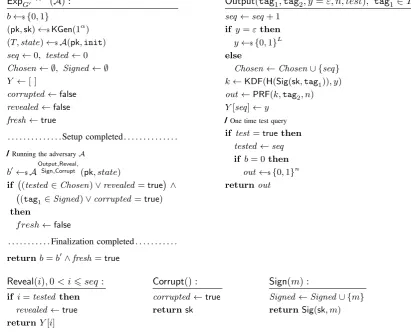
ExpWrapperG0 (A) :
b←${0,1}
(pk,sk)←$KGen(1α) (T,state)←$A(pk,init)
seq←0, tested←0
Chosen← ∅, Signed← ∅
Y ←[ ]
corrupted←false
revealed←false
fresh←true
. . . Setup completed . . . .
//Running the adversaryA
b0←$A
Output,Reveal,
Sign,Corrupt (pk, state)
if (tested∈Chosen)∨revealed=true∧
(tag1∈Signed)∨corrupted =true) then
f resh←false
. . . Finalization completed . . . .
returnb=b0∧fresh =true
Output(tag1,tag2, y=ε, n, test), tag1∈T :
seq←seq+ 1 if y=εthen y←${0,1}L else
Chosen←Chosen∪ {seq}
k←KDF(H(Sig(sk,tag1)), y)
out←PRF(k,tag2, n) Y[seq]←y
//One time test query if test =truethen
tested←seq
if b= 0 then
out←${0,1}n returnout
Reveal(i),0< i6seq:
if i=tested then
revealed←true returnY[i]
Corrupt() :
corrupted←true returnsk
Sign(m) :
Signed←Signed∪ {m}
returnSig(sk, m)
Fig. 2: Security experiment for adversaryA against security of wrapperG0.
Motivation for the security model
In this section we provide the arguments why the proposed security model correctly captures our desired properties, as stated informally in Section I on page 2.
Consider the second informal security property as stated in the contributions, considering the adversaries which are able to break or even to control the CSPRNG output. The proposed model captures these capabilities by allowing the adversary to make queries of two types: in the first case the CSPRNG output is chosen by the adversary and in the second one it is chosen by the challenger uniformly at random. Also the adversary is allowed to reveal the CSPRNG output used for the second type queries.
The security model and the security proof depend on the concept of “freshness”, which intuitively encodes the adversary not winning the game trivially by making the obvious revealorsign/corruptqueries (see definition offreshqueries). Thus, the security proof obtained in this model can be interpreted as follows. If the adversary learns only one of the signature or the usual randomness generated on one particular instance, then under the security assumptions on our primitives, the wrapper construction should output randomness that is indistinguishable from a random string. Together, these two cases cover the first and second informal properties. The third property, regarding the confidentiality of the private key, follows directly from the guarantees of the signature scheme.
Our security model also explicitly assumes thatSig(sk,tag1)never appears externally elsewhere in the protocol so that the
adversary has no hope of seeing it and using it. If this dedicated signature becomes public, security degrades to the normal case of generating pseudorandom numbers. Of course, in practice actually forcingSig(sk,tag1)to appear may still be difficult
or impossible for an adversary. Note also that these signatures are agent-specific, which improves containment. Thus, leaking Sig(sk,tag1)only for a specific agent, using a unique fixed stringtag1, only affects this agent, and has no consequences for
other agents using the same key sk. The fact that in realitytag2 changes also helps to prevent the use of repeated random numbers when there is a poor entropy source.
The tags are assumed to be known and even to be chosen by the adversary in our security model. In practice they may not be, which only adds an extra layer of protection in practice. The only restrictions on the choice is that the tags values along with the CSPRNG output should be unique in total for the test query.
Note that the model also restricts the size of the setT containing the possible values of tag1 for the security proof. In
parameter, and that the set oftag1, intended to be used during the long-term key life, should be fixed at the system initialization
stage. Obviously, both can be easily achieved in reality.
V. PROOF OF SECURITY
Theorem 5.1:Let PRFbe a Variable-length output pseudorandom function, and letKDFbe a key derivation function that is KDF secure and uniformness preserving. Let Sig be a deterministic signature and H a hash function that together are Sig,H-secure. Then, any probabilistic polynomial time adversary has only negligible advantage in winning the security game described in Section IV.
Proof 5.2:We prove the theorem a game hopping proof: Starting from the base challenge game, we apply small variations that yield negligible advantage (based on our primitive security assumptions) and ultimately bound to a probability negligible in the security parameter.
Let Game 0 denote the original security game as defined in our security model definition. LetSj denote the event of the adversary winning Game j. Our goal in this proof is to bound Pr(S0) to show that it is only at most negligibly above 12.
Although the security argument is very intuitive (“the adversary must surely need bothy and skto guess the secret”) we will formally prove it in a game hopping proof.
At some point in time, the adversary must issue atestquery. Lettagi1,tagi2, yi denote the values used by the challenger for this query. We prove this theorem in a case partition on whether the adversary has revealed Sig(sk,tagi1) oryi (if the adversary has queried for neither, then it is clearly in an even worse position to win the game).
We now proceed with our case partition.
Case 1: The adversary has revealed yi or has chosen yi by itself.: In this case, the adversary is not allowed to query forsk or for the signature oftagi1, otherwise the test output query would not be fresh.
Game 1.Let Game 1 be identical to Game 0 except the challenger guesses in advance an integerj∈[1, . . . , l]and aborts (and the adversary loses) unlesstagi1=tj. This is a large failure event game hop and it is easy to see that
Pr(S0)≤lPr(S1)
Game 2.Define Game 2 to be identical to Game 1 except H(Sig(sk,tagi1))is replaced with a valuexi sampled uniformly at random for eachoutputquery withtag1=tagi1. Here we claim that
Pr(S1)≤Pr(S2) +H,Sig
In particular, no probabilistic polynomial time distinguisher algorithm can distinguish between Game 1 and Game 2, since this would imply a way to beat the hash-signature game with better than H,Sig advantage. Precisely, an adversary in the hash-signature game could beat it with better thanH,Sig advantage as follows.
It acts as a challenger in the hybrid game and inserts the value ofpkfrom the hash-signature game. As an adversary in the hash-signature game, it inserts the knowntag1 value from the previous game and asks a test query straight away, receiving
eitherH(Sig(sk,tagi1))or a uniformly randomly chosen valuexi as per the rules of the hash-signature game. It inserts this value as the value forH(Sig(sk,tagi1))in the hybrid game. Based on Game 1, the adversary knows where to make this swap in the game. Theoutputqueries withtag16=tj are processed by the adversary using queries for signatures to its challenger. The adversary can now simulateoutputand test queries as normal using this value. The adversary does not have to worry about simulating acorruptquery because we are in case 1. Finally, it can simulate signature queries by merely forwarding them along to the hash-signature game. This perfectly simulates the hybrid game: it is identical to Game 1 if the test returns H(Sig(sk,tagi1)), and it is identical to Game 2 if it returns a uniformly randomly chosen valuexi. The adversary follows the coin flip choice in the simulated hybrid game as its guess for the hash-signature game. By assumption of the hardness of the hash-signature game, the adversary can only win with at most advantageH,Sig. Therefore, the difference in advantages of adversaries across Game 1 and Game 2 can also only be separated by at mostH,Sig. This completes the proof of the above claim.
Game 3. Define Game 3 to be identical to Game 2 exceptKDF(xi,·) is replaced with an ideal random function ρ(·)for outputquery withtag1=tj. We claim that
Pr(S2)≤Pr(S3) +KDF.
Here we present the simulation argument for the KDF game. Because of Game 1, the adversary knows where to make this swap in the game precisely foroutputqueries withtag1=tj. The KDF adversary makes queriesy to computeKDF(xi, y) for required y for the keyxi chosen by the challenger uniformly at random. If the adversary has made the(tag1,tag2, n)
at most advantageKDF. Therefore, the difference in advantages of adversaries across Game 2 and Game 3 can also only be separated by at mostKDF. Thus the claim above is proven.
Game 4.Define Game 4 to be identical to Game 3 except the response to the testoutputquery is replaced with a value chosen uniformly randomly.
Here we claim that
Pr(S3)≤Pr(S4) +mu-PRF.
Here we present the simulation argument for the multi-user PRF game with at most q keys where q is the number of outputqueries. Because of Game 1, the PRF adversary knows whatoutputqueries should be processed with the usage of its challenger. Theoutputqueries withtag1=tj and differenty are processed with the different keys by asking the mu-PRF challenger with the suitable indexes in queries. Since the test query should be non-trivial,yi ortagi2 should be new
(we neglect the probability that for the outputquery of the type(tag1,tag2, n)theyi value chosen by the challenger itself collides with the previous values). Therefore, the mu-PRF adversary can use its test query to swap thePRF(ρ(yi),tagi2, n)
with the value obtained as a response on the test query in the mu-PRF game. All other queries are simulated in the normal way. This perfectly simulates the hybrid game. Therefore, the difference in advantages of adversaries across Game 2 and Game 3 can also only be separated by at mostPRF. Thus the claim above is proven.
It is clearly impossible for the adversary to have any advantage in guessing the secret bit in Game 4 (in either case, the wrapper generates a uniformly randomly chosen string). As such,Pr(S4) =12. Thus in this casePr(S0)≤ 12+l((H,Sig)+KDF+mu-PRF) which is negligibly close to 12.
Case 2: The adversary has revealedskorSig(sk,tagi1).: In this case, the adversary is not allowed to revealyi or to choose
yi by itself, otherwise the test output query would not be fresh. Thus, yi ∈ {0,1}L is chosen uniformly randomly by the challenger and is used only for the testoutputquery.
Game 1.This game is identical to Game 0 exceptKDF(H(Sig(sk,tagi1)), yi)for testoutputquery is replaced with a value
ksampled uniformly at random. We claim that
Pr(S0)≤Pr(S1) +UP
In the simulation the UP adversary forKDFchooses private keyskby itself and simulates all queries except for the test outputquery in the normal way. To simulate the testoutputquery(tagi1,tagi2, n)the UP adversary makes a query with H(Sig(sk,tagi1))to its UP challenger. The challenger choosesyi←${0,1}L and returns a valuekb. Then the UP adversary computes and returns the value PRF(kb,tagi2, n). This perfectly simulates the hybrid game. Therefore, the difference in
advantages of adversaries across Game 0 and Game 1 can also only be separated by at mostUP. Thus the claim above is
proven.
Game 2.Define Game 2 to be identical to Game 1 except the response to the testoutputquery is replaced with a value chosen uniformly randomly.
Here we claim that
Pr(S1)≤Pr(S2) +mu-PRF
The simulation is the same as for Game 4 from the other case but here is enough to make one test query for one key in the multi-user PRF game since the keykis used once for the test outputquery only.
It is clearly impossible for the adversary to have any advantage in guessing the secret bit in Game 2 (in either case, the wrapper generates a uniformly randomly chosen string). As such, Pr(S2) =12. Thus in this casePr(S0)≤12+UP+mu-PRF which is negligibly close to 12.
VI. PERFORMANCE
To evaluate the performance of our wrapper construction, we implemented the randomness wrapper in C using the BoringSSL library. We implemented the Extract and Expand routines using HKDF-Extract and HKDF-Expand, as described in [14].
The computational cost of our construction comes in two parts: the first is the one-off cost of computing the hashed signature, which is the same for all invocations, and therefore can be cached. This amounts roughly to producing one signature at initialisation/startup time. For any concrete implementation this is negligible compared to other initialisation/startup operations.
A. Isolated wrapper overhead
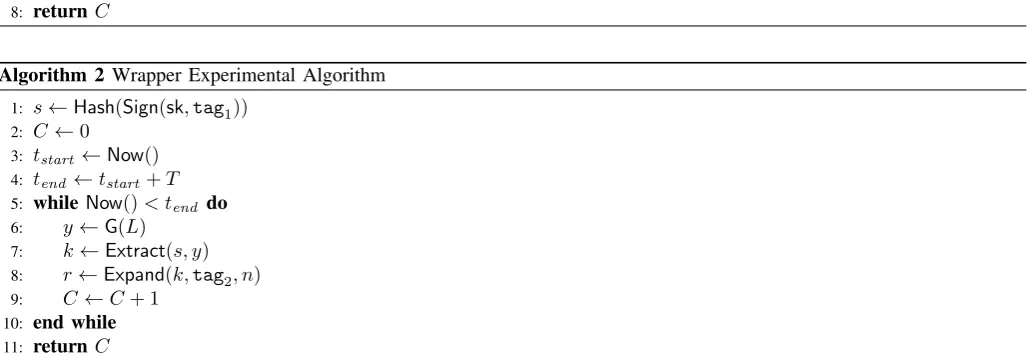
With our implementation, we then ran the following baseline and wrapper experimental algorithms detailed in Algorithm 1 and 2, respectively, with configuration inputs sk, tag1, and tag2 of 64 bits, and requested output size of n = 256 bits corresponding to32bytes, loop timerT = 1E + 09(in nanoseconds, corresponding to1.0s), and KDF output size of L= 256
bits. The wrapper experimental algorithm computes the signatureonce and reuses it for all subsequent extractions. Nowis a function that returns the current time in nanoseconds.
Algorithm 1 Baseline Experimental Algorithm 1: C←0
2: tstart ←Now()
3: tend ←tstart+T 4: while Now()< tend do
5: r←G(n)
6: C←C+ 1
7: end while
8: return C
Algorithm 2 Wrapper Experimental Algorithm
1: s←Hash(Sign(sk,tag1))
2: C←0
3: tstart ←Now() 4: tend ←tstart+T 5: while Now()< tend do 6: y←G(L)
7: k←Extract(s, y)
8: r←Expand(k,tag2, n)
9: C←C+ 1
10: end while
11: return C
When run on a Macbook Pro laptop with a 3.3 GHz Intel Core i7 CPU and 16GB of RAM, we obtain the numbers in Table I. Thus, the wrapper is about four times slower than directly accessing the raw randomness. This is more caused by
Algorithm Loop iterations Throughput
1 Baseline 1053668 16.9 MB/s 2 Wrapper 271000 4.3 MB/s
TABLE I: Throughput based on looping for 1.0s.
the extreme efficiency of the raw randomness code than by the speed of Extract/Expand. However, as we show below, this is domainated by other factors in real-world protocols (or, in fact, any other cryptographic operation in general).
B. Wrapper overhead in the context of TLS 1.3
To evaluate the cost of the wrapper in a real-world context, we considered four scenarios: using TLS 1.3 server and client without wrappers, both with wrappers, and the scenarios where only one end uses the wrapper. Using the wrapper implementation in the context of the BoringSSL library, we started a local server and client and ran 10000 connections for each scenario. We averaged the times afterwards. This yields the results in Table II.
Config Client Server Average Percent time (ms) difference
Baseline raw raw 0.01459430 0.00 One-sided wrapper raw 0.01470534 0.76 One-sided raw wrapper 0.01473091 0.94 Full wrapper wrapper 0.01476728 1.19
TABLE II: Wrapper overhead in TLS 1.3: no wrapper, one-sided wrappers, and wrappers on both sides.
VII. CONCLUSION
In this work we provided a new wrapper construction for random number generators that strictly reduces the security impact of untrusted randomness, which is a feature that is unfortunately still lacking in many modern security protocols. Our construction provides a practical solution for this issue. It depends on the specific use of a long-term signature key, which makes it compatible with existing HSM deployments, and allows for the re-use of existing signature keys without breaking cryptographic separation. Furthermore, because our construction does not change the observable behaviour of any code that uses it, it can be deployed incrementally.
In the context of a protocol like TLS 1.3, this means our construction can be deployed on only some servers or some clients without disrupting operation, and without generating new keys, while immediately providing stronger security guarantees. This makes the construction especially useful for, e.g., servers with HSMs that get deployed in untrusted environments, such as for content delivery networks (CDNs). However, the security provided by our construction has many more obvious benefits, and would have effectively prevented the exploitation of weaknesses such as the Dual EC backdoor and the Debian random number generator vulnerability. In the former case of the Dual EC backdoor, it would have prevented reconstructing the internal state from the observable randomness; and even if it were reconstructed, an attacker would still need the signature of the targeted party. For the latter case of the Debian RNG, the pool of generated numbers was small and shared by all devices. With our wrapper, even though the space of the generated raw random numbers would be too small, the signature would have caused each device to have its own unique pool, meaning that attacks would have become device specific; and the dynamic second tag would increase the output space, thereby increasing the pool size beyond that of the flawed RNG.
We formally defined the security property provided by our construction in terms of a game between a challenger and an adversary and provided a security proof. Our analysis shows that the construction fulfills the claimed security requirements: if the adversary learns only one of the signature or the usual randomness generated on one particular instance, then under the security assumptions on the used primitives, the wrapper construction should output randomness that is indistinguishable from a random string.
Our proof-of-concept implementation shows that the wrapper is feasible and that the computational overhead is negligible with respect to the other operations of a real-world security protocol such as TLS 1.3. Thus, we showed that our construction improves the generation of pseudorandom numbers and provides concrete security guarantees for a generic class of protocols at negligible cost to efficiency.
Acknowledgments The authors would like to thank Christopher Wood for providing implementation experiments.
REFERENCES
[1] RDRAND on AMD CPUs does not work, 2019. https://github.com/systemd/systemd/issues/11810 (Accessed Oct 9th, 2019). [2] Paolo Abeni, Luciano Bello, and Maximiliano Bertacchini. Exploiting DSA-1571: How to break PFS in SSL with EDH, July 2008.
[3] Erdem Alkim, Roberto Avanzi, Joppe W. Bos, L´eo Ducas, Antonio de la Piedra, Peter Schwabe, Douglas Stebila, Martin R. Albrecht, Emmanuela Orsini, Valery Osheter, Kenneth G. Paterson, Guy Peer, and Nigel P. Smart. NewHope. https://newhopecrypto.org/, March 2019. Submission to the NIST Post-Quantum Cryptography standardization project, Round 2.
[4] Mihir Bellare, Ran Canetti, and Hugo Krawczyk. Keyed hash functions and message authentication. InProceedings of Crypto’96, pages 1–15. Springer, 1996.
[5] Daniel J Bernstein, Tanja Lange, and Ruben Niederhagen. Dual EC: A Standardized Back Door. Technical report, Cryptology ePrint Archive, Report 2015/767, 2015.
[6] Stephen Checkoway, Jacob Maskiewicz, Christina Garman, Joshua Fried, Shaanan Cohney, Matthew Green, Nadia Heninger, Ralf-Philipp Weinmann, Eric Rescorla, and Hovav Shacham. A systematic analysis of the juniper dual ec incident. InProceedings of the 2016 ACM SIGSAC Conference on Computer and Communications Security, CCS ’16, pages 468–479, New York, NY, USA, 2016. ACM.
[7] Stephen Checkoway, Ruben Niederhagen, Adam Everspaugh, Matthew Green, Tanja Lange, Thomas Ristenpart, Daniel J. Bernstein, Jake Maskiewicz, Hovav Shacham, and Matthew Fredrikson. On the practical exploitability of dual EC in TLS implementations. In23rd USENIX Security Symposium (USENIX Security 14), pages 319–335, San Diego, CA, August 2014. USENIX Association.
[8] Shaanan Cohney, Andrew Kwong, Shachar Paz, Daniel Genkin, Nadia Heninger, Eyal Ronen, and Yuval Yarom. Pseudorandom black swans: Cache attacks on CTR DRBG. Cryptology ePrint Archive, Report 2019/996, 2019. https://eprint.iacr.org/2019/996.
[9] C. Cremers, L. Garratt, S. Smyshlyaev, N. Sullivan, and C. Wood. Randomness Improvements for Security Protocols – Revision 7, 2018. https: //www.ietf.org/id/draft-irtf-cfrg-randomness-improvements-07.txt.
[10] Mich`ele Feltz and Cas Cremers. Strengthening the security of authenticated key exchange against bad randomness. Designs, Codes and Cryptography, pages 1–36, 2017.
[11] D. Harkins and D. Carrel. The Internet Key Exchange (IKE). RFC 2409, https://www.ietf.org/rfc/rfc2409.txt.
[12] C. Kaufman, P. Hoffman, Y. Nir, and P. Eronen. Internet Key Exchange Protocol Version 2 (IKEv2). RFC 5996, https://www.ietf.org/rfc/rfc5996.txt. [13] S. Kent and K. Seo. Security Architecture for the Internet Protocol. RFC 4301, https://tools.ietf.org/html/rfc4301.
[14] H. Krawczyk and P. Eronen. HMAC-based Extract-and-Expand Key Derivation Function (HKDF), 2010. https://tools.ietf.org/html/rfc5869.
[15] Hugo Krawczyk. HMQV: A High-Performance Secure Diffie-Hellman Protocol. Cryptology ePrint Archive, Report 2005/176, 2005. https://eprint.iacr.org/ 2005/176.
[16] Hugo Krawczyk. Cryptographic Extraction and Key Derivation: The HKDF Scheme. Cryptology ePrint Archive, Report 2010/264, 2010. https: //eprint.iacr.org/2010/264.
[17] Hugo Krawczyk. Cryptographic extraction and key derivation: The HKDF scheme. InAnnual Cryptology Conference, pages 631–648. Springer, 2010. [18] Brian LaMacchia, Kristin Lauter, and Anton Mityagin. Stronger security of authenticated key exchange. InProvable Security, pages 1–16. Springer, 2007. [19] Thomas Lendacky. x86/CPU/AMD: Clear RDRAND CPUID bit on AMD family 15h/16h, 2019. https://lore.kernel.org/patchwork/patch/1115413/
(Accessed Oct 9th, 2019).
[21] Rob Marvin. Google admits an android crypto PRNG flaw led to Bitcoin heist (August 2013).
[22] Tsutomu Matsumoto, Youichi Takashima, and Hideki Imai. On seeking smart public-key-distribution systems. E69(2). [23] Eric Rescorla. The Transport Layer Security (TLS) Protocol Version 1.3. RFC 8446, https://tools.ietf.org/html/rfc8446.
[24] Scott Yilek, Eric Rescorla, Hovav Shacham, Brandon Enright, and Stefan Savage. When private keys are public: results from the 2008 Debian OpenSSL vulnerability. InProceedings of the 9th ACM SIGCOMM conference on Internet measurement conference, pages 15–27. ACM, 2009.
APPENDIX
A. Changes
• v1.2, October 2019. Nearly complete rewrite: integrated presentation of newest version of the mechanism, fully revised and significantly expanded analysis, and added experimental results. To reflect the new content the title was changed as well. • v1.1, March 2019. Clarifications and minor improvements corrsponding to small mechanism changes.