1-1-1998
An evaluation and prospectus of the Value-Added
Agricultural Products and Processes Financial
Assistance Program of the State of Iowa
Nadezhda K. Novotorova
Iowa State University
Follow this and additional works at:https://lib.dr.iastate.edu/rtd
This Thesis is brought to you for free and open access by the Iowa State University Capstones, Theses and Dissertations at Iowa State University Digital Repository. It has been accepted for inclusion in Retrospective Theses and Dissertations by an authorized administrator of Iowa State University Digital Repository. For more information, please [email protected].
Recommended Citation
Novotorova, Nadezhda K., "An evaluation and prospectus of the Value-Added Agricultural Products and Processes Financial Assistance Program of the State of Iowa" (1998).Retrospective Theses and Dissertations. 17826.
Financial Assistance Program of the State of Iowa
by
N adezhda K. N ovotorova
A thesis submitted to the graduate faculty
in partial fulfillment of the requirements for the degree of
MASTER OF SCIENCE
Major: Business Administrative Sciences Major Professor: Max S. Wortman, Jr.
Iowa State University
Ames, Iowa
Graduate College Iowa State University
This is to certify that the Master's thesis of Nadezhda K. Novotorova
has met the requirements of Iowa State University
TABLE OF CONTENTS
CHAPTER 1. INTRODUCTION 1
Purpose of the Study 2
Significance of the Study 3
Overview of the Thesis 4
CHAPTER 2. LITERATURE REVIEW 6
Areas of Potential Growth in Value-Added Agriculture 6
Value-Added Agricultural Exports 11
Capital for Innovation: a Major Barrier 16
Summary 17
CHAPTER 3. DESCRIPTION OF THE VALUE-ADDED AGRICULTURAL
PRODUCTS AND PROCESSES FINANCIAL ASSISTANCE (V AAPF AP) 21
Introduction 21
Program Components 22
General Eligibility 23
Awards 23
Application Procedures 24
CHAPTER4. METHODOLOGY 26
Definitions 26
Research Questions 27
Sources of Data 27
Analysis 30
Delimitations of the Study 3 1
Summary 31
CHAPTER 5. RESEARCH FINDINGS 33
Data and Results 33
Overview of the Value Added Agricultural Products and Processes Financial
Assistance Program (V AAPFAP) 35
Examination of the Research Questions 48
Summary 68
CHAPTER 6. CONCLUSIONS AND SUMMARY 72
Conclusions 72
Limitations 75
Summary 75
APPENDIX B. SURVEY QUESTIONNARIE
APPENDIX C. ALETTER TO SURVEY PARTICIPANTS APPENDIX D. EVALUATION FORM
REFERENCES
ACKNOWLEDGMENTS
CHAPTER! INTRODUCTION
In today's global economy, value-added and innovative products play an important role in the success of many U.S. agribusinesses. Value-added agriculture offers good economic growth potential by reducing dependence on foreign imports, providing an alternative use for farm products, improving the environment, creating jobs and strengthening rural economic development.
However, entrepreneurial firms with an ambition for innovation may encounter many barriers before succeeding in this mission. Access to external finance (e.g. loans, grants, venture capital) for agribusinesses that are introducing new value-added or innovative
agricultural products or services appears to be a major bottleneck. The higher the technological and commercial risks involved in the investment, the more difficult it is to find venture capital 1.
This is particularly true for small and newly emerging firms. In a Dutch survey among innovative firms, the firms were asked to name the most important obstacle throughout the phases of an innovation project. Of the small innovators, 3 8 percent pointed out that financing was the main obstacle, another 3 8 percent said market possibilities were the main problem and 25 percent judged that technological issues were the main barrier to success of the project. For the medium and large sized technology driven companies, financing was mentioned as the main barrier in 9 and 12 percent of the companies respectively2.
a large share of the internal capital relative to that which is needed before the first returns on investments are generated. Therefore, public funding could be an important source of financing in these first high-risk phases.
The State oflowa recognizes that financial assistance is needed for the agribusinesses which want to introduce value-added or innovative products or services. Therefore, the Value-Added Agricultural Products and Processes Financial Assistance Program (V AAPF AP) was introduced by the Iowa Department of Economic Development in October, 1994. The purpose of V AAPF AP was to encourage the increased utilization of agricultural commodities produced
in Iowa. The program assists efforts to revitalize rural regions of the state by providing financial assistance to new or existing value-added production facilities (e.g. renewable fuels facilities).
Among the fifty states, Iowa ranks first in production of corn, soybeans, red meat production, hogs, pig crop and hog marketed. This ranking gives evidence of the national importance of the state as an agricultural region. As the governor oflowa, Terry E. Branstad noted, " ... value-added agriculture transforms crops and livestock into products worth more to the world marketplace, resulting in increased job opportunities and income for Iowans. Iowa State University estimates that value-added agriculture, including livestock production, has the potential to increase rural incomes by 50 percent in just a few years"3.
Purpose of the Study
agriculture on the U.S. economy and specifically the increase of U.S. exports, and only a few
studies have addressed the area of financial support for innovative projects in agribusiness.
This study is the first attempting to examine the effectiveness of the Value-Added
Agricultural Products and Processes Financial Assistance Program (V AAPF AP) in Iowa. Data
from the Iowa Department of Economic Development were examined to identify how program
funds have been allocated among different types of agribusinesses. A survey was designed to
collect and analyze data from the agribusinesses, which have participated in this program.
Limitations in analyzing program data also will be addressed.
This study is designed to:
1. Provide an overview of V AAPF AP from 1994 through 1997.
2. Evaluate the effectiveness ofV AAPFAP.
3. Determine the possibilities of V AAPF AP for use as a model in other states.
4. Provide a prospectus of V AAPF AP opportunities for the future.
Significance of the Study
The study is intended to serve three basic goals. First, it is intended to provide
knowledge about the existing financial support on the state level for agribusinesses interested
in developing and introducing value-added or innovative products or services. There is no
similar program to the Value-Added Agricultural Products and Processes Financial Assistance
Program (V AAPF AP) at the state level. By having the results of the effectiveness of this
program available to public, it could help to promote public awareness of value-added
Second, the results of the study could be used by other states to introduce similar programs to V AAPF AP to assist agribusinesses in adding value to their agricultural commodities.
Third, the study is also intended to add knowledge in the field of agribusiness. There is no doubt that financial assistance and research in the area of value-added agriculture is needed to enhance the competitive value of U.S. agricultural products. Specifically, there is an
opportunity to obtain greater economic value from agricultural materials through conversion to high-value products for both domestic and export markets, with the benefits of increased income, job creation, and rural development. This opportunity can be realized through the development of new products (from conventional and new plant and animal sources), making existing products more valuable, increasing process efficiencies, making greater use of co-products and waste materials.
Overview of Thesis
Chapter 2 of this thesis includes a literature search on value-added agriculture. This chapter begins with a discussion of its importance. Two general areas of potential growth in
In reviewing the methodology, Chapter 4 incfodes definition of terms, sources of data,
and method of analysis. A discussion of the thesis research questions is also included in this
Chapter. Concluding the chapter are potential delimitations.
Chapter 5 presents the results of the study based on the data from the Iowa Department
of Economic Development and the survey responses. The data are analyzed, grouped and
compared through the use of tables and graphs in the research areas of size of enterprises,
creation of new business compared to the expansion of existing business, usefulness of
V AAPF AP, importance of V AAPF AP funds to the project, percentage of funds compared to
total invested funds in the project, and employment created by the project. Additionally, five
research questions are analyzed to provide conclusions to the effectiveness and efficiency of
VAAPFAP.
The implications and significance for practitioners, academics and the field of
agribusiness are discussed in Chapter 6. Limitations of the study are shown and addressed.
Recommendations for future research concludes this chapter.
Notes
1. Patricia Boekhoit, "Financing Innovation in the Post-Subsidy Era -Public Support Mechanisms to Mobilize Finance for Innovation," International Journal of Technology Management, 12 (July/August 1996): 762.
2. Boekhoit, 762.
CHAPTER2
LITERATURE REVIEW
Agriculture 's role in manufacture and commerce is manifest in many ways ... the food we eat, the building materials we use, the clothes we wear. That roles strengthened whenever agricultural plant and animal commodities and products reach the shelves of our domestic markets and find their way into the shopping baskets of people of other nations. We must always be seeking to discover, develop, and promote products and technologies which have their origin in a plant or animal material. The bottom line is jobs for our people, markets and value for our endeavors, and health for our economy and Nation ( Mike Espy, Secretary of Agriculture
)1.
Areas of Potential Growth in Value-Added Agriculture
The importance of value-added agriculture grows every day. Science and technology are having a profound affect on agriculture. Production agriculture is being affected by new discoveries in genetics resulting in more productive crops that are resistant to many of the
threats to high yields. Animal agriculture is being affected by new discoveries in the production of pork and beef New food products are being produced from raw agricultural products, and new non-food uses of agriculture are being invented.
A number of studies has focused on a future potential of value-added agricultural products and bio-based materials. There is little doubt that once a raw commodity is processed, the final product is more valuable than the original product. Agribusinesses would maximize profitability if commodities received further processing, packaging or marketing.
foster U.S. competitiveness"2. According to Whitney MacMillan, the chairman and chief
executive of Cargill Inc., a leading trader of U.S. grain, "the outlook for U.S. agriculture is for
greater value-added processing and increased exports of higher-value products"3. High-value
products also have more stable prices than bulk products, are easier to differentiate through
advertising, and offer a greater rate of return than bulk agricultural commodities priced at 3 to
5 cents/lb.4 There are two general areas of potential growth in value-added agriculture: (1)
high value-added food products, and (2) innovative non-food products.
High Value-Added Food Products
The first is innovative specialty or high value-added food products that offer greater
quality, better nutrition or increased convenience. Microwave-packaged rather than ordinary
popcorn, breaded chicken breasts instead of whole chickens, vegetables mixed with a sauce
and sealed in a microwaveable or boilable plastic pouch rather than simply frozen are all
examples of innovations in this area5.
Farmers are becoming more involved in processing and marketing the products they
grow. Studies have shown that food processors and marketers received an average 14 percent
return on equity, while farmers receive an average 2 percent return. Therefore, as Freund
noted, "today's farmers are flexing their financial muscles and using marketing savvy to gain
more of the food dollar through value-added agriculture"6•
Alternative crops, organic or environmentally oriented production, niche markets and
commodity processing cooperatives could benefit farmers. For example, instead of selling
turkey to the marketplace, a group of Iowa's farmers has formed a cooperative and bought the
" ... turkey processing in Iowa accounts for more than 5,000 jobs and generates $83 million in income, which has an economic multiplier effect estimated at about $580 million"7.
Growing organic crops and marketing them through cooperatives is another example of the possibility of making more money for farmers through value-added processing. Freund indicated that "the additional step adds a greater return, enabling the farmers to generate more economic flow back into the community. Farmers need not change occupation or acquire a second job to make more money, but instead can involve themselves in value-added
agriculture"8.
Transforming agricultural commodities into food and other products is an important activity for economic development, increasing employment as well as for increasing prices
received by farmers and ranchers. Industrial Non-food Products
The second area of potential growth in value-added agriculture is industrial non-food products derived from oilseeds or other grains. According to The Cargill Bulletin, in the last few years, policymakers, farmers, agricultural businesses and researchers have banded together to advance the new non-food uses of agricultural products9. There are new products from traditional crops such as ethanol made from com, plastic polymers made from starch, high-strength composites from wood fibers, printing inks and varnishes from soybean oil. There are new products from new crops such as lubricants from crambe and rapeseed, natural rubber
from guaule, cosmetics and industrial greases from lesquerella, paper from kenaf
As
has been proven by numbers of studies, the ethanol industry has made a significantand the related issue of what is considered a risky level of reliance on imports of nonrenewable petroleum made ethanol a major public issue. The private sector has joined forces with
government in pumping millions of dollars to fuel ethanol's future.
According to the Des Moines Register, the ethanol industry in 1997 alone used 440 million bushels of corn and is expected to raise farm income by up to $10 .2 billion over the next eight years10.
Findings regarding the economic impact of ethanol on the U.S. economy are summarized by Urbunchuk11. He argued that the goods and services purchased by ethanol producers represent purchases of final demand of other industries. These include purchases of corn and other grain from farmers (agriculture), natural gas, electricity, water and sewer, and telephone (utilities), and accounting and legal services (business services). Each of these supplier industries in turn purchases inputs from other industries. If ethanol producers were no longer in business, these supplier firms would have to find alternative markets for their output. Urbanchuk noted the significance of ethanol for crop producers. He stated that farm income will be $2.2 billion, or nearly 3 percent, higher each year because of ethanol production. If the market for ethanol did not exist, corn stocks probably would rise, prices would fall,
final demand, will indirectly support an average of 48,900 jobs annually throughout all other
industries in the entire economy.
As Sam Brownback, Kansas Secretary of Agriculture, noted: "A number of nonfood
agricultural products are in the commercial marketplace, but this initial stream of products
needs to become a flood"12. He indicated that the vision exists to expand the mission of U.S.
agriculture from food and fiber production to food, fuel, pharmaceuticals, and industrial
feedstocks. Brownback further stated that the desire exists to expand the contributions of U.S.
farmers and agribusinesses to the economy through increased value-added product offerings
while, at the same time helping the environment. In order to accomplish that vision and desire,
he suggested that agriculture must take several steps:
• Have an industry-wide discussion on the advantages and disadvantages of focusing efforts on industrial uses -a discussion which must culminate in a consensus on the topic;
• Focus research resources from agriculture and other relevant fields increasingly into nonfood uses of farm commodities;
• Get close to consumers. We must find out what bio-based products consumers want and what they will pay for them;
• Commercialize research efforts rapidly through "product consortia" consisting of business,
university, and government organizations highly focused on getting a particularly bio-based product on the market;
• Emphasize technology transfer; and,
• Show the public what we can do13.
Lotterman argued that both groups of products-high value-added foods and industrial
non-food products-will have markedly different economic impacts. While innovative
value-added specialty products tend to be relatively labor-intense, industrial non-food products tend
quantities of agricultural products as inputs and may have limited impact on general
agricultural prices or profitability. Facilities that transform oilseeds or feed and food grains into non-food products generally use far larger quantities of agricultural commodities and may significantly increase commodity prices. However, they are extremely capital-intensive14.
Value-Added Agricultural Exports
High value products accounted for more than 80 percent of world agriculture trade from 1987 through 198915. The continued growth of value-added exports provides long-term
security for all players in the agricultural industry, from farmers to food companies and their employees.
During the last 20 years, international trade has become increasingly important to the U.S. agricultural sector. In 1996, U.S. agricultural exports reached a record high of nearly $60 billion, helping boost farm income, generating billions more in additional economic activity and providing jobs for over one million Americans16.
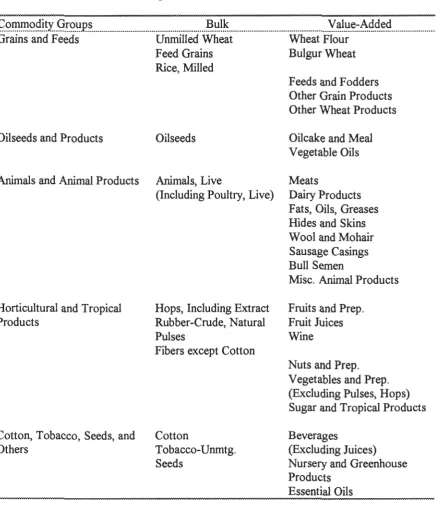
A number of previous works have focused on the importance of exporting processed instead of raw agricultural products. Lee, Henneberry, and Pyles felt that the term "value-added agricultural exports" denoted both processed products, because they have "value-added value through some processing, and unprocessed high-value commodities. Nuts, fresh fruits, and vegetables are categorized as unprocessed high-value commodities. Processed products can include both semi-processed and highly processed products (see Table 2.1 ). This study
Table 2.1 . Classification of Agricultural Commodities in Bulk and Value-Added Form
...
~9.~9.~~~Y.
..
9.!g
.
~P.~
...
..
..
.
...
...
...
.
...
.
..
~.~!~
...
.
...
.
.
..
....
.
.
..
.
..
.
.
..
..
.
...
.Y~~
.
~~
.
~
.
A~~~~···
··
····
··
··
·
···
·
···
Grains and Feeds Unmilled Wheat Wheat Flour
Feed Grains Bulgur Wheat
Oilseeds and Products
Animals and Animal Products
Horticultural and Tropical Products
Cotton, Tobacco, Seeds, and Others
Rice, Milled
Oilseeds
Animals, Live
(Including Poultry, Live)
Hops, Including Extract Rubber-Crude, Natural Pulses
Fibers except Cotton
Cotton
Tobacco-Unmtg. Seeds
Source: Lee, Henneberry, and Pyles, 1991: 142
Feeds and Fodders Other Grain Products Other Wheat Products
Oilcake and Meal Vegetable Oils
Meats
Dairy Products Fats, Oils, Greases Hides and Skins Wool and Mohair Sausage Casings Bull Semen
Misc. Animal Products
Fruits and Prep. Fruit Juices Wine
Nuts and Prep. Vegetables and Prep. (Excluding Pulses, Hops) Sugar and Tropical Products
Beverages
(Excluding Juices) Nursery and Greenhouse Products
Lee, Henneberry, and Pyles argued that the factors causing the sharp drop in exports of
bulk commodities were a substantial production increase in both major exporting and
importing countries, strong value of the U.S. dollar, the impact of global debt, and increased
self-sufficiency in many developing country markets. However, despite these circumstances,
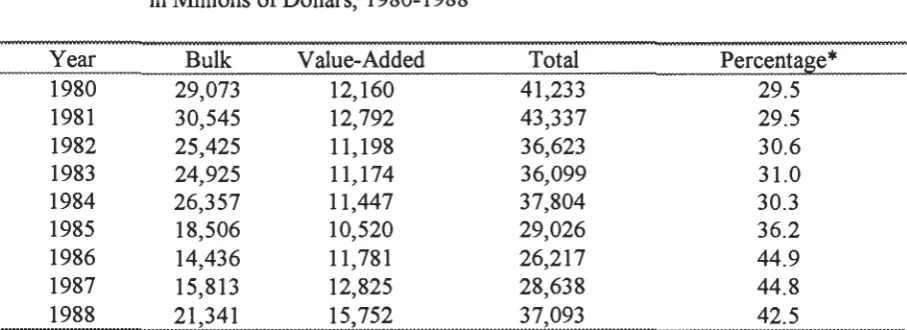
the value-added exports have shown little decline and has been increased to 42.5 percent of
[image:18.580.59.513.295.460.2]total agricultural exports in 1988 from 29.5 percent in 1980 (see Table 2.2)17.
Table 2.2.
Year 1980 1981 1982 1983 1984 1985 1986 1987 1988
U.S. Agricultural Exports by Category of Bulk and Value-Added Commodities
in Millions of Dollars, 1980-1988
Bulk 29,073 30,545 25,425 24,925 26,357 18,506 14,436 15,813 21,341 Value-Added 12,160 12,792 11,198 11,174 11,447 10,520 11,781 12,825 15,752 Total 41,233 43,337 36,623 36,099 37,804 29,026 26,217 28,638 37,093 Percentage* 29.5 29.5 30.6 31.0 30.3 36.2 44.9 44.8 42.5
*Includes semi-processed and processed products (because it has added value through some processing) as well as some unprocessed high value products such as fresh fruits, vegetables, and nuts.
Source: Lee, Henneberry, and Pyles, 1991: 142
As Duram and Lyon stated: "While greater benefits are expected to accrue from
higher-value food exports, there would not be such an interest if manufactured food exports
from the U.S. were not so low relative to other developed nations"18. They found that in both
1975 and 1985 processed food shipments from the U.S. were the lowest amongst the OECD
production was exported during most of the eighties. While this situation has improved, US shipments of consumer-oriented foods held only a 16 percent share of world trade in 1993 compared to a 25 percent share for the European Union19.
The U.S. effort has been limited by a numbers of factors, including significant trade barriers in foreign markets, high U.S. labor costs, and either the size of the U.S. domestic market being large enough to keep U.S. producers satisfied at home or the attraction of off-shore production through licensing agreements and joint-ventures with foreign companies20.
Schluter and Clayton argued that when exporting processed commodities instead of their bulk agricultural components, what is actually exported is the domestic goods plus services of assembly, processing and distribution. These can be accounted for as factors in increased business activity, and the associated increase in employment and personal income21.
The study of Schluter and Edmondson indicates that exporting processed agricultural products rather than raw commodities benefits society much more than just the increased value of the commodities themselves. They estimated that processing wheat worth $1million would generate as much as $9 million in business activity, 109 full-time jobs, $1.9 million in personal income, $160,000 in Federal personal income taxes, and $199,000 in Federal corporate income taxes22. Processing other commodities could yield even greater economic benefits.
During the seven year period 1985-92, U.S. exports of meats, poultry, and dairy products increased by 207 percent or at an average rate of nearly 1 7 percent. Annual growth rates for beef, pork, and poultry were 24, 29, and 20 percent, respectively. The 207 percent growth in meat, poultry, and dairy products compares to a 476 percent growth for all
and dairy product are Asia, Canada, and Mexico, and these markets have also been growing
rapidly. This growth is being driven by increases in consumer income, trade liberalization,
environmental and cost constraints in a number of importing countries, and by reliability of the
United States as a source of high-quality products at competitive prices. According to the
long-term agricultural trade strategy of the USDA, the shift toward greater exports
ofhigh-value foods such as meat instead of feed grain has major beneficial implications for the U.S.
rural economy. First, expanding exports of red meat and poultry expands domestic demand for
feed grain and oilseed meal. Second, the income multiplier effect from high-value exports is
greater than from bulk commodity exports (2.88 versus 1.86). This means that dollar for
dollar, high-value exports generate more jobs than exports of bulk commodities 24•
Findings regarding the economic impact of agricultural exports on the economy of
Louisiana are summarized in the study ofBairak and Hughes25 . They found that increasing the
export of processed products could boost overall activity in Louisiana's economy. Louisiana
agricultural exports directly and indirectly generate 35,241 jobs in the State and $2,197 million
in gross sales.
As Stephen MacDonald noted, "of the 1.06 million U.S. jobs tied to agricultural
exports, more than half (555,000) are associated with high value product exports. About a
third of the jobs generated by U.S. farm exports are nonfarmjobs in food processing,
manufacturing, transportation, and other services"26 .
Durham and Lyon indicated that expanding exports of agricultural products is the goal
influences upon export behavior are examined to assess government policy to expand exports of processed food27.
Halliburton and Henneberry conducted a comparative analysis of non-price export promotion programs for U.S. red meat and wheat using FAS data for the Targeted Export Assistance Program/Market Promotion Program and Commodity Market Development Program ranging from 1986 through 1988. The results of their study revealed that there are differences in market development strategies for bulk versus value-added products (wheat being a bulk commodity and red meat being a value-added commodity). Specifically they found that the majority of wheat promotions were accounted for as a trade servicing and technical assistance activities in lesser developed countries whereas red meat promotions consisted of primarily generic consumer promotions to higher developed countries28.
Capital for Innovation: A Major Barrier
However, access to external financing for innovative projects and new technology based firms, appears to be a major bottleneck for many entrepreneurs. As Boekhoit
alternatively indicated that traditional Research Development (R&D) and the associated public support mechanism seems to be ending in favor of public-private risk-sharing and partnership. Thus, other obstacles to innovation, such as access to risk-capital, become contemporary barriers to innovation other than access to R&D29.
Twenty seven initiatives and public schemes were identified within the European Union in a survey of public mechanisms to mobilize private finance for innovation. Four types of support mechanisms are distinguished by Boekholt:
of mechanism is 'innovation insurance', where the firm and the (public) funders can pay an insurance fee that covers the failure of a particular innovative project. Tax incentives are another possible mechanism.
Mechanisms to increase the liquidity of and rewards for investors: These include measures to facilitate exit-mechanisms and improve the functioning of secondary markets.
Mechanisms to reduce the current costs and/or scale of investment for the investor: Here public bodies give an ex-ante financial support for the investor when investing in a specific type of business. This could be part of the investment sum (co-investment), or tax and interest relief for investment in technology based firms and projects.
Mechanisms to attract new type of investors in innovation financing: This type of support aims to attract investors that have no familiarity with technology based firms. These could be either very traditional institutional investors, or wealthy private persons preferably with managerial expertise30.
Summary
The importance of value-added agriculture grows every day. In the area of food
production raw commodities are transformed into new food products which are frozen, dried,
microwavable, packaged, and offer convenience, quality and nutrition. Non-food products of
fuels, pharmaceuticals and industrial feedstocks create opportunities in increased utilization of
farm commodities. Economic development implications provide employment (production,
product development, marketing) and markets (domestic and export) for farmer-produced
products; both of which results in additional income to the U.S. economy.
One of the major barriers for supporting proliferation of value-added products is access
to capital for research and development, production and marketing. One of the financial
assistance programs designed and implemented to facilitate the implementation of more
value-added products is Value-Added Agricultural Products and Processes Financial Assistance
Program, which will be discussed in the following chapters.
1. Jonathan Harsch, "New Industrial Uses, New Markets for U.S. Crops: Status of Technology and Commercial Adoption," U.S. Department of Agriculture, Cooperative State Research Service, (August 1993):1.
2. Karen Halliburton and Shida R. Henneberry, "A Comparative Analysis of Export
Promotion Programs for US Wheat and Red Meats," Agribusiness, 11 (March 1995): 211.
3. Lee Egerstorm, "Value-Added Exports Called Agriculture's Future," The Journal of Commerce, (May 21, 1993): SA.
4. U.S. General Accounting Office, Agricultural Trade-High Value Products and U.S.
Export Promotion Efforts, GAO/T-GGD-92-64, U.S. Government Printing Office, Washington DC, July 28, 1992.
5. Ed Letterman, "Adding Value to Agriculture: New Life for an Old Industry?," Articles on Value-Added Agriculture, January, 1993. URL: http://thorplus.lib.purdue.edu/ (April 13, 1998).
6. Tamara Freund, "The Value of Value-Added Agriculture," Community Connection News Release, July 8, 1996.
http://www.exnet.iastate.edu/Pages/communities/news/ComCon40.html, (April 13, 1998).
7. Rod Boshart, "State Decides This Week on Loan for Turkey Plant," Cedar Rapids Gazette,
(October 22, 1996): IA.
8. Tamara Freund, "The Value of Value-Added Agriculture," Community Connection News Release , July 8, 1996.
http ://www.exnet.iastate.edu/Pages/ communities/news/ComCon40. html, (April 13, 1998).
9. "New Uses, New Products, New Markets Link Agriculture's Past and Future", The Cargill
Bulletin, Vol. 3, No. 6 (August, 1995): 4.
10. "Ethanol Burned, But How Much", Des Moines Register, (May 12, 1997): 4M.
11. John M. Urbanchuk, "Ethanol: Fueling an Economic Engine. Macroeconomic and Fiscal Impacts of Ethanol Production under the 1996 Farm Bill," April 19,1996.
http://www.ethanolrfa.org/mary.html (April 13, 1998).
12. Harsch, 1.
13. Harsch, 2-3.
URL: http://thorplus.lib.purdue.edu/ (April 13,1998).
15. U.S. Department of Agriculture, Economic Research Service, "High Value Products Boost Farm Exports", Farmline. (July 4, 1992): 4.
16. Review the Effectiveness of Agricultural Export Programs, U.S. Government Printing
Office, Serial No. 105-11, Washington, (April 24, 1997): 119.
17. Jung-Hee Lee, David Henneberry, and David Pyles, "An Analysis of Value-Added Agricultural Exports to Middle-Income Developing Countries: the Case Of Wheat and
Beef Products", Southern Journal of Agricultural Economics, (December 1991):141-142.
18. Catherine A. Durham and Jesse D. Lyon, "Manufacturer Versus Trading Company Export
Behavior: the U.S. Processed Fruit Industries," Agribusiness, 13 (January 1997): 59.
19. Durham and Lyon, 59-70.
20. U.S. Department of Agriculture, Economic Research Service,"High Value Products Boost
Farm Exports", Farmline. (July 1992): 4-7.
21. Gerald Schluter and Kenneth C. Clayton, "Expanding the Processed Product Share of U.S.
Agricultural Exports," Washington DC: U.S. Department of Agriculture, Economic
Research Service, July 1981.
22. Gerald Schluter and William Edmondson, "Exporting Processed Instead of Raw
Agricultural Products," Washington DC: U.S. Department of Agriculture, Economic
Research Service,, November 1989.
23. "Meat, Poultry and Dairy Product Exports: A Silent Revolution: Implications for U.S. Grain and Oilseed Policies," Abel, Daft & Earley, Alexandria, April, 1983.
24. Westphal, Donella, "Northern Great Plains Rural Development Commission. Work Group
on Value-Added Agriculture," http://www.agvalue.state.ia.us (April 13,1998).
25. Bairak R. and Hughes D.; "Evaluating the impact of agricultural exports on the Louisiana economy," Louisiana-Agriculture, 1996, 39:1, 11-13.
26. U.S. Department of Agriculture, Economic Research Service,"High Value Products Boost
Farm Exports", Farmline. (July 1992): 7.
27. Durham and Lyon, 59-71.
29. Patricia Boekhoit, "Financing Innovation in the Post-Subsidy Era - Public Support Mechanisms to Mobilize Finance for Innovation," International Journal of Technology Management , 12 (July/ August 1996): 762
CHAPTER3
DESCRIPTION OF THE VALUE-ADDED AGRICULTURAL PRODUCTS
AND PROCESSES FINANCIAL ASSISTANCE PROGRAM (V AAPFAP)
''Iowa is uniquely positioned to reap significant benefits from the global food market for several reasons. We have abundant natural resources
to produce grain and livestock- the two fundamentals required to produce food for the world's tables. We have the infrastructure that can transport, process and market those products. Iowa's productive capacity is unmatched
in both agriculture and manufacturing. And, value-added agricultural products offer the best return on investment of any economic sector in the
state."
(David Lyons, Director of the Iowa Department of
Economic Development)
1 •Introduction
The State oflowa has recognized the significant economic opportunities of value-added agriculture and importance of the public financial support for agribusiness companies in the area of value-added and new innovative products. To encourage increased utilization of agricultural commodities produced in the state, and to assist in efforts to revitalize rural regions of the state by committing resources to provide financial assistance to new or existing value-added production facilities, the 75th General Assembly passed HF 2337 in April, 1994. This Act allocated state funds to create the Value-Added Agricultural Products and Processes Financial Assistance Program (V AAPF AP).
Program Components
There are three components to V AAPFAP:
• The Agricultural Products and Processed Component, which relates to operations
involved in the development of new and innovative products or processes related to
agriculture. An application based on this component shall be considered if either of the
following apply:
1. The business will produce a product derived from an agricultural commodity, if
the product is not commonly produced in Iowa from an agricultural commodity;
or
2. The business will utilize a process to produce a product derived from an
agricultural commodity, if the process is not commonly used in Iowa to produce the
product;
• The Renewable Fuel Component, which relates to renewable fuel production facilities with
a priority given to those renewable fuel facilities producing a co-product which directly
supports livestock production operations.
• The Project Creation Component, which was launched in Fiscal 1997. The purpose of this
program component is to help develop new business consortiums by bringing together
research and ideas. This component is for projects that eventually could be eligible for
General Eligibility
A person is eligible to apply for assistance under this program if the following requirements are met:
1. The existing or proposed facility is located in this state.
2. The person applies to the Iowa Department of Economic Development (IDED) in a manner and according to procedures required by the Department.
3. The person submits a business plan which demonstrates managerial and technical expertise.
Awards
Financial assistance awarded under this program may be in the form of a loan,
forgivable loan, deferred loan, grant, or a combination thereof The department will not award more than 25 percent ofV AAPFAP yearly state allocation to support a single project. The department may help finance any size of facility. However, the department will reserve up to 50 percent of the total amount allocated for projects of $100,000 or less .. The 50 percent restriction will apply until the end of the third quarter of the state fiscal year, after which time no percentage allocation will apply to large versus small awards.
Funds available for project awards will be allocated on the basis of 40 percent (Component 1), 40 percent (Component 2), 20 percent (Component 3).
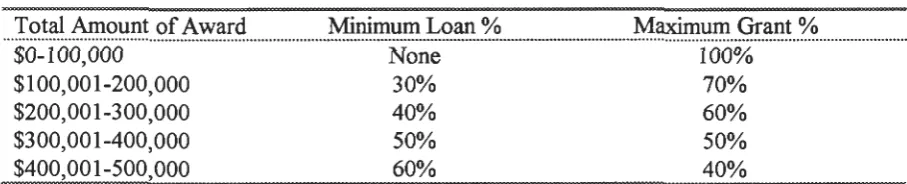
Grants, forgivable loans, and loans shall generally be awarded on the basis of Table 3 .1. For awards of $500,001 - 900,00 the maximum grant or forgivable loan portion
Table 3.1. Allocation of the V AAPFAP Awards
Total Amount of Award Minimum Loan % Maximum Grant %
...
$0-100,000 None 100%
$100,001-200,000 30% 70%
$200,001-300,000 40% 60%
$300,001-400,000 50% 50%
$400,001-500,000 60% 40%
The department reserves the right to provide any project a higher percentage of loan than indicated above. A higher percentage of grant may be provided only with a waiver of the rules by the department director upon a finding that the company being assisted would not be viable without such extra consideration.
Application Procedures
To apply for the V AAPF AP funds, the applicant has to fill out an application form available at the department of economic development. An applicant also must present a comprehensive business plan including the following sections:
• Marketing plan for the project;
• Project budget and status of alternative financing (if applicable); • Production operation;
• Management structure;
• Personnel needs;
• Description of product, process or practice; • Status of product/service development;
Subject to availability of funds, applications are reviewed and rated by the IDED staff on an ongoing basis. Applications are also reviewed by the Agricultural Products Advisory Council (APAC) on a regular basis. APAC is a ten-member advisory council with five
members appointed by the Secretary of Agriculture and five members appointed by the
Director of the Iowa Department of Economic Development. This Council was formed in 1990 by HF 549 and its duties were expanded in 1994 by HF 2337. Recommendations from the IDED staff and the Council are submitted to the Director of the Department for final approval, denial or deferral. The goal of the process of the application's review is to have award
decisions made in thirty days from the time the applications are received.
Description of the V AAPFAP projects funded or approved for funding FY 1995-1997 are in Appendix A
Notes
CHAPTER4
METHODOLOGY
This chapter provides an explanation of the methodology used in this study.
Definitions, research questions, sources of data, and methods of analysis are included. In
regard to the survey respondents, all relevant information and descriptors are provided, with
attention taken to preserve the confidentiality of all participants.
Definitions
The following definitions apply to the terms used in this study:
Forgivable Loan: A loan for which repayment is eliminated in part or entirely ifthe
borrower satisfies specified conditions (job support, sale increase, et.)
Grant: A loan which does not have to be repaid.
IDED: The Iowa Department of Economic Development
Innovative: A new or different agricultural product or a method of processing
agricultural products which is an improvement over traditional methods in a new, different, or
unusual way.
Loan: An award of assistance with the requirement that the award be repaid with
term, interest rate, and other conditions specified as part of the award.
Value-Added Agriculture: An area of business which transforms crops and livestock
into products worth more to the world marketplace.
Value-added agricultural product: A product, which through a series of activities or
VAAPFAP: The Value-Added Agricultural Products and Processes Financial
Assistance Program.
Research Questions
Based on the purpose of the study and the information from the literature review,
research question arise. The following questions are the focus of the study:
1. How important is financial assistance for the agribusinesses interested in developing
and introducing innovative or value-added agricultural product or process?
2. How does VAAPFAP affect economic development of the State oflowa?
3. How effective is V AAPF AP for the agribusinesses, which have participated in this
program?
4. What are the possibilities of V AAPF AP to be used as a model in the other states?
5. What are the V AAPF AP opportunities for the future?
The interrelationship research questions and survey questions are shown in Table 4.1.
Sources of Data
This section provides insights on the sources of data used in the study: participants
included, methods of selection, and the method of data gathering.
Participants Inclusion and Selection
The data were collected from: (1) the Iowa Department of Economic Development
(IDED); and (2) agribusinesses, which have participated in V AAPFAP. Potential survey
participants were chosen through information and assistance from the IDED. A questionnaire
was distributed only to the agribusinesses, which have participated in V AAPF AP from the
Table 4.1 . Interrelationship Research Questions and Survey Questions
..
.
.
~~~~~~~
.
~.Q
.
~~
.
~~~9.
.
~~
...
....
~~!Y.
.
~Y.
.
.
Q~~~~~~~~
.
.
~~~
-
~~~?.
..
~9.
..
~
.
~
.
~
-
~~~~~
..
Q~~~~~~~~
.
.
.
.
...
....
.
...
...
...
.
.
.
.
.. .
1. • Would you introduce your innovative or value-added product
2.
3.
4.
5.
(process) without the V AAPF AP funds?
• How important is this project for the development of economic activity in your community?
• What is the most important benefits from your project
implementation?
• What percentage of your project budget were the V AAPF AP funds?
• What is the number of employees created by project?
• What is the percentage of total revenue that resulted from this project implementation?
• How did you learn about V AAPF AP?
• How would you evaluate usefulness of the V AAPF AP funds for your company?
• Would you introduce your innovative or value-added product (process) without the V AAPF AP funds?
• What percentage of your project budget were the V AAPF AP funds?
• How would you evaluate usefulness of the V AAPF AP funds for your company?
• What do you think should be done to increase the effectiveness ofVAAPFAP?
• What is the most important benefits from your project
implementation?
By using this group of agribusinesses, a more detailed examination of the effectiveness of the V AAPF AP funds was carried out.
Data Gathering
Based on the literature review and input from the sources listed below, a survey was created (See Appendix B for the Survey Questionnaire used). The development of the survey from its inception until it was mailed to the participants was as follows:
• Step 1 - Conducted a literature review at the Iowa State University Library for information concerning value-added agriculture and importance of financial support foe innovative companies.
• Step 2 - Visited with Dr. Max S. Wortman, College Business, Iowa State
University, and Mr. Joseph H. Jones, V AAPF AP Program Coordinator, IDED, for input concerning survey topics and methodology.
• Step 3 - Created survey in a rough draft form and discussed it with Dr. Max S. Wortman and Mr. Joseph H. Jones for an evaluation of its appearance, content,
technical information, and ease of completion.
• Step 4 - Created a survey in a final form. The survey questions were designed specifically to answer the research questions of this study.
• Step 5 -Mr. Joseph H. Jones, wrote a personal letter to all of the survey
participants asking for their cooperation in completing the survey (See Appendix C for the copy ofthis letter).
participated in V AAPFAP during FY1994-96. The time frame allowed for the
return of the surveys was four weeks.
Analysis
The survey responses were segregated into the following areas for ease of comparison:
1. Sources of knowledge about the Value-Added Agricultural Products and Processes
Financial Assistance Program. The sources of knowledge about the V AAPF AP funds
include State and local economic development organizations, media, agricultural
organizations, and others.
2. General company's background information. This background information includes:
number of the company's employees, percentage of the V AAPF AP funds from the project
budget, number of employees created by project, total company's revenue and percentage
of revenue that resulted from project implementation.
3. The usefulness of the V AAP F AP funds for the company. All survey participants were asked
to evaluate the usefulness and importance of the V AAPF AP funds for their business
activity in the area of value-added agriculture.
4. The role and importance of the value-added and innovative agricultural projects/or
development of economic activity in the communities. All survey participants were asked
to evaluate the importance of their value-added and innovative projects for development of
economic activity in their communities, and to list the most important benefits from the
projects' implementation.
For a contrasting perspective, the survey participants were formed in groups (e.g. size,
The tables and graphs use the same information given in the surveys and permit the reader to
compare and contrast among the agribusinesses participated in this survey. Based on the
information taken from the survey and presented in Chapter 5, conclusions are drawn.
Delimitations of the Study
Due to the nature of the study, certain delimitations were expected before the study
was initiated. First, V AAPF AP has had a short duration since inception. This limited time
frame has been insufficient to expose the objectives and results to all of the variables and risks
that will eventually come with the passage of time. Second, many of the enterprises that
partake in the benefits of V AAPF AP have short time horizons. Their success or lack of
success has not yet had the opportunity to be fully expressed. Third, the number of enterprises
is relatively small. Fourth, there is no formal monitoring system established by the Iowa
Department of Economic Development to collect data from the beneficiaries of the V AAPF AP
products. The voluntary nature of reporting may skew the statistical data thus collected.
Summary
This chapter details the methodology used in the study. Definitions for value-added
agriculture, value-added agricultural products, innovative products, loan, forgivable loan,
grant, V AAPF AP, IDED. Five research questions that are the focus of the study are also
presented and discussed.
The data gathering and sample selection are detailed. Thirty four agribusinesses which
have participated in the V AAPF AP during FYI 994-96 were chosen for participation in the
Based on the research questions, the data are presented in a comparative and
CHAPTERS
RESEARCH FINDINGS
This chapter reports the findings of the data obtained from the Iowa Department of
Economic Development (IDED) and the agribusiness companies, which participated in the
Value-Added Agricultural Products and Processes Financial Assistance Program (V AAPFAP)
from FY 1995-1997.
The first section of Chapter 5 covers the IDED records which were used to provide an
overview of V AAPF AP and a summary of the program awards. The second section is a
comparative, cross-sectional analysis through the use of tables and graphs which examines the
research questions based on the survey data.
Data and Results
Data used to conduct the analysis were compiled from the IDED records and from the
V AAPF AP participants via a mail questionnaire. A survey for 34 Iowa agribusinesses that
participated in V AAPFAP in FY 1995-1996 was developed and sent in March, 1998. The
actual number of funded projects in FY 1995-1996 was thirty eight. However, two companies
received awards for their projects twice during this period. Therefore, only one survey was
sent to those companies (MB S and Bravo Cardiovascular which changed its name to
Inno-Valve IVT in 1996). The other two companies were awarded but one of them, moved its
business to another state instead of Iowa, and the other has not moved its business to Iowa yet.
Twenty-six surveys were returned during the following four weeks after the initial mailing.
mailing, non-respondents were called with a telephone remainder. As a result, two other
companies responded to a survey. Total number ofretumed surveys with usable responses was
twenty-eight with a usable response rate of 82.4 percent.
All companies in the survey were asked for general background information about their
firms such as total company's revenue and total number of employees. The survey respondents
then were grouped into three size categories. Agribusinesses with less than 10 employees and
with total revenue less than $500,000 were classified as small. Firms with more than 100
employees and total revenue more than a million were classified as large. Agribusinesses not
meeting the large or small criteria were classified as medium. The results are shown in the
Table 5.1.
Table 5 .1. Firm Average Revenue and Number of Employees By Category of Companies
Number of Companies
Firm Average Revenue, $ Average Number of Employees per Company
Small Firms 10
172,500
5
Medium Sized Firms Large Sized Firms
13 5
1,057,690 1,250,000
12 151
The companies participating in the survey were asked to describe their business project
as a new business or as an expansion of existing business. The results of the responses are
shown in the Table 5 .2. Fifteen agribusinesses responded that they created a new business
Table 5.2. The Survey Respondents by Company's Size and Description of Business
.
...
.
.
...
...
.
...
....
~.~~!.~..
!':~~~...
M~~-~~~..
~-~~~~.!~~~.
...
~~g~ .. ~-~~~-~.¥..~~~---·...
!.9.~~~..
.
.
New business 7 6 2 15
Expansion of existing business
Total
3
10
7 3
13 5
Overview of the Value-Added Agricultural Products and Processes Financial Assistance Program (V AAPF AP)
13
28
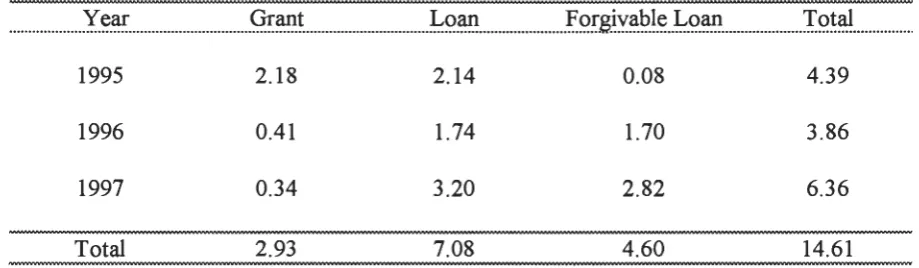
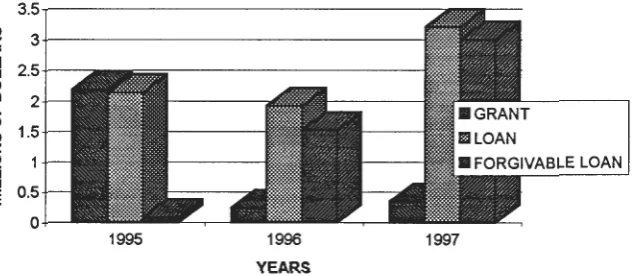
V AAPF AP, authorized by the 7 5th Iowa General Assembly in April, 1994, provided over 14.5 million dollars to value-added agricultural businesses in the State of Iowa (see Table 5.3, Figure 5.1) in form of grants, loans, and forgivable loans.
The major sources of funds are loans. Table 5.3 indicates that V AAPFAP provided over seven million dollars of loans to the Iowa's agribusinesses during FY 1995-97 or 50 percent of the total funds, and 4.6 million dollars or more than 30 percent of forgivable loans.
During this period, the total amount of grants was 20 percent of the funds or about three million dollars.
Table 5.3. The Sources of the V AAPFAP Funds by FY 1995-1997, in Millions of Dollars
...
...
..
.X.~.~.
...
.
.
....
...
.
...
9!.~~..
...
...
...
...
.
..
.
..
~2~...
.
...
.
...
.
..
.
£2~g_~Y.~!?.!~..
~g·~···.!9.~~···1995 2.18 2.14 0.08 4.39
1996 0.41 1.74 1.70 3.86
1997 0.34 3.20 2.82 6.36
During the first year of operations, the funds were almost equally divided between grants and loans, and less than two percent of the funds were forgivable loans (see Figure 5.1). In later years, grants were replaced by forgivable loans. These loans obtained under the
federally-funded Community Development Block Grant system do not have to be repaid if certain conditions are met.
3.5
~ 3
:s
2.5 ...Ig
LI. 20 1.5
Cl)
z
g
...I0.5
i
0
1995 1996 1997
[image:41.580.103.421.249.387.2]YEARS
Figure 5. 1. The V AAPF AP Funds by Sources and Years, in Millions of Dollars
For example, in the case of one V AAPFAP funded project, West Liberty Food, Inc., the cooperative has to maintain an employment level of 425 jobs, as a condition for loans which are not to be repaid. As a result of this policy, the amount of forgivable loans has been increased to almost three million dollars in FY 1997, while funds in form of grants were less than a half of a million dollars in the same year. Therefore, through this system of forgivable loans, IDED has better control over funds provided by V AAPF AP.
Application Approval and Funding the V AAPFAP Projects
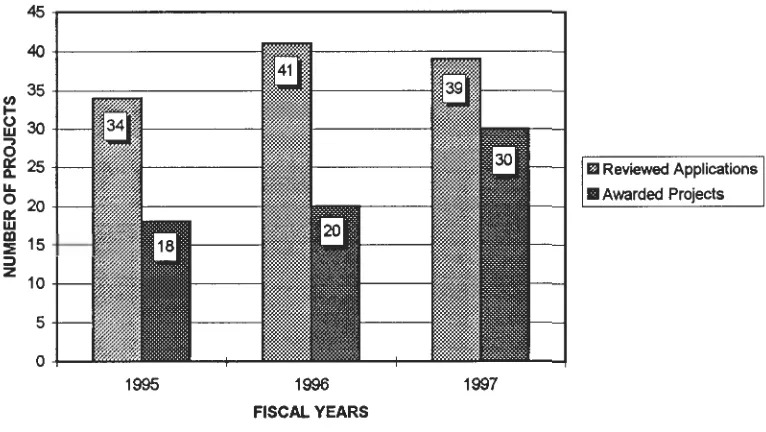
Through FY 1997, one hundred and fourteen applications were reviewed and
sixty-eight of them were funded by V AAPF AP. An application procedures have been discussed in
Chapter 3.
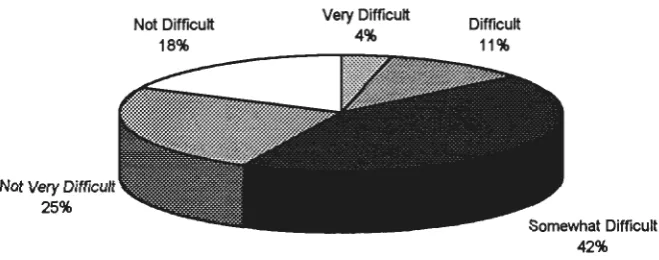
In the survey the participants were asked a question: How difficult was the procedure
of your application approval? The results of the survey responses are shown in Figure 5.2.
Not Very Difficult 25%
Not Difficult 18%
Very Difficult
4% Difficult
11%
[image:42.580.121.451.293.423.2]Somewhat Difficult 42%
Figure 5.2. Level of Difficulty of the Application Approval Procedure, in Percent
For the majority of the respondents the application procedure approval was somewhat
difficult (42%), not difficult (25%), and not very difficult (18%) respectively. Only 4 percent
of respondents indicated that the application procedure approval was very difficult, and 11
percent of them noted that it was difficult.
In FY 1995, from a possible thirty-four applicants, eighteen had been funded by
38
5.3). As the V AAPFAP report to the Iowa General Assembly indicated, $3,775,000 went to
businesses located in communities of 10,000 populations or less. Forty percent went to
renewable fuel facilities and sixty percent went to companies providing new value-added
products and processes1.
During FY 1996, fifty percent of applications had been funded by V AAPF AP with
total awards of approximately 4. 0 million dollars. Through FY 1997, thirty-nine applications
were reviewed and thirty or almost 77 percent of them were funded. In this year, VAAPFAP
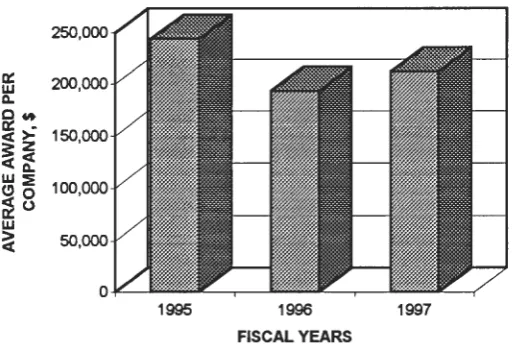
committed over $6.0 million to a wide range of projects. As shown in Figure 5.3, the number
of awarded projects increased each year during FY 1995-1997, while average amount of award
per project decreased in FY 1996 and FY 1997 comparing to FY 1995 (see Figure 5.4). The
amount of awards varies widely with the highest of $900, 000 and the smallest of $20, 000.
45
40
35
Cl) ...
frl
30 ...., 0~ 25 LI. 0 20 a:: w
~ 15
:::> z 10
5
0
1995 1996
FISCAL YEARS
1997
[image:43.580.112.495.432.648.2]E3 Reviewed Applications •Awarded Projects
a:
w
D.
c~
a: -<>
~~
w :!E(!) 0
~o w
~
250,000
200,000
150,000
100,000
50,000
o ¥'---_...=~-,--- m..,.:
""'----,---1995 1900 1997
[image:44.580.110.367.115.287.2]FISCAL YEARS
Figure 5.4. Average the VAAPFAP Award per Company, FY 1995-1997
Overview of the Funded Projects
All awarded projects can be aggregated into seven commodity classifications: Ethanol,
Value Added Com, Value Added Soybeans, Value Added Pork, Value Added Beef, Value
Added Poultry, and Other Value Added Products and Processes. Funds allocation among these
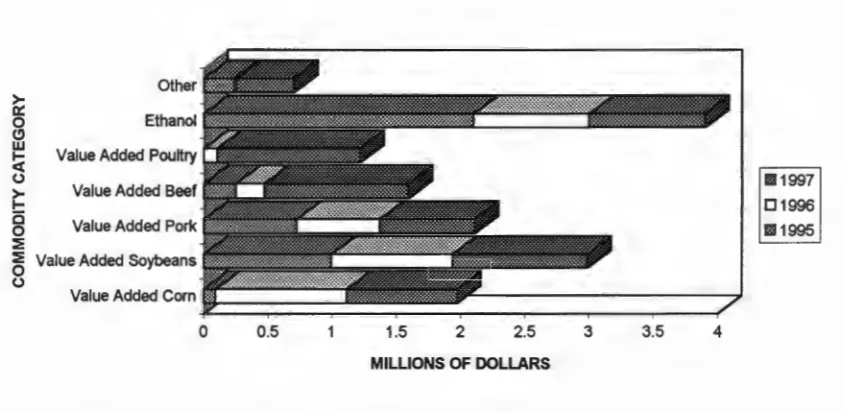
groups is shown in Figure 5.5, 5.6.
During FY 1995-1997, the Ethanol category received 26 percent of the total
V AAPF AP funds. The second largest V AAPF AP fund recipients were Value Added Soybeans
Products, accounting for 21 percent of total V AAPF AP funds. Value Added Pork and Value
Added Corn Products, ranked third and fourth, respectively, with 15 percent and 14 percent of
V AAPF AP funds, have been channeled to these groups. Value Added Beef and Value Added
Poultry Products received 11 percent and 8 percent, while Other Value Added Products and
~
Ethanol
26%
Value Added Beef
11%
Other
5% Value Added Corn 14%
Value Added Soybeans
21%
Value Added Pork
[image:45.580.105.493.115.278.2]15%
Figure 5.5. The VAAPFAP Funds Allocation among Commodity Category, FY 1995-1997, in Percent.
Other
... . .·... . . .
Ethanol :.::::::::::::::::=:::-.-.·:·.:::::::::::::::::::::·:·:::
0
C)
w
~ Value Added Poultry
0
~
i5
0
~
Value Added Beef
Value Added Pork
~ Value Added Soybeans
0
0 0.5 1.5 2 2.5
MILLIONS OF DOLLARS
3 3.5 4
111111997 01996 111111995
[image:45.580.71.494.419.625.2]The V AAPF AP budget by commodity category through FY 1997 are shown in Figure 5.6. From 1995 to 1997, Value Added Beef, Value Added Poultry and Other Value Added Products and Processes categories have increased their share of total V AAPF AP funds significantly while agribusinesses in the Ethanol group have decreased their share of total V AAPF AP expenditures.
The Ethanol Projects Ethanol, already using almost 4 percent of U.S. com acreage,
is the clear leader in creating new demand for com2. Feeding the ethanol industry's demand for
com and production for fuel itself is one of the largest economic activities in Iowa. Iowa is the number-one com-producing state and has the second largest ethanol producing capacity at 280 million gallons. Through FY 1997, V AAPF AP funded six ethanol projects with a total funding of $3. 9 million or 26 percent as shown in Figure 5. 5.
Among ethanol projects, which have been funded by the program, five are large in size ($15 -$30 million) and have received most of the funds ($3.8 million). Sunrise Energy
Cooperative in Blairstown, Iowa is one of them. This enterprise has been awarded $900,000 in form ofloans ($720,000) and grants ($180,000) to build a 7.5 million gallons per year ethanol plant in conjunction with a cattle feedlot to use the com gluten co-products of the ethanol processes. The overall project totaled 15 million dollars.
42
V AAPF AP reported that when all plants in operation they will utilize 50 to 60 million
bushels of com per year and provide feed for approximately 160,000 head of cattle3.
Value Added Soybeans Projects As one of the major U.S. crops, soybeans have
enjoyed the advantages of years of private and public research programs. The soybean today
comes as close as any crop to fully utilizing all of the raw materials into usable products.
Farmers throughout the country are thoroughly familiar with raising soybeans, and future
improvements in yields are expected to be gradual rather than dramatic4.
Through FY 1997, V AAPF AP approved funds for ten value added soybean projects.
These projects ranked second in total V AAPF AP awards (see Figure 5. 5) and represent a wide
range of businesses producing products from soybeans, such as industrial cleaners, methyl
ester, soybean oil hydraulic fluid, and soy food snacks.
One of the largest projects ($5 million) in the category of Value Added Soybeans has
been awarded $300,000 loan and $200,000 forgivable loan. This award was provided to Ag
Processing Inc., located in Sergeant Bluff, Iowa to cover costs associated with expansion and
environmental compliance improvements of a soybean processing facility.
Another company, which has been awarded by V AAPFAP, is Natural Products, Inc .. It
has received a $137,500 loan and a $137,500 grant to purchase a soybean dry-milling plant in
Minnesota and move it to the Grinnell, Iowa area. The company is producing flour from
soybeans through a dry roasting process that does not involve the use of chemical solvents,
allowing them to market a "natural" soy product for health food stores and the baking industry.
The process will increase demand for identity- preserved soybean varieties, including
Among other examples are Interwest, Inc., Homestead Farms, Inc., and Lee Seed Co ..
Interwest, Inc., Ralston, Iowa, has been awarded a $100,000 grant from V AAPFAP
supporting an overall project of $700,000 to build and equip a plant to process soybeans into
methyl ester and glycerol. Homestead Farms, Inc., Des Moines, has been awarded $125,000 in
form of 50% loan and 50% grant to bottle soybean oil for retail and institutional markets. A
$50,000 forgivable loan was provided to Lee Seed Co., Inwood, Iowa to purchase equipment
to process Iowa soybeans into snack foods.
Value Added Corn Projects Today's challenge to U.S. corn farmers is to create
new markets capable of putting the Nation's idle corn acreage back into production. New
industrial markets for corn offer tremendous opportunities.
V AAPF AP has committed 14 percent of its funds to Value Added Com Products for
eight projects during FY 1995-1997. One of the awarded companies is MBS Composition
Systems in Story City, Iowa. Through VAAPFAP, MBS Composition Systems have obtained
three awards. Its first project received a $187,500 funds in form of a grant in FY 1995 to
provide service to grain elevators for testing of specialty grains such as high oil com. The
second award was a $137,500 forgivable loan to assist 15 Iowa grain elevators in purchasing
near-infrared sensing instruments to be used for testing grain for protein, oil, starches, etc. As a
result of the funding, 15 facilities were able to install and utilize grain analyzers. Based on
survey information from 11 of these 15 facilities, company reported that Iowa producers were
provided with over $200, 000 of additional revenue in just the first five months of operation of
V AAPFAP invested more than $300,000 in MBS Composition Systems during FY
1995-1996. According to MBS Composition Systems comments, these two awards represents
a 75.6% rate ofretum on the State's investment. (Assuming that 10 percent of the revenues
generated by these two awards are paid to the State in some form of taxation)5.
In summary, the Iowa grain analyzers are operating successfully. The assistance of the
State of Iowa, through the V AAPF AP grant and loan, has given the elevators the capability to
identify and segregate higher-value grain. Premiums are being paid to Iowa farmers, rewarding
them for growing higher-value crops. Therefore, the third MBS Composition Systems project
has been awarded by VAAPFAP in June, 1997. A $200,000 award in the form of forgivable
loan has been provided to cost share purchase and installation of 16 near-infrared grain quality
measuring instruments to be placed at grain elevators throughout the state.
Minsa Corp., Red Oak, Iowa, has received a $225,000 award from VAAPFAP in the
form of a $90,000 loan and a $135,000 forgivable loan for an overall $4 million project to
remodel and expand a vacant com milling facility to produce white com tortilla flour for the
growing Mexican food market.
The other examples of Value Added Com projects funded by V AAPF AP are:
production litter for small animals and birds from com cobs in Green Mountain, Iowa (Green
Products); and a com stover processing plant in Harlan, Iowa (Great Lakes Chemical Corp.).
Value Added Pork Projects The traditional form of value-added agriculture,
namely the production of quality animals and animal products, has major implications for the
State of Iowa. During FY 1995-1997, Value Added Pork projects received over two million
commodity category. One of the largest awards was received by Bee-Lor, Inc., Oskaloosa. The company was awarded $500,000 to market a tofu/pork bratwurst, an innovative consumer food, that was developed in cooperation with Iowa State University. This Project uses Iowa soybeans and Iowa pork to make a good tasting low-fat bratwurst sausage. The project involved a 60 percent loan and 40 percent grant, with 60 percent funded at project commencement and the remainder as the company reaches certain sales goals.
The other large award ($3 70, 000) was given to AMPC, Inc. in the form of a $111, 000 loan and a $259,000 grant to refurbish a production facility in Harlan, Iowa at an overall cost of $2.5 million. The facility is to process pork tissue from local meat packers. The material was formerly used only for pet foods or as waste products. Now the AMPC process converts pork tissue for new use in higher value food ingredients. As a result of this project, 65 jobs will be
added in the Harlan area.
Among relatively small $40-50,000 awards are those granted to Glenn Freie Natural Meats of Latimer and Chemtec oflowa of Des Moines. A $40,000 forgivable loan was approved to Glenn Freie Natural Meats of Latimer to produce, process and market natural pork as fresh meat and as a cooked product in old-fashioned jars. All products are chemical free. Chemtec oflowa received a $50,000 forgivable loan in FY 1996 to produce and sell an odor control product to be used primarily in the pork industry. This product was tested at Iowa State University and found to control approximately 85 percent of odors from confinement waste lagoons.
Value Added Beef Projects Through VAAPFAP, the State oflowa invested over