" 111111 I
I
11111IIII~
IIIiK
I
I.
aUD
I hII
I'l1li
REPORT NO. 1115
} (;
MARCH 1961
.
~.A THIRD SURVEY OF DOMESTIC
ELECTRONIC DIGITAL COMPUTING SYSTEMS
Martin H. Weik
This report supersedes BRL Report
No.
1010
Department of the Army Project No. 5B03-06-002
Ordnance Management Structure Code No. 5010.11.812
BALLISTIC--·RESEARCH
LABORATORIES
ASTIA AVAILABILITY NOTICE
BALLISTIC RESEARCH LABORATORIES REPORT NO. 1115
March 1961
A THIRD SURVEY OF DOMESTIC ELECTRONIC DIGITAL COMPUTING SYSTEMS Martin H. Weik
This report supersedes BRL Report No. 1010 (Public Bulletin 111996R> U. S. Department of Commerce, Office of Technical Services)
BALLISTIC RESEARCH LABORATORIES
REPORT NO. 1115
MWeik/vJc
Aberdeen Proving Ground, Mi.
March 1961
A THIRD SURVEY OF DOMESTIC ELECTRONIC DIGITAL COMPUTING SYSTEMS
ABSTRACT
Based on the results of a third survey, the engineering and programming
characteristics of two hundred twenty-two different electronic digital computing
systems are given. The data are presented from the point of view of
applica-tion, numerical and arithmetic characteristics, input, output and storage systems, construction and checking features, power, space, weight, and site
preparation and personnel requirements, production records, cost and rental
rates, sale and lease policy, reliability, operating experience, and time
availability, engineering modifications and improvements and other related topics. An analysis of the survey data, fifteen comparative tables, a
dis-cussion of trends, a revised bibliography, and a complete glossary of computer
engineering and programming terminology are included.
ACKNCMLEOOMENT
On behalf of the Computing Laboratory of the Ballistic Research Laboratories, the
author wishes to extend his appreciation for the excellent spirit of cooperation displayed
by the various representatives of government and industry who have devoted their time and
effort in responding to the survey inquiries.
Many valuable suggestions were received from the engineering and mathematical staff
personnel of the Computing Laboratory of the Ballistic Research Laboratories.
The Data Systems Research Staff, Office of the Assistant Secretary of Defense,
Comptrolle~ devoted much effort during the conduct of the survey, particularly as pertains
to coordination within the Armed Services. It is the expressed intent of the Office of
the Assistant Secretary of Defense, Comptroller, to reprint this report at the Government
Printing Office, Washington, D. C., for sale and distribution to the public.
The g~eatest individual assistance was rendered by WAC Staff Sergeant Violet J. Confer. An undertaking as comprehensive as this national survey, requires that a large quantity
of data be acqUired, correlated, transcribed and checked. Particular attention must be
paid to accuracy and detail. We are heavily indebted to Staff Sergeant Confer for the
major role she has performed in all phases of preparation of this report. She has been
responsible for the general conduct of the survey, the control of communications with
respondents, the preparation of correspon~ence, screening returns, sorting returns, preparing
the layout of all pages, and dOing all the art work, typing, titles, and photo arrange~~nts.
TABLE OF CONTENTS
ABSTRACT. • • • •
ACKNOWLEroEMENT •
CHAP.rER
I. INTRODUCTION.
PURPOSE OF THE SURVEY REPORT.
SCOPE OF THE SURVEY REPORT. •
PROCESSING OF THE SURVEY DATA •
INTERPRETATION OF THE SURVEY DATA • •
USE OF THE SURVEY REPORT. • • •
II. COMPUTING SYSTEMS DESCRIPTIONS
System
AF CRC. • • •
AIlt1AC II • • •
AIlt1AC III E
AMOS IV • • •
AN/ASQ 28(v) EDC.
AN/ ASQ 28( v) MOe.
AN/FSQ 7 AN/FSQ 8 (SAGE). AN/FSQ
;1
(v) • • . AN/FSQ ;2 •AN/MJQ 1 REDSTONE •
AN/TYK 4v COMPAC AN/TYK 6v BASIC PAC •
AN/TYK 7v INFORMER.
AN/USQ 20 • •
ASC 15. • •
ATHENA • • • • • • •
BENDIX CUBIC TRACKER.
BENDIX. D 12 •
BENDIX;. G 15 •
BENDIX G 20 .
BIZMAC I • •
BIZMAC II
BOGART • • •
BRLESC. • •
BURROUGHS 204 •
Page 14 16
18
2834
36
4044
4648
50 52 54 56 58 60 6264
6686
8898
· 102
· 104
· loB
5
System
BURROUGHS 205.
BURROUGHS 220. .
BURROUGHS D 10;.
BURROUGHS D 104. • .
BURROUGHS D 105. •
BURROUGHS D 107 • •
BURROUGHS D 201. .
BURROUGHS D 202. .
BURROUGHS D 20;.
BURROUGHS D 204. .
BURROUGHS D 208.
BURROUGHS D 209 • . BURROUGHS E 101.
BURROUGHS E 102 . .
BURROUGHS E 10;. •
CCC REAL TIME. •
CDC 160. .
CDC 1604 • . .
CIRCLE • • • •
CUBIC AIR TRAFFIC. CUBIC TRACKER.
CYCLONE. • • •
DATAMATIC 1000
DE 60 • •
DIANA • • • • •
TABLE OF COWrENTS (CONTINUED)
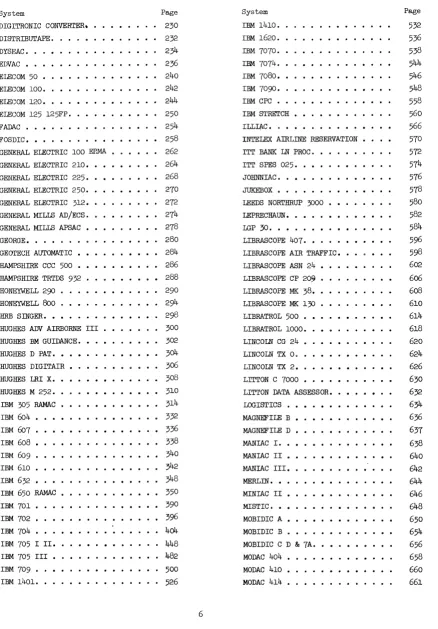
System Page System Page
DIGITRONIC CONVERTER.
.
230 IBM 1410. 532DISTRIBUTAPE. 232 IBM 1620.
.
536DYSEAC. 234 IBM 7070. 538
EDVAC • 236 IBM 7074. 544
ELECOM 50 • 240 IBM 7080. 546
ELECOM 100. 242 IBM 7090.
.
·
548ELECOM 120. 244 IBM CPC • 558
ELECOM 125 125FP.
·
250 IBM STRETCH 560FAMC • 254 ILLIAC. 566
FOSDIC.
.
258 INTELEX AIRLINE RESERVATION • 570GENERAL ELECTRIC 100 EP~ • 262 ITT BANK LN PROC. 572
GENERAL ELECTRIC 210. 264 ITT SPES 025. 574
GENERAL ELECTRIC 225. 268 JOHNNIAC.
.
·
576GENERAL ELECTRIC 250. 270 JUKEBOX • 578
GENERAL ELECTRIC 312. 272 LEEDS NORTHRUP 3000 • 580
GENERAL MILLS AD/ECS. 274 LEPRECHAUN •
.
582GENERAL MILLS APSAC • 278 LGP 30.
.
.
584GEORGE. 280 LIBRASCOPE 407.
.
596GEOTECH AUTOMATIC •
·
.
· .
284 LIBRASCOPE AIR TRAFFIC. 598HAMPSHIRE CCC 500 • 286 LIBRASCOPE ASN 24 602
HAMPSHIRE TRTDS 932 • 288 LIBRASCOPE CP 209 606
HONEYWELL 290 • 290 LIBRASCOPE MK 38. 608
HONEYWELL 800 •
.
294 LIBRASCOPE MK 130.
.
610HRB SlNGER.
.
298 LIBRATROL 500 • 614HUGHES ADV AIRBORNE III • 300 LIBRATROL 1000. 618
HUGHES BM GUIDANCE.
·
302 LINCOLN CG 24 • 620HUGHES D PAT.
·
304 LINCOLN TX O.. .
.
· ·
624HUGHES DIGITAIR • 306 LINCOLN TX 2.
.
.
626HUGHES LRI X.
·
308 LITTON C 7000 • 630HUGHES M 252.
. ·
.
.
310 LITTON DATA ASSESSOR • 632IBM 305 RAMAC 314 LOGISTICS. 634
IBM 604 • 332 MAGNEFlLE B • 636
IBM 607 •
· .
336 MAGNEFlLE D • 637IBM 608 • 338 MANIAC 1.
.
.
638IBM 609 340 MANIAC II • 640
IBM 610 342 MANIAC III. 642
IBM 632 • 348 MERLlN.
.
644IBM 650 RAMAC 350 MINIAC II
·
.
646IBM 701 • 390 MISTIC.
.
0·
.
.
648IBM 702 • 396 MOBIDIC A • 650
IBM 704 • 404 MOBIDIC B • 654
IBM 705 I II. 0
·
448 MOBIDIC C D & 7A. 656IBM 705 III •
· .
482 MODAC 404 • 658IBM 709 •
.
·
500 MODAC 410 • 660IBM 1401.
. .
·
·
526 MODAC 414 • 661 [image:8.613.81.519.87.716.2]System
MODAC 5014.
MONROBOT III.
MONROBOT V • •
MONROBOT VI •
MONROBOT IX • •
MONROBOT XI •
MONROBar MU •
NAREC • • • • • •
NATIONAL 102 A. •
NATIONAL 102 D. •
NATIONAL 107.
NATIONAL 304.
NATIONAL 315.
NATIONAL 390. •
NORC • • • • •
NORDEN VOrE TALLY
NUMERICORD. •
OARAC • • • •
OKLAHOMA UNIV • •
ORACLE • • • • •
ORDVAC • • • •
PACKARD BELL 250.
PENNSTAC • •
PERK I I I • •
PHILCO 1000 •
PHILCO 2000 •
PHILCO 3000 •
PHILCO CXPQ •
PROGRAMMED DATA PROCESSOR • •
RASTAC. RASTAD •• RCA 110 •
RCA 200 • •
RCA 300 •
RCA 301 •
RCA 501
RCA 601 • READIX.
RECOMP I CP 266
RECOMP I I • •
REPAC • • • • • •
TABLE OF CONTENTS (CONTINUED)
Page 662 664 666 668 670 672 674 676 680 684 690 692 710 714 716 720 724 726 728 730 734 740 746 750 752 754 760 762 764 766 768 770 772 773 774 778 804 808 816 820 830 7 System
RICE UNIVERSITY. • •
RPC 4000 •
RPC 9000 •
RW 300 •
RW 400 • •
SCRIBE • •
SEAC •
SPEC • •
STORED PROGRAM DDA •
SWAC •
SYLVANIA S 9400 • •
SYLVANIA UDOFTT. •
TARGET INTERCEPl'
TELEREG ISTER MAGNEr BID ASKED. •
TELEREG ISTER MAGNET INVENT CONT.
TELEREG ISTER TEIEF lLE •
TELEREGISTER UNIFIED AIRLINE •
TRICE.
UDEC I I I III.
UNIVAC 60. UNIVAC 120 •
UNIVAC 490 •
UNIVAC 110l.
UNIVAC 1102 • •
UNIVAC 1103 11031\ • •
UNIVAC 1105 • •
UNIVAC 1107 • • •
UNIVAC FILE O.
UNIVAC FILE 1.
UNIVAC IARC. • • •
UNIVAC SOLID STATE 80/90 •
UNIVAC ?TEP. •
UNIVAC I •
UNIVAC I I • • •
UNIVAC I I I • •
UNIVERSAL DATA TRANS •
VERDAN • • • • • •
WESTINGHOUSE AIRBORNE. •
WHIRLWIND I I • • •
WISC • • • • • • • •
WRU SEARCHING SELECTOR •
TABLE OF CONTENTS (CONTINUED)
CHAPrER
III. Al."'qALYSIS AND TRENIS
INTRODUCTION • • •
DESIGNATION OF COMPUTING SYSTEMS
MANUFACTURERS OF COMPUl'ING SYSTEMS
APPLICATIONS OF COMPUl'ING SYSTEMS •
PROGRAMMING AND NUMERICAL SYSTEMS •
ARITHMm'IC UNITS
STORAGE
INPUl' •
OUl'PUl'
.
...
.
"...
ClRCUIT ELEMENTS OF ENTIRE SYSTEMS
CHECKING FEATURES • • • • • • • • •
POWER, SPACE, WEIGHT AND SITE PREPARATION.
PRODUCTION RECORDS • • • • • • • • • • • •
COST, PRICE AND RENTAL RATES
PERSONNEL REQUIREMENTS • • • •
RELIABILITY, OPERATING EXPERIENCE AND TIME AVAILABILITY.
ADDITIONAL FEATURES AND REMARKS •
FUl'URE PLANS
INSTALLATIONS •
IV. BIBLIOGRAPHY •
V. REVISED GLOSSARY OF- COMPUl'ER ENGINEERING AND PROGRAMMING TERMINOLOGY
VI.
TABLE NUMBER
DISTRIBUl'ION LIST • • • • • • • • • • •
1. MANUFACTURERS OF COMPUl'ING SYSTEMS.
LIST OF TABLES
TITLE
II. QUANTITY OF COMPUl'ING SYSTEMS MANUFACTURED TO DATE
III. WORD LENGTH OF COMPUl'ING SYSTEMS • • • • • • • • • • • • • • • •
IV. ARITHMETIC OPERATION TIME (EXCLUDING ACCESS) OF COMPUl'ING SYSTEMS •
V. ARITHMm'IC OPERATION TIME (INCLUDING ACCESS) OF COMPUTING SYS1~ • VI. ACCESS TIME OF HIGH SPEED STORAGE UNITS • • • • • • • •
VII. CAPACITY OF HIGH SPEED STORAGE UNITS. • • • • • • • • • • • •
VIII. LOG10 CAPACITY/ACCESS TIME OF HIGH SPEED STORAGE UNITS
IX. CAPACITY OF MAGNETIC DRUM OR DISC STORAGE UNITS •
X. TUBE QUANTITY IN COMPUl'ING SYSTEMS • • • • • • •
XI. CRYSTAL DIODE QUANTITY IN COMPUl'ING SYSTEMS • • •
XII. TRANSISTOR QUANTITY IN COMPUl'ING SYSTEMS • • •
XIII. APPROXIMATE POWER REQUIREMENT OF COMPUl'ING SYSTEMS
XIV. APPROXIMATE COST OF BASIC COMPUl'ING SYSTEMS • • • •
XV. CHRONOLOGICAL ORDER OF INITIAL OPERATION OF COMPUl'ING SYSTEMS •
8
...
Pa.ge
1025
1026
1026
1026
1021
1021 1029
1029
1031
1031
1032
1033
10;4-1035 1035
10;6 10;6
1031 1031
1031
1089
1111
10;8
1043
1045
1051
1055
1059 1062
1066
1069
1012 1074
1016
1018
1081
CHAPrER I
INTRODUCTION
INTRODIJCTION
PURPOSE OF THE SURVEY REPORT
Before any major decision can be made regarding the acqaisition, installation, operation,
improve-ment or retireimprove-ment of computing eqaipimprove-ment, first hand technical information must be obtauJ.ed concern-ing the characteristics, availabil·ity, cost, operational problems, capability and useful l.ife of avail-able systems. Efficient management requires that the experience of others be exploited wherever
such exploitation is beneficial. The present trend in the rapidly changing computing and data
process-ing hardware field is toward higher operational speeds, increased memory capacity and reliability, and
solid state electrical components, including a widespread use of semi-conductors and the advent of the
use of thin magnetic films in standard connnercial systems. However, onl.y existing or readily available equipment may be utilized for the immediate solution of scientific and connnercial data processing
problems.
funy persons in the computing and data processing field continually seek answers to many different
questions simultaneously. Some of these qaestions are: Can present methods, practices and procedures
used jn a given organization be accomplished by automatic computing and data processing eqaipment~ Will investment in such equipment reduce costs, provide improved service, conserve manpower or save
time~ When shall existing computing equipment be modified, supplemented or replaced? Of all available
equipment, what type of system is best suited for the solution of a given problem or a given group of
problems? Is the maximum possible return being obtained from- a given investment in computing
equip-ment? Does a given problem require specially built equipment or is a solution to be found with
commer-cially available standard equipment? Should computing eqUipment be rented or purchased? Should a
system be installed "on the premises" or should computer time be purchased elsewhere~ The purpose of a surveillance and evaluation program is to provide answers to these and s1milar qaestions.
Government agenCies, particularly Department of Defense agencies, and their contractors, require
the latest technical information concerning computing and data processing eqaipment in order to properly establish their policy regarding acqaisition, installation, operation, improvement and retirement of
equipment. The purpose, therefore, of this survey report is to allow government agencies and their
contractors to benefit fram the results of the computing system surveillance and evaluation program
conducted by the Ballistic Research Laboratories.
In 1955, a survey of electronic digital computing systems was conducted by the Ballistic Research
Laboratories in order to provide technical data for the evaluation of the then existing computing
machine complement of the Laboratories. The results of that survey were made available in BRL Report
Number 971, M. Weik "A Survey of Domestic Electronic Digital Computing Systems". The report was well received by persons in government and industry. The U. S. Department of Commerce undertook further
printing and distribution of the report under cover of Public Bulletin 111996, Office of Technical Services.
A new survey of electronic digital computing systems Was conducted during October, November and
December 1956 and January 1957 by the Computing Laboratory of the Ballistic Research Laboratories. The new survey was conducted as part of the continuous surveillance and eValuation program of the
Laboratory. The results were published as BRL Report Number 1010, June 1957. This report covered the
results of the new survey and superseded BRL Report 971. The U. S. Department of Cammerce undertook
further printing and distribution of this report also, under cover of Public Bulletin 111996R, Office
of Technical Services.
l)ue to the great interest which has developed in these survey reports, the Department of Defense has co-ordinated this activity among the Armed Services. This report contains the results of a third survey
of domestic electronic digital computing systems.
SCOPE OF THE SURVEY REPORT
This report is limited to commercially avai.lable and existing operational electronic digital
computing and data processing systems manufactured or operated within the United States. Large, inter-mediate and small scale systems are included, regardless of whether the determination of "scale" is
based on size, weight, cost, storage capacity or any reasonable criterion. An attempt has been made
to include both general purpose and special purpose equipment. It must be borne in mind that there is
no clear-cut line of demarcation between systems designated as special purpose computing machines and certain "on-line" control applications, in which a computer is used to determine operational
control-commands, based upon data received by the system from instruments measuring the results of the commands.
These systems usually have analog input and output with internal digital computation and transformation of information to and from digital form.
Among the items not covered by this report are analog computing systems, foreign systems or separate
computing system components, such as analog-digital converters, separate storage units, arithmetic units,
input-output units, and data recording units, except when these are associated with specific complete
systems. Many recording media converters, such as magnetic tape-to-card converters, card-to-paper tape converters, etc., are not specifically covered, except again as they are used with specific complete
systems. By a "complete system" is meant an electronic digital computing system with input, output,
control, arithmetic and/or logical and storage units.
PROCESSING OF THE SURVEY DATA
A consolidated system description was prepared from data made available by the user and the
manu-facturer. Information concerning each computing system was divided into the following sub-headings: Applications
Programming and Numerical System
Arithmetic Unit Storage
Input
Output
Circuit Elements of Entire System
Checking Features
Power, Space, Weight and Site Preparation
Production Record Cost, Price and Rental Rates
Personnel Requirements
Reliability, Operating Experience and Time Availability
Additional Features and Remarks
Future Plans
Installations
The large volume of technical data processed for this report will make errors unaVOidable, particu-larly in correlating and transcribing information. It will be appreciated if errors are brought to the
attention of the Ballistic Research Laboratories. Statements, claims and criticisms were screened as
much as possible. Every endeavor was made to insure that the information included in this report is
factual. To a large extent certain superlative adjectives used in describing equipment, were deliber-ately eliminated as a matter of fairness and in order to avoid implication in sales activities.
~ON OF THE SURVEY DATA
The interpretation of the data included in this report is perhaps the most difficult aspect of
all, therefore much of this activity is left to the reader. In Chapter II, the data are grouped under alphabetically sequenced computing systems descriptions. The charts and tables in Chapter III have
been prepared in order to show various relative characteristics, features and trends. A brief aneilysis
and interpretation of the -data accompanies these tables. It must be emphasized again that data
concern-ing computconcern-ing systems taken out of context or disassociated from other related data, can be misleadconcern-ing.
Because of this, the information contained in this report, particularly the tabular data of Chapter III,
Dnlst be used with app~opriate caution.
It is recommended that the prepared tables in Chapter III be used only as generalizations to show
trends. Data on specific systems should be taken from the systems descriptions rather than from the prepared tables. Further details must be obtained from manufacturers or users directly. This report
does not constitute an indorsement of any of the products described within it.
USE OF THE SURVEY REPORT
As has been previously stated, the computing field is a dynamic and rapidly changing one. From a
technologic,al point of view, some of the information contained in this report is Obsolete. Certain
computing systems may be considered obsolete when they are installed. However, in most cases, manufact-urers are accepting orders and will continue to produce, the systems described in this report for quite
a number of years. Chapter II contains engineering and programming descriptions of 222 d:lfferent types of computing systems. Persons who are interested in the acquisition of systems will find useful
infor-mation on applications, cost, personnel reqUirements, and power and ~pace requirements for specific
systems. Operators may find useful suggestions on modifications and improvements. The question of
reliability, a particularly difficult one to resolve, has been answered to some extent under the sub-heading: Reliability, Operating Experience and Time Availability. Under each sub-heading, the source
of information is given. When a source is not stated, the manufacturer is the source of data.
A List of References and a revised Glossary are given in Chapters IV and V.
It is hoped that enough general and specific technical data have been compiled in the following
four chapters to permit anyone involved in the computing and data processing field to draw at least
some general conclusions and find answers to the questions which may be occupying his mind at the
present time.
CHAPrER II
COMPUTING SYSTEMS DESCRIPTIONS
AF GRG
Air Force Cambridge Research Center Magnetic Computer
APPLICATIONS
Air Force Cambridge Research Center
Located at AFCRC, Hanscom Field, Mass., the system is used for general purpose scientific computations and as a flexible buffer for transfering data to paper tape.
PROGRAMMI NG AND NUMERICAL SYSTEM
Internal number system Decimal digits/word Arithmetic system
AF CRC
Binary coded decimal 10 plus sign
Fixed point
14
MANUFACTURER
Remington Rand Univac
Division of Sperry Rand Corporation
Photo by Air Force Cambridge Research Center
Operation Time Add Mult
Arithmetic mode
AR ITHMETI
C UNIT
Incl Stor Access Microsec
90
300 to 1,700 Serial by dec dig within word Parallel by bit within dec dig Pulse repitition rate660
kilocycles/secTiming Synchronous
STORAGE
22,000 decimal digits l2,000 words, each ten digits plus sign). Aluminum drum, plated with nickel-co-balt alloy, spins at 16,500 rpm. Average access time 1.8 milliseconds. Four hundred of the 2,000 words are stored in fast-access bands with average access time of 450 microseconds. Active drum sur-face is 5 in. in diameter and 3 in. long.
AFCRC Media Paper Tape Typewriter Real-time Input
AFCRC
INPUT
Speed
180 char/sec Alphanumeric 10 char/sec Alphanumeric 8,000 bits/sec
OUTPUT
Media Speed
Paper Tape 180 char/sec Alphanumeric Typewriter 10 char/sec Alphanumeric Color Scope 1,100 points/sec
Can be plotted in 3 colors Real-time Output 154,000 bits/sec
C
I RCU IT ELEMENTS OF ENTI RE SYSTEM
Six hundred miniaturized circuit packages
Magnetic core Ferractors, developed by Sperry-Rand, are used as the basic logical control element for sn tching and amplifying.
15 Vacuum tubes are used.
All processing and control circuitry is mounted in one cabinet. Primarily solid state design.
POWER, SPACE. WEIGHT, AND SITE PREPARATION
AFORCPower, computer 15 'KVA, 3 phase, 208 volt, 60 cps Volume, computer 140 cu ft
Area, computer 500sq ft
Room size, computer 20 ft x 30 ft x 8 ft Weight, computer 4,000 Ibs
Computer unit is 6 ft high, 6 ft 6 in long and 1 ft 6 in deep. Console is 4 ft 6 in high, 6 ft long, and 3 ft deep. Cooling is by integral fan.
COST
pPRICE AND RENTAL RATES
AFCRC
Cost of system is $800,000, including development costs. DevelO];1ment by Remington Rand Univac was sponsored by the Air Force Cambridge Research Center.
Maintenance/service contracting costs are $21,000 per man per year.
15
PERSONNEL REQU I REMENTS
Three 8-HOur Shifts Used Recommended
Supervisors 1 1
Analysts 4 4
Programmers 4 4
Operators 2 3
Engineers 1 1
Technicians 1 3
Operation tends toward open shop.
Method of training used is by apprenticeship.
RELIABILITY, OPERATING EXPERIENCE,
AND TIME AVAILABIUfV
AFCRe
Average error-free running period 30 Hours Good time 126 Hours/Week (Average) Attempted to run time 140 Hours/Week (Average) Operating ratio ( Good/Attempted to run time) 0.90 Above figures based on period 1 Apr 59 to 1 Apr 60 Passed Customer Acceptance Test Apr 56
Time is not available for rent to outside organiza-tions.
ADDITIONAL FEATURES AND REMARKS
AFORCOutstanding feature is its solid state magnetic circuitry with a unique system of logic.
The color scope, the high-speed paper tape punch, and the circuitry for alphanumerics were added to the computer by AFCRC personnel.
FUTURE PLANS
AFCRCThe addition of a core memory of 4,096 words is anticipated. It is expected that this will speed up average computing time by a factor of 5 over minimum latency programming on the drum.
It is planned to improve the paper tape handling capability of the computer by installing newer paper tape readers and punches.
It is planned to expand the input-output capability by installing high-speed magnetic tape units.
INSTALLATIONS
U. S. Air Force
Cambridge Research Center ARDC Laurence G. Hanscom Field Bedford, Massachusetts
ALWAC II
Alwac (Axel-Wenner-Gren) Computer Model II
APPLICATIONS
Located at the Aerodynamics Laboratory, Transonic Building, the system is used for wind tunnel data reduction and computation and for solving engineer-ine and scientific problems.
ALWAC II 16
MANUFACTURER
Alwac Computer Division El-Tronics, Inc.
Formerly Logistics Research, Inc.
Photo by U. S. Navy David Taylor Model Basin
PROGRAMMING AND NUMERICAL SYSTEM
Internal number system Binary digits/word Binary digits/instruction
Instructions per word
Binary 32 plus sign
16 or 8, depending on instruction
Arithmetic system Fixed point Floating point can be programmed. Instruction type One address
Some orders do not require an address, but it is basically one address system. An instruction con-sists of an order and an address (16 binary digits) or an order (8 binary digits). Since this computer follows orders from the first syllable (4 per word) of each of 8 words before following orders from the second syllable, each word could have 4 addresses, 1 order and 3 addresses, 2 arid 2, 3 and 1 or 4 orders. Number range 0 to
:!:
232 _ 1Add
Mult
Div
ARITHMETIC UNIT
Exclud Stor Access Microsec
1,000 32,000
Construction (Arithmetic unit only)
32,000
Vacuum tubes and diodes Arithmetic mode
Timing Operation
Serial Synchronous Sequential Input device is parallel.
STORAGE
Media Magnetic Drum Magnetic Drum (Fast Access)
No. of Words
2,048
64No. of Digits 32 bits & sign 32 bits & sign
Access Micro sec
8,000
Information must be blocks of 32 words.
copied into fast access in
INPUT
Media Speed
Flexowriter Keyboard Flexowriter Paper Tape
10 char/sec (alpha-numeric) 10 char/sec (alpha-numeric)
OUTPUT
Media Speed
Flexowriter Keyboard 10 char/sec (alpha-numeric) Flexowriter Punch 10 char/sec (alpha-numeric)
Computer has programmed format controls.
C
I RCU IT ELEMENTS OF ENTI RE SYSTEM
Tubes
Crystal diodes Tube types
Quantity 250 3,500
5963, 5687, l2AT7 (excluding power supply)
There are 13 different tyPes of plug-in units.
CHECKI NG FEATURES
Checking features include memory verification, over-flow, impossible order code, and automatic sequencing.
POWER, SPACE, WEI GHTv AND SITE PREPARATION
Power, computer Power, air conditioner Volume, computer Volume, air conditioner Area, computer
4
Kw6 Kw
158 cu ft (incl console)
44
cu ft35 sq ft (incl console)
17
7 sq ft 240 sq ft Area, air conditioner
Room size, computer
Floor loading 93 lbs/sq ft 900 lbs concen max Capacity, air conditioner 5 Tons
Weight, computer 2,100 lbs Weight, air conditioner 1,000 lbs
Power is 115 V, 60 cycles, single phase. Air con-ditioner depends on room size and cooling. The 5 Ton air conditioner is used for 2 computers in one room. Area and volume figures include the console, but weights do not.
PRODUCTION RECORD
Number produced to date 2
No longer in current production. MOdel II has been superseded by the III E. (See ALWAC III E).
COSTv
PRICE AND RENTAL RATES
System cost approximately $50,000.
Maintenance is performed by our own electronic engineer.
PERSONNEL REQU I REMENTS
This is an old computer, still operable with nominal maintenance required. It is not used in regular production, but for miscellaneous engineering problems where its speed is relatively unimportant.
RELIAB I LlTY, OPERATI NG EXPER I ENCE,
AND TIME AVAILABILITY
Average error-free running period 43 HOurs
Good time 3,250 HOurs
Attempted to run time 4,065 HOurs Operating ratio (Good/Attempted to run time) 0.80 Above figures based on period 7 Jun 54 to 16 Oct 56 Passed Customer Acceptance Test 7 Jun 54
ADDITIONAL FEATURES AND REMARKS
System advantages are order address is automatic, has a decision register, low cost, and ease of maintenance. This machine is no longer in produc-tion in favor of an improved model.
U. S. Navy Bureau of Ships
INSTALLATIONS
David Taylor MOdel Basin Washington 7, D. C.
ALWAC mE
Axel Wenner Gren Automatic Computer III E
APPLICATIONS
Manufacturer
System is used for computer simulation, photogrammetry analysis, on-line ~ngine test data acquisition and reduction, automatic numerical machine tool control, linear programming and general purpose computing.
The Adjutant General, U.S.A.
System is used for analytical statistics such as correlation matrices, matrix algebra, test scoring, item analysis, test selection, and factor analysis.
David Taylor MOdel Basin
System is used for wind tunnel data reduction and computation, solving engineering and scientific prob-lems, and for the solution of general engineering problems.
Offutt AFB, Nebraska
System is used for Geodesy, i.e. datum conversions, coordinate transformations, range and azimuths, and geodetic position computations; for photogrammetry, i.e. analytical triangulation, photo orientation and rectification; for intelligence reduction; and for library retrieval.
Aeronautical Structures Laboratory
High temperature, structural, fat igue, and loads research projects. Data reduction on check-out, pre l:iminary, and final test. Results are presented in a form to be tabulated on a 402 and plotted on elec-troplotters. The answer cards contain fixed infor-mation, answers and series of "x" punches to control printing in any of 14 columns. Thus, the results of a test are available in tabular form suitable for inclusion in reports.
Statistical data from fleet flight-maneuver and air-craft landing-loads programs. MOtion pictures are made of the airplane approach and landing aboard an aircraft carrier. After the film is analyzed and transcribed on the film-reading system to IBM cards, a versatile computer program fits by a least-square-curve fitting method a polynomial space-time-least-square-curve to the airplane motion. Numerical differentiation of this curve is used to obtain velocity and accelera-tion at different points in the flight path.
Alto-ALWAC III E 18
MANUFACTU RER
Alwac Computer Division El-Tronics, Incorporated
Photo by Alwac Computer Division of El-Tronics, Inc.
get her 22 landing parameters are obtained from each landing. A further statistical analysis of the para-meters is performed to determine ~robability curves, deViation, skewness, variance, confidence limits and other statistical relationships. For the flight-loads program, information concerning the use of naval airplanes is obtained from flight recorders which make a permanent record of the most important things that happen, structure-Wise, to the airplane while it is happening. From this data, airspeed, altitude, Mach number, 3 "G" load factors and 3 accel-erations are computed.
Study of structural problems associated with space vehicles. Solution on the computer of nonlinear differential equation with variable coefficients by numerical methods of approximating the required solu-tion.
Bulova Research & Development Laboratories, Inc. System is used for the numerical solution of systems of ordinary differential equations, optical ray trac-ing, parameter variation studies, reduction of test data, e.g. curve fitting and auto correlation, spec-trum analysis, and probability distribution analysis.
Institute of Gas Technology
System is used for the calculation of mass spectro-meter data, gas d'istribution network analYSiS, chemi-cal equilibrium studies, and correlation problems involving gas send-out and weather data.
Reliance Electric & Engineering Company System is used for the design of electric machinery, and associated problems.
Southwestern Computing SerVice, Inc.
PROGRAMMING AND NUMERICAL SYSTEM
Internal number system Binary digits per word Binary digits/instruction Instructions per word Instructions decoded
Binary
32 + sign
16 2, 3 or 4
101 Basic (Many are micro-programmable)
Arithmetic system Fixed point
Commands normally consider numbers to be integral Instruction type One address
Optimum sequencing is built in Number range 64 bits
Negative numbers are indicated by sign
Decimal input and output are built-in with a single command capable of taking in up to 8 digits.
Several systems are available both for floating point or fixed point operations.
Neumonic interpretive routines as well as symbolic compilers are in use.
There are four registers, viz, a main accumulator
32 bits + sign + recoverable overflow bit, a second-ary accumulator 32 bits + sign, an auxiliary regis-ter 32 bits + Sign, and a 16 bit B-Box Index register.
The first two registers are combined for double precision operations. Also, complete shiftability
19
Photo by U. S. Army - TAGO
applies to main accumulator as well as double length accumulator. Auxiliary register is used in multipli-cation, division, for special floating point assist-ance commands and masking operat ions.
ARITHMETIC UNIT
Incl Stor Access Exclud Stor Access Microsec
Add 1,000
Mult 17,000
Div 17,000
Construction (Arithmetic unit only) Vacuum-tubes 132
Diodes ),000
Arithmetic mode Serial
Timing Synchronous
Operation Sequential
Micro sec 1,000 17,000 17,000
Two commands at once are picked off the drum and unless the first command of the pair is an executed jump instruction, a second access to the drum is not required as the next command is held ready for imme-diate use in a static register.
Manufacturer
Media
Drum Drum
Core
Magnetic Tape
STORAGE
No. of Words 128 8,192 32
Access Microsec
o
to 8,000o
to 16,000500
No. of units that can be connected 16 Units No. of chars/linear inch of tape 155 Chars/inch Channels or tracks on the tape
7
Tracks/tape Blank tape separating each record 0.25 InchesTape speed 120 InChes/sec
Transfer rate 20,800 Chars/sec
Start time 9 Millisec
Stop time
7
MillisecAverage time for experienced
operator to change reel of tape 60 Seconds Physical properties of tape
Width 1/2 Inches
Length of reel 2,400 Feet Composition Sandwich Mylar Each tape transport has its own search register. Once directed to search for data, the transport is independent of the computer and tape buffer. The tape buffer is a 32-word core storage unit which works between the computer and up to 16 magnetic
ALWAC III E 20
Photo by U. S. Navy - Bureau of Ships
tape handlers. Individual words within the core buffer are addressable and useable by the computer.
INPUT
Manufacturer
Media Speed
Paper Tape (Flexowriter) Manual or 10 ct~/sec
Paper Tape (High-Speed) 180 char/sec 80-Column Cards 100 cards/mj.n Curve Follower 20 points/sec
Special tie-ins have been made to analog to digital conversion equipment. Speed of entry possible de-pends upon number system and format arrangement.
Aeronautical Structures Laboratory
OUTPUT
Manufacturer Speed
Paper Tape (Flexowriter) 10 char/sec Paper Tape (High-Speed) 60 char/sec 80-Column Cards 100 cards/min Line Printer 150 lines/min Magnetic Tape 21,000 char/sec
Plotter 20 pOints/sec
The line printer used is an IBM type 407. It is completely useable as a standard off-line unit with only a change of plug board.
Aeronautical Structures Laboratory
Off-line the data is tabulated on an IBM 402 alpha-betical accounting machine (series 50) or plotted on the two electroplotters which operate at 25 cards/ minute.
Institute of Gas Technology
A Western Electric paper tape punch at 50 Char/sec is connected to the computer through a buffer.
21
Photo by U. S. Air Force - Offutt AFB
C
I RCU IT ELEMENTS OF ENTI RE SYSTEM
Type
Tubes Diodes
Manufacturer Quantity
780 13,500
Remarks 319 in basic system 5,870 in basic system
Transistors
7,630 in additional eqUipment 75 66 tape transport
9 tape buffer Magnetic Cores 1,280
The basic system includes the Power Supply, Memory Unit, and Logic Unit.
Additional Equipment includes the Standard Card Converter, Magnetic Tape Buffer, Magnetic Tape Trans-port, and the High Speed Paper Tape Console.
CHECKING FEATURES
Manuf'acturer
An arithmetic operation overflow alarm is built on. A switch-controlled bit by bit comparison of all data transferred between high-speed loops and main memory can be made.
Photo by Bulova Research and Development Laboratories
The Adjutant General, U.S.A. Power, computer 13 Kw Power, air conditioner 100 KVA Volume, computer 277 cu ft Volume, air conditioner 50 cu ft Area, computer 52 sq ft
POWER, SPACE, WEIGHT, AND SITE PREPARATION
Area, air conditioner Room Size, computer 500 sq ft 8 sq ft in computer room ManufacturerPower, computer 5 Kw 0.9 - 1.0 pf Volume, computer 160 cu ft
Area, computer 30 sq ft Room size, computer 16 ft x 19 ft Weight, computer 2,690 lbs
Above requirements are for the basic system. The ideal site requirements are cable troughs, an acoustic ceiling, 750F room ambient temperature, 4
ft. clearance around computer, a maintenance bench with 2 electrical outlets, and a storage space for spare parts.
AJ.JjfAC III E
Room size, air conditioner 200 sq ft Floor loading 91 lbs/sq ft
140 lbs concen max Capacity, air condition 12 1/2 Tons
Weight, computer 4,800 lbs
David Taylor Model Basin
Power, computer 6 Kw 220 V Power, air conditioner 6 Kw
Optional, depends on room size and cooling Volume, computer 231 cu ft
Volume, air conditioner 44 cu ft Area, computer 45 sq ft Area, air conditioner 7 sq ft Room size, computer 240 sq ft Floor loading 80 Ibs/sq ft
900 Ibs concen max Capacity, air conditioner 5 Tons
Weight, computer 2,200 Ibs Weight, air conditioner 1,000 Ibs
Area and volume include console and high speed reader but weights do not.
System uses 220 Volt, single phase, 60 cycles, 3 wire. Air conditioner is used for 2 computers in one room.
Offutt AFB, Power, computer Volume, computer Area, computer Room size
Floor loading
Nebraska 17.5 Kw
361 cu ft 64 sq ft
0.9 - 1.0 pf
26 ft x 26 ft 676 sq ft
88 Ibs/sq ft 140 Ibs concen max Weight, computer 5,630 Ibs
The building is air conditioned. An AC voltage regulator and adequate power outlets are required.
23
Photo by the Institute of Gas Technology
Aeronautical Structures Laboratory Power, computer 10 Kw 15 KVA Power, air conditioner 45 Kw
Volume, computer, 234 cu ft Volume, air conditioner 64 cu ft Area, computer 47 sq ft Area, air conditioner 24 sq ft Room size, Computer 20 ft x 16 ft
Room size, air conditioner Suspended from ceiling Floor loading 100 lbs/sq ft
Capacity, air conditioner 33 Tons Weight, compUter 3,200 Ibs
Air conditioner includes peripheral equipment re-quirements.
The computer facility area 80 feet by 48 feet is partitioned into the following areas:
Computer and off-line output equipment Data reduction (film)
Data reduction (oscillographs) Equipment repair
Office space
The following was installed: acoustic celotex ceiling, 230V, 100A, 3 phase, outlet for computer, camp. air (90 p.s.i.) with valves and hoses in each area, three power distribution panels 110V, lOOA, 1 phase with extensive outlets for the peripheral equipment.
Bulova Research & Development Laboratories, Inc. Power, computer 7.7 Kw
Volume, computer 185.35 cu ft Area, computer 38.9 sq ft
Room size 18 ft x 18 ft x 11 ft Weight, computer 2,864 lbs
Air conditioning is an estimated 5 Tons from central air conditioning system.
Site preparations included soundproofed room, additional air conditioning ducts, and an exhaust fan with hood.
Institute of Gas Technology Power, computer 7 Kw Volume, computer 248 cu ft Volume, air conditioner 37 cu ft Area, computer 45 sq ft Area, air conditioner 5 1/4 sq ft Room size, computer 18 ft x 24 ft Room Size, air conditioner 18 ft x 24 ft Capacity, air conditioner 3 Tons Weight, computer 2,500 lbs
Site preparation included a required 220V, 60 cycle, single phase, power line.
Reliance Electric & Engineering Company Power, computer 7 Kw 7 KVA 0.97 pf Volume, computer 4,000 cu ft
Area, computer 500 sq ft Room size, computer 24 ft x 24 ft
Air eond.i tioner is combined with other equipment. Room was designed for electronic tabulating equip-ment.
ALWAC III E 24
Photo by Logistics Research, Inc.
PRODUCTION RECORD
Manufacturer
3 Number in current production
Time required for delivery 1 Month
COST
pPRICE AND RENTAL RATES
Manufacturer
Components of Basic System Power Supply, Flexowriter, Mon-itor Scope, Control Console, Logic and Control Unit, Memory Unit
Additional Equipment High Speed Perforated Tape Con-sole (Punch & Read)
Paper Tape Buffer Card Converter Magnetic Tape Buffer Magnetic Tape Transport
Maintenance
Cost $76,950
10,950
26,200 21t,750 21,000 2;,100
Rental/ Monthly $2,500
290
750 660 580 640
Full-time resident engineer - $15,000 per year. On-Call - $120/Day plus travel, not to exceed 500 miles.
The Adjutant General, U.S.A.
Computer (including console and Flexowriter), card converter, and magnetic tape buffer cost $105,000.
Rental rates for additional equipment is a card reader and punch at $140/month.
Maintenance, including parts is $12,000 per year. David Taylor Model Basin
Cost is approximately $70,000.
High Speed Paper Tape Reader and Punch rents at $260/month.
Maintenance is done by our own electronic engineer. Offutt AFB, Nebraska
The computer control and arithmetic unit cost $69,950, the modified Flexowriters (2) cost $4,950,. and the high speed punch and tape cost $4,950. The card converter cost $22,500, the IBM 514 reproducing punch cost $5,700, the magnetic tape transports (2) cost $46,000, and the magnetic tape buffer cost $18,000.
Maintenance cost $15,000 per annum. Aeronautical Structures Laboratory
Power supply, logic, magnetic drum, card converter cost $85,000.
Peripheral equipment - five oscillogram and three film reading systems and two electroplotters cost $169,000.
The IBM 514 input-output to computer rents at $1,320 per year.
IBM
peripheral equipment-punches, verifier, sorter, statistical machine, reproducing punches, accounting machine, etc. rent at $20,000/year.ASL does its own maintenance and servicing. Bulova Research
&
Development Laboratories, Inc. The Memory Cabinet (8,196 word drum), Flexowriter, Oscilloscope, Logic Cabinet, Power Supply Cabinet, Control Panel, and Memory Display rents at$2,3501
month.
The High Speed Paper Tape, Reader, and Punch rents at $260/month.
Institute of Gas Technology
The basic computer, Flexowriter input and output cost $50,000. The High Speed Paper Tape Reader and Punch, with one word buffer cost $10,000.
Reliance Electric
&
Engineering Company The Flexowriter and basic computer, with4,096
word drum, cost $56,000.The High Speed Console cost $18,000 and the 8,192 word drum (replacement) cost $12,000.
Maintenance cost $600/month.
Southwestern Computing Service, Inc.
System requires almost no maintenance. We do our own.
PERSONNEL REQU I REMENTS
Manufacturer
One 8-Hour Two 8-Hour Three 8-HOur Shift Shift Shift Supervisors 1
Coders 2
Operators 1 2 3
Engineers 1 1 2
Training made available by the manufacturer to users includes free training in coding and operation at manufacturing plant. Training in maintenance is by special arrangement.
25
The Adjutant General, U.S.A.
Two 8-Hour Shifts Used Recommended
Supervisors 1 1
Analysts 3 3
Programmers 3 4
Clerks 1/2
Librarians 1/2
Operators 2 2
Engineers 1 1
Specific to needs and problems encountered in this organization (other users may very well require more or fewer of each).
Operation tends toward closed shop. David Taylor MOdel Basin
Two 8-Ho~ Shifts Used Recommended
Supervisors 1 1
Programmers 2 3
Operators 3 3
Engineers (Maint.) 1 1
Operation tends toward closed shop.
Methods of training used includes informal instruc-.tion. Machine made available to engineers on open
shop basis using Floating Point interpretive routines or compilers.
Offutt
AFB,
NebraskaOne 8-Hour Shift Recommended
Two 8 .. HOur Shifts Used Recomm Supervisors
Programmers
2 2
4
4
Engineers 1
Operation tends toward open shop. Methods of training used includes ing.
on-the-job
train-Aeronautical Structures Laboratory
One 8-Hour Two 8",HOur
Shift Shitts
Used Recomm Used Recomm
Supervisors 2 2
Programmers 2
Clerks 1
Operators 1 1 1
Engineers 1 2
Technicians 4 4 1 1
Operation tends toward open shop fpr peripheral equipnent and closed shop for computer. Some per-sonnel have taken courses in advanced programming, numerical analysis and numerical solutions of diff-erential equations. On-the-job training is used for the technicians and IBM training is used for periph-eral IBM equipnent.
Bulova Research
&
Development Laboratories, Inc.Supervisors Analysts Programmers Operators
One 8-HOur Shift Used Recommended
1 1
2 2
1 2
1
Engineers 1 1
Operation tends toward closed shop.
Methods of training used includes individual instruc-tion on the job.
Institute of Gas Technology
One 8-Hour Shift U sed Recommended
Supervisors 1 1
Programmers 1 2
Clerks 1 1
Technicians 1 1
Methods of training used includes on-the-job.
Reliance Electric & Engineering Company One 8-Hour Shift Used Recommended
Supervisors 1/2
Programmers 1 2
Operators 1 1
Operation tends toward closed shop.
Methods of training is mostly on individual basis. Computer has made a major contribution to our engineering effort. Recognition of this fact is company-wide, and unchallenged.
Southwestern Computing Service, Inc. One 8-Hour Shift
Programmers 2
Operators 1
Operation tends towards closed shop.
RELIABILITY, OPERATING EXPERIENCE,
AND TIME AVAILABI LlTY
Manufacturer
Average user reliability figures are 96.4~ useful computing time.
The Mjutant General, U.S.A.
Time is available for rent to qualified outside or-ganizations.
The current model of the ALWAC III E (serial 28) was instaJ.led so recently that adequate data are not yet available.
David Taylor Model Basin
Good time 46 Hours/Week (Average) Attempted to run time 52 Hours/Week (Average) Operating ratio (Good/Attempted to run time) 0.884 Above figures based on period 1 May 59 to 30 Apr 60 Time is available for rent to qualified outside or-ganizations.
Offutt AFB, Nebraska
Average error-free running period 20 Hours Good time 75 Hours/Week (Average) Operating ratio (Good/Attempted to run time) 0.94 Above figures based on period Jul 59 to May 60 Time is not available for rent to outside organiza-tions.
Aeronautical Structures Laboratory Average error-free running period 100 Hours Good time 72 Hours/Week (Average) Attempted to run time 80 Hours/Week (Average) Operating ratio (Good/Attempted to run time) 0.90 Above figures based on period Nov 55 to Apr 60 Passed Customer Acceptance Test Nov 55
Time is available for rent to qualified outside or-ganizations.
In May 1957, after 2,000 hours of good computing time, a card converter, larger memory and new power supply were install~d. Since October 1958 the com-puter has been on a two-shift operation. A new drum
was installed in October 1959. As of 1 May 1960, the computer has over 9,000 hours of good computing time.
Bulova Research
&
Development Laboratories, Inc. Average error-free running period 2 Weeks Good time 25 Hours/Week (Average) Attempted to run time 27 Hours/Week (Average) Operating ratio (Good/Attempted to run time) 0.926 Above figures based on period 22 Jan 59 to 16 Jun 60 Passed Customer Acceptance Test 22 Jan 59Time is available for rent to outside organizations. Above figures include scheduled maintenance. If this time is omitted, the figures are good time 25, attempted to run time 25.5, and operating ratio 0.98.
ALWAC III E 26
Institute of Gas Technology
Average error-free running period 80 hrs, approx. Good time 35 Hours/Week (Average) Attempted to run time 40 Hours/Week (Average) Operating ratio (Good/Attempted to run time) 0.875 Above figures based on period from 55 to Present Passed Customer Acceptance Test 1955
Time is available for rent to qualified outside or-ganizat ions.
Our records are not set up to obtain the above data accurately.
Reliance Electric & Engineering Company
Good time 36 Hours/Week (Average) Attempted to run time 40 Hours/Week (Average) Operating ratio (Good/Attempted to run time) 0.90 Above figures based on period Feb 56 to Present Passed Customer Acceptance Test Feb 56 Time is available for rent to qualified outside organizations.
Southwestern Computing Service, Inc.
Good time 40 Hours/Week (Average) Attempted to run time 39 Hours/Week (Average) Operating ratio (Good/Attempted to run time) 0.975 Above figures based on period from 56 to Present Time is available for rent to outside organizations.
ADDITIONAL FEATURES AND REMARKS
Manufacturer
Outstanding features include a large internal memory, (Over 16,000 program step storage), built-in-to hardware decimal-binary conversion, a large command structure, fully alpha numeric notation and an index register.
Unique system advantages include automatic decimal-binary conversion on cards, tape transports with in-dependent searchability, and as many as 4 commands per word.
Special recommended procedures for m~etic tape storing includes temperature at 60 - 85 F and humid-ity at 40~ to 60~.
The Mjutant General, U. S. A.
'1'his ALWAC III Ehas been modified to read binary which is quite desirable for the work here. The system, for the cost, is large, flexible, and highly useful. The first ALWAC at the Personnel Research Branch was installed in June 1958. Although it was a useful productive machine, the precent of up time was less than would be desirable. The replacement computer, a larger and improved model, has been in-stalled too recently to eValuate. Up time is ex-pected to be well above 80~.
David Taylor Model Basin
Large memory and powerful logic structure make this system powerful and easy to program. It has an "E" box, it can read any 6-level paper tape, and it has complete program control of input-output operations and format.
Offutt AFB, Nebraska
Outstanding features include hexadecimal numbering system. Tapes are stored in steel filing drawers. The temperature and himidity are controlled to pre-ve~t damage to the tapes while in storage.
Bulova Research
&
Development Laboratories, Inc. Outstanding features include a large memory, the ability to pack instructions. 2 - 4 instructions per word, and built-in decimal-binary conversion.Due to its small amount of tubes, the ALWAC III E is extremely reliable and easy to maintain.
serial binary computer. The computer has 86 instruc-tions and one index register. Basic number system for input-output is hexadecimal, using the digits a, b, c, d, e, f, for la, 11, 12, 13, 14 and 15, respectively, in addition to 0, 1, 2, 3, 4, 5, 6, 7, 8, and 9. Magnetic tape and punched card equip-ment is also available.
Insti tute of Gas Technology
Outstanding features include large memory, rapid input-output, and a large order list.
System advantages includes a single address system which allows two program steps per word.
Reliance Electric & Engineering Company Outstanding features include a large memory, low cost, and great flexibility. The Flexowriter gives unlimited flexibility in using all kinds of easily prepared forms. The paper tape is convenient for filing and for transmission via Teledata over tele-phone lines. It is used this way. Low cost made it possible for engineering to get it for its own use without sharing time with others.
Southwestern Computing Service, Inc. Outstanding feature is reliability.
FUTURE PLANS
Aeronautical Structures Laboratory
To prevent interruptions in data processing, expan-sion of the facility is planned in stages. The in-stallation of a new computer (with magnetic tape and punched card capabilities) is planned at the same time as the installation of the laboratory's high-speed data-gathering equipment. In the second stage, the existing ALWAC III will be modernized to the equivalent of the ALWAC III-E so that programs and routines can be interchanged. As a final stage, magnetic-tape capabilities will be added to the modernized ALWAC III for further flexibility of operations.
Southwestern Computing Service, Inc. A faster input from the paper tape reader will be built.
27
I NSTALLA TI ONS
The Adjutant General, U.S.A. 2nd & T Streets, S. W. Washington 25, D. C. David Taylor Model Basin Washington 7, D. C.
544th Reconnaissance Technical Group Offutt Air Force Base, Nebraska
Aeronautical Structures Laboratory Naval Air Material Center
Philadelphia 12, Pennsylvania
Bulova Research & Development Laboratories, Inc. 62 - 10 Woodside Avenue
Woodside
77,
New YorkInstitute of Gas Technology 17 West 34th Street
Chicago 16, Illinois
Reliance Electric & Engineering Company 24701 Euclid Avenue
Cleveland 17, Ohio
Southwestern Computing Service, Inc. 910 S. Boston
Tulsa 19, Oklahoma
AMOS IV
AMOS IV Computer National Bureau of Standards
MANUFACTURER
AMOS
IV
BLOCK DIAGRAM WITH APPROACH VISIBILITY CONFIGURATION
•...
TRANSMISSOMETER
ILLUMINATION
NOTE:
.
.
i
TYPEWRITER TO PROCESSOR OR MANUAL OPERATION (ALSO PUNCHED PAPER TAPEI
CiliIillJ
1117101-1
@li@l±]
APPROACH LIGHTS
SETTING CONCURRENT PROCESSING. INPUT. TELETYPE OUTPUT. AND TYPEWRITER OPERATION.
APPLICATIONS
The National Bureau of Standards in cooperation with the U. S. Weather Bureau has developed a spec-ialized digital computer for the Weather Bureau to use as a research tool in exploring the concept of the automatic weather station. The AMOS IV Computer receives data from weather-sensing instruments and processes these data through such functions as samp-ling, comparing, selecting a maximlm, and arithmetic operations. The results are transmitted via tele-type to a central forecasting station and to other airport weather stations. Values of two quantities recently developed as aids to air safety - runway visual range and approach light contact height -are given by the machine through automatic table look-up.
For a number of years, the Weather Bureau has been appraising the possibilities of an automatic weather station. Such stations could be widely distributed, and would be especially useful in relatively inaccess-ible locations that are important sources of early data on meteorological activity. The various devel-opmental prototypes of this concept have been called
AMOS IV 28
Chart by National Bureau of Standards
(Automatic Meteorological Observation Station); the current version, containing transistorized packages, is AMOS IV. I t is an outgrowth of previous work done by NBS for the Weather Bureau that resQlted in a special computer for processing cloud-height sig-nals from a ceilometer. The ceilometer was intended for use with the AMOS III.
Several of the input quantities to the AMOS Comput-ers, such as cloud height and precipitation, cannot be satisfactorily represented by instantaneous values but must be time-averaged. Varying amounts of data processing must therefore be associated with the different instruments measuring these quantities. In the AMOS III concept, several complex units were required for these functions. Although many of the functions were Similar, the hardware was not minimized because of a diversity of design that resulted from the isolated development of the individual units. Analysis of the overall system indicated that a
con-siderable reduction could be made in hardware and therefore in maintenance.
receives data from the input instruments at any de-sired interval. These data are suitably processed and arranged in a specified order for teletype trans-mission in a variety of message formats and at var-ious speeds. The computer also operates local and remote displays. Much latitude is available for re-search into the most desirable form of data process-ing because of the inherent flexibility of the inter-nally programmed machine.
The machine must accomodate a number of input de-Vices, all furnishing data continuously.
Extensive stored tables are needed for empirically determined data which varies from station to station.
A short word length is sufficient, since the data
29
Photo by National Bureau of Standards
comes primarily from physical instruments; three digits and sign appear suffiCient, relying on double-precision methods for those few cases where needed.
A comparatively slow circuit speed is acceptable, working in conjunction with the magnetic drum, Which rotates at a moderate speed for long life and reduced cost.
The machine needs only a limited arithmetic capa-bility, in view of the extensive stored tables; it can perform addition and subtraction, with other operations available through programming.
The machine must transmit teletypewriter messages at high and low speeds, independently of each other and of the data processor.
Provision must be included for operating local and remote displays.
The machine must concurrently process input data, transmit teletypewriter messages, and perform data processing.
PROGRAMMING AND NUMERICAL SYSTEM
Internal number system Decimal digits/word Instructions/word Instructions decoded Instruction type
AMOS IV
Binary coded decimal
3 plus sign and parity
0.5
21
One address
30
Photo by National Bureau of Standards
Information word
tl tl
~
___
-+~
__
~~
__
-+-~~~~
__
~-L4~2:~+
100 Sign
~ __ ~ ____ ~~~ __ ~L-____ ~ ____ .~ __ ~
~nstruction Word
Word Operation Cbannel
a 13
I
I
+I
:!:
-Data word at even ad- Data word at odd address dress
The operations are coded in two decimal digits. The (a,f3)of the word upon which the operation is per-formed is placed in the first two and last two
deci-mal positions of the instruction. The sign at the end of the instruction bas no bearing upon the func-tion; the sign at the center of the instruction affects
31
Photo by National Bureau of Standards
the computer's operation within predetermined modes. (In the future, when the remainder of the drum. is activited, the sign at the end of the word will bave significance. )
The content of each register is shown on the indi-cator panel.
IR - Instruction Register. The instruction being performed is stored in this register.
rAC - Instruction Address Counter. The address
(a,
13) of the next instruction is contained in this reg-ister.FLEX Buffer. This is the intermediate stage for flexowriter input and output. It indicates what is being written or read by the flexowriter.
A Register. This register is used for storage in various operations.
B Register. This register is also used for storage in various operations.
IR - Index Register. The index register, two decimal digits in size, is filled by operation1s (60) trans-ferring two digits of the address into it. In the operation of the machine, if an address enters the IR which is II impossible" , such as (Uxll), the
con-tent of the index register replaces the
a
portion of the address in the IR.ARITHMETIC UNIT
In addition to an address counter and decoding net-work for obtaining commutating pulses, the input cir-cuit has
a
one-word shift register which serves as a buffer between the instruments and the input record-ing circuit. Data words from sampled instruments are inserted in the register by means of a parallel transfer, up to 13 bits at a time (three decimal dig-its and sign). The number representation need not be binary-coded deCimal, since the computer can per-form code conversion, if required.STORAGE
Medium No. of Words Magnetic Drum 10,000
To store data, the machine uses a magnetic drum operating at 1800 rpm that ca