1 Full Title: Do natural enemies really make a difference? Field scale impacts of
parasitoid wasps and hoverfly larvae on cereal aphid populations. Running title: Do natural enemies really make a difference
Correspondence author: Mark Ramsden
Address: ADAS UK Ltd, Pendeford House, Pendeford Business Park, Wolverhampton, UK
Contact number: 01902 271290
Contact email: [email protected]
Additional authors: Rosa Menendez;
Lancaster Environment Centre, Lancaster University, Lancaster, UK Simon Leather;
Crop and environmental Sciences, Harper Adams University, Shropshire, UK Felix Wäckers;
Lancaster Environment Centre, Lancaster University, Lancaster, UK
2 Abstract
1. Naturally occurring predators and parasitoids are known to reduce the abundance of pest invertebrates in arable crops, yet current treatment thresholds do not account for this contribution to pest management.
2. Here, we provide evidence for the presence of natural enemies correlating with a subsequent reduction in pest population growth.
3. The abundance of cereal aphid pests and two key aphidophagous natural enemies, parasitoid wasps (Aphidiinae) and hoverfly larvae (Syrphinae) were assessed at field boundaries and interiors in southeast England.
4. The highest rate of aphid population growth was associated with locations where no natural enemies were found. The presence of either Aphidiinae wasps or predatory Syrphinae larvae was associated with a reduction in the rate of aphid population growth irrespective of location within the field, and overall aphid population growth was negatively correlated with increasing natural enemy abundance.
5. This work indicates that natural enemies contribute significantly to pest control, and provides further evidence in support of using management strategies to promote their occurrence in agro-ecosystems.
3 Introduction
The potential cost of pest insect outbreaks are highly unpredictable and can lead to reductions in yield far in excess of the cost of insecticide application (Larsson, 2005; Oerke, 2006; Jacquemin et al., 2014). Pest thresholds provide farmers with a basis for deciding when to apply treatments.
However, the low direct cost of insecticide applications and high risks associated with failure to prevent pest outbreaks mean that calendar sprays have become common practice. The difficulty in accurately predicting insect populations in large crop areas and in managing fields accordingly has further encouraged calendar sprays with little, if any, pest assessment (Bailey et al., 2009; Reisig et al., 2012). The resulting gratuitous use of pesticides has reduced the biological control potential of natural enemies of crop pests and selected for insecticide resistance in pests (Geiger et al., 2010; Foster et al., 2014), increasing the risk of long term crop losses (Bass et al., 2014). Insecticides are not the only tool for controlling invertebrate pests, and European legislation (Sustainable Use Directive 2009/128/EC) requires professional users of pesticides to follow the general principles of Integrated Pest Management (IPM), in which chemical control is used as a last resort as part of a management plan (Bruce, 2010; Sabatier et al., 2013). The majority of farmers employ cultural control, such as crop rotation and soil cultivations, to help reduce pests, but enhancement of natural enemies is rarely practiced (Bommarco et al., 2013; Ramsden et al., 2014). This may be due to a combination of factors, including a lack of awareness of the contribution natural enemies can have in arable pest control, and a lack of knowledge about how to promote natural enemies in
agricultural landscapes. Previous work investigating epigeal predators in cereal fields has shown that their impact on pest control declines with distance to the crop edge (Griffiths et al. 2008). Relatively little information is available on whether or not this occurs for flight capable natural enemies.
We used cereal aphids and two key natural enemy groups in winter wheat as a model to study crop/pest/natural enemy interactions. The grain aphid, Sitobion avenae (Fabricius)
4 cherry-oat aphid, Rhopalosiphum padi (Linnaeus) (Hemiptera: Aphididae) can also cause damage by direct feeding during spring (Leather et al., 1989), but is more important as a vector of barley yellow dwarf virus (BYDV) in autumn (Riedell et al., 2007). A third aphid, the rose grain aphid,
Metopolophium dirhodum (Walker)(Hemiptera: Aphididae), is rarely an economic pest (Howard and Dixon, 1995). Summer populations in UK wheat crops are normally dominated by S. avenae, which is found on the underside of upper leaves, on the stem, and on the ears. Current guidelines
recommend treatment of aphid infestation in spring/summer when half the tillers are infested prior to growth stage (GS) 61, when two-thirds are infested between stem extension to flag-leaf
emergence, or when more than two thirds of tillers are infested and numbers are increasing between flowering and watery ripe (George and Gair, 1979; AHDB, 2014). Available thresholds are only based on pest levels and do not consider natural enemy population levels (Zhang and Swinton, 2009).
Syrphinae larvae (Diptera: Syrphidae) are naturally occurring predators which consume large numbers of aphids until they pupate (Chambers and Adams, 1986), whilst adult Aphidiinae
5 crop; however there is little published data available on the intereactions between aphid
populations and their natural enemies (Vorley and Wratten, 1987; Ramsden et al., 2014).
The aim of this study was to investigate the relationship between the abundance of natural enemies and subsequent changes in the abundance of cereal aphid abundance during summer infestations, and whether this relationship differed with respect to location within-field. This was done by adapting the model used in Chaplin-Kremer et al. (2013) to correlate the number of natural enemies caught per unit area with a subsequent change in pest numbers caught. We then discuss the results of our study in relation to current thresholds for applying insecticide treatments for summer aphid infestations.
Materials and methods
Study site and experimental design
Cereal aphids and their natural enemies were collected using water traps in winter wheat fields on three arable farms in the UK. Two of the farms were in Berkshire: Stern Farm (Latitude: 51° 12’ 45” N, Longitude: 0° 56’ 14” W) and Manor Farm (Latitude: 51° 12’ 29” N, Longitude 1° 3’ 15” W), and a third was in Essex: Fingrith Hall Farm (Latitude: 51° 42’ 28” N, Longitude 0° 19′ 39" E). At each farm three winter wheat fields of 200 metres width or greater were selected at random giving nine fields in total. In each field, all field edges bordering a second cereal crop were identified, from which one edge of 200 metres was selected at random. All field margins were dominated by grass species, alongside hawthorn-dominated hedgerows. There were few floral herbs at any of the sites. No insecticides were applied to any of the fields throughout the experiment.
6 and three centimetres deep, made using a plastic plant pot saucer fixed to a 40cm wooden stake driven 10cm into the ground. A second saucer was placed into the first, and filled with 1 litre of 10% ethylene glycol solution to preserve samples and 1 mL of detergent to break surface tension and ensure any trapped insects sunk and drowned. We chose brown water traps as a way to passively collect invertebrates, as yellow or white traps can disproportionately attract individuals searching for floral resources (Bowie, 1999; Laubertie et al., 2006). Other sampling methods, such as sweep netting and vacuum sampling, were not used as they can cause damage to plants, affecting their physical condition and releasing volatiles which can influence visitation of pests and natural enemies to the area over repeat visits (Paré and Tumlinson, 1999).
The traps were set on 28th June, and reset each week until 19th July 2010, after which the aphid population underwent the mid-season crash (Karley et al., 2004). Samples were preserved in industrial methylated spirits and were later identified following keys in Powell (1982), Shaw and Huddleston (1991), Goulet and Huber (1993), Blackman and Eastop (2000), and Stubbs and Falk (2002). All aphids, including the common agricultural pests, M. dirhodum, R. padi and S. avenae,
were grouped together as “cereal aphids”, though samples were dominated by S. avenae. In this study we focussed on parasitic wasps (Aphidiinae spp.), and hoverfly larvae (Syrphinae spp.), both of which were collected using the water traps. Syrphidae larvae were identified to functional group (aphidophagous Syrphinae), and all Syrphinae adults were identified to species to determine the common species. A random selection of 315 adult Aphidiinae were identified to species where possible to determine the most common species.
Statistical analyses
7 ΔA = aphids per trap in week (t)/mean weekly number of aphids trapped per trap in previous two weeks
Generalized Linear Mixed Model (GLMMs) via lme4 and languageR packages in R version 2.14.1 (R Development Core Team, 2005; Bates and Maechler, 2009; Baayen, 2012) were used to assess the relationship between aphid population growth and the abundance of Aphidiinae and Syrphinae during the previous two weeks (Chaplin-Kramer et al., 2013). As these models produced estimated F statistics, degrees of freedom are not reported. The response of aphids (ΔA) to natural enemy abundance was also investigated with respect to the distance from the field margin
(Boundary versus Interior). Models included farm, the field within farm, and the distance along each transect within field as nested random effects and the week in which aphid trapping took place as a random effect. The abundance of aphids and their natural enemies were count data, so a Poisson error structure and a log link function with the Laplace approximation were used for the analyses. The data were explored following the protocol in Zuur et al. (2010) and model assumptions were checked using the R package LMERConvenienceFunctions (Tremblay, 2012). Where relevant, stepwise deletion from the maximal model was carried out to determine the minimal adequate model, including the interaction between the abundance of both groups of natural enemies
(Crawley, 2007). The significance of each factor and their interactions were identified using z-values, and subsequent changes in deviance between models with and without individual terms were tested using chi-squared (2) tests (Zuur et al., 2010). The 2 values and p-values from the relevant model comparisons are provided in the results. Estimates calculated by the minimal adequate model for mean and standard errors were back transformed for graphical representation.
8 A total of 9,664 cereal aphids were collected between 28th June and 19th July. Variation in aphid abundance among sampling locations was very high, and there was no significant difference between the boundary and interior transects (χ2 =3.4107, p=0.066, Figure 1).
##Figure 1##
During the sampling period 1,113 Aphidiinae were collected. The most common species identified in the randomly select 315 sampled were Aphidius ervi (Haliday), A. rhopalosiphi (De Stefani-Perez), Praon volucre (Haliday), and P. gallicum (Stary), which together represented 54% identified to species level. Aphidius picipes (Nees),A. uzbekistanicus (Luzhetzhi)and Ephedrus plagiator (Nees) made up a further 7% (Supplementary Table 1).During the sampling period 741 Syrphinae larvae were collected. Adult Syrphinae were collected to determine the species present but were not included in the analysis. Four species were identified: Platycheirus manicatus (Meigen), P. clypeatus
(Meigen), Syrphini ribesii (Linnaeus) and Episyrphus balteatus (de Geer), of which E. balteatus was the most abundant.
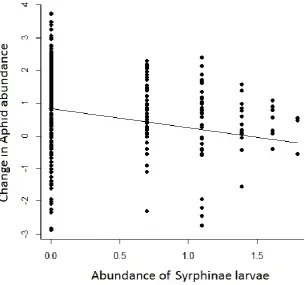
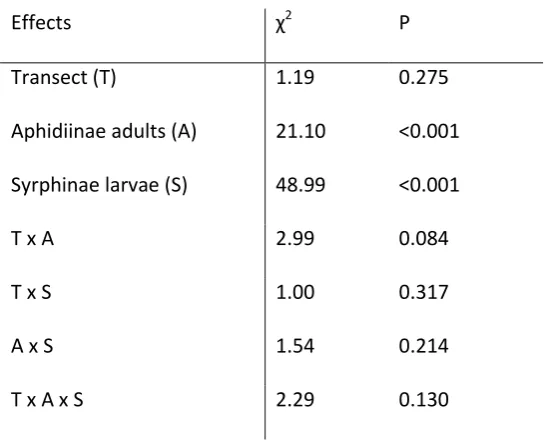
The change in number of cereal aphids caught over time was not affected by distance into the crop, but was significantly affected by the abundance of natural enemies in the previous two weeks (Table 1). As the abundance of Aphidiinae or Syrphinae larvae increased, the aphid population growth slowed (Figure 2 ab).
##Figure 2 ab ##
There was no significant interaction between the two natural enemy groups. From the model it is possible to estimate the average number of natural enemies collected in previous weeks that correlates with no change in the number of aphids collected, i.e. no increase in aphid population. The collected number of Aphidiinae associated with no change in aphid catch was 2.86 ± 0.09 per trap, while the number of Syrphinae larvae was 3.33 ± 0.11 per trap.
##Table 1##
9 Our results show that the number of natural enemies trapped correlated with the subsequent change in cereal aphid abundance. We found that in this respect, increase abundance of natural enemies recorded led to a reduction in the rate of change of aphids caught. The relationship between natural enemies and subsequent abundance of aphids caught in cereal fields was unaffected by location, either at 10 metres or 100 metres from the field boundary.
On average, where no Syrphinae larvae or Aphidiinae were trapped the subsequent number of aphids collected increased. The presence of either natural enemies reduced the rate of increase. The importance of natural enemies in preventing invertebrate pest outbreaks is well recognised (Chambers and Adams, 1986). Despite this, their population levels are not considered in current pest threshold models and limited targeted actions are taken to promote them in arable crops (Kean et al., 2003, Ramsden et al., 2014). Our results also indicate that increasing numbers of natural enemies can have an increasing impact on the reducing aphid abundance. This further supports the provision of additional resources in agro-ecosystems through conservation biological control (Olson and Wäckers, 2006).
Syrphinae larvae and Aphidiinae were found to impact aphid numbers in both the boundary and interior of the crop. In previous field experiments, epigeal natural enemy populations were shown to have limited dispersal from alternative habitats at the field boundary, and this is
10 commute between the crop and non-crop vegetation to feed on pollen - a vital source of proteins for egg maturation, and nectar for sustenance (Hogervorst et al., 2007; Choate and Lundgren, 2013; Van Rijn et al., 2013; van Rijn and Wäckers, 2016). Aphidiinae do not exploit adult protein sources, but do require carbohydrates for survival. While honeydew from their aphid hosts is widely utilised by these parasitoids, floral nectar found outside the crop can be superior to honeydew for sustaining adults and will be of particular relevance under conditions of low host availability (Wäckers, 2000; Lee et al., 2004; Wäckers et al., 2008). Individual parasitoids are unlikely to commute in and out of the crop, and it is more likely that in this study the aphid populations were sufficient to support the Aphidiinae population up to 100 m from the crop margin. Both Syrphinae and Aphidiinae
populations would benefit from additional resource provision during periods of the year when cereal aphid populations are not widely available (Karley et al., 2004; Roitberg and Gillespie, 2014;
Ramsden et al., 2014).
Cereal aphids overwinter outside the crop in habitats such as grass margins, which can provide a significant source of infestation in adjacent crops, leading to initially higher pest levels close to field boundaries (Lewis, 1969; Vialatte et al., 2007). The original source of infestation has little effect on subsequent within-field aphid distribution and abundance (Winder et al., 1999; Vialatte et al., 2005; Al Hassan et al., 2013), and the continuous re-infestation of the crop by alate aphids throughout the season contributes to high variation within fields and over time, as we observed in this study (Cocu et al., 2005; Vialatte et al., 2005; Klueken et al., 2009). This variation makes it difficult to assert whether or not infestations will lead to a reduction in yield and limits the reliability of current thresholds. Furthermore, current UK treatment threshold do not account for the impact of environmental conditions, such as plant health or the presence of natural enemies
11 thresholds are essential in making them implementable, confidence in over-simplistic thresholds is limited. The absence of natural enemy contribution from these thresholds also undermines efforts to promote IPM strategies, and encouraging risk-averse application of insecticides.
Our study indicates that increasing abundance of natural enemies has a significant impact on reducing subsequent aphid population growth rates, suggesting that the abundance of natural enemies in the crop should be considered as an important factor in the decision to apply insecticides. More research is needed to make thresholds for treatment accurate and
implementable, and the incorporation of natural enemies into agronomic decision making could help reduce the reliance on insecticides at a time when restrictions on chemical applications is increasing (Griffiths et al., 2008; Caballero-López et al., 2012; Hillocks, 2012; Holland et al., 2012; Popp et al., 2013). A key challenge remains the convenience and low purchase cost of insecticide applications and the fact that environmental and long term costs of pesticide use are not incorporated in the price of insecticides.
In our study we did not relate aphid catch rates to numbers of aphids on the crop, or assess impact on yield. To establish crop protection programmes that account for biological control further work is needed to investigate the implications of tri-trophic interactions on yield loss. The water traps used are likely to have underestimated the abundance of Syrphinae larvae (Bowie et al. 2001), however, as we were not comparing abundance across different habitats the relative catch rate remains a valid method for monitoring these predators. We only assessed the impact of two natural enemies in this work, as other important predators (e.g. Chrysoperla carnea (Stephens) (Neuroptera: Chrysopidae)) were not collected in sufficient abundance on which to carry out analysis. As the relative importance of different natural enemy species change with agricultural landscapes over time, multi-year experiments would be useful in exploring the impact of other beneficial species (Tscharntke et al. 2007).
12 Our aim was to provide evidence for the role of natural enemies in reducing aphid pest abundance in cereal crops, and investigate whether this was limited at the field scale by distance from the field margin. We found that as the number of natural enemies caught increased, the subsequent growth rate of cereal aphid population caught was reduced. The relationship between natural enemy abundance and subsequent aphid abundance was unaffected by distance into a field from the boundary. Long-term studies need to relate the contribution of biological control to reducing yield losses, however, the results of this study provide further evidence that natural enemy abundance should be a factor in decisions to apply insecticide treatments to pest infestations. They also suggest that targeted resource provision for natural enemies has the potential for improving biological control of cereal aphid, though impacts must always be considered in the context of the landscape matrix in which they are placed.
Acknowledgments:
This project was funded by Biotechnology and Biological Sciences Research Council. We are grateful for the time and effort that Chris Bucknell, Paul Sigley and Steve Berry put into providing assistance with the management of the land used in the study, and to Jeffery Pullinger for his assistance in the field. We thank Steve Ellis and Rosie Burdon for their comments on the work, and are grateful for the constructive comments of three anonymous reviewers.
References
AHDB (2014) Encyclopaedia of pests and natural enemies in field crops. AHDB 2014, 200pp
Almohamad, R., Verheggen, F.J., Francis, F. and Haubruge, E. (2007) Predatory hoverflies select their oviposition site according to aphid host plant and aphid species. Entomologia Experimentalis et Applicata, 125, 13–21.
13 Bailey, A.S., Bertaglia, M., Fraser, I.M., Sharma, A. and Douarin, E. (2009) Integrated pest
management portfolios in UK arable farming: results of a farmer survey. Pest management science, 65, 1030–9.
Bass, C., Puinean, A.M., Zimmer, C.T., Denholm, I., Field, L.M., Foster, S.P., et al. (2014) The evolution of insecticide resistance in the peach potato aphid, Myzus persicae. Insect Biochemistry and
Molecular Biology, 51, 41–51.
Batáry, P., Holzschuh, A., Orci, K.M., Samu, F. and Tscharntke, T. (2012) Responses of plant, insect and spider biodiversity to local and landscape scale management intensity in cereal crops and grasslands. Agriculture, Ecosystems and Environment, 146, 130–136.
Bates, D. and Maechler M. (2012) Linear mixed-effects models using S4 classes. CRAN.
system processes and services via functional traits. Biodiversity and Conservation, 19, 2873–2893. Blackman R.L. and Eastop V.F. (2000) Aphids on the world’s crops: An identification and information guide, 2nd edition. John Wiley & Sons, Chichester, 414 pp., 59 figs, 51 plates
Bommarco, R., Kleijn, D., and Potts, S.G. (2013) Ecological intensification: harnessing ecosystem services for food security. Trends in Ecology and Evolution, 28, 230–238.
Bowie, M.H. (1999) Effects of distance from field edge on aphidophagous insects in a wheat crop and observations on trap design and placement. International Journal of Pest Management, 45, 69–73. Bowie M.H., Gurr M., and Framptthreshold
parasitoid fauna in wheat in New South Wales, Australia. New Zealand Entomologist, 24, 3-6
Bruce, T.J.A. (2010) Tackling the threat to food security caused by crop pests in the new millennium.
Food Security, 2, 133–141.
14 Chambers, R.J. and Adams, T.H.L. (1986) Quantification of the impact of hoverflies (Diptera,
Syrphidae) on cereal aphids in winter wheat: an analysis of field populations. The Journal of Applied Ecology, 23, 895–904.
Chaplin-Kramer, R., Valpine, P. de, Mills, N.J. and Kremen, C. (2013) Detecting pest control services across spatial and temporal scales. Agriculture, Ecosystems and Environment, 181, 206–212.
Choate, B.A. and Lundgren, J.G. (2013) Why eat extrafloral nectar? Understanding food selection by Coleomegilla maculata (Coleoptera: Coccinellidae). BioControl, 58, 359–367.
Cocu, N., Harrington, R., Hulle, M. and Rounsevell, M.D.A. (2005) Spatial autocorrelation as a tool for identifying the geogrpahical patterns of aphid annual abundance. Agricultural and Forest
Entomology, 7, 31–43.
Crawley, M. J. (2007) Data Input, in The R Book, John Wiley & Sons, Ltd, Chichester, UK.
Foster, S.P., Paul, V.L., Slater, R., Warren, A., Denholm, I., Field, L.M. and Williamson, M.S. (2014) A mutation (L1014F) in the voltage-gated sodium channel of the grain aphid, Sitobion avenae, is associated with resistance to pyrethroid insecticides. Pest Management Science, 70, 1249-1253 George, K.S. and Gair, R. (1979) Crop loss assessment on winter wheat attacked by the grain aphid,
Sitobion avenae, (F.), 1974-77. Plant Pathology, 28, 143-149.
Geiger, F., Bengtsson, J., Berendse, F., Weisser, W.W., Emmerson, M., Morales, M.B., Ceryngier, P., Liira, J., Tscharntke, T., Winquist, C., Eggers, S., Bommarco, R., Part, T., Bretagnolle, V., Plantegenest, M., Clement, L.W., Dennis, C., Palmer, C., Onate, J.J., Guerrero, I., Hawro, V., Aavik, T., Thies, C., Flohre, A., Hanke, S., Fischer, C., Goedhart, P.W., and Inchausti, P. (2010) Persistent negative effects of pesticides on biodiversity and biological control potential on European farmland. Basic and Applied Ecology, 11, 97-105.
15 Goulet, H. and Hubert, J. F. (1993) Hymenoptera of the world. An identification guide to families. — Research Branch, Agricultural Canada Publication. Canada Communication Group-Publishing, Ottawa. 668 Seiten. Griffiths, G.J.K., Holland, J.M., Bailey, A. and Thomas, M.B. (2008) Efficacy and economics of shelter habitats for conservation biological control. Biological Control, 45, 200–209. Hågvar, E.B. and Hofsvang, T. (1991) Aphid parasitoids (Hymenoptera, Aphidiidae): biology, host selection and use in biological control. Biocontrol News and Information, 12, 13–41.
Hassan, D. Al, Georgelin, E., Delattre, T., Burel, F., Plantegenest, M. and Kindlmann, P. (2013) Does the presence of grassy strips and landscape grain affect the spatial distribution of aphids and their carabid predators? Agricultural and Forest Entomology, 15, 24–33.
Hillocks, R.J. (2012) Farming with fewer pesticides: EU pesticide review and resulting challenges for UK agriculture. Crop Protection, 31, 85–93.
Hogervorst, P.A.M., Wäckers, F.L. and Romeis, J. (2007) Detecting nutritional state and food source use in field-collected insects that synthesize honeydew oligosaccharides. Functional Ecology, 21, 936–946.
Holland, J.M., Oaten, H., Moreby, S., Birkett, T., Simper, J. and Southway, S. (2012) Agri-environment scheme enhancing ecosystem services: A demonstration of improved biological control in cereal crops. Agriculture, Ecosystems and Environment, 155, 147–152.
Hӧller, C.A. (1991) Evidence for the existence of a species closely related to the cereal aphid parasitoid Aphidius rhopalosiphi De Stefani-Perez based on host ranges, morphological characters, isoelectric focusing banding patterns, cross-breeding experiments and sex pheromone specificities (Hymenoptera, Braconidae, Aphidiinae). Systematic Entomology, 16, 15-28
Howard, M. T. and Dixon, A. F. G. (1995) Factors determining the pest status of the rose-grain aphid,
16 Jacquemin, G., Chavalle, S. and Proft, M. De. (2014) Forecasting the emergence of the adult orange wheat blossom midge, Sitodiplosis mosellana (Géhin) (Diptera: Cecidomyiidae) in Belgium. Crop Protection, 58, 6–13.
Karley, A. J., Parker, W.E., Pitchford, J.W. and Douglas, A. E. (2004) The mid-season crash in aphid populations: Why and how does it occur? Ecological Entomology, 29, 383–388.
Kean, J., Wratten, S., Tylianakis, J. and Barlow, N. (2003) The population consequences of natural enemy enhancement, and implications for conservation biological control. Ecology Letters, 6(7), pp.604-612.
Klueken, A.M., Hau, B., Ulber, B. and Poehling, H.M. (2009) Forecasting migration of cereal aphids (Hemiptera: Aphididae) in autumn and spring. Journal of Applied Entomology, 133, 328–344.
Landis, D.A., Wratten, S.D., and Gurr, G.M. (2000) Habitat management to conserve natural enemies of arthropod pests and in agriculture. Annu. Rev. Entomol. 45, 175–201.
Larsson, H. (2005) A crop loss model and economic thresholds for the grain aphid, Sitobion avenae (F.), in winter wheat in southern Sweden. Crop Protection, 24, 397–405.
Laubertie, E. A., Wratten, S.D. and Sedcole, J.R. (2006) The role of odour and visual cues in the pan-trap catching of hoverflies (Diptera: Syrphidae). Annals of Applied Biology, 148, 173–178.
Leather, S.R., Walters, K.F.A., and Dixon, A.F.G. (1989) Factors determing the pest status of the bird cherry-oat aphid, Rhopalosiphum padi (L.) (Hemiptera: Aphididae), in Europe: a study and review.
Bulletin of Entomological Research, 79, 345-360.
Lee, J.C., Heimpel, G.E. and Leibee, G.L. (2004) Comparing floral nectar and aphid honeydew diets on the longevity and nutrient levels of a parasitoid wasp. Entomologia Experimentalis et Applicata, 111, 189–199.
Lewis, T. (1969) The diversity of the insect fauna in a hedgerow and neighbouring fields. Journal of Applied Ecology, 6, 453-458.
17 Olson, D.M. and Wäckers, F.L. (2006) Management of field margins to maximize multiple ecological services. Journal of Appllied Ecolology, 44, 13–31.
Paré P.W. and Tumlinson J.H. (1999) Plant Volatiles as a Defense against Insect Herbivores. Plant Physiology, 121, 325-332
Pineda, A. and Marcos-Garcia, M., A. (2008) Use of selected flowering plants in greenhouses to enhance aphidophagous hoverfly populations (Diptera: Syrphidae). Annales De La Societe Entomologique De France, 44, 487–492.
Popp, J., Peto, K. and Nagy, J. (2013) Pesticide productivity and food security. A review. Agronomy for Sustainable Development, 33, 243–255.
Powell, W. (1982) The identification of hymenopterous parasitoids attacking cereal aphids in Britain.
Systematic Entomology, 7, 465-473
Powell W., and Zhi-Li Z. (1983) The reactions of two cereal aphid parasitoids, Aphidius uzbekistanicus
and A. ervi, to host aphids and their food-plants. Physiological Entomology, 8, 439-443
Pungerl N.B. (1986) Morphometric and electrophoretic study of Aphidius species (Hymenoptera: Aphidiidae) reared from a variety of aphid hosts. Systematic Entomology, 11, 327-354
R Development Core Team (2005) R: A Language and Environment. R Foundation for Statistical Computing, Vienna, Austria ISBN 3-900051-07-0.
Ramsden, M.W., Menéndez, R., Leather, S.R. and Wäckers, F. (2014) Optimizing field margins for biocontrol services: The relative role of aphid abundance, annual floral resources, and overwinter habitat in enhancing aphid natural enemies. Agriculture, Ecosystems and Environment, 199, 94–104. Reisig, D.D., Bacheler, J.S., Herbert, D.A., Kuhar, T., Malone, S., and Philips, C. (2012) Efficacy and value of prophylactic vs. integrated pest management approaches for management of cereal leaf beetle (Coleoptera: Chrysomelidae) in wheat and ramifications for adoption by growers. Journal of Economic Entomology, 105, 1612–1619.
18 Rijn, P.C.J. Van, Kooijman, J. and Wäckers, F.L. (2013) The contribution of floral resources and
honeydew to the performance of predatory hoverflies (Diptera: Syrphidae). Biological Control, 67, 32–38.
Rijn P.C.J. Van, and Wäckers, F.L. (2016) Nectar accessibility limits fitness, flower choice and abundance of zoophagous hoverflies. Journal of Applied Ecology, 53, 925-933
Roitberg, B.D. and Gillespie, D.R. (2014) Natural enemies on the landscape - Integrating life-history theory and landscapes. Biological Control, 75, 39–47.
Sabatier, R., Meyer, K., Wiegand, K. and Clough, Y. (2013) Non-linear effects of pesticide application on biodiversity-driven ecosystem services and disservices in a cacao agroecosystem: A modeling study. Basic and Applied Ecology, 14, 115–125.
Sadeghi, H. and Gilbert, F. (2000) Aphid suitability and its relationship to oviposition preference in predatory hoverflies. Journal of Animal Ecology, 69, 771–784.
Shaw, M.R. and Huddleston, T. (1991) Classification and Biology of Braconid Wasps. Handbooks for the identification of British Insects, 7. Royal Entomological Society of London, London.
Stubbs, A.E. and Falk, S. (2002) British hoverflies, an illustrated identification guide. Second edition. British Entomological and Natural History Society, Reading.
Sutherland, J.P., Sullivan, M.S. and Poppy, G.M. (2001) Distribution and abundance of
aphidophagous hoverflies (Diptera: Syrphidae) in wildflower patches and field margin habitats.
Agricultural and Forest Entomology, 3, 57–64.
Tremblay, A. (2012) A suite of functions of back-fit effects and forward-fit random effects, as well as other miscellaneous functions. CRAN.
19 Vialatte, A., Dedryver, C.-A., Simon, J.-C., Galman, M. and Plantegenest, M. (2005) Limited genetic exchanges between populations of an insect pest living on uncultivated and related cultivated host plants. Proceedings of the Royal Society B: Biological Sciences, 272, 1075–1082.
Vialatte, A., Plantegenest, M., Simon, J.C. and Dedryver, C.A. (2007) Farm-scale assessment of movement patterns and colonization dynamics of the grain aphid in arable crops and hedgerows.
Agricultural and Forest Entomology, 9, 337–346.
Vorley, V.T., and Wratten, S.D. (1987) Migration of parasitoids (Hymenoptera: Braconidae) of cereal aphids (Hemoptera: Aphididae) between grassland, early-sown cereals and late-sown cereals in southern England. Bulletin of Entomological Research, 77, 555-568
Wäckers, F.L. (2000) Do oligosaccharides reduce the suitability of honeydew for predators and parasitoids ? A further facet to the function of insect-synthesized honeydew sugars. Oikos, 90, 197– 201.
Wäckers, F.L., Rijn, P.C.J. van and Heimpel, G.E. (2008) Honeydew as a food source for natural enemies: Making the best of a bad meal? Biological Control, 45, 176–184.
Winder, L., Perry, J.N. and Holland, J.M. (1999) The spatial and temporal distribution of the grain aphid Sitobion avenae in winter wheat. Entomologia Experimentalis Et Applicata, 93, 277–290. Zhang W., and Swinton S. (2009) Incorporating natural enemies in an economic threshold for dynamically optimal pest management. Ecological Modelling, 220, 1315-1324
20 Figure 1: The overall mean number of cereal aphids per trap ±SE. (χ2 =3.4107, p=0.066).
a)
21 Figure 2. The change in aphid abundance (log transformed) against the abundance (log
22 Table 1. Results of Generalised linear mixed models (χ2 provided, see methods) for the effect of position within the crop (boundary v centre) and abundance of three natural enemies in the previous two weeks, on the change in aphid abundance in cereal fields, and the effect of the interactions between these factors. For all groups, sample size = 90 traps (nested in 9 fields and 3 farms).
Effects χ2 P
Transect (T) 1.19 0.275
Aphidiinae adults (A) 21.10 <0.001 Syrphinae larvae (S) 48.99 <0.001
T x A 2.99 0.084
T x S 1.00 0.317
A x S 1.54 0.214
23 Supplementary Tables:
Supplementary Table 1: The species of Syrphinae and Aphidiinae adults identified in during the study.
Natural enemies identified Number identified
Syrphinae (adults) Diptera: Syrphidae: Syrphinae (1)
Platycheirus manicatus 4
Platycheirus ckyoeatus 6
Syrphini ribesii 11
Episyrphus balteatus 17
Aphid parasitoids (adults) Hymenoptera: Braconidae: Aphidiinae (2)
Aphidius ervi 57
Aphidius rhopalosiphi 49
Praon volucre 41
Praon gallicum 23
Aphidius pocopes 9
Aphidius uzbekistanicus 6
Ephedrus plagiator 7
Other Aphidius spp. 32
Other Praon spp. 17
Other Aphidiinae spp. 38
Indeterminate 36
(1) Total number identified during sampling period.