Modern Large-Scale Computer System Design
· .
.
Walter F. Bauer
Logical and Combinatorial Problems in Computer Design
· . . Robert McNaughton
Transistorized Magnetic Core Memory
, , \ '
GUIDED MISSILE
RESEARCH and DEVELOPMENT
A major guided missile research and development program has several significant characteristics that are of particular interest to the scientist and engineer.
First, it requires concurrent development work in a number of dif-ferent technical areas such as guidance and control, aerodynamics, struc-tures, propulsion and warhead. Each of these large areas in turn contains a wide variety of specialized technical activities. As an example, digital computer projects in the guidance and control area involve logical design, circuit design, programming, data conversion and handling, component and system reliability, input-output design, and environmental and mechanical design.
A second characteristic is frequently the requirement for important state-of-the-art advances in several of the technical areas. For instance, the supersonic airframe needed for a new missile may rlecessitate not only novel theor:etical calculations, but also the design and performance of new kinds of experiments.
A third characteristic of missile development work is that such close interrelationships exist among the various technical areas that the entire project must be treated as a single, indivisible entity. For example, what is done in the guidance portion of the system can affect directly what must be done in the propulsion and airframe portions of the system, and vice versa.
These characteristics make it dear why such work must be organized around strong teal11s of scientists and engineers. Further, for such teams to realize their full potential, they must be headed by competent scientists and engineers to provide the proper technical management. And finally, all aspects of the organization and its procedures must be tailored care-fully to maximize the effectiveness of the technical people.
Principles such as these have guided The Ramo-Wooldridge Corpora-cion in carrying out its responsibility for overall systems engineering and technical direction for the Air Force Intercontinental and Intermediate Range Ballistic Missiles. These major programs are characterized by their importance to the national welfare and by the high degree of challenge they offer to the qualified engineer and scientist .
.
. . .
. .
. .
...
.
"...
"...
"...
.,.
,.....
"...
,....
.,.
Openings exist for scientislf and engineer; in these fields 0/
current activity:
Guided Missile Research and Development Aerodynamics and Propulsion Sy$iems Communications SY$tems
Automation and Data Processing Digital Computers and Control Systems Airborne Electronic and Control Systems
COMPUTERS
AND
CYBERNETICS
•
ROBOTS
•
AUTOMATION
AUTOMATIC CONTROL
Vol. 6, No. 1
January,1957
ESTABLISHED SEPTEMBER, 1951
Part 1 (separate part):
ARTICLES
Modern Large Scale Computer System Design
Logical and Combinatorial Problems
in Computer Design
Transistorized Magnetic Core Memory
REFERENCE INFORMATION
New Patents
FORUM
1957
Western Joint Computer Conference, Los Angeles,
Feb.
26-28, 1957,
and Association for Computing
Machinery Symposium, March
1IBM
Yorktown Research Center
The Editor's Notes
Index of Notices
Advertising Index
Walter F. Bauer
Robert McNaughton
Bell Telephone Labs.
Part
2(separate part):
EDUCATION AND COMPUTERS
ARTICLES
Education for Automation
Social and Public Relations' Responsibilities
of the Computer Industry
High School Science Education
Objective Measures of Education
FORUM
Hughes to Give Fellowships to 200 in Science
The Editor's Notes
Alston S. Householder
Jay Wo Forrester
Richard W. Melville
Donald Truitt
Editor: Edmund C. Berkeley Assistant Edi tors: Neil D. ~Iacdonald, F. L. Walker
Contributing Editors: Andrew D. Booth, John M. Breen, John W. carr, III, Alston S. Householder Advisory Committee: Part 1 _ Samuel B. Williams, Herbert F. Mitchell Jr.
Part 2 - Howard T. Engstrom, Alston S. Householder
Publisher: Berkeley Enterprises, Inc.
815 Washington Street, Newtonville 60. Mass. - Decatur 2-5453 or 2-3928
Advertising Representatives:
New York - Milton L. Kaye, 601 Madison Ave., New York 21, N.Y., Plaza 5-4680 San Francisco - W. A.Babcock, 605 Market St., San Francisco 5, Calif., Yukon 2-3954
8
30
26
42.
28
31
6 6
46
51
52
55
60
63
50
Los Angeles - Wentworth F. Green, 439 So. Western Ave., Los Angeles 5, Calif., Dunkirk 7 -8135 Elsewhere - the Publisher
COMPUTERS AND AUIDMATION is published monthly. Copyright, 1957,. by Berkeley Enterprises, Inc.
Subscription rates~ in the United States - one year $5.50, two years SlO.50~ in Canada - one year $6.00, two years 511.50; elsewhere - one year $6.50, two years $12.50
Entered as second class matter at.;~ Post Office, New York, N.Y.
-New
lIIiniatare diod.
constraction
fOI
cool operation
Now, designers can incorporate Sylvania's
new miniaturized diode in equipment where
space is at a premium. It meets the standard
Retma outline of .105" maximum diameter and
.265" maximum over-all length and meets
re-quirements for automatic production methods.
Its cQnstruction inherently assures greater
reliability and superior performance.
Shown
actual
size
Metal eyelet-fused to glass
tubing-provides strong
con-struction and builds
in
pro-vision for cooler
oper~tion.In Sylvania's metal to-glass
p~ckage,
heat is dissipated
by
the eyelets and leads.
"
::'
~ ,---~
featares metal-to-.,Iass
~a"gedness
and
Nickel-plated Steel pin -
butt-welded to copper lead adds
structural strength and provides
coupli?g between the internal
Ide structure and the metal eyelet for greater
it dissipation. Nickel plating insures strong
Ids, and good solder sealing.
New whisker mounting-The
use of a crimp hold rather than
impulse weld to mount the
whisker eliminates the
possibil-in production of overheatpossibil-ing the tungsten
isker. ,Thus, the conductive properties
re-lin
undisturbed, assuring more reliable
per-mance over longer life.
~
A
Smooth Solder Seal-is
possible
" '
only with glass-to-metal
con-, '
struction. It adds reliability by
preventing cracks and chips
when leads are bent at right angles for
mount-ing
in
printed circuit boards.
r---,
I
Write for complete details on thisI
I important new diode development. I
I
L _________________________ Address Dept. A22R JI
SYLVANIA ELECTRIC PRODUCTS INC.
1740 Broadway, New York 19, N. Y.
In Canada: Sylvania Electric (Canada) Ltd. Shell Tower Bldg., Montreal
THE
EDITOR'S NOTES
EDUCATION AND COMPUTERS - I
This issue of "Computers and Automation", vol. 6, no. 1, starts our sixth year of publication. For the first time we publish an issue in two parts, Part 1, a regular issue, and Part 2, "Education and Computers, Report No.1". Why?
At the Eastern Joint Computer Conference in New York, December 10 to 12, at the luncheon for the press on December 10, at the co c k tail party that evening, at the meeting of the Council of the Association for Computing Machinery the evening of December 11, and at the meeting of the Joint Computer Conference Committee the evening of December 12, your editor not ice d among other things a sense of concern and urgen-cy and even distress about something new. The subject was not machines, nor scientific frontiers in machines, nor programming - but people. The marvelous machines that we in the computer field have been making, the marvelous promises of help that these machines offer to human beings and their enterprises, are setting up a vast de-mand for people to come into the computer field. And not just any people, but educated people. Nearly every organization in the computer field is trying to hire educated people.
And of course the computer field is not alone in needing educated people. The aircraft industry, the electronics industry generally, a great many branches of science, the executive ranks of bus-iness and industry, the teaching profession itself - all are hunting for educated people. In "Com-puters and Automation" for July we published some sad but important comparisons, which we repeat in Part 2 of this issue on page 50.
It has never been a policy of ours to "1 e t George do it". Here is a need where "Computers and Automation" might help. Let's try. Part 2, "Education and Computers, Report No.1" is the first step in trying. We hope there will be many more steps we can take. You, our readers -please write us, tell us, advise us.
WHO'S WHO IN THE COMPUTER FIELD, 1956-7
Here is a brief report as of December 20 (January issue press time) on the status of "Who's Who in the Computer Field, 1956-7". (This is an extra number of "Computers and Automation" ,
6
-price $15, to be published early in 1957, which we expect will contain names, addresses, and some information for an estimated 10,000 com-puter people.) We have received several thous-and Who's Who entry forms, including, for ex-ample, 62 from Ramo- Wooldridg_e alone. We have collated these entry forms with -all names and addresses of persons whom we know of as inter-ested in computers, and all Who's Who entries published June 1955 and later. We are bus ily producing final copy for the first part of the al-phabet. It now looks as if we may get the Who's Who to press in January.
As to orders, we have received to date about 130, or about 1/4 of what we estimated we would receive by this time. Evidently, not many people want the Who's Who, and it looks again like an unre asonable undertaking.
*
*
*
SPECIAL ISSUES OF
~~COMPUTERS
AND
AUTOMATION"
The Junp issue of "Computers and Automa-tion" in each year commencing with 1955 is a special issue, "The Computer Directory", con-taining a cumulative "Roster of Organizations" and a cumulative "Roster of Products and Services in the Computer Field", and other reference in-formation.
In early 1957, we shall publish Edition No. 2 of a cumulative "Who's Who in the Computer Field", as an extra number of "Computers and Automation". For more information, see page 38.
* - - - *
---*
INDEX OF NOTICES
For Information on.: Adve rtising Index Advertising Rates and
Specifications Back Copies
Bulk Subscription Rates Manuscripts
Reader's Inquiry Form Special Issues
See Page: 46 44
40 34 see Nov. issue
46
6
..
ffu
electro~i
net'W'ork
·~::~;:;~tion4
of autoInated factories
Think of it . . . Completely automatic factories, hun-dreds of miles apart, all operated by a single Remington Rand Univac@ computing system. Flow of materials, processing, quality control, packaging, even market analysis, controlled from the electronic "brain center" . . . control so complete that when a shift in the wind changes the draft of a chimney at a distant plant, the computer corrects the firing of a boiler.
Far fetched? Not at Univac. The Univac team of scientists, engineers and technicians has already de-signed the completely automatic facto~y. They have built a computer (Univac Scientific) capable of remote control of ten to a hundred factories. The next step-central control of chains of automated plants-will completely revolutionize· American industry.
This is the kind of challenge that awaits you at Univac. As a Univac engineer or technician you'll find top salaries, excellent working conditions and opportunities unlimited-unlimited as the future of Univac itself.
@Reg. U.S. Pat. Off.
IMMEDIATE OPENINGS FOR
ELECTRONIC CIRCUIT DESIGNERS -To utilize such new circuit elements as transistors and magnetic amplifiers in high speed digital computing circuits. RR degree or equivalent experience required. Pulse circuit techniques, particularly such as are ac-quired in radar, telemetering, guided missiles or TV will satisfy many of our requirements .
MAGNETIC CORE MEMORY - For memory core and general mag-netic testing projects. Degree in 'B.E. or equivalent plus circuitry experience. To be responsible for program.
LOGICAL DESIGNERS - Experi~nce in logical design of digital computers.
MECHANICAL ENGINEERS (ELECTRO) - Development of computer input-output devices and servo-mechanisms. Research and de-velopment work in the field of small, high speed, electrically-actuated mechanisms where ultra reliability is a must.
PHYSICISTS - For research and development of new circuits. CHEMISTS-Inorganic or physical. Minimum of 5 years' experience.
TECHNICAL PUBLICATION ENGINEERS-Engineers with background in circuitry mathematics or symbolic logic with writing experience.
Send Complete Resume to:
~R.nd~
DIVISION OF SPERRY RAND CORPORATION at anyone of these four plant locations.
D. A. BOWDOIN FRANK KING CAL BOSIN Dept. PJ·15 Dept. NJ-15 Dept. YJ-15 2300 W. Allegheny Ave. WIlson Avenue 315 Fourth Ave. Philadelphia, Pa. South Norwalk, Conn. New York City
MODERN 'LARGE
SCALE COMPUTER SYSTEM
DESIGN
WALTER F. BAUER The Ramo-Wooldridge Corporation
Los Angeles, Calif.
(This report arises from lectures the author has given in the special summer sessions on computers given at the University of Michigan in 1954, 1955 and 1956.)
The objective of this report is to provide a survey of modern computer system design tech-nology especially as it pertains to the use of large-scale systems for commercial and scientific pur-poses. The areas to be discussed are: Memory Devices, Information Storage and Internal Check-ing, Operating Speeds, Instruction Logic, and
In-put-Output and Off-Line Equipment. The compon-ents or design aspects of a number of modern com-puter systems will be referred to including the IBM-701, IBM-704, IBM-705, NORC, BIZMAC, UNIVAC I, UNIVAC II, Univac Scientific Mod e 1 s 1103 and 1103A, and the LARC. These are the computers available for rent or purchase, or built by organizations which rent or sell cornputers. Occasionally other computers will be referred to. Under System Design, the Project ERMA machine and the Office of Air Controller machine will be briefly discussed. In this survey and comparison, empht:.sis will be place d on the unusual or especial-ly commendable aspects of the system.
Conspicuous by its absence here is a Biblio-graphy of articles on the various machines and techniques presented. In this most rapidly chang-ing field, most new developments are almost never found in books, and are seldom found in journals.
The information recorded here was gained through reading manufacturers' reports and brochures, through discussions with manufacturers' agents, and through conversations with computer people generally. Manufacturers' reports, brochures, and discussions are available for the asking.
Memory Devices
The first operating stored program comput-er, the SEAC computer of the National Bureau of Standards, was equipped with mercury delay line memory. A short time later the ERA-l101 computer appeared with its magnetic drum mem-0ry. Again within approximately one year's time, the first cathode ray tube storage machines a p
8
-peared, the first one of which, and most notable, was the Whirlwind I computer at M. I. T. The fam-ily of Institute for Advanced Study machines in-volved the Williams tube-type storage which was somewhat different in design from that of th e M. I. T. storage tube design. More recently the trend is toward the magnetic core memory. The first machines of commercial availability which were produced with magnetic core memories were the Univac Scientific, Model 1103 computers, and the first one delivered went to the Operations Re-search Office of Johns Hopkins University in July, 1954. All succeeding 1103 type computers and the 1103A types to follow have magnetic core memor-ies. With the more modern computers, again com-mercially available, the IBM-702 had electrostatic storage as did the 701. The 704 and 705 are equipped with magnetic core memories. The UNIV AC I is the only computer ever produced com-mercially with a mercury delay line type memory. Its successor, the UNN AC II, to become available this year will involve a magnetic core memory for the basic high-speed internal storage device.
Systea DesiA!J two weeks, while the maximum interval went up
from a few days to approximately six weeks. Spec-ific memory maintenance time .was reduced from a large figure to a couple hours per month". Thus, the reliability measured in tel"ms of intervals be-tween parity alarms or as represented by mainten-ance time increased by a factor of at least 10 in
this case. Since probably upwards of 70% of the down time caused by electronic component failure (not including electro-mechanical devices) of a computer can be attributed to memory device fail-ures' overall computer reliability will jump con-siderably.
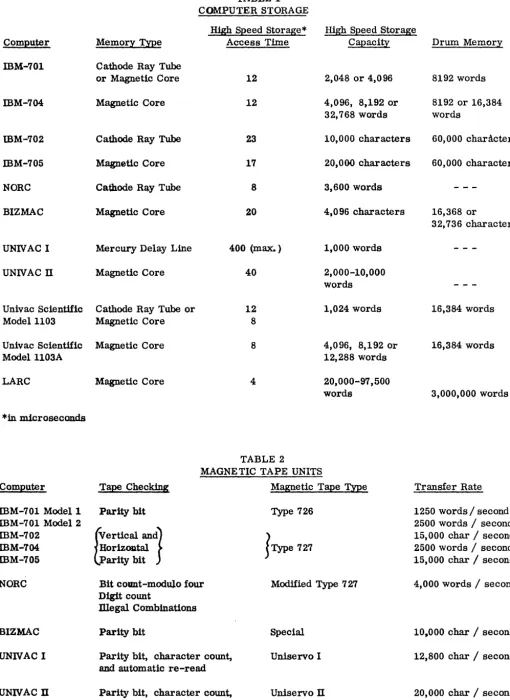
Besides the advantages over electrostatic and mercury delay line type memories in areas of reliability, magnetic cores offer a tremendous speed a,dvantage. The average access time with the mercury delay lines in the SEAC computer is 192 microseconds. This can be compared with the 6-10 microseconds access time with the core memories. Magnetic cores offer only a slight mar-gin of greater speed over electrostatic types since electrostatic memories usually operate in the 10 or 12 microsecond region (some considerably highr er), whereas magnetic cores operate in the 6-8 microsecond region. Specifications and character-istics of a number of modern computers are given in Table 1. The 4 microsecond memory cycle of the LARC computer as presnted there is essent-ially
an
effective cycle since the design is s u c h that there is a 2 microsecond overlap between the next operation and the last 2 microseconds of the normal 6 microsecond cycle time of the memory - that is, the normal memory cycle involves something like the following: 2 microseconds for select and 2 microseconds for the destructive read. Selection of the next read is performed simultan-eously with re-writing the information destructed in the reading operation.It is generally agreed among computer de-signers that the conventional ferrite core cannot be switched at speeds which would result in basic cycles considerably less than 4 microseconds. Certain investigations continue in the direction of non-destructive read techniques. Also, it is ex-pected that the future will show shorter memory accesses with a magnetic device, called the "film wafer". In this technique, the resulting magnetic field is extremely low in power and consequently can be switched at extremely high rates. Signal amplification and reliability will be the critical obstacles in this development.
Memory sizes are increasing as f~st as memory speeds. The conventional high-speed
computer for scientific purposes has 4,096 words of magnetic core storage with options of 8,000 and 12,000 words, and in some cases an optional 32,000 word core memory. Table 1 lists the memory sizes, available, together with certain optional sizes. High capacity, ultra-high access memories are necessary in scientific computing activities. Most large-scale scientific installations are happy with 4,000 to 8,000 words o~ high-speed storage. 'The IBM Corporation has announced the future availability of a 32,000 word magnetic core storage. The three options available are 4,000, 8,000, and 32,000 words with respective monthly rental figures of approximately $6,000.00, $12,000.00 and $15,000.00. The difference in rental . price between 8,000 words of core storage and 16,000
words of drum storage, as compared with 32,000 words core storage, is almost negligable. Because of this, most installations who have need for 8,000 words of magnetic core and a considerable amount of drum storage are ordering the 32,000 word core storage. Presently, up to 12,000 words of magne,tic core storage are available on the 1103A computer, together with 16,000 words of drum storage. It is expected that optional replacement of the magnetic drum with magneti.c core will be announced soon.
Dr. Edward Teller of the University of Cal-ifornia Radiation Laboratory at Livermore which wrote the specifications 'for and ordered the LARC computer, opined at the Western Joint Computer Conference in San Francisco in January, 1956, that the 50-100,000 words of high-speed storage to which people have occasionally referred, does not appear on the horizon as a necessity for the hydrodynamics applications of that group. Essentially, the Liver-more group feels that the 20,000 words of core stor-age will suffice. The interest in the 32,000 words of core storage in connection with the
ruM
comput-ers as referred to above largely results only from the fact that the small increase in price is attrac-tive even in view of the increase, only moderate, in flexibility and convenience with the capacious high-speed storage. There is little doubt, however, that the future will see many problems requiring 32,000 word, or larger, core memories.The need for a moderate-speed, medium ac-cess and high volume storage for commercial pur-poses is great, however. IBM has r e c e n t 1 Y announced the IBM-305 Magnetic Disc memory. This memory will allow relatively low access to 5 million characters of information stored on discs to which reading and recording heads will travel for read and, write operations. Remington Rand had included in their LARC proposal a magnetic
t
disc file which would allow access to each of two million words of information in less than one
-9-Computers and .\utomatioll
second. This has been removed from the LARC equipment complemen~ but a reasonable guess is that equipment of this type is contemplated for future systems.
On Table 1 there is also included the drum storage available on the various computers. The drums on the 701, 704, and 705 computers turn at rates which give maximum access times of 100, 25, and 16 milliseconds respectively. The drum on the Univac Scientific models turns at about 1800 r. p. m. with a consequent maximum access time of 35 milliseconds. The addressing scheme on the Univac Scientific drums is such that each 0 f th e 16,384 words can be addressed directly and can be used as an operand in the, instructions. There is a trend in magnetic drum storage devices toward a higher pulse density with more modern techniques such as non-return-to-zero recording. This re-sults in greater storage capacity for a given size drum and a higher transfer rate after the waiting or access time. It is of small consequence to the user except for the fact that it will probably r e -sult in a lower cost per item stored on magnetic drum. All of the magnetic drums on these comput-ers are of the "single head type". - that is, one head is used for both reading and writing on each track. It is also interesting to note that sin c e these drums are used for semi-bulk storage, no schemes for reducing access time such as the circulating registers on the ElectroData computer and the Bendix G-15 computer are in evidence.
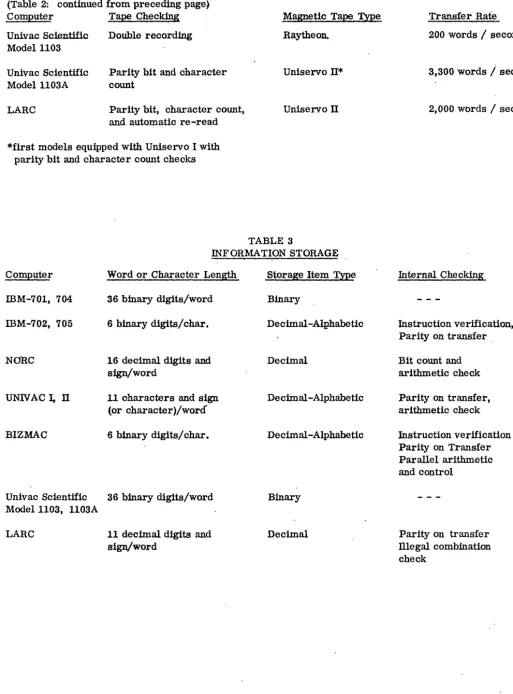
On Table 2 there is recorded the maj~r
characteristics of the various tape units used with the large-scale computers. It is interesting to note that all of the tapes involve the parity bit for checking. Also, all of these tape units record the information as 6 bits plus a parity check bit plus a bit serving as a timing channel. The hori-zontal parity bit on the ffiM 727 tape units is an innovation and involves forming parity bits for each of the 6 information channels of the entire unit record after each record is recorded.
,
In the case of a parity bit failure with the Uniservo I and IT equipments, the information is re-read auto-matically twice with bias voltages changed, and the parity bit re-checked each time. The Uniservo I equipment to be used with the first models of the 1103A involves, in addition to the parity check bit, the placing of a certain code word in a register upon the occurrence of a parity bit failure. By means of programming, the information can be re-read with high and low bias voltages with the ex-pectation that such re-reading will be performed correctly.-10-The obvious trend with magnetic tapes is to-ward an increase in speed and recording density. For example, the transfer rate of the tapes used on the 1103A will be ten times greater than the Raytheon units used with the 1103, and at a later date the Uniservo II equipments will provide an in-crease factor of about 16 over the Raytheon units. The very high transfer rate on the special magnet-ic tapes of the NORC computer is achieved primar-ily by the high recording density of 510 pulses per inch, and 140 inches per second tape speed.
It is interesting to note that none of th e s e computers have the means to accomplish independ-ent tape search. We refer to the ability to com-mand a search for a particular block of information 'on magnetic tape and have the search carried out
while computation proceeds. This feature 1s found on many of the smaller drum computers. W h 11 e simultaneous read and write is possible with both the Univac and IBM-705, it is interesting to note that complete flexibility such as simultaneous writ-ing on two or more tape units is still an item for the future in large-scale system design. IDM plans to announce a modification of the 704 which will allow this.
Information Storage and Internal Checking
There exists a definite trend in large-scale computer system design toward the handling of num-erical information in decimal form and the ability to handle the full keyboard of alphabetic characters. The scientific computers now on the market still use the binary type of internal storage; however, it iS'likely that the 704 and the 1103A will be the last scientific computers to use the internal binary num-ber system. This will probably be true despite the feelings of certain groups using scientific calculat-ors that the storage of numerical information in bi-nary form has distinct advantages in performing the complicated programming logic desired in scientif-ic applscientif-ications. It is entirely possible that future scientific computers will include the logic to handle both decimal and binary information.
The internal checks mentioned in Table 3 in-volve that checking performed in the machine in the control unit and in transfers between the various units such as transfers between the memory unit and control unit. We have discussed checking feat-ures above in connection with magnetic tape units.
Computer
IDM-701
IDM-7M
WM-702
IDM-70S
NORC
BIZMAC
UNIVAC I
UNIVAC
n
Univac Scientific Model 1103
Univac Scientific Model 1103A
LARC
*in microseconds
Computer
mM-701 Modell mM-701 Model 2 mM-702
mM-7M mM-70S
NORC
BIZMAC
UNIVAC I
UNIVAC
n
Syst.em Desi~
TABLE 1 COMPUTER STORAGE
RUth S2eed Storage* High S2eed Storage Memory Type
Cathode Ray Tube or Magnetic Core
Magnetic Core
Cathode Ray Tube
Magnetic Core
Cathode Ray Tube
Magnetic Core
Mercury Delay Line
Magnetic Core
Cathode Ray Tube or Magnetic Core
Magnetic Core
Magnetic Core
Access Time
12
12
23
17
8
20
400 (max.)
40
12 8
8
4
TABLE 2
MAGNETIC TAPE UNITS
Capacity
2,048 or 4,096
4,096, 8,192 or 32,768 words
10,000 characters
20,000 characters
3,600 words
4,096 characters
1,000 words
2,000-10,000 words
1,024 words
4,096, 8,192 or 12,288 words
20,000-97,500 words
Tape Checking Magnetic Tape Type
Parity bit
~
vertiCal
andJ Horizcm.tal Parity bitBit count-modulo four
Digit count
megal Combinations
Parity bit
Parity bit, character count, and automatic re-read
Parity bit, character count,
and automatic re -read
Type 726
IType
727Modified Type 727
Special
Uniservo I
Uniservo
n
Drum Memory
8192 words
8192 or 16,384 words
60, 000 char~cters
60,000 characters
16,368 or
32,736 characters
16,384 words
16,384 words
3,000,000 words
Transfer Rate
1250 words / second 2500 words / second 15,000 char / second 2500 words / second 15,000 char / second
4,000 words / second
10,000 char / second
12,800 char / second
20,000 char / second
[image:11.608.29.539.42.742.2]-Computers and Automation . (Table 2: continued from preceding page)
Computer Tape Checking Univac Scientific
Model 1103
Univac Scientific Model 1103A
LARC
Double recording
Parity bit and character count
Parity bit, character count, and automatic re -read
*first models equipped with Uniservo I with parity bit and character count checks
Magnetic Tape Type Raytheon.
Uniservo n*
Uniservo II
TABLE 3
INFORMATION STORAGE
Computer Word or Character Length Storage Item Type
IDM-701, 704 36 binary digits/word Binary
IBM-702, 705 6 binary digits/char. Decimal-Alphabetic
Nolie 16 decimal digits and Decimal sign/word
UNIVAC I, n 11 characters and sign Decimal-Alphabetic (or character)/wora
BIZMAC 6 binary digits/char. Decimal-Alphabetic
Univac Scientific 36 binary digits/word Binary Model 1103, 1103A
LARC 11 decimal digits and Decimal sign/word
12
-Transfer Rate 200 words / second
3,300 words / sec.ond
2,000 words / seoond
Internal Checking
Instruction verification, Parity on transfer _
Bit count and arithmetic check
Parity on transfer, arithmetic check
Instruction verification Parity on Transfer Parallel arithmetic and control
[image:12.615.52.565.46.739.2]System Design
checking features are increasing in number. One notices that the 701 and 1103 had no internal check-ing at all. The trend is seen' especially in the com-puters for business. This is probably due to the fact that one number wrong out of a thousand num-bers is not catastrophic in scientific work; usually the scientist knows on the basis of reasonableness what to expect and can ferret out the incorrect val-ue from many. Also, many scientific problems allow ~ natural check. For example, the answer to a linear system of algebraic equations can be checking by re-substitution thereby allowing, in a few seconds, a complete check on hours of comput-er time. In the case of the business application, however, one wrong answe~ often means an irate employee or customer (or ex-customer). Another factor may be the rather conservation outlook which the businessman has toward electronic de-vices.
The design of Univac I centered around the requirements of the Bureau of Census, for the first Univac was delivered there in 1951. The Bureau specifications called for a machine having ample checking features for the assurance of the correct processing of the large amount of census data. In the Univac this was accomplished by build-ing parallel arithme tic units and con t r 0 1 un its
which perform the operations tWice, simultaneously ;md independently, followed by an appropriate check. The trend is away from such parallel construction which implies duplicate equipment and tqward other types such as parity checks on transfer. Despite certain shortcomings evident today, it is amazing that the Univac, designed 7 -8 years ago, has with-stood the test of time in the face of extremely rapid technological improvements.
Some of the more common checks in use to-day are as follows:
1. Parallel arithmetic 2. Parity bit on transfer 3. lliegitimate combination 4. Arithmetic checks 5. Instruction verification.
The parallel arithmetic check of the Univac has been described above. Parity bit check on transfer is perhaps most commonly used today. On each transfer between the various units the parity bit is checked and the machine halted or a signal ini-tiated upon the dete~tion of an improper parity. The illegitimate combination check implies that a check is made to see whether the character code is legitimate or whether the instruction code is in the computer repertoire. With the character code
check for computers performing decimal arithmetic the four binary digits (or, in some cases' six binary digits)" representing one of the digits from 0 to 9 would be checked to see if the combinations 10 through 15 were present. This type of check is very popular in medium-speed computer design, and is included, as examples, in the Datatron and IBM-650.
The arithmetic check usually involves the carrying of a check digit along with operands in the arithmetic operations. These check digits re-main invariant under the operation. As a result of the same operation performed on the check digit a check can be made to determine whether that digit is appropriate to the result. This type check is found on the NORC computer. The bit count check of the NORC is essentially a parity bit but sums the binary digits modulo 4 rather than modulo 2 as with the parity bit.
The instruction verification check is found on the ffiM-702 and lBM-705 computers and involves checking an instruction while it is being performed to determine whether the instruction code digits are legal ~d have been interpreted correctly.
Operating Speeds
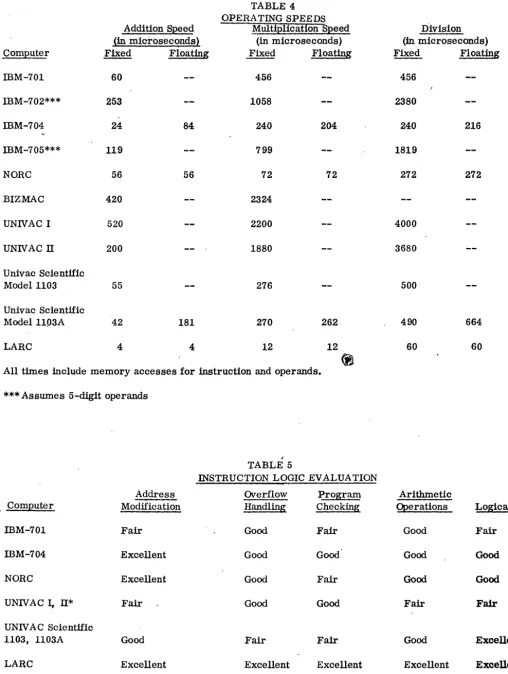
In Table 4 there is shown the operation times for the computers. All operation times include the appropriate number of accesses to the memory in-cluding the access time necessary to get the instruc-tion itself. This implies 2 accesses for the 704, 3 accesses with the 1103, and 4 with the NORC. Ar-ithmetic operation times on the 702, 705, and the BIZMAC, those computers intended solely for bus-iness applications, are based on the assumption that all operands are 5 digits in length.
No important trends are in evidence here ex-cept the obvious one that computing times for the scientific computers is drastically reduced with the announcement of each new system. The most recently announced computer, the LARC, has the remarkable addition time of 4 m i c r 0 sec 0 n d s ,
achieved mainly by an overlap between instruction execution and memory access. Recently, the Un-iversity of. California Radiation Laboratory at Los Alamos asked for bids on a computer which would have an addition time less than one microsecond including memory access. The response to this request is the ffiM-STRETCH Project which will result in a computer considerably more advanced than the LARC.
-Computers and Automation
There are a number of interesting compari-sons. For scientific computations the 704 enjoys a wide margin of speed over its predecessor, the 701, besides the floating point feature which the 701 does not have. Since the 1103A is a1most complete-ly program-compatible with the 1103, the differ-ences in time reflect only the difference in oper-ating speeds between the electrostatic and the mag-netic core memories. The add and divide times for the 1103 (1103A) are seen to be considerably slower than those of the 704, while the multiply times are comparable. The NORC will most likely be the fastest computer in operation until ear ly 1958 when the LARC appears. No figures are avail-able for the STRETCH computer to be announced by
mM
for operation about 1960.Operating speeds for the commercial com-puters are considerably less important. The core memory of the 705 has given it a considerable speed advantage over the 702. The greatly inc rea sed speed of the Univac II over its predecessor Univac I will no doubt allow greater convenience and flex-ibility in those commercial applications w her e computation must proceed simultaneously with tape transfers as it does in most cases.
Instruction Logic
A short time ago a divergence of opinion close to a controversy existed between the advocates of the single address logic and advocates of the
mul-~iple (usually three, sometimes four) address logic. In 1951 the SEAC and Mark
m
computers with their four-and three-address logic were compared with the Whirlwind and ERA-1101 with their single ad-dress logic. Champions of the single adad-dress got a big boost when the so-called Princeton (Institute for Advanced Study, or von Neumann) machines and themM
machines appeared. Except for the NORC and the 1103 and 1103A, all the large-scale computers 6f Table 5 have single address instruc-tion structure, thus indicating the rather general acceptance of the advantages of single-address log.-ic.Advocates of the single-address logic say that it is natural - that the programming pro-cesses are similar to those of a desk calculator, the accumulator of the high -speed device having _ the central dials as its counterpart on the mech-anical device. Despite the advantages, certain important disadvantages exist in a hypothetical system wher~ there is an accumulator and one can use instructions, each with a single address. Take, as a simple example, evaluating the alge-braic expression ab
+
cd. After multiplying a byb, the result most be removed from the accum-ulator so that the product cd can be formed there. Later ab is essentially returned to the accumulator for formation of the final value. As another example, suppose in the commercial application a part number is being searched for. The part number is stored in the accumulator and is compared with, say, part numbers from magnetic tape. As each part number is compared with the one sought, the number is re-moved from the accumulator so that it can be used for address modification. In each of these cases it seems desirable to have a second accumulator and an instruction logic which can make use of either one. In each of the examples cited apprOximately one out of six instructions could be saved by the second accumulator.
Advocates of multiple addressing schemes point to the flexibility and convenience in using two and three address instructions in logical and transfer of control operations. Consider the con-ditional transfer of control operation. Advocates of the two address logic, for example, would point out that the two branches of the program are clearly and explicitly given in the instruction; the contents of address X is compared with the accumulator and control either reverts to the next instruction or to
Y, the other address given. These people would say that this is handled 3:'Ykwardly in the single address scheme wlfere two instructions are neces-sary to handle the normal program biforcation: one to form the difference between the quantity in X and the accumulator, another to transfer if that difference is positive.
Nevertheless, the single-address instruction logic, in overall evaluation probably scores high-est, for, besides advantages to the user, it offers certain simplicity in the control components. How-ever, the addressing system apparent~y gaining pppularity may be referred to as the "augmented single address" or the "one-and-one-half address logic". In this logic there is only one address , and, therefore, only one operand involved in oper-ations with the accumulator. However, the accum-ulator has a number of parts or a number of special registers are available for use with certain orders. The normal operations are modified (or subdivided) into similar operations but dealing with a special part of the accumulator or a special register. Al-though none of the large-scale systems have pro-gressed far along these lines, the mM-705 does indeed have a total of 16 accumulator registers, each one of which is available for addition and comparison operations.
The idea of having certain special registers is certainly not new. Most single address
-System Design ers have an "x register" or something equivalent.
However, there will no doubt be an increasinz use of these registers for greater flexibility and more powerful operations.
The "polynomial multiply" instruction is an example. This rather new instruction takes the contents of the accumiilator, multiples it by the contents of address A, adds the product to contents of B, leaving the result in'the accumulator. One sees that with this process one makes one step in evaluating the polynomial in the "inside out" man-ner as indicated by
r·~
[lA"x+
"\._1)X+
"\.-~
x···1
+Ao
This operation is performed very frequently in scientific computation. The Univac Scientific Mod-el1103A will be equipped with this instruction. No special X register is necessary with the 1103A since it has a two-address scheme. However, the future will no doubt see more of these special reg-isters with their attendant flexibility. As a matter of fact, the LARC will have two decimal digits of the instruction word reserved to specify (up to 100) special arithmetic registers. IDM will soon announce changes in the 704 which will be along the lines of more powerful instructions such as the polynomial multiply mentioned above.
Let us examine Table 5 containing an evalu-ation of the instruction logic of six large-scale computers intended primarily for scientific applic-ations' and Univac I and fi, intended mostly for commercial applications but used to great extent
in scientific work. Despite the fact that the 705
is not listed in the table, it should be realized that its variable word length operation means that
it can be profitably used on many scientific prob-lems, especially those involving extra-precision or programmed floating point.
"Address Modification" is the first category. A computer with the B-register for automatic ad-dress modification gets the "excellent" rating, all others the "fair" rating except the 1103 and 1103A which have the "repeat" feature which allows auto-matic address modification with less flexibility. The B-register is an important feature, _since machines equipped with it probably use 15-20 per-cent less storage for instructions and operate about 10 percent faster on representative problems.
The next category, "overflow handling", in-volves the proviSions for the detection and handling of overflow in arithmetic operations. The 701,
~ NORC, Univac 1, and IT all have the ability to
ipterrogate by means of the program whether over-flow has occurred and, therefore, the ability to correct it quickly and automatically by means of the program. Optionally, these computers will halt on overflow detection. The 1103 and 1103A have only an alarm which stops the computer on alarm detection. The LARC will have a complete detection system which will allow an automatic jump to one of a number of registers depending on the operation producing the overflow. Overflow handling with the floating point computers (704,
NORC, 1103A) is bot as important as with those having only fixed point operations.
"Program Checking" features are tho s e designed to help the programmer in rapid program-ming mistake diagnosis. The 701, NORC, and 1103-1103A have virtually no built-in features for mistake
di~osis. The Univac I and IT have breakpoints which allow the programmer to halt the computer (or cause change of control) at specified points in the program. The 704 has a "trapping mode" which allows high-speed tracing of the program by caus-ing control jump to special cells and the wherewithal to return when the program reaches any jump in-struction. The LARC will have an elaborate break-point system and will, in addition, allow the pro-grammer to address the "current instruction count-er" directly. Also, the address of the "last jump" will be filed and will be available directly t o t h e programmer. This provides the wherewithal for the development of extremely high-speed, complete program "debugging" routines.
The "Arithmetic Operations" category refers to the part of the machine logic designed to make arithmetic easy and convenient. Taken into account here are instructions for double precision, floating point (by programming), and ease of accomplish-ment of arithmetic operations. It is comparatively somewhat awkward on the Univac I-IT to perform addition since three instructions (one and one-half words) are necessary. Also the Univac I-II does not have a double length accumulator convenient in arithmetic operations. The 1103-1103A has the multiply-add instruction which allows, in one in-struction, a multiplication and an addition of the product to a previously obtained quantity, and pro-vides, with the use of the repeat instruction,
evalua-tion of a vector inner product (a1 b1
+
a2b 2+ ••. +anbn) with only two instructions. As previously mentioned, the 1103A will be equipped with a poly-nomial D1ultiply instruction in floating point. The most recently designed computer, the LARC, will have a host of instructions for convenient arithmet-ic operati&ns. Included, for example, are inBtruc ... tions which will actually perform double precision
-Computers and Automation
TABLE 4 OPERA TING SPEEDS
Addition SEeed Multiplication SEeed D'ivision {in microseconds~ (in microseconds) (in microseconds) Computer Fixed Floating Fixed Floating Fixed Floating
IBM-701 60 456 456
IBM-702*** 253 1058 2380
IBM-704 24 84 240 204 240 216
IBM-705*** 119 799 1819
NORC 56 56 72 72 272 272
BIZMAC 420 2324
UNIVAC I 520 2200 4000
UNIVAC
n
200 1880 3680Univac Scientific
Model 1103 55 276 500
Univac Scientific
Model 1103A 42 181 270 262 490 664
LARC 4 4 12 12 60 60
(8
All times include memory accesses for instruction and operands.
*** Assumes 5-digit operands
TABLE 5
INSTRUCTION LOGIC EVALUATION
Address Overflow Program Arithmetic
Computer Modification Handling Checking Operations Logical
IBM-701 Fair Good Fair Good Fair
IBM-704 Excellent Good Good Good Good
NORC Excellent Good Fair Good Good
UNIVAC 1, 11* Fair Good Good Fair Fair
UN IV A C Scientific
1103, 1103A Good Fair Fair Good
Excellent
LARC Excellent Excellent Excellent Excellent
Excellent
*The UNIVAC is included here although not primarily a machine for scientific calculation.
[image:16.612.40.549.33.708.2]-System Desip!
arithmetic operations.
The rating on "Arithmetic Operations" ig-nores the great programming convenience in float-ing point. The 704, the NORC, and the LARC all have the feature. Later models of the 1103A will
be equipped with floating point.
The column of Table 5 headed "Logical" re-fers to' all aspects of the instruction logic which are non-mathematical. and are not specifically"men-tioned in the remaining columns. Included her e are all those tnStructi<?ns which reduce the program-mer's "red-tape" such as subroutine handling, ex-traction of parts of the computer ytord, etc. The mM-704 has the "logical and" and "logical or" commands which are powerful and flexible. The 701 does not have the ability to' "file the ~urrent
instruction register" to make subroutine handling smoother. The 704 does have this feature which is used in conjunction with the index registers.
The 1103 -1103A, with its two address logic, has a complete set of jump instructions which are easy to use. One of these is a "Q-jump" which examines the left-most bit of the quotient register and jumps control or does not jump, depending on the presence of a binary 0 or 1, and then s h if t s left one binary digit. This allows the storage 'of a complete jump sequence in readily available form. The 1103-1103A also has the "interpret instruction" which jumps control to a specific cell and files the instruction counter, thereby allowing 30 digits to the progr'am to specify any interpreting language he wishes handled by subroutines. The 1103A has an "interrupt feature" by means of which an ex-ternal equipment, operating aSY,nchronous to the computer can interrupt the program and cause ,transfer of control to a specific cell with the
in-struction counter filed for later access. This allows programming convenience in input-output operations, and also allows application to devices such as analog-digital conversion devices. The LARC h~s a complete complement of instructions of this type. A rather unusual instruction is one which performs a "logical inclusion" test, thereby checking whether the binary ones in a word are in-cluded in the binary ones of another.o
-A discussion of future t,rends in instruction logic turns to the LARC. This machine will have addressable error registers for overflow of var-ious causes, arithmetic error, and transfer error. Presumably blts will be introduced into these reg-isters for program interrogation and subsequent automatic program- handling. Also, all B-registers will be directly addressable as well as the current
instruction counter and the counter at performance of the last jump instruction. The addressability of
all these counters will be of great convenience t9 the programmer and will no do~t be generally found in all future large-scale system design.
There are two ways of handling overflow, arithmetic and transfer errors: 1) have bits intro-duced into certain cells (or flip-flops set) which are later interrogated, or 2) have control trans-ferred to a cell upon occurrence ·of one of these ) conditions. The former way is the design of the 701,_ 704, and 705 •. It is not clear at this early date what the design of the LARC in this regard will be. It is the opinion of this writer that the second method is more desirable. Automatic trans-fer to the appropriate error register will allow wrl-form treatment of the condition by all programmers. Also, placing the appropriate command in the error reg1ster to handle possible errors will be 'similar to setting a manual switch by automatic program-ming means; it should be r"ealized that putting a halt instruction in the register would correspond to putting the overflow switch (or other 'switch) in the halt position. As a last reason for the first method, it will reduce the amount of program in-structions in cases where a uniform treatment of a given type of error is possible over a large por-tion of the program as is usually the case.
The interrupt feature of the 1103A will no doubt be embodied in many future computers. It is available as an optional feature on the 704. This feature, which allows program interruption by equipment operating asynchronous to the computer, will allow, for- example; greatly simplified timing of the row-read instructions in card reading opera-tions. Also, it will allow convenience in the use of analog-digital cOJlversion devices, for with it a clock source outside the computer can tell the com-puter when a new quantity has been (is to be) sampled. As a matter of fact, future computers would do well to have perhaps as many as five interrupt channels, so that interruption due to five different causes can be distinguished.
The overall trend in instruction logic is to provide an increase in programmer convenience and automatic machine operation- to reduce i die time. These increases are at the expense of com-plexity of computer design and construction and will result in more expensive computers. An increase in programmer convenience is necessary for survival in this era of the national programmer shortage. The two mos~ important additions for programmer
convenienc~ are the B-register and floating point. Others, mentioned above, will follow. The other
17-f.omllU ters and Au torna tion
item, the increase in automatic operation, is just as essential. in this era of high-speed and high cost computer operation. The implicit cost of the non-productive computer time used whilc the machine operator reaches for a manual switch is appalling and will become even more so. In the future all
large-scale machines of good design will have the ability to change all switches at high speed by pro-gram control. Future changes on the 704 will in-clude this feature. Duty cycles of computers will be increased; it will not be unusual for computers to work on two problems simultaneously by means of an interrupt feature. Other inclusions will be
available for increased automaticity. The Whirl-wind I computer at M. I. T. already has the ability to interrogate a time clock (also optionally avail-able on the 704) ~der program control and has an "idling alarm" which, if not interrogated in the pro-gram at regular intervals sounds and informs the operator of the idling of the computer or its being caught in a tight program loop.
System Design
The system design of most computers avail-able today for rent or purchase can be called con-ventional. This sytem design consists of a central data processing unit with copious numbers of input-output devices with which it commWlicates. This communication, as will be discussed in more detail further below, is implemented by the central pro-cessor having the ability, under program control, to start an external equipment in motion 'a n d to transfer information from its memory to a limited buffer storage device from which the information is taken by the external equipment. In this design the system performs only one operation at a time '
- the operation in regards external or auxiliary eq uipment is serial. The important trend fro m this convention3.J. system is toward one' with larger buffering storage and simultaneous operation of many auxiliary equipments. This trend is be s t illustrated by the system design of four computing or data processing systems: ERMA, the Electron-ic Recording Machine.- Accounting; the RCA BIZ-MAC; the OAC Compu~r, Office of Air Controller; and the LARC. The OAC computer i,s designed to handle the large scheduling and logistics problems of the AIr Force, and ERMA is a sy~tem designed at Stanford Research Institute for the Bank of Am-erica. The BIZMAC, the only one of the four in the hands of a user, and LARC have been referred to previously. The ERMA will be built by General Electric and will no doubt involve a construction (and sales) program beyond the 30-odd machines 'intended for the Bank of America. This w r it e r
does not know whether the OAC computer will be
built.
Project ERMA was conceived to build a machine to handle the commercial accoWlt problem -check handling and accounting - for the Bank of America, probably America's largest bank. As illustrated by Figure 1, the system consists of an input device which reads check and deposit d a t a into a magnetic drum processor. Periodically, in-formation fr~m drum storage is read from the drum memory onto magnetic tapes for subsequenf printing of customer statements.
A.
sorter, completely apart from the rest of the system, sorts checks for return to ,the customer along with the state~ent.With this system all checks and deposit slips will have a customer account number printed on them with a "magnetic ink". Customers use the standard forms or pay extra for the unusual hand-ling of non-standard forms. Clerks working at 5-10
input stations input the dollar amounts of the checks or deposit sUps by means of keyboards. The mach-ine automatically reads the account number and the two pieces of information are recorded on a magnet-ic drum. Also recorded on the magnetmagnet-ic drum is the customer's balance and iDformation on the "hold-ing" ,or "stopping payment" of checks. If no hold or stop payment action takes place, the amount of the check (or deposit) is deducted (added) to the balance. Periodically and automatically, as the drum fills, inf-ormation ':'1s tapped off the drum, sorted by ac-count numbers, edited and recorded on tape to pro-vide the desired account statement to the customer.
The ERMA machine is strictly speaking not a computer but is rather a special purpose device much like the Speed Tally system for mail 0 r de r house use or the Reservisor for airline seat reser-vation handling. The operators can exercise little . control on the course of events, no programming is necessary or possible and, by and large, the machine performs the same operations day to day. However, it must be said that the very real-problem of handling checking accounts is handled re asonably well by a system which allows a simultaneous input, data processing, and data output.
The system design of the BIZMAC is unusual or at least does not closely resemble the conven-tional computer system design. As indicated in Figure 2, the system can be thought of as five groups of components each using tape units of the magnetic Tape File. The computer is general. purpose with magnetic core and magnetic drum internal memory, and can read and write information onto the tape qnits. The sorter is a special purpose computer
-Check and Deposit Input Data
Input Equipment
Output Equipments
System nesi~l
Data Processor
[image:19.617.64.499.28.691.2]Sorter
Figure 1
Computer
I
Tape FileFigure 2
19
-)
Interrogation
Unit
Magnetic Tape
~,
Printed Customer Statements
Computers and Automation
for arranging, merging, and extracting data stored in the tape file. The interrogation unit has facility for selecting a particular message from the tape file and printing it locally. The output equipments consist of a high-speed, 600 line/minute printer, high-speed camera allowing 4,000 character pe r
seco~d output, and a' paper tape punch. Each of these is magnetic tape-driven. The input equip-ments which input data to the Tape File consist of a magnetic tape input, and an mM card input. In addition to the input-output equipments described there is a keyboard machine to produce paper tape and a typewriter which is paper tape driven.
The important fact to realize about the BIZ-MAC system schematized in Figure 2 is that the whole system is not under the control of the comput-er. Each equipment communicates only with the Tape File. The Computer, Sorter, and Interroga-tion Unit control or use the Tape File, each in its own way: the Computer under program control, the Sorter and Interrogation Unit as a result of manual switch initiation. The various' units are manually connected to the Tape File by means of a control console plugboard. Apparently only the computer can select tape units at high speeds and in complex logical situations. Once certain manual plug-ins have been effected the system does allow simultan-eous ope'ration of the many units. The Sorter, al-though it can work simultaneously with the comput-er, is of somewhat limited processing powcomput-er, and the Interrogation Unit can only search .LI 0 r f i I e items. The Input-Output linits oper'ate to and from magnetic tapes like most equipment offered by Rem-ington Rand and mM.
The design of the OAC computer would allow it to handle the large matrix operations of Air Force program scheduling. Since that application is not fully or finally defined, the design is such as to allow expansion to a greater number of units or substitution of faster units for slower ones. Par-ticular emphasis was placed on the input-output problem and the resultant scheme essentially uses the entire memory as input-output buffer storage.
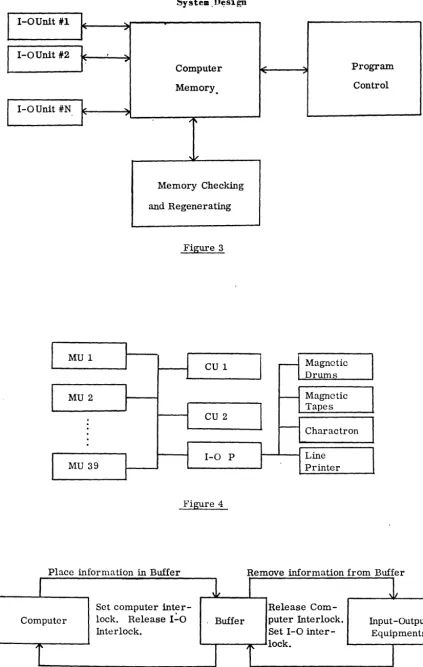
The system shown schematically in Figure 3, consists of a high-speed memory which communi-cates with three devices: the Program Control unit consisting of the arithmetic and control sections, the Memory Checking and Regeneration unit, and the Input-Output units. Under program control the computer wiU command transfers to input-output units from the memory. Transfers can occur sim-ultaneously with normal computation except for time-sharing a shift register. The time scheduling of all
~-out operations will be handled independent of thep 20
-central computer control so that these operations will not interrupt normal computing; an input-out-put instruction causes a transfer to be accomplished subsequently as computing continues. Accesses to the memory by the arithme tic and control units '
will proceed simultaneously (or will be dove-tailed) with the accesses for input-output operations. The plan also calls for a separate Memory Checking and Regenerating unit which will proceed simultan-eously' with its necessary memory accesses, with the operation of the computing and input-output func-tions.
Clearly the system design of the OAC c6m-puter allows the possibility of conflicts in the interaction of the various components. The con-flict of two units requiring a simultaneous access to the memory is avoided by assigning certain machine cycles to the various units similar to the "time slot" idea of the LARC described below or the buffering concept on the modified 704. Con-flicts between input-output devices for the high-speed memory are also avoided by setting up a time schedule by which each device, in turn, has access to the memory. Certain conflicts are not unavoidable and will cause an interlock condition to be set up until the conflict no longer exists. For example, if a transfer into the memory is not com-pleted before an access to the same part of the memory occurs, the computer automatically idles until the transfer is completed. One sees that with this system design the input-output can proceed al-most completely simultaneously with computation since essentially the entire memory is used as an input-output buffer register.
The LARC represents the most ambitious design of any system yet made available for gen-eral public information. The accent here is on modular construction: units comprising the sys-tem will be self-sufficient even for air-condition-ing and may be added to or deleted from the nor-mal system complement. The heart of the system consists of a number of ~omputing Units and one Input-Output Processor tied to a common informa-tion bus. The Processor is tied to a number' of memory units. Two Computing Units, besides the Processor, and as many as 39 memory units, each with 2500 words of high-speed storage and complete selection circuitry, are possible. *
*The LARC system as initially ordered by the Livermore Radiation Laboratory will consist of one Computing Unit, one Input-Output Pro-cessor, 8 Memory ,Units (20,000 Words), 12
System D~sign
Twenty-four drums (six million words) and forty Uniservo II tape units, a 600 line per minute print-er, a 25,000 character per second Charactron Tube (see Input-Output Equipments below), can b~ integ-rated into the system under control of the Input-Output Processor. Reference is made to Figure.4 for a schematic of the system. The computer is controlled by a number of consoles.
The system design of the LARC carries the idea of simultaneous operation of major units much further than in any other system while still keeping the desirable features of flexibility and the qualities of a single integrated automatic system. The Com-puting Units (CU) and the Input-Output Processor (1-0 P) are complete computers in themselves ex-cept for memory storage. The Processor will have a complete set of input-output instructions in addition to the arithmetic and logical ones but will be slower in operating speed than the CU's, its add operation requiring 16 microseconds. Each CU and the Processor will be able to operate on any quantity stored in the Memory Units (MU's). The cuts are designed for the basic computing function while the Processor is designed primarily to handle data transfers to and from the MUls.
It has been mentioned earlier that the LARC gains much of its computing speed by overlapping parts of successive operations in executing an in-struction. This time-overlap is again seen in the use of the CUls and Processor in an interesting "time slot" technique for using the MUls. Since only one unit can use the iriformation bus to the MU's, the four microsecond memory cycle is div-ided into eight one-half microsecond time slots, with each communicating unit assigned certain slots. The units then use the bus during the slots to address the memory. It will be possible, for example, for a CU to address Memory Unit 1 and 2 and the Processor address Unit 3 so that the three accesses are performed in only six micro-seconds, rather than apprOximately 15 microsec-onds without overlap.
In the full-blown LARC system it will be possible to use one or more curs on one problem, along with the Processor, or to use the CU's on different problems, each sharing the Processor. Communication between the units will be possible. For example, a CU will be abIe to signal a Pro-cessor that certain quantities have now been com-puted and require editing for output to tape units or transfer to drum storage. Most likely the sys-tem will operate as follows: upon the Processor's receipt qf a signal from the CU it will examine a memory cell into which the CU has placed a code
21
-word to specify the input-output or transfer oper-ation desIred.
It is interesting to note that among these four large-scale processing systems chosen for their unique system design, two are intended for business purposes and two for scientific. More-over, an important difference exists between the two pairs: the scientific computers largely oper-ate as one large, integroper-ated system in which all activities of input-output and processing are . handled automatically in a pre-programmed se-quence. In this sense the scientific computers are more conventional. However, all of these computers show the important trend of simultan-eous operation of major components allowed by duplicating certain processing components and allowing intricate simultaneous use of a memory storage by the processor and input-output devices.
Perhaps it should be emphasized here that the discussion of the system aspects of ERMA and BIZMAC does not imply that these designs are endorsed over the IDM-705 or UN IV AC IL As a matter of fact, a comparison. of these general purpose machines with the special purpose ERMA would be inappropriate. In connection with the re-mark made above concerning the trend toward . simultaneous input-output and processing, it is pointed out that this trend was started by the 705 and UNN AC systems with their off-line card (or keyboard) to magnetic tape devices and their ~ag
netic tape-driven printers.