warwick.ac.uk/lib-publications
Original citation:
Kuroki, Agnès, Sangwan, Parveen, Qu, Yue, Peltier, Raoul, Sanchez-Cano, Carlos, Moat, John, Dowson, Christopher G., Williams, Elizabeth G. L., Locock, Katherine E. S., Hartlieb, Matthias and Perrier, Sébastien. (2017) Sequence control as a powerful tool for improving the selectivity of antimicrobial polymers. ACS Applied Materials & Interfaces, 9 (46). pp. 40117-40126.
Permanent WRAP URL:
http://wrap.warwick.ac.uk/97732
Copyright and reuse:
The Warwick Research Archive Portal (WRAP) makes this work by researchers of the University of Warwick available open access under the following conditions. Copyright © and all moral rights to the version of the paper presented here belong to the individual author(s) and/or other copyright owners. To the extent reasonable and practicable the material made available in WRAP has been checked for eligibility before being made available.
Copies of full items can be used for personal research or study, educational, or not-for profit purposes without prior permission or charge. Provided that the authors, title and full bibliographic details are credited, a hyperlink and/or URL is given for the original metadata page and the content is not changed in any way.
Publisher’s statement:
This document is the Accepted Manuscript version of a Published Work that appeared in final form in ACS Applied Materials & Interfaces, copyright © American Chemical Society after peer review and technical editing by the publisher.
To access the final edited and published work see http://dx.doi.org/10.1021/acsami.7b14996
A note on versions:
The version presented here may differ from the published version or, version of record, if you wish to cite this item you are advised to consult the publisher’s version. Please see the ‘permanent WRAP url’ above for details on accessing the published version and note that access may require a subscription.
1
Sequence control as a powerful tool for improving the
selectivity of antimicrobial polymers
Agnès Kuroki,
aParveen Sangwan,
bYue Qu,
cRaoul Peltier,
aCarlos Sanchez-Cano,
aJohn
Moat,
dChristopher G. Dowson,
dElizabeth G. L. Williams,
bKatherine E. S. Locock,
b,eMatthias
Hartlieb,
a, †*Sébastien Perrier
a, f*[a] Department of Chemistry, University of Warwick, Coventry, UK
[b] CSIRO Manufacturing, Clayton, Victoria, Australia
[c] Department of Microbiology, Faculty of Medicine, Nursing and Health Science, Monash University, Clayton, VIC 3800,
Australia
[d] School of Life Sciences, University of Warwick, Coventry, UK
[e] Department of Chemical and Biomolecular Engineering, University of Melbourne, Melbourne, VIC 3010, Australia
[f] Faculty of Pharmacy and Pharmaceutical Sciences, Monash University, 381 Royal Parade, Parkville, Victoria, Australia
†
Current Address: Institute of Biomaterial Science, Helmholtz-Zentrum Geesthacht, Kantstr. 55, 14513 Teltow, Germany
* Correspondence to [email protected] and [email protected]
Keywords: Antimicrobial Resistance, Antimicrobial Polymers, Antimicrobial Peptide
Mimics, Multiblock Copolymers, RAFT Polymerization;
Abstract
Antimicrobial polymers appear as a promising alternative to tackle the current development of bacterial
resistance against conventional antibiotics as they rely on bacterial membrane disruption. This study
investigates the effect of segmentation of hydrophobic and cationic functionalities on antimicrobial
polymers over their selectivity between bacteria and mammalian cells. Using RAFT technology,
statistical, diblock and highly segmented multiblock copolymers were synthesized in a controlled
manner. Polymers were analysed by HPLC and the segmentation was found to have a significant
influence on their overall hydrophobicity. In addition, the amount of incorporated cationic comonomer
was varied to yield a small library of bioactive macromolecules. The antimicrobial properties of these
compounds were probed against pathogenic bacteria (Escherichia coli, Pseudomonas aeruginosa,
Staphylococcus aureus and Staphylococcus epidermidis) and their biocompatibility was tested using
hemolysis and erythrocyte aggregation assays, as well as mammalian cell viability assays. In all cases,
diblock and multiblock copolymers were found to outperform statistical copolymers, and for polymers
with a low content of cationic co-monomer, the multiblock showed a tremendously increased selectivity
for P. aeruginosa and S. epidermidis compared to its statistical and diblock analogue. This work
2 well as their interaction with biological systems. Due to the outstanding selectivity of multiblock
copolymers towards certain bacteria strains, the presented materials are a promising platform for the
treatment of infections and a valuable tool to combat antimicrobial resistance.
Introduction
As an increasing number of studies emphasize the alarming situation concerning life-threatening
infectious diseases caused by antibiotic resistant bacteria,1-3 health organizations urge for the discovery
of novel antibiotics.4-6 The development of antimicrobial resistance (AMR) is partly due to the narrow
range of available antibiotics7 which have reached their limitations in infection treatment because of
their high target specificity. In such context, antimicrobial peptides (AMPs) have recently attracted
interest as they were shown to target bacterial membranes instead of individual proteins.8,9 Present in
the innate immune systems of various organisms, these peptides have an amphipathic structure which
can adopt a facially amphiphilic arrangement with hydrophobic groups on one side and cationic
moieties on the other side of the molecule.8 Although the precise mechanism of bacterial killing is still
under investigation, the cationic groups of the AMPs are thought to bind to the negatively charged
phospholipids of bacterial membranes via electrostatic interactions, upon which the hydrophobic
functionalities would induce membrane disruption and lead to cell death.8 Due to the mostly non-
charged surface of mammalian cells, AMPs exhibit good selectivity towards bacterial membranes.
However, their isolation or production on a large scale is expensive and their peptidic nature renders
them vulnerable e.g. to protease based countermeasures.10 In order to overcome these issues, a wide
range of synthetic mimics have been developed in recent years from oligomers to polymers using
different methodologies.11 The key structural parameters which were found to affect antimicrobial
activity were the choice and balance of cationic to hydrophobic moieties, the molecular weight, the
nature of the charge and the structure of the polymer backbone.12-23 As the main specifications for
antimicrobial potency have been elucidated, current research focuses on reducing the toxicity of
synthetic antimicrobial peptides (SAMPs) against mammalian cells, and more interestingly towards red
blood cells (RBCs), by investigating new structural parameters.24-26
The activity of peptides is highly dependent on their structural organization,8,27 and mimicking this
feature, i.e. by self-assembly into nano-sized objects is the next substantial challenge in improving the
performance of SAMPs. The morphology of core-shell nano particles28 did not affect the antimicrobial
activity, whereas the size of PEGylated nanoparticles29 reduced both the antimicrobial and the
hemolytic activity. However, the effect of the shape on the toxicity against mammalian cells was not
addressed in those studies. Similarly, flower-like micelles30,star-shaped polymers24 and hyperbranched
polymers31 were shown to be efficient at disrupting bacterial membrane whilst maintaining low
3 Intramolecular interactions of SAMPs were analyzed to a higher extent, since the helical structure of
certain AMPs was thought to be responsible for their activity. However, it was demonstrated that this
conformation was not required for SAMPs to exhibit antimicrobial activity. Instead, an amphiphilic
structure, able to adapt to the cell surface was sufficient for polymers to induce bacterial membrane
penetration, according to Mowery and co-workers.19 The importance of the conformation of the
polymers in the potency of SAMPs was highlighted by Nguyen et al.32 using single-chain nanoparticles.
Similarly, unimolecular aggregates with a cationic shell and a hydrophobic core obtained from the
folding of amphiphilic copolymers were studied by Oda and co-workers.33 The diblock copolymers
exhibited a lower hemolytic activity than their random counterpart but an increased hemagglutination,
demonstrating the effect of the conformation of single polymeric chains on their interactions with cells.
The effect of polymer architecture in SAMPs was investigated by the comparison of diblock copolymers
with the statistical34 and gradient35 counterparts. The level of hemolytic activity was decreased for
diblock copolymers in both cases without observing any effect on antimicrobial properties. However,
the self-assembly of these systems was not analysed, therefore, the difference in the hemolytic activity
is not necessarily attributed to the sequence but could be related to micelle formation. Indeed, the
sequence not only strongly affects the self-assemblies of the polymers, but also the folding of the
polymer chains, hence affecting their physico-chemical properties.36,37 As previously discussed, inter
and intramolecular assemblies of SAMPs seem to have an important effect on their antimicrobial
activity and hemocompatibility, but the impact of the monomer sequence beyond diblocks and gradient
copolymers on these properties has, to the best of our knowledge, yet to be determined for polymers.
By using multiblock copolymers, systems with a controlled monomer sequence can be obtained.38 By
varying the degree of segmentation of functional units within a polymer chain an in-depth
structure-activity relationship of the sequence of SAMPs on the antimicrobial structure-activity could be established.
Well-defined multiblock copolymers have been synthesized via various Living Radical Polymerization
(LRP)39,40 techniques such as Cu(0)-mediated radical polymerization41,42 or Reversible
Addition-Fragmentation chain Transfer (RAFT).43,44 The latter was proven to be a versatile and robust process,39
compatible with a wide range of monomers and solvents to obtain polymers with narrow molecular
weight distributions.40 Furthermore, the optimization of the reaction conditions allows for the sequential
one-pot synthesis of multiblock copolymers.45 As the up-scaling of these synthetic processes has
recently been explored by using tubular reactors, the availability of SAMPs with a precisely defined
structure is not an issue.46,47
The current work focuses on the investigation of multiblock copolymers, which represent an
4
Results and discussion
Design and synthesis of SAMPs. Acrylamides were chosen as a monomer class for this study as their
high propagation rate (kp) allows the synthesis of multiblock copolymers in a straight forward manner
and their non-degradable nature.44,48 The hydrophobic monomer which was selected for the synthesis
of SAMPs was N-Isopropylacrylamide (NIPAM) as it mimics the structure of Leucine. Furthermore,
its hydrophobicity is relatively low compared to monomers which have been used in previous
studies,49,50 and should therefore, lead to a good hemocompatibility.51 The cationic amino-acid mimic
chosen for the design of antimicrobial polymers was an acrylamide-based Lysine mimic:
Amino-EthylAcrylamide (AEAM). To avoid potential aminolysis of the trithiocarbonate group of the CTA
during the polymerisation process, the Boc-protected equivalent of the monomer (Boc-AEAM)52 (Fig.
SI-1 and SI-2) was polymerised and a post-polymerisation deprotection method was used to obtain
functional SAMPs.
As we were interested in the influence of the monomer distribution along the chain on antimicrobial
activity and toxicity against RBCs, statistical, diblock and multiblock copolymers (Scheme 1) were
synthesised via RAFT polymerization using different ratios of hydrophobic to cationic pendant groups.
The SAMPs were named according to their degree of segmentation (H, S, M and D for homopolymer,
statistical, multiblock and diblock copolymers respectively) and their content of cationic co-monomer
in % (0, 30, 50, 70 and 100) with protected polymers labelled BOC.
Scheme 1. Schematic representation of structure, composition and segmentation of synthesized
polymers
As the bacterial cell wall might be impermeable to long polymers and hemocompatibility decreased
5 carefully.53 In this study, the degree of polymerization (DP) was set to 100, as the maximum degree of
segmentation achievable using a RAFT-based multiblock approach scales with the length of the
polymer chain.
The shortest block length that was targeted was DP 10, since it was shown that for DPs below 6, a
significant number of chains would fail to contain the total number of blocks, according to an analysis
of the statistical nature of polymer chain growth.54 By taking this limitation into consideration,
multiblock copolymers were designed with the highest number of blocks compatible for each
composition. Therefore, seven blocks were targeted for 30 and 70 % BocAEAM content, (M30BOC and
M70BOC respectively) and ten blocks for M50BOC which has 50 % of BocAEAM (Table SI-1) each in
an alternating fashion. From the design of these polymers, modifying the structure from statistical to
multiblock and diblock copolymer will demonstrate the effect of having cationic and hydrophobic
domains of variable lengths, and segregations, whilst maintaining the overall DP and chemical
composition.
(Propanoic acid)yl butyl trithiocarbonate (PABTC) was chosen as the Chain Transfer Agent (CTA) as
it has previously been used to synthesise multiblock copolymers by maintaining a high livingness.45
Additionally, the choice of a carboxylic acid based end group has been shown previously to favour
lower levels of hemotoxicity.55 Optimization of the reaction conditions allowed to reach full conversion
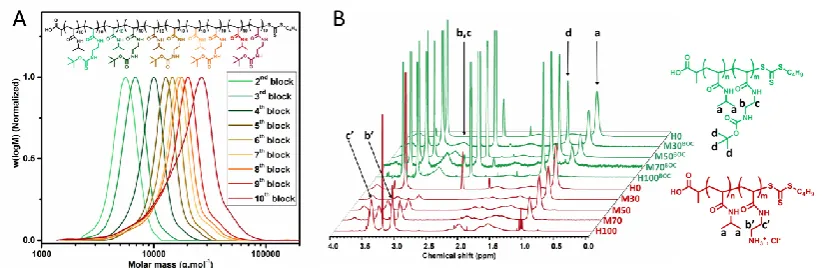
after each block according to 1H NMR spectroscopy (Fig. SI-3 − 8), to achieve a sequential one-pot
synthesis of the protected statistical, diblock and multiblock copolymers. The size distribution of the
protected polymers as determined by SEC was narrow for all synthesized architectures (Table SI-7, Fig.
1A, Fig. SI-9 − 10). The deprotected polymers could not be analyzed by SEC as they were not soluble
in the available eluents. The polymers were then quantitatively deprotected using hydrochloric acid as
supported by the disappearance of the signal associated with the BOC-protecting groups in 1H NMR
spectra (Fig. 1B, Fig. SI-11 − 12) as well as by the shift of CH2 protons associated with the amine
pendant groups.
Figure 1. A) DMF-SEC chromatograms for successive chain extensions of M50BOC; B) 1H NMR
spectra of SAMPs on the example of homopolymers and multiblock copolymers before and after
[image:6.595.75.487.549.683.2]6 Physico-chemical properties of SAMPs. As electrostatic interactions play a major role in the binding
of SAMPs to bacterial membranes, the polymers have to maintain their positive charge in a
physiological environment. The cationic properties of the primary amines at physiological pH was
confirmed by potentiometric titration. Furthermore, by comparing the behaviour of statistical, diblock
and multiblock copolymers of similar composition, the effect of segmentation on the pKa of the pendant
groups can be evaluated. The window of pKa of the primary amines of H100 (Fig. SI-13) ranges from
8 to 11, which was similar to the pKa of the amine group of Lysine at 8.9.56 The range of pKa observed
for the three copolymers was similar to that of the homopolymer. The majority of the primary amines
are protonated at physiological pH, rendering the polymers positively charged. However, on the titration
curves of the polymers (Fig. SI-13), a lower change in the pH was observed with the statistical
copolymer S30 compared to D30 and M30, when the same amount of base was added. Therefore, S30
would have a higher buffering capacity than its diblock and multiblock counterpart. Indeed, the
deprotonation of the primary amines could be facilitated when the groups are statistically distributed
along the polymer backbone.
While positively charged groups are necessary for the antimicrobial activity of the SAMPs, the balance
between hydrophilic and hydrophobic groups has arguably the most significant impact on their
selectivity.11,12 For this reason, the effect of segmentation on this property of SAMPs was analyzed by
High Performance Liquid Chromatography (HPLC). Non water-soluble diblock and statistical
copolymers have previously been studied by HPLC, showing that the elution volume varied between
the two different structures with a similar composition.57 However, to the best of our knowledge, this
remains the only investigation of the influence of copolymer architecture on the amphiphilic balance.
A comparison of the amphiphilicity of the various polymers can be established by monitoring their
elution characteristics, as a higher elution volume indicates a more hydrophobic polymer in a reversed
phase system (Fig. SI-14 and SI-15).
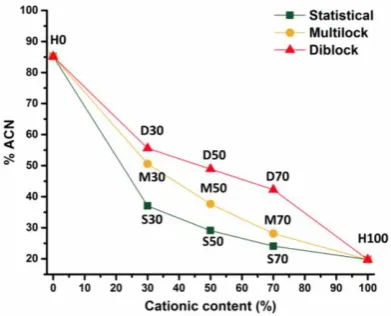
For a set architecture (statistical, diblock or multiblock), content of THF necessary to elute the polymer
decreases with the cationic content (Fig. 2). As expected, the hydrophilicity increases with the amount
of positive charges along the polymer chain. As NIPAM shows a cloud point behaviour in water58
measurements at 20 and 60 °C (Fig. SI-16) were carried out and revealed no significant difference in
the elution volume. For a fixed composition, the hydrophobicity varies with the architecture of the
SAMPs, with diblock copolymers being most hydrophobic, followed by the multiblock and finally, the
statistical counterpart. Interestingly, this trend was observed for all three compositions (30, 50 and 70
% cationic). As the multiblock represents an intermediate level of charge segregation between diblock
and statistical copolymers, the order at which the polymers elute matches the monomer distribution.
7 composition but also on the monomer sequence and distribution of isopropyl functionalities along the
[image:8.595.200.396.119.277.2]polymer backbone, which could have an impact on their bioactivity.
Figure 2. Elution characteristics of the SAMPs depending on the composition and the architecture by
HPLC (▲ Diblock copolymers, ● Multiblock copolymers, ■ Statistical copolymers).
As the amphiphilic properties of the polymers might induce self-assembly,59 Dynamic Light Scattering
(DLS) was used to investigate the solutions of polymer at 37 °C in Phosphate Buffer Saline (PBS) (Fig.
SI-19, Table SI-8). The measurements revealed no phase segregation for cationic copolymers, whereas
particle formation was observed with H0. Therefore, the positively charged primary amine groups
appear to prevent any particle formation, even for diblock copolymers, which could be a result of the
electrostatic repulsion. This further supports that the variation in hydrophobicity depending on the
polymer architecture is not associated with intermolecular interactions.
Dye leakage study. Before investigating the antimicrobial activity, the ability of the SAMPs to disrupt
bacterial membranes was examined using a dye leakage assay. Liposomes mimicking Gram-positive
and Gram-negative bacterial membranes were loaded with a fluorescent dye which signals membrane
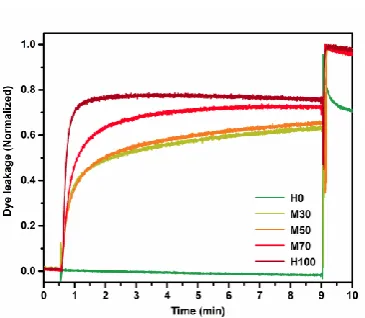
disruption. All polymers, except for H0, showed an increase in fluorescence against both Gram-positive
(Fig. SI-17) and Gram-negative (Fig. 3 and SI-18) membrane models. Additionally, as the charge
content of SAMPs increases, so does the induced leakage in most cases, which demonstrates the
importance of electrostatic interactions in this process. Statistical, multiblock and diblock copolymers
exhibited similar dye leakage profiles. Although this assay is not quantitative as demonstrated by Tew
8 Figure 3. Dye leakage study with multiblock copolymers (M30, M50 and M70) and the homopolymers
H0 and H100 on Gram-negative bacteria model. Fluorescence was read at 537 nm (emission) at an
excitation wavelength of 492 nm. The sample was added at 30 s measurement time and vesicles were
lysed by addition of Triton X at 9 min.
Antibacterial susceptibility assays. Growth inhibition was studied using two strains of Gram-negative
bacteria: Escherichia coli (E. coli) and Pseudomonas aeruginosa (P. aeruginosa); and two
Gram-positive strains: Staphylococcus aureus (S. aureus) and Staphylococcus epidermidis (S. epidermidis).
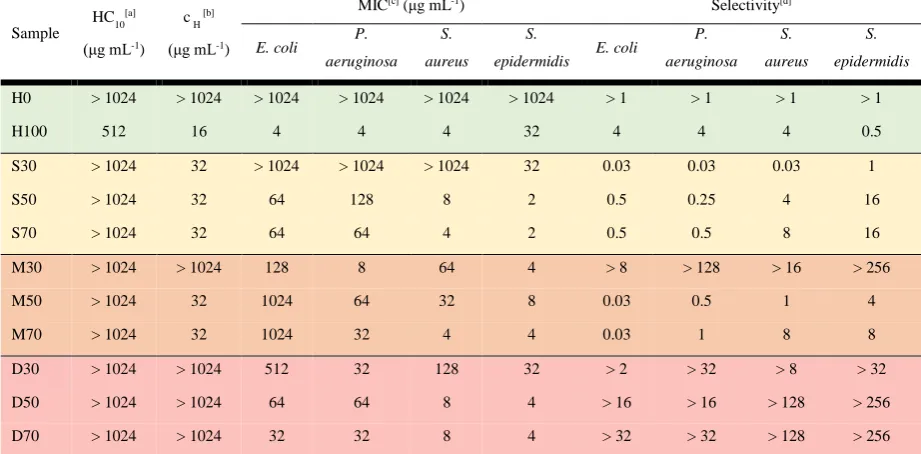
For statistical and diblock copolymers, the antimicrobial activity against all four strains increased with
the cationic content as shown on Table 1, which is consistent with previous investigations.15 For
multiblocks, no clear trend could be established.
Interestingly, for the set of polymers with 30 % charge, a drastic reduction of the MIC was observed
from the statistical copolymer (S30), which was inactive towards most bacterial strains tested
(MIC>1024μg mL-1, except against S. epidermidis with MIC=32 μg mL-1) , to diblock and heptablock
(D30 and M30), showing MIC values as low as 4 ug mL-1. Across the four bacterial strains,
Gram-negative bacteria such as P. aeruginosa were particularly affected by the polymer architecture, with
MICs decreasing from over 1000 (S30) to 32 and 8 μg mL-1 for D30 and M30 respectively (Fig. SI-20),
which could be due to the difference in the composition60 of their bacterial cell envelope. Gram-negative
bacteria possess an outer membrane (OM), which is a lipid bilayer comprised of an outer leaflet of
lipopolysaccharides and of an inner leaflet of phospholipids.61 As the lipopolysaccharides have long
saturated acyl chains (leading to an increased membrane stiffness) combined with hydrophilic
saccharides, they offer a protective barrier which renders Gram-negative bacteria difficult targets. The
variations in the physico-chemical properties due to the monomer sequence, as monitored by HPLC,
could hence alter the disruption of this OM. The presence of hydrophilic domains in the block
copolymers, as compared to the broad distributions of the cationic pendant groups in the statistical
copolymers might lead to an increased efficiency of the interaction of the macromolecules with the
9 between architectures using HPLC, could also have an influence. However, the improvement of the
OM permeabilization of Gram-negative bacteria with segmented systems seems unlikely to be related
[image:10.595.67.528.177.404.2]to the increase in the hydrophobicity of the polymers with the segmentation.
Table 1. Antimicrobial activity, hemolytic activity and hemagglutination of antimicrobial polymers.
Sample
HC10[a]
(μg mL-1)
c H [b]
(μg mL-1)
MIC[c] (μg mL-1) Selectivity[d]
E. coli P.
aeruginosa S.
aureus
S.
epidermidis E. coli
P. aeruginosa S. aureus S. epidermidis
H0 > 1024 > 1024 > 1024 > 1024 > 1024 > 1024 > 1 > 1 > 1 > 1 H100 512 16 4 4 4 32 4 4 4 0.5 S30 > 1024 32 > 1024 > 1024 > 1024 32 0.03 0.03 0.03 1 S50 > 1024 32 64 128 8 2 0.5 0.25 4 16 S70 > 1024 32 64 64 4 2 0.5 0.5 8 16 M30 > 1024 > 1024 128 8 64 4 > 8 > 128 > 16 > 256 M50 > 1024 32 1024 64 32 8 0.03 0.5 1 4 M70 > 1024 32 1024 32 4 4 0.03 1 8 8 D30 > 1024 > 1024 512 32 128 32 > 2 > 32 > 8 > 32 D50 > 1024 > 1024 64 64 8 4 > 16 > 16 > 128 > 256 D70 > 1024 > 1024 32 32 8 4 > 32 > 32 > 128 > 256
[a] HC10 is the minimum concentration at which at least 10 % of the maximum lysis was observed
[b] cH is the lowest concentration at which the polymers induce aggregation of RBCs
[c] MIC is the minimum inhibitory concentration at which no visible bacteria growth can be observed.
[d] Selectivity: lowest value between HC10 and cH (hemocompatibility concentration) divided by the MIC of the
bacterial strains concerned.
Hemocompatibility of SAMPS. Although the main target is to obtain SAMPs with high potency
against bacteria, their toxicity towards mammalian cells has to be minimized to be considered for any
human health application. Since blood is the principal vector distributing active compounds to cells, a
focus has been drawn to the toxicity of SAMPs towards RBCs. The first assay was directed towards the
investigation of the lysis of the RBCs in presence of the polymers, since they were shown to be
membrane active according to the dye leakage studies. The hemolytic concentration HC10
(concentration to elicit 10 % hemolysis), was determined at concentrations between 2 and 1024 μg mL -1 with only H100 disrupting RBCs (Table 1, Fig. SI-21), which is a result of the limited hydrophobicity
of NIPAM compared to having pendant alkyl chains of 4 carbons and more.
To obtain a complete picture of the hemocompatibility of the polymers, hemagglutination, which is not
necessarily related to hemolysis was studied as well since positively charged polymers can interact with
negatively charged sialic acid groups at the surface of RBCs, leading to intercellular binding.17 The
10 was determined (Table 1,Table SI-9). In line with the study of Locock and co-workers,17 H100 induced
hemagglutination at low concentration, whereas no aggregates were observed for H0, which confirms
the hemocompatibility of polyNIPAM. Interestingly, the three diblock copolymers (D30, D50 and D70)
as well as M30, had cH values of over 1000 μg mL-1. Therefore, with similar cationic content, these
SAMPs did not induce any hemagglutination, as opposed to their statistical counterparts. These results
could be explained by cationic moieties being distributed over the full length of the chain, as for
statistical and multiblock copolymers, rendering cross-linking between RBCs more likely as opposed
to diblock copolymers for which the charges are concentrated on a single segment of the
macromolecule. These results highlight the importance of charge segregation in the interaction with
RBCs.Furthermore, according to HPLC data (Fig. 2), the four cationic copolymers which did not induce
any hemagglutination, are the most hydrophobic SAMPs, hence a correlation between these parameters
is possible.
Using the data obtained by probing the hemocompatibility of the presented polymers, a selectivity value
was determined for each bacterial strains using the ratio between the hemocompatibility concentration
(which is the lowest value of HC10 and cH, Table SI-10)and the MIC against the specific strains (Table 1,
Fig. 4).This value is a powerful tool to assess the potential of antimicrobial substances, as only those
with a pronounced activity against bacteria and which do not affect RBCs will have high selectivity
values.18 As none of the SAMPs exhibit distinct hemolytic potency, hemagglutination concentration
was used to calculate the selectivity (Equation 1, Table 1).
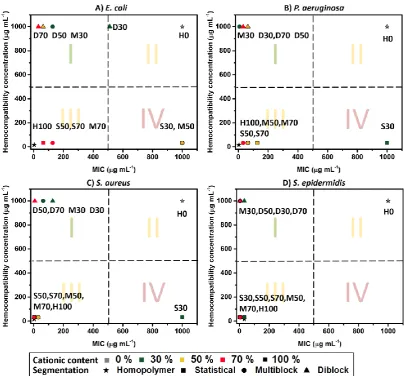
𝑆𝑒𝑙𝑒𝑐𝑡𝑖𝑣𝑖𝑡𝑦 = 𝑐𝐻 𝑀𝐼𝐶
Equation 1. Determination of the selectivity against RBCs for a specific bacterial strain.
Increasing the cationic content improves the selectivity for statistical and diblock copolymers with all
four species of bacteria studied. Fig. 4 illustrates the selectivity of the SAMPs by dividing them into
categories with the most inactive and hemotoxic polymers in the bottom-right corner (highlighted in
red; IV), most potent and hemocompatible species in the top-left corner (I), and two yellow intermediate
zones in the top-right (II) and bottom-left (III) corner being the inactive but hemocompatible polymers
and active but hemotoxic ones, respectively. The most selective polymers for the four different bacterial
strains appear to be the diblocks (D30, D50 and D70) and the multiblock copolymer M30. The largest
variation with segmentation was observed for SAMPs with a charge content of 30%, with S30 being in
the red corner (IV) for all the bacterial species, except S. epidermidis, as opposed to M30 and D30
which were highly active and hemocompatible. For 50 and 70 % cationic SAMPs, the selectivity also
improved from statistical and multiblock to diblock due to an increased hemocompatibility. By altering
the polymer sequence, thus charge segregation, the selectivity with RBCs can be drastically modified
11 Figure 4. Selectivity of the SAMPs with RBCs against E. coli (A), P. aeruginosa (B), S. aureus (C)
and S. epidermidis (D).
Biocompatibility of SAMPs. Potential applications for the SAMPs include their use as wound
dressings or as oral antibiotics. As such, murine embryonic fibroblasts (NIH 3T3) and human colorectal
epithelial (Caco2) cells were used to further determine the biocompatibility of the SAMPs. NIH 3T3
are one of the most commonly used fibroblast cell lines, a type of cell that is part of the connective
tissue of animals, and is involved in the synthesis of the extracellular matrix thus playing a critical role
in wound healing. Additionally, Caco2 cells are well characterised colorectal cells that can be used as
a model for intestinal absorption.62
To determine the ability of the compounds to inhibit cell proliferation, NIH 3T3 and Caco2 cells were
incubated with polymer concentrations ranging from 32 to 1024 μg mL-1 for 3 days. As expected, H0
displayed no toxicity at any of the concentrations used, while H100 showed pronounced interference
with the cell viability (Fig. SI-22) for both cell lines. The Inhibitory Concentration (IC50) values, which
are the polymer concentrations inhibiting growth of 50 % of the cells, were calculated for NIH 3T3 and
12 content of cationic groups per polymer chain led to an increased toxicity in both cell lines, which is
similar to the trend observed with hemotoxicity results. This could be attributed to the membrane
activity of the polymers. Additionally, the SAMPs were more toxic on Caco2 cells than NIH 3T3 cells,
which might be due to increased uptake by the colorectal cells. According to Fig. 5, for polymers with
[image:13.595.76.523.175.358.2]30 % of charged co-monomer, the IC50 increases from D30 to M30, followed by S30 with Caco2 cells.
Figure 5. IC50 of the SAMPs for A) NIH 3T3 and B) Caco2 cells after incubation at 37˚C for 72 h by
XTT assay.
These cytotoxicity results seem to direct potential application of the SAMPs towards skin wound
treatment rather than oral use. Therefore, the following discussions relative to cytotoxicity will be based
on the results obtained with NIH 3T3 cells. Similarly to the selectivity calculated for the RBCs, the
therapeutic index (TI) was obtained from the ratio of the IC50 for the mammalian cells to the MIC for
each bacteria strain63 (Equation 2, Table SI-11) and graphs representing the IC
50 against the MIC
illustrated the TI for NIH 3T3 (Fig. SI-23).
𝑇𝐼 =𝐼𝐶50 𝑀𝐼𝐶
Equation 2. Determination of the TI with a cell line for a specific bacteria species.
From Fig. SI-23, M30 appears to be the ideal candidate against the four strains of bacteria when taking
into account the toxicity towards NIH 3T3 cells. Indeed, at 30 % charge, the segmentation allowed for
the improvement of the selectivity of S30 (being non-toxic but poorly active) to D30 and M30
(exhibiting low toxicity and high potency). Although D50 and D70 were shown to be as selective as
M30 with RBCs, their selectivity towards NIH 3T3 was much lower, as displayed in Fig. SI-23.
The overall performance was analysed by illustrating the TI of the SAMPs for NIH 3T3 cells against
the selectivity for the different bacterial species over RBCs (Fig. 6 only displays polymers with a value
13 polymers are located in the top-right green corner which represents the SAMPs of selectivity and TI of
10 and above. The highest values regarding the selectivity of the three mammalian cells combined were
[image:14.595.87.508.146.541.2]associated with M30 for both P. aeruginosa and S. epidermidis.
Figure 6. TI of the SAMPs with NIH 3T3 cells against their selectivity with RBCs for E. coli (A), P.
aeruginosa (B), S. aureus (C) and S. epidermidis (D).
This finding highlights the importance of segmentation on the overall performance of these materials
as despite similar chemical composition M30 outperforms S30 and D30. The multiblock copolymer
shows a low tendency of erythrocyte aggregation and does interfere less with mammalian cell viability
as compared to its diblock analogue, while maintaining a high membrane activity against pathogenic
bacteria. It needs to be emphasized that presented polymers show a pronounced activity against
Gram-negative bacteria despite the presence of an OM which confers a protective barrier to these bacteria.
This renders this class of SAMPs a highly promising candidate for the treatment of infections, as the
antibiotic pipeline for this type of bacteria is depleting rapidly. Their excellent compatibility with
14 Bacterial resistance. One of the main issues with currently used antibiotics is the ability of bacteria to
develop resistance against them, rendering the antibiotics inactive after an extended contact of bacteria
with non-lethal doses.1 However, as previously mentioned, bacteria cannot acquire resistance against
SAMPs as easily, since the polymers seem to act directly on the cellular membrane. In order to
demonstrate the potential of the SAMPs as an alternative to currently used antibiotics, the development
of the MIC was studied for S30, M30 and D30 against a MRSA strain (USA 300) over 4 weeks of
exposure at a concentration of a tenth of the MIC (one passage per day). The antibacterial activity did
not vary throughout the assay (Fig. SI-25) and no resistant mutants could be detected by incubating the
final bacterial suspension. Therefore, the development of resistance against these polymers by bacteria
is not easily acquired, which is independent of the segmentation. This indicates a similar, membrane
based mechanism for the herein presented SAMPs.
Conclusion.
Synthetic antimicrobial peptides (SAMPs) based on a cationic (AEAM) and a hydrophobic co-monomer
(NIPAM) with various degrees of segmentation were synthesised by exploiting RAFT multiblock
technology. From our study, the segmentation of the monomer distribution appeared to have an impact
on various levels. Firstly, the hydrophobicity of the polymers increased with the length of the blocks,
thus introducing an additional handle for tuning of this parameter. Furthermore, antimicrobial activity
was dependent on the sequence at low contents of cationic co-monomer, particularly with
Gram-negative bacteria, which could be a result of an increased interaction of the cationic moieties with the
outer membrane of bacteria, when these functionalities are organised in domains. Additionally, this
study has shown that NIPAM is a co-monomer of choice as no hemolytic activity was observed, whilst
the antimicrobial potency of the copolymers was maintained.
By cross-examination of the selectivity towards erythrocytes, epithelial cells and fibroblasts, the
biocompatibility of the SAMPs was further investigated. In all cases, diblock copolymers were found
to outperform statistical copolymers, and at low incorporation of cationic co-monomer, the multiblock
showed a tremendously increased selectivity for P. aeruginosa and S. epidermidis compared to its
statistical and diblock analogue. These results are independent to any self-assembling behaviour as,
within the tested concentrations, the SAMPs are in their unimolecular form. The multiblock technology
allowed us to highlight the remarkable effect of charge segregation on both, the physical properties of
the materials as well as their interaction with biological systems. The performance of these SAMPs
demonstrates their potential as alternatives to standard antibiotics for wound treatment, as these
polymers possess a low toxicity towards mammalian cells and do not seem to generate bacterial
15
Acknowledgements
The CSIRO PhD scholarship scheme (AK), the INTEGRATE AMR Funding (RC1HSB3010) (JM), the
CSIRO Julius Career Award (KL) and the German Research Foundation (DFG, GZ: HA 7725/1-1)
(MH) as well as the Royal Society Wolfson Merit Award (WM130055; SP), and the Monash-Warwick
Alliance (SP), are acknowledged for funding.
Competing interests
The authors declare no competing financial interests.
References
(1) Antimicrobial resistance: Global report on surveillance, World Health Organization, 2014.
(2) B. Spellberg; R. Guidos; D. Gilbert; J. Bradley; H. W. Boucher; W. M. Scheld; J. G. Bartlett; J. J. Edwards, The epidemic of antibiotic-resistant infections: A call to action for the medical community from the infectious diseases society of america, Clinical Infectious Diseases 2008, 46, 155-164.
(3) S. B. Levy; B. Marshall, Antibacterial resistance worldwide: Causes, challenges and responses, Nat Med 2004, 10, S122-S129.
(4) J. W. M. Van Der Meer; R. Fears; V. Ter Meulen, Can we tackle the antibiotic threat?, European Review 2016, 24, 49-62.
(5) K. Bush; P. Courvalin; G. Dantas; J. Davies; B. Eisenstein; P. Huovinen; G. A. Jacoby; R. Kishony; B. N. Kreiswirth; E. Kutter; S. A. Lerner; S. Levy; K. Lewis; O. Lomovskaya; J. H. Miller; S. Mobashery; L. J. V. Piddock; S. Projan; C. M. Thomas; A. Tomasz; P. M. Tulkens; T. R. Walsh; J. D. Watson; J. Witkowski; W. Witte; G. Wright; P. Yeh; H. I. Zgurskaya, Tackling antibiotic resistance, Nat Rev Micro 2011, 9, 894-896.
(6) L. D. M. Otto Cars; Högberg, Mary; Nordberg,Olle; Sivaraman,Satya; Lundborg,Cecilia S.; So,Anthony D.; Tomson,Gö, Meeting the challenge of antibiotic resistance, British Medical Journal 2008, 337.
(7) E. D. Brown; G. D. Wright, Antibacterial drug discovery in the resistance era, Nature 2016, 529, 336-343.
(8) M. Zasloff, Antimicrobial peptides of multicellular organisms, Nature 2002, 415, 389-395.
(9) R. E. W. Hancock; H.-G. Sahl, Antimicrobial and host-defense peptides as new anti-infective therapeutic strategies, Nat Biotech 2006, 24, 1551-1557.
(10) M.-D. Seo; H.-S. Won; J.-H. Kim; T. Mishig-Ochir; B.-J. Lee, Antimicrobial peptides for therapeutic applications: A review, Molecules 2012, 17, 12276.
(11) M. S. Ganewatta; C. Tang, Controlling macromolecular structures towards effective antimicrobial polymers, Polymer 2015, 63, A1-A29.
(12) M. Hartlieb; E. G. L. Williams; A. Kuroki; S. Perrier; K. Locock, E. S. , Antimicrobial polymers: Mimicking amino acid functionality, sequence control and three-dimensional structure of host-defense peptides, Current Medicinal Chemistry 2017, 24, 1-1.
(13) K. Kuroda; G. A. Caputo, Antimicrobial polymers as synthetic mimics of host-defense peptides, Wiley Interdisciplinary Reviews: Nanomedicine and Nanobiotechnology 2013, 5, 49-66.
16 (15) K. E. S. Locock; T. D. Michl; J. D. P. Valentin; K. Vasilev; J. D. Hayball; Y. Qu; A. Traven; H. J. Griesser; L. Meagher; M. Haeussler, Guanylated polymethacrylates: A class of potent
antimicrobial polymers with low hemolytic activity, Biomacromolecules 2013, 14, 4021-4031. (16) G. J. Gabriel; A. E. Madkour; J. M. Dabkowski; C. F. Nelson; K. Nüsslein; G. N. Tew, Synthetic mimic of antimicrobial peptide with nonmembrane-disrupting antibacterial properties, Biomacromolecules 2008, 9, 2980-2983.
(17) K. E. S. Locock; T. D. Michl; N. Stevens; J. D. Hayball; K. Vasilev; A. Postma; H. J. Griesser; L. Meagher; M. Haeussler, Antimicrobial polymethacrylates synthesized as mimics of tryptophan-rich cationic peptides, ACS Macro Letters 2014, 3, 319-323.
(18) M. F. Ilker; K. Nüsslein; G. N. Tew; E. B. Coughlin, Tuning the hemolytic and
antibacterial activities of amphiphilic polynorbornene derivatives, Journal of the American Chemical Society 2004, 126, 15870-15875.
(19) B. P. Mowery; S. E. Lee; D. A. Kissounko; R. F. Epand; R. M. Epand; B. Weisblum; S. S. Stahl; S. H. Gellman, Mimicry of antimicrobial host-defense peptides by random copolymers, Journal of the American Chemical Society 2007, 129, 15474-15476.
(20) K. Kuroda; W. F. DeGrado, Amphiphilic polymethacrylate derivatives as antimicrobial agents, Journal of the American Chemical Society 2005, 127, 4128-4129.
(21) K. Kuroda; G. A. Caputo; W. F. DeGrado, The role of hydrophobicity in the antimicrobial and hemolytic activities of polymethacrylate derivatives, Chemistry – A European Journal 2009, 15, 1123-1133.
(22) A. Muñoz-Bonilla; M. Fernández-García, Polymeric materials with antimicrobial activity, Progress in Polymer Science 2012, 37, 281-339.
(23) L. Timofeeva; N. Kleshcheva, Antimicrobial polymers: Mechanism of action, factors of activity, and applications, Appl Microbiol Biotechnol 2011, 89, 475-492.
(24) S. J. Lam; N. M. O'Brien-Simpson; N. Pantarat; A. Sulistio; E. H. H. Wong; Y.-Y. Chen; J. C. Lenzo; J. A. Holden; A. Blencowe; E. C. Reynolds; G. G. Qiao, Combating multidrug-resistant gram-negative bacteria with structurally nanoengineered antimicrobial peptide polymers, Nature Microbiology 2016, 1, 16162.
(25) D. J. Phillips; J. Harrison; S.-J. Richards; D. E. Mitchell; E. Tichauer; A. T. M. Hubbard; C. Guy; I. Hands-Portman; E. Fullam; M. I. Gibson, Evaluation of the antimicrobial activity of cationic polymers against mycobacteria: Toward antitubercular macromolecules, Biomacromolecules 2017, 18, 1592-1599.
(26) A. Muñoz-Bonilla; M. Fernández-García, The roadmap of antimicrobial polymeric materials in macromolecular nanotechnology, European Polymer Journal 2015, 65, 46-62.
(27) R. Saravanan; S. Bhattacharjya, Oligomeric structure of a cathelicidin antimicrobial peptide in dodecylphosphocholine micelle determined by nmr spectroscopy, Biochimica et
Biophysica Acta (BBA) - Biomembranes 2011, 1808, 369-381.
(28) D. Yao; Y. Guo; S. Chen; J. Tang; Y. Chen, Shaped core/shell polymer nanoobjects with high antibacterial activities via block copolymer microphase separation, Polymer 2013, 54, 3485-3491.
(29) F. Costanza; S. Padhee; H. Wu; Y. Wang; J. Revenis; C. Cao; Q. Li; J. Cai, Investigation of antimicrobial peg-poly(amino acid)s, RSC Advances 2014, 4, 2089-2095.
(30) F. Nederberg; Y. Zhang; J. P. K. Tan; K. Xu; H. Wang; C. Yang; S. Gao; X. D. Guo; K. Fukushima; L. Li; J. L. Hedrick; Y.-Y. Yang, Biodegradable nanostructures with selective lysis of microbial membranes, Nat Chem 2011, 3, 409-414.
(31) R. N. Zangeneh; R. J. Kwan; T.-K. Nguyen; J. Yeow; F. L. Byrne; S. H. Oehlers; E. Wong; C. Boyer, The effects of polymer topology and chain length on the antimicrobial activity and
hemocompatibility of amphiphilic ternary copolymers, Polymer Chemistry 2017.
17 (33) Y. Oda; S. Kanaoka; T. Sato; S. Aoshima; K. Kuroda, Block versus random amphiphilic copolymers as antibacterial agents, Biomacromolecules 2011, 12, 3581-3591.
(34) Y. Wang; J. Xu; Y. Zhang; H. Yan; K. Liu, Antimicrobial and hemolytic activities of copolymers with cationic and hydrophobic groups: A comparison of block and random copolymers, Macromolecular Bioscience 2011, 11, 1499-1504.
(35) R. Liu; X. Chen; S. Chakraborty; J. J. Lemke; Z. Hayouka; C. Chow; R. A. Welch; B. Weisblum; K. S. Masters; S. H. Gellman, Tuning the biological activity profile of antibacterial polymers via subunit substitution pattern, Journal of the American Chemical Society 2014, 136, 4410-4418.
(36) N. Hadjichristidis; S. Pispas; G. Floudas In Block copolymers; John Wiley & Sons, Inc.: (2003), p 195-202.
(37) N. Hadjichristidis; S. Pispas; G. Floudas In Block copolymers; John Wiley & Sons, Inc.: (2003), p 203-231.
(38) M. Zamfir; J.-F. Lutz, Ultra-precise insertion of functional monomers in chain-growth polymerizations, Nature Communications 2012, 3, 1138.
(39) G. Moad; E. Rizzardo; S. H. Thang, Living radical polymerization by the raft process – a third update, Australian Journal of Chemistry 2012, 65, 985-1076.
(40) S. Perrier; P. Takolpuckdee, Macromolecular design via reversible addition– fragmentation chain transfer (raft)/xanthates (madix) polymerization, Journal of Polymer Science Part A: Polymer Chemistry 2005, 43, 5347-5393.
(41) A. Simula; V. Nikolaou; A. Anastasaki; F. Alsubaie; G. Nurumbetov; P. Wilson; K. Kempe; D. M. Haddleton, Synthesis of well-defined [small alpha],[small omega]-telechelic multiblock copolymers in aqueous medium: In situ generation of [small alpha],[small omega]-diols, Polymer Chemistry 2015, 6, 2226-2233.
(42) C. Boyer; A. H. Soeriyadi; P. B. Zetterlund; M. R. Whittaker, Synthesis of complex multiblock copolymers via a simple iterative cu(0)-mediated radical polymerization approach, Macromolecules 2011, 44, 8028-8033.
(43) L. Martin; G. Gody; S. Perrier, Preparation of complex multiblock copolymers via aqueous raft polymerization at room temperature, Polymer Chemistry 2015, 6, 4875-4886.
(44) G. Gody; T. Maschmeyer; P. B. Zetterlund; S. Perrier, Exploitation of the
degenerative transfer mechanism in raft polymerization for synthesis of polymer of high livingness at full monomer conversion, Macromolecules 2014, 47, 639-649.
(45) G. Gody; T. Maschmeyer; P. B. Zetterlund; S. Perrier, Pushing the limit of the raft process: Multiblock copolymers by one-pot rapid multiple chain extensions at full monomer conversion, Macromolecules 2014, 47, 3451-3460.
(46) C. H. Hornung; X. Nguyen; S. Kyi; J. Chiefari; S. Saubern, Synthesis of raft block copolymers in a multi-stage continuous flow process inside a tubular reactor, Australian Journal of Chemistry 2013, 66, 192-198.
(47) A. Kuroki; I. Martinez-Botella; C. H. Hornung; L. Martin; E. G. L. Williams; K. E. S. Locock; M. Hartlieb; S. Perrier, Looped flow raft polymerization for multiblock copolymer synthesis, Polymer Chemistry 2017, 8, 3249-3254.
(48) J. Barth; M. Buback; P. Hesse; T. Sergeeva, Termination and transfer kinetics of butyl acrylate radical polymerization studied via sp-plp-epr, Macromolecules 2010, 43, 4023-4031.
(49) H. Takahashi; E. F. Palermo; K. Yasuhara; G. A. Caputo; K. Kuroda, Molecular design, structures, and activity of antimicrobial peptide-mimetic polymers, Macromolecular Bioscience 2013, 13, 1285-1299.
18 (51) I. Sovadinova; E. F. Palermo; R. Huang; L. M. Thoma; K. Kuroda, Mechanism of polymer-induced hemolysis: Nanosized pore formation and osmotic lysis, Biomacromolecules 2011, 12, 260-268.
(52) L. J. Hobson; W. J. Feast, Poly(amidoamine) hyperbranched systems: Synthesis, structure and characterization, Polymer 1999, 40, 1279-1297.
(53) K. Lienkamp; K.-N. Kumar; A. Som; K. Nüsslein; G. N. Tew, “Doubly selective” antimicrobial polymers: How do they differentiate between bacteria?, Chemistry – A European Journal 2009, 15, 11710-11714.
(54) G. Gody; P. B. Zetterlund; S. Perrier; S. Harrisson, The limits of precision monomer placement in chain growth polymerization, Nature Communications 2016, 7, 10514.
(55) T. D. Michl; K. E. S. Locock; N. E. Stevens; J. D. Hayball; K. Vasilev; A. Postma; Y. Qu; A. Traven; M. Haeussler; L. Meagher; H. J. Griesser, Raft-derived antimicrobial polymethacrylates: Elucidating the impact of end-groups on activity and cytotoxicity, Polymer Chemistry 2014, 5, 5813-5822.
(56) P. M. Dewick Essentials of organic chemistry: For students of pharmacy, medicinal chemistry and biological chemistry; Wiley, (2006).
(57) G. Glöckner; A. H. E. Müller, Gradient high-performance liquid chromatography of statistical and block copolymers of styrene and t-butyl methacrylate, Journal of Applied Polymer Science 1989, 38, 1761-1774.
(58) M. A. G. Ward, T.K., Thermoresponsive polymers for biomedical applications, Polymers 2011, 3, 1215-1242.
(59) R. Nagarajan In Amphiphiles: Molecular assembly and applications; American Chemical Society: (2011); Vol. 1070, p 1-22.
(60) R. F. Epand; P. B. Savage; R. M. Epand, Bacterial lipid composition and the antimicrobial efficacy of cationic steroid compounds (ceragenins), Biochimica et Biophysica Acta (BBA) - Biomembranes 2007, 1768, 2500-2509.
(61) T. J. Silhavy; D. Kahne; S. Walker, The bacterial cell envelope, Cold Spring Harbor Perspectives in Biology 2010, 2, a000414.
(62) I. D. Angelis; L. Turco In Curr. Protoc. Toxicol.; John Wiley & Sons, Inc.: (2001). (63) P. Y. Muller; M. N. Milton, The determination and interpretation of the therapeutic index in drug development, Nat Rev Drug Discov 2012, 11, 751-761.