warwick.ac.uk/lib-publications
Original citation:Heath-Kelly, Charlotte. (2016) Algorithmic autoimmunity in the NHS : radicalisation and the clinic. Security Dialogue, 48 (1). pp. 29-45.
Permanent WRAP URL:
http://wrap.warwick.ac.uk/88386
Copyright and reuse:
The Warwick Research Archive Portal (WRAP) makes this work of researchers of the University of Warwick available open access under the following conditions.
This article is made available under the Creative Commons Attribution 3.0 (CC BY 3.0) license and may be reused according to the conditions of the license. For more details see:
http://creativecommons.org/licenses/by/3.0/
A note on versions:
The version presented in WRAP is the published version, or, version of record, and may be cited as it appears here.
Security Dialogue 2017, Vol. 48(1) 29 –45 © The Author(s) 2016
Reprints and permissions: sagepub.co.uk/journalsPermissions.nav
DOI: 10.1177/0967010616671642 journals.sagepub.com/home/sdi
Algorithmic autoimmunity in the
NHS: Radicalisation and the clinic
Charlotte Heath-Kelly
University of Warwick, UK
Abstract
This article explores the extension of counter-radicalisation practice into the National Health Service (NHS). In the 2011 reformulation of the UK Prevent strategy, the NHS became a key sector for the identification and suppression of ‘radicalisation’. Optometrists, dentists, doctors and nurses have been incorporated into counter-terrorism and trained to report signs of radicalisation in patients and staff. This article explores how calculative modalities associated with big data and digital analytics have been translated into the non-digital realm. The surveillance of the whole of the population through the NHS indicates a dramatic policy shift away from linear profiling of those ‘suspect communities’ previously considered vulnerable to radicalisation. Fixed indicators of radicalisation and risk profiles no longer reduce the sample size for surveillance by distinguishing between risky and non-risky bodies. Instead, the UK government chose the NHS as a pre-eminent site for counter-terrorism because of the large amount of contact it has with the public. The UK government is developing a novel counter-terrorism policy in the NHS around large-N surveillance and inductive calculation, which demonstrates a translation of algorithmic modalities and calculative regimes. This article argues that this translation produces an autoimmune moment in British security discourse whereby the distinction between suspicious and non-suspicious bodies has collapsed. It explores the training provided to NHS staff, arguing that fixed profiles no longer guide surveillance: rather, surveillance inductively produces the terrorist profile.
Keywords
Autoimmunity, civil society, counter-radicalisation, global health, insecurity, radicalisation
Introduction
The 2011 review of the Prevent strategy undertaken by the UK’s coalition government introduced three new developments in the relationship between health, security and surveillance. Firstly, it established that healthcare professionals would be trained to recognise signs of ‘radicalisation’ in their patients and co-workers and would have a legal duty to report suspicious individuals (through institutional processes) to the police. Since this review, then, doctors and nurses have been made active participants in counter-terrorism. Secondly, it extended the remit of ideological surveillance
Corresponding author:
Charlotte Heath-Kelly, Politics and International Studies, University of Warwick, Coventry, CV4 8LR, UK. Email: [email protected]
to the entire UK population through healthcare (and education), marking a discursive shift away from counter-terrorism practices that profile suspect communities.1 Indeed, the policy documenta-tion explains that the extension of ideological monitoring to all citizens is a functional and neces-sary step. Thirdly, the Prevent review packaged this extension of counter-radicalisation surveillance using the healthcare terminology of the ‘safeguarding’ measure. National Health Service (NHS) safeguarding procedures are codified duties and responsibilities placed upon healthcare profes-sionals to report any concerns about the physical, sexual and economic abuse of patients. By situat-ing the new counter-radicalisation duties as a safeguardsituat-ing measure to protect patients, the Prevent review explicitly refigured the terrorist as one who has suffered ideological abuse: a victim. It further embeds the notion of radicalisation as a pathological process towards terrorism that results from exposure to abusive radicalisers, and which can be recognised through discernible symptoms of ‘extremism’.
How did it become possible, within the otherwise uncompromising regime of UK counter-ter-rorism policies, for the figure of the terrorist to be associated with victimhood? And how did it become possible to monitor the ideological beliefs of the entire UK population through their healthcare providers, in a state which otherwise professes to support rights to privacy and freedom of expression? What politics of knowledge has effaced these contradictions, such that the Prevent duty has been implemented throughout the NHS with little public contestation?
This article argues that a mode of calculation associated with algorithms and big data method-ologies contributes to these contemporary developments in UK counter-radicalisation. Central to this conclusion is the shift in profiling techniques, whereby extremism monitoring has been extended to all persons. The racial and religious profiles that originally underwrote the Prevent policy2 (which reduced the total ‘N’ to a suspect community and was intended to generate effi-ciency in surveillance resourcing) have shifted towards calculative modalities drawn from the digi-tal realm. These now address the whole of the population through the NHS. In such inductive calculation, pre-determined ‘characteristics’ of a supposedly radicalising profile are not used to isolate suspects from a mass of population for the subsequent application of surveillance. Rather, the heterogeneous mass of data (patient contacts with NHS services, in this case) is reconceptual-ised as an asset, not a bewildering haystack that obscures the needle. Indeed, the complexity implicit within massive datasets becomes the modality of calculation, because it is presumed (in the style of big data methodology) that such complexity has the potential to reveal new patterns and connections between previously disparate factors through digital analytic techniques of partition-ing and re-assembly (Amoore and Piotukh, 2015; Comfort et al., 2010).
used to identify the targets of security intervention; instead complexity is operationalised to inductively produce new terrorist profiles and subjectivities. In this rendering, the profile no longer guides the deployment of surveillance; rather, surveillance of the population now guides the pro-duction of the terrorist profile (Leese, 2014).
Louise Amoore’s work on the UK e-borders program has been pivotal in exploring algorithmic security calculation, showing how digital analytics combine discrete and unrelated pieces of data (such as travel histories and methods of payment) to constitute possible futures of risk or normality (Amoore, 2011). The mode of inductive calculation associated with algorithmic prediction involves the ingestion, partitioning and machinic reassembly of vast amounts of data – transforming them into knowledge ‘spoken’ into being by the algorithmic process (Amoore and Piotukh, 2015). The ‘data derivative’ is the name given to the judgement that emerges from this analysis of large amounts of data (Amoore, 2011; Leese, 2014). Such inductive methods usually reside in the digital realm, but the contribution of this article lies in mapping the transition of inductive, digital dis-courses of calculation to the non-digital arena. The algorithms themselves do not move into the non-digital arena, but the calculative regimes in which they are embedded do.
The Prevent review replicates the calculative modality associated with the algorithm by operation-alising whole-of-population surveillance and reporting around unfixed and ambiguous indicators3 of radicalisation. The surveillance is not interested in the reporting of pre-identified profiles; rather, it actively distances counter-radicalisation training from a reliance on static indicators. The training of NHS staff in counter-radicalisation is intended to impart a ‘professional judgement’ such that ‘risk’ can be identified despite the mutability and ambiguity of indicators (NHS England, 2015). The train-ing describes the importance of developtrain-ing an intuition, such that ambiguous profiles and combina-tions of risk factors can be managed. An attitude of creative alertness to radicalisation (and compliant reporting) is now required of NHS staff, as emphasised in official NHS England and Department of Health documents, rather than the prescribed reporting of set profiles. Such discourse represents a translation of inductive calculative discourse from the digital to the non-digital realm because safe-guarding policies imagine the vast amount of NHS patient contacts as a productive asset which can generate previously unseen leads and connections. In the policy framing, the intuitive professional judgment of NHS staff is envisioned as the mechanism by which inductive calculation can occur in a situation of complexity. The calculative regime of digital analytics has been translated into policy documentation for non-digital surveillance.
It is important to note, however, that such a policy discourse does not necessarily lead to either: a) the replacement of other profiling techniques within UK security practice (such that race and religiosity are rendered irrelevant in surveillance judgments); or b) changes in the practice of NHS professionals. While the author is keen to develop future research within the NHS to ascertain the dynamics and effects of counter-radicalisation training, this article utilises only official policy documentation and online training modules to explore the framing of counter-radicalisation safe-guarding within healthcare discourse.
knowledge-production: rather than standing outside the system under observation, the human has progressively been recognised as being a systemic component. Life and the digital have increasingly become understood as intertwined, mutual and inseparable (Hayles, 1999: 9–12). Hayles’ work seemingly anticipated the Prevent review, whereby the security calculation now relies on data pro-duced by a human need for healthcare – a primary feature of human embodiment. The imagination of the subject within the Prevent review conceives of a material-informational entity: part embodied subject who feels pain and requires medicine, and part constituent of an informational flow.
Simultaneously, this post-human shift in governmental discourse indicates an autoimmune ten-dency. The datafication of life blurs distinctions between constitutions of the insecure, risky body and the hurt body requiring healthcare, rendering everyone potentially suspect by virtue of their embodiment. The inductive calculative method implies the radical potentiality that everyone’s embodied existence is implicitly productive of security data, revealing previously unknown pat-terns and connections. As subjects, we are thus constituted through an autoimmune gaze whereby the system cannot differentiate between healthy and radical cells, and turns on those cells previ-ously afforded protection.
The article begins by exploring the historical relationship between health and security sectors, contextualising the novelty of the Prevent review within Foucault’s reading of biopolitics. While health and security share biopolitical functions in the constitution of population as an object of government, the move towards total ideological surveillance of the population (in a self-professed liberal state) indicates autoimmune tendencies – where, as Derrida teaches us, security turns upon itself to efface political aporia (Borradori, 2003; Mitchell, 2005). Subsequently, the article inter-rogates policy documents and NHS counter-radicalisation training modules to build the argument that inductive calculative modalities have here translated into the non-digital realm, replicating assumptions within big data methodology about induction, complexity and the making visible of previously unseen patterns.
The unhealthy matrix of health and security, and the coming of
autoimmunity
The Prevent Strategy has constituted one quarter of the UK’s counter-terrorism strategy, ‘CONTEST’, since 2004, and outlines the responsibilities and roles of government and partner agencies in the detection and suppression of ‘radicalisation’.4 The 2010–2015 UK coalition gov-ernment undertook a review of Prevent in 2011, arguing that previous formulations of counter-radicalisation by the Labour Government had failed to tackle the ‘extremist ideology’ responsible for terrorism. In the resulting reformulation of Prevent, the NHS became a key sector for the iden-tification and suppression of ‘dangerous’ beliefs and ‘pre-criminal’ trajectories (NHS England, 2015; see also Home Office, 2011).5 Optometrists, dentists, doctors and nurses have been incorpo-rated within security practice.
society (especially police, but more recently schools) have been responsibilised for spotting the supposed signs of ‘radicalisation’ since the original Prevent strategy, counter-terrorism is now practiced by those with extensive experience in spotting symptoms – medical professionals.
To begin assessing the novelty and significance of the deployment of counter-terrorism through healthcare, we must first understand the historical relationship between sectors of health and secu-rity. In several regards, it would appear wholly unprecedented for counter-terrorism to be per-formed through the delivery of health. For instance, the 2011 Prevent review was the first piece of British legislation to introduce the overlap between counter-radicalisation and healthcare, although previous iterations of the CONTEST strategy had developed the capacities of other sectors of social security for the task. Before piloting counter-radicalisation with several health trusts in 2010, Prevent utilised ‘partnerships’ with police, charities, prisons, schools and communities to spread awareness and understanding of ‘radicalisation’ as the ideological symptoms and social vulnerabilities which precede terrorism.
Furthermore, before the ‘radicalisation’ discourse came to prominence in 2005 (Sedgwick, 2010), previous counter-terrorism campaigns also abstained from deploying counter-terrorism through healthcare. In Northern Ireland, for example, the British government eventually utilised certain provi-sions of social security to try and draw the allegiance of Belfast’s divided population away from para-military groups and towards a common civic identity organised around consumerism (Neill, 2010). Alongside brutal measures of internment, the suppression of civil rights and the extra-judicial execu-tion of suspected paramilitary members, the British government attempted to foster the economic growth of Belfast in the 1980s and 90s through measures such as the construction of the new Castle Court shopping centre (Needham, 1998: 171), making a gesture towards an overlap between provid-ing services for a population and practicprovid-ing counter-terrorism. But there was no place for healthcare within the deployment of counter-terrorism in contemporary British history until 2010/2011.
Yet, despite this novelty of performing counter-terrorism through counter-radicalisation safe-guarding in the healthcare sector, the overlap between security and health in international politics is fluid and long-running. Since the creation of the World Health Organisation in 1946, the health of all peoples has been recognised as a cornerstone for the attainment of security (Elbe, 2010: 1). While Stefan Elbe shows that this bold constitutional statement went largely ignored throughout much of the 20th century, the securitisation of viruses in the contemporary era as harbingers of potential catastrophe demarcates a clear shift in political attention. Health issues relating to Ebola, AIDS and pandemic flus have risen to occupy prime political terrain on the security agendas of international organisations. A growing literature in the field of global health analyses the ways in which health issues have been successfully securitised by actors, shedding light on the ways in which (inter)national security and social security sectors are merging (Davies, 2008; Heymann, 2003; Howell, 2011; Kamradt-Scott and McInnes, 2012). Given the prominence of these concerns, calls are now made to reclaim global health from its association with nation states (and Copenhagen School theorising) and to refigure the concept through emancipatory theory to expose relations of domination in the international system (Nunes, 2014).
diagnoses being used to discipline and constitute the social body, demonstrating that medicine has never been separate from statecraft, before exploring the development of medical techniques during warfare which later crossed back into the domestic polity. As she succinctly summarises:
It seems easy to assume that curing and killing are at opposite ends of the spectrum of human activity. However, as I will argue, the ‘threat-defence’ logic does not get imported into ‘society’, health, or medicine through the so-called process of ‘securitisation’. Rather, modern medicine at least from the nineteenth century has always already functioned through this logic, precisely because it has been a science of social security and public safety at the level of the population. (Howell, 2014: 971)
This historical co-constitution is also evident in the contemporary era. Consider, for example, the viral framing of militancy used within counterinsurgency policies of the United States Army in Iraq and Afghanistan, which framed the colonisation of local ‘hearts and minds’ as inoculation against viral militant incursion. Similarly, to serve their counter-terrorist mission, the CIA invented a vaccination campaign against Hepatitis B in Abbottabad to collect genetic material that might indicate the presence of Osama Bin Laden’s family (Rubenstein, 2015). As Howell demonstrates, counter-insurgency and medical treatments of infection share a common logic.
As such, the UK’s deployment of counter-terrorism through healthcare could be contextualised as a relatively minor development in the longstanding relationship between security and health. So what is important about the British case, beyond the discrete novelties of the particular context? I will argue that two significant developments are evident here: the translation of calculative modali-ties associated with digital analytics, and a broader indication of autoimmune tendencies.
The importance of counter-terrorism performed through the NHS stems from what it reveals about the universalisation of counter-terrorism surveillance to an entire population, and the under-lying translation of algorithmic calculative modalities from the digital realm to the non-digital practice of security. Specifically, the surveillance of the whole of the population through the NHS indicates a transition away from traditional profiling logics (which create suspect communities, reducing the total ‘N’, for the attention of the security services) to a scenario where every recipient of healthcare is subject to security screening. As I will discuss in the next section, this transition to a whole-of-population inductive calculative model is indicative of big data methodology and its transition to the non-digital realm.
But this mass surveillance simultaneously signifies an autoimmune development. There is an autoimmune logic at play in the transformation of counter-terrorism surveillance from a targeted practice to a whole-of-society practice. The UK has moved from the traditional security logic asso-ciated with immunity, which invokes an external other that could contaminate the national body, to a regime of practices that posit the mutating, unpredictable profile of the contaminant – and the escalation of protective measures against all cells, regardless of their healthy appearance.
The Derridean logic of autoimmunity shows us how the medicalised metaphor of immunity captures the binary oppositions that traditionally inform national security. The outside is posed as a threat to the body politic. According to this biopolitical logic, the health of the population is sus-ceptible to contamination and infection by the other – a perfect metaphor for most identity dis-courses operating within national security practice. Yet, as both Derrida (Borradori, 2003) and Roberto Esposito (2008) show us, the immunity paradigm is actually constituted through an aporia – the dangerous outside is simultaneously taken into the body to produce the immunological secu-rity response. We must be exposed to contaminants in order to produce resistance. Therefore, the supposed ‘boundary’ between outside and inside is leaky and porous.
discursive ordering fails, and the separation can no longer be maintained, we encounter autoim-munity. Autoimmunity refers to the backfiring of a protective measure (the immune system within the body, or national security) such that it destroys that which it tries to protect. Derrida’s concept mirrors the operation of autoimmune diseases where the function of the immune protective system radically backfires. The protective system targets the internal healthy cells and becomes killer.
The Derridean concept of autoimmunity (Borradori, 2003) helps us to understand the radical extension of counter-radicalisation surveillance to the entire UK population. Both the NHS and the security apparatus of the British state were designed to effect the protection of the body politic. The discourses of both health and security utilise the metaphor of protecting the body from external threats and viruses, thereby constituting population as an object of government. They are, in this biopolitical reading, immunological systems that separate bodies-to-be-protected from unqualified bodies. However, after the 2005 bombings of London by British citizens, rather than foreign nation-als, the radicalisation discourse became a prevalent mode of understanding terrorism (Sedgwick, 2010). Its operations signalled a turn towards the monitoring of the domestic population for internal signs of threat. This retasking of security towards the detection of rogue internal cells and the deployment of suppressive measures upon them speaks directly of an autoimmune response. Counter-radicalisation then targets healthy cells (parts of the national body) and attacks them, in its desperate search for the radical. The distinction between the inside and outside, the threat and the referent object of security, is radically disrupted in the autoimmune response (Mitchell, 2005).
Such autoimmune responses deny all knowledge of mistaken identification of threats. They reject the voices which assert the misdiagnosis of threat, such as the cellular assertion of normality and the critical assertions that ‘radicalisation’ has no predictive power and is not a real representa-tion of the transirepresenta-tion towards violence, but instead inappropriately stigmatises communities (Baker-Beall et al., 2014; Githens-Mazer and Lambert, 2010). This rejection of rational evidence and knowledge has elsewhere been called the epistemological crisis of counter-terrorism (Jackson, 2015) to highlight the silencing of knowledge regarding the inefficacy of counter-terrorist meas-ures, and the relentless push to continue them anyway. The immune system refuses to heed the evidence that it is attacking healthy parts of the body or, in this case, its own citizenry. It is instead compelled to destroy through its corrupted logic of protection.
So, while health and security have long co-constituted population as an object of government in the biopolitical era, the radicalisation agenda and the incorporation of the NHS into counterterrorism prac-tice are novel in their demonstration of the autoimmune, self-destructive culmination of this logic.
The significance of counter-radicalisation’s implementation through healthcare resides in the implosion of inside/outside and healthy/unhealthy distinctions into total ambiguity. The immuno-logical distinction between bodies-to-be-protected and dangerous bodies, which long underwrote both health and security discourses, functioned to conceal the aporia that plagues identity distinc-tions (Mitchell, 2005). As Derrida (1982: 1–28) has shown through his notion of différance, self and other are never separate but are paired: reliant upon each other for distinction. But différance has now been deconstructed in the autoimmunity of British counterterrorism. The identities of the securitised body and the recipients of care have become ambiguous. This phenomenon, as I will argue in the next section, is coterminous with the translation of inductive, calculative modalities from the digital to the non-digital realm of security.
The algorithmic shift in British counter-radicalisation policy
around mass surveillance and inductive profiling, where every body is rendered in post-human terms: as part material body, part informational flow that contributes to the mapping of radicalisation.
Before the Prevent review of 2011, the knowledge regime underpinning the radicalisation dis-course imagined political violence differently. ‘Radicalisation’ was supposedly the result of a ‘vulnerable’ subject position juxtaposed against the proximity of contagious material and actors (like internet chat rooms, jihadist reading material and networks of ‘radicalisers’).6 UK counter-radicalisation policy utilised explicit and implicit profiles of potential terrorist suspects to inform the distribution of policing resources. Its calculation was based upon the linear rendering of a static profile of the risky, racialized suspect and its potential transition towards violence. Indeed, the Prevent strategy began its life as a program of counterinsurgency delivered explicitly through racial demographics. Initial funding from central government for Prevent activities was allocated on the basis of 5% Muslim population density within local authorities (DCLG, 2007: 6). In keep-ing with the history of British counter-terrorism from the era of the Northern Ireland troubles, racial profiles of suspect communities constituted the counter-terrorism imaginary in the post-9/11 era (Awan, 2012; Baker-Beall et al., 2014; Fussey, 2013; Hillyard, 1993; Kundani, 2009; Pantazis and Pemberton, 2009; Spalek and McDonald, 2010).
Under the Labour Government, the Prevent strategy was reworked to soften this overtly racist tone, repackaging the deployment of suspicion upon minority communities under the rubric of ‘community cohesion’. It became ‘sayable’, in the climate of the ‘death of multiculturalism’ and the assimilatory demands made within policies of ‘community cohesion’, that community integra-tion (specifically, the lack thereof) played a role in fostering the communicability of extremist ideas (for critiques of this trend, see: Heath-Kelly, 2013; Kundnani, 2009). The explicit focus on racial and religious demographics in the first iteration of Prevent was rephrased through an asso-ciation of terrorism with ‘failed integration’ into British society. Prevent then funded a significant number of activities under community cohesion rubrics to integrate communities, and thus suppos-edly reduce the risk of terrorism.
However, in the climate of austerity, the 2011 Conservative-Liberal Democrat review of Prevent removed this funding of counter-terrorism through sport, discussion activities and training sessions (DCLG, 2008: 19), arguing that integration and terrorism are separate matters (Home Office, 2011). Surface-level attempts were made by the coalition to distance the association of counter-terrorism with the integration of British Asian communities. For instance, the coalition government responded to criticism of counter-terrorism as racially prejudiced by making tokenistic and half-hearted reference to right wing extremism as a threat of significant interest (Bentley, 2014).
Before the Prevent review, then, politicians attempted to show that Prevent does not target reli-gious or racial communities. However the baseline assumption that underwrote pre-2011 counter-radicalisation is that extremist ideology and social ‘vulnerability’ combine to drive persons towards violent actions. A linear causality was drawn between ‘vulnerability indicators’ and terrorism. Prevent calculated and constituted terrorism as the result of a combination of factors including migration, conversion, displacement, exposure to extremist material in mosques or online, frus-trated ambition, and (most recently) background tolerance of extremist rhetoric (David Cameron quoted in Wintour, 2015).
little commentary in academia or the public media has noticed the shift imposed upon social care. We can note only mild concern voiced in the pages of The Psychiatrist (Witharana et al., 2012) and the British Medical Journal when considerations were made about balancing patient trust with new obligations to ‘keep watch on patients and try to predict what will happen in the future’ (BMA quoted in Dyer, 2011; see also English, 2011). The discomfort felt by the medical profession is evidently being kept on the back burner while they, at the time of writing, fight larger public battles against suspected moves to privatise more of the healthcare system
The post-2011 changes to the Prevent strategy explicitly demonstrate the translation of big data methodology to non-digital realms of counterterrorism policy. Algorithmic security operates according to an ontology of big data analysis. In this ontology, the sheer scale of such datasets is framed as an asset, rather than an impenetrable complexity, because the non-linear, algorithmic discourse of knowledge production asserts that more complexity and more data result in the pro-duction of more visibility. Scale, in this discourse, enables the invisible to become visible through analytic techniques of partitioning and reassembly, whereby correlations between previously unre-lated data scraps become apparent (Amoore, 2011; Amoore and Piotukh, 2015; Comfort et al., 2010; Leese, 2014).
This inductive calculative frame (but not the use of algorithms themselves) has transitioned into the non-digital realm of security. For example, the incorporation of the NHS into counter-terrorism provision occurs because healthcare workers have extensive contact with the public. This, in the framing of the Prevent review of 2011, qualifies the health service as the preeminent site for the deployment of counter-radicalisation. We can see this fetishization of scale, and evidence of the inductive calculation agenda, in the strategy’s bold rationale for the incorporation of the NHS into the fight against ‘radicalisation’:
1.3 million NHS workers have contact with over 315,000 patients daily and some 700,000 workers in private and voluntary healthcare organisations see many thousands more … Given the very high numbers of people who come into contact with health professionals in this country, the sector is a critical partner in Prevent. There are clearly many opportunities for doctors, nurses and other staff to help protect people from radicalisation. The key challenge is to ensure that healthcare workers can identify the signs that someone is vulnerable to radicalisation, interpret those signs correctly and access the relevant support (Home Office, 2011: 83–85).
The government evaluates the importance of the NHS to counter-terrorism in relation to their unparalleled contact with the public, not because the NHS is a site of insecurity where terrorist plots are hatched. Whereas religious and racial characteristics were previously used to generate a profile of possible militant communities, thus streamlining the distribution of security resources, the relationship between the profile, the population and security has been reinvented. Now mass surveillance of a population sized ‘N’ is construed as the efficacious route for counter-terrorism. The dementia patient, the short-sighted and the population at large are now constituted as equally relevant subjects for counter-radicalisation surveillance, because all bodies have been reframed as informational flows that allow radicalisation to be detected more efficiently.
counter-terrorism partner due to its preeminent contact with the public. The policy documentation considers mass ideological surveillance as a large-N procedure that can produce to the terrorist profile through massive amounts of patient contact and tasking NHS professionals with reporting potential extremists. The policy, however, provides minimal training in recognising potential extremism.
It is also important to note that NHS training modules on the new counter-radicalisation duties leave the characteristics of the potential extremist largely unspecified. The training provided to NHS staff, especially the ambiguous profiles of risky subjects, demonstrates that they are not being instructed to recognise a static profile. Rather, the training attempts to operationalise inductive profiling, whereby NHS staff constitute the extremist profile as a kind of ‘data derivative’ – from, it is surmised, the intuition and ‘professional judgement’ (NHS England, 2015) gained from expo-sure to massive amounts of ‘data’ in the form of prolific patient contacts. The guidelines surround-ing the Prevent competencies for NHS staff explicitly indicate that risk factors for radicalisation are not static but continuously evolve, therefore staff are required to operationalise the ambiguity of non-linear profiling beyond fixed indicators. They must:
Understand there is no single checklist or profile of a terrorist, and that health staff are a key group and must use their professional judgement in assessing behaviours and risks. (NHS England 2015)
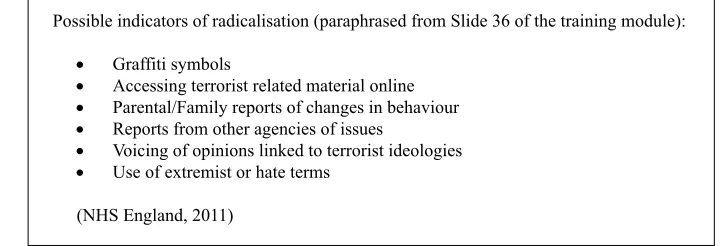
The reframing of surveillance around intuition, rather than training staff to recognise fixed indica-tors, is also apparent in the ambiguous content of counter-radicalisation training. Figures 1, 2 and 3 show examples from the online training modules that accompany the 2011 Department of Health Guidance on the Prevent strategy. These predominantly situate ‘radicalisation’ within broader types of preventable abuse (including domestic abuse, child abuse and elder abuse). When access-ing the trainaccess-ing module, NHS staff are required to read forty-one PowerPoint slides on their duties of care towards vulnerable children and adults, occasionally completing tests on the correct identi-fication of abuse and the required reporting response to line managers. The guidance turns to radi-calisation as an issue that staff are duty bound to report, and which can be identified through the following indicators:
But it is important to consider how one would distinguish ‘extremist material’ or ‘hate terms’ that fell within the remit of Prevent. What constitutes graffiti symbols, opinions and online material as terrorist-linked? How are NHS professionals to recognise specifically relevant indicators from the benign? The training offers no guidance on this, and serves to induce an organisational culture
Possible indicators of radicalisation (paraphrased from Slide 36 of the training module):
• Graffiti symbols
• Accessing terrorist related material online
• Parental/Family reports of changes in behaviour
• Reports from other agencies of issues
• Voicing of opinions linked to terrorist ideologies
• Use of extremist or hate terms
[image:11.482.53.414.421.544.2](NHS England, 2011)
of reporting rather than expertise. Indeed, at levels 1 and 2 of Prevent Safeguarding competency training (the lowest levels), staff training is only intended to explain the objectives of the Prevent strategy, discuss some ‘vulnerability’ factors in radicalisation, and impart upon staff their new responsibilities to report radicalisation-related-concerns (NHS England, 2015).
I will argue that the characteristics of the potential terrorist are left blank because the inductive calculative logic of the new Prevent strategy requires them to be so. Surveillance is no longer understood as the result of a pre-existing profile of characteristics; it is now framed as producing the profile through large-N induction. The characteristics of the potential-terrorist must be left blank, so that a variety of patient-contacts can be reported and the new data derivative can come into existence. In accordance with the algorithmic logic of calculation, a big data methodology is applied to terrorist detection – and the characteristics of the potential militant must be left vague to enable the mechanism to produce a new profile through its access to massive amounts of popula-tion data.
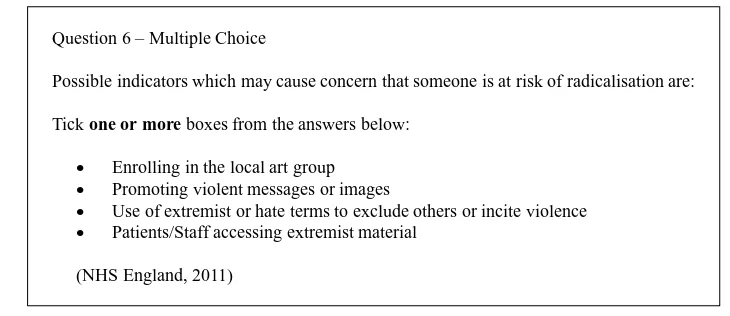
The purpose of the training is to induce a culture of reporting, not to describe a fixed profile. Subsequent pages of the training module detail the specific contacts available for referrals, famil-iarising staff with the names and agencies they can find on the hard copies of documentation in the workplace. The module then directs staff to undertake the end-of-module quiz, to successfully complete their training. Question six tests retained knowledge of radicalisation indicators using a multiple choice format. From the outlandish inclusion of ‘joining the local art group’ as a possible answer, one can begin to question the goals of the training program:
Question 6 – Multiple Choice
Possible indicators which may cause concern that someone is at risk of radicalisation are:
Tick one or more boxes from the answers below:
• Enrolling in the local art group
• Promoting violent messages or images
• Use of extremist or hate terms to exclude others or incite violence
• Patients/Staff accessing extremist material
[image:12.482.57.422.309.467.2](NHS England, 2011)
Figure 2.
Through this provision of such an obvious wrong answer within the test, it can presumed that the training module is not intended to convey any expertise about ‘radicalisation’ – otherwise the test might direct the health professional to consider something more serious than the ‘local art group’. One could imagine a module which instead offered options regarding religious appearance or political dress, to generate a comparison between ‘indicators of radicalisation’ and uninformed speculation. But the module does not function as such; it instead offers easily identifiable – and slightly humorous – wrong answers.
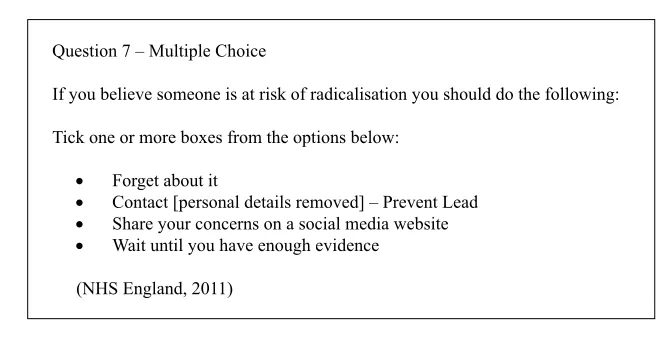
for later calculation. In this algorithmic paradigm, reporting must be maximised because irrelevant data is no longer strictly considered irrelevant; rather, it is imagined within the terms of a large-N methodology as contributing to a richer picture from which patterns can be distinguished. For example, question seven tests the staff member’s recollection of reporting procedures – providing obvious wrong answers (‘forget about it’, ‘social media’) to consolidate the take-home message of reporting, and deferring, the situation to a manager:
The training does not impart any detailed consideration of ‘radicalisation’, or any expertise. Instead it reproduces the already existing safeguarding expertise present within the NHS regarding the identification of patients suffering physical and sexual abuse, and redeploys it in the context of security. ‘Ideological’ grooming is slotted into a pre-existing apparatus for safeguarding vulnerable patients against physical, sexual, economic and emotional abuse in their wider lives. It is an exten-sion of the everyday mechanisation of care – whereby symptoms of abuse become indicators which stimulate reporting and the subsequent involvement of other agencies.
The manipulation of these safeguarding structures for the policing of political thought and expression is, on reflection, an indication of contemporary securitisation in the UK. Healthcare professionals have been responsibilised for reporting ideological deviance without significant out-cry from the public or media. Instead, the biopolitical constitution of population around an immu-nological boundary between self and other has collapsed into indistinction, whereby all bodies are securitised and surveilled.
Conclusion
Safeguarding against politics: Autoimmunity writ large
In this concluding section, the article considers the autoimmunity resonant within the conception of counter-terrorist ‘safeguarding’, whereby the terrorist is the product of preventable abuse. This collapsing of the discursive separation between health and security is the culmination of biopoliti-cal logics, which deploy both risk and pity in their imagination of insecurity (Aradau, 2004; Heath-Kelly, 2013).
What does it mean to safeguard against terrorism? In the pre-2011 immunological era of British counter-terrorism, this would have meant the protection of the population from terrorist violence, but
Question 7 – Multiple Choice
If you believe someone is at risk of radicalisation you should do the following:
Tick one or more boxes from the options below:
• Forget about it
• Contact [personal details removed] – Prevent Lead
• Share your concerns on a social media website
• Wait until you have enough evidence
[image:13.482.68.397.132.302.2](NHS England, 2011)
the autoimmune developments in post-2011 counter-radicalisation policy demonstrate a change in that meaning. Safeguarding against terrorism now refers to the identification of ideological abuse which prefigures terrorism. ‘Radicalisation’, in the Prevent review, has been reframed as a form of abuse that vulnerable children and adults can suffer, much like the domestic and sexual abuse which healthcare professionals are already required to notice and act upon within their ‘safeguarding’ protocols.
This is a remarkable depoliticization. Building upon previous policy articulations of ‘radicalisa-tion’ as a process driven by risk and vulnerability factors (Heath-Kelly, 2013), political violence has now been further depoliticized such that it is categorised as a pathological behaviour that results from ‘ideological abuse’. For example:
Preventing someone from becoming a terrorist or from supporting terrorism is substantially comparable to safeguarding in other areas, including child abuse or domestic violence … The Department of Health has also supported the review of the ‘No Secrets’ guidance on safeguarding [vulnerable] adults. This will embed the principles of Prevent within existing processes for safeguarding vulnerable adults and enable healthcare workers across the country to understand the parallels between Prevent and existing support and intervention processes. (Home Office, 2011: 83–84)
This framing of political violence as a health and safeguarding issue is developed further in the Department of Health’s guidance document for healthcare professionals vis-à-vis the Prevent strat-egy, Building Partnerships; Staying Safe. Here they outline the compatibility of ‘safeguarding’ patients from being drawn into terrorism with existing procedures for dealing with vulnerable adults, framing both as activities of care:
Public sector agencies, charitable organisations and private sector bodies including health services need to work together to protect vulnerable individuals from being drawn into terrorism. Collaborative working also adds real value to patient care … It is important that we all share a responsibility for safeguarding and promoting the welfare of vulnerable individuals. In your work you may notice unusual changes in the behaviour of patients and/or colleagues which are sufficient to cause concern. Contracts of employment,
professional codes of conduct and safeguarding frameworks such as No Secrets and Safeguarding Adults:
The role of health services require all healthcare workers to exercise a duty of care to patients and, where
necessary, to take action for safeguarding and crime prevention purposes. Through Prevent this will include taking preventive action and supporting those individuals who may be at risk of, or are being drawn into, terrorist related activity. (UK Department of Health, 2011: 4–5)
How has it become sensible to imagine terrorism as the result of ideological abuse? The depoliti-cisation of political violence is common within British history, with Margaret Thatcher provoking the Hunger Strikes of the 1980s in Northern Ireland’s jails by refusing to recognise the political status of Irish nationalist detainees, and Tony Blair participating in the post-2001 framing of Al-Qaeda as apocalyptic and evil rather than as politically motivated. But never before has the British state labelled convicted terrorists victims of a process of exploitation.
And it is the algorithmic paradigm of inductive calculation which made this final step in depo-liticization possible. The mode of calculation which utilises a large ‘N’ to inductively partition and reassemble complex datasets enabled the move away from profiling suspect communities with identifiable characteristics. This modality enabled the reframing of transitions to terrorism as pop-ulation-wide pathological processes to which all are vulnerable, and against which all should be safeguarded through the NHS. The effects of the big data paradigm have translated into the non-digital realm of counter-terrorism practice, enabling the culmination of autoimmunity.
Here social security and national security blur into indistinguishable processes. And while Foucault and Howell have pointed to their shared biopolitical logics over history, we do a disser-vice to the novel features of the Prevent review if we ignore the autoimmunity symptomatic within this collapsed distinction. The sick and the well, the dangerous and the protected bodies of security, have become ambiguous in the era of algorithmic inductive calculation. It is only when healthy cells can no longer be distinguished from threatening ones, in the autoimmune metaphor, that political violence can be pathologised as the result of abuse.
In conclusion, then, it is the calculative logic of big data which is responsible for the autoimmune implosion of British counter-terrorism, where the figures of terrorist and victim become interchange-able. This article has shown that the NHS has been selected as a counterterrorism partner of the Home Office solely because of the large-N potential evident within its public-facing operations. The decision to incorporate the NHS into counterterrorism was made so that counter-terrorism processes could have access to a bigger N. Ambivalent to the discursive separation of the health and security sectors in pub-lic discourse and liberal thought, the maximisation of sample size was prioritised above all else – dem-onstrating the commitment of governmental actors to big data ontologies of complexity and inductive analysis, such that their translation to the non-digital arena was not considered problematic.
This inductive calculative frame appeared again in the training provided to NHS staff to identify ‘radicalisation’. NHS staff, it seems, are not supposed to be looking for terrorist profiles or indica-tors (otherwise their training would be far more intensive). Instead, the calculative modality of big data analysis has spilled over into the non-digital policy world, and healthcare professionals are trained to refer patients to their institutional safeguarding boards without comprehensive expertise. Increasing the amount of data forwarded to the security services is the priority, not training NHS staff in fixed indicators of radicalisation, because algorithmic calculative paradigms prioritise the scale of data from which the derivative judgement of security appears. The historical logic of British counter-terrorism has been augmented so that, within the discourse of safeguarding at least, racialized logics of suspicion no longer determine the deployment of surveillance. Rather, the algorithmic paradigm has made it sensible to surveille the entire population so that a data deriva-tive emerges from the array of disparate facts.
The question of the ethics of this shift becomes increasingly important, but beyond the scope of this article. Is it ethically preferable for counter-terrorism surveillance to be performed on an ‘egalitarian’, population-wide basis, or was it more ethical to deploy surveillance on the basis of reductionist profiles of racialized characteristics, given that it affected fewer people? Whatever the answer to this question, it is clear that the Prevent review reveals an important shift in the mechanics of suspicion.
algorithmic autoimmunity, where the NHS and the security services are merged and Foucault’s identification of shared biopolitical logics between the clinic and national security has come to full, self-destructive fruition. Mirroring Hayles’ reading of the post-human episteme (1999), the Prevent review dictates that all bodies must now be read for their implicit data; and all such readings enact the ‘self-learning’ of the inductive analytic, whereby NHS professionals gain their supposed ‘intui-tion’ for ‘radicalisa‘intui-tion’. Patient-bodies are figured as part material entity and part information flow; and NHS bodies are figured as part material entity and part intuitive analytic.
Acknowledgements
This article has been significantly improved by the generous comments and feedback provided by multiple reviewers and editors. Their time and effort is greatly appreciated. The article remaining inadequacies are, of course, my own.
Funding
This research received no specific grant from any funding agency in the public, commercial, or not-for-profit sectors.
Notes
1. For literature on the deployment of counter-terrorism via racial and religious profiles, especially regard-ing the creation of suspect communities, see: Awan, 2012; Baker-Beall et al., 2014; Fussey, 2013; Heath-Kelly, 2013; Hillyard, 1993; Kundani, 2009; Pantazis and Pemberton, 2009; Ragazzi, 2016; Spalek and McDonald, 2010.
2. For example, initial funding from central government for Prevent activities was allocated on the basis of 5% Muslim population density within local authorities (DCLG, 2007: 6; see also: Heath-Kelly, 2013; Kundani, 2009).
3. Indeed, NHS England’s typology of Prevent Training and Competencies outlines the need for non-linear profiling of radicalisation. Staff identified at levels 1 and 2 of Prevent Safeguarding responsibility are exposed to online training on the objectives of the Prevent Strategy, their new responsibilities and the ‘vulnerability factors’ that contribute to radicalisation (which are shown to be ambiguous in later stages
of this article). They must implicitly work with ambiguity and non-linearity. However, staff for whom
higher levels of competency are required are explicitly expected to operationalise the ambiguity of
non-linear profiling beyond fixed indicators; they must: ‘Understand there is no single checklist or profile of
a terrorist, and that health staff are a key group and must use their professional judgement in assessing behaviours and risks.’ (NHS England, 2015: 10)
4. I will continually place scare quotes around this term, given the proliferation of critical literature which argues that processes of radicalisation do not exist. This literature argues instead that ‘radicalisation’ is a pre-emptive security discourse of risk and vulnerability that creates suspect communities, enables the governance of religious identity, and perpetuates the myth that terrorism can be pre-empted (Baker-Beall et al., 2014; Heath-Kelly, 2013; Kundnani, 2009; Lindekilde, 2013; Pantazis and Pemberton, 2009). 5. As has the education sector. Teachers and university staff have, since 2015, legal responsibilities to
safeguard their students against ‘radicalisation’ by reporting their suspicions to their institutional Prevent Lead, who will then contact the police.
6. There is a vast academic literature that identifies processes and factors in ‘radicalisation’ (unlike the critical readings highlighted earlier). Prominent contributions include: Awan et al., 2011; Coolsaet, 2008; Githens-Mazer, 2008; Hoffman et al., 2007; Ranstorp, 2010; Sageman, 2008.
Bibliography
Amoore L (2011) Data derivatives: On the emergence of a security risk calculus for our times. Theory,
Amoore L and Piotukh V (2015) Life beyond big data: Governing with little analytics. Economy and Society
44(3): 341–366.
Aradau C (2004) The perverse politics of four-letter words: Risk and pity in the securitisation of human
traf-ficking. Millennium: Journal of International Studies 33(2): 251–277.
Awan A, Hoskins A and O’Loughlin B (2011) Radicalisation and Media: Connectivity and Media in the New
Media Ecology. Abingdon: Routledge.
Awan I (2012) ‘I am a Muslim not an extremist’: How the Prevent strategy has constructed a ‘suspect’
com-munity. Politics and Policy 40(6): 1158–1185.
Baker-Beall C, Heath-Kelly C and Jarvis L (eds) (2014) Counter-Radicalisation: Critical Perspectives.
Abingdon: Routledge.
Bentley M (2014) Recognition masking response: Preventing far-right extremism and radicalisation. In:
Baker-Beall C, Heath-Kelly C and Jarvis L (eds) Counter-Radicalisation: Critical Perspectives.
Abingdon: Routledge, 106–123.
Borradori G (2003) Philosophy in a Time of Terror: Dialogues with Jürgen Habermas and Jacques Derrida.
Chicago: University of Chicago Press.
Comfort L, Oh N, Ertan G and Scheinert S (2010) Designing adaptive systems for disaster mitigation and
response: The role of structure. In: Comfort L, Boin A and Demchak C (eds) Designing Resilience:
Preparing for Extreme Events. Pittsburgh: University of Pittsburgh Press, 33–61.
Coolsaet R (2008) (ed) Jihadi Terrorism and the Radicalisation Challenge in Europe. Aldershot: Ashgate.
Davies S (2008) Securitising infectious disease. International Affairs 84(2): 295–313.
Derrida J (1982) Margins of Philosophy, trans. Bass A. Chicago: University of Chicago Press.
Dyer C (2011) Doctors will be asked to help identify people at risk of becoming terrorists. British Medical
Journal 342. Available at: http://dx.doi.org/10.1136/bmj.d3627 (accessed 9 September 2015).
Elbe S (2010) Security and Global Health. Cambridge: Polity.
English P (2011) Doctors should not agree to identify potential terrorists. British Medical Journal 343.
Available at: http://www.bmj.com/content/343/bmj.d4211 (accessed 9 September 2016).
Esposito R (2008) Bios: Biopolitics and Philosophy, trans. Campbell T. Minneapolis: University of Minnesota Press.
Fussey P (2013) Contested topologies of UK counterterrorist surveillance: The rise and fall of Project
Champion. Critical Studies on Terrorism 6(3): 351–370.
Githens-Mazer J (2008) Islamic radicalisation among North Africans in Britain. British Journal of Politics
and International Relations 10(4): 550–570.
Githens-Mazer J and Lambert R (2010) Why conventional wisdom on radicalization fails: The persistence of
a failed discourse. International Affairs 86(4): 889–901.
Hayles NK (1999) How We Became Posthuman: Virtual Bodies in Cybernetics, Literature and Informatics.
Chicago: University of Chicago Press.
Heath-Kelly C (2013) Counter-terrorism and the counterfactual: Producing the ‘radicalisation’ discourse and
the UK PREVENT Strategy. British Journal of Politics and International Relations 15(3): 394–415.
Heymann D (2003) The evolving infectious disease threat: Implications for national and global security.
Journal of Human Development and Capabilities 4(2): 191–207.
Hillyard P (1993) Suspect Community: People’s Experience of the Prevention of Terrorism Acts in Britain.
London: Pluto.
Hoffman B, Rosenau W, Curiel AJ and Zimmerman D (2007) The Radicalization of Diasporas and Terrorism:
A Joint Conference by the RAND Corporation and the Centre for Security Studies, ETH Zurich. Santa
Monica: RAND.
Home Office (2011) Prevent Strategy. London: HM Government.
Howell A (2011) Madness in International Relations: Psychology, Security and the Global Governance of
Mental Health. Abingdon: Routledge.
Howell A (2014) The global politics of medicine: Beyond global health, against securitisation theory. Review
of International Studies 40(5): 961–987.
Jackson R (2015) The epistemological crisis of counterterrorism. Critical Studies on Terrorism 8(1): 33–54.
Kamradt-Scott A and McInnes C (2012) The securitisation of pandemic influenza: Framing, security and public
policy. Global Public Health: An International Journal for Research, Policy and Practice 7(S2): 95–110.
Leese M (2014) The new profiling: Algorithms, black boxes, and the failure of anti-discriminatory safeguards
in the European Union. Security Dialogue 45(5): 494–511.
Lindekilde L (2013) Neo-liberal governing of ‘radicals’: Danish radicalization prevention policies and
poten-tial iatrogenic effects. International Journal of Conflict and Violence 6(1): 109–125.
Mitchell WJT (2005) Picturing terror: Derrida’s autoimmunity. Cardozo Law Review 27(2): 913–925.
Needham R (1998) Battling for Peace. Belfast: Blackstaff.
Neill W (2010) Rebranding the Renaissance city: From ‘the Troubles’ to the Titanic quarter. In: Punter J (ed)
Urban design and the British Urban Renaissance. Abingdon: Routledge, 305–322.
NHS England (2011) Safeguarding Adults and Children Level 1 Training. Available at:
http://www.dpte-learning.co.uk/SafeguardingAdultsandChildrenLevel1v2/story.html (accessed 23 June 2015).
NHS England (2015) NHS England Prevent Training and Competencies Framework. London: NHS England
Nursing Directorate. Available at: https://www.england.nhs.uk/wp-content/uploads/2015/02/train-com-petnc-frmwrk.pdf (accessed 9 August 2016).
Nunes J (2014) Questioning health security: Insecurity and domination in world politics. Review of
International Studies 40(5): 939–960.
Pantazis C and Pemberton S (2009) From the “old” to the “new” suspect community: Examining the impacts
of recent UK counter-terrorist legislation. British Journal of Criminology 49(5): 646–666.
Ragazzi F (2016) Suspect community or suspect category? The impact of counter-terrorism as ‘policed
mul-ticulturalism’. Journal of Ethnic and Migration Studies 42(5): 724–741.
Ranstorp M (2010) Understanding Violent Radicalisation: Terrorist and Jihadist Movements in Europe.
Abingdon: Routledge.
Rubenstein L (2015) Global health and security in the age of counterterrorism. Journal of the Royal Society
of Medicine 108(2): 49–52.
Sageman M (2008) Leaderless Jihad: Terror Networks in the Twenty First Century. Philadelphia: University
of Pennsylvania Press.
Sedgwick M (2010) The concept of radicalization as a source of confusion. Terrorism and Political Violence
22(4): 479–494.
Spalek B and McDonald LZ (2010) Terror crime prevention: Constructing Muslim practices and beliefs as
‘anti-social’ and ‘extreme’ through CONTEST 2. Social Policy and Society 9(1): 123–132.
UK Department for Communities and Local Government (DCLG) (2007) Preventing Violent Extremism
Pathfinder Fund: Guidance Note for Government Offices and Local Authorities in England. London:
HM Government.
UK Department for Communities and Local Government (DCLG) (2008) Preventing Violent Extremism
Pathfinder Fund: Mapping of Project Activities 2007/2008. London: HM Government.
UK Department of Health (2011) Building Partnerships; Staying Safe: The Health Sector Contribution to HM
Government’s Prevent Strategy: Guidance for Workers. London: Department of Health.
Wintour P (2015) David Cameron to unveil new limits on extremists’ activities in Queen’s Speech. The
Guardian, 13 May 2015. Available at:
http://www.theguardian.com/uk-news/2015/may/13/counter-ter-rorism-bill-extremism-disruption-orders-david-cameron (accessed 3 July 2015).
Witharana D, Olumoroti OJ and Larkin F (2012) Identifying terror suspects: The role of psychiatrists. The
Psychiatrist 36(4): 155.
Dr. Charlotte Heath-Kelly is Assistant Professor at the Department of Politics and International Studies,
University of Warwick. Her forthcoming monograph, Death and Security: Memory and Mortality at the
Bombsite, explores mortality effacement (in practices of disaster recovery and memorialisation) as a
retro-spective form of security. She has previously published a monograph entitled Politics of Violence (2013) with
Routledge, as well as two edited books (Counter-Radicalisation: Critical Perspectives (2014) and
Neoliberalism and Terror (2015)), and multiple articles in Security Dialogue, The British Journal of Politics