
© 2019, IRJET | Impact Factor value: 7.211 | ISO 9001:2008 Certified Journal | Page 4823
Classification of Assembly (W-Section) using Artificial Intelligence
Namratha Thange M
1, K R Sumana
21
PG Student, Department of MCA, NIE, Mysuru India
2Assistant Professor, C.S.Division, NIE, Mysuru, India
---***---Abstract -
Artificial Intelligence (AI) has becomeincreasingly important in modern world and it is that which makes machine work smart. Machine Learning is an application of AI.ML is the ability to learn without being explicitly programmed. Deep Learning (DL) is the part of ML methods based on Learning. They can be supervised, semi-supervised and unsemi-supervised. In this paper we are using a Convolutional Neural Network (CNN) to classify the Assembly by using one of the classification model .i.e., inception V3 model. This project classifies the images of the W-sections based on the training data and provides us the classified folders of the images as Three-Bolts, Two-Bolts, Four-Bolts and etc. And also determines whether it is correct or wrong assembly by giving the image through the Web client.
Key Words: Artificial Intelligence, Machine Learning,
Supervised, Semi-supervised, Unsupervised, Deep Learning, Convolutional Neural Network, inception V3.
1. INTRODUCTION
Classification of Assembly (W-Section) using Artificial Intelligence is a paper which tells us about the correct and wrong W-Sections based on the real time image of the assembly.
W-Section are a one of a hot rolled steel section. It is also called as H-sections or Wide Flange Beams or W-type I beams. And these W-section beams are widely used in building the bridges, Building structures, ships and etc.
Fig -1: Real time image of W-Section
[image:1.595.332.551.216.465.2]In the Steel Fabrication Industry it is very difficult to know whether the Assembly designed is correct and have its components in particular place provided in the D-Sheet.(D-sheet is the D-Sheet.(D-sheet which is the design drawing of the assembly is given with the dimension and other information of the components to be placed.)So we are trying to classify and verify the assembly for automation.
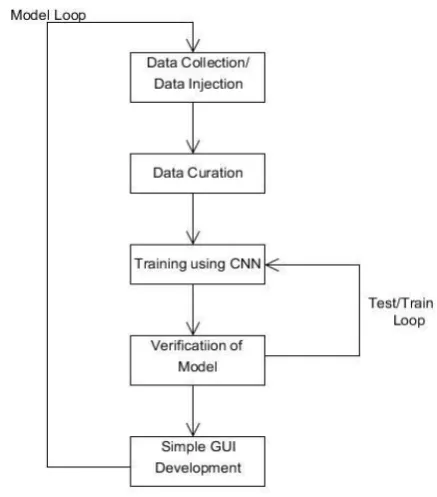
Fig. 2: The Flow of the Project
The Data Collection is the first step followed in our paper. It is the process of gathering the data for the process and then it is taken for the data curation which is the next step of the process and then the data are trained using the TensorFlow and then based on the training data and the threshold of the images the images will be tested and then it will classify the images into the respective folders. And display it with the score of the image on the web client.
2. PLATFORMS INVOLVED IN THE PROJECT
The Paper includes different platforms in it. Advanced construction technologies in the field of Civil Engineering have a wide range of modern techniques and practices. The use of technology in the civil engineering, has become a game changer in many of the aspects. And the platform which are included in the paper are explained below.
© 2019, IRJET | Impact Factor value: 7.211 | ISO 9001:2008 Certified Journal | Page 4824
Intelligence is a way of making a computer-controlled robot,or a software think intelligently, in the similar manner as to how the human intelligence works.
2.2 Machine Learning: Machine learning is one of the
application of Artificial Intelligence (AI) that gives the systems the ability to learn automatically and improve from experience without programmed explicitly. Machine learning focuses on the development of computer programs that can access data and use it learn for themselves and to provide efficient output.2.3 Deep Learning: Deep learning it is also known as deep
structured learning or also called as hierarchical learning is a part of broader family of machine learning methods based on the learning data representations. Learning can be of supervised, semi-supervised or unsupervised.2.4 Convolutional Neural Network: Convolutional
neural network, which is also called as CNN or ConvNet. And it is a part of deep learning and artificial neural networks (ANN), and it is most commonly applied to visual images and also in classification. Convolutional networks are inspired by biological processes in that the connectivity pattern between neurons.3. LITERATURE SURVEY
This Section includes the Literature survey for the Paper. As the application of Artificial Intelligence is been used in many different fields and technology. We have divided our survey into different domains where there has been use of AI and which are much relevant to our project, i.e. Deep Learning & Artificial Neural Network, Image Processing and use of Artificial Intelligence in Civil Engineering.
3.1 Deep Learning & Artificial Neural Networks
“Use of Artificial Neural Networks for Optimal Sensing in Complex Structures Analysis: This paper was published by R. Kozma, M. Kitamura, A.Malinowski and J.M. Zurada on 20-23 Nov in 1995” This paper deals with the information that how the Artificial Neural networks is trained and also how the backend needs to be in order to perform the assigned work properly. In this paper, the generalization rate of the trained network is analyzed as a possible means of selecting optimum model parameters which are, convergence of training, capability to reveal structural knowledge and generalization. Pros of the paper is that, it uses Partial skeletonization to avoid the problem of over-sensitivity to perturbation of the weights and input patterns as well.
“Structural Damage Assessment Using Artificial Immune Systems and Wavelet Decomposition: This paper was published by Arthur Shi and Xiao-Hua Yu on 14-19 May 2017”This paper mainly deals with the quality of the
structures, and it uses AI techniques to decide that whether the building is healthy or not. Many modern Structural Health Monitoring (SHM) methods have been developed to detect, evaluate, and determine the health of a building. However, most of them require training data that include both “normal” class (i.e. when the building is in its “healthy” status) and “abnormal” class (i.e. when the building is damaged); Artificial Immune Systems can be trained by the “normal” data of buildings only - that is, there is no need to tear down or destroy the building to obtain measurements of “abnormal” data for training; however, its performance is often limited by the curse of dimensionality issue. To overcome this problem, they have come up with and used energy distribution ratio of sub-band frequency decomposed by wavelet transform.
“Building Recognition System Based on Deep Learning: This paper was published by Pavol Bezak on 19-21 Sept in 2016”, The paper deals with the basic machine learning techniques, methods and CNN as a part of machine learning methods. The deep learning approach in the recognition of objects in the historical building photographs of the town of Trnava. Visualization of the internal CNN state allows us to see feature map activations and it demonstrates what the CNN learned to detect object features.
“Simple Convolutional Neural Network on Image Classification: This paper was published by Tianmei Guo, Jiwen Dong and Henjian LiˈYunxing Gaoon 10-12 March 2017” This paper deals with the convolutional neural networks consist of convolutional and pooling layers based on neurons with supervised feature learning and classification capabilities and present very good results in machine learning applications. The layers are Convolutional Layer, Pooling Layer and Fully-connected Layer.
3.2 Image Processing
“Surface Defects Detection for Ceramic Tiles Using Image Processing &Morphological Techniques by H. Elbehiery, A. Hefnawy, and M. Elewa in 2005 at The World Academy of Science, Engineering and Technology” The paper aims to create a visual system that is capable of detecting surface defects on ceramic tiles. Detection of faults & irregularities in a textured surface has been a challenging task. Few of the techniques used to detect faults in the ceramic tiles are image acquisition & capturing, edge finding, Morphological operations. Certain Algorithms used are, Pin-hole effect Algorithm, Blob defect Algorithm, Crack defect Algorithm, Spot detection algorithm.
© 2019, IRJET | Impact Factor value: 7.211 | ISO 9001:2008 Certified Journal | Page 4825
an image using skin modelling & with the use of adaptiveboosting algorithm, similarly objects can be recognized using template matching techniques where two images are used to find an object.
“Image processing for safety assessment in civil engineering: This paper was presented by Belen Ferrer, Juan C. Pomares, Ramon Irles, Julian Espinosa, and David Mas in June 2013” This paper focuses on the edge protection in building constructions to prevent damage on workers from accidentally falling into voids in construction slope surfaces, various image processing algorithms like image cleaning , object detection, noise filtering techniques were used.
“An Enhanced Tibia Fracture Detection Tool Using Image Processing & Classification Fusion Techniques in X-ray images: This journal was presented by S.K.Mahendran, S.Santhosh Baboo in the year 2011” It focuses on the automatic detection of fractures from X-ray images which is an important process in medical image processing. It mainly focuses on detecting fractures on the leg bone (Tibia). It uses four steps to detect fractures using image processing i.e., pre-processing, segmentation, feature extraction, bone detection which uses amalgamation of image processing techniques successful in detecting fractures.
3.3 Artificial Intelligence in Civil Engineering
“Using an Artificial Intelligence Approach to Build an Automated Program Understanding/Fault Localization Tool”, and this paper was presented by Ilene Burnstei N, Floyd Saner, and Yachai Limpiyakorn in 1999. Using an Artificial Intelligence Approach to Build an Automated Program in Understanding/Fault Localization Tool Describes the efforts to apply generic algorithms and similarity problem in the context of an automated program understanding/fault localization system.
“Machine Learning Techniques for Civil Engineering Problems by Yurem Reich in 1997” Machine Learning Techniques for Civil Engineering Problems describes about Better understanding of the nature of different learning problems is critical and can be improved by studying previous applications and trying to form characterizations of engineering domains.
“Delamination Detection in CFRP Composite Beam Using Modified AIS Algorithm: This paper was presented by B.Mohebbi in 2012”Delamination Detection in CFRP Composite Beam Using Modified AIS Algorithm 22describes the improvement of reliability, safety and efficiency advanced methods of supervision, fault detection and fault diagnosis become increasingly important in many engineering systems such as composite structures.
4. TENSORFLOW AND INCEPTION V3 MODEL
[image:3.595.308.559.264.385.2]4.1 TensorFlow: TensorFlow is a free and open-source
software library for dataflow and differentiate programming across a range of tasks. TensorFlow is one of the symbolic math library, and it is used in the machine learning applications, and the applications are used in neural networks, it is used for both research stream and production at the Google. And the TensorFlow was developed by the Google Brain team for the internal use of Google. It was released under the Apache 2.0 open-source license on November 9, 2015.TensorFlow is used as Training software in our project. In order to train the images.Fig -3: Working of TensorFlow
4.2 Inception V3 Model: This section discusses about
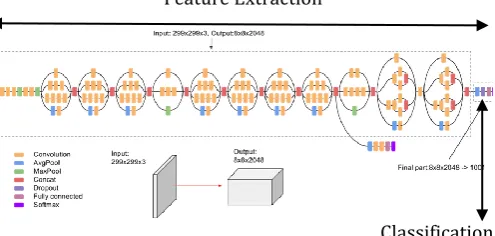
the Inception model. Inception V3 is a widely used image recognition model which includes two parts in it and they are as follows: Feature extraction with the CNN
Classification using fully connected and softmax layers
Inception v3 Model is a pre-trained model which will achieve certain accuracy for recognizing the objects with many classes, may be like “bolts”, ”assemblies”, ”animals” ad etc.
Feature Extraction
Classification
[image:3.595.312.560.599.717.2]© 2019, IRJET | Impact Factor value: 7.211 | ISO 9001:2008 Certified Journal | Page 4826
In the Inception Model, when we will build a new model toclassify our original dataset. We will reuse the feature extraction and re-train the classification part with our dataset. Before the model starts recognize the images, it should be trained. And it is most done by using the supervised Learning using a large sets of labelled images. But common used labeled image sets is ImageNet.
5. METHODS
5.1 Collecting Dataset: The dataset for the project is
collected by taking the real time images of the W-section or assembly. And the dataset collected are in the JPG, PNG format. And the data are copied to the input folder for the process.5.2 Training the Module: Training the inception v3
module by providing the 70% of the data from the dataset by using the TensorFlow library. Then the trained module provides us the bottleneck files for the trained data.5.3 Testing data: The testing of data takes place by taking
the bottleneck file of the trained classes or images. And the testing is done for the remaining 30% of the data in the dataset. And then the testing is carried out based on the threshold value of the images. Here the default threshold value is 0.6.5.4 Classification: Finally the trained and the tested
classes are classified using convolutional b=neural network based on the training module as the following folders-three bolts, two bolts, four bolts and others. While classifying the threshold value of the image whose value is less than 0.6 is considered to others, because it cannot classify image below the default frequency.6. RESULTS
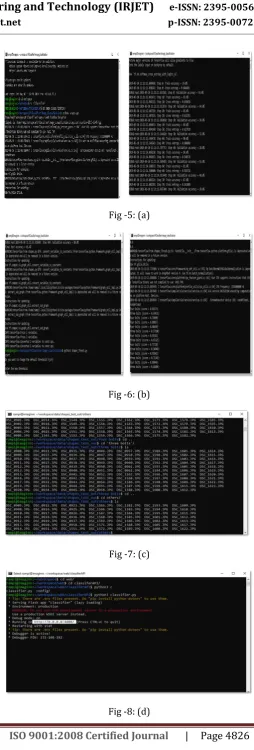
Results from Backend
(a)
Running the Training Module and Gives the accuracy of the training images(b)
Takes the Bottleneck Files of the trained images, Starts Testing Images by taking the Threshold Value and Starts Testing the remaining 30% of the Dataset based on the Training Data and provides the threshold score for the testing images.(c)
Classified Folders of the Dataset(d)
Running a webclientFig -5: (a)
Fig -6: (b)
Fig -7: (c)
[image:4.595.304.559.49.801.2]© 2019, IRJET | Impact Factor value: 7.211 | ISO 9001:2008 Certified Journal | Page 4827
Result displaying Through GUI
[1] Home Page of the Application
[2] Choosing the file to upload in the Application
[3] Uploading the File and Classifying the Assembly
[4] The output with the Threshold value of the Assembly and the Information whether it is Correct or Wrong
[5] The Error Message for the Untrained Images is as follows
Fig -9: [1]
Fig 10: [2]
Fig 11: [3]
Fig 12: [4]
Fig 13: [4]
3. CONCLUSION
This project is carried out using PYTHON programming for assembly classification. Artificial Intelligence, Machine learning and deep learning are basically machine perception. It is the power to interpret the sensory data. Because of the high volume data generation the machine can learn to distinguish the pattern; and make a decision. The conclusion of this is to present highlights of references pertaining to artificial intelligence in civil engineering and would provide the theoretical foundation or may play an important role in the development of artificial intelligence in civil engineering and further we can apply this classification to other steel sections in future.
ACKNOWLEDGEMENT
I would like to thank my guides K R Sumana and Ram Prasad K R for valuable guidance. My sincere thanks to my parents for their blessing and my colleagues for their help.
REFERENCES
[image:5.595.233.544.53.434.2] [image:5.595.47.502.119.812.2]© 2019, IRJET | Impact Factor value: 7.211 | ISO 9001:2008 Certified Journal | Page 4828
[2] R. Kozma ; M. Kitamura ; A. Malinowski ; J.M. Zurada“On performance measures of artificial neural networks trained by structural learning algorithms” ,20-23 Nov. 1995, Dunedin, New Zealand, New Zealand, Print ISBN: 0-8186-7174-2.
[3] Arthur Shi ;Xiao-Hua Yu;” Structural damage assessment using artificial immune systems and wavelet decomposition”, 14-19 May 2017, Anchorage, AK, USA, Electronic ISSN: 2161-4407.
[4] Pavol Bezak,” Building recognition system based on deep learning”, 19-21 Sept. 2016, Lodz, Poland, Electronic ISBN: 978-1-4673-9187-0.
[5] Tianmei Guo ; Jiwen Dong ; Henjian Li ; Yunxing Gao,” Simple convolutional neural network on image classification”, 10-12 March 2017, Beijing, China, Electronic ISBN: 978-1-5090-3619-6
[6] Deepika P.U; Shivangi Chauhan; Neetu Narayan, “Artificial Intelligence techniques used to detect object and face in an image”, Amity University Uttar Pradesh, Noida, 2017 International Conference on Computational Intelligence and Networks.
[7] Belen Ferrer, Juan C. Pomares; Ramon Irles; Julian Espinosa; and David Mas; “Image processing for safety assessment in civil engineering”, Department of Civil Engineering, University of Alicante. University Institute of Physics Applied to Sciences and Technologies, University of Alicante, Spain, posted 24 May 2013 (Doc. ID 185417); published 19 June 2013.
[8] S.K. Mahendran; S. Santhosh Baboo “An Enhanced Tibia Fracture Detection Tool Using Image Processing and Classification Fusion Techniques in X-Ray Images”, Sankara College of Science and Commerce, Coimbatore, Tamil Nadu, India, Print ISSN: 0975-4350
[9] Ilene Burnstein, Floyd Saner, Yachai Limpi yakorn,”Using an Artificial Intelligence Approach to Build an Automated Program Understanding/Fault Localization Tool”, Chicago, IL, USA, USA, 9-11 Nov. 1999, 1082-3409
[10] Yoram Reich, ”Machine Learning Techniques for Civil Engineering Problems”, Tel Aviv University, Ramat Aviv 69978, Israel,12 (1997), 295–310
[11] Belen Ferrer,1 Juan C. Pomares,1 Ramon Irles,1 Julian Espinosa,2 and David Mas2, “Image processing for safety assessment in civil engineering”.1. Department of Civil Engineering, University of Alicante, P.O. Box, 99, Alicante 03080, Spain.2.University Institute of Physics Applied to
Sciences and Technologies, University of Alicante,P.O. Box, 99, Alicante 03080, Spain, Received 15 February 2013; revised 10 April 2013; accepted 21 May 2013;posted 24 May 2013 (Doc. ID 185417); published 19 June 2013.
![Fig 12: [4]](https://thumb-us.123doks.com/thumbv2/123dok_us/9337814.435814/5.595.233.544.53.434/fig.webp)
