. , '" I . . . .
..,.
"Our computer tape is clean and error·free. We think that our supe-rior cleaning process makes it cleaner than anybody else's, but of course we're prejudiced. Point is, to be computer tape at
Clean and comfortable
when we ship it
when you store it
Then, for the only sure protection in storage, we pack our tape in a unique all-plastic ca nister.lt keeps tape clean because it cannot generate contam-all, it has to be clean and free from dropouts.
ination and its positive seal prevents outside dirt from getting in; comfortable because it pro-tects against shock and humidity. This canister is even encased in an
o
o
But we don't stop at merely making clean tape; we make sure that it gets to you clean and that you can keep it clean. 'Here's how:
Our exclusive environmental shipper which we call the Tape-Safe keeps dust out and your tape "clean and comfortable." Clean, because the polystyrene foam won't shed like cardboard; comfortable, because it cushions the tape in transit against shock and damaging fluctuations of temperature and humidity. Best of all, it's free with your minimum order of Ampex tape for IBM and IBM-compatible computers.
airtight poly bag during shipment. From then on, it's up to you.
C'
'~, FREE! If you'd like a few suggestions on how to keep tape clean, .../ write Tape·Safe, AmpexCorpora-tion,401 Broadway, Redwood City, I
AM PEX
ICalifornia 94063, for a copy of our , ' TREN DS Bulletin No. 12, "Care Career opportunities? Write Box D, and Storage of Computer Tape." Redwood City, California 94064.
CIRCLE 1 ON READER CARD
r
,-..
IKEYED TO
MOVE DATA
FAST. .. AND
AUTOMATICALLY
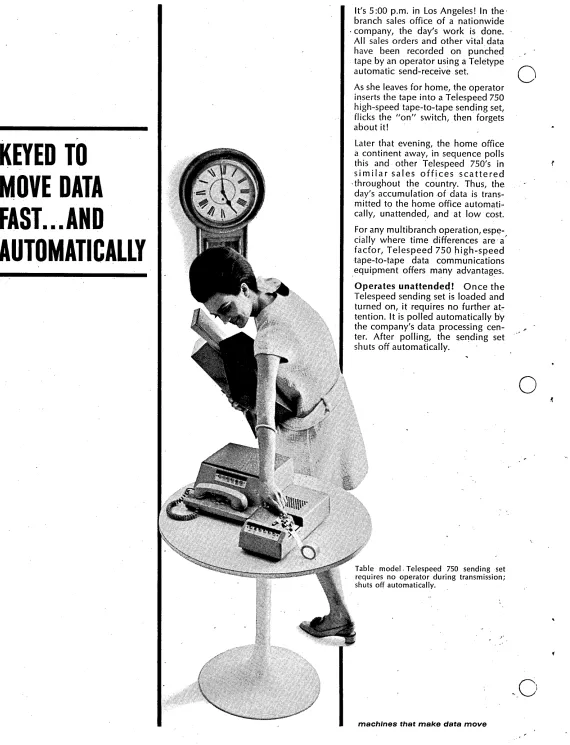
It's 5:00 p.m. in Los Angeles! In the-branch sales office of a nationwide . company, the day's work is done. All sales orders and other vital data have been recorded on punched tape by an operator using a Teletype automatic send-receive set.
0
As she leaves for home, the operator inserts the tape into a Telespeed 750 high-speed tape-to-tape sending set, flicks the "on" switch, then forgets about it!
Later that evening, the home office a continent away, in sequence polls this and other Telespeed 750's in s i mil a r s a I e s 0 ff ice ss c a tt ere d . throughout the country. Thus, the. day's accumulation ,of data is trans-mitted to the home office automati-cally, un'attended, and at low cost.
For any multibranch operation, espe-cially where time differences are' a' facfor, Telespeed 750 high-speed tape-to-tape data communications equipment offers many adv~ntages.
Operates unattende~! Once the Telespeed sending set is loaded and turned on, it requires no further at:-tention. It is polled automatically by the company's data processing cen-ter. After polling, the ~e~ding set shuts off automatically.
Table model. Telespeed 750 sending set requires no operator during transmission; shuts off automatically.
machines that make data move
[image:4.612.42.612.19.764.2]o
o
o
Reduces cost. By confining trans-mission to night hours, data can be sent when communication lines are less busy, more economical.
Even if transmission is done during the day, the speed and efficiency of Telespeed data communications equipment lets you take advantage of every minute of line time.
Because' transmission is automatic, the operator can devote her entire working day to logging of data. Thus, she can process all orders and other data received at the -branch for later transmission; no need to carryover to the next day, no delay in handling important information.
Teletype equipment is ·fast. The Telespeed 750 machines operate at 75 characters per second; 750 words per minute. The time required to transmit a full day's sales orders, or other data, can be. reduced to a matter of minutes.
Increases accuracy; improves cus-tomer relations. A major accept-ance corporation, providing install-ment loan service for thousands of .their retail outlets, uses Telespeed 750 equipment to good advantage.
Their many branch offices across the country average 300 transactions daily. Every afternoon, the process-ing center contacts the branches allowing each branch three minutes time, including the time required to make the connection. Thanks to the speed of Telespeed 750's, the trans-mission of the punched-tape data, almost 60 feet daily from each office, can be handled in
1'12
to 2 minutes.The company's computer is. now able to update each account, de-termine collection action, and pre-pare notices daily.
Results: streamlined office proce-dures; increased accuracy in han-dling accounts; improved customer relations for the retailers! They no longer worry about payment re-minders being sent to customers who have already paid.
T E L E T Y P E
--- ---
-The Telespeed 750 receiving set collects all branch office data recorded on the punched tape; all automatically, all unat-tended.
CIRCLE 5 ON READER CARD
Gives you the jump on competition. With competition ever-increasing, the company that "services" best is the one that gets the most business. Telespeed 750's, working with data processing equipment in auditing, production, inventory control, and shipping, give any company a com-petitive edge.
CIRCLE 6 ON READER CARD
4
february
1968
volume 14 number 2
Publisher Editor
GARDNER F. LANDON ROBERT B. FOREST
Managing Editor & Art Director
Associate Editor
CLEVE MARIE BOUTELL WILLIAM J. ROLPH WENDY REID JANET EYLER ANGELINE PANTAGES PHIL HIRSCH EDITH GOODMAN CHARLES WHITE HOWARD BROMBERG ROBERT V. HEAD PHIL HIRSCH Assistant Editors
Eastern Editors
Midwestern Editor European Editor Contributing Editors
Washington Reporter Editorial Adviser Technical Consultant Production Manager Director of Circulation Circulation Fulfillment
Eastern Distrid Managers
New England District Manager
& Vice President
Midwest District Manager
Western District Manager
& Senior Vice President
ROBERT l. PATRICK lOWELL AMDAHL MARILEE PITMAN FRANK DeCARLO AlGENE TRAINA
JAMES M. MORRIS WARREN A. TIBBETTS 35 Mason Street, Greenwich, Conn. 06B30 (203) 661-5400 WARREN A. Tl3BETTS 112 West Haven Rd., Manchester, N.H., 03104 (603) NAtional 5-9498 JOHN BRENNAN, 205 West Wackw Drive, Chicago, III. 60606
(312)' Financial 6-1026 HAMILTON S. STYRON 94 So. Los Robles Ave., Pasadena, Col., 91101 (213) 795-9721 (213) 6BI-84B6-from Los Angeles
EDITORIAL OFFICES
9.4 So. Los Rob ,I e s A V e .
P a sa den a, C a I i f. ' 9 1 1 0 1
IiII1
Circulation audited by Business Publications Audit
Member, American Business Press, Inc.
DATAMATION is published monthly on or about the tenth day of every month by F. D. Thompson Publications, Inc., Frank D. Thompson, Chairman; Gardner F. Landon, Pres-ident; Gilbert Thayer, Senior Vice President. Executive, Circulation and Advertising offices, 35 Mason Street, Greenwich, Conn. 06830 (203) 661-5400. Editorial offices, 94 So, Los Robles Ave., Pas,!dena, California 91101. Published at Chicago, III. DATAMATION is circulated without charge by name and title to certain qualified individuals who are employed by companies involved with automatic information han-dling equipment. Available to others by subscription at the rate of $15.00 annually; Single issues (when available) $1.50. Reduced rate for qualified students. Foreign sub-scriptions are on a paid basis only at a me of $25.00 annually. No subscription agency is authorized by us to solicit or take orders for subscriptions. Controlled circulation paid at Columbus, O. and Chicago, III. Form 3579 to be sent to F. D. Thompson Publications, Inc., 205 W. Wacker Dr., Chicago, III. 60006. Copyright 1968, F. D. Thompson Publications, Inc. Microfilm copies of DATAMATION may be obtained from University Microfilms, Inc., 313 No. FirstSt., Ann Arbor, Michigan.
Printed by Beslow Associates, Inc.
This issue 71,506 copies
DATAMATICN
c
o
o
o
Data
Pumps™
sell
outright lor
$4751
How come the big bargain? It's simple! Ultronic is an equipment manufacturer in a competitive position. With thousands of installations in brokerage offices, in Burrough's on-line Bank-ing Systems and in a variety of data communi-cations systems, volume production keeps costs down. Advanced design engineering capabili-ties help hold the cost line ... and guarantee the solid state reliability that permits Data Pumps to transmit or receive 1200 bits per second over unconditioned Schedule 4 voice-grade telephone lines day after day, with rio error or breakdown ... virtually no maintenance. Plus factors ... simple controls, easy operation, simplex or full duplex operating modes and remote and local test capability. If you're on-line now or going on line, drop us a line for all the details. Better yet, call us collect.
DATA COMMUNICATION PRODUCTS DIV.
ULTRONIC SYSTEMS CORP.
SUBSIDIARY OF
SYLVANIA ELECTRIC PRODUCTS INC. MOUNT LAUREL INDUSTRIAL PARK MOORESTOWN, N.J. 08057. PHONE: 609/235-7300
r---l
I
ULTRONIC SYSTEMS CORP.I
I
Mount Laurel Industrial Park, Moorestown, N.J. 08057I
I Tell me more about Data Pumps.
I
I
I
I
m~I
I
I
I
COMPANYI
I
I
I
ADDRESSI
I
I
I CITY STATE/ZIP
I
L ________________
~~~~~JMULTIPLEXING SYSTEMS • MAGNETIC TAPE TRANSMISSION TERMINALS • DATA SETS
APPLIED DATA RESEARCH. INC. ANNOUNCES:
o
NEW AUTOFLOW® FOR HOI\IEVWELL H-2DD
m
IMPROVED AUTO FLOW WITH 4 NEW OPTIONS
m
ADVANCED AUTO FLOW THAT ACCEPTS 7 ADDITIONAL
ASSEMBLVLANGUAGES
I)
PDm INFORMATION RETRIEVAL SYSTEM.
o
New for '68-AUTOFLOW is now available for the Honeywell H-200 series. The H-200 series AUTOFLOW directly accepts Honeywell's COBOL and EASYCODER languages.m
User-tested and approved, AUTOFLOW is in use at 150 installations. ADR's AUTOFLOW® Computer Documentation System~:~ produces two-dimensional flowcharts automatically, accu-rately, and effortlessly, directly from COBOL, FORTRAN and Assembly source programs. AUrOFLOW's four new options, available at an additional cost along withthe basic AUTOFLOWsystem, are: . '
A. Speed-Pak option, which can be used on IBM/360, Systems model 40 and larger. It has the capability of processing source programs four times faster than the current version of AUTOFLOW.
B. Hi-level/COBOL option, which can be used in conjunction with the IBM 360 or RCA Spectra 70 COBOL AUTOFLOW system, produces high level as well as detailed COBOL flowcharts from the same COBOL source program.
C. Hi-level/FORTRAN option, which can be used in conjunction with the IBM 360 or RCA Spectra 70 FORTRAN AUTOFLOW system, pro-duces high level as well as detailed FORTRAN flowcharts from the same FORTRAN source program.
D. Stromberg-Carlson option, which produces
·Patent pending
microfilm and hardcopy flowchart output on the SC-4020 plotter.
m
While' AUTOFLOW is available for COBOL and FORTRAN languages, the original Assembly languages only included AUTOCODER (IBM 1401, 1410, 7010), BAL (IBM 360, SPECTRA 70) BAP /MAP (IBM 7090, 7094). Now . . . ADVANCED AUTOFLOW accepts 7 additional Assembly languages on the IBM 360. They are: SLUETH (UNIVAC 1107, 1108); SYMBOL, META-SYMBOL (SDS 910, 920, 930); COM-PASS (CDG 3200, 3300, 3400, 3600); DAP " (DDP 24, 124, 224); ART (UNIVAC 418); AUTO-CODER (IBM 7070, 7074).I)
Now available . • . PDQ (Program for De-scriptive Query) an Information Retrieval sys-tem, designed by Computer Associates (COM-PASS), an ADR subsidiary, for use with IBM System/360 computers, models 30 and larger. PDQ has been designed for information retrieval applications in industry, research facilities, edu-cational institutions, and governmental agencies.While ADR is
a
recognized leader in proprietary software, corporate activities range from soft-ware developmentto
management sciences, application programming, and research.Contact
us
today . .. we can give you details on total software packages ora
complete array of career opportunities.ADR is an equal opportunity employer
,~.
APPLI
~o~ 20~~ ~:eeto~~~;=/o~~9~8~oH.
INC.
with offices in Boston, Mass., Washington, D.C., Los Angeles, Calif., New York, N.Y., Chicago, ilL, and Detroit, Mich.
CIRCLE 8 ON READER CARD
o
o
0
febru·ary
1968
volume 14 number 2
automatIc
information
processIng
for business
industry &science
February 1968
®
22
LARGE-SCALE INTEGRATION: A STATUS REPORT,
by Donald
E.
Farina.
An over-all look at the evolution, present stage, and probable future developments of LSI, with examples of existing products.30 WHAT'S NEXT IN MEMORIES?
by David Mayne.
Cost of manufac-turing is seen as a ma;or factor in determining the direction of future memory developments, with core, film, and LSI the contenders.33
PROJECT CONTROL FOR DATA PROCESSING, by
Max
Gray
and Herbert B. Lassiter.
A ma;or area resisting planning and control within the organization is the data. processing group; the authors suggest some ways to establish a pro;ect cont;ol system to overcome this.39 COMPUTER TECHNOLOGY IN COMMUNIST CHINA,
by P.
Rus-sell Nyberg.
The recent announcement of a new computer causes a historical review of Sino-bernetics.45
COMPUTERIZED LIBRARY CATALOG, by
Richard D. Franke.
The Navy library at Port Hueneme, Calif., has developed a mechanized catalog production system for the efficient handling of documents needed aboard ship and on shore.
58
WHAT IS SYSTEMS PROGRAMMING?
by Fred
H.
Otte.
A helpful guide for the p~rplexed, clarifying this cloudy sub;ect by the use of a simple, everyday analogy. .65
SAM ALEXANDER, 1910-1967.
datamation departments
9
Calendar99
New Products11
Letters to the Editor 109 New Literature17
Look Ahead115
Books21
The Editor's Readout133
Datamart .69
News Briefs135
People93
World Report139
Index to Advertisers97
Washington Report143
The Forum·
iz·for
BIg-
puter
experts.
P.
t
'1
1. Open ended time-sharing PDP-10's are beingar
e
A delivered. Other companies delivering time-. time-. sharers are _ _ _ _ _ _ _ _ _ _ _ _ _ _ _ _
2. Complete time~sharing software is now being delivered with the PDP-10 hardware. Others delivering completely integrated hardware / software time-sharing systems are _ _ _ _ _ _ 3. Digital's PDP-10 can directly address up to 262,144 36 bit words. It has al usec memory' cycle time, a logically complete order code, 7 fully nested programmable interrupt levels, 16 accumulators (15 of which can be used as
instantaneous index registers), a high speed, full word multiplexer, and floating point hardware. An equivalent computer might be _ _ _ _ _ _ ~
4. Basic PDP·10's go for as low as $113,000 but most customers usually buy everything they need to solve big problems. The typical PDP~10 time-sharing system actually sells for between $300,000 and $400,000. An equivalent problem ' solver from another company probably cost~-_
5. General purpose, multi-user PDp·10 systems can handle multiple jobs simultaneously-conversational time-sharing, real·time simulation and control, batch processing. What other computing system can do this ? _ _ _ _ _ _ _ 6. How much does it cost? _ _ _ _ _ _ _ _ _ 7. PRIZES: Part one' of this quiz will be followed by part 2 and part 3. What, beside a PDp·10 brochure, do you consider an appropriate prize for answering all questions in the three parts correctly? And what would 'you consider an appropriate prize for the' man who suggests the most appropriate prize? Send Entries to Dept. A, Digital Equipment Corp., Maynard, Mass.
mOmODma
COMPUTeR~ • MOOUI.,ESDIGITAL EQUIPMENT CORPORATION, Maynard, Massachusetts 01754, Telephone; (617) 897·8821 • Cambridge, Mass,. New Haven· Washington, D.C, • Parsippany, N,J .• Princeton, N.J .• Rochester, N.Y •• Long Island, N.Y •• Philadelphia. Huntsville. Pittsburgh· Chicago' Denver· Ann Arbor. Houston " Albuquerque " Los Angeles. Palo Alto " Seattle. INTERNATIONAL, Carleton Place and Toronto, Ont. • Montreal; Quebec ." Reading and Manchester, England. Paris. France· Munich and Cologne, Germany. Oslo, Norway. Stockholm, Sweden. Sydney and West Perth, Australia' Modules distributed also through Allied Radio
CIRCLE 9 ON READER CARD
r""
I.
~
o
calendar
SPONSOR/
DATE TITLE LOCATION CONTACT
Mar. 11-13 Life Insurance Chase Park Plaza LOMA, 757 Third Automation Forum Hotel, St. Louis Ave., New York,
N.Y. 10017 Mar. 12-15 Spring Joint Conf. Benjamin Franklin Harry Rayner,
Univac Users Assn. & Hotel, Philadelphia Univac, P.O. Box Univac Sci. Exchange 8100,
Philadel-phia, Pa. 19101 Mar. 14-16 6th Annual Symposium Shamrock Hilton Univ. of Texas,
ORGANIZE
on Interface of Houston, Texas Div. of Cont. Computer Science & Educ., P.O. Box
file
Statistics 20367, Houston
77025
with
Mar. 14-16 2nd Annual Indiana Purdue Univ., ACM/D.G. Fryer, Com puters Users Mtg. Lafayette, Ind. G-161, Math Sci.
OBLIQUE
Bldg., Purdue Univ., West
Lafay-SUSPENDED
ette, Ind. 47907LATERAL FILING
Mar. 18-21 International Con- Coliseum & N.Y. IEEE/W. C. Copp,vention & Exhibit Hilton Hotel, 72 W. 45 St.,
0
Mar. 29 Seminar: Computers New York, N.Y. Holiday Inn ACM/J:M. N.Y.C. 10036 in Graphical DP. Hampton, Va. Adams, Jr., 211 E. Fee: $40-50 43 St., New York,N.Y. 10017 Apr. 3-5 Numerical Control: Philadelphia Numerical Control
Tomorrow's Tech. Society, 44 Nassau
Today St., Princeton,
N.J. 03540 Apr. 8-10 Users Meeting: Small Pick Congress COMMON/Laura
IBM Computers Chicago Austin, Adm. Div., General Motors Inst., flint, Mich. Apr. 16-18 2nd National Sympo- liT Research Inst. liT Research Inst.,
sium on Law Enforce- Chicago 10 W. 35 St., ment Sci. & Tech. Chicago 60616 Apr. 23-25 4th Annual Conf. Sheraton-Chicago NRECA,2000
on Data Processing Chicago Florida Ave., N.W.,
Washing-Oblique gives you more tools for ton, D.C. 20009
efficient filing than any other Apr. 26-27 Users Meeting Bellevue Stratford DECUS, Maynard, method. Write for free illustrated Hotel, Philadelphia Mass. 01754 brochures: A Value Analysis, A Apr. 30- Spring Joint Convention Cfr. AFIPS Solution to Forms Filing, A Solu· tion to EDP Printout, A Solution May 2 Computer Conference Atlantic City to Service Department Filing, A May 1-3 Annual Convention Ft. Worth, Tex. Assn. for Educa- Solution to X·Ray Filing.
tional Data
DBLIQ\\\.
0
SystemsMay 3·4 5th Annual National Univ. of Pa. Dr. David Lefkow- Suspended Filing C,ompartments Colloquium on Info. Philadelphia 19104 itz, Moore School, R. P. GILLOTTE & co., INC.
~
Retrieval Univ. of Pa., 929 Holland Ave., Cayce, S. C. 29033
Philadelphia (803) 254·8452
CIRCLE 10 ON READER CARD
DYNAMIl:
MEMORY
LOl:ATION
YOKKAICHI, JAPAN
Yokkaichi, where centuries-old tradition lives side by side with modern technology. Located here today is
Mitsubishi's Yokkaichi Petrochemical Plant, with automatic closed-loop control provided by a MELCOM
330
computer and three .Digital Development Corporation Model
10530drum memories for on-line data
storage.
0As a leader of technological innovation during a period of unequalled economic growth, the
Mitsubishi industrial family relies upon more than a dozen memory systems designed and manufactured
by Digital Development Corporation.
0Today DDC memories are helping to automate numerous
applica-tions -
chemical, petroleum, electrical, cement, paper, and glass -
at other industrial centers throughout
this progressive island nation.
0If
you're interested in high performance rotating memories, contact
Digital Development Corporation, a subsidiary of the Xebec Corporation,
5575Kearny Villa Road, San
Diego, California
92123,Phone
(714) 278-9920.CIRCLE 11 ON READER CARD
c
( '
.\
o~
letters
o
o
census tapes Sir:"Look Ahead" (Oct., p. 183) made reference to trouble with "Census Bu-reau county/city data bank summary tapes." Your description made it ap-pear that the tapes in question were those of' our County and City Data Book series (latest edition, 1967), which are in wide current use and which, to our knowledge, have no de-fects of the type described. The item was intended to refer to documenta-tion discrepancies for an entirely unre-lated computer file comprising county summary records of the 1960 popula-tion census. The difficulty with re-spect to this documentation has been corrected.
EDWIN D. GOLDFIELD
Chief, Statistical Reports Div. Bureau of the C enslls
Washington, D.C.
time-sharing review
Sir:
In "Time-Sharing Tally Sheet" (Nov., p. 42), R. L. Patrick attempts to assess the results of five different statistical experiments, although he
IS,
by his own admission, ". . . over-whelmed by the statistics involved. ... " His repeated disparaging remarks concerning the statistical content of the various papers reviewed by him reveal a personal bias which has per-haps been nurtured by his own failure to understand the basic notions of sampling theory. Surely, Mr. Patrick cannot be so naive as to believe 'that numerical data derived from very small samples can be extrapolated and generalized to the point of supporting sweeping conclusions, without at least undergoing an objective appraisal of the relative magnitudes of sampling errors and measured effects!In commenting on the paper by Schatzoff, Tsao and Wiig, Patrick states, "For reasons academic or polit-ical, the authors neglected to draw any hard conclusions from their
exper-February 1968
imental measures. The dissertation trails off into a lengthy discussion of mathematical statistics, primarily of interest to those who do not produce results for a living . . . . " This type of remark can serve no useful purpose in a forum designed to promote the in-terchange of knowledge and ideas, for it is as devoid of intellectual content as it is of factual support. The " . . . lengthy discussion of mathematical statistics . . . " alluded to by Patrick consists of one short paragraph (bot-tom of page 262) aimed at helping the intelligent reader to interpret the
large array of data presented in Tables II and III, and a paragraph at the very end of the paper describing how one might use the results of the study as a guide to the statistical design of future experiments of this type. The criticism on lack of conclusions is equally unfounded, since much of sec-tions 3 and 4 of the paper is in fact devoted to. an assessment of what con-clusions might be reasonably drawn
from the data, in light of the very small sample size. Perhaps Mr. Patrick should re-assess the "hard conclu-sions" drawn by him from the data of all five studies, and answer up honest-ly to the question of whether he is " ... producing results for a living."
MARTIN SCHATZOFF
Visiting Associate Professor of Statis-tics
Yale University
New Haven, Connecticut
Mr. Patrick responds: My apologies to the good professor. Perhaps with my quill dipped in
vinegar I pressed too hard. Upon re-reading the Schatzoff Communication I find that it parses into 32.7 column inches devoted to title, abstract, intro, arid design; 17 ci of analysis; 16.6 ci for tables of experimental results; 16.6 ci of "implications"; and 1.2 ci of references for a total of 84.0 column inches. I objected to the 16.6 ci of implications on how to design a better statistical experiment and 0.0 ci on what time-sharing had to offer that batch did not or con-versely. This, of course, causes one to wonder: Why was the experiment performed?
Sir:
R. L. Patrick's "Time-Sharing Tally Sheet" was accurate and readable.
Several more points are relevant to any time-sharing/batch comparison,
however: .
1. No time-sharing system is yet very powerful or convenient from the user's point of view-there is no good communications terminal, few facilities for incremental assembly and compilation, and little in the way of display and edit features for typical TS users. Until TS can ex-ploit its medium as well as batch
does, any comparison is really be-tween two particular systems. 2. In complexity and operational overhead, a good large-scale multi-programming system is nearly as "bad" as a TS system, since the latter requires only time-slicing over' the former, in which sophisticated memory allocation, interrupt han-dling, data management,etc., are already inherent. One reason prog-ress has been so slow is that TS depends on good
letters
ming, which is also being developed for the first time.
Since manpower costs are climbing while computational costs are decreas-ing, the TS economic position im-proves even as the state of the art stands still. One hopes that TS will have more to recommend itself in the future than that!
TAD PINKERTON
Ann Arbor, Michigan
on program protection
Sir:
Mr. Puckett's article (Nov., p. 55) presents an excellent summary and ex-tension of frequently expressed views on the legal protection of computer programs.
However, copyrights are conceptu-ally unsuited for "utilitarian" objects, since a copyright on a description of an art gives no protection against the
use of the art disclosed. The definition
of "copy" is also unsettled. A hardware computer is not a copy of an equiva-lent program; a program' made from a How chart is probably not a copy of the How chart; a program on mag-netic tape may not even be a copy of an identical printed program. Also, paradoxically enough, copyrights may give too much protection to programs. Their standard of "originality" is ex-tremely low, well within the ordinary skill in the art; almost any routine program would be copyrightable in this regard.
Patentability of programs has been largely premised on the characteriza-tion of a program as either an entity in itself or as a new use for an old ma-chine. It is suggested, however, that a program may be patentable as either: (a) a product in itself, if it has a physical structure; (b) a process of constructing a computer, whether or not the computer configuration con-structed by the program is new; or ( c) as the computer so constructed, if the configuration is also new. This "Tinker Toy" view sees a computer as a high-entropy collection of idle pieces which, are brought to a particular state of operative order by a template fur-nished by the program; it may be anal-ogized somewhat to von Neumann's approach to the theory of self-repro-ducing machines. Patents are more suited theoretically to the protection of programs than are copyrights. Fur-thermore, the writing and examination of software patents might easily turn out to be far less costly and time-con-suming than that for any other type of patent.
12
In my opmlOn, both patents and copyrights are desirable for programs, in addition to trade secrets. Patents would protect the more inventive pro-grams, while limited copyrights would cover the routine but very laborious programs. . An alternative scheme would be to slant protection of the program toward the type of protection which would be afforded the product of the program: e.g., patents for CAD programs (since the circuits thus de-signed may be patentable), copyrights for data-compilation programs (the data produced being copyrightable), etc.
Three final points. First, it has been stated that statutory protection would impair standardization. Quite the op-posite is the case; secrecy impedes standardization and leads to wasteful duplication of effort. Secondly, the low capital investment required by programming, coupled with defined and enforceable rights, may rejuve-nate in this area the small or independ-ent invindepend-entor whose decline has occa-sioned much grumbling against the patent system in recent years. Finally, the concept of the "program" remains undifferentiated in legal circles. The more mathematical aspects of program concepts and classifications by those versed in machine theory and pro-gramming theory would be most help-ful in this area. Lawyers, businessmen and legislators have already spoken. Perhaps the mathematicians should now be invited to express their thoughts.
J.
MICHAEL ANGLINIndianapolis, Indiana
software In europe
Sir:
Mr. Yasaki's article (Dec., p. 27) was a cogent summary of the European software market. We noted with inter-est, however, that Mr. Yasaki was not acquainted with the European opera-tion of our firm, Data Systems Ana-lysts, Inc.
DSA has maintained a
self-support-ing operation with a staff of more than a dozen people in the 'common market for over two years. This does not in-clude that portion of our European business which is serviced in the U.S. Our European operation has' been re-turning a small profit, which (we infer from Mr. Yasaki's article) seems to be unusual for American software firms in Europe. Unlike other firms, DSA's European effort has steadily grown and is expeded to double within less than a year.
The omission, however, is under-standable as we have been far too busy serving our clients to publicize our operation. Our work has been with European firms, rather than with the U.S. government or with European branches of American firms. As such, the publicity we have had has been largely in the European press.
CHARLES H. MARGOLIN
Data Systems Analysts, Inc. Pennsauken, New Jersey
who knows?
Sir:
Perhaps the answer to the question you pose at the bottom of p. 21 of the December issue ("Given the marve-lous benefits of the machine, what will
[man ] do with it?") can be found on p. 78 of the same issue.
D. W. DRAWBAUGH
Pittsburgh, Pennsylvania
Ed. note: Mr. Drawbaugh may be referring to a story concerning computer-produced horo-scopes, the charge of illegal use of edp gear at the Chicago Board of Education, the forthcom-ing order for $150 million worth of command/ control equipment . . . or all three.
t-s economics
Sir:
In Part II of their article "Economics of Time-Shared Computing Systems" (Dec., p. 41), Messrs. Bauer and Hill published a table of commercial time-sharing systems (p. 49) which they claim is «adapted" from data pub-lished by Computer Research Corp. The information they published in this table is over a year-and-a-half old, and they have omitted mentioning many fine organizations which provide time-shared computer service today, and included one organization which has since closed its doors.
The data which Bauer and" Hill "adapted" is published periodically by Computer Research Corp. in its copy-righted publication "The
Time-Shar-ing System Scorecard."
I would also like to make one tech-nical comment about the Bauer-Hill piece. The economics of using a shared system, or comparing one time-sharing system with another cannot be
[image:14.612.217.373.215.648.2]o
o
o
Conventional Tran.ml ..
lon
28 Telqrapll
Un ..
ClfIlTIID
CffiIBi]t::I
Tel.mux IV
System 1 .Volc.
Grad.Line
c=lm
Cffi1ifc=l
TIMED-SHIRED COMPUTER USERS
save the cost 01 multiPle communications
lines to
Jour central
computer-a remote TELEM UX IV concentrcomputer-ates dcomputer-atcomputer-a
from many different types of low speed
input terminals over one voice-grade line
for example, as many as 26 indlvld~al ASR·33 teleprinters
as . Input devices can be concentrated over a single 2400 baud line For details,
contact LouisE. Swinand Sales Manager (609) 424'-2400
DACOM DIVISION. COMPUTER TEST CORPORATION
THREE COMPUTER DRIVE, CHERRY HILL, N.J. 08034 • (6091 424-2400 CIRCLE 12 ON READER CARD
One company
designs and
builds IF
shielded
enclosures
with visual
appeal
as well as
high DB
attenuation.
., Quiet
levolution
from
14
Blectronic
m
Bnclosures·lnc
225 South Aviation Boulevard EI Segundo, California 90245 (213) 679-0181,
7825 Airport Highway Pennsauken, New Jersey (609) 665-,6810
WRITE FOR COMPLETE INFORMATION
CIRCLE 13 ON READER CARD
letters
analyzed by simply dividing the cost of operating the system by the number of users. For example, it is misleading to wonder about "a factor of six spread ($5-$30) in the per terminal hour charge" of various systems. What really counts is the problem-solving effectiveness that is gained from spending an hour on a particular sys-tem.
A point missed by the authors is that the cost per terminal hour of
a time-shared computer is roughly equivalent to the cost of.a man hour. It follows that a system which costs twice as much as' another but which . allows a user to solve a problem five times faster would be a real bargain. One must therefore consider the eco-nomics of a time-sharing system, not only when it is executing debugged programs, but in all the steps from problem conception to solution. The cost effectiveness of a ti~ ~-sharing
system will of course depend upon the types of problems that are presented to it as well as the skill of the user. Unfortunately, due to lack of space, I cannot go into all the ramifications of these concepts. The point is that a great body of literature exists on the subject, and while we still can learn a great deal more, I must disagree with the authors who say" . : . more expe-rience is required before cost factors in
time-s~ared systems are well under-stood.
LEWIS C. CLAPP
Computer Research Corporation Newton, Massachusetts
Sir:
"Economics of Time-Shared Comput-ing Systems-Part II" was well done and fairly accurate.
The authors focus on some relative-ly important - system design areas which bear heavily on the quality of service one makes available to users. The quality of service is best gauged by the (1) response time of the com-puter to queries during the debugging stages of program development and (2) the execution speed when run-ning the program. Response time for
searches of files and retrieval of infor-mation is also given substantial import by those who evaluate and select TSS capabilities.
Table 1 in this article, however, omits any mention of Dial-Data, Inc., which offers a commercial time-shar-ing system in the Boston area. DDI services users with an SDS 940 com-puter.
THOMAS A. WELCH
Dial-Data, Inc.
Newton, Massachusetts
MISery
Sir:
Hooray for correspondent David M. Jones (Letters, Dec., p. 12). It takes courage to take on the sacred cow of MIS, and·Bob Head as well. However, Mr. Jones is quite accurate in his ap-praisal of Mr. Head's apap-praisal.
I have always felt that MIS Systems ( MISS?) were designed by people in a MIST (Management Information Sys-tems Team), headed by a Mismanag-er. I am sure, however, that until we define management in the structured manner required by a "system," we face an impossible task. Perhaps the answer is a new verb in COBOL: MAN-AGE. Followed, of course, by MOVE (WITH RESUME).' Let us try to get the payroll working first.
DICK H. BRANDON
New York, N.Y.
E.d. Note: Mr. Head declined an invitation to reply to Messrs. Jones and Brandon.
wanted: paper tigers
Sir:
The TSS Project of SHARE has formed the Advanced Time-Sharing Study Group whose charter is to prepare a position paper outlining functional specs for both an operating system and appropriate hardware for the large-scale, general-purpose time-shar-ing system five years hence. The group meets about every two to three months, and has held discussions on the virtual machine approach, seg-mentation, and computer architecture and devices of the next five years. At the last meeting, the primary topic was an examination of auxiliary stor-age requirements for a large-scale t-s system.
The group includes Ted Dolotta of Princeton, Oliver Selfridge of Lincoln' Labs, Pete Markstein and Norm Ras-mussen of IBM, Bob Woodruff of Yale, Al Irvine of Jacobi Systems Corp., and myself (chairman).
Although the membership of the group represents considerable experi-ence with various aspects of the de-sign, implementation and use of t-s
o
o
o
systems, we carinot do an effective job without the support of the technical community. We therefore encourage anyone who would like to. express his opinions on any aspect of the large-scale t-s system of the future (hard-ware, operating systems, user require-ments, etc.) , to write down· his thoughts and forward them to me.
'ANDY KINSLOW
John Morrissey Associates 18 East 41st Street
New York, New York 1001'7
new terminology? .
Sir:
I think it's time to introduce a new word into the edp vocabulary: "man-ageware." With this word we can classify the development of informa-tion systems into the following three generations:
lst-hardware-the computer .2nd-software-the computer's work
3rd-manageware-manageinent with computers.
LUIS ARROYO
Madrid, Spain
binary history
Sir:
As I was browsing through an old arithmetic book, I stumbled across a mutilated IBM card which had writ-ten ~n the ,back (in part) :
"100 score and III years ago, our 100-fathers landed upon this conti-nent and brought 100th a new na-tion ... "
Do you think this might have histor-ical significance? . . ' . JACK ALLEN
Virginia B~ach, Virginia
on-line solution
Sir:
Re the time-sharing scheduling prob-lem: It is well-known that a. human ,·l:5eing's respiration rate is directly
pro-portional to his level of frustration. Hence, there is no need for scheduling algorithms. All we have to do is attach an electrode to each user and vary' their priority levels directly in propor-tion to their jitter-level.
;'
ANTHONY AMORT
Beloit, Wisconsin
l
DA T AMA nON welcomes corre-spondenceabout the computer in-dustry and its effects on society, as well as comments on the contents of this publication. letters should be ,typed, .double-spaced, and brief. Only those reaching the edi-tors by the' 5th can be considered for the next month's issue. We re-serve the right to edit or select ex-cETrpts from letters submitted to us.
February
1968. , . . .
..
6000
qUiet
. lines·
"
.
'a minute.
The
Me
4600
PATAL~®printer.
Using, a cathode ray tube
with fiber optics, the MC 4600
. silently prints 6000 liries a
minute, 32 columns per line.
No moving parts used in the
printing process. A
non-im-pact, low cost 'serial printer,
the MC 4600 operates from
any digital data source.
puter compatible, provides
asynchronous operation and
presents no interface
prob-lems. For further information,
specifications or a
demonstra-tion, phone DA T ALOG
Divi-sion of Litton Industries,
343 Sansome Street, San
Fran-cisco 94104. Area Code (415)
397:-2813 ..
The DATALOG MC 4600
·isreliable, its MTBF is in
ex-cess of 4000 hours.
It is com-
[8
DATALOG,
DIVISION OF LITTON INDUSTRIESDATALOG is a registered trademark of Litton Industries
CIRCLE 14 ON READER CARD
16
An evolutionary answer
to data processing expansion.
Now there is a family of ele.ctronic data processing systems which cern't be outgrown. The Burroughs 500 Systemsfamily-the broadest line of EDP equipment you can find.
There's a basic computer, the B 2500. And a powerful medium-scale machine, the B 3500. Higher capacity large-scale systems like the
B 5500, B 6500 and B 7500. And the B 8500 supercomputer. So you can start off with a system that matches your company's present
EDP needs, yet can grow in step with your changing requirements. You can add components and capabilities to your Burroughs 500 com-puter at any time. Or move up to a larger 500 system. Develop a combination of systems. ,A network of systems. And you can do this without the prohibitive cost of rewriting your computer program libraries. That's because you communicate with all Burroughs 500
Systems computers in the same standard scientific or business-oriented languages.
Your Burroughs representative has more gpod reasons why you should meet the 500 Systems far,nily. Ask him.
CIRCLE 15, ON READER CARD
DATAMATIDN
•
LIldchoose
the best ever assembled, anywhere. )ing and the work they expect ing groups know more. And ours \NCED WORK. Openings exist
systems • advanced graphic systems r customers' application • Pre- and FTWARE COMES FIRST, LAST
~ design is taking place, not as an )f modifying it as the entire system
and the duty - to make sure RICTL Y "HANDS ON". Because our ssional job. Our Programming
i own profusion of hardware systems. one of the nation's fastest-growing
systems, peripheral equipment lars. Our Programming Department's opportunities for advancement ssume.
~ the same reputation of quality for ners are persons with names, not just
I small, informal groups, all of whom WHERE WE ARE. Digital Equipment md several other picturesque, tnd only 45 minutes from Boston lopolitan city nearby, or vice-versa. (or a detailed letter) in confidence to
In, 146 Main St., Maynard, Mass. 01754.
-" \
cjook~ahead
o
o
A LOUD GOOD WORD
FOR THE MODEL 67
Although many IBM 360/67 users have expressed
dissatisfaction with the system's on-line capability,
the Uriiv. of Michigan says its interim MTS (Michigan
Time-Sharing) system is going full blast. Using a
5l2K 67 with 2314 disc plus a drum, the system has
gone from four TTY's to saturation, with 30 lines
coming in without taxing the system.
Using 67 relocation hardware full steam, the
system offers a beautiful, dramatic improvement,
gushes Michigan's Bernie Galler, who anticipates
40 lines coming in soon.
OS-compatible, MTS offers
Fortran G and F-level assembler with file management,
plus PIL, a Joss-like language out of the Univ. of
Pittsburgh, Snobol IV, and five other languages.
,Terminals include the 1050, 2741, 2250, Teletypes, and
several small computers around the campus, with data
coming through
a
home made concentrator to a 67 cpu
(second 67 cpu due this summer).
Background includes
one to three streams which look like terminals to the
supervisor. Work was restricted up to Jan. 1 to
sponsored and faculty thesis work, but is now open
to the entire campus, including student course and
thesis work.
MTS is not using full segmentation capability;
programs are being run using two segments, but using
full paging capability.
BURROUGHS PLAYS
NUMBERS RA'CKET
Burroughs will announce this month a B 500 which is
not part of the series 500.
The upgraded 300 cpu with
96K core, 2.4 megacharacter disc (23 msec access),
printer, card reader and punch, three-mag tape cluster
and typewriter will lease for around $4600/month.
System will handle up to 64 communications lines, is
buffered for on-line work, offers Cobol.
Non-disc
systems will also be available.
FROM T-S ASHES,
!
SOFTWARE PHOENIX
An L.A. firm which found its original time-sharing
service bureau plans temporarily uneconomical has
converted into a proprietary software house.
Time Sharing Services, Inc., under ex-Hughes and
North American man Jim Foust, is busy peddling a
program checkout package which creates test data,'
allegedly cuts checkout time in half for the 360/40
and up.
Also available: a Cobol-Cobol converter for
second to third generation or Brand X to Brand Y
machines. And they're working on a Mark
IV~typegeneralized file management system.
The company is also brokering time on a 360/50
offering the checkout package, logged 100 hours the
first month.
Plans are to install on-line IBM 2250's
for an unnamed customer, offer time nationally. Now
11 men strong, TSSI hopes to do $500K this year, is
eyeing $1 million within a year and a half.
18
40%of the computer
libraries in the USA
have fewer than
400 tapes
in the last two years 20% of that number bought
this cleaner
and there is good reason for this. The GKI Model 580
Magnetic Tape Cleaner does everything a blade cleaner is supposed to do-and does it beUer. It maintains the initial condition of high quality tape and extends its useful life.
It cleans both surfaces of the' tape more effectively, effi-ciently and safely than any other presently available blade cleaner. It is more effective because the design of its unique Controlled Motion Blade permits the optimum positioning of the working edge, and Bidirectional Cycling insures max-imum coverage. It is more efficient because the self sharp-ening, self cleaning blade never needs replacement and always presents a clean and precise edge to the surface debris. It is safer because there is no danger of scratching or dirt pile-up due to a dull scraping blade.
But don't take our word for it. The proof is. in the accep-tance and that is overwhelming. Give us a call.and let us show you why the GKI Model 580 is the preferred tool for tape maintenance in the small library. Come to think of it, we sell a lot to the large installations, too.
General Kinetics Inc., Isaac Newton Square, Reston, Va.
Wash. D.C. area (703)
471-7522·Phila.
(215)945-4640
Atlanta (404) 457-7770 • Chicago
(312)255-0240
Los Angeles
(714)540-1148.
GKI
GENERAL KINETICS INC.
CIRCLE 16 ON READER CARD
DATAMATION
c
c
-''''" ...PUBLICATIONS BY
AUTHOR I
INTO A SECOND PRINT RUN, THOMF
AFIPS
832 pages, illus. $2
(50% discount to all m AFIPS affiliated soc
Contains all the formal papers, by some seventy authors, Computer Conference giving you broad and balancec expanding fields of computer technology and applicat covered are: Hybrid. Facility }lerformance Improvem Generated Graphics; Advances in Computer Circuits; I Applications; Display Systems and Equipment; Executive Output Techniques; Management Information Systems; C and Social Sciences; Memory System Technology; Digital Systems; Advances in Medical Data Processing; New De, Languages and Language Processors and many other topi
292 pages, illus. $12.l
OTHERTHOMP
Data/Information Availability edited by Ralph I. Cole 183 pages, 6x9 ill us. $8.50 Faith, Hope and Parity edited by Jack Moshman
In pages, 6x9 illus. $5.50
Today's 'Information for Tomorrow's Products by George K. Chacko
256 pages, 6x9, ill us. $11.00
Proceedings of 21st National ACM Conference 545 pages, 81/;!xll, illus. $14.40
Proceedings of 22nd National ACM Conference 604 pages, 8Vzxll, ill us. S15.50
Annals of Reliability and Maintainability 984 pages, 81/;!xll, illus. S25.00
Proceedings of AFIPS Spring Joint Computer Conference, 1967, Volume 30
795 pages, 8Vzxll, illus. 520.20 Improving EffediveneSl in R&D edited by Ralph I. Cole 260 pages, 6x9, ill us. 512.00
Information Retrieval: A Critical View edited by George Schecter
282 pages, 6x9, ill us. S11.00 Computers: Their Impad on Society Part II, 1965 Fall Joint Computer Conference 200 pages, 8Y2xl1, illus. S6.00
Numerical Analysis edited by J. Walsh
o
o
o
look ahead
MARSHALL LABS JOINS
DISC DRIVE'MAKERS
NEW ENGLAND SOFTWARE:
YEAR OF THE ACQUISITION
IBM FIRST WITH PLAN FOR
-TECH REPCOMMYSSIONS
February 1968
Although the disc pack
busines~is one of the current
big winners in the marketplace, only three firms have
be,en making the disc drives--IBM,
Con~rolData,and
Memorex.
Now comes Marshall Laboratories of Torrance,
Calif., a subsidiary of Marshall Industries.
Their
first commercial products in the computer field will
be the Model 2500 drive, directly compatible with the
IBM 2311.
In
fact~you can just plug it into the
2841 qontrol unit.
'
Due to be announced early this year, the 2500
will beat the competition in access time: maximum
access time is 70 msec, average random is 50 msec.
And it's said to be less prone to errors and
maintenance problems.
Cost will be about $19K, with
bargains for large quantities, and deliveries are
scheduled to start in June.
In recent months, two New England software houses have
been swallowed--Computer Associates by Applied Data
Research, Wolf Research by EG&G.
Now industry
pioneer Charles Adams, we hear, has been conducting'
merger talks with Control Data, which recently
acquired software and service bureau biggie CEIR.
Adams Associates is some 6Qtechnical people strong,
specializes in consulting and special applications
design and implementation. ' Money acquired by
acquisition would probably pe pumped into ailing
Adams' subsidiary Keydata, one of the first commercial
time-sharing service bureaus, and reportedly not ,part
of the acquisition talks. Keydata ran into
ea~lyhardware troubles, has since paid the price of
offering special application packages to on-line
users, as opposed to t-s bureaus which offer 'only
assemblers and compilers.
Adams declined comment.
IBM is working on an incentive program for systems
engineers--carrying on the sound, long-standing theme
that "at IBM, everybody sells." The problem is to
figure out how to measure the SE's contribution; the
proposed solution is to relate it to the success of
the salesman he's helping to
suppo~t.The pilot project sets up a group of 4-6 salesmen
and their systems engineers-about a dozen.
The
latter's performance is then checked as a team by
the success of the salesmen.
The rewards are
arranged so that big losses or gains are most unlikely
--the commission might represent 20% of the SE's
total income.
Action against the war in Viet Nam is being organized
among
programmers~engineers, and mathematicians by
employees at a New York software house.
The
Anti-Complicity Movement (ACM) , led by Robert Kirkland, is
urging that doves in the computer, field not work on
contracts contributing to the war effort.
The group
intends to work with other peace movements, hold
debates, and publish a newsletter containing data on
defe'nse proj ects . and suppliers. , Those interested in
ACM and its newsletter may write to P.O. Box 7.
Fleetwood Station, Mt.
Vern~n"N.Y.Vying for a place in the sum, a proliferation of small
service bureaus and software houses are bravely
battling anonymity with unusual names. LDV Systems,
(Continued on page 121)
[image:21.612.0.584.33.778.2]Anyone can promise you time-sharing soft.ware.
We can demonstrate it.
Nearly every computer manufacturer has some sort of
time-sharing hardware ready to deliver.
Including us.
'
But when you ask a computer salesman about
software, he's likely to start talking about the
future. Because what most computer
manu-facturers have to' offer is an operating
sys-tem, a primitive FORTRAN, and a
tape full of promises.
- Not us.
When we sell you a 940
time-sharing system it comes
com-plete with an operating system,
plus BASIC (a programming
tool for begimiers) plus a conversation'al
algebraic language, plus a conversational
FORTRAN IV, plus a FORTRAN II, plus
a powerful text editor,. plus a two pass assembler, plus a
ma-chine language debugging package, plus a whole library of
programs and subroutines. All operating and ready to work.
Now.
The reason we have more is that we've been at it longer. We
started working on time-sharing in prehistoric times, almost
two years ago. Since then we've sold our 940;s to companies,
to research institutes, and to time-sharing utility service
cen-ters. And they have used them for everything from character
recognition to locating a 4-door sedan with red upholstery in
a car dealer's inventory.
'r---....
~o
when you ask an SDS salesman
5 C .
5--"
about time-sharing software he won't
start talking about the future. He'll
plug in his teletype unit and put you in
direct contact with our 940 computer.
Scientific Data Syste~s,It
can speak for itself.'
Santa Monica, Californiao
o
1
1
f
o
February 1968
editor's read3rut
A NEW SEASON
The long, long football season is over and, miffed by the fact that we didn't
receive Art Buchwald's TV football watching award, we turn our attention to baseball. It's spring training time, after all, and as the pitchers start the long warmup, as chewing tobacco sales rise, as the sports-page cliche level once more rises sharply, it's time for a quick peek at how Computing's '68 major league season shapes up.
IBM. Still hustling despite the fact that they've purloined the pennant ump-teen years running, the Giants have everything it takes to cop it all in '68 and '69 and '70 ... and so on. As with the Yankees of old, the cry continues, "Break 'em up." Even should the Feds step in, a big and varied arsenal, strong bench, a stronger front office make the pinstripes' lead almost insurmountable.
Univac. A well organized, profit-oriented front office has halted the slide of this famous old team. Changing emphasis from walk-and-steal-sacrifice 1004 thinking to the long-ball 1108, the Blue Bells have even forced the Giants to look for more power in their lineup. Strong in some positions; solid upper division team.
RCA. Trying to emulate the Giants, the Cherry Hill Choppers are pleased with box office biz which hasn't yet been translated into steady profits. Lack the long ball; attempts to meet the enemy across the board hurting short-term chances for number two spot. Wait'll next decade.
Honeywell. Anticipating the '64 Giant pennant drive, the Honeydos unleashed their plan to liberate the fans, have since been slow to react to the reaction of the league leader. Have been trying to appeal to the minor league fan with more than moderate success. It's a long haul, but first division finish assured.
Control Data. The Conmen from the land of many lakes don't have water on their brains, have recovered from a disastrous '65, are once more surging back into contention with primary emphasis on the long-ball 6000 series and farm-system peripherals. Strong head man, weak coaching staff, lousy bench.
General Electric. The management reorganization cycle has stepped up, fol-lowing some near-fatal lineup decisions which wrecked '66 and '67 for the Lightbulbs. Slow to translate minor-league time-sharing successes into big-league results. Lack the long ball, majority of lineup over the hill. Look for new blood soon.
Burroughs. The Mules are still sticking with lineup rushed to majors too soon, but now beginning to prove selves. The power-hitting 8500 strikes out too often, not yet a proven big-timer. Peripheral farm systems strong; beginning to make move in time-sharing league. Solid, dull. Lacks finances and imagination to move swiftly.
NCR. The best of the bush leaguers, the Cash Registers somehow survive with good field, no hit. New lineup with same old coaching staff may mean second division for some time to come.
Scientific Data Systems. Pennant ardor has cooled for the Sigmas, seemingly content to make money in the second division. Hit lots of singles and doubles, get runs in bunches, with long dry spells in between. Rumors of management changes; lots of veterans riding out their options.
That's about it. The first person to make any sense of our projections gets a free season pass to the biggest show on earth.
LARGE-SCALE
INTEGRATION:
coming on big
A STATUS REPORT
by DONALD E. FARINA
D
The term "large-scale integration" (LSI) gen-erally refers to the technology of making very complex integrated monolithic circuits. This article will attempt to substantiate that LSI is now an existing technology and will desc~ibe the various techniques used. Examples of exi~ting LSI products and some of the problems encountered in their design and manufacture will be discussed. The influence LSI is having on computer architecture will also be discussed.One might define large-scale integration as that technol-ogy which enables the functional complexity of a monolithic integrated circuit to be increased to the point where the integrated circuit is in itself a subsystem function rather than an arbitrary increase in the number of identical gates or flip-flops. To be classified as practical LSI, it must also offer a significant economic advantage over that attainable with conventional integrated circuits.
In the early 1960' s-as technology progressed-semi-conductor transistor geometries became smaller and smaller. It became obvious that many transistors could be contained
in a reasonable sized chip of silicon with reasonable yield. Methods were devised to isolate active· areas of transistors to build what was known as monolithic circuits'! Monolithic circuits contained 20 to 30 transistors and resistors and were the elemental building blocks necessary to build digital equipment such as gates and flip-flops. Many classes of monolithic circuits evolved, covering the speed and power
spectrum. .
. As the technology progressed further, it became evident that reasonable yields could be obtained if more transistors or functions were contained in a single chip of silicon of . similar area. The challenge was to identify subsystems
func-. The author wishes to acknowledge the work of the R&D and Engineering 'activities of Philco-Ford Microelectronics Division.
1. William H. Richmond, "Integrated Circuits for Commercial Computers,"
DATAMATION, November, 1965.
22
tions that could employ a multiplicity of gates and flip-flops and yet be useful in many types of equipment.
Important assumptions were made about the. semicon-ductor technology that influenced the approach to LSI. Two of these assumptions were as follows:
The cost of making an LSI silicon chip is primarily a func-tion of the silicon chip area and only somewhat a funcfunc-tion of the complexity of the circuitry within that silicon area. This statement was reasonable if the technology was con-stant. In other words, device geometries were the same and the masking and alignment tolerance requirements were the . same.
Although the packaging and testing costs would be higher for LSI, the cost per function attainable would be considerably lower if the functional density were increased
Mr. Farina is technical staff specialist for the director of marketing at Philco-Ford's Mi-croelectronics Division. He has
been active in research and en-gineering for MOS devices
there and was previously with Fairchild Semiconductor, work-ing on bipolar structure
devel-opment. He has a BSEE from
New York Univ. and has done
graduate work in mathematics
and physics at Adelphi and Temple Univs.
DATAMATION