warwick.ac.uk/lib-publications
Original citation:
Cullen, Stephen Michael and Cullen, Mairi Ann (2018) Evaluation of the Autism Education Trust Programme, 2017-2018. Coventry ; London: Centre for Educational Development, Appraisal and Research (CEDAR), University of Warwick ; Autism Education Trust.
Permanent WRAP URL:
http://wrap.warwick.ac.uk/104928
Copyright and reuse:
The Warwick Research Archive Portal (WRAP) makes this work by researchers of the University of Warwick available open access under the following conditions. Copyright © and all moral rights to the version of the paper presented here belong to the individual author(s) and/or other copyright owners. To the extent reasonable and practicable the material made available in WRAP has been checked for eligibility before being made available.
Copies of full items can be used for personal research or study, educational, or not-for-profit purposes without prior permission or charge. Provided that the authors, title and full bibliographic details are credited, a hyperlink and/or URL is given for the original metadata page and the content is not changed in any way.
A note on versions:
The version presented in WRAP is the published version or, version of record, and may be cited as it appears here.
1
Evaluation of the Autism Education Trust Programme,
2017-2018
Stephen M. Cullen
Mairi Ann Cullen
Centre for Educational Development, Appraisal and Research (CEDAR), University of
2
Contents
Evaluation of the Autism Education Trust Programme, 2017-2018 ... 1
DRAFT ... Error! Bookmark not defined. Centre for Educational Development, Appraisal and Research (CEDAR), University of Warwick ... 1
1. Executive Summary ... 5
1.1 Introduction ... 5
1.2 Findings ... 6
1.2.1 Attribution ... 6
1.2.2 Findings presented ... 6
1.2.3 The Settings ... 7
1.2.4 The Survey ... 8
1.3 Conclusions and recommendations ... 9
1.3.1 Conclusions on the impact of the AET training and materials from the work by CEDAR ... 9
1.3.2 Recommendations on future evaluation work by the AET ... 10
2 Introduction ... 12
2.1 Background ... 12
2.2 The evaluation, 2017-2018 ... 13
2.2.1 Aims of the evaluation ... 13
2.2.2 Data collection ... 13
2.2.3 Attribution ... 15
2.3 This report ... 17
3. The four case-study settings ... 18
3.1 Setting 1 (S1). A mainstream secondary school. ... 18
3.1.1 The backgrounds of the staff and sources of autism support available ... 18
3.1.2 Setting practice re children with autism ... 21
3.1.3 The experience of autism support ... 21
3.1.4 Setting 1, conclusions... 31
3.2 Setting 4 (S4). A specialist primary school. ... 31
3.2.1 The backgrounds of the staff and sources of autism support available. ... 31
3.2.2 Setting practice re children with autism ... 33
3.2.3 The experience of autism support ... 34
3.2.4 Setting 4, conclusions... 39
3.3 Setting 5 (S5). A Montessori nursery ... 40
3.3.1 The backgrounds of the staff and the sources of autism support available. ... 40
3
3.3.3 The experience of autism support ... 41
3.3.4 Setting 5, conclusions... 46
3.4 Setting 6 (S6). A mainstream primary school... 46
3.4.1 The backgrounds of the staff and sources of autism support available ... 46
3.4.2 Setting practice re children with autism ... 47
3.4.3 The experience of autism support ... 48
3.4.4 Setting 6, conclusions... 53
4. The online survey ... 53
4.1 Introduction ... 53
4.2 About the respondents ... 54
4.2.1 Role of respondents ... 54
4.2.2 Experience working with children or young people ... 55
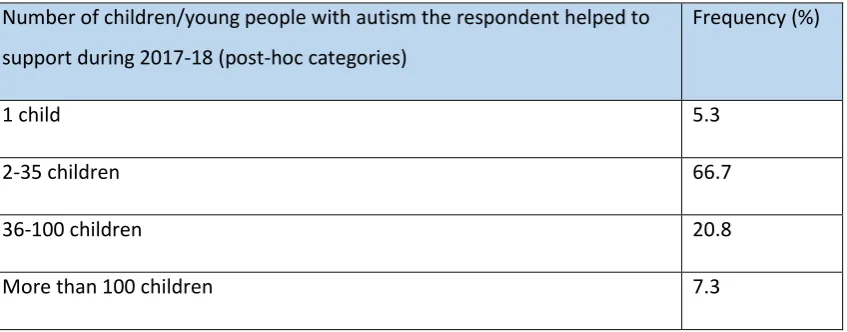
4.2.3 Number of children/young people with autism helping to support, 2017-18 ... 55
4.2.4 Last receipt of CPD training in relation to autism support ... 56
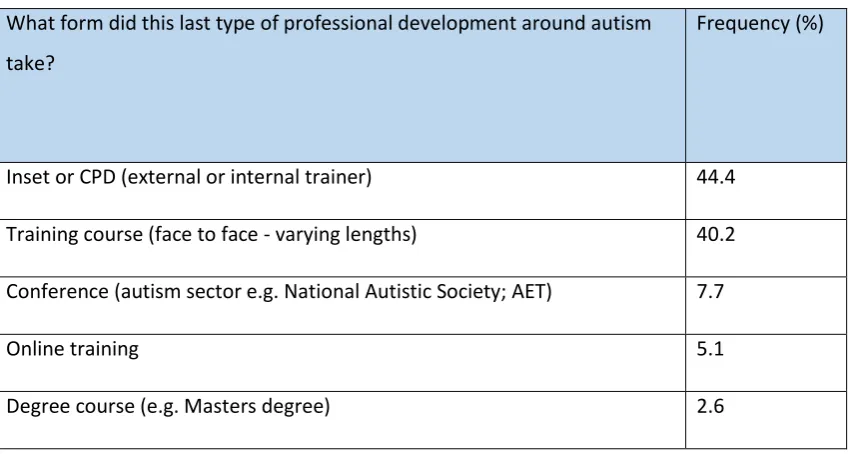
4.2.5 Form of the training around autism ... 57
4. 3 Views of the respondents ... 58
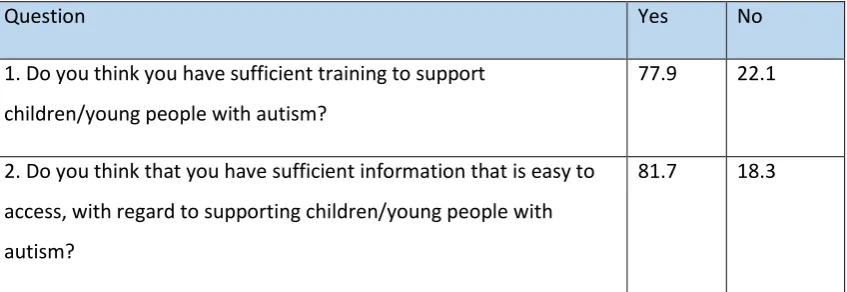
4.3.1 Views about sufficiency of training and accessible information ... 58
4.3.2 Views about AET training ... 58
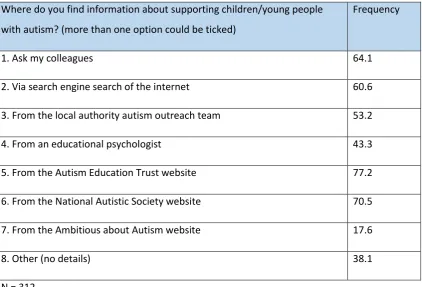
4.3.3 Information sources about supporting children/young people with autism ... 59
4.3.4 Views of additional support, information or CPD that would be useful ... 60
4.4 Conclusion ... 71
5. Conclusions ... 71
Appendix 1 ... 73
Initial interview with settings’ staff. ... 73
Appendix 2 ... 74
Follow-up interview questions... 74
Appendix 3 ... 74
Final follow-up interview questions ... 74
Appendix 4 ... 76
Additional material provided by Setting 4 (Specialist primary school) ... 76
Appendix 5 ... 80
Online survey, ‘The Evaluation of the Autism Education Trust Programme, 2017-2018’. ... 80
Appendix 6 ... 84
5
1. Executive Summary
1.1
Introduction
The Autism Education Trust’s (AET) capacity building programme is now in its eighth year. There
have been four earlier rounds of the Programme – the AET Programme 2011-2013; 2013-2015;
2015-2016, and 2016-2017. The AET Programme 2011-13 established the regional hubs training
model and introduced school years training for all school staff working with children and young
people with autism. The 2013-15 Programme involved the development of new Early Years (EY) and
Post-16 (P-16) training materials for workforces and settings supporting EY and P-16 children and
young people with autism. The 2013-15 Programme also involved the development and roll-out of
National Standards and Competency Frameworks for EY and P-16 settings. The 2015-2016
Programme introduced a newly developed Progression Framework, designed for the AET by Autism
Associates.
All stages of the AET Programme have been evaluated by the Centre for Educational Development,
Appraisal and Research (CEDAR), the University of Warwick. The evaluations showed that the AET
Programme, the training hubs model, and the training and support materials, including the
Competency Framework, National Standards, and Progression Framework, were all successful in
delivering well-regarded, high quality training to the workforce for children from Early Years to
Post-16. For the 2017-2018 period, the AET asked CEDAR to create a small number of detailed
case-studies of the processes of supporting children and young people with autism in a range of
education settings. The aims of the evaluation were:
To map work with children and young people with autism.
To examine the particular needs of the children and young people during the period of the
evaluation.
To understand the processes by which the settings’ staff responded to those needs and how
they sought to support the children and young people.
To identify the sources of training and information, including, in particular, those from the
6
To establish, where possible, the specific impact of the AET Programme in terms of enabling
staff to support children and young people with autism, and improving the educational
experience of those children.
1.2
Findings
1.2.1 Attribution
Addressing the aims of the evaluation required the creation of a ‘diary’ of work with children and
young people with autism over the period of the evaluation. In addition, there was a need to identify
the differing sources of autism education knowledge and practice in order to assess the impact of
the AET Programme. The latter raised the issue of attribution - that is, identifying the AET
Programme as the source of knowledge and practice in settings where staff drew on a range of
information and practice. Two methodological approaches to the issue of attribution were adopted
for the evaluation. The approaches were, causal contribution analysis, and the stakeholder
participation perspective.
1.2.2 Findings presented
The findings are presented by setting. Four settings remained involved in the evaluation throughout;
these were:
A mainstream secondary school. A specialist primary school. A Montessori nursery.
A mainstream primary school.
In addition, the findings from an online survey, ‘The Evaluation of the Autism Education Trust
Programme, 2017-2018’ (Appendix 5) are presented. This survey was e-mailed to 14,000 people on
the AET’s database (an undifferentiated database), with a covering notice (Appendix 6), and was
7
1.2.3 The Settings
1.2.3.1 A mainstream secondary school
The evaluation work with the setting showed that in that mainstream secondary school, the SEND
staff with particular responsibility for supporting, and leading, autism education drew on a range of
sources for their knowledge. Both the deputy SENCO and the member of staff (Staff 1) who
facilitated the evaluation, had extensive on the job experience and learning to draw on. However,
they had few opportunities to undertake formal autism training. They could call upon the support of
a local authority educational psychologist, and on their network links with a specialist school. Staff 1
provided evidence throughout the evaluation of the use of the AET Programme, particularly in
relation to the sensory audit, the sensory profile, providing strategies for use at home (Child B’s
homework timetable), and the successful piloting of the AET Progression Framework. This
represented a notable addition to the support for the children with autism, although Child A proved
to have needs that could not be met by this mainstream setting. Participation in the evaluation of
the AET Programme also had benefits for the staff involved, and had helped provide an extra
impetus to further development in relation to autism support.
1.2.3.2 A specialist primary school
The setting was a specialised primary school for children with autism. It was well-resourced for its
role, had experienced and knowledgeable staff, and acted as a centre for training and information
about autism education. In addition, the school was able to call upon external support and advice,
for example, that of the occupational therapist who observed Child B and recommended additional
strategies for supporting him. Although there was already well established autism practice in this
setting, the AET Programme was viewed by staff as an important additional element. Staff 1, who
had responsibility for the support of Child A and Child B, had prior experience of working with
children with autism before she joined the setting, but she found taking the AET Programme Tier 2
training valuable in her role in the school. In addition, the setting used key messages from the AET
Programme Tier 1 ‘Making Sense of Autism’ to create a reporting and monitoring framework for
record-keeping for children in the school.
1.2.3.3 A Montessori nursery
The setting was an example of a small, well-resourced, nursery with highly experienced and trained,
staff. They demonstrated how a range of sources of knowledge, training, co-working and support
8
Programme. The setting worked closely with outside support, such as speech and language services,
and with the parents of their children. The setting was aware of the importance of getting to know
each child individually, of the value of observation, recording, and reflection. Following on from that,
the nursery demonstrated the value of reviewing planning and practice and being willing to develop
new plans and interventions if necessary.
1.2.3.4 A mainstream primary school
The setting was a small, 216 place primary school. In terms of the evaluation, the setting was of
interest in that most of its autism education knowledge came directly from its engagement with the
AET Programme. All the school staff had undertaken AET Programme training, tier 1, while the
SENCo had undertaken tiers 1, 2 and 3, and was, as a result, the school’s autism lead. The SENCo
gave accounts of the value of AET Programme training and materials that stressed the importance of
AET sourced knowledge, and the impact on the confidence of the SENCo and staff in acting to
support children with autism. In addition, the SENCo had begun to use the AET Standards and the
Competency Framework to embed good practice in the school. During the period of the evaluation,
the SENCo also began to trial the AET Progression Framework, finding the ability to record social and
emotional progress valuable. Other sources of autism knowledge and support for the school came
from the local autism outreach team (which was also responsible for delivering the AET Programme
in the area).
1.2.4 The Survey
The online survey, ‘The Evaluation of the Autism Education Trust Programme, 2017-2018’, had 312
responses in a month. The 312 respondents were a self-selected sample, but their responses provide
an interesting insight into the autism education knowledge, training, understanding and experience
of a highly experienced range of people involved in autism education – classroom staff; middle
managers, senior school leaders, and SENCos; Local Authority staff (e.g., advisory teachers, and
educational psychologists; and mentors, support workers, therapists) and parents. Two-thirds of
those who had received the AET training (73% of the sample) rated the training as very useful and a
further third rated it as useful and 96% of these respondents said they were still using ideas from
this training. Eighty seven percent of respondents were using the AET materials (i.e. the Standards,
Competency Framework and Progression Framework).and 98 per cent of this group said that AET
materials were either very useful (50%) or useful (48). These are extremely good ratings and show
9
open question about what other support, sources of information, or CPD would be useful in the
respondents’ work with children and young people with autism produced a range of responses (with
262 responses to this question). These responses, presented above, are of use in future planning for
AET Programme development.
1.3
Conclusions and recommendations
1.3.1 Conclusions on the impact of the AET training and materials from the work by CEDAR
The data from the four settings on the impact of the AET materials and training shows a positive
effect, even in those settings where autism knowledge and practice was already quite advanced.
Similarly, data from the survey of 312 respondents, showed there was overwhelming support and
positive comments for both the AET training received and the AET materials they had used.
1.3.1.1Data from the four settings
In the mainstream secondary school (Setting 1), one member of staff had attended the Tier 3 training
and then introduced other staff to some of the tools and strategies. Staff were doing sensory audits
of the school environment, creating sensory profiles for some of the children and had used Social
Stories with the two selected case study children. They had also trialled the use of the Progression
Framework and found this so useful that they plan to introduce it to all the other pupils with autism
at the school in the future. Staff were also using the Competency Framework to audit staff knowledge.
In the specialist primary school (Setting 2), where almost all the pupils in the eight classes had
autism, there was already a great deal of autism experience and knowledge. Nevertheless, all 24
staff attended the Tier 1 and Tier 2 AET training. Some of the staff were engaged in outreach work
with other schools and said they recommended the AET Progression Framework for monitoring
progress. Staff had used some of the ideas on sensory challenges from the AET training and modified
their stance on making eye contact with the children. The setting also used key messages from Tier 1
to create a reporting and monitoring framework for record-keeping for children in the school. The
evaluation was provided with five examples of this framework, two of which are given in Appendix 4.
In the Montessori nursery (Setting 5), there were four children with autism on roll. The staff felt that
10
promoted by the AET. The nursery had also modified their practice from knowledge gained from the
Inclusion Development Programme developed by the National Strategies in 2009. Nevertheless, all
the staff had attended Tier 1 training and the nursery was using both the AET Standards and
Competency Framework to audit practice and create action plans.
The fourth setting (Setting 6) was a small mainstream primary school with just over 200 children on
roll. Almost all their autism knowledge came from the AET programme. The SENCo had done all three
tiers of training and the whole staff had attended tier 1. They were using the AET Standards and the
Competency Framework and had accessed some of the Tools for Teachers. They had future plans to
use the AET Progression Framework. The SENCo concluded that engaging with the AET training and
materials had boosted her confidence in talking to staff about their practice and in advising parents.
1.3.1.2 Data from the 312 respondents in the online survey
Most of the 312 were working in educational settings and 96% had had more than 5 years’ experience
of working with children and young people with autism. They were thus a knowledgeable group which
provided a good test for the AET programme. Most had received some training in autism in the last 2
years, not necessarily provided by the AET. Almost three quarters of the sample though had attended
AET training, 96% of whom said they were still using the knowledge gained from this. Sixty two percent
rated the training as very useful and a further 37% rated it as useful. In addition, the majority said the
AET website was their main source of information.
Responses were given by 20% of the sample to an open question at the end on what additional support
would be useful. Suggestions included opportunities to meet with colleagues to discuss practice;
greater support for parents and carers; support for children with mental health needs; and regular
updates, video clips of practice and a helpline were also mentioned. Other ideas concerned topics for
further training and are given within this report.
1.3.2 Recommendations on future evaluation work by the AET
Ascertaining what makes a difference to individual autistic children in schools and the extent to which
the AET training and materials contribute to their success is a complex issue. Separating out the
11
challenges; family factors etc.) and the interventions and provision received is not at all easy. The
nature of the evaluation within the four settings reported here was not able to determine the impact
of the AET’s work on individual children very effectively. In the AET’s future evaluations of impact, it
would be extremely useful to ask the key AET trainers and outreach staff within some of the regional
hubs to identify Early Years settings, Schools and Post 16 settings, where:
1 Clear data and evidence exists on the effect of training on individual staff or on part
or whole school practice as a result of:
the AET training at Tiers 1 2 or 3.
using the AET National Standards document to enhance elements of practice
within the school.
using the AET Competency Framework to enhance staff knowledge and
practice within the school.
using the AET Progression Framework to enhance elements of assessment
and recording practice within the school.
For all four above, there may be evidence on the impact on individual children and young people
with autism which staff can highlight for the evaluation. There is likely to be clearer evidence in
settings which have not had very well developed practice in autism until they received the AET
training and materials.
2 The use of the Parents’ Guide in the School Sector to have structured conversations
with parents/carers prior to their child’s entry to the school and/or once placed at
the school.
It would be possible to select key observable elements from the training and the Standards and
Competency Frameworks and the Progression Framework and then to ascertain whether there is
evidence for these within the settings and to determine whether any pupils have shown the benefits
of this being developed and implemented. Future evaluations of the AET programme which capture
12
2 Introduction
2.1 Background
The Autism Education Trust’s (AET) capacity building programme is now in its eighth year. There
have been four earlier rounds of the Programme – the AET Programme 2011-2013; 2013-2015;
2015-2016, and 2016-2017. The AET Programme 2011-13 established the regional hubs training
model and introduced school years training for all school staff working with children and young
people with autism. The 2013-15 Programme involved the development of new Early Years (EY) and
Post-16 (P-16) training materials for workforces and settings supporting EY and P-16 children and
young people with autism. The Programme consisted of three tiers of training which were delivered
via four EY and four P-16 training hubs. The 2013-15 Programme also involved the development and
roll-out of National Standards and Competency Frameworks for EY and P-16 settings. In addition,
guides for parents and carers on working with their children’s schools were produced. The
2015-2016 Programme introduced a newly developed Progression Framework, designed for the AET by
Autism Associates. The Progression Framework was a response to the need for research-based
models that can be applied by school staff to track the progress of children and young people with
autism. The 2016-2017 Programme consisted of a number of strands, which both built upon earlier
Programme delivery, and introduced new, additional elements to the AET Programme. The strands
were: the completion of the national coverage of the AET Early Years Programme and Post-16
Programme through the commissioning of additional hubs; pump priming five regional networks to
support schools and Local Authorities (LAs) using the AET materials to improve autism education;
additional support for the roll out of Post 16 training, and ‘Supporting the Move from School to
College’; the establishment of an ‘AET Young People’s Panel’; the development and delivery of an
autism and exclusions programme; and the maintenance of core functions.
All rounds of the AET Programme were evaluated by the Centre for Educational Development,
Appraisal and Research, the University of Warwick. The evaluations (Cullen, M.A. et al 2012, 2013,
Cullen, S.M. et al, 2014, 2015; Cullen, S.M. 2016; Cullen, S.M. & Thomas, R, 2017) showed that the
AET Programme, the training hubs model, and the training and support materials, including the
Competency Framework, National Standards, and Progression Framework, were all successful in
delivering well-regarded, high quality training to the workforce for children from Early Years to
Post-16. The success of the earlier Programmes led to further Department for Education (DfE) funding for
13
2.2 The evaluation, 2017-2018
2.2.1 Aims of the evaluation
CEDAR was asked by the AET to conduct an evaluation for the September 2017 to April 2018 period.
CEDAR was asked by the AET to create a small number of detailed case-studies of the processes of
supporting children and young people with autism in a range of education settings. The aims of the
evaluation were:
To map work with children and young people with autism.
To examine the particular needs of the children and young people during the period of the
evaluation.
To understand the processes by which the settings’ staff responded to those needs and how
they sought to support the children and young people.
To identify the sources of training and information, including, in particular, those from the
AET Programme, which enable staff to successfully support their charges.
To establish, where possible, the specific impact of the AET Programme in terms of enabling
staff to support children and young people with autism, and improving the educational
experience of those children.
The evaluation format built upon a previous evaluation of the AET programme 2015-2016 (Cullen S.
M., 2016) in which the evaluation worked with five schools – one special secondary school, one
mainstream secondary school, and three mainstream primary schools – to establish case studies of
working with children and young people with autism. The 2017-2018 evaluation reported here
sought to examine a wider range of settings, and attempted to more clearly attribute the role and
impact of AET training and materials in the practice of settings’ staff.
2.2.2 Data collection
To carry out the evaluation it was necessary to recruit a range of different settings covering Early
Years to Post 16. The settings had to be willing to engage with the evaluation over a period of one
and a half school terms (Autumn term, 2017 and the first half of the Spring term, 2018). It was
intended that five settings would be recruited to enable the construction of five case studies.
14
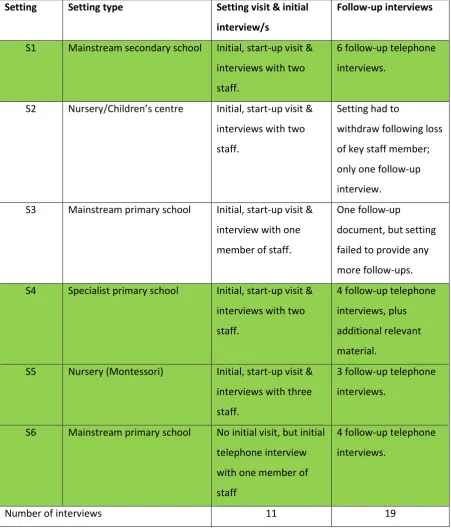
Eighteen settings expressed an interest in taking part in the evaluation, of which six settings began
the evaluation process. However, only four settings remained with the evaluation over the entire
[image:15.595.73.525.197.726.2]course. The details of settings, setting types, and data collection are given in Table 1.
Table 1: Settings and data collection (settings in green completed the evaluation process).
Setting Setting type Setting visit & initial
interview/s
Follow-up interviews
S1 Mainstream secondary school Initial, start-up visit &
interviews with two
staff.
6 follow-up telephone
interviews.
S2 Nursery/Children’s centre Initial, start-up visit &
interviews with two
staff.
Setting had to
withdraw following loss
of key staff member;
only one follow-up
interview.
S3 Mainstream primary school Initial, start-up visit &
interview with one
member of staff.
One follow-up
document, but setting
failed to provide any
more follow-ups.
S4 Specialist primary school Initial, start-up visit &
interviews with two
staff.
4 follow-up telephone
interviews, plus
additional relevant
material.
S5 Nursery (Montessori) Initial, start-up visit &
interviews with three
staff.
3 follow-up telephone
interviews.
S6 Mainstream primary school No initial visit, but initial
telephone interview
with one member of
staff
4 follow-up telephone
interviews.
15
2.2.3 Attribution
2.2.3.1 The attribution problem
In part, the aim of this evaluation (see 2.2.1 above) was to attempt to identify the specific impact of
the AET Programme (including training, materials and resources) in education settings from the Early
Years to secondary school level. In attempting this, the methodological problem of attribution arises.
The attribution problem:
‘is often referred to as the central problem in impact evaluation. The central question is to
what extent changes in outcomes of interest can be attributed to a particular intervention.
Attribution refers to both isolating and estimating accurately the particular contribution of
an intervention and ensuring that causality runs from the intervention to the outcome.’1
There is no universally accepted methodological approach to addressing this issue in small-scale,
qualitative research and evaluation work2. There are, nonetheless, a range of approaches, two of
which have particular relevance for this current evaluation of the AET Programme. The approaches
are, causal contribution analysis, and the stakeholder participation perspective. The first of these
depends upon identifying and accounting for alternative explanations for an observed outcome or
impact. In order to do this, it is necessary to establish clear, accurate accounts of events during the
period of the evaluation, and to investigate all sources underpinning the intervention in question. In
terms of this evaluation, it was necessary to ensure that other possible sources of autism training,
support, advice, information and resources other than those provided by the AET Programme, were
accounted for. The second insight - the stakeholder participation perspective – is based upon the
principle that stakeholders should be involved in the evaluation. In an impact evaluation,
stakeholder participation ‘includes aspects such as the determination of objectives, indicators to be
taken into account, as well as stakeholder participation in data collection and analysis,’3.
1http://siteresources.worldbank.org/EXTOED/Resources/chap4.pdf , p.21 (accessed, 13 March, 2018).
2 White, Howard, & Phillips, Daniel (June 2012), Addressing attribution of cause and effect in small n impact evaluations: towards an integrated framework, (International Initiative for Impact Evaluation/Global
Development Network, Working Paper 15, New Delhi).
16 2.2.3.2 Developing the co-production of the evaluation
The two approaches underpinned the construction of this, current, evaluation of the AET
Programme. From the outset, the settings’ staff who were recruited to the evaluation were enrolled
as collaborators in the evaluation design and process. The stages of creating that co-working were:
1. A detailed, explanatory, e-mail to the setting contact about the aims of the evaluation.
2. An initial, face-to-face meeting with a member of the senior management team of the
setting and the staff member who would be working with the evaluation. (One setting,
setting 6, had an initial meeting conducted by telephone in order to expedite the start of the
project). The initial meeting had a number of purposes: i) it provided the evaluation with
background to the setting; ii) it enabled the setting staff to explain how they thought the
evaluation could be facilitated; iii) it established the training, external support, materials,
knowledge and experience of the setting and its staff in relation to supporting children with
autism; iv) it identified two pupils in each setting whose progress, and work with whom,
would be the focus of the school’s part in the evaluation; v) it enabled an agreement on the
process of the evaluation up until March, 2018.
3. Following the initial meeting, the nominated member of each setting kept records of work
with each of the pupils identified in the initial meeting. These pupils were only known to the
CEDAR evaluator as ‘Child A’ and ‘Child B’ from each setting. The CEDAR evaluator and the
nominated settings’ staff spoke, by telephone, at intervals throughout the evaluation, with
the nominated staff member providing updates on the progress of the pupils, the
interventions carried out by the setting, challenges, successes, and sources of information
and materials used in the support of those pupils.
2.2.3.3 The process of the evaluation
The data collection was built around semi-structured interviews carried out face-to-face for the first
meeting, then by telephone for subsequent contacts. The first interview used a semi-structured
interview schedule designed to establish the background of the setting, and the interviewees; the
existing sources of training, information and support that the setting drew upon; the use of AET
Programme training and materials; how the setting measured impact of interventions; and setting
autism education and support policies (Annex 1). The subsequent follow-up telephone conversations
17
conversation; the progress of the children since the previous conversation and the use (if applicable)
of the AET Progression Framework in tracking that progress; strategies that had been used to
support the children, and sources of those strategies; any other relevant information (Annex 2).
Finally, the last follow-up conversation used additional questions to enable reflections on the
process of supporting the children over the period of the evaluation; these including an assessment
of the period; the most useful sources of information and training in relation to the interventions
that had been made to support the children; the value of the AET Programme and materials; and a
review of the requirements of staff in supporting children with ASD (Appendix 3).
In addition to the data collected through the face-to-face and follow-up telephone interviews, one
setting, Setting 4, provided detailed documents containing staff reporting on the progress of, and
support for six children, using key learning from the setting’s AET Programme Tier 1 training,
‘Making Sense of Autism’. Some of this material is presented in Appendix 4.
The final data collected was a ten question online survey, ‘The Evaluation of the Autism Education
Trust Programme, 2017-2018’ (Appendix 5). This survey was e-mailed to 14,000 people on the AET’s
database (an undifferentiated database), with a covering notice (Appendix 6), and was open from
16th March until 17th April, 2018. There were 312 responses, and the findings are presented here.
2.3 This report
This report presents data from all the four settings which completed all of the evaluation. The data
was gathered between 22nd November, 2017 and 13th March, 2018. The main body of this report
presents data and findings related to the settings that remained with the evaluation throughout the
four months of data collection. Those settings were:
Setting 1 (S1), mainstream secondary school. Setting 4 (S4), specialist primary school. Setting 5 (S5), nursery school.
18
The data, findings, and conclusions are presented here, in the first instance by setting. Each settings’
history in terms of autism support, training, experience and knowledge is examined. Then an
account of the specific issues that each setting faced, over time, in supporting the two children in
each setting who were the focus of the evaluation, is provided. Those issues are then related to
interventions made by the setting staff, along with the outcome and impact of the interventions.
Conclusions are presented in relation to autism training, and materials (where possible in relation to
the AET Programme), and the support of children with autism in the settings. Following the
presentation of the four case-study schools, an overall assessment is made which also draws upon
the additional data gathered from the two settings (S2 and S3) which did not remain with the
evaluation throughout.
The findings from the 312 online survey responses are also presented here, in section 4.
3. The four case-study settings
3.1 Setting 1 (S1). A mainstream secondary school.
3.1.1 The backgrounds of the staff and sources of autism support available
Setting 1 (S1) was a mainstream secondary school of 680 pupils, in Years 7 – 11 (ages 11 to 16). Of
the children at the school 98 were on the Special Educational Needs register (14% of the school roll).
Thirty-four pupils had been diagnosed with autism (5% of the school roll), with 7 on the waiting list
for diagnosis, and a number of other pupils who either display autism characteristics, or are
regarded by the school as needing support as children with autism.
The two staff who were interviewed for the initial interview were Staff 1 and Staff 2. Staff 1 was the
school’s Intervention Co-ordinator, a Teaching Assistant (TA), and the school staff member who was
to work with the evaluation. Staff 2 was the school’s deputy SENCO, and a TA. Both staff members
were experienced TAs, with histories of working with children with autism. Staff 1 gave an account
of her prior experience:
‘I started working about ten years ago in a specialist placement school for students with
19
difficulties. A lot of work with ASD students who were very low level, non-verbal, severe
behaviour linked to their autism. I worked there for four years and I then moved to a
mainstream primary school where I started to work with a Reception class student, who was
quite severely autistic, verbal but only up to a certain point, quite a low level of
understanding, and I worked with him until he was in Year 3. By the time I left he was writing
in sentences, he was sitting on a chair, he was talking coherently, so he did really well.
And then I came to work here, started as a teaching assistant, am still a teaching assistant,
but I am the Interventions Co-ordinator as well and I work probably closely with (I2) and I do
a lot of work with the ASD students as well.’ (Staff 1)
This account is important, as it shows that the staff member did not have any formal training in
supporting children with autism, but, typically, learnt from colleagues and on the job – ‘everything
that I’ve done up until this point is on the job or self-taught’ (Staff 1). She was clear that in respect of
autism training in her previous schools, ‘there were no courses that you were sent out for,’ (Staff 1).
The deputy SENCO (Staff 2), gave a very similar account of her background in terms of autism
training. Since being at Setting 1, she has specialised in mental health and has ensured that the
setting took advantage of the local authority’s education psychology service – ‘we have had the EP
[Educational Psychologist] come in and do a few ASD sessions,’ (Staff 2). Although the educational
psychologist only visited the school once a year for training purposes, the school does access the
service for advice on supporting pupils with autism. In addition, the setting has links with a specialist
setting with expertise in autism provision. Those links were quite extensive:
‘They do ASD outreach for us so they’ll come in, observe some students, meet with the
students one to one, speak to parents and provide us with wonderful support which gives us
loads of strategies to try which obviously we share with teachers and we have spotlight
briefing sessions every other Wednesday so we share any information like that.’ (Staff 2).
The only formal training that the setting staff had undertaken was the AET Programme Tier 3,
20
interview. Staff 1 explained that the setting had begun to use knowledge and materials from that
training:
‘[It was] Level 3 and they provided us with, as part of the package, the password and stuff to
be able to access Tools for Teachers. We’ve implemented certainly the sensory profiles from
there and they’ve actually been a really massive hit. We feed them back to parents and the
parents had input in filling those as well.’ (Staff 1).
The staff were also using the AET Competency Framework, something that had been in use prior to
Staff 1 attending the Tier 3 training.
Apart from the Tier 3 training undertaken by Staff 1, no other formal outside training had been
delivered to staff in the setting. The only other training was the presentations carried out by the
educational psychologist once a school year.
The setting, then, drew upon a range of sources for its knowledge relating to autism education and
supporting children with autism:
On the job experience.
Colleagues sharing information and their experience. Local authority educational psychologist.
Networking with local specialist school.
One member of staff who had undertaken AET Schools Programme, Tier 3.
The setting staff believed that they had good access to advice and support, from the educational
psychology service and from the specialist school they were networked with. Formal staff training,
however, was limited. During the evaluation, the follow-up interviews sought to identify the sources
of interventions, and general practice, in relation to autism support for the two children identified in
21
3.1.2 Setting practice re children with autism
The two setting’s staff gave an account of the settings’ practice in relation to supporting children
with autism. All the work relating to the pupils with autism is organised and overseen by the
Inclusion Department, which is loosely split into SEN and Behaviour sections, staffed by TAs. Autism
practice applied uniformly across the setting, and focused on information and support for all the
setting staff, information and co-working with the parents/carers of the children with autism, and
pupil-specific support.
In order to prepare staff with regards to children with autism coming into the setting, a one page
profile of the child is prepared. That profile is made available to all staff in both electronic and hard
copy forms. In addition:
‘Teachers are connected to the mark sheets and the SEN register [together]. That’s a new
thing we’ve had from September. When a teacher pulls their mark sheet off they can see all
the SEN kids that are in there and all the needs that they have. Also when we enter the data
on our mark sheets there’s a new column now where teachers have to put what quality first
teaching they’re giving the kids in the classroom to support them. And then I will run a
report and pull off all the SEN kids and then I’ll be typing them back some responses to try
this or have your tried that or giving them some strategies to try. So that is with ASD and
other kids that are on our register.’ (Staff 2).
Once the new pupil is in the school, the educational psychologist visits, observes the pupil, and
speaks to both the pupil and their parents/carers. The school itself also works with the parent/carers
getting them to fill in a parent questionnaire, working with them to set targets for their child/ren,
and ensuring good communications between school and home.
3.1.3 The experience of autism support
3.1.3.1 Child ‘A’ and Child ‘B’
At the initial meeting, the school staff chose two pupils who would be tracked for the evaluation –
22
updates about the pupils’ experience and progress, along with staff intervention and support for
each pupil.
Child A was in Year 9, and, at the time of the initial interview, the school was involved in preparing
for an Education Health and Care Plan (EHCP) for him. His parents wanted Child A to be given a
specialist place, preferably a residential place. The setting and the boy’s parents found Child A
challenging. At home, he had a history of destructive behaviour and violence against his siblings. In
school, he was frequently excluded from classes – ‘last week out of 25 lessons he was in one and a
half because he spent the rest of the time in isolation’ (Staff 2). Child A had difficulties following
instructions - ‘unless it’s his idea or his choice, he won’t do it’ – and he frequently used bad
language.
Child B was a boy, with diabetes, in Year 8. He was ‘very verbal, he’s got a lot to say for himself, but
very polite’ (Staff 1). He had problems with anxiety, particularly around not doing his school work
well enough, or failing a test, or getting into trouble. ‘He’s quite a high achiever, academically bright’
(Staff 2). One of the staff gave an example of the impact of his anxiety on Child B:
‘We give consequences if they disrupt the learning or don’t follow instructions so he got like
a D1, which is a warning [lowest level], and he didn’t like that and he physically got out of his
seat and rubbed it off the board because we write them on, just initials, and he got really
upset and then he ran out and hid under a table. This was when he was in Year 7 so he
cannot cope with anything like that that’s in a negative way.’ (Staff 1)
The school staff were aware of this, and tried to frame instructions, or feedback to Child B in positive
terms.
At the initial meeting, the staff said that they were aiming to improve Child A’s inclusion in the
classroom, and help him to ‘accept what others are saying and following instructions’ (Staff 1). For
Child B, the staff wanted to aim to reduce his anxiety around school work, and to help him socialise
23 3.1.3.2 Supporting Child A and Child B
Following the initial meeting, Staff 1 provided the evaluation with six follow-up reports/interviews
by telephone. The follow-up reports typically lasted between 10 and 15 minutes and focused on the
progress of supporting the two children, interventions, and sources of knowledge for the school staff
(see Appendices 2 and 3). The follow-up telephone reports took place in November, December (1st
and 19th), January, February, and March. The progress of each pupil is presented here separately.
Child A:
The first follow-up on Child A noted that there were some classes that he was willing to attend, but
others that he absolutely refused to attend. For Child A the issues revolved around the individual
teachers taking the classes. Child A had some understanding of his autism, and school staff had been
encouraged to gain his attention with a closed (‘Yes/No’) question followed by an open question.
Some improvements in his relationship with some school staff were reported, but Child A continued
to have difficulty moderating his behaviour and his language. Staff 1 was working with Child A using
a booklet called ‘The Big A’, with the aim of helping the boy to better understand his autism.
However, Staff 1 did not think that he did understand. She was also doing social stories with the
pupil. She also reported that neither approach appeared to have any effect on his behaviour. Neither
of the tools used in her work with him were sourced from the AET Programme.
The second follow-up took place three weeks later on 1st December. There had been little change in
the situation:
‘His level of understanding of his autism is non-existent, and we are working with him on
that but he doesn’t really see how it impacts him and so the teachers will ask him to do
something and in his mind he doesn’t understand why he should or the reasons why. And
some teachers are quite good and they’ll explain it to him, and give him the time and other
24
One class, in particular, was problematic, and Child A was no longer attending it. Staff 1 explained
that both Child A and the teacher had ‘very fixed ideas’ about each other that were not going to
change. The pupil’s parents were very supportive of the school, but they struggled at home with
Child A. At that stage, the outcome of the ECHP was still awaited. Staff 1 thought that ‘the decision
has been made both a home and here [school] that actually as much as we are trying this is not the
setting for him. It’s almost like he’s been set up to fail being here at the moment’.
The third follow-up took place just before the end of the Autumn term, on 19 December. Child A had
continued to experience difficulties following school rules. In particular, he had spent the previous
day ‘in isolation’ after calling ‘a member of our senior leadership team pathetic’ (Staff 1). Staff 1
believed that the main issue was that Child A did not understand the school rules, nor their purpose
or necessity:
‘He knows that he has ASD, but he still has no concept of what that means for him, and how
that may influence what he says or how he thinks, or how he sees things. I keep saying to
him, you may think differently, your thoughts are not wrong, but as a school we need to
make sure that you understand and you are ready so that when you go out into the world
you can say, “my name is […] I have autism”’. (Staff 1).
The staff member had continued to work with Child A on this, using the booklet The Big A. In
addition, she was working with him on sensory issues. In this work she was using AET Programme
material from ‘Tools for Teachers’. She was aware that there were some classroom that Child A did
not like to be in, and she was planning, ‘using the sensory audit that they’ve got on the Tools for
Teachers’ to walk around the school site with Child A to carry out a sensory audit.
The fourth follow-up conversation took place three weeks into the Spring term, on 22 January. The
previous week, Child A had been excluded: ‘he is excluded pending permanent [exclusion]; they’re
just waiting for the governors to agree. His [Child A] whole attitude completely changed and
unfortunately we did something stupid and we’ve got ourselves permanently excluded for it,’ (Staff
1). Child A had, by that time, an EHCP for 25 hours a week. The EHCP had said that Child A was
25
it was accepted that Child A was suitable for specialist provision. The staff member was asked if she
thought anything might have been done differently in the school’s support for Child A. She
responded:
‘Honest I think as a school we did absolutely everything we could to support him. He had a
mentor in me, he had another member of staff who was a mentor, he was doing The Big A
programme, he had social stories and he was just so self-directed and so … He didn’t
understand why what he did was wrong on occasions, or if he did understand what he did
was wrong he would still go and do it again. I think really the whole environment of
mainstream school was too much for him to cope with. I think he was let down by not
having an EHCP earlier and not being given special provisions.’ (Staff 1)
The staff member was asked about the interventions that she and other school staff had been using
to try and support Child A. Her reply was a good account of the variety of sources for autism
education that settings’ staff typically draw upon, including those of the AET Programme:
‘Some of it was coming from the AET website, so we were looking at the different sensory
things. I looked at their recommendations for social stories and comic strip cartoons and I
combined theirs with some others that I’d seen around as well. What else was on there?
I’ve probably said sensory profiles already. We did like the 5 point temperature scale, more
for negative emotions, because he couldn’t recognise any negative emotions so everything
was just annoying, whether it was or not. We tried to use that but he was a very tough nut
to crack and if he didn’t want the one to one support off the person then nothing you could
do was going to make him have that. He was very demanding of who he was with.’ (Staff 1).
Child B
The setting staff, and Child B’s parents, wanted to reduce his anxiety around school work, and to
help him socialise more effectively, particularly in relation to listening to his peers. The first
follow-up, on 10 November, was a positive report on his progress. A staff member was working with him on
helping to improve his social skills. This had been done by asking him to choose two peers to work
26
going well. The staff had found that social stories worked really well for Child B. In addition, in
relation to his anxiety about his diabetes, the school allowed him to check his blood sugar levels
whenever he wanted to.
The second follow-up, on 1 December, was also positive. Staff 1 had good reports of his levels of
engagement and focus in classes, and were aware that it was important for staff to gain his attention
and address questions directly to him, as well as appreciating that he tended to start asking
questions or talking before he had checked whether teachers were aware that he was speaking to
them. He told Staff 1 that his mother had told him that he had ‘a little bit’ of autism, but that he was
not ‘special needs’. Staff 1 was concerned to get Child B to accept that he had more autism than he
thought he had; something the Staff 1 returned to in subsequent follow-ups. Staff 1 had made sure
that all school staff used the same strategies with Child B: ‘I asked them to check he has the
attention of the person he wishes to talk to before beginning the conversation. Initiates the
conversation, asks relevant questions and ends conversations using conventional strategies. So
those are the 4 that we’re concentrating on for now,’ (Staff 1). In her work with Child B, Staff 1 used
communication cartoons with him, which she had found worked better than social stories.
‘I use communication cartoons with him […] we kind of do them like a little book, we fold a
sheet of A4 paper in half and we might do 2, 3, 4 pictures. And he quite likes that as well
because he gets to choose the colours and he puts the faces on and so it’s quite interactive
for him. I have used social stories in the past about making mistake and things like that. It
worked for that but for something that’s a bit more complicated for him to get his head
around I think the fact that it’s drawn out for him and it’s in colour and he can choose. I go
“somebody’s angry – what colour would that be?” and he chooses. I think it’s very visual for
him and that helps him with the understanding of how other people may feel.’ (Staff 1)
The staff member’s knowledge of Child B enabled her to adjust her strategies to support the boy.
27
‘They’re just kind of being asked to be aware of this, to pay attention to them if possible and
I email them about every two weeks and say please could you let me know how he’s getting
on with … And most of them actually do respond. They are pretty good, most of them.
Really they’re just reminded to use the social stories that we’ve done previously about
making mistakes and then one of the TAs who works with him in Science and stuff I say to
him could you give this a go and let me know how he does with that. So I get the feedback
that way as well.’ (Staff 1).
Child B’s progress was entered into the school’s electronic system, with the SECO, the deputy SENCo
and the boy’s parents all being alerted to progress, especially following successful interventions.
Although the school already ran a SIMS system, this is optimised for all pupil progression. Staff 1 was
therefore intending to trial the AET Progression Framework with a pupil ‘who hasn’t yet been
diagnosed but is real struggling in mainstream’. In addition, Staff 1 explained that, using the AET
Programme material from the website, the school was beginning to draw up sensory profiles for
each of the pupils with autism, and pupils that the school considered needed that support.
For the third follow-up, on 19 December, Staff 1 said that the two principle issues were Child B’s
anxieties around autism and his homework. Staff 1 had had a meeting with the mother of Child B,
and they had discussed strategies for helping to reduce his anxiety about having autism, and,
particularly, the issues he was having over his homework:
‘He’s so fixated on having to do his homework perfectly. He can get home from school, have
a snack, start his homework at 4.30, and still be doing it at 9 o’clock at night. I’ve e-mailed
his teachers to ask them for the day the homework is set to time bond it, and to say to him
that once you have achieved this, or done this amount of time you must stop.’ (Staff 1)
This was in addition to work that Staff 1 was doing with Child B around accepting time limitations on
work in school too. She also said that the school was expecting some building work to start in the
28
especially with all the changes that are going on,’ (Staff 1). Staff knowledge around sensory issues
came from the AET Programme materials, particularly that in ‘Tools for Teachers’4.
Follow-up 4 was on 22 January, and Staff 1 reported that work had continued in relation to Child B’s
homework. Staff 1 had got Child B’s mother to draw up a homework timetable, using ‘resources to
help plan that on the Autism Education Trust website, which I will forward to mum,’ (Staff 1).
Teachers had also been told that Child B was not to be penalised for not finishing any homework
task, as the priority was to enable him to spend the right amount of time on tasks.
Other work with Child B had focused on socialising and the issue of understanding his autism. To do
facilitate the work on his social skills, Staff 1 was taking advantage of Child B’s liking of comic strips
and conversations by taking images of people talking and reacting to each other and getting him to
explain how he thought they were responding to each other.
The fifth follow-up took place on 5 February. Staff 1 had recently done a sensory audit of the school
with Child B. He had been most concerned about the noise made by his peers, and when peers did
not obey instructions. However, Staff 1 reported that in rooms where he said he did not like being as
much as in other rooms, the key turned out to be that when he was sitting near the door he felt less
anxious. Work was still carrying on with timings for homework and classwork, although progress was
slow and Staff 1 had used communication cartoons to explain that teachers did not want him to
complete all his tasks to 100%, but that timing was important. In addition, he was socialising well,
with ‘quite a network of friends’.
The final follow-up was on 9 March, and incorporated questions summing up the previous months’
experience of supporting the children with autism (see Appendix 3). Staff 1 was able to report good
progress for Child B:
4
http://www.autismeducationtrust.org.uk/sitecore/content/AET2/Global/News/Tools%20for%20Teachers%20h
29
‘He’s been doing really well actually. He seems to have increased in confidence […] His
teachers are all pleased with his progress. He’s still a pleasure to teach. I think he’s calmed
down quite a lot anxiety-wise; he seems much happier when I see him.’ (Staff 1).
Staff 1 attributed the progress to a number of factors:
‘The social stories that we’ve done; anything that’s come up we’ve done a social story about,
so the teachers all have access to those, all members of staff do, and they are also sent
home. And often he just needs to write it, and doesn’t really need to look at it again,
because I think just the act of writing it for him is enough for him to go, “oh, yes, I can see
what’s going on now”. They’re all more aware of where he sits in the classroom, and if he’s
not comfortable they’ll ask him if there’s anything wrong with the environment, if there’s
any noises. They give the class the instructions and then they’ll give [Child B], if necessary,
individual instructions just to check that he understands what he needs to do, and they give
him countdown timers now to let him know when an activity is coming to an end.’ (Staff 1)
Of these strategies, the sensory audit which led to instructions to staff to be more aware of Child B’s
response to being in a classroom, and the stress on individual instructions for the pupil, originated in
the AET Programme. The sensory profile for Child B had been built using the information from the
sensory audit, information from the boy’s parents, and school staff. The resulting profile was put on
the school’s electronic staff system and a hard copy was put in each class folder.
The staff member also reported on the use of the AET Progression Framework, which had been put
in place during the period of the evaluation. Her report on the use of, and the value of the
30 Box 1; Using the AET Progression Framework.
I looked with my deputy SENCO about area we felt would be good to work on for this particular
research project, and we decided to look at his interaction with adults and peers, and so we’ve
used that to monitor how he’s doing and progressing, and it has been noted that whilst eye
contact isn’t essential for him, that is improving.
And it’s just things like, does he do this, can he do that, do you this in him? And the teachers are
very good; they will feed back to me if there’s any concerns. And if I send an email out saying can
you give me feedback because he’s part of a research project, most of them will feedback
something to say, “yes, he’s doing this, he’s managing well”.
So, yes, the [Progression] Framework has been really good actually. My plan is, hopefully, by the
beginning of next academic year to have the Progression Framework for every one of our students
who is on the spectrum, or suspected to be on the spectrum, so that when it comes to getting
EHCPs, or diagnosis, we’ve got something to actually be able to print off, and go, “but look at this
– this is what we’re seeing”.
So the Progression Framework is really good to be able to break things down into really small
ones, really small little targets for him. He’s a lovely child anyway. He’s realy lovely.’
(Staff 1)
The final follow-up also covered a reflective review of the evaluation period. The three main
strategies that Staff 1 said had the most impact were social stories, the sensory audit and profile,
and the Progression Framework; the last two of these being sourced from the AET Programme. Staff
1 further explained:
‘Sensory profiles originally came from the [AET] Autism Lead course [tier 3], and there’s, like,
15 schools involved, and we have access to tolls for teachers through that. So, we got some
suggestions for that and then I went onto the AET website, and printed off the guidance and
looked at the blank sheet that they gave and I adapted that to our setting. So that’s been
31
The staff member also said that undertaking the AET programme Tier 3 course had been very useful,
‘with the AET course you put it all together and you get to see it in black and white, and I’ve directed
other staff members, I’ve saved things onto our system from there, it’s been really good,’ (Staff 1).
Interestingly, the staff member also said that taking part in the evaluation of the AET Programme
had been useful, in that it helped focus the school’s work to support the children with autism. It also
led to Staff 1 planning additional strategies for the next academic year; in particular, she intended to
develop a teaching and learning package for the school to support their young adolescents with
autism around sex education.
3.1.4 Setting 1, conclusions
The evaluation work with Setting 1 showed that in that mainstream secondary school, the SEND staff
with particular responsibility for supporting, and leading, autism education drew on a range of
sources for their knowledge. Both the deputy SENCO and the member of staff (Staff 1) who
facilitated the evaluation, had extensive on the job experience and learning to draw on. However,
they had few opportunities to undertake formal autism training. They could call upon the support of
a local authority educational psychologist, and on their network links with a specialist school. Staff 1
provided evidence throughout the evaluation of the use of the AET Programme, particularly in
relation to the sensory audit, the sensory profile, providing strategies for use at home (Child B’s
homework timetable), and the successful piloting of the AET Progression Framework. This
represented a notable addition to the support for the children with autism, although Child A proved
to have needs that could not be met by this mainstream setting. Participation in the evaluation of
the AET Programme also had benefits for the staff involved, and had helped provide an extra
impetus to further development in relation to autism support.
3.2 Setting 4 (S4). A specialist primary school.
3.2.1 The backgrounds of the staff and sources of autism support available.
Setting 4 (S4) was a specialist primary school, with most of its pupils having a diagnosis of autism. It
has eight classes, each class having between 12-14 children, with three staff members, usually one
teacher and two TAs, plus occasional apprentices. In addition, there is a principal, a vice principal,
and a deputy head. The school also does a great deal of outreach work in relation to autism support,
and trains other schools’ staff in the AET Programme. The school has worked to NAS standards for
32
2, ‘Making Sense of Autism’ and ‘Good Autism Practice’. The two staff members who were
interviewed in the initial interview were Staff 1, a TA2, and Staff 2, the school’s vice principal.
Staff 1 had been working at the setting for just over a year, prior to which she had ‘worked in
numerous mainstream primary schools, and before that, I had my own [sports] coaching company,
and I’ve been to university and got a degree’ (Staff 1). She had prior experience of SEND support:
‘In my previous schools I was part of the SEN team. We delivered numerous interventions,
the Toe by Toe, Colourful Semantics, just your usual ones really, and I worked with a child
who had autism. I was a one to one in my first primary school role to a child who had global
development delay.’ (Staff 1).
She described her role in Setting 4 as:
‘I plan and teach the PE lessons for my class, I do ICT as well, I do the tapestry [an online
learning journal] for our children, so they have two pieces put on tapestry per child every
week, and that helps to communicate with the parents. Each child has a yellow folder and it
has their medical details in, previous assessments and general information about them. I
[also] have one child I work with most of the time, bit, obviously, I do work with the rest of
the class as well.’ (Staff 1).
Staff 2, who had been a teacher for 15 years, had a dual role, being part of the setting staff but also
the manager for the county’s autism outreach team. She described her typical working week:
‘A the moment I have one day a week in school, because I need a day here so I know what’s
going on, and I know who the children are, and what we’re currently doing with a child when
life isn’t at its best. So I’m responsible for a few other things, awards and things – we’ve just
done Basic Skills this week, and the next thing will be coming up soon. I always support the
NAS accreditation that will be coming up for school again next year and the outreach service
33
the week I will be out in other schools. Occasionally, one of those four days might be here
delivering training to people who are coming from those schools as well.’ (Staff 2).
Both staff members, then, were experienced, had undertaken the AET Programme training, and, in
the case of Staff 2 delivered all three tiers of the AET Programme for schools. The school represents
a setting with very high levels of autism knowledge, experience, and training, and is an important
source and provider of autism education for its county.
3.2.2 Setting practice re children with autism
All the children at the school have an EHCP, with associated funding. Children came from a large
catchment area. The school has worked to NAS standards for over a decade, and uses the ‘B
Squared’ assessment and monitoring tool for all children5. This is used in preference to the AET
Progression Framework, as the setting believes that it offers more options for a school that has
many children with autism. Nonetheless, Staff 2, in her outreach work, recommends the AET
Progression Framework to mainstream settings for the tracking and monitoring of progress for their
pupils with autism. In addition to B Squared, and Tapestry, the setting also records the children’s
progress, and communicates with the parents/carers of the pupils, through each child’s ‘Red Book’,
which goes home daily with the children.
The setting monitors interventions and impact using an electronic tool called ‘Blue Sky’:
‘It’s a digital way of recording what – we use it for our performance management across the
school – everybody does. So we’ve got all our files on there. That’s where we identify our
performance management priorities for the next year. Anything we do in terms of training
we record on there, and we have to record impact as well as describing what the training
was, and what we’re going to do next. The people who are admin on there, and that’s
generally the senior leadership team, we get notifications to say so and so has put up a new
CPL activity, and then it needs to be approved and agreed. […] I think it’s really effective.’
(Staff 2).