warwick.ac.uk/lib-publications
Manuscript version: Author’s Accepted Manuscript
The version presented in WRAP is the author’s accepted manuscript and may differ from the
published version or Version of Record.
Persistent WRAP URL:
http://wrap.warwick.ac.uk/111597
How to cite:
Please refer to published version for the most recent bibliographic citation information.
If a published version is known of, the repository item page linked to above, will contain
details on accessing it.
Copyright and reuse:
The Warwick Research Archive Portal (WRAP) makes this work by researchers of the
University of Warwick available open access under the following conditions.
Copyright © and all moral rights to the version of the paper presented here belong to the
individual author(s) and/or other copyright owners. To the extent reasonable and
practicable the material made available in WRAP has been checked for eligibility before
being made available.
Copies of full items can be used for personal research or study, educational, or not-for-profit
purposes without prior permission or charge. Provided that the authors, title and full
bibliographic details are credited, a hyperlink and/or URL is given for the original metadata
page and the content is not changed in any way.
Publisher’s statement:
Please refer to the repository item page, publisher’s statement section, for further
information.
Journal of Communications and Information Networks
Coverage Optimization for UAV-Aided Internet of
Things with Partial Channel Knowledge
Xuanxuan Wang1,2, Wei Feng1,2, Yunfei Chen3, Ning Ge1,2
1. Beijing National Research Center for Information Science and Technology (BNRist), Tsinghua University, Beijing, China 2. Department of Electronic Engineering, Tsinghua University, Beijing, China
3. School of Engineering, University of Warwick, Coventry, CV4 7AL, UK
Abstract: Due to the high maneuverability of unmanned aerial vehicles (UAVs), they have been widely deployed to boost the
performance of Internet of Things (IoT). In this paper, to promote the coverage performance of UAV-aided IoT communications,
we maximize the minimum average rate of the IoT devices by jointly optimizing the resource allocation strategy and the UAV
altitude. Particularly, to depict the practical propagation environment, we take the composite channel model including both
the small-scale and the large-scale channel fading into account. Due to the difficulty in acquiring the random small-scale
channel fading, we assume that only the large-scale channel sate information (CSI) is available. On this basis, we formulate an
optimization problem, which is not convex and challenging to solve. Then, an efficient iterative algorithm is proposed using
block coordinate descent and successive convex optimization tools. Finally, simulation results are presented to demonstrate the
significant performance gain of the proposed scheme over existing ones.
Keywords: block coordinate descent, coverage optimization, Internet of Things (IoT), unmanned aerial vehicles (UAVs)
1
Introduction
Internet of Things (IoT) is one of the crucial applications of the ongoing fifth generation (5G) system [1-6]. It signifi-cantly improves the quality of our daily life by connecting a large number of devices. Generally, IoT devices are energy-limited [7,8], such as remote sensors, they are hardly able to transmit over a long distance and difficult to be served by the IoT server.
Nowadays, utilizing unmanned aerial vehicles (UAVs) as an aerial base station (BS) to serve the ground IoT devices has attracted more and more interest [9-16]. By leveraging the high mobility of UAVs, it is able to move sufficiently close to the IoT devices to collect the data from them, and then transmit it to the central Processor. Thus, the UAV-aided IoT communication system becomes beneficial for coverage ex-pansion and overhead reduction of the IoT networks. In addi-tion, UAVs are usually cost-effective [17-19]. They are quite suitable for on-demand emergency mission in the IoT com-munications. Furthermore, the high maneuverability of UAVs could offer an additional degree of freedom to dynamically
adjust the UAV altitude to best suit the queries from the IoT devices.
severe limitation imposed by a fixed-wing unmanned aircraft on the circular flight operation, the authors in [25] proposed a variable-rate relaying approach to optimize the achievable performance in terms of outage probability and information rate. In [26], the authors derived the analytical expressions for the optimal UAV to minimize the outage probability of air-to-ground links. The authors in [27] analytically obtained and calculated the outage performance for the non-orthogonal multiple access based unmanned aerial vehicles satellite net-works. In [28], the authors studied the optimum placement of UAV as an aerial BS by deriving the overall outage probability and the overall bit error rate (BER).
Although these works have provided very useful guidance on optimizing the UAV-enabled communication system, they might not be directly used for the IoT environment, where coverage performance is a more important issue to be consid-ered. In the IoT communication system, to support the on-demand mission, such as disaster relief operations, surveil-lance, forest fire monitoring and so on, a large amount of IoT devices are randomly scattered over a wide area for their dif-ferent targets. Accordingly, how to enlarge the coverage of IoT communications is quite vital.
In fact, the coverage optimization problem of the UAV-aided communication system has been partially studied. For example, in [29], the authors maximized the minimum throughput of the ground terminals by jointly optimizing the trajectories of the UAVs, the uplink power control, and the time resource allocation for wireless energy transfer and wire-less information transmission. The authors in [30] formulated the minimum average rate maximization problem by jointly optimizing the trajectory, velocity, and acceleration of the UAV and the uplink transmit power of ground nodes. In [31], the authors considered the multipoint-to-multipoint UAV en-abled wireless networks and aimed to maximize the minimum throughput subject to constraints on multiuser communication scheduling, UAV trajectory and power control.
These results have presented insightful results for coverage optimization. However, they may not be suitable for the IoT communication system. Considering the constraint on size and energy, coverage optimization problem in the IoT com-munication system should be rigorously designed so that each IoT could access the IoT network with minimum energy con-sumption. In addition, these studies in [29-31] have assumed an ideal free-space model, which is usually not reasonable and cannot be used to model the link between the mobile UAV and the randomly-scattered IoT devices. To be practical, the UAV should be appropriately placed with a typical channel model. Furthermore, these results [29-31] have assumed the full chan-nel state information (CSI) condition, which is impossible for some mobile UAV-enabled IoT scenarios due to the difficulty in perfectly acquiring the random small-scale channel fading
[32,33].
Motivated by the above observations, in this work, we focus on the coverage optimization for a practical UAV-aided IoT communication system. We maximize the minimum average rate of all the IoT devices, by jointly optimizing the partition ratio of the time resource blocks and the UAV altitude. We consider the composite channel model, which consists of both the small-scale and the large-scale channel fading, to practi-cally depict the typical propagation environment. In general, it is difficult to perfectly acquire the random small-scale chan-nel fading. Thus, we use only the large-scale CSI because it is slowly-varying and can be achieved with quite low cost. This framework has been proposed in our previous work [34]. But therein we mainly considered to improve the system efficiency by maximizing the sum rate. In this work, we take a step fur-ther to consider coverage optimization of the UAV-aided IoT communications using only the large-scale CSI.
The rest of the paper is organized as follows. Section II presents the general UAV-aided IoT communication system model. Section III formulates the optimization problem to maximize the minimum average rate of the IoT devices, and proposes an efficient iterative algorithm. In Section IV, sim-ulation results are presented. Finally, conclusion is made in Section V. Throughout the paper, k · k and | · | denote the Euclidean norm and the absolute value of a complex-valued scalar, respectively.
2
System Model
As shown in Figure 1, we consider a mobile UAV-aided IoT communication system in whichK (K>1)IoT devices equipped with single antenna are supported by one single-antenna UAV which serves as a BS. In this system, UAV collects data from the IoT devices for connecting the server. Thus, we focus on the uplink communication from the IoT devices to the UAV. The downlink can be studied in a simi-lar way from the UAV to the IoT devices. All the devices are located with a horizontal distanceri, i=1, ...,K to the UAV and an angleθi,∀iwith respect to the UAV. In addition, all the IoT devices are arbitrarily distributed in the cell with a radius
rc(rc≥max{r1,r2, ...rK}). Here, it is assumed that the cell locates at the center (0,0,0), and the coordinate for the IoT de-viceican be represented as(ricos(θi),risin(θi),0), whereθi is the corresponding angle for the devicei.
In this system, we assume the UAV locates at an altitude
as-Coverage Optimization for UAV-Aided Internet of Things with Partial Channel Knowledge 3
Figure 1 Illustration of a UAV-aided IoT communication system
sume the coordinate(rUcos(ϕ),rUsin(ϕ),h)as the UAV
ini-tial location, whereϕ is the corresponding initial phase
pa-rameter. Therefore, at the time constant t (0 ≤t ≤TU), the time-varying trajectory for the UAV can be denoted as
(rUcos(rvUt+ϕ),rUsin(rvUt+ϕ),h). In this case, the
time-varying distance between IoT deviceiand the mobile UAV is:
di(t) =
r
h2+r2
i +rU2−2rirUcos
v
rU
t+ϕ−θi
, (1)
whereθiis the corresponding phase for IoT devicei.
Similarly, the path loss between the mobile UAV and IoT deviceiis [19]:
PLidB(t) = A
1+ae−b(ρ¯i(t)−a)+Bi(t), (2)
wheref is the carrier frequency,cis the speed of light,ηLOS,
ηNLOS,aandbare constants related to the propagation envi-ronment,
A=ηLOS−ηNLOS,
Bi(t) =20lg(di(t)) +20lg( 4πf
c ) +ηNLOS,
and
¯
ρi(t)
=180
π arcsin
h
q
h2+r2
i +rU2−2rirUcos(rv
Ut+ϕ−θi) !
is the elevation angle of the mobile UAV relative to the IoT devicei.
Consequently, the absolute power loss between the mobile
UAV and the IoT deviceican be expressed as:
Qi(t) =10
PLi(t)
10 . (3)
In this case, the received signal at the mobile UAV trans-mitted by the IoT deviceiis
yi(t) =
r p
i
Qi(t)
gi(t)xi+zm, (4)
where pi represents the transmission power used by the IoT device i to transmit data, gi(t) is the small-scale fading coefficient following the Gaussian distribution according to C N(0,1),zmis the additive white Gaussian noise (AWGN) at the mobile UAV andδ2=E{|zm|2}is the noise variance. Note that in this work, we assumepi,∀iare constant when the IoT devices transmit data to the UAV.
In this work, we assume all the IoT devices share the same frequency band for their communications with the UAV over a consecutive durationT >0 in second(s). During this time, all the IoT devices operate via a periodic/cyclical time-division multiple access (TDMA). Here, we assumeT =TU for sim-plicity.
Note that, the continuous time variables significantly in-crease the difficulty for mobile UAV. For ease of exposition, we discretize the cyclical flying timeT intoNtime slots, i.e.,
T =N∆t in [20], with∆t representing the length of the unit time slot, which is sufficiently small so that within each time slot, the distance between the mobile UAV and the IoT devices is considered as approximately unchanged whereas the small scale channel fading is time-varying. Furthermore, we assume it consists of amount of time resource blocks in each time slot. Denoteai[n]as the partition ratio of the time resource blocks for the IoT deviceiin the time slotn1. In this case, we have 0≤ai[n]≤1,∀i.
Without loss of generality, we also specify the following constraint
K
∑
i=1
ai[n]≤1, fori∈1, ...,K (5)
in each time slot.
In the time slot n, the received signal at the mobile UAV from the IoT deviceiis
yi[n] =
r p
i
Qi[n]
gi[n]xi+zm, (6)
whereQi[n] =Qi(t)|t=n, andgi[n] =gi(t)|t=n.
Then, the average achievable rate of the IoT deviceiwithin
1 Here, the assignment a
i[n],∀i,nis feasible due to the fact that with the
the flight is [31]
¯
ri= 1
N
N
∑
n=1
ai[n]E "
log21+pi|gi[n]| 2
Qi[n]δ2
#
, (7)
whereE(·)denotes the expectation operator.
3
Coverage Optimization
In this section, we focus on the minimum average rate max-imization for each IoT device2. Specially, letA={ai[n],∀i}. We address the problem by jointly optimizing the partition ra-tio of the time resource blocksAand the UAV altitudeh for the mobile UAV-aided IoT communication system. The prob-lem can be reformulated as
max
A,h mini 1
N
N
∑
n=1
ai[n]E "
log2
1+pi|gi[n]| 2
Qi[n]δ2
#
(8a)
s.t.ai[n]∈[0,1],∀i (8b)
K
∑
i=1
ai[n]≤1,∀i (8c)
h>0. (8d)
where (8c) comes from the constraint (5). In fact, the problem is quite intractable due to the complicated objective function with respect to the altitudeh. Because of the expectation
oper-atorE(·), the objective function presents the form of integrals
and is difficult to be expressed in a closed form in terms ofh. Therefore, problem (9) is challenging to solve with the non-closed-form expression of the achievable average rate ¯riwith respect toh.
Before the further derivation, we defineκ(A,h) = min
i=1,...,Kr¯i as the minimum average rate for simplicity. In this case, the optimization problem can be recast into
max
A,h,κ
κ (9a)
s.t. 1
N
N
∑
n=1
ai[n]E "
log2
1+pi|gi[n]| 2
Qi[n]δ2
#
≥κ,∀i (9b)
ai[n]∈[0,1],∀i (9c) K
∑
i=1
ai[n]≤1,∀i (9d)
h>0. (9e)
In the following, we first derive the closed form of the
2 Note that in this work, we consider the coverage optimization by
maxi-mizing the minimum average rate for all the IoT devices. That’s because the minimum average rate maximization can achieve the fairness for all the IoT devices.
achievable rate ¯ri in (7) so as to remove the expectation op-eratorE(·), and then propose an efficient iterative algorithm for the problem.
3.1
The closed form of the achievable average
rate
r
¯
iBased on the remarkable studies [35,36], we introduce the closed form of the achievable average rate ¯riby applying the random theory matrix as
¯
rapi = 1
N
N
∑
n=1ai[n] (
log2
1+ pi µi,nQi[n]δ2
+log2ehln(µi,n)−1+ 1
µi,n i
)
,∀i, (10)
whereµi,n,i=1, ...,Kcan be uniquely defined as the follow-ing fixed-point equation
µi,n=1+
pi
Qi[n]
δ2+ pi µi,nQi[n]
−1
,∀i,n. (11)
Based on [35], it is easy to know the performance gap between ¯
riand ¯rapi can be negligible. Thus, the above approximation is quite accurate.
In IoT communication system, most IoT devices generally have the limited energy. However, in some complex commu-nication environment, e.g., downtown, urban and rural areas, there exists a large amount of noise sources, which signif-icantly influence the signal transmitted by the IoT devices. Thus, IoT communication system usually has low SNR. In this case, the fixed-point equationµi,ncan be further approxi-mated as
µi,n=1+
pi
Qi[n]
δ2+ pi µi,nQi[n]
−1
(a)
≈1+ pi
Qi[n]δ2 (b)
≈1,∀i,n.
(12)
where(a)holds due to the fact that with low SNR assumption, it followsδ2 pi
µi,nQi[n]. (b)holds due to the fact that
pi
Qi[n]δ2
approaches 0 based on the low SNR assumption. As a result, we have
¯
rapi = 1
N
N
∑
n=1ai[n] h
log21+ pi
Qi[n]δ2
i
,∀i. (13)
3.2
An iterative algorithm for the minimum
av-erage rate maximization
reformu-Coverage Optimization for UAV-Aided Internet of Things with Partial Channel Knowledge 5
(1)
0 2000 4000
0 0.05 0.1 0.15
(2)
0 2000 4000
0 0.01 0.02 0.03
(3)
0 2000 4000
×10-3
0 2 4 6 8 (4)
0 2000 4000
0 0.005 0.01 0.015
(5)
0 2000 4000
0 0.005 0.01 0.015
Altitude h (m)
0 2000 4000
The average achievable rate (bit/s/Hz)
0 0.005 0.01 0.015
[image:6.612.64.289.85.269.2](6)
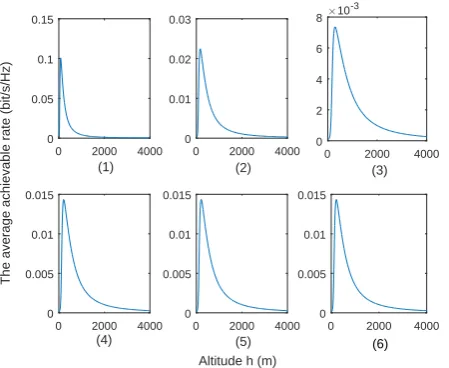
Figure 2 Illustration of the non-convexity of ¯riapin terms ofhbased on the simulation setting in Section 4, where we considerK=6 IoT devices and assumev=2m/s,δ2= −65dBm,T=200s,pi=0.01W,∀i.
lated into
max
A,h,κ
κ (14a)
s.t. 1
N
N
∑
n=1
ai[n]
h
log21+ pi
Qi[n]δ2 i
≥κ,∀i (14b)
ai[n]∈[0,1],∀i,n (14c)
K
∑
i=1
ai[n]≤1,∀n (14d)
h>0. (14e)
Since the constraint (14b) is not convex with respect toh
as illustrated in Figure 2, problem (14) is not convex. In the following, to tackle the non-convex difficulty we propose an effective scheme for the non-convex problem (14) by using the block coordinate descent [37], in which the partition ratio of the time resource blocksAand the altitudehare alternately optimized in each iteration.
1) The optimization of the partition ratio of the time re-source blocksA
For any given altitudeh, the optimization of the partition ratio of the time resource blocksAcan be recast into
max
A,κ
κ (15a)
s.t. (14b),(14c),(14d). (15b)
Problem (15) is convex, which can be solved by the toolbox CVX.
2) The optimization of the altitudeh
For any given partition ratio of the time resource blocksA,
the optimization of the altitudehcan be rewritten as
max h,κ
κ (16a)
s.t. 1
N
N
∑
n=1
ai[n]log2
1+ pi
Qi[n]δ2
≥κ,∀i (16b)
h>0. (16c)
Note that problem (16) is neither a convex nor concave problem due to the non-convex constraint (16b), which can be depicted in Figure 2. In general, there is no efficient method to obtain the optimal solution.
To handle the non-convexity of the constraint (16b), we adopt the successive convex optimization technique, in which the original optimization function can be approximated in a tractable one at a given local point in each iteration. Leth(q)be the local point ofhat theq-th iteration in the successive con-vex optimization technique. Then, ¯rapi can be lower-bounded by its first-order Taylor expansion around the pointh(q).
For the IoT device i, since the absolute power loss at the
n-th time slot Qi[n] is related to the elevation angle of the mobile UAV relative to the IoT deviceiand the distance be-tween them, it is quite complicated. To facilitate the first-order derivation of ¯rapi at the local pointh(q), we first consider the first-order derivation ofQi[n]at the local pointh(q). Here, we set
Qi[n] =10
Fi[n]+Bi[n]
10 , (17)
where
Fi[n] =
A
1+ae−b(ρ¯i[n]−a), Bi[n] =20lg(di[n]) +20lg(
4πf
c ) +ηNLOS,
¯ ρi[n]
=180 π arcsin
h
q
h2+r2
i+rU2−2rirUcos(rvUn+ϕ−θi ),
and
di[n] =
r
h2+r2
i +rU2−2rirUcos
v
rU
n+ϕ−θi
.
The first-order derivation ofFi[n]at the local pointh(q)is
Fi,q[n] =
180Abae−bCi,q[n]
π Di,q[n]
2q
1− h(q) di,q[n]
2 "
1
di,q[n]
− (h
(q))2
(di,q[n])3
# ,
where
di,q[n] =
r
(h(q))2+r2
i +rU2−2rirUcos(
v rU
n+ϕ−θi),
Ci,q[n] = 180
π arcsin
h(q) di,q[n]
−a,
Di,q[n] =1+ae−bCi,q[n].
The first-order ofBi[n]at the local pointh(q)is
Bi,q[n] = 20h(q)
(di,q[n])2
lge. (19)
By taking the first-order Taylor expansion at the local point
h(q), ¯rapi can be lower-bounded by
¯
rapi ≥r¯aplbi
= 1
N
N
∑
n=1
ai[n]log2
1+ pi
Qqi[n]δ2
−log210 10
1
N
N
∑
n=1
ai[n]
pi(Fi,q[n] +Bi,q[n])
pi+Qqi[n]δ2
(h−h(q)),
(20)
whereQqi[n] =10
Fiq[n]+Bqi[n]
10 , Fq
i [n] =Fi[n]|h=h(q) andB q i[n] =
Bi[n]|h=h(q).
Thus, with the local pointh(q)and the lower bound ¯riaplbin (20), problem (16) can be further recast into
max h,κ
κaplb (21a)
s.t. ¯raplbi ≥κ,∀i, (21b)
h>0. (21c)
whereκaplbis the lower bound ofκ.
Now problem (21) is convex, and can be solved by the tool-box CVX. By iteratively optimizing (21) at the given point
h(q) which is updated in each iteration, problem (16) can be solved. The details are summarized in Algorithm 1. Accord-ing to the analysis in [23,24], it is clear that the resultAccord-ing ob-jective value of problem (21) in Algorithm 1 is non-decreasing in each iteration. Accordingly, Algorithm 1 could be guaran-teed to converge.
The overall algorithm for problem (9) can be achieved by alternately solving problem (15) and problem (16) in an itera-tive manner. The details of the algorithm can be summarized in Algorithm 2.
Next, we analyze the convergence of the proposed Algo-rithm 2. It is pointing out that to achieve the optimal altitudeh, problem (16) is solved through its approximate problem (21) based on Algorithm 1. Thus, we cannot directly apply the gen-eral convergence analysis that is for the classical block
coor-Algorithm 1The proposed algorithm for solving problem (16)
1: Initialize: the UAV altitudeh(0)and the accuracyε>0. Setq=0.
2: repeat
3: Solve problem (21) for givenh(q)to obtain the optimal solutionh(q+1).
4: h(q)←h(q+1);q←q+1.
5: untilThe fractional increase of the objective function is below the thresholdε>0.
dinate descent method [24,31]. In the classical block coordi-nate descent method, each optimization problem in each block should be strictly solved with its exact optimality in each iter-ation [37]. Thus, we make a further convergence analysis for our proposed scheme.
Based on problem (15), problem (16) and its approximate problem (21), we have
κ(A(k),h(k)) (a)
≤κ
A(k+1),h(k)
(b)
=κaplb
A(k+1),h(k)
(c)
≤κaplb
A(k+1),h(k+1)
(d)
≤κ
A(k+1),h(k+1)
(22)
whereκ(A,h)has been defined prior to problem (9).(a)holds due to the optimal solutions of problem (15) with the given altitudeh(k); (b)holds due to the convergence of Algorithm 1;(c)holds since h(k+1),
κaplb(k+1)is the optimal solution of
problem (21) with the givenA(k+1), and(d)holds since the
objective value of problem (21) is the lower bound of that of problem (16) ath(k+1) with the givenA(k+1). The result in (22) indicates that the objective value of problem (14) is non-decreasing in each iteration of Algorithm 2. Thus, the proposed Algorithm 2 can be guaranteed to converge.
Algorithm 2The proposed algorithm for solving problem (9)
1: Initialize: the UAV altitudeh(0)and the accuracy ¯ε>0. Letk=0.
2: repeat
3: Solve problem (15) for givenh(k)to obtain the optimal
A(k+1).
4: Solve problem (16) for givenA(k+1)andh(k)using
Al-gorithm 1 to obtain the optimalh(k+1). 5: k←k+1.
Coverage Optimization for UAV-Aided Internet of Things with Partial Channel Knowledge 7
Altitude h (m)
0 200 400 600 800 1000
The Path Loss (dB)
85 90 95 100 105 110 115 120
[image:8.612.322.528.91.251.2]Suburban Urban Dense Urban Highrise Urban
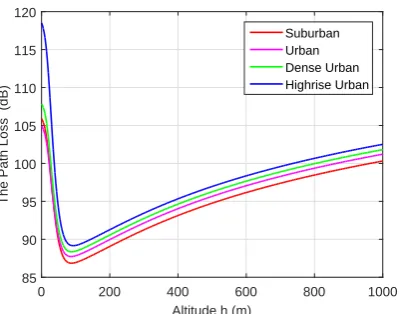
Figure 3 The path loss (dB) versus different altitudehin the different prop-agation environment for one IoT device
4
Numerical Results and Discussion
In this section, we verify the effectiveness of our proposed scheme by means of simulation 3. We set the frequency
f =2.4GHz, the speed of lightc=3×10⁸m/s and the cor-responding initial phase parameterϕ =π6. For the system, we assume six (K=6) IoT devices, which are uniformly distributed within a cell4. In addition, we assume the ran-dom realizations of the IoT devices are located with horizon-tal distancesr1=189m,r2=260m,r3=298m,r4=450m,
r5=680m and r6=759m. We also set θ1= π6, θ2= π3,
θ3= 23π,θ4=56π ,θ5=32π,θ6=109π. The thresholds
pre-sented in Algorithm 1 and 2 are fixed asε=ε¯=10−4. The initial value h(0) in Algorithm 1 is 100m. Also, we con-sider the typical propagation environment using the follow-ing(ηLoS,ηNLoS)pairs(0.1,21),(1.0,20),(1.6,23),(2.3,34) corresponding to suburban, urban, dense urban, and highrise urban, respectively.
Figure 3 presents the path loss versus the UAV altitudeh
in different propagation environment. We choose any one IoT device, i.e., r1=189m and θ1= π6. The curves are achieved based on the equation N1∑Nn=1PLdBi (n) during the UAV’s flight, where i=1. Here, we set T =100s. It can be seen that the path loss first reduces quickly as the altitudeh
increases. Once it achieves the lowest point, it increases when the altitudehbecomes high. Obviously, there must exist an optimalhthat makes the absolute power loss achieve the low-est point. In this case, the system has the blow-est performance. In addition, it can be also seen that the path loss has a high dependence on the practical propagation environment.
In order to show the performance of Algorithm 2 in our
3 The simulation is based on the low SNR assumption.
4 For simplicity, we assumeK=6 IoT devices in this simulation. However,
the proposed algorithms is also applicable for the cases where there exists a large amount of IoT devices.
Flying Period T (s)
500 550 600 650 700 750 800 850 900
Minimum Average Rate (bit/s/Hz)
0.005 0.01 0.015 0.02 0.025 0.03
The proposed scheme with the optimal h The existing scheme with fixed h (h=80m)
Figure 4 The minimum average rate versus different flying periods
proposed scheme, in Figure 4, we compare the minimum aver-age rate achieved by the proposed scheme using the optimalh
with that obtained by the conventional scheme using a fixedh
[31] in the suburban environment, where we assume the noise varianceδ2=−80dBm,, the transmission power of all the IoT devicespi=0.05W,∀i, the UAV constant speedv=2m/s and the initial valueh(0)=100m in Algorithm 2. It can be seen the minimum average rate achieved by Algorithm 2 significantly outperforms that with the fixedh. That’s because by optimiz-ing the altitudeh, the mobile UAV could locate a best altitude to adapt the communication with the randomly-scattered IoT devices during its flying period. In this case, there has the low-est path loss (as illustrated in Figure 3) between the UAV and the IoT devices. Thus, IoT devices could achieve the best av-erage rate. In contrast, fixing the UAV’s altitude would restrict the potential of the UAV’s mobility. Accordingly, it is impos-sible to achieve the optimal altitude for the mobile UAV.
Figure 5 presents the minimum average rate obtained by Algorithm 2 in different urban scenarios. Here, we assume thatδ2=−80dBm,v=2m/s,pi=0.01W,∀iand specify the initial valueh(0) in Algorithm 2 is 80m. It can be observed, in the different propagation environment, the achievable min-imum average rate presents the various behavior. That comes from that the optimalhis highly dependent on the practical urban environment, which could result in the difference of the minimum average rate when we derive the average rate by our proposed scheme. In addition, it can also be seen that as the flying periodT becomes large, the minimum average rate in-creases. The largest minimum average rate is achieved in the urban area, and the smallest minimum average rate is obtained in the highrise urban area.
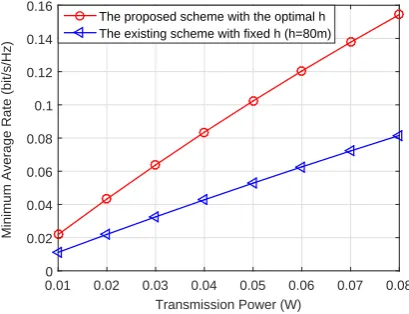
Figure 6 illustrates the comparison between the minimum average rate obtained by our proposed scheme with optimal
h and that obtained by the existing scheme with the fixedh
[31] in terms of different transmission powers. We assume
[image:8.612.65.265.92.249.2]ini-Flying Period T (s)
600 650 700 750 800 850 900
Minimum Average Rate (bit/s/Hz)
0 0.002 0.004 0.006 0.008 0.01 0.012
[image:9.612.42.247.92.250.2]Suburban Urban Dense Urban Highrise Urban
Figure 5 The minimum average rate versus different flying periods in the different urban environment
Transmission Power (W)
0.01 0.02 0.03 0.04 0.05 0.06 0.07 0.08
Minimum Average Rate (bit/s/Hz)
0 0.02 0.04 0.06 0.08 0.1 0.12 0.14 0.16
The proposed scheme with the optimal h The existing scheme with fixed h (h=80m)
Figure 6 The minimum average rate versus different transmission powers
tial value h(0) in Algorithm 2 is 100m. Here, we consider the suburban environment. It is easy to see that the minimum average rate obtained by Algorithm 2 is larger than that ob-tained by the existing scheme. With the optimization of UAV altitude, UAV could adaptively choose the best placement to communicate with the IoT devices. In this case, the absolute power loss achieves the lowest, and the average minimum rate is largest. In addition, the minimum average rate increases as the transmission power increases. That is due to the fact that the achievable rate of all the IoT devices within the flight increases linearly with the transmission power.
5
Conclusion
In this paper, we investigated the UAV-aided IoT commu-nications system, and considered the coverage optimization problem for this system with partial channel knowledge. Spe-cially, we maximized the minimum average rate by jointly op-timizing the partition ratio of the time resource blocks and the
UAV altitude. To characterize the practical propagation en-vironment, the composite channel model including both the small-scale and the large-scale channel fading was adopted. Full CSI assumption was not available because it was impos-sible to acquire the time-varying small-scale channel fading in practice. We only used the slowly-varying large-scale chan-nel fading. The formulated problem was not convex. An efficient iterative algorithm was proposed by means of the block coordinate descent and the successive convex optimiza-tion technique. Numerical results have demonstrated that the performance with the altitude optimization significantly out-performed that with the fixed altitude. Furthermore, the re-sults also implied that the performance of the UAV-aided IoT communications system was strongly dependent on the spe-cific urban environment.
6
Acknowledgment
This work was supported in part by Beijing Natural science Foundation under grant No. L172041, and the National Sci-ence Foundation of China under grant No. 61701457, grant No. 61771286, grant No. 91638205, grant No. 61671478 and grant No. 61621091.
References
[1] L. D. Xu, W. He, S. Li. Internet of Things in industries: A survey [J]. IEEE Transaction on Industrial Informatics, 2014, 10(4): 2233-2243.
[2] C. Zhu, J. J. P. C. Rodrigues, V. C. M. Leung, et al. Trust-based communication for the industrial Internet of Things [J]. IEEE Commununications Magazine, 2018, 56(2): 16-22.
[3] L. Hou, S. Zhao, X. Xiong, et al. Internet of Things Cloud: Architecture and Implementation [J]. IEEE Commununi-cations Magazine, 2016, 54(12): 32-39.
[4] I. Bisio, F. Lavagetto, G. Luzzati. Cooperative Applica-tion Layer Joint Video Coding in the Internet of Remote Things [J]. IEEE Internet of Things Journal, 2016, 3(6): 1418-1426.
[5] D. Pal, S. Funilkul, N. Charoenkitkarn, et al. Internet-of-Things and Smart Homes for Elderly Healthcare: An End User Perspective [J]. IEEE Access, 2018, 6: 10483-10496.
[image:9.612.56.261.302.459.2]In-Coverage Optimization for UAV-Aided Internet of Things with Partial Channel Knowledge 9
ternet of Things automation solutions [J]. IEEE Industrial Electronics Magazine, 2017, 11(4): 8-21.
[7] V. Sharma, R. Kumar, R. Kaur. UAV-assisted content-based sensor search in IoTs [J]. Electronics Letter, 2017, 53(11): 724-726.
[8] S. Lien, K. Chen, Y. Lin. Toward ubiquitous massive ac-cesses in 3GPP machine-to-machine communications [J]. IEEE Communications Magazine, 2011, 49(4): 66-74.
[9] V. Scilimati, A. Petitti, P. Boccadoro, et al. Industrial In-ternet of things at work: a case study analysis in robotic-aided environmental monitoring [J]. IET Wireless Sensor Systems, 2017, 7(5): 155-162.
[10] N. H. Motlagh, M. Bagaa, T. Taleb. UAV-based iot plat-form: A crowd surveillance use case [J]. IEEE Commu-nications Magazine, 2017, 55(2): 128-134.
[11] N. Hossein Motlagh, T. Taleb, O. Arouk. Low-Altitude Unmanned Aerial Vehicles-Based Internet of Things Ser-vices: Comprehensive Survey and Future Perspectives [J]. IEEE Internet of Things Journal, 2016, 3(6): 899-922.
[12] M. Gharibi, R. Boutaba, S. L. Waslander. Internet of Drones [J]. IEEE Access, 2016, 4: 1148-1162.
[13] Q. Yang, S. Yoo. Optimal UAV Path Planning: Sens-ing Data Acquisition Over IoT Sensor Networks UsSens-ing Multi-Objective Bio-Inspired Algorithms [J]. IEEE Ac-cess, 2018, 6: 13671-13684.
[14] A. Giyenko, Y. I. Cho. Intelligent UAV in smart cities us-ing IoT [C]//2016 16th International Conference on Con-trol, Automation and Systems, Gyeongju, 2016: 207-210.
[15] G. Ding, Q. Wu, L. Zhang, et al. An Amateur Drone Surveillance System Based on the Cognitive Internet of Things [J]. IEEE Communications Maganize, 2018, 56(1): 29-35.
[16] S. Arabi, H. Elbiaze, E. Sabir, et al. Tradeoffs for Data Collection and Wireless Energy Transfer Dilemma in IoT Environments [C]//2018 IEEE International Conference on Communications, Kansas City, MO, 2018: 1-6.
[17] D. He, S. Chan, M. Guizani. Communication security of unmanned aerial vehicles [J]. IEEE Wireless Communi-cations, 2017, 24(4): 134-139.
[18] S. Chandrasekharan, K. Gomez, A. Al-Hourani, et al. Designing and implementing future aerial communication networks [J]. IEEE Communications Maganize, 2016, 54(5): 26-34.
[19] A. Al-Hourani, S. Kandeepan, S. Lardner. Optimal LAP Altitude for Maximum Coverage [J]. IEEE Wireless Communications Letter, 2014, 3(6): 569-572.
[20] Y. Zeng, R. Zhang, T. J. Lim. Throughput maximiza-tion for UAV-enabled mobile relaying systems [J]. IEEE Transaction on Communications, 2016, 64(12): 4983-4996.
[21] F. Jiang, A. L. Swindlehurst. Optimization of UAV head-ing for the ground-to-air uplink [J]. IEEE Journal on Se-lected Areas in Communications, 2012, 30(5): 993-1005.
[22] M. M. Azari, F. Rosas, K. Chen, et al. Joint Sum-Rate and Power Gain Analysis of an Aerial Base Station [C]//2016 IEEE Globecom Workshops, Washington, DC, 2016: 1-6.
[23] Y. Zeng, R. Zhang. Energy-efficient UAV communica-tion with trajectory optimizacommunica-tion [J]. IEEE Transaccommunica-tion on Wireless Communications, 2017, 16(6): 3747-3760.
[24] C. Zhan, Y. Zeng, R. Zhang. Energy-Efficient Data Col-lection in UAV Enabled Wireless Sensor Network [J]. IEEE Wireless Communications Letter, 2018, 7(3): 328-331.
[25] F. Ono, H. Ochiai, R. Miura. A Wireless Relay Network Based on Unmanned Aircraft System With Rate Opti-mization[J]. IEEE Transaction on Wireless Communica-tions, 2016, 15(11): 7699-7708.
[26] M. M. Azari, F. Rosas, K. Chen, et al. Ultra Reli-able UAV Communication Using Altitude and Coopera-tion Diversity[J]. IEEE TransacCoopera-tions on CommunicaCoopera-tions, 2018, 66(1): 330-344.
[27] T. Qi, W. Feng, Y. Wang. Outage performance of non-orthogonal multiple access based unmanned aerial vehi-cles satellite networks [J]. China Communications, 2018, 15(5): 1-8.
[28] Y. Chen, W. Feng, G. Zheng. Optimum placement of UAV as relays [J]. IEEE Communications Letters, 2018 22(2): 248-251.
[29] J. Park, H. Lee, S. Eom, et al. Minimum Throughput Maximization in UAV-Aided Wireless Powered Commu-nication Networks [J]. arXiv preprint arXiv:1801.02781, 2018.
[31] Q. Wu, Y. Zeng, R. Zhang. Joint Trajectory and Com-munication Design for Multi-UAV Enabled Wireless Net-works [J]. IEEE Transaction on Wireless Communica-tions, 2018, 17(3): 2109-2121.
[32] C. Liu, W. Feng, T. Wei, et al. Fairness-oriented hybrid precoding for massive MIMO maritime downlink systems with large-scale CSIT [J]. China Communications, 2018, 15(1): 52-61.
[33] W. Feng, Y. Wang, D. Lin, et al. When mmWave com-munications meet network densification: a scalable in-terference coordination perspective [J]. IEEE Journal on Selected Areas in Communications, 2017, 35(7): 1459-1471.
[34] W. Feng, J. Wang, Y. Chen, et al. UAV-Aided MIMO communications for 5G Internet of Things [J]. IEEE In-ternet of Things Journal, to appear, 2018.
[35] W. Feng, Y. Wang, N. Ge, et al. Virtual MIMO in Multi-Cell Distributed Antenna Systems: Coordinated Trans-missions with Large-Scale CSIT [J]. IEEE Journal on Se-lected Areas Communications, 2013, 31(10): 2067-2081.
[36] W. Feng, N. Ge, J. Lu. Coordinated
satellite-terrestrial networks: a robust spectrum sharing perspec-tive [C]//2017 26th Wireless and Optical Communication Conference, Newark, New Jersey, USA, 2017: 1-5.
[37] D. P. Bertsekas. Nonlinear programming [M]. Athena scientific Belmont, 1999.
About the authors
Xuanxuan Wang received the B.S. degree in communica-tion engineering from Henan Polytechnic University, in 2010, and the M.S. degree in electronic and communication engineering from Beijing Univer-sity of Posts and Telecommunications, Beijing, China, in 2013. She re-ceived the Ph.D. degree from Institute of Information and Engineering, Chi-nese Academy of Sciences, China, in 2017. She is with the Department of Electronic Engineering, Tsinghua University. Her current research interests include communication security, wireless information and power transfer, and convex optimization techniques. ([email protected])
Wei Feng (S’06-M’10), corresponding author, received his B.S. and Ph.D. degrees (both with the highest honor) from the Department of Electronic Engineering, Tsinghua University, Beijing, China, in 2005 and 2010, respectively. From 2010 to 2011, he served as a Project Director in the National Science and Technology Major Project Management Office of Tsinghua University. From 2011 to 2014, he was a Postdoctoral Research Fellow with the Department of Electronic Engineering, Tsinghua University, where he has been an Assistant Professor since Oct. 2014 and then an As-sociate Professor since Dec. 2016. His research interests include maritime broadband communication networks, large-scale distributed antenna systems, and coordinated satellite-terrestrial networks. He has published over 70 jour-nal and conference papers. He also holds over 10 granted patents. Dr. Feng has received the Outstanding Ph.D. Graduate of Tsinghua University Award in 2010, the IEEE WCSP Best Paper Award in 2013, the first Prize of Sci-ence and Technology Award of China Institute of Communications in 2015, the IEEE WCSP Best Paper Award in 2015, and the second Prize of Na-tional Technological Invention Award of China in 2016. He currently serves as the Assistant to the Editor-in-Chief of China Communications. ([email protected])
Yunfei Chen (S’02-M’06-SM’10) received his B.E. and M.E. degrees in Electronic Engineering from Shanghai Jiao Tong University, China, in 1998 and 2001, respectively. He received his Ph.D. degree from the University of Alberta, Canada, in 2006. He is with the School of Engineer-ing, Warwick University, Coventry, UK. His research interests include energy harvesting, wireless relaying and general performance analysis and design of wireless systems. ( [email protected])