Topic Models for Dynamic Translation Model Adaptation
Vladimir Eidelman Computer Science
and UMIACS University of Maryland
College Park, MD [email protected]
Jordan Boyd-Graber iSchool
and UMIACS University of Maryland
College Park, MD [email protected]
Philip Resnik Linguistics and UMIACS University of Maryland
College Park, MD [email protected]
Abstract
We propose an approach that biases machine translation systems toward relevant transla-tions based on topic-specific contexts, where topics are induced in an unsupervised way using topic models; this can be thought of as inducing subcorpora for adaptation with-out any human annotation. We use these topic distributions to compute topic-dependent lex-ical weighting probabilities and directly in-corporate them into our translation model as features. Conditioning lexical probabilities on the topic biases translations toward topic-relevant output, resulting in significant im-provements of up to 1 BLEU and 3 TER on Chinese to English translation over a strong baseline.
1 Introduction
The performance of a statistical machine translation (SMT) system on a translation task depends largely on the suitability of the available parallel training data. Domains (e.g., newswire vs. blogs) may vary widely in their lexical choices and stylistic prefer-ences, and what may be preferable in a general set-ting, or in one domain, is not necessarily preferable in another domain. Indeed, sometimes the domain can change the meaning of a phrase entirely.
In a food related context, the Chinese sentence “粉丝很多 ” (“fˇens¯i hˇendu¯o”) would mean “They have a lot of vermicelli”; however, in an informal In-ternet conversation, this sentence would mean “They have a lot of fans”. Without the broader context, it is impossible to determine the correct translation in otherwise identical sentences.
This problem has led to a substantial amount of recent work in trying to bias, or adapt, the transla-tion model (TM) toward particular domains of inter-est (Axelrod et al., 2011; Foster et al., 2010; Snover et al., 2008).1 The intuition behind TM adapta-tion is to increase the likelihood of selecting rele-vant phrases for translation. Matsoukas et al. (2009) introduced assigning a pair of binary features to each training sentence, indicating sentences’genre and collectionas a way to capture domains. They then learn a mapping from these features to sen-tence weights, use the sensen-tence weights to bias the model probability estimates and subsequently learn the model weights. As sentence weights were found to be most beneficial for lexical weighting, Chiang et al. (2011) extends the same notion of condition-ing on provenance (i.e., the origin of the text) by re-moving the separate mapping step, directly optimiz-ing the weight of the genre and collection features by computing a separate word translation table for each feature, estimated from only those sentences that comprise that genre or collection.
The common thread throughout prior work is the concept of adomain. A domain is typically a hard constraint that is externally imposed and hand la-beled, such as genre or corpus collection. For ex-ample, a sentence either comes from newswire, or weblog, but not both. However, this poses sev-eral problems. First, since a sentence contributes its counts only to the translation table for the source it came from, many word pairs will be unobserved for a given table. This sparsity requires smoothing. Sec-ond, we may not know the (sub)corpora our training
1
Language model adaptation is also prevalent but is not the focus of this work.
data come from; and even if we do, “subcorpus” may not be the most useful notion of domain for better translations.
We take a finer-grained, flexible, unsupervised ap-proach for lexical weighting by domain. We induce unsupervised domains from large corpora, and we incorporate soft, probabilistic domain membership into a translation model. Unsupervised modeling of the training data produces naturally occurring sub-corpora, generalizing beyond corpus and genre. De-pending on the model used to select subcorpora, we can bias our translation toward any arbitrary distinc-tion. This reduces the problem to identifying what automatically defined subsets of the training corpus may be beneficial for translation.
In this work, we consider the underlying latent topicsof the documents (Blei et al., 2003). Topic modeling has received some use in SMT, for in-stance Bilingual LSA adaptation (Tam et al., 2007), and the BiTAM model (Zhao and Xing, 2006), which uses a bilingual topic model for learning alignment. In our case, by building a topic distri-bution for the source side of the training data, we abstract the notion of domain to include automati-cally derived subcorpora with probabilistic member-ship. This topic model infers the topic distribution of a test set and biases sentence translations to ap-propriate topics. We accomplish this by introduc-ing topic dependent lexical probabilities directly as features in the translation model, and interpolating them log-linearly with our other features, thus allow-ing us to discriminatively optimize their weights on an arbitrary objective function. Incorporating these features into our hierarchical phrase-based transla-tion system significantly improved translatransla-tion per-formance, by up to 1BLEUand 3TERover a strong Chinese to English baseline.
2 Model Description
Lexical Weighting Lexical weighting features es-timate the quality of a phrase pair by combining the lexical translation probabilities of the words in the phrase2 (Koehn et al., 2003). Lexical condi-tional probabilitiesp(e|f) are obtained with maxi-mum likelihood estimates from relative frequencies
2
For hierarchical systems, these correspond to translation rules.
c(f, e)/P
ec(f, e). Phrase pair probabilitiesp(e|f)
are computed from these as described in Koehn et al. (2003).
Chiang et al. (2011) showed that is it benefi-cial to condition the lexical weighting features on provenance by assigning each sentence pair a set of features,fs(e|f), one for each domain s, which
compute a new word translation tableps(e|f)
esti-mated from only those sentences which belong tos:
cs(f, e)/P
ecs(f, e), wherecs(·)is the number of
occurrences of the word pair ins.
Topic Modeling for MT We extend provenance to cover a set of automatically generated topicszn.
Given a parallel training corpusT composed of doc-umentsdi, we build a source side topic model over
T, which provides a topic distribution p(zn|di) for
zn={1, . . . , K}over each document, using Latent Dirichlet Allocation (LDA) (Blei et al., 2003). Then, we assignp(zn|di) to be the topic distribution for every sentencexj ∈di, thus enforcing topic sharing across sentence pairs in the same document instead of treating them as unrelated. Computing the topic distribution over a document and assigning it to the sentences serves to tie the sentences together in the document context.
To obtain the lexical probability conditioned on topic distribution, we first compute the expected countezn(e, f)of a word pair under topiczn:
ezn(e, f) = X
di∈T
p(zn|di)
X
xj∈di
cj(e, f) (1)
wherecj(·) denotes the number of occurrences of
the word pair in sentencexj, and then compute:
pzn(e|f) =
ezn(e, f) P
eezn(e, f)
(2)
Thus, we will introduce 2·K new word trans-lation tables, one for each pzn(e|f) and pzn(f|e), and as many new corresponding featuresfzn(e|f), fzn(f|e). The actual feature values we compute will depend on the topic distribution of the document we are translating. For a test document V, we infer topic assignments onV,p(zn|V), keeping the topics found fromT fixed. The feature value then becomes
fzn(e|f) = −log
topic distribution of the sentence from which we are extracting the phrase. To optimize the weights of these features we combine them in our linear model with the other features when computing the model score for each phrase pair3:
X
p
λphp(e, f)
| {z }
unadapted features
+X
zn
λznfzn(e|f)
| {z }
adapted features (3)
Combining the topic conditioned word translation table pzn(e|f) computed from the training corpus with the topic distributionp(zn|V) of the test
sen-tence being translated provides a probability on how relevant that translation table is to the sentence. This allows us to bias the translation toward the topic of the sentence. For example, if topickis dominant in
T,pk(e|f)may be quite large, but ifp(k|V)is very small, then we should steer away from this phrase pair and select a competing phrase pair which may have a lower probability inT, but which is more rel-evant to the test sentence at hand.
In many cases, document delineations may not be readily available for the training corpus. Further-more, a document may be too broad, covering too many disparate topics, to effectively bias the weights on a phrase level. For this case, we also propose a local LDA model (LTM), which treats each sentence as a separate document.
While Chiang et al. (2011) has to explicitly
smooth the resultingps(e|f), since many word pairs
will be unseen for a given domains, we are already performing an implicit form of smoothing (when computing the expected counts), since each docu-ment has a distribution over all topics, and therefore we have some probability of observing each word pair in every topic.
Feature Representation After obtaining the topic conditional features, there are two ways to present them to the model. They could answer the question
F1: What is the probability under topic 1, topic 2, etc., orF2: What is the probability under the most probable topic, second most, etc.
A model usingF1 learns whether aspecifictopic is useful for translation, i.e., feature f1 would be
f1 := pz=1(e|f) ·p(z = 1|V). With F2, we
3
The unadapted lexical weight p(e|f) is included in the model features.
are learning how useful knowledge of the topic dis-tribution is, i.e., f1 := p(arg maxzn(p(zn|V))(e|f) · p(arg maxzn(p(zn|V))|V).
UsingF1, if we restrict our topics to have a one-to-one mapping with genre/collection4 we see that
our method fully recovers Chiang (2011).
F1 is appropriate for cross-domain adaptation when we have advance knowledge that the distribu-tion of the tuning data will match the test data, as in Chiang (2011), where they tune and test on web. In general, we may not know what our data will be, so this will overfit the tuning set.
F2, however, is intuitively what we want, since we do not want to bias our system toward a spe-cific distribution, but rather learn to utilize informa-tion from any topic distribution if it helps us cre-ate topic relevant translations. F2 is useful for
dy-namicadaptation, where the adapted feature weight changes based on the source sentence.
Thus, F2 is the approach we use in our work, which allows us to tune our system weights toward having topic information be useful, not toward a spe-cific distribution.
3 Experiments
Setup To evaluate our approach, we performed ex-periments on Chinese to English MT in two set-tings. First, we use the FBIS corpus as our training bitext. Since FBIS has document delineations, we compare local topic modeling (LTM) with model-ing at the document level (GTM). The second settmodel-ing uses the non-UN and non-HK Hansards portions of the NIST training corpora with LTM only. Table 1 summarizes the data statistics. For both settings, the data were lowercased, tokenized and aligned us-ing GIZA++ (Och and Ney, 2003) to obtain bidi-rectional alignments, which were symmetrized us-ing thegrow-diag-final-andmethod (Koehn et al., 2003). The Chinese data were segmented us-ing the Stanford segmenter. We trained a trigram LM on the English side of the corpus with an addi-tional 150M words randomly selected from the non-NYT and non-LAT portions of the Gigaword v4 cor-pus using modified Kneser-Ney smoothing (Chen and Goodman, 1996). We usedcdec(Dyer et al.,
4By having as many topics as genres/collections and setting
Corpus Sentences Tokens
En Zh
FBIS 269K 10.3M 7.9M
[image:4.612.313.547.60.289.2]NIST 1.6M 44.4M 40.4M
Table 1: Corpus statistics
2010) as our decoder, and tuned the parameters of the system to optimizeBLEU(Papineni et al., 2002) on the NIST MT06 tuning corpus using the Mar-gin Infused Relaxed Algorithm (MIRA) (Crammer et al., 2006; Eidelman, 2012). Topic modeling was performed with Mallet (Mccallum, 2002), a stan-dard implementation of LDA, using a Chinese sto-plist and setting the per-document Dirichlet parame-terα= 0.01. This setting of was chosen to encour-age sparse topic assignments, which make induced subdomains consistent within a document.
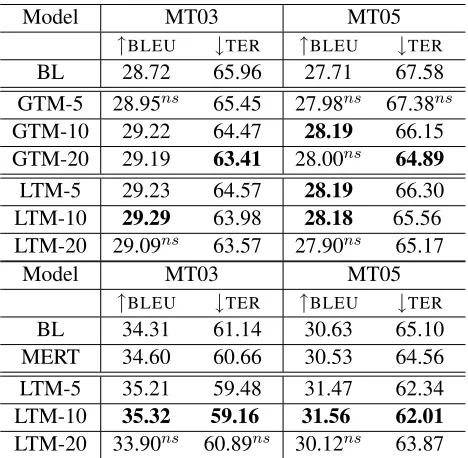
Results Results for both settings are shown in Ta-ble 2. GTM models the latent topics at the document level, while LTM models each sentence as a separate document. To evaluate the effect topic granularity would have on translation, we varied the number of latent topics in each model to be 5, 10, and 20. On FBIS, we can see that both models achieve moderate but consistent gains over the baseline on bothBLEU andTER. The best model, LTM-10, achieves a gain of about 0.5 and 0.6BLEUand 2TER. Although the performance onBLEUfor both the 20 topic models LTM-20 and GTM-20 is suboptimal, the TER im-provement is better. Interestingly, the difference in translation quality between capturing document co-herence in GTM and modeling purely on the sen-tence level is not substantial.5 In fact, the opposite is true, with the LTM models achieving better per-formance.6
On the NIST corpus, LTM-10 again achieves the best gain of approximately 1BLEUand up to 3TER. LTM performs on par with or better than GTM, and provides significant gains even in the NIST data set-ting, showing that this method can be effectively ap-plied directly on the sentence level to large training
5
An avenue of future work would condition the sentence topic distribution on a document distribution over topics (Teh et al., 2006).
6
As an empirical validation of our earlier intuition regarding feature representation, presenting the features in the form ofF1 caused the performance to remain virtually unchanged from the baseline model.
Model MT03 MT05
↑BLEU ↓TER ↑BLEU ↓TER
BL 28.72 65.96 27.71 67.58
GTM-5 28.95ns 65.45 27.98ns 67.38ns
GTM-10 29.22 64.47 28.19 66.15
GTM-20 29.19 63.41 28.00ns 64.89
LTM-5 29.23 64.57 28.19 66.30
LTM-10 29.29 63.98 28.18 65.56
LTM-20 29.09ns 63.57 27.90ns 65.17
Model MT03 MT05
↑BLEU ↓TER ↑BLEU ↓TER
BL 34.31 61.14 30.63 65.10
MERT 34.60 60.66 30.53 64.56
LTM-5 35.21 59.48 31.47 62.34
LTM-10 35.32 59.16 31.56 62.01
[image:4.612.94.280.61.116.2]LTM-20 33.90ns 60.89ns 30.12ns 63.87
Table 2: Performance using FBIS training corpus (top) and NIST corpus (bottom). Improvements are significant at thep <0.05 level, except where indicated (ns).
corpora which have no document markings. De-pending on the diversity of training corpus, a vary-ing number of underlyvary-ing topics may be appropriate. However, in both settings, 10 topics performed best.
4 Discussion and Conclusion
Acknowledgments
Vladimir Eidelman is supported by a National De-fense Science and Engineering Graduate Fellow-ship. This work was also supported in part by NSF grant #1018625, ARL Cooperative Agree-ment W911NF-09-2-0072, and by the BOLT and GALE programs of the Defense Advanced Research Projects Agency, Contracts HR0011-12-C-0015 and HR0011-06-2-001, respectively. Any opinions, find-ings, conclusions, or recommendations expressed are the authors’ and do not necessarily reflect those of the sponsors.
References
Amittai Axelrod, Xiaodong He, and Jianfeng Gao. 2011. Domain adaptation via pseudo in-domain data selec-tion. InProceedings of Emperical Methods in Natural Language Processing.
David M. Blei, Andrew Y. Ng, Michael I. Jordan, and John Lafferty. 2003. Latent Dirichlet Allocation. Journal of Machine Learning Research, 3:2003. Jordan Boyd-Graber and Philip Resnik. 2010. Holistic
sentiment analysis across languages: Multilingual su-pervised latent Dirichlet allocation. InProceedings of Emperical Methods in Natural Language Processing. Stanley F. Chen and Joshua Goodman. 1996. An
empir-ical study of smoothing techniques for language mod-eling. InProceedings of the 34th Annual Meeting of the Association for Computational Linguistics, pages 310–318.
David Chiang, Steve DeNeefe, and Michael Pust. 2011. Two easy improvements to lexical weighting. In Pro-ceedings of the Human Language Technology Confer-ence.
Koby Crammer, Ofer Dekel, Joseph Keshet, Shai Shalev-Shwartz, and Yoram Singer. 2006. Online passive-aggressive algorithms. Journal of Machine Learning Research, 7:551–585.
Chris Dyer, Adam Lopez, Juri Ganitkevitch, Jonathan Weese, Ferhan Ture, Phil Blunsom, Hendra Setiawan, Vladimir Eidelman, and Philip Resnik. 2010. cdec: A decoder, alignment, and learning framework for finite-state and context-free translation models. In Proceed-ings of ACL System Demonstrations.
Vladimir Eidelman. 2012. Optimization strategies for online large-margin learning in machine translation. InProceedings of the Seventh Workshop on Statistical Machine Translation.
George Foster, Cyril Goutte, and Roland Kuhn. 2010. Discriminative instance weighting for domain adapta-tion in statistical machine translaadapta-tion. InProceedings
of Emperical Methods in Natural Language Process-ing.
Philipp Koehn, Franz Josef Och, and Daniel Marcu. 2003. Statistical phrase-based translation. In Pro-ceedings of the 2003 Conference of the North Ameri-can Chapter of the Association for Computational Lin-guistics on Human Language Technology - Volume 1, NAACL ’03, Stroudsburg, PA, USA.
Spyros Matsoukas, Antti-Veikko I. Rosti, and Bing Zhang. 2009. Discriminative corpus weight estima-tion for machine translaestima-tion. InProceedings of Em-perical Methods in Natural Language Processing. A. K. Mccallum. 2002. MALLET: A Machine Learning
for Language Toolkit.
Franz Och and Hermann Ney. 2003. A systematic com-parison of various statistical alignment models. In Computational Linguistics, volume 29(21), pages 19– 51.
Kishore Papineni, Salim Roukos, Todd Ward, and Wei-Jing Zhu. 2002.BLEU: a method for automatic evalu-ation of machine translevalu-ation. InProceedings of the As-sociation for Computational Linguistics, pages 311– 318.
Matthew Snover, Bonnie Dorr, and Richard Schwartz. 2008. Language and translation model adaptation us-ing comparable corpora. InProceedings of Emperical Methods in Natural Language Processing.
Yik-Cheung Tam, Ian Lane, and Tanja Schultz. 2007. Bilingual LSA-based adaptation for statistical machine translation.Machine Translation, 21(4):187–207. Yee Whye Teh, Michael I. Jordan, Matthew J. Beal, and
David M. Blei. 2006. Hierarchical Dirichlet pro-cesses. Journal of the American Statistical Associa-tion, 101(476):1566–1581.