Summarizing Definition from Wikipedia
Shiren Ye
and
Tat-Seng Chua
and
Jie Lu
Lab of Media Search
National University of Singapore
{
yesr|chuats|luj
}
@comp.nus.edu.sg
Abstract
Wikipedia provides a wealth of knowl-edge, where the first sentence, infobox (and relevant sentences), and even the en-tire document of a wiki article could be considered as diverse versions of sum-maries (definitions) of the target topic. We explore how to generate a series of summaries with various lengths based on them. To obtain more reliable associations between sentences, we introduce wiki con-cepts according to the internal links in Wikipedia. In addition, we develop an extended document concept lattice model to combine wiki concepts and non-textual features such as the outline and infobox. The model can concatenate representative sentences from non-overlapping salient lo-cal topics for summary generation. We test our model based on our annotated wiki ar-ticles which topics come from TREC-QA 2004-2006 evaluations. The results show that the model is effective in summariza-tion and definisummariza-tion QA.
1 Introduction
Nowadays, ‘ask Wikipedia’ has become as pop-ular as ‘Google it’ during Internet surfing, as Wikipedia is able to provide reliable information about the concept (entity) that the users want. As the largest online encyclopedia, Wikipedia assem-bles immense human knowledge from thousands of volunteer editors, and exhibits significant contribu-tions to NLP problems such as semantic related-ness, word sense disambiguation and question an-swering (QA).
For a given definition query, many search en-gines (e.g., specified by ‘define:’ in Google) often place the first sentence of the corresponding wiki1
article at the top of the returned list. The use of
1 For readability, we follow the upper/lower case rule
on web(say, ‘web pages’ and ‘on the Web’), and utilize
one-sentence snippets provides a brief and concise description of the query. However, users often need more information beyond such a one-sentence de-finition, while feeling that the corresponding wiki article is too long. Thus, there is a strong demand to summarize wiki articles as definitions with vari-ous lengths to suite different user needs.
The initial motivation of this investigation is to find better definition answer for TREC-QA task using Wikipedia (Kor and Chua, 2007). Accord-ing to past results on TREC-QA (Voorhees, 2004; Voorhees and Dang, 2005), definition queries are usually recognized as being more difficult than fac-toid and list queries. Wikipedia could help to improve the quality of answer finding and even provide the answers directly. Its results are bet-ter than other exbet-ternal resources such as WordNet, Gazetteers and Google’sdefineoperator, especially for definition QA (Lita et al., 2004).
Different from thefreetext used in QA and sum-marization, a wiki article usually contains valuable information like infobox and wiki link. Infobox
tabulates the key properties about the target, such as birth place/date and spouse for a person as well as type, founder and products for a company. In-fobox, as a form of thumbnail biography, can be considered as a mini version of a wiki article’s sum-mary. In addition, the relevant concepts existing in a wiki article usually refer to other wiki pages by wiki internal links, which will form a close set of reference relations. The current Wikipedia recur-sively defines over 2 million concepts (in English)
viawiki links. Most of these concepts are
multi-word terms, whereas WordNet has only 50,000 plus multi-word terms. Any term could appear in the definition of a concept if necessary, while the total vocabulary existing in WordNet’s glossary defini-tion is less than 2000. Wikipedia addresses explicit semantics for numerous concepts. These special knowledge representations will provide additional information for analysis and summarization. We thus need to extend existing summarization tech-nologies to take advantage of theknowledge repre-sentations in Wikipedia.
‘wiki(pedia) articles’ and ‘on (the) Wikipedia’, the latter re-ferring to the entire Wikipedia.
The goal of this investigation is to explore sum-maries with different lengths in Wikipedia. Our main contribution lies in developing a summariza-tion method that can (i) explore more reliable asso-ciations between passages (sentences) in huge fea-ture space represented by wiki concepts; and (ii) ef-fectively combine textual and non-textual features such as infobox and outline in Wikipedia to gener-ate summaries as definition.
The rest of this paper is organized as follows: In the next section, we discuss the background of sum-marization using both textual and structural fea-tures. Section 3 presents the extended document concept lattice model for summarizing wiki arti-cles. Section 4 describes corpus construction and experiments are described; while Section 5 con-cludes the paper.
2 Background
Besides some heuristic rules such as sentence po-sition and cue words, typical summarization sys-tems measure the associations (links) between sen-tences by term repetitions (e.g., LexRank (Erkan and Radev, 2004)). However, sophisticated authors usually utilize synonyms and paraphrases in vari-ous forms rather than simple term repetitions. Fur-nas et al. (1987) reported that two people choose the same main key word for a single well-known object less than 20% of the time. A case study by Ye et al. (2007) showed that 61 different words ex-isting in 8 relevant sentences could be mapped into 16 distinctive concepts by means of grouping terms with close semantic (such as[British, Britain, UK] and [war, fought, conflict, military]). However, most existing summarization systems only consider the repeated words between sentences, where latent associations in terms of inter-word synonyms and paraphrases are ignored. The incomplete data likely lead to unreliable sentence ranking and selection for summary generation.
To recover the hidden associations between sen-tences, Ye et al. (2007) compute the semantic simi-larity using WordNet. The term pairs with semantic similarity higher than a predefined threshold will be grouped together. They demonstrated that collect-ing more links between sentences will lead to bet-ter summarization as measured by ROUGE scores, and such systems were rated among the top systems in DUC (document understanding conference) in 2005 and 2006. This WordNet-based approach has several shortcomings due to the problems of data deficiency and word sense ambiguity, etc.
Wikipedia already defined millions of multi-word concepts in separate articles. Its definition is much larger than that of WordNet. For instance, more than 20 kinds of songs and movies called But-terfly , such asButterfly (Kumi Koda song), Butter-fly (1999 film)andButterfly (2004 film), are listed
in Wikipedia. When people say something about butterfly in Wikipedia, usually, a link is assigned to refer to a particular butterfly. Following this link, we can acquire its explicit and exact seman-tic (Gabrilovich and Markovitch, 2007), especially for multi-word concepts. Phrases are more im-portant than individual words for document re-trieval (Liu et al., 2004). We hope that the wiki con-cepts are appropriate text representation for sum-marization.
Generally, wiki articles have little redundancy in their contents as they utilize encyclopedia style. Their authors tend to use wiki links and ‘See Also’ links to refer to the involved concepts rather than expand these concepts. In general, the guideline for composing wiki articles is to avoid overlong and over-complicated styles. Thus, the strategy of ‘split it’ into a series of articles is recommended; so wiki articles are usually not too long and contain limited number of sentences. These factors lead to fewerlinksbetween sentences within a wiki article, as compared to normal documents. However, the principle of typical extractive summarization ap-proaches is that the sentences whose contents are repeatedly emphasized by the authors are most im-portant and should be included (Silber and McCoy, 2002). Therefore, it is challenging to summarize wiki articles due to low redundancy (and links) between sentences. To overcome this problem, we seek (i) more reliable links between passages, (ii) appropriate weighting metric to emphasize the salient concepts about the topic, and (iii) additional guideline on utilizing non-textual features such as outline and infobox. Thus, we develop wiki con-cepts to replace ‘bag-of-words’ approach for better link measurements between sentences, and extend an existing summarization model on free text to in-tegrate structural information.
By analyzing rhetorical discourse structure of aim, background, solution, etc. or citation context, we can obtain appropriate abstracts and the most influential contents from scientific articles (Teufel and Moens, 2002; Mei and Zhai, 2008). Similarly, we believe that the structural information such as infobox and outline is able to improve summariza-tion as well. The outline of a wiki article using in-ner links will render the structure of its definition. In addition, infobox could be considered as topic signature (Lin and Hovy, 2000) or keywords about the topic. Since keywords and summary of a doc-ument can be mutually boosted (Wan et al., 2007), infobox is capable of summarization instruction.
come from multiple wiki articles. Here the use-ful information may be beyond these snippets but existing terms are possibly irrelevant to the topic. On the contrary, our approach concentrates on the wiki article having the exact topic only. We as-sume that every sentence in the article is used to de-fine the query topic, no matter whether it contains the term(s) of the topic or not. In order to extract some salient sentences from the article as definition summaries, we will build a summarization model that describes the relations between the sentences, where both textual and structural features are con-sidered.
3 Our Approach
3.1 Wiki ConceptsIn this subsection, we address how to find rea-sonable and reliable links between sentences using wiki concepts.
Consider a sentence: ‘After graduating from Boston University in 1988, she went to work at a Calvin Klein store in Boston.’ from a wiki article ‘Carolyn Bessette Kennedy’2, we can find 11
dis-tinctive terms, such asafter, graduate, Boston, Uni-versity,1988, go, work, Calvin, Klein, store, Boston, if stop words are ignored.
However, multi-word terms such as Boston University and Calvin Klein are linked to the corresponding wiki articles, where their definitions are given. Clearly, considering the anchor texts as two wiki conceptsrather than four words is more reasonable. Their granularity are closer to semantic content units in a summarization evaluation method Pyramid (Nenkova et al., 2007) and nuggets in TREC-QA . When the text is represented by wiki concepts, whose granularity is similar to the evaluation units, it is possibly easy to detect the matching output using a model. Here,
• Two separate words, Calvin and Klein, are meaningless and should be discarded; oth-erwise, spurious links between sentences are likely to occur.
• Boston University and Boston are processed separately, as they are different named entities. No link between them is appropriate3.
• Terms such as ‘John F. Kennedy, Jr.’ and ‘John F. Kennedy’will be considered as two diverse wiki concepts, but we do not account on how many repeated words there are.
• Different anchor texts, such as U.S.A. and United States of America, are recognized as
2All sample sentences in this paper come from this article
if not specified.
3Consider new pseudo sentence: ‘After graduating from
Stanford in 1988, she went to work ... in Boston.’ We do not need assign link betweenStanfordandBostonas well.
an identical concept since they refer to the same wiki article.
• Two concepts, such as money and cash, will be merged into an identical concept when their semantics are similar.
In wiki articles, the first occurrence of a wiki concept is tagged by a wiki link, but there is no such a link to its subsequent occurrences in the re-maining parts of the text in most cases. To allevi-ate this problem, a set of heuristic rules is proposed to unify the subsequent occurrences of concepts in normal text with previous wiki concepts in the an-chor text. These heuristic rules include: (i) edit dis-tance between linked wiki concept and candidates in normal text is larger than a predefined threshold; and (ii) partially overlapping words beginning with capital letter, etc.
After filtering out wiki concepts, the words re-maining in wiki articles could be grouped into two sets: close-class terms like pronouns and preposi-tions as well as open-class terms like nouns and verbs. For example, in the sentence‘She died at age 33, along with her husband and sister’, the open-class terms includedie,age,33,husbandandsister. Even though most open-class terms are defined in Wikipedia as well, the authors of the article do not consider it necessary to present their references us-ing wiki links. Hence, we need to extend wiki con-cepts by concatenating them with these open-class terms to form an extended vector. In addition, we ignore all close-class terms, since we cannot find efficient method to infer reliable links across them. As a result, texts are represented as a vector of wiki concepts.
Once we introduce wiki concepts to replace typ-ical ‘bag-of-words’ approach, the dimensions of concept space will reach six order of magnitudes. We cannot ignore the data spareness issue and com-putation cost when the concept space is so huge. Actually, for a wiki article and a set of relevant arti-cles, the involved concepts are limited, and we need to explore them in a small sub-space. For instance, 59 articles aboutKennedy familyin Wikipedia have 10,399 distinctive wiki concepts only, where 5,157 wiki concepts exist twice and more. Computing the overlapping among them is feasible.
se-mantic calculation. Details are available at our tech-nical report (Lu et al., 2008).
Following the principle of TFIDF, we define the weighing metric for the vector represented by wiki concepts using the entire Wikipedia as the observation collection. We define the CFIDF weight of wiki conceptiin articlejas:
wi,j =cfi,j·idfi=
ni,j
P
knk,j
·log |D|
|dj :ti ∈dj|
, (1)
where cfi,j is the frequency of concept i in
arti-cle j; idfi is the inverse frequency of concept i
in Wikipedia; and D is the number of articles in Wikipedia. Here, sparse wiki concepts will have more contribution.
In brief, we represent articles in terms of wiki concepts using the steps below.
1. Extract the wiki concepts marked by wiki links in context.
2. Detect the remaining open-class terms as wiki concepts as well.
3. Merge concepts whose semantic similarity is larger than predefined threshold (0.35 in our experiments) into the one with largestidf.
4. Weight all concepts according to Eqn (1).
3.2 Document Concept Lattice Model
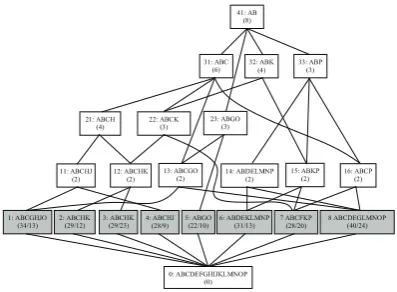
Next, we build the document concept lattice (DCL) for articles represented by wiki concepts. For il-lustration on how DCL is built, we consider 8 sen-tences from DUC 2005 Cluster d324e (Ye et al., 2007) as case study. 8 sentences, represented by 16 distinctive concepts A-P, are considered as the base nodes 1-8 as shown in Figure 1. Once we group nodes by means of the maximal common concepts among base nodes hierarchically, we can obtain the derived nodes 11-41, which form a DCL. A derived node will annotate a local topic through a set of shared concepts, and define a sub concept space that contains the covered base nodes under proper pro-jection. The derived node, accompanied with its base nodes, is apt to interpret a particular argument (or statement) about the involved concepts. Further-more, one base node among them, coupled with the corresponding sentence, is capable of this interpre-tation and could represent the other base nodes to some degree.
In order to Extract a set of sentences to cover key distinctive local topics (arguments) as much as possible, we need to select a set ofimportant non-overlapping derived nodes. We measure the impor-tance of nodeN in DCL of articlejin term of rep-resentative power (RP)as:
RP(N) = X
ci∈N
(|ci|·wi,j)/log(|N|), (2)
[image:4.595.317.516.62.208.2]
Figure 1: A sample of concept lattice
where concept ci in node N is weighted by wi,j
according to Eqn (1), and|N|denotes the concept number in N (ifN is a base node) or the number of distinct concepts in|N|(ifN is a derived node), respectively. Here,|ci|represents thec’s frequency
inN, andlog(|N|)reflectsN’s cost ifNis selected (namely, how many concepts are used inN). For example, 7 concepts in sentence 1 lead to the total |c|of 34 if their weights are set to 1 equally. Its RP is RP(1) = 34/log(7) = 40.23. Similarly, RP(31) = 6∗3/log(3) = 37.73.
By selecting a set of non-overlapping derived nodes with maximal RP, we are able to obtain a set of local topics with highest representativeness and diversity. Next, a representative sentence with max-imal RP in each of such derived nodes is chosen to represent the local topics in observation. When the length of the required summary changes, the num-ber of the local topics needed will also be modi-fied. Consequently, we are able to select the sets of appropriate derived nodes in diverse generalization levels, and obtain various versions of summaries containing the local topics with appropriate gran-ularities.
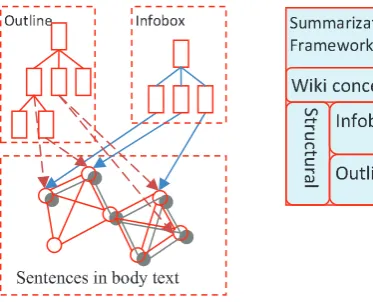
Figure 2: Properties in infobox and their support sentences
3.3 Model of Extended Document Concept Lattice (EDCL)
Different from free text and general web docu-ments, wiki articles contain structural features, such as infoboxes and outlines, which correlate strongly to nuggets in definition TREC-QA. By integrating these structural features, we will generate better RP measures in derived topics which facilitates better priority assignment in local topics.
3.3.1 Outline: Wiki Macro Structure
A long wiki article usually has a hierarchical out-lineusing inner links to organize its contents. For example, wiki articleCatconsists of a set of hier-archical sections under the outline of mouth, legs, Metabolism, genetics, etc. This outline provides a hierarchical clustering of sub-topics assigned by its author(s), which implies that selecting sentences from diverse sections of outline is apt to obtain a balanced summary. Actually, DCL could be con-sidered as the composite of many kinds of clus-terings (Ye et al., 2007). Importing the clustering from outline into DCL will be helpful for the gen-eration of a balanced summary. We thus incorpo-rate the structure of outline into DCL as follows: (i) treat section titles as concepts in the pseudo de-rived nodes; (ii) link these pseudo nodes and the base nodes in this section if they share concepts; and (iii) revise base nodes’ RP in Eqn (2) (see Sec-tion 3.3.3).
3.3.2 Infobox: a Mini Version of Summary
Infobox tabulates the key properties about the topic concept of a wiki article. It could be considered as a mini summary, where many nuggets in TREC-QA are included. As properties in infobox are not complete sentences and do not present relevant ar-guments, it is inappropriate to concatenate them as a summary. However, they are good indicators for summary generation. Following the terms in a property (e.g., spouse name and graduation school),
! "
# $% $& ' (& ) *+,
- .+ /$() 0(1' 2' 3
4
5
6
7
8
5
7
6
9
[image:5.595.77.289.59.210.2] [image:5.595.312.499.64.215.2]:
Figure 3: Extend document concept lattice by out-line and infobox in Wikipedia
we can find the corresponding sentences in the body of the text that contains such terms4. It describes the
details about the involved property and provides the relevant arguments. We call itsupport sentence.
Now, again, we have a hierarchy: Infobox + properties + support sentences. This hierarchy can be used to render a summary by concatenating the support sentences. This summary is inferred from hand-crafted infobox directly and is a full version of infobox; so its quality is guaranteed. However, it is possibly inapplicable due to its improper length. Following the iterative reinforcement approach for summarization and keyword extraction (Wan et al., 2007), it could be used to refine other versions of summaries. Hence, we utilize infobox and its sup-port sentences to modify nodes’ RPs in DCL so that the priority of local topics has bias to infobox. To achieve it, we extend DCL by inserting a hierarchy from infobox: (i) generate a pseudo derived node for each property; (ii) link every derived node to its support sentences; and (iii) cover these pseudo nodes by a virtual derived node called infobox.
3.3.3 Summary Generation from EDCL
In DCL, sentences with common concepts form lo-cal topics by autonomous approach, where shared concepts are depicted in derived nodes. Now we introduce two additional hierarchies derived from outline and infobox into DCL to refine RPs of salient local topics for summarization, which will render a model named extended document
con-cept lattice (EDCL). As shown in Figure 3, base
nodes in EDCL covered by pseudo derived nodes will increase their RPs when they receive influence from outline and infobox. Also, if RPs of their cov-ered base nodes changes, the original derived nodes will modify their RPs as well. Therefore, the new
4Sometimes, we can find more than one appropriate
RPs in derived nodes and based nodes will lead to better priority of ranking derived nodes, which is likely to result in a better summary. One important direct consequence of introducing the extra hierar-chies is to increase the RP of nodes relevant to out-line and infobox so that the summaries from EDCL are likely to follow human-crafted ones.
The influence of human effects are transmitted in a ‘V’ curve approach. We utilize the following steps to generate a summary with a given length (saymsentences) from EDCL.
1. Build a normal DCL, and compute RP for each node according to Eqn 2.
2. Generate pseudo derived nodes (denoted by P) based on outline and infobox, and link the pseudo derived nodes to their relevant base nodes (denoted byB0).
3. Update RP in B0 by magnifying the
contri-bution of shared concepts betweenPandN05.
4. Update RP in derived nodes that coverB0 on
account of the new RP inB0.
5. Selectmnon-overlapping derived nodes with maximal RP as the current observation.
6. Concatenate representative sentences with top RP from each derived node in the current observation as output.
7. If one representative sentence is covered by more than one derived node in step 5, the output will be less thanm sentences. In this case, we need to increase m and repeat step 5-6 untilmsentences are selected.
4 Experiments
The purposes of our experiment are two-fold: (i) evaluate the effects of wiki definition to the TREC-QA task; and (ii) examine the characteristics and summarization performance of EDCL.
4.1 Corpus Construction
We adopt the tasks of TREC-QA in 2004-2006 (TREC 12-14) as test scope. We retrieve arti-cles with identical topic names from Wikipedia6.
Non-letter transformations are permitted (e.g., from ‘Carolyn Bessette-Kennedy’ to ‘Carolyn Bessette-Kennedy’). Because our focus is summariza-tion evaluasummariza-tion, we ignore the cases in TREC-QA where the exact topics do not exist in Wikipedia, even though relevant topics are avail-able (e.g., ‘France wins World Cup in soccer’ in TREC-QA vs. ‘France national football team’
5We magnify it by adding|c
0| ∗wc∗η. Here,c0 is the
shared concepts between P andN0, andηis the influence
factor and set to 2-5 in our experiments.
6The dump is available at
http://download.wikimedia.org/. Our dump was downloaded in Sept 2007.
and ‘2006 FIFA World Cup’ in Wikipedia). Fi-nally, among the 215 topics in TREC 12-14, we ob-tain 180 wiki articles with the same topics.
We ask 15 undergraduate and graduate students from the Department of English Literature in Na-tional University of Singapore to choose 7-14 sen-tences in the above wiki articles as extractive sum-maries. Each wiki article is annotated by 3 per-sons separately. In order for the volunteers to avoid the bias from TREC-QA corpus, we do not provide queries and nuggets used in TREC-QA. Similar to TREC nuggets, we call the selected sentenceswiki nuggets. Wiki nuggets provides the ground truth of the performance evaluation, since some TREC nuggets are possibly unavailable in Wikipedia.
Here, we did not ask the volunteers to create snippets (like TREC-QA) or compose an abstrac-tive summary (like DUC). This is because of the special style of wiki articles: the entire document is a long summary without trivial stuff. Usually, we do not need to concatenate key phrases from diverse sentences to form a recapitulative sentence. Mean-while, selecting a set of salient sentences to form a concise version is a relatively less time-consuming but applicable approach. Snippets, by and large, lead to bad readability, and therefore we do not em-ploy this approach.
In addition, the volunteers also annotate 7-10 pairs of question/answer for each article for fur-ther research on QA using Wikipedia. The cor-pus, called TREC-Wiki collection, is available at our site (http://nuscu.ddns.comp.nus.edu.sg). The system of Wikipedia summarization using EDCL is launched on the Web as well.
4.2 Corpus Exploration
4.2.1 Answer availability
The availability of answers in Wikipedia for TREC-QA could be measured in two aspects: (i) how many TREC-QA topics have been covered by Wikipedia? and (ii) how many nuggets could be found in the corresponding wiki article? We find that (i) over 80% of topics (180/215) in the TREC 12-14 are available in Wikipedia, and (ii) about 47% TREC nuggets could be detected directly from Wikipedia (examining applet modified from Pour-pre (Lin and Demner-Fushman, 2006)). In contrast, 6,463 nuggets existing in TREC-QA 12-14 are dis-tributed in 4,175 articles from AQUAINT corpus. We can say that Wikipedia is the answer goldmine for TREC-QA questions.
4.2.2 Correlation between TREC nuggets and non-text features
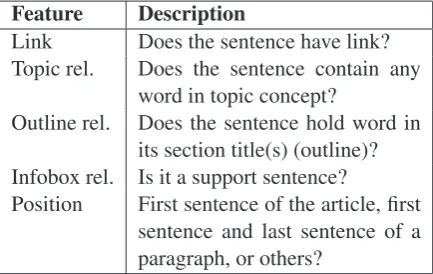
Analyzing the features used could let us understand summarization better (Nenkova and Louis, 2008). Here, we focus on the statistical analysis between TREC/wiki nuggets and non-textual features such as wiki links, infobox and outline. The features used are introduced in Table 1. The correlation co-efficients are listed in Table 2.
Observation: (1) On the whole, wiki nuggets
exhibit higher correlation to non-textual features than TREC nuggets do. The possible reason is that TREC nuggets are extracted from AQUAINT rather than Wikipedia. (2) As compared to other features, infobox and wiki links strongly relate to nuggets. They are thus reliable features beyond text for sum-marization. (3) Sentence positions exhibit weak correlation to nuggets, even though the first sen-tence of an article is a good one-sensen-tence definition.
Feature Description
Link Does the sentence have link? Topic rel. Does the sentence contain any
word in topic concept?
Outline rel. Does the sentence hold word in its section title(s) (outline)? Infobox rel. Is it a support sentence?
[image:7.595.73.290.311.448.2]Position First sentence of the article, first sentence and last sentence of a paragraph, or others?
Table 1: Features for correlation measurement
Feature TREC nuggets Wiki nuggets
Link 0.087 0.120
Topic rel. 0.038 0.058
Outline rel. 0.078 0.076
Infobox rel. 0.089 0.170
Position -0.047 0.021
Table 2: Correlation Coefficients between non-textual features in Wiki and TREC/wiki nuggets
4.3 Statistical Characteristics of EDCL
We design four runs with various configurations as shown in Table 3. We implement a sentence re-ranking program using MMR (maximal marginal relevance) (Carbonell and Goldstein, 1998) in Run 1, which is considered as the test baseline. We ap-ply standard DCL in Run 2, where concepts are determined according to their definitions in Word-Net (Ye et al., 2007). We introduce wiki concepts for standard DCL in Run 3. Run 4 is the full
ver-sion of EDCL, which considers both outline and in-fobox.
Observations: (1) In Run 1, the average
num-ber of distinctive words per article is near to 1200 after stop words are filtered out. When we merge diverse words having similar semantic according to WordNet concepts , we obtain 873 concepts per ar-ticle on average in Run 2. The word number de-creases by about 28% as a result of the omission of close-class terms and the merging of synonyms and paraphrases. (2) When wiki concepts are intro-duced in Run 3, the number of concepts continues to decrease. Here, some adjacent single-word terms are merged into wiki concepts if they are annotated by wiki links. Even though the reduction of total concepts is limited, these new wiki concepts will group the terms that cannot be detected by Word-Net. (3) DCL based on WordNet concepts has less derived nodes (Run 3) than DCL based on wiki con-cepts does, although the former has more concon-cepts. It implies that wiki concepts lead to higher link den-sity in DCL as more links between concepts can be detected. (4) Outline and infobox will bring addi-tional 54 derived nodes (from 1695 to 1741). Ad-ditional computation cost is limited when they are introduced into EDCL.
Run 1 Word co-occurrence + MMR
Run 2 Basic DCL model (WordNet concepts) Run 3 DCL + wiki concepts
[image:7.595.305.543.501.570.2]Run 4 EDCL (DCL + wiki concepts + outline + infobox)
Table 3: Test configurations
Concepts Base nodes Derived nodes
Run 1 1173 (number of words)
Run 2 873 259 1517
Run 3 826 259 1695
Run 4 831 259 1741
Table 4: Average node/concept numbers in DCL and EDCL
4.4 Summarization Performance of EDCL
We evaluate the performance of EDCL from two as-pects such as contribution to TREC-QA definition task and accuracy of summarization in our TREC-Wiki collection.
12. We examine the definition quality by nugget re-call (NR) and an approximation to nugget precision (NP) on answer length. These scores are combined using the F1 and F3 measures. The recall in F3
is weighted three times as important as precision. The evaluation is automatically conducted by Pour-pre v1.1 (Lin and Demner-Fushman, 2006).
Based on the performance of EDCL for TREC-QA definition task listed in Table 5, we observe that: (i) When EDCL considers wiki concepts and structural features such as outline and infobox, its F-scores increase significantly (Run 3 and Run 4). (ii) Table 5 also lists the results of Cui’s system (marked by asterisk) using bigram soft patterns (Cui et al., 2005), which is trained by TREC-12 and tested on TREC 13. Our EDCL can achieve comparable or better F-scores on the 180 topics in TREC 12-14. It suggests that Wikipedia could pro-vide high-quality definition directly even though we do not use AQUAINT. (iii) The precision of EDCL in Run 4 outperforms that of soft-pattern approach remarkably (from 0.34 to 0.497). One possible rea-son is that all sentences in a wiki article are oriented to its topic, and the sentence irrelevant to its topic hardly occurs.
NR NP F1 F3
Run 1 0.247 0.304 0.273 0.252
Run 2 0.262 0.325 0.290 0.267
Run 3 0.443 0.431 0.431 0.442
Run 4 0.538 0.497 0.517 0.534
[image:8.595.75.289.376.460.2]Bigram SP* 0.552 0.340 0.421 0.510
Table 5: EDCL evaluated by TREC-QA nuggets
[image:8.595.76.290.506.653.2]
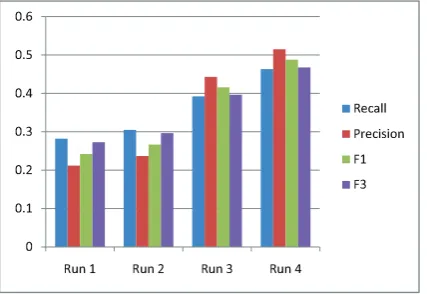
Figure 4: Performance of summarizing Wikipedia using EDCL with different configurations
We also test the performance of EDCL using ex-tractive summaries in TREC-Wiki collection. By means of comparing to each set of sentences se-lected by a volunteer, we examine how many ex-act annotated sentences are selected by the system
using different configurations. The average recalls and precisions as well as their F-scores are shown in Figure 4.
Observations: (i) The structural information of
Wikipeida has significant contribution to EDCL for summarization. We manually examine some sum-maries and find that the sentences containing more wiki links are apt to be chosen when wiki concepts are introduced in EDCL. Most sentences in output summaries in Run 4 usually have 1-3 links and rel-evant to infobox or outline. (ii) When using wiki concepts, infobox and outline to enrich DCL, we find that the precision of sentence selection has im-proved more than the recall. It reaffirms the con-clusion in the previous TREC-QA test in this sub-section. (iii) In addition, we manually examine the summaries on some wiki articles with common top-ics, such ascar, house, money, etc. We find that the summaries generated by EDCL could effectively grasp the key information about the topics when the sentence number of summaries exceeds 10.
5 Conclusion and Future Work
Wikipedia recursively defines enormous concepts in huge vector space of wiki concepts. The explicit semantic representation via wiki concepts allows us to obtain more reliable links between passages. Wikipedia’s special structural features, such as wiki links, infobox and outline, reflect the hidden human knowledge. The first sentence of a wiki article, in-fobox (and its support sentences), outline (and its relevant sentences), as well as the entire document could be considered as diverse summaries with var-ious lengths. In our proposed model, local topics are autonomously organized in a lattice structure according to their overlapping relations. The hier-archies derived from infobox and outline are im-ported to refine the representative powers of local topics by emphasizing the concepts relevant to in-fobox and outline. Experiments indicate that our proposed model exhibits promising performance in summarization and QA definition tasks.
Of course, there are rooms to further improve the model. Possible improvements includes: (a) using advanced semantic and parsing technologies to de-tect the support and relevant sentences for infobox and outline; (b) summarizing multiple articles in a wiki category; and (c) exploring the mapping from close-class terms to open-class terms for more links between passages is likely to forward some interest-ing results.
References
[Ahn et al.2004] David Ahn, Valentin Jijkoun, et al. 2004. Using Wikipedia at the TREC QA Track. In
Text REtrieval Conference.
[Carbonell and Goldstein1998] J. Carbonell and J. Goldstein. 1998. The use of mmr, diversity-based re-ranking for reordering documents and producing
summaries. InSIGIR, pages 335–336.
[Cui et al.2005] Hang Cui, Min-Yen Kan, and Tat-Seng Chua. 2005. Generic soft pattern models for
de-finitional question answering. In Proceedings of
the 28th annual international ACM SIGIR confer-ence on research and development in information re-trieval, pages 384–391, New York, NY, USA. ACM.
[Erkan and Radev2004] G¨unes¸ Erkan and Dragomir R. Radev. 2004. LexRank: Graph-based Lexical Cen-trality as Salience in Text Summarization.Artificial Intelligence Research, 22:457–479.
[Furnas et al.1987] George W. Furnas, Thomas K. Lan-dauer, Louis M. Gomez, and Susan T. Dumais. 1987. The vocabulary problem in human-system
communication. Communications of the ACM,
30(11):964–971.
[Gabrilovich and Markovitch2007] Evgeniy
Gabrilovich and Shaul Markovitch. 2007. Com-puting semantic relatedness using wikipedia-based
explicit semantic analysis. InProceedings of The
Twentieth International Joint Conference for Arti-ficial Intelligence, pages 1606–1611, Hyderabad, India.
[Kor and Chua2007] Kian-Wei Kor and Tat-Seng Chua. 2007. Interesting nuggets and their impact on
defin-itional question answering. InProceedings of the
30th annual international ACM SIGIR conference on Research and development in information re-trieval, pages 335–342, New York, NY, USA. ACM.
[Lin and Demner-Fushman2006] Jimmy J. Lin and Dina Demner-Fushman. 2006. Methods for auto-matically evaluating answers to complex questions.
Information Retrieval, 9(5):565–587.
[Lin and Hovy2000] Chin-Yew Lin and Eduard Hovy. 2000. The automated acquisition of topic signa-tures for text summarization. InProceedings of the 18th conference on Computational linguistics, pages 495–501, Morristown, NJ, USA. ACL.
[Lita et al.2004] Lucian Vlad Lita, Warren A. Hunt, and Eric Nyberg. 2004. Resource analysis for
ques-tion answering. In Proceedings of the ACL 2004
on Interactive poster and demonstration sessions, page 18, Morristown, NJ, USA. ACL.
[Liu et al.2004] Shuang Liu, Fang Liu, Clement Yu, and Weiyi Meng. 2004. An effective approach to docu-ment retrieval via utilizing wordnet and recognizing
phrases. InProceedings of the 27th annual interna-tional ACM SIGIR conference on Research and de-velopment in information retrieval, pages 266–272, New York, NY, USA. ACM.
[Lu et al.2008] Jie Lu, Shiren Ye, and Tat-Seng
Chua. 2008. Explore semantic similarity
and semantic relatedness via wikipedia.
Tech-nical report, National Univeristy of Singapore, http://nuscu.ddns.comp.nus.edu.sg.
[Mei and Zhai2008] Qiaozhu Mei and ChengXiang Zhai. 2008. Generating impact-based summaries for scientific literature. In Proceedings of ACL-08:
HLT, pages 816–824, Columbus, Ohio, June. ACL.
[Nenkova and Louis2008] Ani Nenkova and Annie Louis. 2008. Can you summarize this? identify-ing correlates of input difficulty for multi-document
summarization. In Proceedings of ACL-08: HLT,
pages 825–833, Columbus, Ohio, June. ACL.
[Nenkova et al.2007] Ani Nenkova, Rebecca Passon-neau, and Kathleen McKeown. 2007. The pyra-mid method: Incorporating human content selection
variation in summarization evaluation. ACM
Trans-actions on Speech and Language Processing, 4(2):4.
[Silber and McCoy2002] H. Grogory Silber and Kath-leen F. McCoy. 2002. Efficiently computed lexical chains as an intermediate representation for
auto-matic text summarization. Computational
Linguis-tics, 28(4):487–496.
[Teufel and Moens2002] Simone Teufel and Marc
Moens. 2002. Summarizing scientific articles:
experiments with relevance and rhetorical sta-tus. Computational Linguistics, 28(4):409–445, December.
[Voorhees and Dang2005] Ellen M. Voorhees and
Hoa Trang Dang. 2005. Overview of the trec
2005 question answering track. In Text REtrieval
Conference.
[Voorhees2004] Ellen M. Voorhees. 2004. Overview
of the trec 2004 question answering track. InText
REtrieval Conference.
[Wan et al.2007] Xiaojun Wan, Jianwu Yang, and Jian-guo Xiao. 2007. Towards an iterative reinforcement approach for simultaneous document summarization
and keyword extraction. InProceedings of the 45th
Annual Meeting of the Association of Computational Linguistics, pages 552–559, Prague, Czech Repub-lic, June. ACL.
[Ye et al.2007] Shiren Ye, Tat-Seng Chua, Min-Yen
Kan, and Long Qiu. 2007. Document
con-cept lattice for text understanding and
summariza-tion. Information Processing and Management,