Original Research Article
Relationship between regional food and
hypertension in the East of Turkey
Cihan Önen
1*, Gülsen Güneş
2INTRODUCTION
Hypertension is a controllable and preventable public health problem which is a risk factor for many serious diseases, especially cardiovascular diseases. Hypertension, of which symptoms are rarely seen and, which is silent and fatal, haven’t been diagnosed in many people. Hypertension must be controlled with protection, early diagnosis and effective response in order to achieve important acquisitions for both health and economic aspects. It is important to focus on behavioral risk factors, such as harmful habits (smoking, alcohol, etc.), physical movement restriction, unhealthy diet, for control and prevention of hypertension.1
In addition to hypertension, diabetes, hyperlipidemia and smoke are also among cardiovascular risk factors. Considerable successes have been achieved on smoking in Turkey. Though it has been made progress for awareness, treatment and control of hypertension; it is stil at a low level.2 If it can’t be controlled, it will lead to direct and indirect considerable health expenses. Cost burden is not only resulted from hypertension, it also increases because of hypertension derived diseases.3 Nourishment culture may vary by regions in Turkey. While meat, yogurt and dairy products have been consumed more frequently in some places, fruit consumption is more common in some areas. Fruit has often been consumed in Aegean Sea and fish has often
ABSTRACT
Background: It is important to focus on behavioral risk factors, such as harmful habits, unhealthy diet, for hypertension. In the study the aim is to examine the hypertension frequency of adults in Bitlis city center, factors affecting this and other related factors.
Methods: The target population of the cross-sectional research consists of people aged 30 and higher in Bitlis city center. Face to face interviews were performed with people incorporated to the sample between February 15th and April 15th 2015 time interval in order to collect data from the field.
Results: Hypertension frequency was found to be 35.5%. 59.3% of the people with hypertension are aware of the situation. The blood pressure of 26.3% of the people who are aware of their situation is under control. Significant difference was determined between hypertension and consumption frequency of regional foods such as fried fish, local cheese, fish Basma and Kurut. In logistic regression analysis significant relation was determined between hypertension and old age, women, obesity≥30 and Kurut frequent consumption.
Conclusions: In the research the hypertension frequency was found to be 35.5%. Significant relation was detected between hypertension and frequent consumption of Kurut which is a regional food.
Keywords: Bitlis, Hypertension, Prevalence, Regional nutrition 1
Department of Nursing, Health High School, Bitlis Eren University, Bitlis, Turkey 2
Department of Public Health, Faculty of Medicine, Inonu University, Malatya, Turkey
Received: 13 March 2019
Accepted: 07 May 2019
*Correspondence:
Dr. Cihan Önen,
E-mail: [email protected]
Copyright: © the author(s), publisher and licensee Medip Academy. This is an open-access article distributed under the terms of the Creative Commons Attribution Non-Commercial License, which permits unrestricted non-commercial use, distribution, and reproduction in any medium, provided the original work is properly cited.
been consumed in Black Sea region as well. Besides, poultry has been preferred in the Central Anatolia and East Anatolia and yogurt has been preferred in Southeast Anatolia as well. Our regional cuisine having a positive contribution to the health in general has also included some negative health applications.4
Bitlis is one of the provinces with the richest cuisine of Eastern Anatolia. The basic food items consumed in this province is composed of meat, grains and vegetables. These nutrients are the basic meals for some provinces of region as well.5
Salt, which has a significant place in many cultures, has been mentioned in phrases of communities and attributed positive meanings to phrases. It is also a substance having a cultural significance in Van Lake basin.6 Salt has also been used in preparation of winter foods in the region. fish conversation in salt water, yaprak basma and kurut, which are prepared by being salted, are some of winter foods.7
Buryan, avşor, sheep’s head /foot, sor fish pilaf and fish basma, and meat and fish consumed in Bitlis are among local nutritions. Regarding Buryan; without splitting, male goat / sheep meat is cooked as being hung with hook in floor furnace with cinder fire after fine salt has been spread throughout it. Regarding avşor, salt added meat is removed from its bones after being boiled. A little of oil of buryan that has been cooked in floor furnace is added into its boiled water. Regarding sheep’s head /foot; heads and feet of local cattle and small cattles are cooked in a pot to which hot water added, after being fairly cleaned. Cooked meal is served after crushed garlic and salt are being added into it. Regarding sor fish pilaf; Van Lake gray mullet dried in salt is cooked after being waited in water. It is added into bulgur pilaf that previosly prepared, after bones and shells of fish are removed. Regarding fish conservation in salt water (fish basma); after fishes salted are being waited in water, are taken off bloody water next day and lined in a jar.5,7
Figure 1: (A) Kurut, kurut foods: (B) kurut ası and (C) sengeser, (D) sor fish pilaf.
Kurut and regional cheese are among local dairy products. Regarding Kurut; kocelik is salted and grounded in bag. After its water has been drained, it is rolled in palm and being dried in the shade, adding fine salt. Regarding herby cheese; it is prepared chopping some wild onions and garlic type herbies acquired during
spring and summer months and then adding them into boiled milk.5,7
Based on this information, the prevalence of hypertension in adults in Bitlis province center, local nutrition factors affecting this situation and other associated factors were intented to investigate in the study.
METHODS
Study method and sample size
The universe of this cross-sectional study was constituted by people aged 30 years and over (2013, TurkStat Data; 23153 people) living in the province center of Bitlis. For the calculation of the sample size of the study; the formula of (N=nt2pq /d2 (N - 1) + t2pq), which is applied when target group has been known, was used thereby determining the minimum number of sample size. The minimum number (349 people) was determined on the basis of 95% confidence interval and 34.6% prevalence, (p=0.346) in the formula.8 Since the relation of local hypertension with local nourishment was investigated, double number people(760 people) than predetermined were included in the study. 741 people who have the criteria required for the study, were utilized for the study. Cluster sampling was used in the study. Cluster, composed of 8 family health centers. Cluster weight was identified on the basis of population size and 30 aged and over people were contacted through simple random method. Questionnaire data were collected from study area in the time period between February 15 to April 15 2015.
Data collection tool and measurements
Analysis and evaluation of data
Chi-square test was used for the comparison of categorical data in the study. P<0.05 values were considered statistically significant. Measurable data were presented in mean±standard deviation. The statistical assessment was performed using SPSS software.
The effects of independent variables for hypertension was investigated using logistic regression analysis (Backward Wald). The independent variables which have statistically significant differences with hypertension were included in the logistic regression model. The individuals, whose weekly consumption of any of local nourishments designated within last six months is over median, are classified as those consuming that nourishment frequently.
Study participation criteria
Those who didn’t want to participate in the study, in the age group that was out of study’s scope (aged below 30 years) and pregnant women weren’t included in the study.
RESULTS
Age, residence duration in the center of Bitlis province center and average income of the participants were identified respectively as 46.7±11.8 (30-86), 35.3±17.1 years and 1152 Turkish Liras. Regarding the people participated in the study; marital status of the majority of them (89.6%) was married, native land of 85.3% of them was central region of Bitlis, 63.0% of them weren’t smoking and 54% of them were male. Regarding their educational level; while 47.2% of the females were in lower level than primary education; 42.5% of the males were in primary education level. Regarding BMI values on the basis of gender; BMI values of 14.2% of the males were ≥30, that of 24.9% of the females were ≥30 (Table 1).
The prevalence of hypertension in those including advanced aged ones, females, people with income of 950 TL (Turkish Lira) or below, marital status of widow, unemployed people, educational level of primary education or lower, BMI values ≥30 was highly statistically significant (p<0.05) (Table 2).
Table 1: The comparison of the socio-demographic characteristics of the study group with hypertension.
Variables
Hypertension
X2 P value
Exist No exist
n %* n %*
Age group (in years)
30-39a 30 12.0 219 88.0
141.901 <0.001
40-49a 65 31.4 142 68.6
50-59a 72 49.3 74 50.7
60+a 96 69.1 43 30.9
Gender Male 124 31.0 276 69.0 7.662 0.006
Female 139 40.8 202 59.2
Income >950 TL ≤950 TL 112 28.4 282 71.6 18.349 <0.001
151 43.5 196 56.5
Marital
Married 227 34.2 437 65.8
19.237 <0.001
Single 5 18.5 22 81.5
Widowa 31 62.0 19 38.0
Working Working Doesn’t work 73 23.1 243 76.9 36.949 <0.001
190 44.7 235 55.3
Educational High school /higher 61 25.7 176 74.3 14.480 <0.001 Primary education/ lower 202 40.1 302 59.9
BMI <30 ≥30 191 31.9 408 68.1 17.754 <0.001 72 50.7 70 49.3
Total 263 35.5 478 64.5
*Line percentage; aThose making differences.
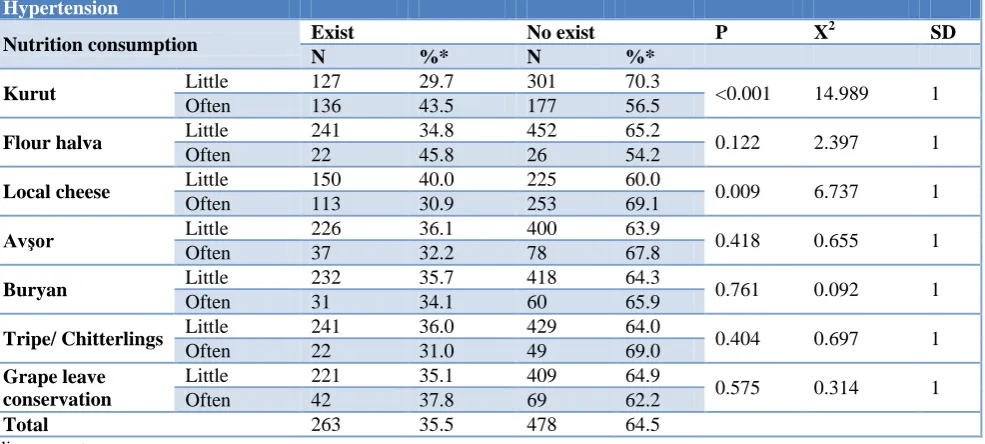
Table 2: Frequency of weekly local nutrition of the participants and hypertension.
Hypertension
Nutrition consumption Exist No exist P X
2
SD
N %* N %*
Dried fish Little 230 33.9 448 66.1 0.003 8.577 1
Often 33 52.4 30 47.6
Fish Basma Little 246 34.7 462 65.3 0.049 3.873 1
Hypertension
Nutrition consumption Exist No exist P X
2
SD
N %* N %*
Kurut Little 127 29.7 301 70.3 <0.001 14.989 1
Often 136 43.5 177 56.5
Flour halva Little 241 34.8 452 65.2 0.122 2.397 1
Often 22 45.8 26 54.2
Local cheese Little 150 40.0 225 60.0 0.009 6.737 1
Often 113 30.9 253 69.1
Avşor Little 226 36.1 400 63.9 0.418 0.655 1
Often 37 32.2 78 67.8
Buryan Little 232 35.7 418 64.3 0.761 0.092 1
Often 31 34.1 60 65.9
Tripe/ Chitterlings Little 241 36.0 429 64.0 0.404 0.697 1
Often 22 31.0 49 69.0
Grape leave conservation
Little 221 35.1 409 64.9
0.575 0.314 1
Often 42 37.8 69 62.2
Total 263 35.5 478 64.5
*line percentage.
Table 3: Factors used in the logistic regression analysis and findings (final model).
Variables P value Odds ratio %95 Confidence Interval
Age group (in years)
30-39 1.00
40-49 0.001 2.28 1.39 3.76
50-59 <0.001 4.99 3.09 8.06
60+ <0.001 17.59 10.21 30.32
Gender Male 1.00
Female 0.001 1.86 1.31 2.65
BMI <30 ≥30 1.00
0.043 1.55 1.02 2.36
Kurut Consumes little 1.00
Often consumes 0.001 1.85 1.31 2.62
Assessing nine of local nutritions consumed by study group; a statistically significant difference was found between those; dried fish, local cheese, fish conservation in salt water, kurut consumption frequency and hypertension (p<0.05) (Table 3).
The characteristics of study’s participants such as being aged 30-39 years, being males, having income >950 TL, being married, working, having high school education and over, BMI <30, little consuming of dried fish, fish pickled, kurut and local cheese were taken as references in the logistic regression analysis.
There are 4 independent variables such as age group, gender, BMI and kurut in the Backward Wald final model. In consequence of Backward Stepwise Logistic Regression analysis; as indicated in Table 3; the characteristics of participants such as being in the range group between 40-49 years (OR=2.28), 50-99 years (OR=4.99); 60 and over (OR=17.59), being female (OR=1.86) and being obese ≥30 (OR=1.55) and often consuming kurut (OR=1.85) have significant effects on hypertension (p<0.05) (Table 4).
Table 4: Distribution of participants according to their hypertension control and awareness.
N n %
Hypertension
Prevalence 741 263 35.5 Awareness 263 156 59.3
Control
In all hyperpietic participants 263 41 15.6 In hyperpietic participants with
awareness 156 41 26.3
Regarding the nutritions frequently consumed in meal intervals by study group; the majority of them (59.2%) consumed fruits; 37.9% of them consumed yogurt, 32.7% them consumed dried nuts; 27.5% of them consumed pastry and so on.
DISCUSSION
The average systolic blood pressure was measured as 126.3 mmHg in the study group. The average systolic blood pressure was measured as 126.4 mmHg in males; 126.2 mmHg in females. It was found when the values obtained until the year of 2015 were assessed that these values were approximate to the average systolic blood pressure of females (126.4 mmHg) and males (125.3 mmHg) aged over 30 years.10
The prevalence of hypertension in the people aged 30 years and over, residing in Balçova district was 40.9%; 73.3% of hyperpietic individuals were aware of being hyperpietic; blood pressure of 49.6% of those with awaresness was kept under control.11 Availability of more population whose educational level is over primary education in Balçova may be the reason of the increase of awareness.
The prevalence of hypertension in the group aged 30 years and over in Bursa Nilüfer Public Health Training and Research Area was determined as 36.8%; awarenes of those was determined as 62.6%; conrol ratio of hypertension in those was determined as 26.6%.12 The average age, the ratio of married people and those with educacational level over high school in Nilufer district is approximate to those in Bitlis province center.
The prevalence of hypertension (34.6%) and blood pressure control percentage (28.9%) in people aged 30 years and over in Kayseri province were approximate to the values acquired in the study performed in Bitlis. The ratio of awareness (70.6%) was also higher.8 The ratio of awareness was also higher. High awareness in the study performed in Kayseri may be resulted from high female ratio and socio-economic differences.
The ratio of blood pressure elevation in women aged 30 and over in Sivas Labour Health Center yielded the lowest value (20.9%). Awareness of hyperpietics (57.4%) is similar to that of this study.13 That Sivas study was performed in the year 2001 and with females, may also be effective on variation of the prevalence ratio.
In the studies performed with similar age group abroad; the prevalence of hypertension for people aged 30 years and over was 41.7% and approximate hypertension awareness was 71% in India, which were higher than the values acquired in Bitlis study. It is seen that hypertension ratio was higher than the values acquired in Bitlis study and other studies.14 In another study performed in the same country; the prevalence of high blood pressure (32.2%) yielded lower and hypertension
awareness yielded in the similar ratio (72%).15 That study was performed with a group with good income status, may contribute prevalence of hypertension to yield lower. It was revealed as a result of logistic regression analysis performed in Bitlis study that advanced age group, female and those whose BMI ≥30 have a significant relation on high blood pressure (p<0.05). A significant relation was found between BMI and high blood pressure in many studies. In the studies performed with age group (aged 30 years and over); a significant relation was found between age and high blood pressure. It was seen in the study performed in Balçova district that the prevalence of hypertension was higher in those with advanced ages and females.11 The prevalence of hypertension was identified significantly higher in patients and those with BMI over 30, in the study performed in Sivas.13 While a significant relation was’t found between gender and high blood pressure, it was detected between age and BMI in some studies.12,14 Hypertension was identified significantly higher in males as compared to in females and age increase and BMI were identified to have a significant relation with high blood pressure in a study.15
The prevalence of hypertension is in the ratio of 73.5% in those aged 65 years and over in Bitlis province center. In a study performed for advanced age group (65 years and older); prevalence of hypertension (61.8%) was yielded higher.16 The risk of high blood pressure development in those with pre-hyperpietic increases in the advancing years.9 4-year’s hypertension incidence increase has been occured in the ages ranging between 35 to 64 and 65 to 90 in the people with high blood pressure as conpared with those with optimum (<120/80 mmHg) and normal (120-129 / 80-84 mm Hg) blood pressure.9,17
Hypertension was significantly higher in people with income status ≤950 TL, marital status of widow, not working, whose educational level is primary education and lower (p<0.05). The prevalence of hypertension in those with low socioeconomic status was yielded higher in another study.18 A significant difference was found between marital status and hypertension in Bitlis study. This difference was resulted from those with marital status of widow. The prevalence of hypertension was seen higher in those with marital status of widow in Balçova study as well.11
foods are preserved by being salted. A significant relation was identified between frequent consumption of kurut, which is one of these local foods, and hypertension as a result of the logistic regression analysis (p<0.05).
A significant difference wasn’t found between sheep’s head /foot, avşor, grape leave conservation, buryan, flour havla which are some of local foods and high blood pressure (p>0.05). Those with high blood pressure likely followed diet for them if they had been informed in advance on this subject. Flour havla has been made by mixing flour or sweet foods like molasses with salt. Consumption of sweet flour havla like molasses is common in the region. Also, avşor ve buryan, which are among local foods, are being produced in floor furnace environment.
Regarding feeding habits of the participants; 27.3% of them took nutritional value of food into account in food choice. It was revealed that vast majority of the study group didn’t take nutritional value of food into account. Instead, participants took care deliciousness (66%) and filling capability (51.6%) of meal. DASH, which is a fruit preferred in fighting hypertension and found useful for Mediterranean diet, was the most preferred food (59.2%) by participants. Yogurt which was ranked as second in respect to consumption in mealintervals, is known to be rich in calcium. Calcium, potassium and magnesium are preferred for balance of high pressure as stated in DASH and Mediterranean diet.19,20
The relation of consumption of traditional foods with hypertension was revealed in other studies as well. The relation of traditional diet with high blood pressure was revealed in a study performed in China. Great amount of salt has been consumed in this traditional diet. In a study performed in Brazil, a high correlation was also revealed between sodium, being used in traditional diet and high blood pressure.21,22 Even though traditional foods consumed in different countries differ from each other, salt has commonly been used in these foods enough to trigger hypertension. In a study performed in Turkey, the prevalence of hypertension (58.2%) was determined high in individuals consuming pickled food frequently.23 Consequently, though many of local foods are salted, yogurt and fruit should be consumed frequently for nourishment. Since many traditional foods have less frequenctly been consumed in general; due to of not being consumed or less consumed compare to past, subject-related findings were similar to the ones revealed in Bitlis province center. A significant relation was found between frequent kurut consumption and hypertension in those with advanced age, females, and those whose BMI ≥30 (p<0.05) in the consequence of logistic regression analysis. The prevalence of hypertension was found 35.5% in people, aged 30 years and over, living in Bitlis province center. 59.3% of people with high blood pressure were aware of this situation. The blood pressure
of 26.3% of those who were aware of being hyperpietic were kept under control.
Funding: No funding sources Conflict of interest: None declared
Ethical approval: The study was approved by the Malatya Clinical Research Ethics Committee
REFERENCES
1. World Health Organization (WHO). A global brief on hypertension: silent killer, global public health crisis. Geneva, Switzerland: WHO Press; 2013. 2. Abacı A. The current status of cardiovascular risk
factors in Turkey. Arch Turk Soc Cardiol. 2011;39:1-5.
3. Gaziano TA, Bitton A, Anand S, Weinstein MC. The global cost of nonoptimal blood pressure. J Hypertens. 2009;27:1472-7.
4. Ertaş Y, Gezmen-Karadağ M. Turkish cuisine in healthy nutrition. Gümüşhane University J Health Sci. 2013;2(1):117-36.
5. Belli GS, Belli O. The traditional culinary culture and food in the Bitlis region from antiquity to the present. Ist İnternational symposium on traditional culinary culture and cuisine of The Eastern Anatolian region; Bitlis, Turkey; 2009: 383-445. 6. Kalafat Y. Salt belief in Turkish cultured folks with
Van Lake basin samplings. Ist İnternational symposium on traditional culinary culture and cuisine of The Eastern Anatolian region; Bitlis, Turkey; 2009: 100-109.
7. Ünsal M. The preparation of the winter food from the past to the present. Ist İnternational symposium on traditional culinary culture and cuisine of The Eastern Anatolian region; Bitlis, Turkey; 2009: 279-285.
8. Öztürk A, Aykut M, Günay O, Gün İ, Özdemir M, Çıtıl R, Öztürk Y. Prevalence and factors affecting of hypertension in adults aged 30 years and over in kayseri province. Erciyes Med J. 2011;33(3):219-28.
9. Chobanian AV, Bakris GL, Black HR, Cushman WC, Green LA, Izzo, Jr JL, et al. The seventh report of the joint national comittee on prevention, detection, evaluation, and treatment of high blood pressure. The JNC 7 Report. JAMA. 2003;289(19):2560-71.
10. Pekel Ö, Arık H, Sözmen MK, Ünal B, Kalaça S. Changes in the prevalence of hypertension in Turkey. Turk J Public Health. 2013;11(3):129-48. 11. Sözmen K, Ergör G, Ünal B. Determinants of
prevalence, awareness, treatment and control of high blood pressure. Dicle Med J. 2015;42(2):199-207. 12. Sarısözen D. Hypertension prevalence and effecting
factors in Nilüfer region. Institute of Health Science, Bursa, Turkey; 2006.
in the region of Sivas Emek Health House. Cumhuriyet Med J. 2001;23(1):9-14.
14. Bartwal J, Awasthi S, Rawat CMS, Singh RK. Prevalence of hypertension and its risk factors among individuals attending outpatient department of rural health training centre, Haldwani. Ind J Comm Health. 2014;26(1):76-81.
15. Yadav S, Boddula R, Genitta G, Bhatia V, Bansal B, Kongara S, et al. Prevalence & risk factors of pre-hypertension & pre-hypertension in an affluent north Indian population. Indian J Med Res. 2008;128(6):712- 20.
16. Altıparmak S, Karadeniz G, Altıparmak O, Ataseven M, Şahin R. Hypertensıon prevalance among elderly people: a sample from Manisa. Turkish J Geriatr. 2006;9(4):197- 201.
17. Vasan RS, Larson MG, Leip EP, Kannel WB, Levy D. Assessment of frequency of progression to hypertension in non-hypertensive participants in The Framingham Heart Study: a cohort study. Lancet 2001; 358: 1682-6.
18. Boylu Ö. Awareness position and hypertension prevalece of 40 and over aged population in Niğde city’s Kemerhisar town. Master's Thesis, Erciyes University, Kayseri, Turkey, 2006.
19. U.S. Department of Health and Human Services, HHS. Your Guide to Lowering Your Blood Pressure
With DASH. Washington, DC, USA: NIH Publication; 2006.
20. Kokkinos P, Panagiotakos DB, Polychronopoulos E. Dietary influences on blood pressure: the effect of the Mediterranean diet on the prevalence of hypertension. J Clin Hypertens. 2005;7(3):165 - 70. 21. Selem SS, Castro MA, César CL, Marchioni DM,
Fisberg RM. Associations between dietary patterns and self-reported hypertension among Brazilian adults: a cross-sectional population-based study. J Acad Nutr Diet. 2014;114(8):1216-22.
22. Qin Y, Boonstra AM, Pan X, Zhao J, Yuan B, Dai Y, Zhou M, Geleijnse JM, Kok FJ, Shi Z. Association of dietary pattern and body weight with blood pressure in Jiangsu Province, China. BMC Public Health. 2014;14(948):1-8.
23. Özkan M. Study of hypertension prevalence and associated criteria by people over 40 in the sub-prefecture of Dinar province of Afyonkarahisar. Master's Thesis, Afyonkarahisar Kocatepe University, Afyonkarahisar, Turkey, 2008.
Cite this article as: Önen C, Güneş G.Relationship between regional food and hypertension in the East of Turkey. Int J Community Med Public Health