441
Energy Management System And Peak
Shaving Algorithm For Smart Home Integrated
With Renewable Energy
S.Gomathy, M.Sabarimuthu, N.Priyadharshini, M.S.Kamalesh
Abstract: Energy management is becoming more critical in recent trends for manufacturing, transportation, information technology, agriculture, household uses, and more. Every country that wants to grow its economy and improve living standards needs to maintain a reliable supply of energy. This paper presents a method of intelligent energy management which reduces the peak energy of the utility, shifts utilizatio n to off-peak hours, and reduces overall energy consumption, particularly in a smart home. The proposed model taking into account the smart home appliances total power and consumption period. It allows those devices to adapt for available power using intelligent monitoring and control algorithms with the assistance of sensor networks. The scheduling of home appliances usage is a reliable method of energy saving. In this paper, the Home Energy Management System (HEMS) is developed on the Android platform to schedule users' appliances. A HEMS monitor electricity consumption to define home appliance activities.
Keywords: Solar, Smart home, Energy Management, peak scheduling, demand response
————————————————————
I INTRODUCTION
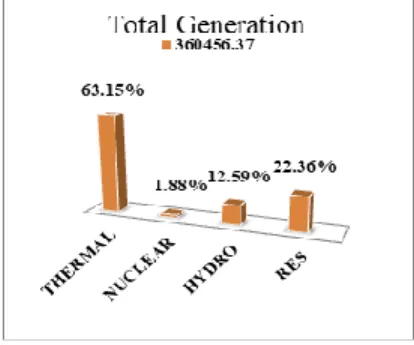
India's energy consumption has risen towards one of the world's highest pace due to population and economic development. India's share of global primary energy demand is expected to roughly double by 2040, endorsed by rapid economic growth and financial progress. Resilient economic growth and population size push a significant increase in India's primary power use, increasing by 1.2 billion tons of petroleum equivalent or 156 percent by 2040, making India by far the largest source of development in the power demand outlook. As of July 2019, the total installed power plant capacity in India stood at 360.46 Gigawatt (GW) as shown in figure 1. Despite continued dependence on fuel sources, non-commercial and conventional sources of energy, including fuelwood,biomass, crop residues, and animal waste, meet substantial energy needs, especially in the economically depressed household sector [1]. An emerging problem is the implementation of a management system that enables the utilization of various energy resources while balancing domestic power requirements and industrial capacity worldwide. Utility sector generated electricity capacity is 1.030.785 billion kWh during the year 2014-15, with a drop in demand of 38.138 billion kWh (-3.6%) when compared to the expected 5.1% deficit. The peak load met was 141,180 MW, with a short drop of 7,006 MW (-4.7 percent) compared to the planned 2.0 percent deficit [2].
Figure 1.Generation capacity of India as on July 2019
Electricity was the primary source of lighting for 53% of rural homes compared to 36% in 1993, according to a survey of 97,882 households in 2002. Although 80% of Indian villages have at least one power line, only 52.5% of rural homes have energy access. Access to energy in metropolitan regions is 93.1% in 2008. The current electrification rate in India is 64.5 percent, while 35.5 percent of the population still lives without access to electricity. Industrial demand in India accounted for 35 percent of the market for power in 2010–11, household use accounted for 28 percent, agriculture for 21 percent, business 9 percent, government lighting, and other diverse applications [3].The rising of smart homes impacts our daily life in many ways where the user can monitor, track, and control various appliances. Household penetration is 7.5% in 2018 and is expected to hit 19.5% by 2022. A smart home facilitates the user by providing security, low operating costs, energy efficiency, and convenience. The 2016–17 electrical demand is anticipated to be at least 1,392 Tera Watt-Hours, with a total electrical demand of 218 GW. The 2021–22 electrical requirements are expected to be at least 1,915 Tera Watt-Hours, with a peak electrical demand of 298 GW.
II ENERGY MANAGEMENT
A. Energy demandFor electricity grids, demand responses are analogous to adaptive demand processes, such as increasing their use at peak moments, to run consumer energy use in order with supply requirements. Demand response may reduce the energy effectively used, which may or may not be linked to the grid in parallel. This concept is different from energy efficiency, which means the user has to use a lesser amount of power to execute similar tasks, consistently or any time the task is done [4]. Peak demand response is an important element of intelligent energy production that includes energy efficiency, distributed renewable resources, smart home and smart energy management systems, and charging of electric vehicles. Simultaneously, demand response is an element of sustainable energy demand,
including energy efficiency, household and building energy management, decentralized renewable resources and charging of electric vehicles [5]. In the present scenario, energy demand solutions schemes are proposed to the small scale and large scale industries and domestic uses, through the use of intelligent control devices to drop loads when demanded by grid or market price conditions. During the significant time frames, the services of domestic appliances are reduced according to the programmed load prioritization management scheme. In general, the demand response is directed towards motivating consumers to decrease demand, thus reducing the rising electricity consumption. Generally, the generation and transmission system is sized to match the peak demand, which ultimately reduces the total plant and expenses. However, depending on the generation capacity configuration, demand response may also be used in times of high output and low need to increase demand (load). This condition may encourage some schemes to resolve disputes between low and high demand times in energy storage. Emergency response to demand is used to prevent unintentional interruptions in supply shortages. Economic energy response of demand is used to enable electrical energy consumers to reduce their energy usage when they are worthless of the efficient or comfort of consuming that electricity than getting paid for
electricity [6].
Energy demand response of ancillary services consists of several specialized services that have been typically delivered by generators to maintain the efficient operation of the electricity grid.
B. SMART HOME
Smart home automation is the interoperability of smarter living standards technology and services via home networking. Home utilities integration makes it easier for them to communicate with each other via the intelligent controller, providing complete control of different home management systems as per the programmed settings or functional modes. Intelligent smart homes can enhance the comfort, safety, and power management of the house. It can also be used for the elderly and disabled, offering safe and secure environments. The limitation is that older adults are more disturbed by their continuous monitoring to explore different activities or change their actions about the threat of losing security. If this capacity is achieved everyone could see the advantages of smart technology at home. When the system can protect residents ' privacy and have a low cost. Major factors of interest in the context of electricity generation are the rapid rise in the demand for random power and the ambiguity in the energy supply involved. It is therefore evident that energy storage is necessary to meet unexpected energy demands. As a form of temporary energy storage, residential customers will be using the battery. Optimal scheduling of devices for efficient energy storage of residential customers, which guarantees a well-balanced load curve [7]. The approach is to curb the electric power system's carbon footprint by merging renewable energy resources. Home automation network assigned to power efficiency, taking into account residents ' usability needs, is responsible for matching power consumption with available power resources. It should reach a balance between the inhabitant's priorities in terms of convenience and price while meeting the devices '
technological limitations. These methods of regulating electricity consumption are key component of the demand response that depends on different electricity costs in order to minimize the high demand [8]. Reduced peak demand reduces bills for electricity and benefits utilities by reducing the unpredictability of grid stability, system failures, brownouts, and blackouts.
C. Peak Shaving
Among the most prevalent applications of power management is peak shaving. In these applications, the energy consumed by the operation is continuously tracked, allowing the power consumption to be automatically adapted to the required levels. The device records the power absorption profile daily, and from that information, it can make predictions of possible power peaks. The program can cut individual loads by priority set by the user to keep the peak load below a certain preset level based on the estimates[9],[10]. A peak shaving system has the main advantage that peak power demands kept within limits accepted with the power supplier, thereby eliminating additional costs and overloads of the power system. Due to daily changes in electricity prices in individual nations, electricity has two different resources: low cost and expensive fuel. Due to the lower demand at that time of day, electrical energy is cheaper at night. The higher tariff is chosen to last from 8 AM to 10 PM, whereas the minimal-cost tariff lasts from 10 PM to 8 AM. The electricity resources are defined in two parameters: the total reserved power and the minimum power. The maximum reserved power is the overall amount of electricity a household can produce. The limit power is determined by a customer and the amount of electricity from the grid is known as the maximum power. In normal working conditions, the quantity should not exceed. Default limit power surpassed if the system output (short duty time) is not affected by it. As a developed algorithm cannot interfere with the behavior of the user, it happens when the user initiates too many processes with execution deadlines that are too rigid [11]. Crossing the limit power is unavoidable in that specific situation. Nevertheless extracting additional power than the maximum reserved power is not necessary. The primary purpose of the intelligent home power management system is to minimize peak power consumption demand through a change from on-peak hours to overload use. Peak load or maximum peak is a term used in energy consumption management that defines a time when electricity availability is expected to be substantially higher than the average supply level for a sustained period. Fluctuations in peak demand can happen on daily, monthly, seasonal, and annual cycles. The real peak demand point for an electric utility company is a one-half-hour or hour cycle that reflects the customer's maximum position of electricity consumption. Total energy consumption will be decreased by using renewable resources and moving high-energy equipment to the night when power costs are reduced and other consumers are actively managed to respond to other renewable resources [12]. A smart home's significant advantages are its ability to utilize energy management attributes through street lights, heating systems, and appliances in the home. By providing planned ON / OFF and device power monitoring, an energy efficient management system focuses on the use of
443
appliances and output management. Tracking of each device's energy consumption and associated costs recorded in the management system's centralized node. These details can be found to the owner of the house as part of a management function by using a cell phone, PC. The network manages the performance of appliances and offers status reports on all devices connected to the device. This will also make it accessible to organizations outside the network, such as a provider for energy management. On the power generation side of things, the system provides input from the service provider for energy management, the utilities, or the system-allocated grid sensing unit. If the grid has a swinging blackout or if the grid has a disparity, the grid sensor provides the system with a preventive command. The sensor alerts the node that takes whatever action it takes to switch off appliances for whatever time it takes [13]. In a planned blackout, the service provider or energy management service provider will notify the node.
III PROPOSED SYSTEM
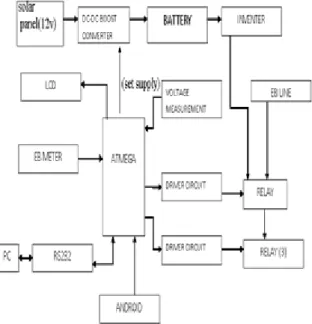
The Energy Management System block diagram is shown in Figure 3.2. The microcontroller is programmed to receive the data and information obtained from the modules, and it performs the necessary operation to control the appliances. The supply is taken via two ways through EB and using battery backup from the solar panel. The DC-DC boost converter boosts the output voltage to the desired level — the driver circuit powers the relay for switching purposes. Digital EB Meter senses the units of energy consumed and sends the output to the circuit consisting of a TTL logic circuit for further processing.LCD shows the status of the power supply and displays the input and output voltage. The relay circuit is connected to the home appliances and operates based on the scheduling of the devices- RS232 acts as an interface between the PC and energy management system as shown in figure 3.
Figure 3 Block diagram of proposed home energy
management system
Depending on the application priority, the power management algorithm relies on its period of use. The algorithm calculates the power of the requested application. If the total power of the user is less than or similar to the power limit, it will activate all applications. If their actual power exceeds the power limit, the programmed algorithm will sort the usage of appliances according to their priority. However, if the total power consumption of the applications requested exceeds the available power limit, the network compares the apps with the lower priority applications up to or below the complete energy usage threshold. Once the algorithm's first stage completed, the algorithm then searches for temporary hold applications that are adequate to operate the residual power. The hold application should operate as long as adequate power is available [14],[15]. Preventive is the act of momentarily interrupting a process task without requiring its support and resuming the task at a later date. The system ensures that the total number of applications required is allowed and that the most important part of the power available is used.
Figure 4 Flowchart of the proposed system
The user needs, and then each relay is given the appropriate ON and OFF set time. The system checks whether the relay one time is set earlier than relay two or not. If relay one is activated or the relay two is activated, the process continues for a specified time. At the end of either relay operation, the ON time of the other relay is verified again if they coincide; relay one is switched OFF simultaneously and ON the other relay. Instead, as usual, the process will proceed, and the appliance will be removed from the device when the OFF time is sensed by relay as shown in figure 4. Full scheduling process takes place during the peak hours of power consumption [16],[17].
IV EXPERIMENTAL SETUP
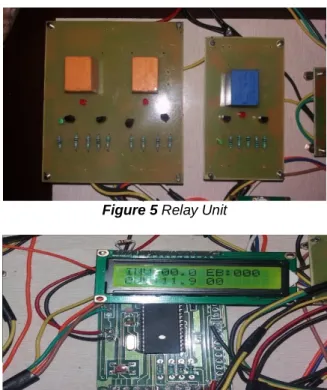
The relay Unit works depending on the scheduling of appliances. The appropriate relay is activated, and the appliance is switched ON/OFF accordingly, as shown in figure 5. The microcontroller operates using the energy stored in the battery, since the output voltage is less than 12V, as shown in figure 6.
Figure 5 Relay Unit
Figure 6 Microcontroller displaying the status of supply.
The Main relay used here is for switching between the EB and renewable energy supply lines. In addition to high watt resistor with fuse used to limit the current in the circuit to less value and a capacitor to block any AC entering into the system, as shown in figure 7.
.
Figure 7 Main Relay with protection circuit.
The Boost Converter to boosts the output obtained from the solar panel uses IRF-540 MOSFET and high range capacitor to boost the output voltage to the nominal value, as shown in figure 8.
Figure 8 Boost converter circuit
The circuit for conversion of analog signals into digital signals using TTL logic and NAND Gate by zero-crossing detection shown in figure 4.6.The assembly of inverter and battery together for supporting the energy obtained from the solar and battery. Inverter and battery connection with project kit. The actual demonstration of the proposed system by scheduling the appliances shown in figure 9.
Figure 9 Demonstration of the proposed system.
The visual C# application for controlling the appliances via the personal computer shown in figure 10
Figure 10 Visual C #applications for controlling the
appliances .
The table 1 shows the scheduling of appliances on the personal computer. For each of the devices, the proposed algorithm sets the appropriate relay time set. Visual C # is used to implement the method. When the system senses the time, the relay will get activated, and the appliance will receive power from the supply in ON condition. At OFF condition, the relay will get automatically deactivated in the circuit, and the device disconnected from the system. The appliance must first be turned ON given the specific time, and then it follows the appropriate time.
Table 1 SCHEDULING THE APPLIANCES USING
PERSONALCOMPUTER
APPLIANCES SCHEDULING OF APPLIANCE COMPACT FLUORESCENT BULB RELAY1 ON TIME: 03:45 PM RELAY 1 OFF TIME: 04:15 PM INCANDESCENT BULB RELAY 2 ON TIME: 04:15 PM RELAY 2 OFF TIME: 04:45PM
445
In the above example, the CFL is scheduled first according to the user's needs. When the system encounters the ON time for relay one, the relay one activated, and after some time when the OFF time met by the system, the relay one deactivated. A similar operation is followed for relay 2.Here simultaneous switching OFF of relay one and switching ON of the relay two takes since the time is the same for both the relays. In this manner, the peak shaving scheduling concept implemented in the proposed project as shown in Table 2.
Table 2 House Applications Ratings and Priorities APPLIANCES (rating in watts) 6PM-7PM 7PM-8PM 8PM-10PM Tubelight(35W) 1 1 2 Ceiling Fan(60w) 2 2 1
Each application can have some four stages that are "on, off, hold and pause."ON status means the program is currently active and the software is off, which the user can switch off or complete the task. The hold status implies that the application to work is pending. However it is inactive at the moment because its priority is small and it does not have enough power to produce. The pause status shows that the user turns the program off and he can restart it when he needs, taking into account the remainder of his operating time when he is paused.
CONCLUSION
Home automation intends to enhance the quality of life of everyday life. In contemporary times, however, it is not commonly accepted. Implementing such a system must offer homeowners maximum quality of life without sacrificing their privacy or ways of controlling their home environment as they wish. The scheduling algorithm implemented in this project, focused on fixed time intervals, provides efficient energy management and household appliance scheduling. The proposed methodology in this project is to store excessively generated renewable energy for future use, thereby charging the battery to minimize monetary expenditure. This algorithm can schedule strategies at a much rapid rate, which is in reality a huge benefit for residential customers and thus helps them to meet their ever-increasing demand for energy needs while proving economical at the same time. This proposed system would have a tremendous future scope if the system were implemented with additional features such as designing a system that comprises feedback on grid electricity and application situations to take their effects on entire system performance into account. Inclusion of light power on the indoor and outdoor power management system a smart algorithm that adapts to the behaviour of the resident. Usage of intelligent and modern house applications that have low energy consumption. The system presented in this can profit from several improvements that make it more secure, reliable, and stable, and user-friendly soon.
REFERENCES
[1] I. Ibrahim and H. Ashour, ―Energy Saving Through Smart Home‖. The Online Journal on Power and Energy Engineering (OJPEE), Vol. (2) – No. (3). [2] Kishore and L.V.Synder, ―Control mechanisms for
residential electricity demand in smart grids‖. IEEE SmartGridComm’10,(pp.443-448),2010.
[3] S.Abras, S. Pesty, S. P.Loix, M.Jacomino, ―An Anticipation Mechanism for Power Management in a Smart Home using Multi-Agent Systems‖. In proceeding of 3rd International Conference on Information and Communication Technologies: From Theory to Applications, 2008. ICTTA 2008.
[4] B. Roberts and C. Sandberg, ―The Role of Energy Storage in Development of Smart Grids,‖ Proc. IEEE, vol. 99, no. 6, pp. 1139-1144, June 2011.
[5] Yuanxiong Guo, Miao Pian, and Yuguang Fang, ―Optimal Power Management Of Residential Customers in the Smart Grid,‖ IEEE Trans. Parallel and Distributed Systems, vol. 23, no. 9, Sep 2012.
[6] Xiaodao Chen, Tongquan Wei, Shiyan Hu, ―Uncertainty Aware Household Appliance Scheduling Considering Dynamic Electricity Pricing in Smart Home,‖ IEEE Trans. Smart Grid, vol. 4, pp. 932-941, June 2013.
[7] A.Mohsenian-Rad, V. Wong, J. Jatskevich, andR.Schober, ―Optimal and Autonomous Incentive-based Energy consumption Scheduling Algorithm for Smart Grid,‖ Proc. Innov. Smart Grid Technol. (ISGT), 2010.
[8] Bilal Mubdir, Asaad Al-Hindawi, Noor Hadi, ― Design of Smart Home Energy Management System for Saving Energy‖, European Scientific Journal ,vol.12, No.33, 2016.
[9] Aswani C. &Rathan N., ―Home Energy Management System for High Power Intensive Loads‖, Emerging Trends in Electrical, Electronics & Instrumentation Engineering: An International Journal (EEIEJ), Vol. 1, No. 2, 2014.
[10]V. Dange and V. K. Gondi , "Powerline Communication Based Home Automation and Electricity Distribution System," International Conference on Process Automation, Control and Computing (PACC), Coimbatore, pp. 1-6, 2011.
[11]Firas Abdullah Thweny Al-Saedi, "Peak shaving energy management for smart home" IJCSET, October 2013, Vol 3, Issue 10, 359-366. www.ijcset.net, ISSN:2231-0711).
[12]R. Sureshkumar, Remya. K. R, ―An Efficient Energy Management and Household Appliances Scheduling for Residential Customers using Embedded System‖ International Journal of Emerging Technology and Advanced Engineering. Website: www.ijetae.com (ISSN 2250-2459, ISO 9001:2008 Certified Journal, Volume 4, Issue 1, January 2014).
[13]A.Virag, S.Bogdan, ―Resource Allocation in Smart Homes Based on Banker’s Algorithm‖, Proceedings of the 2011 IEEE PES Innovative Smart Grid Technologies Conference Europe (ISGT Europe), UK, (pp.1-7), 2011.
[14]M. Pedrassa, T. Spooner, and I. MacGill, ―Coordinated Scheduling of Residential Distributed Energy Sources
to Optimize Smart Home Energy Services,‖ IEEE Trans. Smart Grid, vol. 1, no. 2, pp. 134-144, 2010. [15]Jiakang Lu, Tamim Sookoor, Vijay Srinivasan, Ge Gao,
Brian Holben, John Stankovic, Eric Field, and KaminWhitehouse , The smart thermostat: using occupancy sensors to save energy in homes. In Proceedings of the 8th ACM Conference on Embedded Networked Sensor Systems (SenSys '10). ACM, NewYork, NY, USA, 211-224, 2010.
[16]K. Gill, S. H. Yang, F. Yao and X. Lu ,"A zigbee-based home automation system‖, IEEE Transactions on Consumer Electronics, vol. 55, no. 2, pp. 422-430, 2009.
[17]Z. Zhao, W. C. Lee, Y. Shin and K. B. Song , "An Optimal Power Scheduling Method for Demand Response in Home Energy Management System," in IEEE Transactions on Smart Grid, vol. 4, no. 3, pp. 1391-1400, 2013.
APPENDIX
Gomathy Sengottaiyan received her Bachelor degree in Electrical and Electronics Engineering from Anna University, Chennai, in 2009, Post Graduate degree in Applied Electronics from Anna University, Chennai, India, in 2012. She is currently pursuing his research under the supervision of Professor N.Senthilnathan from the same institution. Her current research interests include Photovoltaics, MPPT, DC-DC converters, Electric vehicle. She is a member of ISTE. At present, she is an Assistant Professor in the Department of Electrical and Electronics Engineering, Kongu Engineering College, Tamil Nadu, India.
Mr.M.Sabarimuthu is an Assistant Professor of Electrical and Electronics Engineering Department at Kongu Engineering College, Perundurai. He has completed his bachelor degree in the field of Electrical and Electronics Engineering at Hindusthan College of Engineering and Technology, Coimbatore in 2009. He Acquired his Master Degree in Applied Electronics at Kongu Engineering College, Perundurai in 2012. He has an experience of seven years in the field of Electric Vehicles, Power Quality and Power Electronics. He has published more than seven papers in International and national conferences, journals.
Priyadharshini Nateson received her bachelor degree in Electrical and Electronics Engineering from Anna University, Chennai, in 2009 and Post Graduate degree in High Voltage Engineering from Anna university, Chennai, India, in 2011. Her current research interests include power system dynamics, wide area monitoring, smart grid and electromagnetic fields. She is a member of ISTE. At
present, she is an Assistant Professor in the department of Electrical and Electronics Engineering, Kongu Engineering College, Tamil Nadu, India.
M.S.Kamalesh is currently working as an Assistant Professor, in the Department of Electrical And Electronics Engineering at Kongu Engineering College, Tamilnadu - India. He has completed his under graduation in Electronics in the year of 2010 and masters in Power Electronics in the year of 2012. He is currently pursuing his research under the supervision of Professor N.Senthilnathan from the same institution. Research interests include power electronic converter design, power market, deregulation, FACTS devices and renewable energy systems. Currently his research activities are mainly focused in formulating a sliding mode based control algorithm in DC-DC converters integrating with renewable energy systems.