Scoring Coreference Partitions of Predicted Mentions:
A Reference Implementation
Sameer Pradhan1, Xiaoqiang Luo2, Marta Recasens3,
Eduard Hovy4, Vincent Ng5and Michael Strube6
1Harvard Medical School, Boston, MA,2Google Inc., New York, NY 3Google Inc., Mountain View, CA,4Carnegie Mellon University, Pittsburgh, PA 5HLTRI, University of Texas at Dallas, Richardson, TX,6HITS, Heidelberg, Germany
[email protected], {xql,recasens}@google.com, [email protected], [email protected], [email protected]
Abstract
The definitions of two coreference scoring metrics—B3 and CEAF—are
underspeci-fied with respect topredicted, as opposed tokey (or gold) mentions. Several varia-tions have been proposed that manipulate either, or both, the key and predicted men-tions in order to get a one-to-one mapping. On the other hand, the metricBLANCwas,
until recently, limited to scoring partitions of key mentions. In this paper, we (i) ar-gue that mention manipulation for scoring predicted mentions is unnecessary, and po-tentially harmful as it could produce unin-tuitive results; (ii) illustrate the application of all these measures to scoring predicted mentions; (iii) make available an open-source, thoroughly-tested reference imple-mentation of the main coreference eval-uation measures; and (iv) rescore the re-sults of the CoNLL-2011/2012 shared task systems with this implementation. This will help the community accurately mea-sure and compare new end-to-end corefer-ence resolution algorithms.
1 Introduction
Coreference resolution is a key task in natural language processing (Jurafsky and Martin, 2008) aiming to detect the referential expressions ( men-tions) in a text that point to the same entity. Roughly over the past two decades, research in coreference (for the English language) had been plagued by individually crafted evaluations based on two central corpora—MUC (Hirschman and
Chinchor, 1997; Chinchor and Sundheim, 2003; Chinchor, 2001) and ACE (Doddington et al.,
2004). Experimental parameters ranged from us-ing perfect (gold, or key) mentions as input for
purely testing the quality of the entity linking al-gorithm, to an end-to-end evaluation where pre-dicted mentions are used. Given the range of evaluation parameters and disparity between the annotation standards for the two corpora, it was very hard to grasp the state of the art for the task of coreference. This has been expounded in Stoyanov et al. (2009). The activity in this sub-field of NLP can be gauged by: (i) the contin-ual addition of corpora mancontin-ually annotated for coreference—The OntoNotes corpus (Pradhan et al., 2007; Weischedel et al., 2011) in the general domain, as well as the i2b2 (Uzuner et al., 2012) and THYME (Styler et al., 2014) corpora in the clinical domain would be a few examples of such emerging corpora; and (ii) ongoing proposals for refining the existing metrics to make them more informative (Holen, 2013; Chen and Ng, 2013).
The CoNLL-2011/2012 shared tasks on corefer-ence resolution using the OntoNotes corpus (Prad-han et al., 2011; Prad(Prad-han et al., 2012) were an attempt to standardize the evaluation settings by providing a benchmark annotated corpus, scorer, and state-of-the-art system results that would al-low future systems to compare against them. Fol-lowing the timely emphasis on end-to-end evalu-ation, the official track used predicted mentions and measured performance using five coreference measures: MUC (Vilain et al., 1995), B3 (Bagga
and Baldwin, 1998), CEAFe (Luo, 2005),CEAFm (Luo, 2005), and BLANC (Recasens and Hovy,
2011). The arithmetic mean of the first three was the task’s final score.
An unfortunate setback to these evaluations had its root in three issues: (i) the multiple variations of two of the scoring metrics—B3 and CEAF—
used by the community to handle predicted men-tions; (ii) a buggy implementation of the Cai and Strube (2010) proposal that tried to reconcile these variations; and (iii) the erroneous computation of
theBLANCmetric for partitions of predicted
men-tions. Different interpretations as to how to com-puteB3 andCEAFscores for coreference systems
when predicted mentions do not perfectly align with key mentions—which is usually the case— led to variations of these metrics that manipulate the gold standard and system output in order to get a one-to-one mention mapping (Stoyanov et al., 2009; Cai and Strube, 2010). Some of these variations arguably produce rather unintuitive re-sults, while others are not faithful to the original measures.
In this paper, we address the issues in scor-ing coreference partitions of predicted mentions. Specifically, we justify our decision to go back to the original scoring algorithms by arguing that manipulation of key or predicted mentions is un-necessary and could in fact produce unintuitive re-sults. We demonstrate the use of our recent ex-tension ofBLANCthat can seamlessly handle
pre-dicted mentions (Luo et al., 2014). We make avail-able an open-source, thoroughly-tested reference implementation of the main coreference evalua-tion measures that do not involve menevalua-tion manip-ulation and is faithful to the original intentions of the proposers of these metrics. We republish the CoNLL-2011/2012 results based on this scorer, so that future systems can use it for evaluation and have the CoNLL results available for comparison. The rest of the paper is organized as follows. Section 2 provides an overview of the variations of the existing measures. We present our newly updated coreference scoring package in Section 3 together with the rescored CoNLL-2011/2012 out-puts. Section 4 walks through a scoring example for all the measures, and we conclude in Section 5.
2 Variations of Scoring Measures
Two commonly used coreference scoring metrics —B3 and CEAF—are underspecified in their
ap-plication for scoringpredicted, as opposed tokey
mentions. The examples in the papers describing these metrics assume perfect mentions where pre-dicted mentions are the same set of mentions as key mentions. The lack of accompanying refer-ence implementation for these metrics by its pro-posers made it harder to fill the gaps in the speci-fication. Subsequently, different interpretations of how one can evaluate coreference systems when predicted mentions do not perfectly align with key mentions led to variations of these metrics that ma-nipulate the gold and/or predicted mentions
(Stoy-anov et al., 2009; Cai and Strube, 2010). All these variations attempted to generate a one-to-one map-ping between the key and predicted mentions, as-suming that the original measures cannot be ap-plied to predicted mentions. Below we first pro-vide an overview of these variations and then dis-cuss the unnecessity of this assumption.
Coining the term twinless mentions for those mentions that are either spurious or missing from the predicted mention set, Stoyanov et al. (2009) proposed two variations toB3 — B3all andB30—to
handle them. In the first variation, all predicted twinless mentions are retained, whereas the lat-ter discards them and penalizes recall for twin-less predicted mentions. Rahman and Ng (2009) proposed another variation by removing “all and only those twinless system mentions that are sin-gletons before applying B3 and CEAF.”
Follow-ing upon this line of research, Cai and Strube (2010) proposed a unified solution for bothB3and CEAFm, leaving the question of handling CEAFe
as future work because “it produces unintuitive results.” The essence of their solution involves manipulating twinless key and predicted mentions by adding them either from the predicted parti-tion to the key partiparti-tion or vice versa, depend-ing on whether one is computdepend-ing precision or re-call. The Cai and Strube (2010) variation was used by the CoNLL-2011/2012 shared tasks on corefer-ence resolution using the OntoNotes corpus, and by the i2b2 2011 shared task on coreference res-olution using an assortment of clinical notes cor-pora (Uzuner et al., 2012).1 It was later identified
by Recasens et al. (2013) that there was a bug in the implementation of this variation in the scorer used for the CoNLL-2011/2012 tasks. We have not tested the correctness of this variation in the scoring package used for the i2b2 shared task.
However, it turns out that theCEAFmetric (Luo,
2005) was always intended to work seamlessly on predicted mentions, and so has been the case with theB3 metric.2 In a latter paper, Rahman and Ng
(2011) correctly state that “CEAFcan compare
par-titions with twinless mentions without any modifi-cation.” We will look at this further in Section 4.3. We argue that manipulations of key and re-sponse mentions/entities, as is done in the exist-ing B3 variations, not only confound the
evalu-ation process, but are also subject to abuse and can seriously jeopardize the fidelity of the
evalu-1Personal communication with Andreea Bodnari, and
contents of the i2b2 scorer code.
ation. Given space constraints we use an exam-ple worked out in Cai and Strube (2010). Let the key contain an entity with mentions {a, b, c}
and the prediction contain an entity with mentions
{a, b, d}. As detailed in Cai and Strube (2010, p. 29-30, Tables 1–3), B30 assigns a perfect
pre-cision of 1.00 which is unintuitive as the system has wrongly predicted a mentiondas belonging to the entity. For the same prediction, B3all assigns a
precision of 0.556. But, if the prediction contains two entities{a, b, d} and{c} (i.e., the mentionc
is added as a spurious singleton), then B3all
preci-sion increases to 0.667 which is counter-intuitive as it does not penalize the fact thatcis erroneously placed in its own entity. The version illustrated in Section 4.2, which is devoid of any mention ma-nipulations, gives a precision of 0.444 in the first scenario and the precision drops to 0.333 in the second scenario with the addition of a spurious singleton entity{c}. This is a more intuitive be-havior.
Contrary to bothB3andCEAF, theBLANC
mea-sure (Recasens and Hovy, 2011) was never de-signed to handle predicted mentions. However, the implementation used for the SemEval-2010 shared task as well as the one for the CoNLL-2011/2012 shared tasks accepted predicted mentions as input, producing undefined results. In Luo et al. (2014) we have extended the BLANCmetric to deal with
predicted mentions
3 Reference Implementation
Given the potential unintuitive outcomes of men-tion manipulamen-tion and the misunderstanding that the original measures could not handle twinless predicted mentions (Section 2), we redesigned the CoNLL scorer. The new implementation:
• is faithful to the original measures;
• removes any prior mention manipulation, which might depend on specific annotation guidelines among other problems;
• has been thoroughly tested to ensure that it gives the expected results according to the original papers, and all test cases are included as part of the release;
• is free of the reported bugs that the CoNLL scorer (v4) suffered (Recasens et al., 2013);
• includes the extension of BLANC to handle
predicted mentions (Luo et al., 2014). This is the open source scoring package3 that
we present as a reference implementation for the
3http://code.google.com/p/reference-coreference-scorers/
SYSTEM MD MUC B3 CEAF BLANC CONLL
m e AVERAGE
F1 F11 F21 F1 F31
CoNLL-2011; English
lee 70.7 59.6 48.9 53.0 46.1 48.8 51.5
sapena 68.4 59.5 46.5 51.3 44.0 44.5 50.0
nugues 69.0 58.6 45.0 48.4 40.0 46.0 47.9
chang 64.9 57.2 46.0 50.7 40.0 45.5 47.7
stoyanov 67.8 58.4 40.1 43.3 36.9 34.6 45.1
santos 65.5 56.7 42.9 45.1 35.6 41.3 45.0
song 67.3 60.0 41.4 41.0 33.1 30.9 44.8
sobha 64.8 50.5 39.5 44.2 39.4 36.3 43.1
yang 63.9 52.3 39.4 43.2 35.5 36.1 42.4
charton 64.3 52.5 38.0 42.6 34.5 35.7 41.6
hao 64.3 54.5 37.7 41.9 31.6 37.0 41.3
zhou 62.3 49.0 37.0 40.6 35.0 35.0 40.3
kobdani 61.0 53.5 34.8 38.1 34.1 32.6 38.7
xinxin 61.9 46.6 34.9 37.7 31.7 35.0 37.7
kummerfeld 62.7 42.7 34.2 38.8 35.5 31.0 37.5
zhang 61.1 47.9 34.4 37.8 29.2 35.7 37.2
zhekova 48.3 24.1 23.7 23.4 20.5 15.4 22.8
irwin 26.7 20.0 11.7 18.5 14.7 6.3 15.5
CoNLL-2012; English
fernandes 77.7 70.5 57.6 61.4 53.9 58.8 60.7
martschat 75.2 67.0 54.6 58.8 51.5 55.0 57.7
bjorkelund 75.4 67.6 54.5 58.2 50.2 55.4 57.4
chang 74.3 66.4 53.0 57.1 48.9 53.9 56.1
chen 73.8 63.7 51.8 55.8 48.1 52.9 54.5
chunyang 73.7 63.8 51.2 55.1 47.6 52.7 54.2
stamborg 73.9 65.1 51.7 55.1 46.6 54.4 54.2
yuan 72.5 62.6 50.1 54.5 46.0 52.1 52.9
xu 72.0 66.2 50.3 51.3 41.3 46.5 52.6
shou 73.7 62.9 49.4 53.2 46.7 50.4 53.0
uryupina 70.9 60.9 46.2 49.3 42.9 46.0 50.0
songyang 68.8 59.8 45.9 49.6 42.4 45.1 49.4
zhekova 67.1 53.5 35.7 39.7 32.2 34.8 40.5
xinxin 62.8 48.3 35.7 38.0 31.9 36.5 38.6
li 59.9 50.8 32.3 36.3 25.2 31.9 36.1
CoNLL-2012; Chinese
chen 71.6 62.2 55.7 60.0 55.0 54.1 57.6
yuan 68.2 60.3 52.4 55.8 50.2 43.2 54.3
bjorkelund 66.4 58.6 51.1 54.2 47.6 44.2 52.5
xu 65.2 58.1 49.5 51.9 46.6 38.5 51.4
fernandes 66.1 60.3 49.6 54.4 44.5 49.6 51.5
stamborg 64.0 57.8 47.4 51.6 41.9 45.9 49.0
uryupina 59.0 53.0 41.7 46.9 37.6 41.9 44.1
martschat 58.6 52.4 40.8 46.0 38.2 37.9 43.8
chunyang 61.6 49.8 39.6 44.2 37.3 36.8 42.2
xinxin 55.9 48.1 38.8 42.9 34.5 37.9 40.5
li 51.5 44.7 31.5 36.7 25.3 30.4 33.8
chang 47.6 37.9 28.8 36.1 29.6 25.7 32.1
zhekova 47.3 40.6 28.1 31.4 21.2 22.9 30.0
CoNLL-2012; Arabic
fernandes 64.8 46.5 42.5 49.2 46.5 38.0 45.2
bjorkelund 60.6 47.8 41.6 46.7 41.2 37.9 43.5
uryupina 55.4 41.5 36.1 41.4 35.0 33.0 37.5
stamborg 59.5 41.2 35.9 40.0 32.9 34.5 36.7
chen 59.8 39.0 32.1 34.7 26.0 30.8 32.4
zhekova 41.0 29.9 22.7 31.1 25.9 18.5 26.2
[image:3.595.306.536.66.525.2]li 29.7 18.1 13.1 21.0 17.3 8.4 16.2
Table 1: Performance on theofficial, closedtrack in percentages using all predicted information for the CoNLL-2011 and 2012 shared tasks.
community to use. It is written in perl and stems from the scorer that was initially used for the SemEval-2010 shared task (Recasens et al., 2010) and later modified for the CoNLL-2011/2012 shared tasks.4
Partitioning detected mentions into entities (or equivalence classes) typically comprises two dis-tinct tasks: (i) mention detection; and (ii) coref-erence resolution. A typical two-step corefcoref-erence algorithm uses mentions generated by the best
4We would like to thank Emili Sapena for writing the first
a b
c
d
e f
g
h
a b
c
d e
h
i i
f g f g
h i
c d a b
Solid: Key Dashed: Response
Solid: Key
Dashed: partition wrt Response
[image:4.595.76.286.64.188.2]Solid: Partition wrt Key Dashed: Response
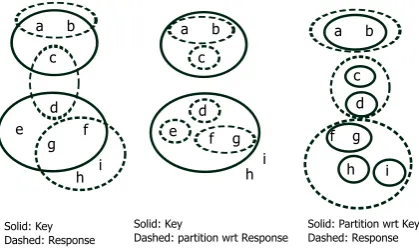
Figure 1: Example key and response entities along with the partitions for computing the MUC score.
possible mention detection algorithm as input to the coreference algorithm. Therefore, ideally one would want to score the two steps independently of each other. A peculiarity of the OntoNotes corpus is that singleton referential mentions are not annotated, thereby preventing the computation of a mention detection score independently of the coreference resolution score. In corpora where all referential mentions (including singletons) are an-notated, the mention detection score generated by this implementation is independent of the corefer-ence resolution score.
We used this reference implementation to rescore the CoNLL-2011/2012 system outputs for the official task to enable future comparisons with these benchmarks. The new CoNLL-2011/2012 results are in Table 1. We found that the over-all system ranking remained largely unchanged for both shared tasks, except for some of the lower ranking systems that changed one or two places. However, there was a considerable drop in the magnitude of all B3 scores owing to the
combi-nation of two things: (i) mention manipulation, as proposed by Cai and Strube (2010), adds single-tons to account fortwinlessmentions; and (ii) the
B3 metric allows an entity to be used more than
once as pointed out by Luo (2005). This resulted in a drop in the CoNLL averages (B3is one of the
three measures that make the average).
4 An Illustrative Example
This section walks through the process of com-puting each of the commonly used metrics for an example where the set of predicted mentions has some missing key mentions and some spu-rious mentions. While the mathematical formu-lae for these metrics can be found in the original papers (Vilain et al., 1995; Bagga and Baldwin,
1998; Luo, 2005), many misunderstandings dis-cussed in Section 2 are due to the fact that these papers lack an example showing how a metric is computed on predicted mentions. A concrete ex-ample goes a long way to prevent similar misun-derstandings in the future. The example is adapted from Vilain et al. (1995) with some slight modifi-cations so that the total number of mentions in the key is different from the number of mentions in the prediction. The key (K) contains two entities with mentions{a, b, c}and{d, e, f, g}and the re-sponse (R) contains three entities with mentions
{a, b};{c, d}and{f, g, h, i}:
K= K1
z }| {
{a, b, c} K2
z }| {
{d, e, f, g} (1)
R= R1
z}|{
{a, b} R2
z }| {
{c, d} R3
z }| {
{f, g, h, i}. (2)
Mentioneis missing from the response, and men-tionshandiare spurious in the response. The fol-lowing sections useR to denote recall andP for precision.
4.1 MUC
The main step in theMUC scoring is creating the
partitions with respect to the key and response re-spectively, as shown in Figure 1. Once we have the partitions, then we compute theMUCscore by:
R=
PNk
i=1(|Ki| − |p(Ki)|)
PNk
i=1(|Ki| −1)
=(3−2) + (4−3) (3−1) + (4−1)= 0.40
P=
PNr
i=1(|Ri| − |p0(Ri)|)
PNr
i=1(|Ri| −1)
=(2−1) + (2−2) + (4−3) (2−1) + (2−1) + (4−1)= 0.40,
where Ki is the ith key entity and p(Ki) is the set of partitions created by intersecting Ki with response entities (cf. the middle sub-figure in Fig-ure 1);Ri is theith response entity andp0(Ri)is the set of partitions created by intersectingRiwith key entities (cf. the right-most sub-figure in Fig-ure 1); andNkandNrare the number of key and response entities, respectively.
TheMUCF1score in this case is 0.40.
4.2 B3
For computingB3 recall, each key mention is
the sum of credits over all key mentions normal-ized over the number of key mentions. B3
preci-sion is computed similarly, except switching the role of key and response. Applied to the example:
R=
PNk
i=1PNrj=1
|Ki∩Rj|2 |Ki|
PNk
i=1|Ki|
=1 7×(
22
3 + 12
3 + 12
4 + 22
4) = 1 7×
35 12≈0.42
P=
PNk
i=1PNrj=1
|Ki∩Rj|2 |Rj|
PNr
i=1|Rj|
=81×(222+122+122+242) = 18×41= 0.50
Note that terms with 0 value are omitted. TheB3 F1score is 0.46.
4.3 CEAF
The first step in the CEAF computation is getting
the best scoring alignment between the key and response entities. In this case the alignment is straightforward. EntityR1aligns withK1andR3
aligns withK2. R2remains unaligned.
CEAFm
CEAFm recall is the number of aligned mentions
divided by the number of key mentions, and preci-sion is the number of aligned mentions divided by the number of response mentions:
R=|K1∩R1|+|K2∩R3| |K1|+|K2| =
(2 + 2) (3 + 4)≈0.57
P=|K1∩R1|+|K2∩R3| |R1|+|R2|+|R3| =
(2 + 2) (2 + 2 + 4)= 0.50 TheCEAFmF1score is 0.53.
CEAFe
We use the same notation as in Luo (2005):
φ4(Ki, Rj)to denote the similarity between a key entityKiand a response entityRj. φ4(Ki, Rj)is defined as:
φ4(Ki, Rj) =2|× |Ki|K+i∩|RRj|j|.
CEAFerecall and precision, when applied to this
example, are:
R= φ4(K1, R1) +N φ4(K2, R3)
k =
(2×2) (3+2)+(2(4+4)×2)
2 = 0.65
P= φ4(K1, R1) +φ4(K2, R3)
Nr =
(2×2) (3+2)+(2(4+4)×2)
3 ≈0.43 TheCEAFeF1score is 0.52.
4.4 BLANC
The BLANC metric illustrated here is the one in
our implementation which extends the original
BLANC (Recasens and Hovy, 2011) to predicted
mentions (Luo et al., 2014).
Let Ck and Cr be the set of coreference links in the key and response respectively, andNk and
Nr be the set of non-coreference links in the key and response respectively. A link between a men-tion pairm andnis denoted bymn; then for the example in Figure 1, we have
Ck={ab, ac, bc, de, df, dg, ef, eg, fg}
Nk={ad, ae, af, ag, bd, be, bf, bg, cd, ce, cf, cg}
Cr={ab, cd, fg, fh, fi, gh, gi, hi}
Nr={ac, ad, af, ag, ah, ai, bc, bd, bf, bg, bh, bi,
cf, cg, ch, ci, df, dg, dh, di}.
Recall and precision for coreference links are:
Rc=|Ck|C∩k|Cr|=29≈0.22
Pc=|Ck|C∩r|Cr|=28= 0.25
and the coreference F-measure,Fc ≈0.23. Sim-ilarly, recall and precision for non-coreference links are:
Rn= |Nk|N∩k|Nr|=128 ≈0.67
Pn= |Nk|N∩r|Nr|=208 = 0.40,
and the non-coreference F-measure,Fn = 0.50. So theBLANCscore isFc+Fn
2 ≈0.36.
5 Conclusion
We have cleared several misunderstandings about coreference evaluation metrics, especially when a response contains imperfect predicted mentions, and have argued against mention manipulations during coreference evaluation. These misunder-standings are caused partially by the lack of il-lustrative examples to show how a metric is com-puted on predicted mentions not aligned perfectly with key mentions. Therefore, we provide detailed steps for computing all four metrics on a represen-tative example. Furthermore, we have a reference implementation of these metrics that has been rig-orously tested and has been made available to the public as open source software. We reported new scores on the CoNLL 2011 and 2012 data sets, which can serve as the benchmarks for future re-search work.
Acknowledgments
References
Amit Bagga and Breck Baldwin. 1998. Algorithms for scoring coreference chains. In Proceedings of LREC, pages 563–566.
Jie Cai and Michael Strube. 2010. Evaluation metrics for end-to-end coreference resolution systems. In
Proceedings of SIGDIAL, pages 28–36.
Chen Chen and Vincent Ng. 2013. Linguistically aware coreference evaluation metrics. In
Pro-ceedings of the Sixth IJCNLP, pages 1366–1374,
Nagoya, Japan, October.
Nancy Chinchor and Beth Sundheim. 2003. Mes-sage understanding conference (MUC) 6. In
LDC2003T13.
Nancy Chinchor. 2001. Message understanding con-ference (MUC) 7. InLDC2001T02.
George Doddington, Alexis Mitchell, Mark Przybocki, Lance Ramshaw, Stephanie Strassel, and Ralph Weischedel. 2004. The automatic content extrac-tion (ACE) program-tasks, data, and evaluaextrac-tion. In
Proceedings of LREC.
Lynette Hirschman and Nancy Chinchor. 1997. Coref-erence task definition (v3.0, 13 jul 97). In
Proceed-ings of the 7th Message Understanding Conference.
Gordana Ilic Holen. 2013. Critical reflections on evaluation practices in coreference resolution. In Proceedings of the NAACL-HLT Student Research
Workshop, pages 1–7, Atlanta, Georgia, June.
Daniel Jurafsky and James H. Martin. 2008. Speech and Language Processing: An Introduction to Nat-ural Language Processing, Computational
Linguis-tics, and Speech Recognition. Prentice Hall. Second
Edition.
Xiaoqiang Luo, Sameer Pradhan, Marta Recasens, and Eduard Hovy. 2014. An extension of BLANC to system mentions. In Proceedings of ACL, Balti-more, Maryland, June.
Xiaoqiang Luo. 2005. On coreference resolution per-formance metrics. InProceedings of HLT-EMNLP, pages 25–32.
Sameer Pradhan, Eduard Hovy, Mitchell Marcus, Martha Palmer, Lance Ramshaw, and Ralph Weischedel. 2007. OntoNotes: A Unified Rela-tional Semantic Representation. International
Jour-nal of Semantic Computing, 1(4):405–419.
Sameer Pradhan, Lance Ramshaw, Mitchell Marcus, Martha Palmer, Ralph Weischedel, and Nianwen Xue. 2011. CoNLL-2011 shared task: Modeling unrestricted coreference in OntoNotes. In
Proceed-ings of CoNLL: Shared Task, pages 1–27.
Sameer Pradhan, Alessandro Moschitti, Nianwen Xue, Olga Uryupina, and Yuchen Zhang. 2012. CoNLL-2012 shared task: Modeling multilingual unre-stricted coreference in OntoNotes. InProceedings
of CoNLL: Shared Task, pages 1–40.
Altaf Rahman and Vincent Ng. 2009. Supervised mod-els for coreference resolution. In Proceedings of
EMNLP, pages 968–977.
Altaf Rahman and Vincent Ng. 2011. Coreference res-olution with world knowledge. In Proceedings of ACL, pages 814–824.
Marta Recasens and Eduard Hovy. 2011. BLANC: Implementing the Rand Index for coreference eval-uation. Natural Language Engineering, 17(4):485– 510.
Marta Recasens, Llu´ıs M`arquez, Emili Sapena, M. Ant`onia Mart´ı, Mariona Taul´e, V´eronique Hoste, Massimo Poesio, and Yannick Versley. 2010. Semeval-2010 task 1: Coreference resolution in multiple languages. In Proceedings of SemEval, pages 1–8.
Marta Recasens, Marie-Catherine de Marneffe, and Chris Potts. 2013. The life and death of discourse entities: Identifying singleton mentions. In
Pro-ceedings of NAACL-HLT, pages 627–633.
Veselin Stoyanov, Nathan Gilbert, Claire Cardie, and Ellen Riloff. 2009. Conundrums in noun phrase coreference resolution: Making sense of the state-of-the-art. In Proceedings of ACL-IJCNLP, pages 656–664.
William F. Styler, Steven Bethard an Sean Finan, Martha Palmer, Sameer Pradhan, Piet C de Groen, Brad Erickson, Timothy Miller, Chen Lin, Guergana Savova, and James Pustejovsky. 2014. Temporal annotation in the clinical domain. Transactions of
Computational Linguistics, 2(April):143–154.
Ozlem Uzuner, Andreea Bodnari, Shuying Shen, Tyler Forbush, John Pestian, and Brett R South. 2012. Evaluating the state of the art in coreference res-olution for electronic medical records. Journal of
American Medical Informatics Association, 19(5),
September.
Marc Vilain, John Burger, John Aberdeen, Dennis Con-nolly, and Lynette Hirschman. 1995. A model theo-retic coreference scoring scheme. InProceedings of
the 6th Message Understanding Conference, pages
45–52.
Ralph Weischedel, Eduard Hovy, Mitchell Marcus, Martha Palmer, Robert Belvin, Sameer Pradhan, Lance Ramshaw, and Nianwen Xue. 2011. OntoNotes: A large training corpus for enhanced processing. In Joseph Olive, Caitlin Christian-son, and John McCary, editors,Handbook of Natu-ral Language Processing and Machine Translation:
DARPA Global Autonomous Language Exploitation.