A Structured Distributional Semantic Model for Event Co-reference
Kartik Goyal∗ Sujay Kumar Jauhar∗ Huiying Li∗ Mrinmaya Sachan∗ Shashank Srivastava∗ Eduard Hovy
Language Technologies Institute School of Computer Science
Carnegie Mellon University
{kartikgo,sjauhar,huiyingl,mrinmays,shashans,hovy}@cs.cmu.edu
Abstract
In this paper we present a novel ap-proach to modelling distributional seman-tics that represents meaning as distribu-tions over reladistribu-tions in syntactic neighbor-hoods. We argue that our model approxi-mates meaning in compositional configu-rations more effectively than standard dis-tributional vectors or bag-of-words mod-els. We test our hypothesis on the problem of judging event coreferentiality, which in-volves compositional interactions in the predicate-argument structure of sentences, and demonstrate that our model outper-forms both state-of-the-art window-based word embeddings as well as simple ap-proaches to compositional semantics pre-viously employed in the literature.
1 Introduction
Distributional Semantic Models (DSM) are popu-lar in computational semantics. DSMs are based on the hypothesis that the meaning of a word or phrase can be effectively captured by the distribu-tion of words in its neighborhood. They have been successfully used in a variety of NLP tasks includ-ing information retrieval (Manninclud-ing et al., 2008), question answering (Tellex et al., 2003), word-sense discrimination (Schütze, 1998) and disam-biguation (McCarthy et al., 2004), semantic sim-ilarity computation (Wong and Raghavan, 1984; McCarthy and Carroll, 2003) and selectional pref-erence modeling (Erk, 2007).
A shortcoming of DSMs is that they ignore the syntax within the context, thereby reducing the distribution to a bag of words. Composing the
∗
*Equally contributing authors
distributions for “Lincoln”, “Booth”, and “killed” gives the same result regardless of whether the in-put is “Booth killed Lincoln” or “Lincoln killed Booth”. But as suggested by Pantel and Lin (2000) and others, modeling the distribution over prefer-ential attachments for each syntactic relation sep-arately yields greater expressive power. Thus, to remedy the bag-of-words failing, we extend the generic DSM model to several relation-specific distributions over syntactic neighborhoods. In other words, one can think of the Structured DSM (SDSM) representation of a word/phrase as sev-eral vectors defined over the same vocabulary, each vector representing the word’s selectional preferences for its various syntactic arguments.
We argue that this representation not only cap-tures individual word semantics more effectively than the standard DSM, but is also better able to express the semantics of compositional units. We prove this on the task of judging event coreference. Experimental results indicate that our model achieves greater predictive accuracy on the task than models that employ weaker forms of compo-sition, as well as a baseline that relies on state-of-the-art window based word embeddings. This suggests that our formalism holds the potential of greater expressive power in problems that involve underlying semantic compositionality.
2 Related Work
Next, we relate and contrast our work to prior re-search in the fields of Distributional Vector Space Models, Semantic Compositionality and Event Co-reference Resolution.
2.1 DSMs and Compositionality
The underlying idea that “a word is characterized by the company it keeps” was expressed by Firth
(1957). Several works have defined approaches to modelling context-word distributions anchored on a target word, topic, or sentence position. Collec-tively these approaches are called Distributional Semantic Models (DSMs).
While DSMs have been very successful on a va-riety of tasks, they are not an effective model of semantics as they lack properties such as compo-sitionality or the ability to handle operators such as negation. In order to model a stronger form of semantics, there has been a recent surge in stud-ies that phrase the problem of DSM composition-ality as one of vector composition. These tech-niques derive the meaning of the combination of two wordsaandbby a single vectorc =f(a, b).
Mitchell and Lapata (2008) propose a framework to define the compositionc=f(a, b, r, K)where
r is the relation between a and b, and K is the
additional knowledge used to define composition. While this framework is quite general, the actual models considered in the literature tend to disre-gardKandrand mostly perform component-wise
addition and multiplication, with slight variations, of the two vectors. To the best of our knowledge the formulation of composition we propose is the first to account for bothKandrwithin this
com-positional framework.
Dinu and Lapata (2010) and Séaghdha and Ko-rhonen (2011) introduced a probabilistic model to represent word meanings by a latent variable model. Subsequently, other high-dimensional ex-tensions by Rudolph and Giesbrecht (2010), Ba-roni and Zamparelli (2010) and Grefenstette et al. (2011), regression models by Guevara (2010), and recursive neural network based solutions by Socher et al. (2012) and Collobert et al. (2011) have been proposed. However, these models do not efficiently account for structure.
Pantel and Lin (2000) and Erk and Padó (2008) attempt to include syntactic context in distribu-tional models. A quasi-composidistribu-tional approach was attempted in Thater et al. (2010) by a com-bination of first and second order context vectors. But they do not explicitly construct phrase-level meaning from words which limits their applicabil-ity to real world problems. Furthermore, we also include structure into our method of composition. Prior work in structure aware methods to the best of our knowledge are (Weisman et al., 2012) and (Baroni and Lenci, 2010). However, these meth-ods do not explicitly model composition.
2.2 Event Co-reference Resolution
While automated resolution of entity coreference has been an actively researched area (Haghighi and Klein, 2009; Stoyanov et al., 2009; Raghu-nathan et al., 2010), there has been relatively lit-tle work on event coreference resolution. Lee et al. (2012) perform joint cross-document entity and event coreference resolution using the two-way feedback between events and their arguments. We, on the other hand, attempt a slightly different problem of making co-referentiality judgements on event-coreference candidate pairs.
3 Structured Distributional Semantics In this paper, we propose an approach to incorpo-rate structure into distributional semantics (more details in Goyal et al. (2013)). The word distribu-tions drawn from the context defined by a set of relations anchored on the target word (or phrase) form a set of vectors, namely a matrix for the tar-get word. One axis of the matrix runs over all the relations and the other axis is over the distri-butional word vocabulary. The cells store word counts (or PMI scores, or other measures of word association). Note that collapsing the rows of the matrix provides the standard dependency based distributional representation.
3.1 Building Representation: The PropStore
To build a lexicon of SDSM matrices for a given vocabulary we first construct a proposition knowl-edge base (the PropStore) created by parsing the Simple English Wikipedia. Dependency arcs are stored as 3-tuples of the formhw1, r, w2i,
denot-ing an occurrence of words w1, wordw2 related
by r. We also store sentence indices for triples
as this allows us to achieve an intuitive technique to achieve compositionality. In addition to the words’ surface-forms, the PropStore also stores their POS tags, lemmas, and Wordnet supersenses. This helps to generalize our representation when surface-form distributions are sparse.
The PropStore can be used to query for the ex-pectations of words, supersenses, relations, etc., around a given word. In the example in Figure 1, the query (SST(W1) = verb.consumption, ?, dobj)
i.e. “what is consumed” might return expectations [pasta:1, spaghetti:1, mice:1 . . .]. Relations and
us-Figure 1: Sample sentences & triples
ing Wordnet Fellbaum (1998).
3.2 Mimicking Compositionality
For representing intermediate multi-word phrases, we extend the above word-relation matrix symbol-ism in a bottom-up fashion using the PropStore. The combination hinges on the intuition that when lexical units combine to form a larger syntactically connected phrase, the representation of the phrase is given by its own distributional neighborhood within the embedded parse tree. The distributional neighborhood of the net phrase can be computed using the PropStore given syntactic relations an-chored on its parts. For the example in Figure 1, we can compose SST(w1) = Noun.person and
Lemma(W1) = eat appearing together with a nsubj
relation to obtain expectations around “people eat” yielding [pasta:1, spaghetti:1 . . .] for the object
relation, [room:2, restaurant:1. . .] for thelocation
relation, etc. Larger phrasal queries can be built to answer queries like “What do people in China eat with?”, “What do cows do?”, etc. All of this helps us to account for both relationrand knowledgeK
obtained from the PropStore within the composi-tional frameworkc=f(a, b, r, K).
The general outline to obtain a composition of two words is given in Algorithm 1, which returns the distributional expectation around the composed unit. Note that the entire algorithm can conveniently be written in the form of database queries to our PropStore.
Algorithm 1ComposePair(w1, r, w2)
M1 ←queryMatrix(w1) (1)
M2 ←queryMatrix(w2) (2)
SentIDs←M1(r)∩M2(r) (3)
return ((M1∩SentIDs)∪(M2∩SentIDs)) (4)
For the example “noun.person nsubj eat”, steps
(1) and (2) involve querying the PropStore for the individual tokens, noun.person and eat. Let the re-sulting matrices beM1 andM2, respectively. In
step (3), SentIDs (sentences where the two words appear with the specified relation) are obtained by taking the intersection between the nsubj compo-nent vectors of the two matrices M1 andM2. In
step (4), the entries of the original matrices M1
andM2 are intersected with this list of common
SentIDs. Finally, the resulting matrix for the com-position of the two words is simply the union of all the relationwise intersected sentence IDs. Intu-itively, through this procedure, we have computed the expectation around the wordsw1andw2when
they are connected by the relation “r”.
Similar to the two-word composition process, given a parse subtree T of a phrase, we obtain
its matrix representation of empirical counts over word-relation contexts (described in Algorithm 2). Let theE = {e1. . . en}be the set of edges inT,
ei= (wi1, ri, wi2)∀i= 1. . . n.
Algorithm 2ComposePhrase(T)
SentIDs←All Sentences in corpus
fori= 1→ndo
Mi1 ←queryMatrix(wi1)
Mi2 ←queryMatrix(wi2)
SentIDs←SentIDs∩(M1(ri)∩M2(ri)) end for
return ((M11∩ SentIDs) ∪ (M12∩ SentIDs)
· · · ∪(Mn1∩SentIDs)∪(Mn2∩SentIDs))
The phrase representations becomes sparser as phrase length increases. For this study, we restrict phrasal query length to a maximum of three words.
3.3 Event Coreferentiality
[image:3.595.103.481.62.130.2]SDSM matrices for composed concepts. However, are these correct? Intuitively, if they truly capture semantics, the two SDSM matrix representations for “Booth assassinated Lincoln” and “Booth shot Lincoln with a gun" should be (almost) the same. To test this hypothesis we turn to the task of pre-dicting whether two event mentions are coreferent or not, even if their surface forms differ. It may be noted that this task is different from the task of full event coreference and hence is not directly compa-rable to previous experimental results in the liter-ature. Two mentions generally refer to the same event when their respective actions, agents, pa-tients, locations, and times are (almost) the same. Given the non-compositional nature of determin-ing equality of locations and times, we represent each event mention by a triple E = (e, a, p) for the event, agent, and patient.
In our corpus, most event mentions are verbs. However, when nominalized events are encoun-tered, we replace them by their verbal forms. We use SRL Collobert et al. (2011) to determine the agent and patient arguments of an event mention. When SRL fails to determine either role, its empir-ical substitutes are obtained by querying the Prop-Store for the most likely word expectations for the role. It may be noted that the SDSM repre-sentation relies on syntactic dependancy relations. Hence, to bridge the gap between these relations and the composition of semantic role participants of event mentions we empirically determine those syntactic relations which most strongly co-occur with the semantic relations connecting events, agents and patients. The triple(e, a, p)is thus the composition of the triples(a, relationsetagent, e)
and (p, relationsetpatient, e), and hence a
com-plex object. To determine equality of this comcom-plex composed representation we generate three levels of progressively simplified event constituents for comparison:
Level 1: Full Composition:
Mf ull=ComposePhrase(e, a, p). Level 2: Partial Composition:
Mpart:EA =ComposePair(e, r, a)
Mpart:EP =ComposePair(e, r, p). Level 3: No Composition:
ME =queryM atrix(e)
MA=queryM atrix(a)
MP =queryM atrix(p)
To judge coreference between events E1 and E2, we compute
pair-wise similarities Sim(M1f ull, M2f ull),
Sim(M1part:EA, M2part:EA), etc., for each
level of the composed triple representation. Fur-thermore, we vary the computation of similarity by considering different levels of granularity (lemma, SST), various choices of distance metric (Euclidean, Cityblock, Cosine), and score normalization techniques (Row-wise, Full, Column-collapsed). This results in 159 similarity-based features for every pair of events, which are used to train a classifier to decide conference.
4 Experiments
We evaluate our method on two datasets and com-pare it against four baselines, two of which use window based distributional vectors and two that employ weaker forms of composition.
4.1 Datasets
IC Event Coreference Corpus: The dataset (Hovy et al., 2013), drawn from 100 news articles about violent events, contains manually created annotations for 2214 pairs of co-referent and non-coreferent events each. Where available, events’ semantic role-fillers foragentandpatientare an-notated as well. When missing, empirical substi-tutes were obtained by querying the PropStore for the preferred word attachments.
EventCorefBank (ECB) corpus: This corpus (Bejan and Harabagiu, 2010) of 482 documents from Google News is clustered into 45 topics, with event coreference chains annotated over each topic. The event mentions are enriched with se-mantic roles to obtain the canonical event struc-ture described above. Positive instances are ob-tained by taking pairwise event mentions within each chain, and negative instances are generated from pairwise event mentions across chains, but within the same topic. This results in 11039 posi-tive instances and 33459 negaposi-tive instances.
4.2 Baselines
IC Corpus ECB Corpus
Prec Rec F-1 Acc Prec Rec F-1 Acc
SDSM 0.916 0.929 0.922 0.906 0.901 0.401 0.564 0.843
[image:5.595.133.468.64.163.2]Senna 0.850 0.881 0.865 0.835 0.616 0.408 0.505 0.791 DSM 0.743 0.843 0.790 0.740 0.854 0.378 0.524 0.830 MVC 0.756 0.961 0.846 0.787 0.914 0.353 0.510 0.831 AVC 0.753 0.941 0.837 0.777 0.901 0.373 0.528 0.834
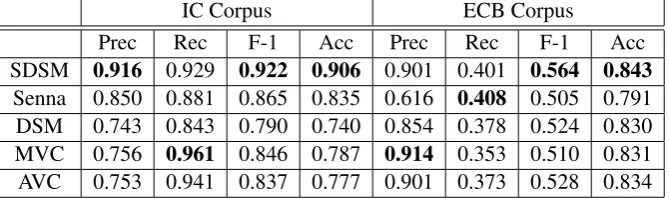
Table 1: Cross-validation Performance on IC and ECB dataset
SENNA to generate level 3 similarity features for events’ individual words (agent, patient and ac-tion). As our final set of baselines, we extend two simple techniques proposed by (Mitchell and Lap-ata, 2008) that use element-wise addition and mul-tiplication operators to perform composition. We extend it to our matrix representation and build two baselines AVC (element-wise addition) and MVC (element-wise multiplication).
4.3 Discussion
Among common classifiers, decision-trees (J48) yielded best results in our experiments. Table 1 summarizes our results on both datasets.
The results reveal that the SDSM model con-sistently outperforms DSM, SENNA embeddings, and the MVC and AVC models, both in terms of F-1 score and accuracy. The IC corpus com-prises of domain specific texts, resulting in high lexical overlap between event mentions. Hence, the scores on the IC corpus are consistently higher than those on the ECB corpus.
The improvements over DSM and SENNA em-beddings, support our hypothesis that syntax lends greater expressive power to distributional seman-tics in compositional configurations. Furthermore, the increase in predictive accuracy over MVC and AVC shows that our formulation of composition of two words based on the relation binding them yields a stronger form of compositionality than simple additive and multiplicative models.
Next, we perform an ablation study to deter-mine the most predictive features for the task of event coreferentiality. The forward selection pro-cedure reveals that the most informative attributes are the level 2 compositional features involving the agent and the action, as well as their individ-ual level 3 features. This corresponds to the in-tuition that the agent and the action are the prin-cipal determiners for identifying events. Features involving the patient and level 1 features are least
useful. This is probably because features involv-ing full composition are sparse, and not as likely to provide statistically significant evidence. This may change as our PropStore grows in size.
5 Conclusion and Future Work
We outlined an approach that introduces structure into distributed semantic representations gives us an ability to compare the identity of two repre-sentations derived from supposedly semantically identical phrases with different surface realiza-tions. We employed the task of event coreference to validate our representation and achieved sig-nificantly higher predictive accuracy than several baselines.
In the future, we would like to extend our model to other semantic tasks such as paraphrase detec-tion, lexical substitution and recognizing textual entailment. We would also like to replace our syn-tactic relations to semantic relations and explore various ways of dimensionality reduction to solve this problem.
Acknowledgments
The authors would like to thank the anonymous re-viewers for their valuable comments and sugges-tions to improve the quality of the paper. This work was supported in part by the following grants: NSF grant 1143703, NSF award IIS-1147810, DARPA grant FA87501220342.
References
Marco Baroni and Alessandro Lenci. 2010. Distri-butional memory: A general framework for corpus-based semantics.Comput. Linguist., 36(4):673–721, December.
Marco Baroni and Roberto Zamparelli. 2010. Nouns are vectors, adjectives are matrices: representing adjective-noun constructions in semantic space. In
Methods in Natural Language Processing, EMNLP ’10, pages 1183–1193, Stroudsburg, PA, USA. As-sociation for Computational Linguistics.
Cosmin Adrian Bejan and Sanda Harabagiu. 2010. Unsupervised event coreference resolution with rich linguistic features. InProceedings of the 48th An-nual Meeting of the Association for Computational Linguistics, ACL ’10, pages 1412–1422, Strouds-burg, PA, USA. Association for Computational Lin-guistics.
Massimiliano Ciaramita and Yasemin Altun. 2006. Broad-coverage sense disambiguation and informa-tion extracinforma-tion with a supersense sequence tagger. InProceedings of the 2006 Conference on Empirical Methods in Natural Language Processing, EMNLP ’06, pages 594–602, Stroudsburg, PA, USA. Associ-ation for ComputAssoci-ational Linguistics.
Ronan Collobert, Jason Weston, Léon Bottou, Michael Karlen, Koray Kavukcuoglu, and Pavel Kuksa. 2011. Natural language processing (almost) from scratch. J. Mach. Learn. Res., 999888:2493–2537, November.
Georgiana Dinu and Mirella Lapata. 2010. Measuring distributional similarity in context. InProceedings of the 2010 Conference on Empirical Methods in Natural Language Processing, EMNLP ’10, pages 1162–1172, Stroudsburg, PA, USA. Association for Computational Linguistics.
Katrin Erk and Sebastian Padó. 2008. A structured vector space model for word meaning in context. In
Proceedings of the Conference on Empirical Meth-ods in Natural Language Processing, EMNLP ’08, pages 897–906, Stroudsburg, PA, USA. Association for Computational Linguistics.
Katrin Erk. 2007. A simple, similarity-based model for selectional preferences.
Christiane Fellbaum. 1998. WordNet: An Electronic Lexical Database. Bradford Books.
John R. Firth. 1957. A Synopsis of Linguistic Theory, 1930-1955. Studies in Linguistic Analysis, pages 1– 32.
Kartik. Goyal, Sujay Kumar Jauhar, Mrinmaya Sachan, Shashank Srivastava, Huiying Li, and Eduard Hovy. 2013. A structured distributional semantic model : Integrating structure with semantics. In Proceed-ings of the 1st Continuous Vector Space Models and their Compositionality Workshop at the conference of ACL 2013.
Edward Grefenstette, Mehrnoosh Sadrzadeh, Stephen Clark, Bob Coecke, and Stephen Pulman. 2011. Concrete sentence spaces for compositional distri-butional models of meaning. InProceedings of the Ninth International Conference on Computational Semantics, IWCS ’11, pages 125–134, Stroudsburg, PA, USA. Association for Computational Linguis-tics.
Emiliano Guevara. 2010. A regression model of adjective-noun compositionality in distributional se-mantics. In Proceedings of the 2010 Workshop on GEometrical Models of Natural Language Seman-tics, GEMS ’10, pages 33–37, Stroudsburg, PA, USA. Association for Computational Linguistics.
Aria Haghighi and Dan Klein. 2009. Simple coref-erence resolution with rich syntactic and semantic features. InProceedings of the 2009 Conference on Empirical Methods in Natural Language Process-ing: Volume 3 - Volume 3, EMNLP ’09, pages 1152– 1161, Stroudsburg, PA, USA. Association for Com-putational Linguistics.
E.H. Hovy, T. Mitamura, M.F. Verdejo, J. Araki, and A. Philpot. 2013. Events are not simple: Iden-tity, non-idenIden-tity, and quasi-identity. InProceedings of the 1st Events Workshop at the conference of the HLT-NAACL 2013.
Heeyoung Lee, Marta Recasens, Angel Chang, Mihai Surdeanu, and Dan Jurafsky. 2012. Joint entity and event coreference resolution across documents. In Proceedings of the 2012 Joint Conference on Empirical Methods in Natural Language Process-ing and Computational Natural Language LearnProcess-ing, EMNLP-CoNLL ’12, pages 489–500, Stroudsburg, PA, USA. Association for Computational Linguis-tics.
Christopher D. Manning, Prabhakar Raghavan, and Hinrich Schütze. 2008. Introduction to Information Retrieval. Cambridge University Press, New York, NY, USA.
Diana McCarthy and John Carroll. 2003. Disam-biguating nouns, verbs, and adjectives using auto-matically acquired selectional preferences.Comput. Linguist., 29(4):639–654, December.
Diana McCarthy, Rob Koeling, Julie Weeds, and John Carroll. 2004. Finding predominant word senses in untagged text. In Proceedings of the 42nd Annual Meeting on Association for Computational Linguis-tics, ACL ’04, Stroudsburg, PA, USA. Association for Computational Linguistics.
Jeff Mitchell and Mirella Lapata. 2008. Vector-based models of semantic composition. InProceedings of ACL-08: HLT, pages 236–244.
Patrick Pantel and Dekang Lin. 2000. Word-for-word glossing with contextually similar words. In Pro-ceedings of the 1st North American chapter of the Association for Computational Linguistics confer-ence, NAACL 2000, pages 78–85, Stroudsburg, PA, USA. Association for Computational Linguistics.
pages 492–501, Stroudsburg, PA, USA. Association for Computational Linguistics.
Sebastian Rudolph and Eugenie Giesbrecht. 2010. Compositional matrix-space models of language. In
Proceedings of the 48th Annual Meeting of the As-sociation for Computational Linguistics, ACL ’10, pages 907–916, Stroudsburg, PA, USA. Association for Computational Linguistics.
Hinrich Schütze. 1998. Automatic word sense dis-crimination.Comput. Linguist., 24(1):97–123.
Diarmuid Ó Séaghdha and Anna Korhonen. 2011. Probabilistic models of similarity in syntactic con-text. InProceedings of the Conference on Empirical Methods in Natural Language Processing, EMNLP ’11, pages 1047–1057, Stroudsburg, PA, USA. As-sociation for Computational Linguistics.
Richard Socher, Brody Huval, Christopher D. Man-ning, and Andrew Y. Ng. 2012. Semantic com-positionality through recursive matrix-vector spaces. In Proceedings of the 2012 Joint Conference on Empirical Methods in Natural Language Process-ing and Computational Natural Language LearnProcess-ing, EMNLP-CoNLL ’12, pages 1201–1211, Strouds-burg, PA, USA. Association for Computational Lin-guistics.
Veselin Stoyanov, Nathan Gilbert, Claire Cardie, and Ellen Riloff. 2009. Conundrums in noun phrase coreference resolution: making sense of the state-of-the-art. InProceedings of the Joint Conference of the 47th Annual Meeting of the ACL and the 4th In-ternational Joint Conference on Natural Language Processing of the AFNLP: Volume 2 - Volume 2, ACL ’09, pages 656–664, Stroudsburg, PA, USA. Association for Computational Linguistics.
Stefanie Tellex, Boris Katz, Jimmy J. Lin, Aaron Fer-nandes, and Gregory Marton. 2003. Quantitative evaluation of passage retrieval algorithms for ques-tion answering. InSIGIR, pages 41–47.
Stefan Thater, Hagen Fürstenau, and Manfred Pinkal. 2010. Contextualizing semantic representations us-ing syntactically enriched vector models. In Pro-ceedings of the 48th Annual Meeting of the Associa-tion for ComputaAssocia-tional Linguistics, ACL ’10, pages 948–957, Stroudsburg, PA, USA. Association for Computational Linguistics.
Stephen Tratz and Eduard Hovy. 2011. A fast, ac-curate, non-projective, semantically-enriched parser. In Proceedings of the Conference on Empirical Methods in Natural Language Processing, EMNLP ’11, pages 1257–1268, Stroudsburg, PA, USA. As-sociation for Computational Linguistics.
Hila Weisman, Jonathan Berant, Idan Szpektor, and Ido Dagan. 2012. Learning verb inference rules from linguistically-motivated evidence. In Proceedings of the 2012 Joint Conference on Empirical Methods in Natural Language Processing and Computational
Natural Language Learning, EMNLP-CoNLL ’12, pages 194–204, Stroudsburg, PA, USA. Association for Computational Linguistics.