Named Entity Recognition using Cross-lingual Resources: Arabic as an
Example
Kareem Darwish
Qatar Computing Research Institute Doha, Qatar
Abstract
Some languages lack large knowledge bases and good discriminative features for Name Entity Recognition (NER) that can general-ize to previously unseen named entities. One such language is Arabic, which: a) lacks a capitalization feature; and b) has relatively small knowledge bases, such as Wikipedia. In this work we address both problems by in-corporating cross-lingual features and knowl-edge bases from English using cross-lingual links. We show that such features have a dramatic positive effect on recall. We show the effectiveness of cross-lingual features and resources on a standard dataset as well as on two new test sets that cover both news and microblogs. On the standard dataset, we achieved a 4.1% relative improvement in F-measure over the best reported result in the literature. The features led to improvements of 17.1% and 20.5% on the new news and mi-croblogs test sets respectively.
1 Introduction
Named Entity Recognition (NER) is essential for a variety of Natural Language Processing (NLP) ap-plications such as information extraction. There has been a fair amount of work on NER for a variety of languages including Arabic. To train an NER sys-tem, some of the following feature types are typi-cally used (Benajiba and Rosso, 2008; Nadeau and Sekine, 2009):
- Orthographic features: These features include capitalization, punctuation, existence of digits, etc. One of the most effective orthographic features is capitalization in English, which helps NER to gener-alize to new text of different genres. However, capi-talization is not very useful in some languages such as German, and nonexistent in other languages such
as Arabic. Further, even in English social media, capitalization may be inconsistent.
- Contextual features: Certain words are indica-tive of the existence of named entities. For example, the word “said” is often preceded by a named en-tity of type “person” or “organization”. Sequence labeling algorithms (ex. Conditional Random Fields (CRF)) can often identify such indicative words.
- Character-level features: These features typ-ically include the leading and trailing letters of words. In some languages, these letters could pre-fixes and sufpre-fixes. Such features can be indicative or counter-indicative of the existence of named entities. For example, a word ending with “ing” is typically not a named entity, while a word ending in “berg” is often a named entity.
- Part-of-speech (POS) tags and morphological features: POS tags indicate (or counter-indicate) the possible presence of a named entity at word level or at word sequence level. Morphological features can mostly indicate the absence of named entities. For example, Arabic allows the attachment of pronouns to nouns and verbs. However, pronouns are rarely ever attached to named entities.
- Gazetteers: This feature checks the presence of a word or a sequence of words in large lists of named entities. If gazetteers are small, then they would have low coverage, and if they are very large then their entries may be ambiguous. For example, “syn-tax” may refer to sentence construction or the music band “Syntax”.
of the Arabic gazetteers that were used for NER were small (Benajiba and Rosso, 2008), there has been efforts to build larger Arabic gazetteers (Attia et al., 2010). Since training and test parts of stan-dard datasets for Arabic NER are drawn from the same genre in relatively close temporal proximity, a named entity recognizer that simply memorizes named entities in the training set generally performs well on such test sets. Thus, the results that are re-ported in the literature are generally high (Abdul-Hamid and Darwish, 2010; Benajiba et al., 2008). We illustrate the limited capacity of existing recog-nizers to generalize to previously unseen named en-tities using two new test sets that include microblogs as well as news texts that cover local and interna-tional politics, economics, health, sports, entertain-ment, and science. As we will show later, recall is well below 50% for all named entity types on the new test sets.
To address this problem, we introduce the use of cross-lingual links between a disadvantaged lan-guage, Arabic, and a language with good discrim-inative features and large resources, English, to improve Arabic NER. We exploit English’s ortho-graphic features, particularly capitalization, as well as Arabic and English Wikipedias, including exist-ing annotations from large knowledge sources such as DBpedia. We also show how to use transliter-ation mining to improve NER, even when neither language has a capitalization (or similar) feature. The intuition is that if the translation of a word is in fact a transliteration, then the word is likely a named entity. Cross-lingual links are obtained using Wikipedia cross-language links and a large Machine Translation (MT) phrase table that is true cased, where word casing is preserved during training. We show the effectiveness of these new features on a standard dataset as well as two new test sets. The contributions of this paper are as follows:
- Using cross-lingual links to exploit orthographic features in other languages.
- Employing transliteration mining to improve NER. - Using cross-lingual links to exploit a large knowl-edge base, namely English DBpedia, to benefit NER.
- Introducing two new NER test sets for Arabic that include recent news as well as microblogs. We plan to release these test sets.
- Improving over the best reported results in the liter-ature by 4.1% (Abdul-Hamid and Darwish, 2010) by strictly adding cross-lingual features. We also show improvements of 17.1% and 20.5% on the new test sets.
The remainder of the paper is organized as fol-lows: Section 2 provides related work; Section 3 de-scribes the baseline system; Section 4 introduces the cross-lingual features and reports on their effective-ness; and Section 5 concludes the paper.
2 Related Work
2.1 Using cross-lingual Features
linguis-tic tools and cross language links in Wikipedia to automatically annotate text in different languages. Transliteration Mining (TM) has been used to en-rich MT phrase tables or to improve cross language search (Udupa et al., 2009). Conversely, people have used NER to determine if a word is to be transliter-ated or not (Hermjakob et al., 2008). However, we are not aware of any prior work on using TM to de-termine if a sequence is a NE. Further, we are not aware of prior work on using TM (or transliteration in general) as a cross lingual feature in any annota-tion task. In our work, we use state-of-the-art TM as described by El-Kahki et al. (2011)
2.2 Arabic NER
Much work has been done on NER with mul-tiple public evaluation forums. Nadeau and Sekine (Nadeau and Sekine, 2009) surveyed lots of work on NER for a variety of languages. Signifi-cant work has been conducted by Benajiba and col-leagues on Arabic NER (Benajiba and Rosso, 2008; Benajiba et al., 2008; Benajiba and Rosso, 2007; Benajiba et al., 2007). Benajiba et al. (2007) used a maximum entropy classifier trained on a feature set that includes the use of gazetteers and a stop-word list, appearance of a NE in the training set, leading and trailing word bigrams, and the tag of the previous word. They reported 80%, 37%, and 47% F-measure for locations, organizations, and persons respectively on the ANERCORP dataset that they created and publicly released. Benajiba and Rosso (2007) improved their system by incorporating POS tags to improve NE boundary detection. They re-ported 87%, 46%, and 52% F-measure for loca-tions, organizaloca-tions, and persons respectively. Be-najiba and Rosso (2008) used CRF sequence label-ing and incorporated many language specific fea-tures, namely POS tagging, base-phrase chunking, Arabic tokenization, and adjectives indicating na-tionality. They reported that tokenization generally improved recall. Using POS tagging generally im-proved recall at the expense of precision, leading to overall improvements in F-measure. Using all their suggested features, they reported 90%, 66%, and 73% F-measure for location, organization, and persons respectively. In Benajiba et al. (2008), they examined the same feature set on the Auto-matic Content Extraction (ACE) datasets using CRF
sequence labeling and a Support Vector Machine (SVM) classifier. They did not report per category F-measure, but they reported overall 81%, 75%, and 78% macro-average F-measure for broadcast news and newswire on the ACE 2003, 2004, and 2005 datasets respectively. Huang (2005) used an HMM-based NE recognizer for Arabic and reported 77% F-measure on the ACE 2003 dataset. Farber et al. (2008) used POS tags obtained from an Ara-bic tagger to enhance NER. They reported 70% F-measure on the ACE 2005 dataset. Shaalan and Raza (2007) reported on a rule-based system that uses hand crafted grammars and regular expressions in conjunction with gazetteers. They reported up-wards of 93% F-measure, but they conducted their experiments on non-standard datasets, making com-parison difficult. Abdul-Hamid and Darwish (2010) used a simplified feature set that relied primarily on character level features, namely leading and trailing letters in a word. They also experimented with a variety of phrase level features with little success. They reported an F-measure of 76% and 81% for the ACE2005 and the ANERCorp datasets datasets respectively. We used their simplified features in our baseline system. The different experiments reported in the literature may not have been done on the same training/test splits. Thus, the results may not be completely comparable. Mohit et al. (2012) per-formed NER on a different genre from news, namely Arabic Wikipedia articles, and reported recall values as low as 35.6%. They used self training and recall oriented classification to improve recall, typically at the expense of precision. McNamee and Mayfield (2002) and Mayfield et al. (2003) used thousands of language independent features such as character n-grams, capitalization, word length, and position in a sentence, along with language dependent features such as POS tags and BP chunking. The use of CRF sequence labeling for NER has shown success (Mc-Callum and Li, 2003; Nadeau and Sekine, 2009; Be-najiba and Rosso, 2008).
3 Baseline Arabic NER System
For the baseline system, we used the CRF++1
im-plementation of CRF sequence labeling with default parameters. We opted to reimplement the most
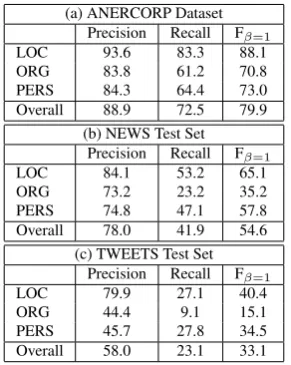
cessful features that were reported by Benajiba et al. (2008) and Abdul-Hamid and Darwish (2010), namely the leading and trailing 1, 2, 3, and 4 letters in a word; whether a word appears in the gazetteer that was created by Benajiba et al. (2008), which is publicly available, but is rather small (less than 5,000 entries); and the stemmed form of words (after removing coordinating conjunctions, prepositions, and determiners using a rule-based stemmer akin to (Larkey et al., 2002)). As mentioned earlier, the leading and trailing letters in a word may indicate or counter-indicate the presence of named entities. Stemming is important due to the morphological complexity of Arabic. We used the previous and the next words in their raw and stemmed forms as features. For training and testing, we used the AN-ERCORP dataset (Benajiba and Rosso, 2007). The dataset has approximately 150k tokens and we used the 80/20 training/test splits of Abdul-Hamid and Darwish (2010), who graciously provided us with their splits of the collection and they achieved the best reported results on the dataset. We will re-fer to their results, which are provided in Table 1, as “baseline-lit”. Table 2 (a) shows our results on the ANERCORP dataset. Our results were slightly lower than their results (Abdul-Hamid and Darwish, 2010). It is noteworthy that 69% of the named enti-ties in the test part were seen during training.
We also created two new test sets. The first test set is composed of news snippets from the RSS feed of the Arabic (Egypt) version of news.google.com from Oct. 6, 2012. The RSS feed contains the headline and the first 50-100 words in the news ar-ticles. The set has news from over a dozen differ-ent news sources and covers international and local news, politics, financial news, health, sports, enter-tainment, and technology. This set contains roughly 15k tokens. The second set contains a set of 1,423 tweets that were randomly selected from tweets au-thored between November 23, 2011 and Novem-ber 27, 2011. We scraped tweets from Twitter us-ing the query “lang:ar” (language=Arabic). This set contains approximately 26k tokens. The test sets will be henceforth be referred to as the NEWS and TWEETS sets respectively. They were annotated by one person, a native Arabic speaker, using the Lin-guistics Data Consortium tagging guidelines. Ta-ble 2 (b) and (c) report on the results for the baseline
system on both test sets. The results on the NEWS test are substantially lower than those for ANER-CORP. It is worth noting that only 27% of the named entities in the NEWS test set were observed in the training set (compared to 69% for ANERCORP). As Table 3 shows for the ANERCORP dataset, using only the tokens as features, where the labeler mainly memorizes previously seen named entities, yields higher results than the baseline results for the NEWS dataset (Table 2 (b)). The results on the TWEETS test are very poor, with 24% of the named entities in the test set appearing in the training set.
ANERCORP Dataset Precision Recall Fβ=1
LOC 93 83 88
ORG 84 64 73
PERS 90 75 82
[image:4.595.346.489.274.335.2]Overall 89 74 81
Table 1: “Baseline-lit” Results from (Abdul-Hamid and Darwish, 2010)
(a) ANERCORP Dataset Precision Recall Fβ=1
LOC 93.6 83.3 88.1 ORG 83.8 61.2 70.8 PERS 84.3 64.4 73.0 Overall 88.9 72.5 79.9
(b) NEWS Test Set Precision Recall Fβ=1
LOC 84.1 53.2 65.1 ORG 73.2 23.2 35.2 PERS 74.8 47.1 57.8 Overall 78.0 41.9 54.6
(c) TWEETS Test Set Precision Recall Fβ=1
[image:4.595.345.491.402.585.2]LOC 79.9 27.1 40.4 ORG 44.4 9.1 15.1 PERS 45.7 27.8 34.5 Overall 58.0 23.1 33.1
Table 2: Baseline Results for the three test sets
ANERCORP Dataset Precision Recall Fβ=1
[image:4.595.345.489.636.696.2]LOC 95.3 62.7 75.6 ORG 86.3 44.7 58.9 PERS 85.4 36.4 51.0 Overall 91.0 50.0 64.5
4 Cross-lingual Features
We experimented with three different cross-lingual features that used Arabic and English Wikipedia cross-language links and a true-cased phrase ta-ble that was generated using Moses (Koehn et al., 2007). True-casing preserves case information dur-ing traindur-ing. We used the Arabic Wikipedia snap-shot from September 28, 2012. The snapsnap-shot has 348,873 titles including redirects, which are alter-native names to articles. Of these articles, 254,145 have cross-lingual links to English Wikipedia. We used DBpedia 3.8 which includes 6,157,591 entries of Wikipedia titles and their “types”, such as “per-son”, “plant”, or “device”, where a title can have multiple types. The phrase table was trained on a set of 3.69 million parallel sentences containing 123.4 million English tokens. The sentences were drawn from the UN parallel data along with a variety of parallel news data from LDC and the GALE project. The Arabic side was stemmed (by removing just pre-fixes) using the Stanford word segmenter (Green and DeNero, 2012).
4.1 Cross-lingual Capitalization
As we mentioned earlier, Arabic lacks capitalization and Arabic names are often common Arabic words. For example, the Arabic name “Hasan” means good. To capture cross-lingual capitalization, we used the aforementioned true-cased phrase table at word and phrase levels as follows:
Input: True-cased phrase tableP T, sentenceScontainingnwords
w0..n, max sequence lengthl, translationsT1..k..mofwi..j
fori= 0→ndo
j=min(i+l−1, n)
ifP Tcontainswi..j&∃TkisCapsthen
weight(wi..j) =
P Tk isCaps
P(Tk) P
Tk isCaps
P(Tk)+ P Tk notCaps
P(Tk) roundweight(wi..j)to first significant figure
settag ofwi=B-CAP S-weight
settag for wordswi+1..j=I-CAP S-weight
else
ifj > ithen j -else
tag ofwi=null
end if end if end for
Where: P T was the aforementioned phrase ta-ble; l = 4; P(Tk) equaled to the product of p(source|target)andp(target|source)for a word
sequence; isCaps and notCaps were whether the
[image:5.595.312.525.505.686.2]translation was capitalized or not respectively; and the weights were binned because CRF++ only takes nominal features. In essence we tried every subse-quence ofSof lengthlor less to see if the translation was capitalized. A subsequence can be 1 word long. We tried longer sequences first. To determine if the corresponding phrase was capitalized (isCaps), all non-function words on the English side needed to be capitalized. As an example, the phrase
øXAêË@ ¡JjÖÏ@
(meaning ”Pacific Ocean”) was translated to a cap-italized phrase 36.7% of the time. Thus, the word¡JjÖÏ@
was assigned B-CAPS-0.4 andøXAêË@
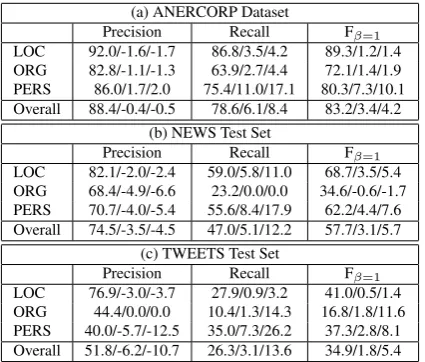
was assigned I-CAPS-0.4. Using weights avoids using capitalization as a binary feature.Table 4 reports on the results of the baseline system with the capitalization feature on the three datasets. In comparing baseline results in Table 2 and cross-lingual capitalization results in Table 4, recall consistently increased for all datasets, par-ticularly for “persons” and “locations”. For the different test sets, recall increased by 3.1 to 6.1 points (absolute) or by 8.4% to 13.6% (relative). This led to an overall improvement in F-measure of 1.8 to 3.4 points (absolute) or 4.2% to 5.7% (rela-tive). Precision dropped overall on the ANERCORP dataset and dropped substantially for the NEWS and TWEETS test sets.
(a) ANERCORP Dataset
Precision Recall Fβ=1
LOC 92.0/-1.6/-1.7 86.8/3.5/4.2 89.3/1.2/1.4 ORG 82.8/-1.1/-1.3 63.9/2.7/4.4 72.1/1.4/1.9 PERS 86.0/1.7/2.0 75.4/11.0/17.1 80.3/7.3/10.1 Overall 88.4/-0.4/-0.5 78.6/6.1/8.4 83.2/3.4/4.2
(b) NEWS Test Set
Precision Recall Fβ=1
LOC 82.1/-2.0/-2.4 59.0/5.8/11.0 68.7/3.5/5.4 ORG 68.4/-4.9/-6.6 23.2/0.0/0.0 34.6/-0.6/-1.7 PERS 70.7/-4.0/-5.4 55.6/8.4/17.9 62.2/4.4/7.6 Overall 74.5/-3.5/-4.5 47.0/5.1/12.2 57.7/3.1/5.7
(c) TWEETS Test Set
Precision Recall Fβ=1
LOC 76.9/-3.0/-3.7 27.9/0.9/3.2 41.0/0.5/1.4 ORG 44.4/0.0/0.0 10.4/1.3/14.3 16.8/1.8/11.6 PERS 40.0/-5.7/-12.5 35.0/7.3/26.2 37.3/2.8/8.1 Overall 51.8/-6.2/-10.7 26.3/3.1/13.6 34.9/1.8/5.4
4.2 Transliteration Mining
An alternative to capitalization can be translitera-tion mining. The intuitranslitera-tion is that named entities are often transliterated, particularly the names of loca-tions and persons. This feature is helpful if cross-lingual resources do not have capitalization infor-mation, or if the “helper” language to be consulted does not have a useful capitalization feature. We per-formed transliteration mining (aka cognate match-ing) at word level for each Arabic word against all its possible translations in the phrase table. We used a transliteration miner akin to that of El-Kahki et al. (2011) that was trained using 3,452 parallel Arabic-English transliteration pairs. We aligned the word-pairs at character level using GIZA++ and the phrase extractor and scorer from the Moses machine translation package (Koehn et al., 2007). The align-ment produced mappings between English letters se-quences and Arabic letter sese-quences with associated mapping probabilities. Given an Arabic word, we produced all its possible segmentations along with their associated mappings into English letters. We retained valid target sequences that produced trans-lations in the phrase table.
Again we used a weight similar to the one for cross-lingual capitalization and we rounded the val-ues of the ratio the significant figure. The weights were computed as:
P
TkisT ransliteration
P(Tk)
P
TkisT ransliteration
P(Tk) + P
TknotT ransliteration
P(Tk)
(1)
whereP(Tk)is probability of thekthtranslation of a word in the phrase table.
If a word was not found in the phrase table, the feature value was assigned null. For example, if the translations of the word
ák
are “Hasan”, “Has-san”, and “good”, where the first two are transliter-ations and the last not, then the weight of the word would be:P(Hasan| ák) +P(Hassan| ák)
P(Hasan| ák) +P(Hassan| ák) +P(good| ák) (2)
In our experiments, the weight of
ák
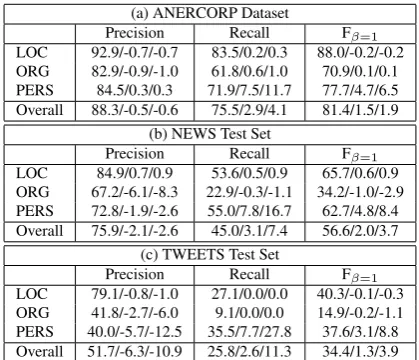
was equal to 0.5 (after rounding). Table 5 reports on the re-sults using the baseline system with the transliter-ation mining feature. Like the capitaliztransliter-ationfea-ture, transliteration mining slightly lowered preci-sion – except for the TWEETS test set where the drop in precision was significant – and positively increased recall, leading to an overall improvement in F-measure for all test sets. Overall, F-measure improved by 1.9%, 3.7%, and 3.9% (relative) com-pared to the baseline for the ANERCORP, NEWS, and TWEETS test sets respectively. The similarity of results between using transliteration mining and word-level cross-lingual capitalization suggests that perhaps they can serve as surrogates.
4.3 Using DBpedia
DBpedia2is a large collaboratively-built knowledge
base in which structured information is extracted from Wikipedia (Bizer et al., 2009). DBpedia 3.8, the release we used in this paper, contains 6,157,591 Wikipedia titles belonging to 296 types. Types vary in granularity with each Wikipedia title having one or more type. For example, NASA is assigned the following types: Agent, Organization, and Govern-mentAgency. In all, DBpedia includes the names of 764k persons, 573k locations, and 192k organiza-tions. Of the Arabic Wikipedia titles, 254,145 have Wikipedia cross-lingual links to English Wikipedia, and of those English Wikipedia titles, 185,531 have entries in DBpedia. Since Wikipedia titles may have multiple DBpedia types, we opted to keep the most popular type (by count of how many Wikipedia ti-tles are assigned a particular type) for each title, and we disregarded the rest. We also chose not to use the “Agent” and “Work” types because they were highly ambiguous. We found word sequences in the manner described in the pseudocode for cross-lingual capitalization. For translation, we gener-ated two features using two translation resources, namely the aforementioned phrase table and Arabic-English Wikipedia cross-lingual links. When using the phrase table, we used the most likely transla-tion into English that matches an entry in DBpedia provided that the product of p(source|target) and
p(target|source) of translation was above 10−5.
We chose the threshold qualitatively using offline experiments. When using Arabic-English Wikipedia cross-lingual links, if an entry was found in the Arabic Wikipedia, we performed a look up in
pedia using the English Wikipedia title that corre-sponds to the Arabic Wikipedia title. We used Ara-bic Wikipedia page-redirects to improve coverage. For both features (using the two translation meth-ods), for an Arabic word sequence corresponding to the DBpedia entry, the first word in the sequence was assigned the feature “B-” plus the DBpedia type and subsequent words were assigned the fea-ture “I-” plus the DBpedia type. For example, for
é
ÊË@ H. Qk
(meaning “Hezbollah”), the wordsH. Qk
andé
ÊË@
were assigned “B-Organization” and “I-Organization” respectively. For all other words, the feature was assigned “null”. Using the phrase ta-ble for translation likely yielded improved coverage over using Wikipedia cross-lingual links. However, Wikipedia cross-lingual links likely led to higher quality translations, because they were manually cu-rated. Table 6 reports on the results of using the baseline system with the two DBpedia features. Us-ing DBpedia consistently improved precision and re-call for named entity types on all test sets, except for a small drop in precision for locations on the ANERCORP dataset and for locations and persons on the TWEETS test set. For the different test sets, improvements in recall ranged between 4.4 and 7.5 points (absolute) or 6.5% and 19.1% (relative). Pre-cision improved by 0.9 and 5.5 points (absolute) or 1.0% and 7.1% (relative) for the ANERCORP and NEWS test sets respectively. Overall improvement in F-measure ranged between 3.2 and 7.6 points (ab-solute) or 4.1% and 13.9% (relative).4.4 Putting it All Together
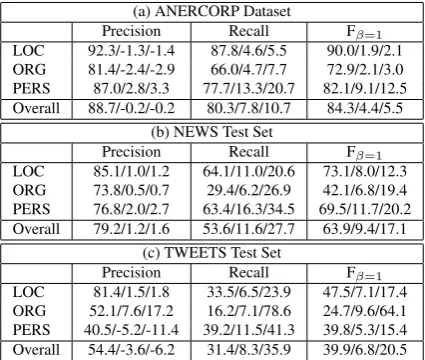
Table 7 reports on the results of using all aforemen-tioned cross-lingual features together. Figures 1, 2, and 3 compare the results of the different setups. As the results show, the impact of cross-lingual features on recall were much more pronounced on the NEWS and TWEETS test sets – compared to the ANER-CORP dataset. Further, the recall values for the AN-ERCORP dataset in the baseline experiments were much higher than those for the two other test sets. This confirms our suspicion that the reported values in the literature on the standard datasets are unrealis-tically high due to the similarity between the training and test sets. Hence, these high effectiveness results may not generalize to other test sets. Of all the
cross-(a) ANERCORP Dataset
Precision Recall Fβ=1
LOC 92.9/-0.7/-0.7 83.5/0.2/0.3 88.0/-0.2/-0.2 ORG 82.9/-0.9/-1.0 61.8/0.6/1.0 70.9/0.1/0.1 PERS 84.5/0.3/0.3 71.9/7.5/11.7 77.7/4.7/6.5 Overall 88.3/-0.5/-0.6 75.5/2.9/4.1 81.4/1.5/1.9
(b) NEWS Test Set
Precision Recall Fβ=1
LOC 84.9/0.7/0.9 53.6/0.5/0.9 65.7/0.6/0.9 ORG 67.2/-6.1/-8.3 22.9/-0.3/-1.1 34.2/-1.0/-2.9 PERS 72.8/-1.9/-2.6 55.0/7.8/16.7 62.7/4.8/8.4 Overall 75.9/-2.1/-2.6 45.0/3.1/7.4 56.6/2.0/3.7
(c) TWEETS Test Set
Precision Recall Fβ=1
[image:7.595.312.522.95.275.2]LOC 79.1/-0.8/-1.0 27.1/0.0/0.0 40.3/-0.1/-0.3 ORG 41.8/-2.7/-6.0 9.1/0.0/0.0 14.9/-0.2/-1.1 PERS 40.0/-5.7/-12.5 35.5/7.7/27.8 37.6/3.1/8.8 Overall 51.7/-6.3/-10.9 25.8/2.6/11.3 34.4/1.3/3.9
Table 5: Results with transliteration mining with /abso-lute/relative differences compared to baseline
(a) ANERCORP Dataset
Precision Recall Fβ=1
LOC 92.7/-0.9/-0.9 87.1/3.9/4.6 89.9/1.7/1.9 ORG 84.6/0.8/0.9 66.6/5.3/8.7 74.5/3.7/5.3 PERS 87.8/3.6/4.2 69.9/5.5/8.6 77.8/4.8/6.6 Overall 89.8/0.9/1.0 77.2/4.7/6.5 83.0/3.2/4.0
(b) NEWS Test Set
Precision Recall Fβ=1
LOC 87.8/3.6/4.3 61.8/8.6/16.2 72.5/7.4/11.3 ORG 76.1/2.9/3.9 30.2/7.0/30.1 43.2/8.0/22.7 PERS 83.2/8.5/11.3 54.2/7.1/15.0 65.7/7.8/13.6 Overall 83.5/5.5/7.1 49.5/7.5/18.0 62.2/7.6/13.9
(c) TWEETS Test Set
Precision Recall Fβ=1
[image:7.595.314.522.329.509.2]LOC 77.4/-2.5/-3.1 30.5/3.5/12.9 43.8/3.4/8.4 ORG 57.0/12.5/28.2 15.9/6.8/75.1 24.8/9.8/64.9 PERS 40.8/-4.9/-10.6 31.7/4.0/14.3 35.7/1.2/3.4 Overall 55.3/-2.6/-4.5 27.5/4.4/19.1 36.8/3.7/11.2
Table 6: Results using DBpedia with /absolute/relative differences compared to baseline
Figure 1: ANERCORP Dataset Results
Figure 2: NEWS Test Set Results
When using all the features together, one notable result is that precision dropped significantly for the TWEETS test sets. We examined the output for the TWEETS test set and here are some of the factors that affected precision:
- the presence of words that would typically be named entities in news but would generally be reg-ular words in tweets. For example, the Arabic word “Mubarak” is most likely the name of the former Egyptian president in the context of news, but it would most likely mean “blessed”, which is com-mon in expressions of congratulations, in tweets. - the use of dialectic words that may have transliter-ations or a named entity as the most likely transla-tion into English. For example, the word
ú
æ
is typ-ically the dialectic version of the Arabic wordZú
æ
, meaning something. However, since the MT sys-tem that we used was trained on modern standard Arabic, the dialectic word would not appear in train-ing and would typically be translated/transliterated to the name “Che” (as in Che Guevara).- Since tweets are restricted in length, authors fre-quently use shortened versions of named entities. For example, tweets would mostly have “Morsi” instead of “Mohamed Morsi” and without trigger words such as “Dr.” or “president”. The full ver-sion of a name and trigger words are more
com-Figure 3: TWEETS Test Set Results
(a) ANERCORP Dataset
Precision Recall Fβ=1
LOC 92.3/-1.3/-1.4 87.8/4.6/5.5 90.0/1.9/2.1 ORG 81.4/-2.4/-2.9 66.0/4.7/7.7 72.9/2.1/3.0 PERS 87.0/2.8/3.3 77.7/13.3/20.7 82.1/9.1/12.5 Overall 88.7/-0.2/-0.2 80.3/7.8/10.7 84.3/4.4/5.5
(b) NEWS Test Set
Precision Recall Fβ=1
LOC 85.1/1.0/1.2 64.1/11.0/20.6 73.1/8.0/12.3 ORG 73.8/0.5/0.7 29.4/6.2/26.9 42.1/6.8/19.4 PERS 76.8/2.0/2.7 63.4/16.3/34.5 69.5/11.7/20.2 Overall 79.2/1.2/1.6 53.6/11.6/27.7 63.9/9.4/17.1
(c) TWEETS Test Set
Precision Recall Fβ=1
LOC 81.4/1.5/1.8 33.5/6.5/23.9 47.5/7.1/17.4 ORG 52.1/7.6/17.2 16.2/7.1/78.6 24.7/9.6/64.1 PERS 40.5/-5.2/-11.4 39.2/11.5/41.3 39.8/5.3/15.4 Overall 54.4/-3.6/-6.2 31.4/8.3/35.9 39.9/6.8/20.5
Table 7: Results using all the cross-lingual features with /absolute/relative differences compared to baseline
mon in news. This same problem was present in the NEWS test set, because it was constructed from an RSS feed, and headlines, which are typically com-pact, had a higher representation in the test collec-tion. We observed the same phenomenon for orga-nization names. For example, “the Real” refers to “Real Madrid”. Nicknames are also prevalent. For example, “the Land of the two Sanctuaries” refers to “Saudi Arabia”.
[image:8.595.311.524.247.427.2]5 Conclusion
In this paper, we presented different cross-lingual features that can make use of linguistic properties and knowledge bases of other languages for NER. For translation, we used an MT phrase table and Wikipedia cross-lingual links. We used English as the “helper” language and we exploited the En-glish capitalization feature and an EnEn-glish knowl-edge base, DBpedia. If the helper language did not have capitalization, then transliteration mining could provide some of the benefit of capitalization. Transliteration mining requires limited amounts of training examples. We believe that the proposed cross-lingual features can be used to help NER for other languages, particularly languages that lack good features that generalize well. For Arabic NER, the new features yielded an improvement of 5.5% over a strong baseline system on a standard dataset, with 10.7% gain in recall and negligible change in precision. We tested on a new news test set, NEWS, which has recent news articles (the same genre as the standard dataset), and indeed NER effective-ness was much lower. For the new NEWS test set, cross-lingual features led to a small increase in pcision (1.6%) and a very large improvement in re-call (27.7%). This led to a 17.1% improvement in overall F-measure. We also tested NER on the TWEETS test set, where we observed substantial improvements in recall (35.9%). However, precision dropped by 6.2% for the reasons we mentioned ear-lier. For future work, it would be interesting to apply cross-lingual features to other language pairs and to make use of joint cross-lingual models. Further, we also plan to investigate Arabic NER on social media, particularly microblogs.
References
A. Abdul-Hamid and K. Darwish. 2010. Simplified Fea-ture Set for Arabic Named Entity Recognition. Pro-ceedings of the 2010 Named Entities Workshop, ACL 2010, pages 110115.
Mohammed Attia, Antonio Toral, Lamia Tounsi, Mon-ica Monachini, and Josef van Genabith. 2010. An au-tomatically built named entity lexicon for Arabic. In: LREC 2010 - 7th conference on International Lan-guage Resources and Evaluation, 17-23 May 2010, Valletta, Malta.
Y. Benajiba, M. Diab, and P. Rosso. 2008. Arabic Named Entity Recognition using Optimized Feature Sets. Pro-ceedings of the 2008 Conference on Empirical Meth-ods in Natural Language Processing, pages 284293, Honolulu, October 2008.
Y. Benajiba and P. Rosso. 2008. Arabic Named En-tity Recognition using Conditional Random Fields. In Proc. of Workshop on HLT & NLP within the Arabic World, LREC08.
Y. Benajiba, P. Rosso and J. M. Benedi. 2007. ANER-sys: An Arabic Named Entity Recognition system based on Maximum Entropy. In Proc. of CICLing-2007, Springer-Verlag, LNCS(4394), pp.143-153 Y. Benajiba and P. Rosso. 2007. ANERsys 2.0:
Con-quering the NER task for the Arabic language by combining the Maximum Entropy with POS-tag infor-mation. In Proc. of Workshop on Natural Language-Independent Engineering, IICAI-2007.
Christian Bizer, Jens Lehmann, Georgi Kobilarov, Sren Auer, Christian Becker, Richard Cyganiak, Sebastian Hellmann. 2009. DBpedia A Crystallization Point for the Web of Data. Journal of Web Semantics: Science, Services and Agents on the World Wide Web, Issue 7, Pages 154165, 2009.
D. Burkett, S. Petrov, J. Blitzer, D. Klein. 2010. Learning Better Monolingual Models with Unannotated Bilin-gual Text. Proceedings of the Fourteenth Conference on Computational Natural Language Learning, pages 46–54.
A. El Kahki, K. Darwish, A. Saad El Din, M. Abd El-Wahab and A. Hefny. 2011. Improved Transliteration Mining Using Graph Reinforcement. EMNLP-2011. B. Farber, D. Freitag, N. Habash, and O. Rambow. 2008.
Improving NER in Arabic Using a Morphological Tag-ger. In Proc. of LREC08.
K. Ganchev, J. Gillenwater, and B. Taskar. 2009. Depen-dency grammar induction via bitext projection con-straints. In ACL-2009.
Spence Green and John DeNero. 2012. A Class-Based Agreement Model for Generating Accurately Inflected Translations. In ACL-2012.
Ulf Hermjakob, Kevin Knight, and Hal Daum III. 2008. Name translation in statistical machine translation: Learning when to transliterate. ACL-08: HLT, Pages 389-397.
F. Huang. 2005. Multilingual Named Entity Extraction and Translation from Text and Speech. Ph.D. Thesis. Pittsburgh: Carnegie Mellon University.
for Statistical Machine Translation, Annual Meeting of the Association for Computational Linguistics (ACL), demonstration session, Prague, Czech Republic, June 2007.
J. Lafferty, A. McCallum, and F. Pereira. 2001. Con-ditional random fields: Probabilistic models for seg-menting and labeling sequence data, In Proc. of ICML, pp.282-289, 2001.
Leah S. Larkey, Lisa Ballesteros, and Margaret E. Con-nell. 2002. Improving stemming for Arabic informa-tion retrieval: light stemming and co-occurrence anal-ysis. SIGIR-2002.
J. Mayfield, P. McNamee, and C. Piatko. 2003.Named Entity Recognition using Hundreds of Thousands of Features. HLT-NAACL 2003-Volume 4, 2003. A. McCallum and W. Li. 2003. Early Results for Named
Entity Recognition with Conditional Random Fields, Features Induction and Web-Enhanced Lexicons. In Proc. Conference on Computational Natural Language Learning.
P. McNamee and J. Mayfield. 2002. Entity extraction without language-specific. Proceedings of CoNLL, .2002
Behrang Mohit, Nathan Schneider, Rishav Bhowmick, Kemal Oflazer, Noah A. Smith. 2012. Recall-oriented learning of named entities in Arabic Wikipedia. In Proceedings of the 13th Conference of the European Chapter of the Association for Computational Linguis-tics (EACL 2012), pp. 162-173. 2012.
D. Nadeau and S. Sekine. 2009. A Survey of Named En-tity Recognition and Classification. Named Entities: Recognition, Classification and Use, ed. S. Sekine and E. Ranchhod, John Benjamins Publishing Company. Alexander E. Richman and Patrick Schone. 2008. Mining
wiki resources for multilingual named entity recogni-tion. Proceedings of the 46th Annual Meeting of the Association for Computational Linguistics: Human Language Technologies. 2008.
K. Shaalan and H. Raza. 2007. Person Name Entity Recognition for Arabic. Proceedings of the 5th Work-shop on Important Unresolved Matters, pages 1724, Prague, Czech Republic, June 2007.
L. Shi, R. Mihalcea, M. Tian. 2010. Cross Language Text Classification by Model Translation and Semi-supervised Learning. Proceedings of the Conference on Empirical Methods in Natural Language Process-ing, EMNLP 2010.
Raghavendra Udupa, Anton Bakalov, and Abhijit Bhole. 2009. They Are Out There, If You Know Where to Look: Mining Transliterations of OOV Query Terms for Cross-Language Information Retrieval. Advances in Information Retrieval. Pages: 437-448.