A Conceptual Design of “What and How
Should a Proper Macro-Prudential
Policy Framework Be?” A Globalistic
Approach to Systemic Risk and
Procuring the Data Needed
Cakir, Murat
29 July 2016
Online at
https://mpra.ub.uni-muenchen.de/72832/
1
A Conceptual Design of “What and How
Should a Proper Macro-Prudential Policy
Framework Be?” A Globalistic Approach to
Systemic Risk and Procuring the Data
Needed
2
A Conceptual Design of “What and How Should a Proper Macro-Prudential Policy
Framework Be?” A Globalistic Approach to Systemic Risk and Procuring the Data
Needed1
ABSTRACT
During the last half-decade, the 2007 global crisis has kept all interested parties busy and urged them to focus on the causes of this crisis, to find solutions for recovery, and to contrive to be capable of projecting potential ones that may happen in the future. As one of the precautionary tool-sets devised for the authorities among others the classical macro-prudential and systemic risk models focused on banks and sought for the systemically important ones (SIFIs). It had been argued by a handful of interest groups that this sort of approach to risk embedded in a network structure was both unbalanced condoning potential plausible sources of risk to monitor passively as well as take policy actions pro-actively and further was undue in remedying possible causes if, when and where seen indispensable. Therefore, a more macro stance towards the conventional macro-prudential paradigms considering micro elements of the system was seen as vital.
This work attempts to draw an extended framework that would span all potential incumbents forming part of the Circular Flow of Income (CFI), which is treated as a network or a bijective counter-party mapping of incumbent groups of different sources that each have claims against the funds granted to other groups or to members of the same group.
Availability of data would be a focal point for the operability of a model as such. Though the significance of data availability being a central question is inarguable and the necessary data is really scarce, that doesn’t abstain one from devising usable designs, nor does it from standing in a proper position in such design efforts for public welfare. In reality, the data is available for a different variety of incumbent groups at different levels of congruity, but unfortunately sparsely distributed among different collectors and users2. Still, there is data that can be used for empirical analysis purposes but needs a considerable extent of effort to collect and make use of.
We propose a simple methodology on how to use the data on the extended framework, -tipping on another study- a data procural system shortly, and provide an in-exhaustive list of potential features that can be used for our extended model at the end. There will be no issue of identification neither of risks from a particular source, nor of policy recommendations since they are a subject of another work and out of the scope of the current one.3 Still, one should bear in mind that though this other stream of work of ours
1 I am grateful to Dr. Eray Yucel for his very valuable thoughts and comments on the preparation and
format and the conceptual framework of this work, and sharing his precious scarce time in discussing with me about all these matters. Dr Yucel is now teaching at Kadir Has University.
2The problem with data usually is with the last element of the previous statement: congruity. This can
be solved to a great extent by a centralisation effort of all the different datasets and letting users feed in and source out from this centre thereby maximising efficiencies at blazing fast speeds and at lowest costs per use at highest possible security levels. This is the subject of another work. For an elaborate analysis consult Cakir (2014).
3 The particulars of this endeavour should be revealed before you read it through. Firstly, this is a
3
employs any kind of analytical methodology that’d fit a particular context a general balance sheet, and the valuation of sub-portfolios at risk are the main architectural frame that shapes our analytical basis4.
Keywords: Systemic Risk, Macro Prudential Policy, Circular Flow of Income JEL classification: E58, G28
platform. One should be aware if one still will proceed. Particular self-contained specimens are referred to in the remaining of the text; therefore, no specific literature review part is an issue of this work.
4 Take for example, a credit portfolio of a given bank that is unbalanced with/ biased towards a
4
Prologue: What’s with the Traditional Systemic Risk Models and Macro-Prudential Policy Frameworks?
Banks fail5, non-bank firms fail6, households fail too, even the individuals fail7! In a Schumpeterian world, firm level entries and exits in a healthy economy, though not wished, are normal as long as the number of firms or banks or households that fail doesn’t constitute a large and an important part of the given economy or economies in terms of employment, volume of sales, asset sizes and number and complexities in and of describable relationships between and among the economic agents. Most of the bank failures are rooted from the firm failures, in general, or firms’ failing to pay back loans to the lender (bank), one way or another.
A further and mostly overlooked wave of failures and being in a lead-lag relationship that result in bank distress emanate from the households either because of a general macroeconomic distress or a lack of discipline in consumption at an atomic level spread throughout the households space, a set of repetitive small or a one shot big size mistake(s)/failure(s) taken with non-rational expectations -some of them being conscious almost as dependent on chance as gambling!- in financing or investment decisions of households and/or individuals either due to financial illiteracy, ignorance about and negligence of risk and/or in the worst case malfeasance8 [or other burdens of life not to mention here].
The failures of companies including banks have been subject of a huge literature resulting from failure studies since late 1930s. A lot has been said about the failures of single entities, but only a few were able to make a fully explanatory statement about the whole picture relating them to the environment they are operating in9, so they started to fade out, though valuable individually in a given framework in and of themselves. Another stream of work that tried to combine the individual risks in a more complex web structure emerged as systemic risk studies, in their stead.
Systemic risk studies, although they date back to as early as 1960s, got more attention in the past two decades and more so after the last crisis breakout in 2007/2008, by the authorities, practitioners and the academia. Failures of big financial institutions during and in its aftermath further intensified the need to focus on the financial sector players that pose
5 Consult Guvenir, and Cakir (2009) for a bibliography of bank failure studies.
6 Consult Cakir (2005) for a bibliography of firm failure studies (In Turkish).
7 Individuals and households also fail as they are not very sophisticated financially, their financial data
is almost immeasurable and/or mostly unavailable, and they are not as well covered as the corporates by legislation, hence they are practically defenceless in case of failure compared to corporate entities and enterprises. In mass failures, social and economic costs are heavier which are not perfectly fully measurable.
8 Such as overdue and/or abuse of credit cards and low cost personal credits taken mostly due to lack
of sufficient funds to lead a decent life, to be more open rolled over in overlapping periods, which can be defined as moral hazard at an individual level resulting in a Ponzi scheme.
9Most failure studies, including mine, have made then sufficient but in fact now naïve and distorted
5
considerable risk to the whole financial system10. Though only a few of this strand of work define the systemic risk not only related to this specific sector, much unfortunately, is either limited mostly solely to it or no other non-financial agent gets ever or just seldom mentioned as systemically important11. However, by definition and at least theoretically, anything that has to do with monetary and financial transactions is sure a part of this very risk, therefore, should be included in this stream of work for them to be fully explanatory. Therefore, this focus had been an incomplete one in that it missed out a large and important part of the economy which itself, as mentioned above, is a critical source of distress12 to the financial sector; namely, the real sector enterprises and households are just two among the many.Some argued this focus only on banks is an undue one due to the very same reason: coverage. Still, it’s not totally undue. The economy is a whole, and any focus on any of these individual parts is due, but this focus should be fair and as much inclusive as possible; not one of the particular risks can be singled out. Hence, all the atomic parts and their features should/must be considered all together, with a little bit more weight13 to non-financials to tune for the current imbalance towards the financial sector. As said “it’s better for the banks too, as it’s not about only protecting the value of the banks’ assets for a given period of time, but also about guaranteeing the circular flow of money and income” (Knibbe 2013) 14.
Traditional Framework for Systemic Risk Reconsidered: A Conceptual Counterparty-Based Financial Distress Approach
An economic system comprises subsystems, which are the households, financial sector, and real sector firms, and others interconnected with a set of complex relations, which hence even when distinctly defined, are not totally independent from one another; in fact,
10 Though the risk is a tail event, when happened the cost to the whole system is mostly devastating.
Some argue that some sort of insurance pool with premia for individual failures would suffice. I would doubt that; cascading propagation demands more insurance payments in total than calculated in the event of realized failures, as past experiences reveal. Still, this does not mean that insurance premia should not be charged, nor buffers be set aside. But the amounts of premia should be more realistic and be computed more conservatively which implies a higher amount than in a usual traditional insurance system thereby increasing the cost of financing in turn.
11 A quick research on abstracts and introductions of most of the work at the links below reveal this
very fact
http://www.systemic-risk-hub.org/reference_list.php http://www.riskresearch.org/
http://www.risk.net/ http://www.risklibrary.net/ http://www.systemicrisk.ac.uk/
12 We are not after the process of formation of this distress. For a simple yet informative explanation of
a chronology of distress build-up consult Adrian and Brunnermeier (2011).
13 Traditional macro stress testing implicates application of risk weights on particular items defined by
regulators for banks. These are not a question for the non-banks in such a testing procedure. Some like Acharya, Engle, and Pierret (2013) argue that even the use of regulatory risk weight itself is risky. If one is to use weights, they should be determined differently for each agent and for each source of risk for the item.
14 Good news is household debt is now becoming a point of interest by the academia and practitioners,
6
horizontally and vertically as well as cross-integrated. This integration can be depicted with an intertwined relationship network, the workings of which, simply, can be summarised as the supply of and the demand for “the funds” between and among these subsystems,borrowing simply from the systematic structure of the circular flow of income. A simple smaller version of this network is depicted as below (Figure 1)15.
Figure.1 Graphical Representation of a Simple 3-Agent Funds Flows Network16
HOUSEHOLDS BANKS
NON-BANK FIRMS
A set of direct and indirect flows relationship exists between these subsystems imposed by the aforementioned supply of and demand for funds’ framework:
1.
Households17 can take out loans to close their funds shortage, to finance their spending and purchases, and to make investments like buying a residential house. They may otherwise want to invest their excess funds from their savings and other incomes into financial and/or investment vehicles, or they simply deposit money in the banks or bank equivalents.2.
Real sector firms, (i.e. non-financial business entities) may enter into credit relationships with banks to invest in physical capital (capital goods) or to finance their routine operations (working capital) as well as to invest in other instruments, mostly in other operations as independent business entities. Besides, they may set up credit and fund transfer relationship(s) between and among each other (e.g. trade credits (notes, bonds, bills as well as trade accounts payables and receivables), inter/intra-group fund transfers etc. (payables to and receivables from shareholders, participations, and affiliated enterprises)).15 A further smaller two-agent (bank-firm) model is devised by Tedeschi, Mazloumian, Gallegati, and
Helbing (2012). For a depiction of a 2-agent (bank-firm) network with empirical data consult the appendix.
16 Internode arrows might refer to any type of flows in and/or from the individual nodes (incumbents
or incumbent groups), that may include payments of loans, deposits, reciprocal payments on those flows, etc. This can be further complicated by adding multiple agents to each subgroup and depicting network relationships explained below.
7
3.
Financial sector firms (banks etc.) may have mutual and/or simultaneous debit and credit relationships with one another. Banks may also enter into syndicated loans contracts with non-domestic banks which in turn themselves define a loan agreement for the bank(s) and pose a risk - if/when an essential amount of it is not paid back or settled mostly due to non-performing loans (loan losses) - of a cascaded/avalanche-like propagation from non-financial sector firms to other financial and non-financial sector firms. [Illustrated later].Both financial sector and real sector firms, if they are a subordinate of a holding company, and if allowed by legislation, there would [definitely] be a funds flow between the group companies and/or holding subordinates as well as the holding company in line with laws and regulations. These happen mostly in unconventional ways. In one particular example, we had observed that a corporation had incurred debt at a specific amount from the bank, and had lent out the same amount to its subordinate18. A more complicated depiction of such a network should be as follows.
Figure.2. Graphical Representation of a Conceptual Almost Fully-Exhaustive n-Agent Funds Flow Network19
HOUSEHOLDS
OUTSIDE WORLD
FINANCIAL MARKETS
BANKS
NON BANK FIRMS
CENTRAL BANK
CENTRAL GOV'T
An exhaustive and alternative representation of this flow network is a counter-party matrix where each fund user and source is bijective (two-way) matched if/when appropriate or available; that is to say a mapping is possible for the contracted debit-credit (i.e. funds flow) relations between and/or among the agents. This complicated multi-dependency network briefly describes the [very] network model upon which a fully exhaustive systemic risk model can be established.
18 This was a very specific example of a financially stronger incumbent incurring debt at favourable
terms and using this debt for financing its operations other than its own legally defined activities, a case which must be closely monitored for tax evasion purposes.
19 Though our original design of Circular Flow of Income is not based upon it there are similarities in
8
Table.1. Counterparty Relationship Matrix20
HOUSEHOLDS ? ?
NON BANK FIRMS ?
BANKS
FINANCIAL MARKETS ? ? ? ? ?
CENTRAL GOV'T ?
CENTRAL BANK ?
OUTSIDE WORLD ?
O U T SID E WO R L D USERS S O U R C E S H O U SE H O L D S N O N B A N K F IR MS B A N KS F IN A N C IA L MA R KE T S C E N T R A L G O V 'T C E N T R A L B A N K
To exemplify the relationships on this source and form a mapping, using the counter-party relationship matrix, take loans from households to banks (housing, consumer credits and credit cards) and fund flows to banks from households into personal accounts (term deposits, investment, etc.), payments from/to the government to/by the households such as taxes, receivables/payables of firms from/to other firms’ accounts (trade bills, bonds and accounts of residents and non-residents). These examples can be extended to almost any number of flow relationships that can be imagined.
A Globalistic Macro-Prudential Framework
The significance of the facts and implications of the late crisis had made policy-makers to feel urged to take a stronger and proactive stance towards a more prudent role, and they had either deliberately or by force started to shift their focus towards a more inclusive set of rules that would depict a down-to-earth and more realistic framework usableby all policy-makers working in cooperation with signals/messages understandable by all incumbents. In an effort to decipher this statement a set of necessary attributes of a policy-making structure upon which new pillars could be laid down as such:
1.
Prudence, in the sense that, it can predict possible/potential risks and help taking proper measures before the event [and as early as possible],2.
Inclusion or exhaustiveness, in the sense that, a policy making structure should embrace as many individual stakeholders as possible that are believed to be in and/or to have a more complicated in-between relationship,3.
Realism, i.e. being realistic, with a more plausible set of inputs, of it being able to produce more doable outputs, ideally policy proposals,4.
Understandability by all incumbents/stakeholders,5.
Robustness enough to be capable of working with large groups of datasets, requiring a proper algorithm and hardware and software, and6.
Complementarity to other policy frameworks, in the sense that, it can enhance as well as accompany other economic policies already effective and administered in concert.20 Check marks refer to plausible mutual fund flows and question marks to not easily definable /
9
The traditional approach to the matter would bespeak the good old macro-prudential framework, which in contrast to micro-prudential framework, and aiming at filling the gap between micro-prudential regulations and macroeconomic policy, by mitigating the risk of financial system as a whole, is said to involve therefrom a systemic and an endogenous component by assumption that all individual entities operate in a close network of relations and the risk arises from within due to this complex network structure.By definition, the traditional cure, namely the macro-prudential framework looks and sounds perfectly totally enveloping, as is. By practice however, it doesn't fulfil the inclusiveness and/or exhaustiveness property. This is claimed by the very fact that the typical traditional systemic risk model condones the unfair treatment of solely the financial sector as mentioned in the prologue, concentrating on the risk levied on individual banks21 (potential distress) as well as their financials and interbank network relationship. This can be pictured/demonstrated like so (Figure.3).
Figure.3. Graphical Depiction of the Current Traditional Macro-Prudential Frameworks
RISK INFO RMATIO N
BANKS
B ANK(1)
BANK(n)
B ANK(3)
BANK(n-1) BANK(2)
RISK (LO AN) DATABA SE (NO N-BANKS'
LO AN LEVELS e tc.)
D
IS
T
R
E
S
S
DISTR ESS
This is a typical design of the traditional framework from which a SIFI or SIFIs supposedly whose distress or disorderly failure due to its/their size(s), complexity(ies) and interconnectedness with other financial institutions would cause significant disruption to the wider system and economic activity, can be identified. In this design, one or several of these from this n-bank system is/are/may be identified as SIFI or SIFIs.
With a mighty and assertive claim of entirety (full exhaustiveness), this macro-prudential framework, overlooks the existence of non-bank (non-financial) agents of the whole structure. In this sense, the macro-prudential framework is unbalanced and biased towards the banking sector.
A bank goes into distress due to myriad reasons one of which, and the one related to its operations, is the probability of one or a couple of its large debtors22, or a large number of a
21 Individual node in a network setting.
22 High debtors are high bettors; crowding out small ones from a limited source of fund base, and
10
group of small entities operating in a particular sector (e.g. contractors in a construction sector operating domestically, earning in domestic currency, but having taken out loans in non-domestic currency and hit by an FX shock) fail/s to honour its/their debt payments, due to multitude of reasons.The Vicious Risk/Distress Cycle
Think of a risk/distress cycle where a particular bank, identified as a SIFI, is normally at the heart of a traditional macro-prudential policy set-up. In this particular instance, the first impulse is due to a sole non-financial entity that abruptly exerts distress failing to pay back its financial duties on loans. Therefore, the first step to modify the traditional/conventional framework is to include the plausible sources (here the big firm with a huge balance of debt vis à vis the SIFI) that would exert an initial distress to the SIFI in case of an extreme event the examples of which are plenty23. This modification procedure of inclusion of a step to the framework yields a process called the determination/identification of a non-financial agent with high potential of failure or with high level of debt to the financial system, shortly the identification of the Systemically Important Non-Financial Institution (or agent) (SINFI).
Figure.4. Proposed Set to Modify the Unbalanced Macro-Prudential Frameworks
BANKS
FIRM(1)
FIRM(m)
FIRM(3)
FIRM(n-1)
FIRM(2)
RISK (BILLS AND BO NDS)
D
IS
T
R
E
S
S
DIS T R E S
RISK INFO RMATIO N
Take another example; a group, which may be due to the same or similar reasons, is the cause of an exogenous shock to the financial system. This may be a group of income, a sector as a whole, a specific geographical region of the country, or a group of individual independent entities that act simultaneously in very similar way for no specific reason (e.g where resides a number of subcontractors of a production network that are vertically, horizontally and cross integrated24), etc. In this case, the identification of this group is more
belongs to me but me, nor is there an empirical basis I would present, but I hypothesize based on my
experience and observations. Claim not to confute otherwise, as I won’t bother answering!
23 The case of multiple simultaneous distresses of different agents is a more extreme (tail-risk) event
which we will not cover here but found worth mentioning. In such a major event the split asset bases of individual agents might behave in more complicated ways.
24 LikeFirms are the firms that operate within the same or similar sectors, within the same or close
11
complex, still, vital and the procedure can be dubbed [loosely] as the identification of theSystemically Important Economic Agents (SIEA); an umbrella term, more formally, an enveloping scheme that subsumes [almost] all the individual subgroups of the circular flow of income that have a potentially very high risk of detriment to the whole of the system if failed.25
This adds a micro-prudential perspective in that an exogenous shock might cause an imbalance in the financial system which would propagate due to its within-system (systemic) properties. This, in the second round, may be, in case of a SIFI or a group of SIFIs, the cause of an endogenous crisis (Figure.5)26. Possible cascading failures propagating from the first corporate failure down to individuals (or households) are as well depicted on this figure.27
operate in different and/or dissimilar sectors, in different and/or farther geographical regions (should not be too far for them to be integrable), dissimilar in size (asset, capital, net sales, etc.) and/or have different financial structures. Integrable firms are those that can be vertically/horizontally or cross integrated. Both LikeFirms and UnlikeFirms can be integrated within a project framework according to various criteria (Cakir, 2012-2015).
25 A generalised agent (systemically important agent) approach, meaning an economic agent implies
any kind of incumbent generally rather than banks specifically, is employed by Acemoglu, Ozdaglar,
Tahbaz-Salehi (2015). Systemically important agents’ concept looks very similar to our systemically
important economic agents which is explained later in this text.
26 Dr. Mahir Binici and I had very fruitful discussions on the distress propagation, and some of the
design attributes are derived from these discussions. He is an affiliated researcher at CBRT and ECB.
27 Please consult Adrian, Covitz, and Liang (2014) for a more concise treatment of systemic risk as it
12
FIRM1(F1)(1) BIG FIRM DEFAULTS
(7) LAYOFFS
F2
F3
F4
DISTRESS ON SIFI
AND/OR SYNDICATE (LARGEST POSITION)
DOMESTIC BANK2 (SIFI)
(2) GOES INTO FINANCIAL DISTRESS (3) FAILS TO HONOUR DEBT
(6) BANK DEFAULTS
DOMESTIC BANK1
DOMESTIC BANK3
F9
F11
Fn
Fn-1 FOREIGN BANK
(LOAN SYNDICATE)
(3),(6)
(3)
F10
F12
(3),(6)
SMALL FIRMS SHUT DOWN AND/OR LAY OFF EMPLOYEES
=>
(7) HOUSEHOLDS UNEMPLOYED AND DEFAULT ON LOANS
H1 H2 H3 H4 H5 H6 H7 H8 H9 H10 H11 H12 Hn
BIG FIRM SHUTS DOWN AND/OR LAYS OFF EMPLOYEES =>
(7) HOUSEHOLDS UNEMPLOYED AND DEFAULT ON LOANS
UNEMPLOYED
HOUSEHOLDS GO INTO DISTRESS
(8) DEFAULT ON LOANS
(CONSUMER, HOUSING, AND CREDIT CARDS)
=>
DISTRESS ON BANKS
28The firm F1 can be a representative entity which comprises a group of large debtors, firms operating in a particular sector, in a particular geographical region, with an
13
Provision and Procural of the Data Requirements – Model-Driven Feature Selection and Model Deployment Process
Data provision and/or procural is a more complex procedure than it first appears. Conceptually, a fully exhaustive systemic risk model should/must embrace by definition all available and potential data that relate to risk29, particularly to those in relation of significant loss in value in an incumbent’s net worth. Such a model should be fed by the most granular data with minute details at the shortest time possible, which means the availability of data at massive scales is a must30, and the data should be processed the best way there is and as fast as possible31.
Another conceptual property of risk assessment and management is the ability to model the risk with the real data and to manage it in the field. This might imply the flexibility in building the model (either empirical or theoretical) through feature identification and employment and the deployment in a recursive manner. As regards the flexibility, rather than enforcing a straightforward and empirically proven set of attributes/features (variables) that can be employed in macro-prudential modelling, a conceptual schema of selecting classes of features, and a two-way model driven self-feeding feature identification process can be adopted for a more global type of modelling. This is both by observation that, though most studies employ a particular group of variables in their models, there still isn’t a consensus which set fits best, and by conjecture that each proprietary model might produce a different list of a set of variables (attributes/features) that are relevant solely in a particular study albeit with some similar variables for distinct studies. In a two dimensional layout for a smaller network the feature identification process flow can be simply simulated as in Figure 6.
Systemic risk model building thus, based on a recursive feature employment and model deployment process should target the discovery of the potential features that can be employed for macro-modelling with no particular type of pre-imposed model (either proprietary or previously employed) for target risk groups to be specified. More specifically the rules for the model driven feature identification process can be formulated as such:
29 A basic predictive model should employ an objective, measurable and a possibly full data set. Though
risk (particularly operational) identification and prediction are not solely limited to quantitative determinants, they are the necessary, and most of the time, the best affordable and sufficient inputs to feed a basic model. Data features are out of the scope of this work. Consult for the basic features of data with other sources. Still, availability, measurability, consistency and the quality of the data should be mentioned as necessary conditions/features. Acharya and Bisin (2014) pointed to the fact, under less than perfect information, that agents take on excessive Pareto inefficient (excessive) risk positions, which emphasises the necessity of trading on a centralised clearing system fed with data and supposed to supply it to the public in a transparent set up.
30 This appears to be sufficient not necessarily the necessarycondition. Still, each proprietary system itself
would reveal the specific data needs for the particular model and/or paradigm. Although, the claim made by Alter, Craig, and Raupach (2014) might seem highly assertive in that the use of a large credit database is a plus when dealing with contagion, there seems to be a consensus that the greater the relevant data set the better the information content the analytical models produce, as the empirical results as well support by many data mining learning schemes.
31 This means software and hardware capabilities of such [an analysis] platform is an important
14
previously employed traditional) features deemed relevant should be included in the final model deployment process. The deployed final model is to involve all features that relate to potential net loss in net worth,2. There is no constraint in the employment of models, but we suggest that the groups of sources of risk (financial firms, non-financial firms, households etc.) should be differentiated in selecting the models (independent of the other group or groups of risk),
3. Weighting of the features rests upon the particular model as well as the risk groups. It might prove to be complicated but it must be done no matter what and has to consider the stake at the bank’s assets (loss given default perhaps!),
4. Final model shall be static for a shorter and dynamic for a longer period of time, and 5. Each individual model with a set of features found relevant for the static periods will
be proprietary for the given period and the given particular economy.
In summary, such a model deployment process can be defined as being an amalgam of a top down approach whereby relevant features identified conceptually are blended with a bottom up approach where the largest set of features adopted from literature in concordance with this particular conceptual design.
Figure.6. Flow Chart of Feature Identification and Model Building Process
+
FEATURES in the mixed final model
Direct and Indirect Impact on
Value in Case of Extreme Event Traditional
Models
Output
Sources of Risk Weight
Determination
MIXED MODELLING subject to protection
value / stake at risk WEIGHTS
FEATURES Proprietary
Models
Intermediary Modelling
Feature
Identification Final Modelling
HOUSEHOLDS
BANKS NON-BANK
FIRMS
Unquestionably, among these groups, individuals and households are the hardest ones for any type of modelling endeavour, as a model as such would have to deal with behavioural issues along with many economic, financial and accounting variables most of which are unavailable for most incumbents belonging to these groups. It’s even harder to find a larger set of features over a global scale relevant for all countries [which should be empirically tested].
By intuition and experience the data are categorised under four main groups32 (Table.2). Some potential data types belonging to these pairs may be enumerated like, data about banks’ financials, corporate financials, markets, loans (individual and total), credit cards, securities and stakeholding, funds transfers all in ratio and notional sizes or fair values
32 An alternative categorisation devised for modelling the vulnerabilities of U.S. financial system can be
15
complicated and impossible in households’ case33.Table.2. Potential Features Categories that Can Be Included in the Proposed Framework for the Groups of Incumbents
FI N A N C IA L R IS K ( L O A N C R E D IT ) O P E R A T IO N A L C O N N E C T E D N E S S (N E T WO R K )
HOUSEHOLDS ?
NON BANK FIRMS
BANKS
FEATURE TYPE N O D E T Y P E (S Y S T E M IN C U MB E N T S )
As the punchline of this work, the practical and down to earth issue of procuring the relevant, and in fact necessary data to complete the whole design should be mentioned for one last time. The conceptual facet of the procurement surely is maybe the most difficult part of the design, and most certainly is of the implementation. The cure for difficulties in data procurement is decidedly the most special, proprietary and context-specific experience of the designer, and in most situations depend on the legislative structures of the individual data providing frameworks residing in distinct sovereign bodies. Therefore, it shouldn’t be surprising to come across models from different legislative structures albeit with same or similar variables but mostly with totally different ones overall, across the board.
33 For a tentative inexhaustive set of lists of features based on this categorisation please consult the
16
Acemoglu, Daron, Asuman Ozdaglar and Alireza Tahbaz-Salehi (2015), ‘Networks, Shocks, and Systemic Risk’, NBER Working Paper No. 20931.
Acharya, Viral and Alberto Bisin (2014), ‘Counterparty Risk Externality: Centralized versus
Over-the-Counter Markets’, Journal of Economic Theory, Vol. 149 pp 153–182
Acharya, Viral, Robert Engle, and Diane Pierret (2013), ‘Testing Macro-Prudential Stress Tests: The Risk of Regulatory Risk Weights’, Journal of Monetary Economics, July 2014, Vol. 65 pp 36–53
Adrian, Tobias, and Markus K. Brunnermeier (2011), ‘CoVaR’, NBER Working Paper No.
17454
Adrian, Tobias, Daniel Covitz, and Nellie Liang (2014), ‘Financial Stability Monitoring’,
Federal Reserve Bank of New York Staff Reports, Report no 601.
Aikman, David, Michael T. Kiley, Seung Jung Lee, Michael G. Palumbo, and Missaka N. Warusawitharana (2015), ‘Mapping Heat in the U.S. Financial System’, Finance and
Economics Discussion Series Divisions of Research & Statistics and Monetary Affairs Federal Reserve Board, Washington, D.C.
Alter, Adrian, Ben Craig, and Peter Raupach (2014), ‘Centrality-based Capital Allocations’, IMF Working Paper No. WP/14/237
Amini, Hamed, and Andreea Minca (2014), ‘Inhomogeneous Financial Networks and
Contagious Links’, Available at SSRN: http://ssrn.com/abstract=2518840 or
http://dx.doi.org/10.2139/ssrn.2518840
Brunnermeier, Markus, and Patrick Cheridito (2014), ‘Measuring and Allocating Systemic
Risk’ Available at SSRN: http://ssrn.com/abstract=2372472 or
http://dx.doi.org/10.2139/ssrn.2372472
Cakir, Murat (2005), ‘Machine Learning Techniques in Determining the Dynamics of
Corporate Financial Distress: An Empirical Treatment and a Comparative Analysis of Financial and Non-Financial Micro Data of the Turkish Private Sector’, MPRA Paper 55975, University Library of Munich, Germany.
Cakir, Murat (2012-2015), ‘Pull-out Strategies for SMEs from Crisis through Horizontal and Vertical Integration via Source Sharing – A Generic Project Framework’, Unpublished Working Paper.
Cakir, Murat (2014), ‘National Data Centre and Financial Statistics Office: A Conceptual Design for Public Data Management’, MPRA Paper 53869, University Library of Munich, Germany.
Guvenir, H. Altay and Murat Cakir (2009), ‘Voting Features based Classifier with Feature
Construction and its Application to Predicting Financial Distress’, MPRA Paper 21595, University Library of Munich, Germany.
Haldane, Andrew, Simon Hall and Silvia Pezzini (2007), ‘A new approach to assessing risks
to financial stability’, Bank of England Financial Stability Paper No. 2.
Haldane, Andrew and Robert M. May (2011), ‘Systemic Risk in Banking Ecosystems’,
Nature, Vol 469
Knibbe, Merijn (2013), ‘An undue focus on banks’, Real-World Economics Review Blog,
17
Worldwide’, NBER Working Paper No. 21581.
Tedeschi, Gabriele, Amin Mazloumian, Mauro Gallegati, and Dirk Helbing (2012),
‘Bankruptcy Cascades in Interbank Markets’ PLoS ONE 7(12): e52749.
18
A. Representation of a Bank-Firm (2-Agent) Loan Relationship Network with Empirical Data
Panel – A Panel – B
Fruchterman-Reingold Algorithm Harel-Koren Fast Multiscale Algorithm
Nodes refer to both banks as well as the firms that borrow from those banks. This network diagram was constructed by using real data to exemplify how such a relationship can be portrayed using data about debtee / obligee, debtor / obligor and risk balance (loan/credit balances). Panel A is drawn à la Fruchterman-Reingold Algorithm while Panel B Harel-Koren à la Fast Multiscale Algorithm. The relationship does not change however visualisation may improve to convey the same information about a sample of about 1700 data points depicting a loan relationship between 631 individual firms with 11 individual banks. Weights (size of loan balance) and identification data are concealed due to confidentiality reasons. Networks were produced by using NodeXL34.
34 NodeXL Basic is a free, open-source template for Microsoft® Excel® 2007, 2010, 2013 and 2016 that
19
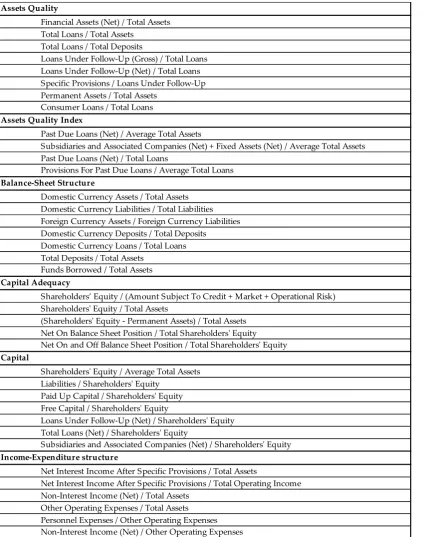
Note that we do not claim that these lists are fully exhaustive and they are just meant to be provided as a basis for any systemic risk study to employ, if one would like to opt to.Table B.1a Financial Ratio Features for Banks
Assets Quality
Financial Assets (Net) / Total Assets Total Loans / Total Assets
Total Loans / Total Deposits
Loans Under Follow-Up (Gross) / Total Loans Loans Under Follow-Up (Net) / Total Loans Specific Provisions / Loans Under Follow-Up Permanent Assets / Total Assets
Consumer Loans / Total Loans
Assets Quality Index
Past Due Loans (Net) / Average Total Assets
Subsidiaries and Associated Companies (Net) + Fixed Assets (Net) / Average Total Assets Past Due Loans (Net) / Total Loans
Provisions For Past Due Loans / Average Total Loans
Balance-Sheet Structure
Domestic Currency Assets / Total Assets Domestic Currency Liabilities / Total Liabilities Foreign Currency Assets / Foreign Currency Liabilities Domestic Currency Deposits / Total Deposits
Domestic Currency Loans / Total Loans Total Deposits / Total Assets
Funds Borrowed / Total Assets
Capital Adequacy
Shareholders’ Equity / (Amount Subject To Credit + Market + Operational Risk)
Shareholders' Equity / Total Assets
(Shareholders' Equity - Permanent Assets) / Total Assets Net On Balance Sheet Position / Total Shareholders' Equity Net On and Off Balance Sheet Position / Total Shareholders' Equity
Capital
Shareholders' Equity / Average Total Assets Liabilities / Shareholders' Equity
Paid Up Capital / Shareholders' Equity Free Capital / Shareholders' Equity
Loans Under Follow-Up (Net) / Shareholders' Equity Total Loans (Net) / Shareholders' Equity
Subsidiaries and Associated Companies (Net) / Shareholders' Equity
Income-Expenditure structure
Net Interest Income After Specific Provisions / Total Assets
Net Interest Income After Specific Provisions / Total Operating Income Non-Interest Income (Net) / Total Assets
20
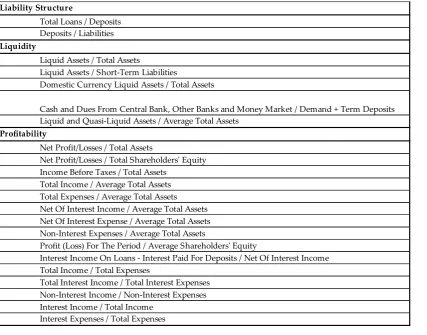
Liability StructureTotal Loans / Deposits Deposits / Liabilities
Liquidity
Liquid Assets / Total Assets
Liquid Assets / Short-Term Liabilities
Domestic Currency Liquid Assets / Total Assets
Cash and Dues From Central Bank, Other Banks and Money Market / Demand + Term Deposits Liquid and Quasi-Liquid Assets / Average Total Assets
Profitability
Net Profit/Losses / Total Assets
Net Profit/Losses / Total Shareholders' Equity Income Before Taxes / Total Assets
Total Income / Average Total Assets Total Expenses / Average Total Assets Net Of Interest Income / Average Total Assets Net Of Interest Expense / Average Total Assets Non-Interest Expenses / Average Total Assets
Profit (Loss) For The Period / Average Shareholders' Equity
Interest Income On Loans - Interest Paid For Deposits / Net Of Interest Income Total Income / Total Expenses
Total Interest Income / Total Interest Expenses Non-Interest Income / Non-Interest Expenses Interest Income / Total Income
[image:21.595.110.538.81.416.2]Interest Expenses / Total Expenses
Table B.1b Financial Level Indicator Features for Banks
Size
Derivatives
Securities Financing Transactions (SFTs) Other Assets
Gross Notional Amount of Off-Balance Sheet Items
Substitutability/Financial Institution Infrastructure
Payments Made in the Reporting Year (Excluding Intragroup Payments) Assets under Custody
Underwritten Transactions in Debt and Equity Markets Equity Underwriting Activity
Debt Underwriting Activity
Complexity
Notional Amount of Over-The-Counter (OTC) Derivatives OTC Derivatives Cleared Through a Central Counterparty OTC Derivatives Settled Bilaterally
Trading and Available-For-Sale Securities Held-For-Trading Securities (HFT) Available-For-Sale Securities (AFS)
Trading and AFS Securities That Meet the Definition of Level 1 Assets
Trading and AFS Securities That Meet the Definition of Level 2 Assets, with Haircuts Level 3 Assets
Cross-Jurisdictional Activity
Cross-Jurisdictional Claims Cross-Jurisdictional Liabilities
Foreign Liabilities (Excluding Derivatives and Local Liabilities in Local Currency) (Any Foreign Liabilities to Related Offices Included)
[image:21.595.108.531.92.767.2]21
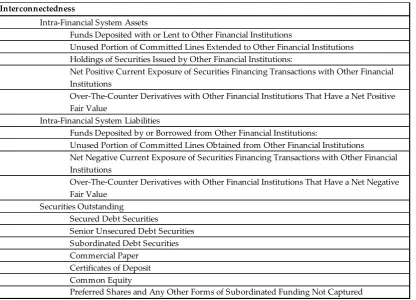
InterconnectednessIntra-Financial System Assets
Funds Deposited with or Lent to Other Financial Institutions
Unused Portion of Committed Lines Extended to Other Financial Institutions Holdings of Securities Issued by Other Financial Institutions:
Net Positive Current Exposure of Securities Financing Transactions with Other Financial Institutions
Over-The-Counter Derivatives with Other Financial Institutions That Have a Net Positive Fair Value
Intra-Financial System Liabilities
Funds Deposited by or Borrowed from Other Financial Institutions:
Unused Portion of Committed Lines Obtained from Other Financial Institutions
Net Negative Current Exposure of Securities Financing Transactions with Other Financial Institutions
Over-The-Counter Derivatives with Other Financial Institutions That Have a Net Negative Fair Value
Securities Outstanding
Secured Debt Securities
Senior Unsecured Debt Securities Subordinated Debt Securities Commercial Paper
Certificates of Deposit Common Equity
[image:22.595.110.527.80.380.2]22
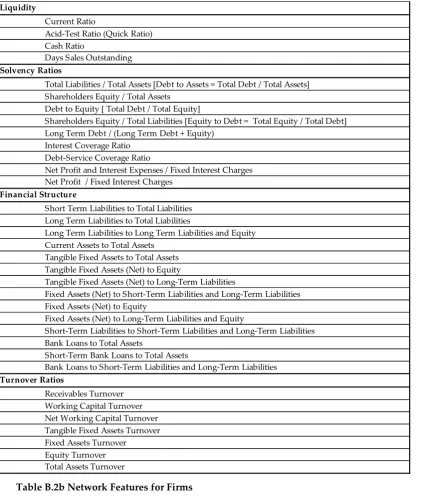
LiquidityCurrent Ratio
Acid-Test Ratio (Quick Ratio) Cash Ratio
Days Sales Outstanding
Solvency Ratios
Total Liabilities / Total Assets [Debt to Assets = Total Debt / Total Assets] Shareholders Equity / Total Assets
Debt to Equity [ Total Debt / Total Equity]
Shareholders Equity / Total Liabilities [Equity to Debt = Total Equity / Total Debt] Long Term Debt / (Long Term Debt + Equity)
Interest Coverage Ratio Debt-Service Coverage Ratio
Net Profit and Interest Expenses / Fixed Interest Charges Net Profit / Fixed Interest Charges
Financial Structure
Short Term Liabilities to Total Liabilities Long Term Liabilities to Total Liabilities
Long Term Liabilities to Long Term Liabilities and Equity Current Assets to Total Assets
Tangible Fixed Assets to Total Assets Tangible Fixed Assets (Net) to Equity
Tangible Fixed Assets (Net) to Long-Term Liabilities
Fixed Assets (Net) to Short-Term Liabilities and Long-Term Liabilities Fixed Assets (Net) to Equity
Fixed Assets (Net) to Long-Term Liabilities and Equity
Short-Term Liabilities to Short-Term Liabilities and Long-Term Liabilities Bank Loans to Total Assets
Short-Term Bank Loans to Total Assets
Bank Loans to Short-Term Liabilities and Long-Term Liabilities
Turnover Ratios
Receivables Turnover Working Capital Turnover Net Working Capital Turnover Tangible Fixed Assets Turnover Fixed Assets Turnover
[image:23.595.110.535.81.578.2]Equity Turnover Total Assets Turnover
Table B.2b Network Features for Firms
Interconnectedness
Loans and Credits
Short Term Bank Loans Long Term Bank Loans Trade Notes Receivable Trade Notes Payable
Trade Bonds and Bills Receivable Trade Bonds and Bills Payable Stake and Share Holdings
[image:23.595.110.524.580.768.2]23
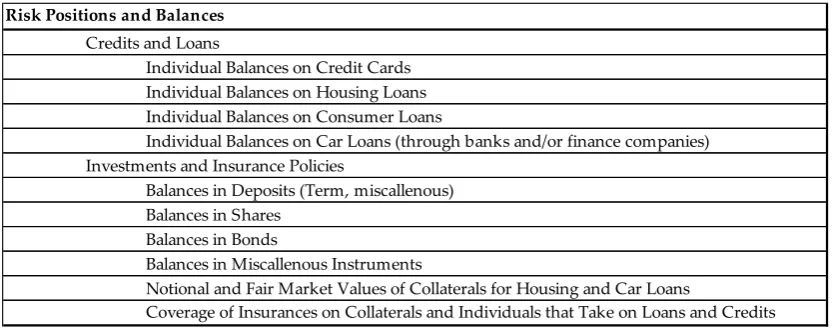
Risk Positions and BalancesCredits and Loans
Individual Balances on Credit Cards Individual Balances on Housing Loans Individual Balances on Consumer Loans
Individual Balances on Car Loans (through banks and/or finance companies) Investments and Insurance Policies
Balances in Deposits (Term, miscallenous) Balances in Shares
Balances in Bonds
Balances in Miscallenous Instruments
Notional and Fair Market Values of Collaterals for Housing and Car Loans
[image:24.595.107.525.81.246.2]