Proceedings of the 49th Annual Meeting of the Association for Computational Linguistics:shortpapers, pages 329–334,
Types of Common-Sense Knowledge
Needed for Recognizing Textual Entailment
Peter LoBue and Alexander Yates Temple University
Broad St. and Montgomery Ave. Philadelphia, PA 19130
{peter.lobue,yates}@temple.edu
Abstract
Understanding language requires both linguis-tic knowledge and knowledge about how the world works, also known as common-sense knowledge. We attempt to characterize the kinds of common-sense knowledge most often involved in recognizing textual entailments. We identify 20 categories of common-sense knowledge that are prevalent in textual entail-ment, many of which have received scarce at-tention from researchers building collections of knowledge.
1 Introduction
It is generally accepted that knowledge about how the world works, or common-sense knowledge, is vital for natural language understanding. There is, however, much less agreement or understanding about how to define common-sense knowledge, and what its components are (Feldman, 2002). Existing large-scale knowledge repositories, like Cyc (Guha and Lenat, 1990), OpenMind (Stork, 1999), and Freebase1, have steadily gathered together impres-sive collections of common-sense knowledge, but no one yet believes that this job is done. Other da-tabases focus on exhaustively cataloging a specific kind of knowledge — e.g., synonymy and hyper-nymy in WordNet (Fellbaum, 1998). Likewise, most knowledge extraction systems focus on extracting one specific kind of knowledge from text, often fac-tual relationships (Banko et al., 2007; Suchanek et al., 2007; Wu and Weld, 2007), although other spe-cialized extraction techniques exist as well.
1
http://www.freebase.com/
If we continue to build knowledge collections fo-cused on specific types, will we collect a sufficient store of common sense knowledge for understand-ing language? What kinds of knowledge might lie outside the collections that the community has fo-cused on building? We have undertaken an empir-ical study of a natural language understanding task in order to help answer these questions. We focus on the Recognizing Textual Entailment (RTE) task (Dagan et al., 2006), which is the task of recogniz-ing whether the meanrecogniz-ing of one text, called the Hy-pothesis (H), can be inferred from another, called the Text (T). With the help of five annotators, we have investigated the RTE-5 corpus to determine the types of knowledge involved in human judgments of RTE. We found 20 distinct categories of common-sense knowledge that featured prominently in RTE, besides linguistic knowledge, hyponymy, and syn-onymy. Inter-annotator agreement statistics indicate that these categories are well-defined. Many of the categories fall outside of the realm of all but the most general knowledge bases, like Cyc, and differ from the standard relational knowledge that most auto-mated knowledge extraction techniques try to find.
The next section outlines the methodology of our empirical investigation. Section 3 presents the cate-gories of world knowledge that we found were most prominent in the data. Section 4 discusses empirical results of our survey.
2 Methodology
We follow the methodology outlined in Sammons et
al. (2010), but unlike theirs and other previous
stud-ies (Clark et al., 2007), we concentrate on the world
#56 - ENTAILMENT
T: (CNN) Nadya Suleman, the Southern
Cali-fornia woman who gave birth to octuplets in Jan-uary, [...] She now has four of the octuplets at home, along with her six other children.
1) “octuplets” are 8 children (definitional) 2) 8 + 6 = 14 children (arithmetic) H: Nadya Suleman has 14 children.
Figure 1: An example RTE label, Text, a condensed “proof” (with knowledge categories for the back-ground knowledge) and Hypothesis.
knowledge rather than linguistic knowledge required for RTE. First, we manually selected a set of RTE data that could not be solved using linguistic knowl-edge and WordNet alone. We then sketched step-by-step inferences needed to show ENTAILMENT or CONTRADICTION of the hypothesis. We iden-tified prominent categories of world knowledge in-volved in these inferences, and asked five annotators to label the knowledge with the different categories. We judge the well-definedness of the categories by inter-annotator agreement, and their relative impor-tance according to frequency in the data.
To select an appropriate subset of the RTE data, we discarded RTE pairs labeled as UNKNOWN. We also discarded RTE pairs with ENTAILMENT and CONTRADICTION labels, if the decision re-lies mostly or entirely on a combination of linguistic knowledge, coreference decisions, synonymy, and hypernymy. These phenomena are well-known to be important to language understanding and RTE (Mirkin et al., 2009; Roth and Sammons, 2007). Many synonymy and hypernymy databases already exist, and although coreference decisions may them-selves depend on world knowledge, it is difficult to separate the contribution of world knowledge from the contribution of linguistic cues for coreference. Some sample phenomena that we explicitly chose to disregard include: knowledge of syntactic vari-ations, verb tenses, apposition, and abbreviations. From the 600 T and H pairs in RTE-5, we selected 108 that did not depend only on these phenomena.
For each of the 108 pairs in our data, we created
proofs, or a step-by-step sketch of the inferences that
lead to a decision about entailment of the hypothesis.
Figure 1 shows a sample RTE pair and (condensed) proof. Each line in the proof indicates either a new piece of background knowledge brought to bear, or a modus ponens inference from the information in the text or previous lines of the proof. This labor-intensive process was conducted by one author over more than three months. Note that the proofs may not be the only way of reasoning from the text to an entailment decision about the hypothesis, and that alternative proofs might require different kinds of common-sense knowledge. This caveat should be kept in mind when interpreting the results, but we believe that by aggregating over many proofs, we can counter this effect.
We created 20 categories to classify the 221 di-verse statements of world knowledge in our proofs. These categories are described in the next section.2 In some cases, categories overlap (e.g., “Canberra is part of Australia” could be in the Geography cate-gory or the part of catecate-gory). In cases where we foresaw the overlaps, we manually specified which category should take precedence; in the above exam-ple, we gave precedence to the Geography category, so that statements of this kind would all be included under Geography. This approach has the drawback of biasing somewhat the frequencies in our data set towards the categories that take precedence. How-ever, this simplification significantly reduces the an-notation effort of our survey participants, who al-ready face a complicated set of decisions.
We evaluate our categorization to determine how well-defined and understandable the categories are. We conducted a survey of five undergraduate stu-dents, who were all native English speakers but oth-erwise unfamiliar with NLP. The 20 categories were explained using fabricated examples (not part of the survey data). Annotators kept these fabricated ex-amples as references during the survey. Each anno-tator labeled each of the pieces of world knowledge from the proofs using one of the 20 categories. From this data we calculate Fleiss’sκ for inter-annotator agreement3 in order to measure how well-defined the categories are. We computeκonce over all
ques-2
The RTE pairs, proofs, and category judgments from our study are available at
http://www.cis.temple.edu/∼yates/data/rte-study-data.zip 3Fleiss’s
tions and all categories. Separately, we also compute κ once for each categoryC, by treating all annota-tions for categoriesC0 6=Cas the same.
3 Categories of Knowledge
By manual inspection, we arrived at the following 20 prominent categories of world knowledge in our subset of the RTE-5 data. For each category, we give a brief definition and example, along with the ID of an RTE pair whose proof includes the example. Our categories can be loosely organized into form-based categories and content-based categories. Note that, as with most common-sense knowledge, our exam-ples are intended as rules that are usually or typically true, rather than categorically or universally true.
3.1 Form-based Categories
The following categories are defined by how the knowledge can be described in a representation lan-guage, such as logic.
1. Cause and Effect: Statements in this category
re-quire that a predicatep holds true after an event or actionA.
#542: Once a person is welcomed into an
organiza-tion, they belong to that organization.
2. Preconditions: For a given action or eventAat
timet, a preconditionpis a predicate that must hold true of the world before timet, in order forAto have taken place.
#372: To become a naturalized citizen of a place,
one must not have been born there.
3. Simultaneous Conditions: Knowledge in this
cat-egory indicates that a predicatepmust hold true at the same time as an event or second predicatep0.
#240: When a person is an employee of an
organi-zation, that organization pays his or her salary.
4. Argument Types: Knowledge in this category
specifies the types or selectional preferences for ar-guments to a relationship.
#311: The type of thing that adopts children is the
type person.
5. Prominent Relationship: Texts often specify that
there exists some relationship between two entities, without specifying which relationship. Knowledge in this category specifies which relationship is most likely, given the types of the entities involved.
#42: If a painter is related to a painting somehow
(e.g., “da Vinci’s Mona Lisa”), the painter most likelypaintedthe painting.
6. Definition: Any explanation of a word or phrase.
#163: A “seat” is an object which holds one person.
7. Functionality: This category lists
relation-shipsRwhich are functional; i.e., ∀x,y,y0R(x, y)∧ R(x, y0)⇒y=y0.
#493:f atherOf is functional — a person can have only one father.
8. Mutual Exclusivity: Related to functionality,
mu-tual exclusivity knowledge indicates types of things that do not participate in the same relationship.
#229: Government and media sectors usually do not
employ the same person at the same time.
9. Transitivity: If we know thatRis transitive, and
thatR(a, b) andR(b, c) are true, we can infer that R(a, c)is true.
#499: Thesupportsrelation is transitive. Thus, be-cause Putin supports the United Russia party, and the United Russia party supports Medvedev, we can infer that Putin supports Medvedev.
3.2 Content-based Categories
The following categories are defined by the content, topic, or domain of the knowledge in them.
10. Arithmetic: This includes addition and
subtrac-tion, as well as comparisons and rounding.
#609: 115 passengers + 6 crew = 121 people
11. Geography: This includes knowledge such as
“Australia is a place,” “Sydney is in Australia,” and “Canberra is the capital of Australia.”
12. Public Entities: This category is for well-known
properties of highly-recognizable named-entities.
#142: Berlusconi is prime minister of Italy.
13. Cultural/Situational: This category includes
knowledge of or shared by a particular culture.
#207: A “half-hour drive” is “near.”
14. is member of: Statements of this category
indi-cate that an entity belongs to a larger organization.
#374: A minister is part of the government.
15. has parts: This category expresses what
compo-nents an object or situation is comprised of.
#463: Forests have trees.
16. Support/Opposition: This includes knowledge
of the kinds of actions or relationships towardXthat indicate positive or negative feeling towardX.
17. Accountability: This includes any knowledge that is helpful for determining who or what is re-sponsible for an action or event.
#158: A nation’s military is responsible for that
na-tion’s bombings.
18. Synecdoche: Synecdoche is knowledge that a
person or thing can represent or speak for an organi-zation or structure he or she is a part of.
#410: The president of Russia represents Russia.
3.3 Miscellaneous Categories
19. Probabilistic Dependency: Multiple phrases in
the text may contribute to the hypothesis being more or less likely to be true, although each phrase on its own might not be sufficient to support the hypothe-sis. Knowledge in this category indicates that these separate pieces of evidence can combine in a proba-bilistic, noisy-or fashion to increase confidence in a particular inference.
#437: Stocks on the “Nikkei 225” exchange and
Toyota’s stock both fell, which independently sug-gest that Japan’s economy might be struggling, but in combination they are stronger evidence that Japan’s economy is floundering.
20. Omniscience: Certain RTE judgments are only
possible if we assume that the text includes all in-formation pertinent to the story, so that we may dis-credit statements that were not mentioned.
#208: T states that “Fitzpatrick pleaded guilty to
fraud and making a false report.” H, which is marked as a CONTRADICTION, states that “Fitzpatrick is accused of robbery.” In order to prove the falsehood of H, we had to assume that no charges were made other than the ones described in T.
4 Results and Discussion
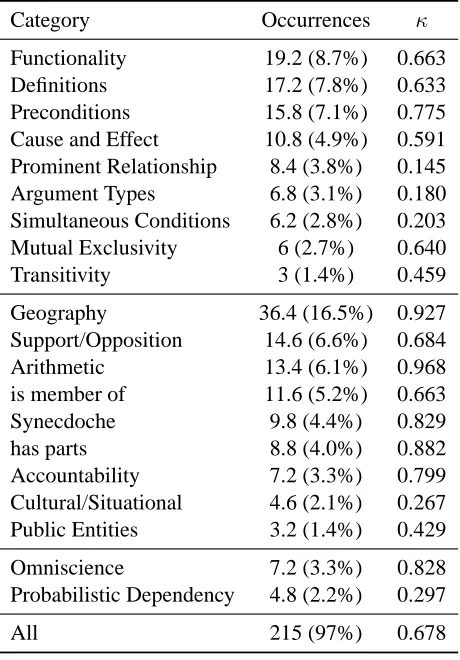
Our headline result is that the above twenty cat-egories overall are well-defined, with a Fleiss’s κ score of 0.678, and that they cover the vast majority of the world knowledge used in our proofs. This has important implications, as it suggests that concen-trating on collecting these kinds of world knowledge will make a large difference to RTE, and hopefully to language understanding in general. Naturally, more studies of this issue are warranted for validation.
Many of the categories — has parts, member of, geography, cause and effect, public entities, and
Category Occurrences κ
Functionality 19.2 (8.7%) 0.663
Definitions 17.2 (7.8%) 0.633
Preconditions 15.8 (7.1%) 0.775
Cause and Effect 10.8 (4.9%) 0.591
Prominent Relationship 8.4 (3.8%) 0.145
Argument Types 6.8 (3.1%) 0.180
Simultaneous Conditions 6.2 (2.8%) 0.203
Mutual Exclusivity 6 (2.7%) 0.640
Transitivity 3 (1.4%) 0.459
Geography 36.4 (16.5%) 0.927
Support/Opposition 14.6 (6.6%) 0.684
Arithmetic 13.4 (6.1%) 0.968
is member of 11.6 (5.2%) 0.663
Synecdoche 9.8 (4.4%) 0.829
has parts 8.8 (4.0%) 0.882
Accountability 7.2 (3.3%) 0.799
Cultural/Situational 4.6 (2.1%) 0.267
Public Entities 3.2 (1.4%) 0.429
Omniscience 7.2 (3.3%) 0.828
Probabilistic Dependency 4.8 (2.2%) 0.297
[image:4.612.314.544.73.403.2]All 215 (97%) 0.678
Table 1: Frequency and inter-annotator agreement for each category of world knowledge in the survey. Fre-quencies are averaged over the five annotators, and agree-ment is calculated using Fleiss’sκ.
support/opposition — will be familiar to NLP re-searchers from resources like WordNet, gazetteers, and text mining projects for extracting causal knowl-edge, properties of named entities, and opinions. Yet these familiar categories make up only about 40% of the world knowledge used in our proofs. Com-mon knowledge types, like definitional knowledge, arithmetic, and accountability, have for the most part been ignored by research on automated knowledge collection. Others have only earned very scarce and recent attention, like preconditions (Sil et al., 2010) and functionality (Ritter et al., 2008).
Several interesting form-based categories, in-cluding Prominent relationships, Argument Types,
and Simultaneous Conditions, had quite low
further studies with better training of the annotators will support this. One issue during annotation was that certain pieces of knowledge could be labeled as a content category or a form category, and instruc-tions may not have been clear enough on which is appropriate under these circumstances. Neverthe-less, considering the number of annotators and the uneven distribution of data points across the cate-gories (both of which tend to decreaseκ),κscores are overall quite high.
In an effort to discover if some of the categories overlap enough to justify combining them into a sin-gle category, we tried combining categories which annotators frequently confused with one another. While we could not find any combination that sig-nificantly improved the overallκscore, several com-binations provided minor improvements. As an ex-ample of a merge that failed, we tried merging
Ar-gument TypesandMutual Exclusivity, with the idea
that if a system knows about the selectional prefer-ences of different relationships, it should be able to deduce which relationships or types are mutually ex-clusive. However, theκscore for this combined cat-egory was 0.410, significantly below theκof 0.640
for Mutual Exclusivityon its own. One merge that
improvesκis a combination ofProminent
Relation-shipwithArgument Types(combinedκof 0.250, as
compared with 0.145 forProminent Relationshipand 0.180 for Argument Types). However, we believe this is due to unclear wording in the proofs, rather than a real overlap between the two categories. For instance, “Painters paint paintings” is an example of theProminent Relationshipcategory, and it looks very similar to theArgument Typesexample, “Peo-ple adopt children.” The knowledge in the first case is more properly described as, “If there exists an unspecified relationship R between a painter and a painting, then R is the relationship ‘painted’.” In the second case, the knowledge is more properly described as, “If x participates in the relationship ‘adopts children’, thenxis of type ‘person’.” Stated in this way, these kinds of knowledge look quite dif-ferent. If one reads our proofs from start to finish, the flow of the argument indicates which of these forms is intended, but for annotators quickly read-ing through the proofs, the two kinds of knowledge can look superficially very similar, and the annota-tors can become confused.
The best category combination that we discovered is a combination ofFunctionalityandMutual
Exclu-sivity (combined κ of 0.784, compared with 0.663
forFunctionalityand 0.640 forMutual Exclusivity).
This is a potentially valid alternative to our classi-fication of the knowledge. Functional relationships Rimply that ifxandx0have different valuesyand y0, thenxandx0must be distinct, or mutually exclu-sive. We intended thatMutual Exclusivityapply to sets rather than individual items, but annotators ap-parently had trouble distinguishing between the two categories, so in future we may wish to revise our set of categories. Further surveys would be required to validate this idea.
The 20 categories of knowledge covered 215 (97%) of the 221 statements of world knowledge in our proofs. Of the remaining 6 statements, two were from recognizable categories, like knowledge for temporal reasoning (#355) and an application of the frame axiom (#265). We left these out of the sur-vey to cut down on the number of categories that an-notators had to learn. The remaining four statements were difficult to categorize at all. For instance,
#177: “Motorcycle manufacturers often sponsor teams in motorcycle sports.” The other three of these difficult-to-categorize statements came from proofs for #265, #336, and #432. We suspect that if future studies analyze more data for common-sense knowl-edge types, more categories will emerge as impor-tant, and more facts that lie outside of recognizable categories will also appear. Fortunately, however, it appears that at least a very large fraction of common-sense knowledge can be captured by the sets of cate-gories we describe here. Thus these catecate-gories serve to point out promising areas for further research in collecting common-sense knowledge.
References
M. Banko, M. J. Cafarella, S. Soderland, M. Broadhead, and O. Etzioni. 2007. Open information extraction from the web. In IJCAI.
I. Dagan, O. Glickman, and B. Magnini. 2006. The PAS-CAL Recognising Textual Entailment Challenge. Lec-ture Notes in Computer Science, 3944:177–190. Richard Feldman. 2002. Epistemology. Prentice Hall. Christiane Fellbaum, editor. 1998. WordNet: An
Elec-tronic Lexical Database. Bradford Books.
R.V. Guha and D.B. Lenat. 1990. Cyc: a mid-term re-port. AI Magazine, 11(3).
V. Vydiswaran M. Sammons and D. Roth. 2010. Ask not what textual entailment can do for you... In Proc. of the Annual Meeting of the Association of Computa-tional Linguistics (ACL), Uppsala, Sweden, 7. Associ-ation for ComputAssoci-ational Linguistics.
Shachar Mirkin, Ido Dagan, and Eyal Shnarch. 2009. Evaluating the inferential utility of lexical-semantic re-sources. In EACL.
Alan Ritter, Doug Downey, Stephen Soderland, and Oren Etzioni. 2008. It’s a contradiction — No, it’s not: A case study using functional relations. In Empirical Methods in Natural Language Processing.
Dan Roth and Mark Sammons. 2007. Semantic and log-ical inference model for textual entailment. In Pro-ceedings of ACL-WTEP Workshop.
Avirup Sil, Fei Huang, and Alexander Yates. 2010. Ex-tracting action and event semantics from web text. In AAAI Fall Symposium on Common-Sense Knowledge (CSK).
D. G. Stork. 1999. The OpenMind Initiative. IEEE Ex-pert Systems and Their Applications, 14(3):19–20. Fabian M. Suchanek, Gjergji Kasneci, and Gerhard
Weikum. 2007. Yago: A core of semantic knowledge. In Proceedings of the 16th International Conference on the World Wide Web (WWW).