Proceedings of the 49th Annual Meeting of the Association for Computational Linguistics:shortpapers, pages 715–719,
Better Automatic Treebank Conversion Using A Feature-Based Approach
Muhua Zhu Jingbo Zhu Minghan Hu
Natural Language Processing Lab. Northeastern University, China
[email protected] [email protected]
Abstract
For the task of automatic treebank conversion, this paper presents a feature-based approach which encodes bracketing structures in a tree-bank into features to guide the conversion of this treebank to a different standard. Exper-iments on two Chinese treebanks show that our approach improves conversion accuracy by1.31%over a strong baseline.
1 Introduction
In the field of syntactic parsing, research efforts have been put onto the task of automatic conversion of a treebank (source treebank) to fit a different stan-dard which is exhibited by another treebank
(tar-get treebank). Treebank conversion is desirable
pri-marily because source-style and target-style annota-tions exist for non-overlapping text samples so that a larger target-style treebank can be obtained through such conversion. Hereafter, source and target tree-banks are named as heterogenous treetree-banks due to their different annotation standards. In this paper, we focus on the scenario of conversion between phrase-structure heterogeneous treebanks (Wang et al., 1994; Zhu and Zhu, 2010).
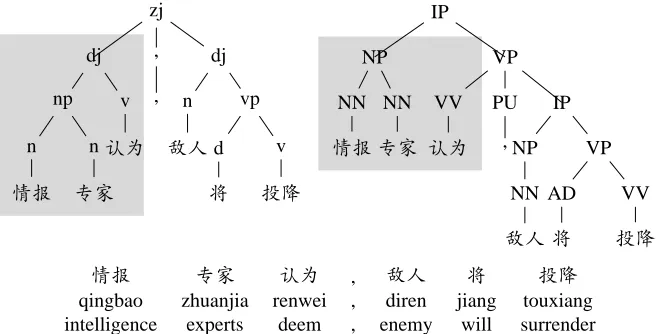
Due to the availability of annotation in a source treebank, it is natural to use such annotation to guide treebank conversion. The motivating idea is illustrated in Fig. 1 which depicts a sentence anno-tated with standards of Tsinghua Chinese Treebank (TCT) (Zhou, 1996) and Penn Chinese Treebank (CTB) (Xue et al., 2002), respectively. Suppose that the conversion is in the direction from the TCT-style parse (left side) to the CTB-TCT-style parse (right side). The constituents vp:[将/will投降/surrender], dj:[敌人/enemy将/will投降/surrender], and np:[情
报/intelligence专家/experts] in the TCT-style parse
strongly suggest a resulting CTB-style parse also bracket the words as constituents. Zhu and Zhu (2010) show the effectiveness of using brack-eting structures in a source treebank (source-side bracketing structures in short) as parsing constraints during the decoding phase of a target treebank-based parser.
However, using source-side bracketing structures as parsing constraints is problematic in some cases. As illustrated in the shadow part of Fig. 1, the TCT-style parse takes “认为/deems” as the right bound-ary of a constituent while in the CTB-style parse, “认为” is the left boundary of a constituent. Ac-cording to the criteria used in Zhu and Zhu (2010), any CTB-style constituents with “认为” being the left boundary are thought to be inconsistent with the bracketing structure of the TCT-style parse and will be pruned. However, if we prune such “inconsistent” constituents, the correct conversion result (right side of Fig. 1) has no chance to be generated.
The problem comes from binary distinctions used in the approach of Zhu and Zhu (2010). With bi-nary distinctions, constituents generated by a target treebank-based parser are judged to be either con-sistent or inconcon-sistent with source-side bracketing structures. That approach prunes inconsistent con-stituents which instead might be correct conversion results1. In this paper, we insist on using source-side bracketing structures as guiding information. Meanwhile, we aim to avoid using binary distinc-tions. To achieve such a goal, we propose to use a feature-based approach to treebank conversion and to encode source-side bracketing structures as a set
1To show how severe this problem might be, Section 3.1
zj
dj
np
n
情报 n
专家 v
认为
,
,
dj
n
敌人 vp
d
将
v
投降
IP
NP
NN
情报 NN
专家
VP
VV
认为
PU
, IP
NP
NN
敌人 VP
AD
将
VV
投降
情报 专家 认为 , 敌人 将 投降
[image:2.612.141.470.74.241.2]qingbao zhuanjia renwei , diren jiang touxiang intelligence experts deem , enemy will surrender
Figure 1: An example sentence with TCT-style annotation (left) and CTB-style annotation (right).
of features. The advantage is that inconsistent con-stituents can be scored with a function based on the features rather than ruled out as impossible.
To test the efficacy of our approach, we conduct experiments on conversion from TCT to CTB. The results show that our approach achieves a1.31% ab-solute improvement in conversion accuracy over the approach used in Zhu and Zhu (2010).
2 Our Approach
2.1 Generic System Architecture
To conduct treebank conversion, our approach, over-all speaking, proceeds in the following steps.
Step 1: Build a parser (named source parser) on a source treebank, and use it to parse sentences in the training data of a target treebank.
Step 2: Build a parser on pairs of golden target-style and auto-assigned (in Step 1) source-target-style parses in the training data of the target tree-bank. Such a parser is named heterogeneous
parser since it incorporates information derived
from both source and target treebanks, which follow different annotation standards.
Step 3: In the testing phase, the heterogeneous parser takes golden source-style parses as input and conducts treebank conversion. This will be explained in detail in Section 2.2.
To instantiate the generic framework described above, we need to decide the following three factors:
(1) a parsing model for building a source parser, (2) a parsing model for building a heterogeneous parser, and (3) features for building a heterogeneous parser. In principle, any off-the-shelf parsers can be used to build a source parser, so we focus only on the latter two factors. To build a heterogeneous parser, we use feature-based parsing algorithms in order to easily incorporate features that encode source-side bracketing structures. Theoretically, any feature-based approaches are applicable, such as Finkel et al. (2008) and Tsuruoka et al. (2009). In this pa-per, we use the shift-reduce parsing algorithm for its simplicity and competitive performance.
2.2 Shift-Reduce-Based Heterogeneous Parser
The heterogeneous parser used in this paper is based on the shift-reduce parsing algorithm described in Sagae and Lavie (2006a) and Wang et al. (2006). Shift-reduce parsing is a state transition process, where a state is defined to be a tuplehS, Qi. Here,S is a stack containing partial parses, andQis a queue containing word-POS pairs to be processed. At each state transition, a shift-reduce parser either shifts the top item ofQontoS, or reduces the top one (or two) items onS.
where each state is represented as a feature vector. In the testing phase, the trained classifier is used to choose actions for state transition. Moreover, beam search strategies can be used to expand the search space of a shift-reduce-based heterogeneous parser (Sagae and Lavie, 2006a). To incorporate in-formation on source-side bracketing structures, in both training and testing phases, feature vectors rep-resenting stateshS, Qiare augmented with features that bridge the current state and the corresponding source-style parse.
2.3 Features
This section describes the feature functions used to build a heterogeneous parser on the training data of a target treebank. The features can be divided into two groups. The first group of features are derived solely from target-style parse trees so they are referred to as target side features. This group of features are completely identical to those used in Sagae and Lavie (2006a).
In addition, we have features extracted jointly from target-style and source-style parse trees. These features are generated by consulting a source-style parse (referred to as ts) while we decompose a
target-style parse into an action-state sequence. Here, si denote the ith item from the top of the
stack, and qi denote the ith item from the front
end of the queue. We refer to these features as
heterogeneous features.
Constituent featuresFc(si, ts)
This feature schema covers three feature functions: Fc(s1, ts), Fc(s2, ts), and Fc(s1◦s2, ts), which
decide whether partial parses on stack S correspond to a constituent in the source-style parsets. That is, Fc(si, ts) = +ifsihas a bracketing match (ignoring
grammar labels) with any constituent in ts. s1◦s2
represents a concatenation of spans ofs1 ands2.
Relation featureFr(Ns(s1), Ns(s2))
We first position the lowest node Ns(si) in ts,
which dominates the span of si. Then a feature
function Fr(Ns(s1), Ns(s2))is defined to indicate
the relationship of Ns(s1) and Ns(s2). If Ns(s1)
is identical to or a sibling of Ns(s2), we say Fr(Ns(s1), Ns(s2)) = +.
Features Bridging Source and Target Parses
Fc(s1, ts) =−
Fc(s2, ts) = +
Fc(s1◦s2, ts) = +
Fr(Ns(s1), Ns(s2)) =−
Ff(RF(s1), q1) =−
[image:3.612.332.521.73.162.2]Fp(RF(s1), q1) =“v↑dj ↑zj↓,”
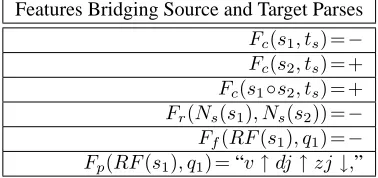
Table 1: An example of new features. Suppose we are considering the sentence depicted in Fig. 1.
Frontier-words featureFf(RF(s1), q1)
A feature function which decides whether the right frontier word of s1 and q1 are in the same base phrase in ts. Here, a base phrase is defined to be
any phrase which dominates no other phrases.
Path featureFp(RF(s1), q1)
Syntactic path features are widely used in the litera-ture of semantic role labeling (Gildea and Jurafsky, 2002) to encode information of both structures and grammar labels. We define a string-valued feature function Fp(RF(s1), q1) which connects the right
frontier word ofs1toq1ints.
To better understand the above feature func-tions, we re-examine the example depicted in Fig. 1. Suppose that we use a shift-reduce-based heterogeneous parser to convert the TCT-style parse to the CTB-style parse and that stack S currently contains two partial parses: s2:[NP (NN情报) (NN
专家)] and s1: (VV 认为). In such a state, we can see that spans of boths2 ands1◦s2 correspond to constituents intsbut that ofs1does not. Moreover, Ns(s1) is dj and Ns(s2) is np, so Ns(s1) and Ns(s2) are neither identical nor sisters in ts. The
values of these features are collected in Table 1.
3 Experiments
3.1 Data Preparation and Performance Metric
In the experiments, we use two heterogeneous tree-banks: CTB 5.1 and the TCT corpus released by the CIPS-SIGHAN-2010 syntactic parsing competi-tion2. We actually only use the training data of these
two corpora, that is, articles 001-270 and 400-1151 (18,100 sentences, 493,869 words) of CTB 5.1 and
2
the training data (17,529 sentences, 481,061 words) of TCT.
To evaluate conversion accuracy, we use the same test set (named Sample-TCT) as in Zhu and Zhu (2010), which is a set of 150 sentences with manually assigned CTB-style and TCT-style parse trees. In Sample-TCT, 6.19% (215/3473) CTB-style constituents are inconsistent with respect to the TCT standard and8.87%(231/2602) TCT-style con-stituents are inconsistent with respect to the CTB standard.
For all experiments, bracketing F1 is used as the performance metric, provided by EVALB3.
3.2 Implementation Issues
To implement a heterogeneous parser, we first build a Berkeley parser (Petrov et al., 2006) on the TCT training data and then use it to assign TCT-style parses to sentences in the CTB training data. On the “updated” CTB training data, we build two shift-reduce-based heterogeneous parsers by using max-imum entropy classification model, without/with beam search. Hereafter, the two heterogeneous parsers are referred to as Basic-SR and Beam-SR, re-spectively.
In the testing phase, Basic-SR and Beam-SR con-vert TCT-style parse trees in Sample-TCT to the CTB standard. The conversion results are evalu-ated against corresponding CTB-style parse trees in Sample-TCT. Before conducting treebank conver-sion, we apply the POS adaptation method proposed in Jiang et al. (2009) to convert TCT-style POS tags in the input to the CTB standard. The POS conver-sion accuracy is96.2%on Sample-TCT.
3.3 Results
Table 2 shows the results achieved by Basic-SR and Beam-SR with heterogeneous features being added incrementally. Here, baseline represents the systems which use only target side features. From the table we can see that heterogeneous features improve con-version accuracy significantly. Specifically, adding the constituent (Fc) features to Basic-SR
(Beam-SR) achieves a 2.79% (3%) improvement, adding the relation (Fr) and frontier-word (Ff) features
yields a 0.79% (0.98%) improvement, and adding
3
http://nlp.cs.nyu.edu/evalb
System Features <= 40words Unlimited Basic-SR baseline 83.34 80.33
[image:4.612.313.536.71.181.2]+Fc 85.89 83.12 +Fr, +Ff 85.47 83.91 +Fp 86.01 84.05 Beam-SR baseline 84.40 81.27 +Fc 86.30 84.27 +Fr, +Ff 87.00 85.25 +Fp 87.27 85.38
Table 2: Adding new features to baselines improve tree-bank conversion accuracy significantly on Sample-TCT.
the path (Fp) feature achieves a0.14%(0.13%)
im-provement. The path feature is not so effective as expected, although it manages to achieve improve-ments. One possible reason lies on the data sparse-ness problem incurred by this feature.
Since we use the same training and testing data as in Zhu and Zhu (2010), we can compare our approach directly with the informed decoding ap-proach used in that work. We find that Basic-SR achieves very close conversion results (84.05%vs. 84.07%) and Beam-SR even outperforms the in-formed decoding approach (85.38% vs. 84.07%) with a1.31%absolute improvement.
4 Related Work
For phrase-structure treebank conversion, Wang et al. (1994) suggest to use source-side bracketing structures to select conversion results from k-best lists. The approach is quite generic in the sense that it can be used for conversion between treebanks of different grammar formalisms, such as from a de-pendency treebank to a constituency treebank (Niu et al., 2009). However, it suffers from limited variations in k-best lists (Huang, 2008). Zhu and Zhu (2010) propose to incorporate bracketing struc-tures as parsing constraints in the decoding phase of a CKY-style parser. Their approach shows signifi-cant improvements over Wang et al. (1994). How-ever, it suffers from binary distinctions (consistent or inconsistent), as discussed in Section 1.
et al., 2008; Nivre and McDonald, 2008), the Pred method for domain adaptation (Daum´e III and Marcu, 2006), and the method for annotation adap-tation of word segmenadap-tation and POS tagging (Jiang et al., 2009). As one of the most related works, Jiang and Liu (2009) present a similar approach to conversion between dependency treebanks. In con-trast to Jiang and Liu (2009), the task studied in this paper, phrase-structure treebank conversion, is rel-atively complicated and more efforts should be put into feature engineering.
5 Conclusion
To avoid binary distinctions used in previous ap-proaches to automatic treebank conversion, we pro-posed in this paper a feature-based approach. Exper-iments on two Chinese treebanks showed that our approach outperformed the baseline system (Zhu and Zhu, 2010) by1.31%.
Acknowledgments
We thank Kenji Sagae for helpful discussions on the implementation of shift-reduce parser and the three anonymous reviewers for comments. This work was supported in part by the National Science Founda-tion of China (60873091; 61073140), Specialized Research Fund for the Doctoral Program of Higher Education (20100042110031), the Fundamental Re-search Funds for the Central Universities and Nat-ural Science Foundation of Liaoning Province of China.
References
Avrim Blum and Tom Mitchell. 1998. Combining La-beled and UnlaLa-beled Data with Co-Training. In
Pro-ceedings of COLT 1998.
Eugene Charniak, Sharon Goldwater, and Mark Johnson. 1998. Edge-Based Best-First Chart Parsing. In
Pro-ceedings of the Six Workshop on Very Large Corpora,
pages 127-133.
Hal Daum´e III and Daniel Marcu. 2006. Domain Adap-tation for Statistical Classifiers. Journal of Artifical
Intelligence Research, 26:101-166.
Jenny Rose Finkel, Alex Kleeman, and Christopher D. Manning. 2008. Efficient, Feature-Based Conditional Random Fileds Parsing. In Proceedings of ACL 2008, pages 959-967.
Daniel Gildea and Daniel Jurafsky. 2002. Automatic La-beling for Semantic Roles. Computational
Linguis-tics, 28(3):245-288.
Liang Huang. 2008. Forest Reranking: Discriminative Parsing with Non-local Features. In Proceedings of
ACL, pages 824-831.
Wenbin Jiang, Liang Huang, and Qun Liu. 2009. Au-tomatic Adaptation of Annotation Standards: Chinese Word Segmentation and POS Tagging - A Case Study. In Proceedings of ACL 2009, pages 522-530.
Wenbin Jiang and Qun Liu. 2009. Automatic Adapta-tion of AnnotaAdapta-tion Standards for Dependency Parsing – Using Projected Treebank As Source Corpus. In
Proceedings of IWPT 2009, pages 25-28.
Andr´e F. T. Martins, Dipanjan Das, Noah A. Smith, and Eric P. Xing. 2008. Stack Dependency Parsers. In
Proceedings of EMNLP 2008, pages 157-166.
Zheng-Yu Niu, Haifeng Wang, and Hua Wu. 2009. Ex-ploiting Heterogeneous Treebanks for Parsing. In
Pro-ceedings of ACL 2009, pages 46-54.
Joakim Nivre and Ryan McDonald. 2008. Integrat-ing Graph-Based and Transition-Based Dependency Parsers. In Proceedings of ACL 2008, pages 950-958. Slav Petrov, Leon Barrett, Romain Thibaux, and Dan
Klein. 2006. Learning Accurate, Compact, and In-terpretable Tree Annotation. In Proceedings of ACL
2006, pages 433-440.
Slav Petrov, Pi-Chuan Chang, Michael Ringgaard, and Hiyan Alshawi. 2010. Uptraining for Accurate Deter-ministic Question Parsing. In Proceedings of EMNLP
2010, pages 705-713.
Kenji Sagae and Alon Lavie. 2006. A Best-First Prob-abilistic Shift-Reduce Parser. In Proceedings of
ACL-COLING 2006, pages 691-698.
Kenji Sagae and Alon Lavie. 2006. Parser Combination by Reparsing. In Proceedings of NAACL 2006, pages 129-132.
Yoshimasa Tsuruoka, Jun’ichi Tsujii, and Sophia Anani-adou. 2009. Fast Full Parsing by Linear-Chain Condi-tional Random Fields. In Proceedings of EACL 2009, pages 790-798.
Jong-Nae Wang, Jing-Shin Chang, and Keh-Yih Su. 1994. An Automatic Treebank Conversion Algorithm
for Corpus Sharing. In Proceedings of ACL 1994, pages 248-254.
Mengqiu Wang, Kenji Sagae, and Teruk Mitamura. 2006. A Fast, Deterministic Parser for Chinese. In
Proceed-ings of ACL-COLING 2006, pages 425-432.
Nianwen Xue, Fu dong Chiou, and Martha Palmer. 2002. Building a Large-Scale Annotated Chinese Corpus. In
Proceedings of COLING 2002, pages 1-8.
Qiang Zhou. 1996. Phrase Bracketing and Annotation on Chinese Language Corpus (in Chinese). Ph.D. thesis, Peking University.
Muhua Zhu, and Jingbo Zhu. 2010. Automatic Treebank Conversion via Informed Decoding. In Porceedings of