Efficient sentence retrieval based on syntactic structure
Ichikawa Hiroshi, Hakoda Keita, Hashimoto Taiichi and Tokunaga Takenobu
Department of Computer Science, Tokyo Institute of Technology {ichikawa,hokoda,taiichi,take}@cl.cs.titech.ac.jp
Abstract
This paper proposes an efficient method of sentence retrieval based on syntactic structure. Collins proposed Tree Kernel to calculate structural similarity. However, structual retrieval based on Tree Kernel is not practicable because the size of the index table by Tree Kernel becomes im-practical. We propose more efficient al-gorithms approximating Tree Kernel: Tree Overlapping and Subpath Set. These algo-rithms are more efficient than Tree Kernel because indexing is possible with practical computation resources. The results of the experiments comparing these three algo-rithms showed that structural retrieval with Tree Overlapping and Subpath Set were faster than that with Tree Kernel by 100 times and 1,000 times respectively.
1 Introduction
Retrieving similar sentences has attracted much attention in recent years, and several methods have been already proposed. They are useful for many applications such as information retrieval
and machine translation. Most of the methods
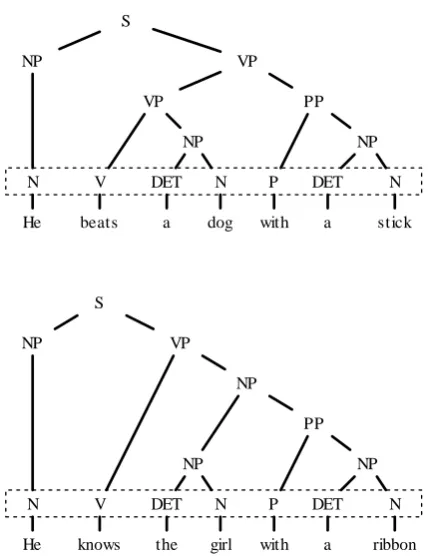
are based on frequencies of surface information such as words and parts of speech. These methods might work well concerning similarity of topics or contents of sentences. Although the surface infor-mation of two sentences is similar, their syntactic structures can be completely different (Figure 1). If a translation system regards these sentences as similar, the translation would fail. This is because conventional retrieval techniques exploit only sim-ilarity of surface information such as words and parts-of-speech, but not more abstract information such as syntactic structures.
He beats a dog with a
V DET N
N P DET
NP
PP
NP S
stick N VP
VP
NP
He knows the girl with a
V DET N
N P DET
NP
PP
NP S
ribbon N NP
VP
[image:1.595.306.521.245.524.2]NP
Figure 1: Sentences similar in appearance but dif-fer in syntactic structure
Collins et al. (Collins, 2001a; Collins, 2001b) proposed Tree Kernel, a method to calculate a sim-ilarity between syntactic structures. Tree Kernel defines the similarity between two syntactic struc-tures as the number of shared subtrees. Retrieving similar sentences in a huge corpus requires cal-culating the similarity between a given query and each of sentences in the corpus. Building an index table in advance could improve retrieval efficiency, but indexing with Tree Kernel is impractical due to the size of its index table.
In this paper, we propose two efficient
rithms to calculate similarity of syntactic struc-tures: Tree Overlapping and Subpath Set. These algorithms are more efficient than Tree Kernel be-cause it is possible to make an index table in rea-sonable size. The experiments comparing these three algorithms showed that Tree Overlapping is 100 times faster and Subpath Set is 1,000 times faster than Tree Kernel when being used for struc-tural retrieval.
After briefly reviewing Tree Kernel in section 2, in what follows, we describe two algorithms in section 3 and 4. Section 5 describes experiments to compare these three algorithms and discussion on the results. Finally, we conclude the paper and look at the future direction of our research in sec-tion 6.
2 Tree Kernel
2.1 Definition of similarity
Tree Kernel is proposed by Collins et al. (Collins, 2001a; Collins, 2001b) as a method to calculate similarity between tree structures. Tree Kernel de-fines similarity between two trees as the number
of shared subtrees. SubtreeSof treeT is defined
as any tree subsumed byT, and consisting of more
than one node, and all child nodes are included if any.
Tree Kernel is not always suitable because the desired properties of similarity are different de-pending on applications. Takahashi et al. pro-posed three types of similarity based on Tree Ker-nel (Takahashi, 2002). We use one of the similar-ity measures (equation (1)) proposed by Takahashi et al.
KC(T1, T2) = max n1∈N1, n2∈N2
C(n1, n2) (1)
whereC(n1, n2)is the number of shared subtrees
by two trees rooted at nodesn1andn2.
2.2 Algorithm to calculate similarity
Collins et al. (Collins, 2001a; Collins, 2001b)
proposed an efficient method to calculate Tree Kernel by usingC(n1, n2)as follows.
• If the productions atn1 andn2 are different
C(n1, n2) = 0
• If the productions at n1 and n2 are the
same, andn1 andn2 are pre-terminals, then
C(n1, n2) = 1
• Else if the productions at n1 andn2 are the
same andn1andn2 are not pre-terminals,
C(n1, n2) = ncY(n1)
i=1
(1 +C(ch(n1, i), ch(n2, i)))
(2)
wherenc(n) is the number of children of noden
and ch(n, i) is the i’th child node of n. Equa-tion (2) recursively calculatesCon its child node,
and calculatingCs in postorder avoids
recalcula-tion. Thus, the time complexity ofKC(T1, T2)is
O(mn), wheremandnare the numbers of nodes
inT1andT2respectively.
2.3 Algorithm to retrieve sentences
Neither Collins nor Takahashi discussed retrieval algorithms using Tree Kernel. We use the follow-ing simple algorithm. First we calculate the simi-larityKC(T1, T2)between a query tree and every
tree in the corpus and rank them in descending or-der ofKC.
Tree Kernel exploits all subtrees shared by trees. Therefore, it requires considerable amount of time in retrieval because similarity calculation must be performed for every pair of trees. To improve re-trieval time, an index table can be used in general. However, indexing by all subtrees is difficult be-cause a tree often includes millions of subtrees. For example, one sentence in Titech Corpus (Noro et al., 2005) with 22 words and 87 nodes includes 8,213,574,246 subtrees. The number of subtrees
in a tree withN nodes is bounded above by2N.
3 Tree Overlapping
3.1 Definition of similarity
When putting an arbitrary node n1 of treeT1 on
noden2 of tree T2, there might be the same
pro-duction rule overlapping inT1andT2. We define
CT O(n1, n2) as the number of such overlapping
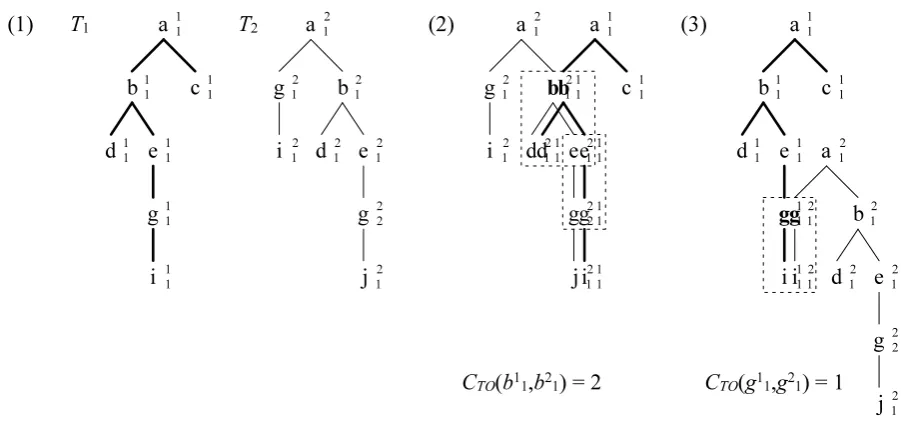
production rules whenn1 overlapsn2 (Figure 2).
We will define CT O(n1, n2) more precisely.
First we define L(n1, n2) of node n1 of T1 and
noden2 ofT2. L(n1, n2)represents a set of pairs
of nodes which overlap each other when putting n1 on n2. For example in Figure 2, L(b11, b21) = {(b1
1, b21),(d11, d21),(e11, e12),(g11, g21),(i11, j12)}.
L(n1, n2) is defined as follows. Hereni andmi
are nodes of tree Ti, ch(n, i) is thei’th child of
noden.
(1) T2 a b d e g j g i a b c d (2) e g i b d e g j a b c d e g i a b c d e g i (3) g i
CTO(b11,b21) = 2 a g i b d e g j T1 a
CTO(g11,g21) = 1 1
1
1 1
1 1 11
1 1 1 1 1 1 2 1 2 1 2 1 2 1 2 1 12
2 2 2 1 1 1 1 1 1 1 11
1 1 1 1 1 1 2 1 2 1 2 1 2 1 2 1 12
2 2 2 1 1 1 1 1 1 1 11
1 1 1 1 1 1 2 1 2 1 2 1 2 1 2 1 12
2 2
[image:3.595.73.524.61.274.2]2 1
Figure 2: Example of similarity calculation
2. If(m1, m2)∈L(n1, n2),
(ch(m1, i), ch(m2, i))∈L(n1, n2)
3. If(ch(m1, i), ch(m2, i))∈L(n1, n2),
(m1, m2)∈L(n1, n2)
4. L(n1, n2) includes only pairs generated by
applying 2. and 3. recursively.
CT O(n1, n2) is defined by using L(n1, n2) as
follows.
CT O(n1, n2)
= ¯¯ ¯¯ ¯¯ ¯¯ ¯
(m1, m2) ¯¯ ¯¯ ¯¯ ¯¯ ¯
m1∈N T(T1) ∧m2 ∈N T(T2) ∧(m1, m2)∈L(n1, n2) ∧P R(m1) =P R(m2)
¯¯ ¯¯ ¯¯ ¯¯ ¯ , (3) whereN T(T)is a set of nonterminal nodes in tree T,P R(n)is a production rule rooted at noden.
Tree Overlapping similarityST O(T1, T2)is
de-fined as follows by usingCT O(n1, n2).
ST O(T1, T2) = max
n1∈N T(T1)n2∈N T(T2)
CT O(n1, n2)
(4) This formula corresponds to equation (1) of Tree Kernel.
As an example, we calculate ST O(T1, T2) in
Figure 2 (1). Putting b11 on b21 gives Figure 2 (2)
in which two production rulesb→d eande→g
overlap respectively. Thus, CT O(b11, b21)becomes
2. While overlappingg11 andg12gives Figure 2 (3)
in which only one production ruleg→ioverlaps.
Thus,CT O(g11, g12)becomes1. Since there are no
other node pairs which gives larger CT O than 2,
[image:3.595.361.466.396.515.2]ST O(T1, T2)becomes2.
Table 1: Example of the index table
p I[p]
a→b c {a11} b→d e {b11, b21} e→g {e11, e21} g→i {g11, g12} a→g b {a21} g→j {g12}
3.2 Algorithm
Let us take an example in Figure 3 to explain the algorithm. Suppose thatT0 is a query tree and the
corpus has only two trees,T1andT2.
The method to find the most similar tree to a given query tree is basically the same as Tree Ker-nel’s (section 2.2). However, unlike Tree Kernel, Tree Overlapping-based retrieval can be acceler-ated by indexing the corpus in advance. Thus, given a tree corpus, we build an index table I[p]
which maps a production rulepto its occurrences.
(1) T0 (2) a b d e g j g i (3) a b c d e
Score: 2 pt. Score: 1 pt.
a b c d e g i a b c d e a b c d e a T2 b d e g j g i a b c d e g i T1 0 1 0 1 0 1 0 1 0 1 1 1 1 1 1 1 11
1 1 1 1 1 1 2 1 2 1 2 1 2 1 2 1 2 2 2 1 0 1 0 1 0 1 0 1 0 1 1 1 1 1 1 1 11
[image:4.595.78.425.66.228.2]1 1 1 1 1 1 0 1 0 1 0 1 0 1 0 1 2 1 2 1 2 1 2 1 2 1 2 1 2 2 2 1 2 1
Figure 3: Example of Tree Overlapping-based retrieval
the position in the tree. I[p]is defined as follows.
I[p] =
m ¯¯ ¯¯ ¯¯ ¯
T ∈F
∧m∈N T(T)
∧p=P R(m)
(5)
where F is the corpus (here {T1, T2}) and the
meaning of other symbols is the same as the defi-nition ofCT O(equation (3)).
Table 1 shows an example of the index table
generated from T1 andT2 in Figure 3 (1). In
Ta-ble 1, a superscript of a nonterminal symbol iden-tifies a tree, and a subscript ideniden-tifies a position in the tree.
By using the index table, we calculateC[n, m]
with the following algorithm.
for all(n, m)doC[n, m] := 0end foreachninN T(T0)do
foreachminI[P R(n)]do
(n0, m0) :=top(n, m)
C[n0, m0] :=C[n0, m0] + 1
end end
where top(n, m) returns the upper-most pair of
overlapped nodes when node n and m overlap.
The value oftopuniquely identifies a situation of overlapping two trees. Functiontop(n, m)is cal-culated by the following algorithm.
functiontop(n, m); begin
(n0, m0) := (n, m)
whileorder(n0) =order(m0)do n0 :=parent(n0)
m0:=parent(m0)
end
return(n0, m0)
end
where parent(n) is the parent node of n, and
[image:4.595.110.291.306.350.2]order(n)is the order of nodenamong its siblings.
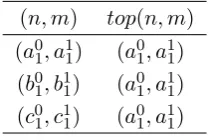
Table 2 shows example values oftop(n, m)
gen-erated by overlappingT0andT1in Figure 3. Note
thattop maps every pair of corresponding nodes
in a certain overlapping situation to a pair of the upper-most nodes of that situation. This enables us to use the value oftopas an identifier of a situ-ation of overlap.
Table 2: Examples oftop(n, m)
(n, m) top(n, m)
(a01, a11) (a01, a11) (b0
1, b11) (a01, a11)
(c01, c11) (a01, a11)
NowC[top(n, m)] =CT O(n, m), therefore the
tree similarity between a query tree T0 and each
treeT in the corpusST O(T0, T)can be calculated
by:
ST O(T0, T) = max n∈N T(T0), m∈N T(T)
C[top(n, m)]
(6)
3.3 Comparison with Tree Kernel
The value ofST O(T1, T2)roughly corresponds to
the number of production rules included in the largest sub-tree shared byT1 andT2. Therefore,
[image:4.595.364.469.496.566.2]by both trees, like Tree Kernel’sKC, though the
definition of the subtree size is different.
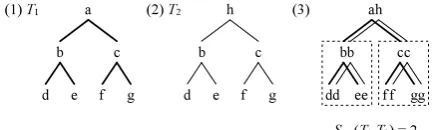
One difference is that Tree Overlapping consid-ers shared subtrees even though they are split by a nonshared node as shown in Figure 4. In Figure 4, T1andT2share two subtrees rooted atbandc, but
their parent nodes are not identical. While Tree Kernel does not consider the superposition putting
nodeaonh, Tree Overlapping considers puttinga
onhand assigns count2to this superposition.
a
b c
f g
(3)
d e
h
b c
f g d e
a
b c
f g d e
h
b c
f g d e
STO(T1,T2) = 2
(1) T1 (2) T2
Figure 4: Example of counting two separated shared subtrees as one
Another, more important, difference is that Tree Overlapping retrieval can be accelerated by index-ing the corpus in advance. The number of indexes is bounded above by the number of production rules, which is within a practical index size.
4 Subpath Set
4.1 Definition of similarity
Subpath Set similarity between two trees is de-fined as the number of subpaths shared by the trees. Given a tree, its subpaths is defined as a set of every path from the root node to leaves and their partial paths.
Figure 5 (2) shows all subpaths inT1 andT2 in
Figure 5(1). Here we denotes a path as a sequence of node names such as (a, b, d). Therefore, Sub-path Set similarity ofT1andT2becomes 15.
4.2 Algorithm
SupposeT0is a query tree,T Sis a set of trees in
the corpus andP(T)is a set of subpaths ofT. We can build an index tableI[p]for each production rulepas follows.
I[p] ={T|T ∈T S∧p∈P(T)} (7)
Using the index table, we can calculate the num-ber of shared subpaths byT0 andT,S[T], by the
following algorithm:
for allT S[T] := 0; foreachpinP(T0)do
foreachT inI[p]do S[T] :=S[T] + 1
end end
4.3 Comparison with Tree Kernel
As well as Tree Overlapping, Subpath Set retrieval can be accelerated by indexing the corpus. The
number of indexes is bounded above byL×D2
whereLis the maximum number of leaves of trees
(the number of words in a sentence) andDis the
maximum depth of syntactic trees. Moreover, con-sidering a subpath as an index term, we can use existing retrieval tools.
Subpath Set uses less structural information than Tree Kernel and Tree Overlapping. It does not distinguish the order and number of child nodes. Therefore, the retrieval result tends to be noisy. However, Subpath Set is faster than Tree Overlapping, because the algorithm is simpler.
5 Experiments
This section describes the experiments which were conducted to compare the performance of struc-ture retrieval based on Tree Kernel, Tree Overlap-ping and Subpath Set.
5.1 Data
We conducted two experiments using different an-notated corpora. Titech corpus (Noro et al., 2005) consists of about 20,000 sentences of Japanese newspaper articles (Mainiti Shimbun). Each sen-tence has been syntactically annotated by hand. Due to the limitation of computational resources, we used randomly selected 2,483 sentences as a data collection.
Iwanami dictionary (Nishio et al., 1994) is a
Japanese dictionary. We extracted 57,982
tences from glosses in the dictionary. Each sen-tences was analyzed with a morphological an-alyzer, ChaSen (Asahara et al., 1996) and the MSLR parser (Shirai et al., 2000) to obtain syntac-tic structure candidates. The most probable struc-ture with respect to PGLR model (Inui et al., 1996) was selected from the output of the parser. Since they were not investigated manually, some sen-tences might have been assigned incorrect struc-tures.
5.2 Method
[image:5.595.73.290.211.276.2](1) T2 a
b
d e
g
j g
i a
b c
d e
g
i T1
(c),
(a,c),
(e,g,i),
(b,e,g,i),
(a,b,e,g,i)
(2) Subpaths of T
1
Subpaths of T2 SSS(T1,T2) = 15
(a), (b), (d), (e), (g), (i),
(a,b), (b,d), (b,e), (e,g), (g,i),
(a,b,d), (a, b, e), (b,e,g),
(a,b,e,g)
(j),
(a,g), (g,j),
(a,g,i), (e,g,j),
(b,e,g,j),
(a,b,e,g,j)
Figure 5: Example of subpaths
[image:6.595.75.527.65.229.2]were extracted from these corpora. The algorithms described in the preceding sections were imple-mented with Ruby 1.8.2. Table 3 outlines the ex-periments.
Table 3: Summary of experiments
Experiment I II
Target corpus Titech Corpus Iwanami dict.
Corpus size 2,483 sent. 57,982 sent.
No. of queries 100 1,000
CPU Intel Xeon PowerPC G5
(2.4GHz) (2.3GHz)
Memory 2GB 2GB
5.3 Results and discussion
Since we select a query from the target corpus, the query is always ranked in the first place in the retrieval result. In what follows, we exclude the query tree as an answer from the result.
We evaluated the algorithms based on the fol-lowing two factors: average retrieval time (CPU time) (Table 4) and the rank of the tree which was top-ranked in other algorithm (Table 5). For ex-ample, in Experiment I of Table 5, the column
“≥5th” of the row “TO/TK” means that there were
73 % of the cases in which the top-ranked tree by Tree Kernel (TK) was ranked 5th or above by Tree Overlapping (TO).
[image:6.595.318.516.306.362.2]We consider Tree Kernel (TK) as the baseline method because it is a well-known existing simi-larity measure and exploits more information than others. Table 4 shows that in both corpora, the retrieval speed of Tree Overlapping (TO) is about
Table 4: Average retrieval time per query [sec]
Algorithm Experiment I Experiment II
TK 529.42 3796.1
TO 6.29 38.3
SS 0.47 5.1
100 times faster than that of Tree Kernel, and the retrieval speed of Subpath Set (SS) is about 1,000 times faster than that of Tree Kernel. This re-sults show we have successfully accelerated the retrieval speed.
The retrieval time of Tree Overlapping, 6.29 and 38.3 sec./per query, seems be a bit long. How-ever, we can shorten this time if we tune the im-plementation by using a compiler-type language. Note that the current implementation uses Ruby, an interpreter-type language.
Comparing Tree Overlapping and Subpath Set with respect to Tree Kernel (see rows “TK/TO” and “TK/SS”), the top-ranked trees by Tree Kernel are ranked in higher places by Tree Overlapping than by Subpath Set. This means Tree Overlap-ping is better than Subpath Set in approximating Tree Kernel.
Although the corpus of Experiment II is 20 times larger than that of Experiment I, the figures of Experiment II is better than that of Experiment I in Table 5. This could be explained as follows. In Experiment II, we used sentences from glosses in the dictionary, which tend to be formulaic and short. Therefore we could find similar sentences easier than in Experiment I.
Table 5: The rank of the top-ranked tree by other algorithm [%]
Experiment I
A/B 1st ≥5th ≥10th
TO/TK 34.0 73.0 82.0
SS/TK 16.0 35.0 45.0
TK/TO 29.0 41.0 51.0
SS/TO 27.0 49.0 58.0
TK/SS 17.0 29.0 37.0
TO/SS 29.0 58.0 69.0
Experiment II
A/B 1st ≥5th ≥10th
TO/TK 74.6 88.0 92.0
SS/TK 65.3 78.8 84.1
TK/TO 71.1 81.0 84.6
SS/TO 73.4 86.0 89.8
TK/SS 65.5 75.9 79.7
TO/SS 76.1 87.7 92.0
similarity calculation of tree structure retrieval, Tree Overlapping approximates Tree Kernel bet-ter than Subpath Set, while Subpath Set is fasbet-ter than Tree Overlapping.
6 Conclusion
We proposed two fast algorithms to retrieve sen-tences which have a similar syntactic structure: Tree Overlapping (TO) and Subpath Set (SS). And we compared them with Tree Kernel (TK) to ob-tain the following results.
• Tree Overlapping-based retrieval outputs
similar results to Tree Kernel-based retrieval and is 100 times faster than Tree Kernel-based retrieval.
• Subpath Set-based retrieval is not so good
at approximating Tree Kernel-based retrieval, but is 1,000 times faster than Tree Kernel-based retrieval.
Structural retrieval is useful for annotationg cor-pora with syntactic information (Yoshida et al., 2004). We are developing a corpus annotation tool named “eBonsai” which supports human to anno-tate corpora with syntactic information and to re-trieve syntactic structures. Integrating annotation and retrieval enables annotators to annotate a new instance with looking back at the already anno-tated instances which share the similar syntactic
structure with the current one. For such purpose, Tree Overlapping and Subpath Set algorithms con-tribute to speed up the retrieval process, thus make the annotation process more efficient.
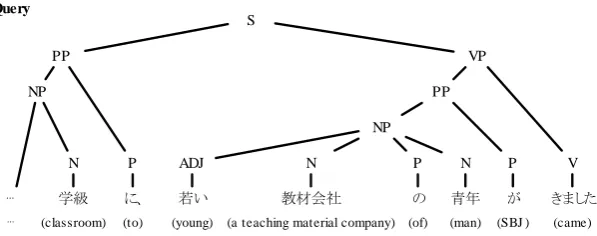
However, “similarity” of sentences is affected by semantic aspects as well as structural aspects. The output of the algorithms do not always con-form with human’s intuition. For example, the two sentences in Figure 6 have very similar struc-tures including particles, but they are hardly con-sidered similar from human’s viewpoint. With this respect, it is hardly to say which algorithm is su-perior to others.
As a future work, we need to develop a method to integrate both content-based and structure-based similarity measures. To this end, we have to evaluate the algorithms in real application envi-ronments (e.g. information retrieval and machine translation) because desired properties of similar-ity are different depending on applications.
References
Asahara, M. and Matsumoto, Y., Extended Models and Tools for High-performance Part-of-Speech Tagger. Proceedings of COLING 2000, 2000.
Collins, M. and Duffy, N. Parsing with a Single Neu-ron: Convolution Kernels for Natural Language Problems. Technical report UCSC-CRL-01-01, Uni-versity of California at Santa Cruz, 2001.
Collins, M. and Duffy, N. Convolution Kernels for Nat-ural Language. In Proceedings of NIPS 2001, 2001.
Inui, K., Shirai, K., Tokunaga T. and Tanaka H., The In-tegration of Statistics-based Techniques in the Anal-ysis of Japanese Sentences. Special Interest Group of Natural Language Processing, Information Pro-cessing Society of Japan, Vol. 96, No. 114, 1996.
Nagao, M. A framework of a mechanical translation between Japanese and English by analogy principle. In Alick Elithorn and Ranan Banerji, editors, Artif-ical and Human Intelligence, pages 173-180. Ams-terdam, 1984.
Noro, T., Koike, C., Hashimoto, T., Tokunaga, T. and Tanaka, H. Evaluation of a Japanese CFG Derived from a Syntactically Annotated Corpus with respect to Dependency Measures, The 5th Workshop on Asian Language Resources, pp.9-16, 2005.
Nishio, M., Iwabuchi, E. and Mizutani, S. (ed.) Iwanami Kokugo Jiten, Iwanamishoten, 5th Edition, 1994.
学級 に、 若い 教材会社 の 青年
P ADJ N
N P N
PP
PP S
が
P VP
NP
きました
V
…
NP
(to) (young) (a teaching material company) (of) (man) (SBJ ) (came)
… (classroom)
頭 に、 着弾した 砲弾 の 破片
P ADJ N
N P N
PP
PP S
が
P VP
NP
直撃した
V
…
NP
(to) (exploded) (bombshell) (of) (piece) (SBJ ) (hit)
… (head)
" A young man of a teaching material company came to the classroom"
" A piece of the exploded bombshell hit his head" Query
[image:8.595.152.451.66.184.2]Top- ranked
Figure 6: Example of a retrieved similar sentence
Processing, Vol. 7, No. 5, pp. 93-112, 2000. (in Japanese)
Somers, H., McLean, I., Jones, D. Experiments in mul-tilingual example-based generation. CSNLP 1994: 3rd conference on the Cognitive Science of Natural Language Processing, Dublin, 1994.
Takahashi, T., Inui K., and Matsumoto, Y.. Methods of Estimating Syntactic Similarity. Special Interest Group of Natural Language Processing, Information Processing Society of Japan, NL-150-7, 2002. (in Japanese)
![Table 4: Average retrieval time per query [sec]](https://thumb-us.123doks.com/thumbv2/123dok_us/249991.524417/6.595.318.516.306.362/table-average-retrieval-time-per-query-sec.webp)
![Table 5: The rank of the top-ranked tree by otheralgorithm [%]](https://thumb-us.123doks.com/thumbv2/123dok_us/249991.524417/7.595.91.272.105.335/table-rank-ranked-tree-otheralgorithm.webp)