The development and evolution of transactive memory
system over time in MUVEs
NISIOTIS, Louis <http://orcid.org/0000-0002-8018-1352> and KLEANTHOUS,
Styliani <http://orcid.org/0000-0003-1594-1340>
Available from Sheffield Hallam University Research Archive (SHURA) at:
http://shura.shu.ac.uk/22181/
This document is the author deposited version. You are advised to consult the
publisher's version if you wish to cite from it.
Published version
NISIOTIS, Louis and KLEANTHOUS, Styliani (2018). The development and
evolution of transactive memory system over time in MUVEs. In: 2018 10th
Computer Science and Electronic Engineering Conference (CEEC). IEEE, 174-179.
Copyright and re-use policy
See
http://shura.shu.ac.uk/information.html
Sheffield Hallam University Research Archive
The Development and Evolution of Transactive
Memory System Over Time in MUVEs
Louis Nisiotis Sheffield Hallam University
Sheffield, UK [email protected]
Styliani Kleanthous Open University of Cyprus
Nicosia. Cyprus [email protected]
Abstract — CSCW in education is a topic that drew a lot of attention over the years, and Multi User Virtual Environments (MUVEs) are one of the tools utilized by many educators to support their teaching objectives. MUVEs enable students to connect, immerse and interact with their peers and the environment, and synchronously engage and collaborate in learning activities. Effective communication and collaboration contributes to student learning, and the topic of Transactive Memory System (TMS) within working groups has been found to be very beneficial. TMS relates to the representation of the knowledge possessed by the members of a team that allows identifying who knows what, providing efficiency in collaboration. While the use of educational MUVEs has been thoroughly investigated in the literature, little is known about the use of such environments to support TMS and their relationship with working group dynamics. This paper presents the results of a study investigating the development and evolution of a TMS between groups within a MUVE, in order to better understand the dynamics that need to be considered when using MUVEs to support teaching and learning.
Keywords — TMS, MUVE, CSCW, Transactive Memory
I. INTRODUCTION
Computer Supported Cooperative Work (CSCW) is an interdisciplinary area which has established itself as a research field aiming to investigate the use of information technologies to support group work [1]. One of the technologies that have been utilised to support CSCW is the use of Multi User Virtual Environments (MUVEs). MUVEs are computer generated 3D environments where users navigate and interact with the environment and others using a virtual representation of them selves known as avatar. The avatar is the virtual presence of the user, as well as the viewpoint of the environment, acting as a mean of social interaction [2]. MUVEs enable users to immerse and communicate, interact and synchronously collaborate in the same shared space, and are identified as effective tools to support access and participation in learning activities [3], allowing teachers to develop immersive experiential and problem based learning activities to support and engage students in the learning process [4]. The educational efficacy of MUVEs has been previously evaluated with very positive results [3, 5-8]. There are many studies suggesting that MUVEs are considered as unique and flexible learning environments [9], offering a range of unique characteristics that support and contribute to the student’s online learning experience. One of the most important attributes of MUVEs
is the feeling of presence that the user develops in the environment. Presence relates to the feeling of the user being present in the virtual environment rather than the physical [10]. Many researchers have investigated the impact of virtual presence in education, suggesting positive learning results [11]. Moreover, the environment provides the ability to establish communication, offer opportunities for socialization that enable the development of the feeling of belonging to a group, and also to be aware of the existence and actions of others [7]. Furthermore, the environment allows to create realistic and/or abstract experiences, in which students can immerse and participate, to enrich, enhance and make learning engaging and enjoyable [3]. MUVEs are different from other online learning tools with varied characteristics associated with them [12]. These unique characteristics have drawn the attention of many scholars and educators, who consider them as effective tools for engagement, learning and collaboration [13].
Transactive Memory (TM) and the development of a Transactive Memory System (TMS) have proven to be very promising for the functioning of teams and groups at several contexts in face-to-face and online communication [14]. TM deals with the encoding, storage and retrieval of information, thus, TMS can provide the option to recall previously visited areas and subjects, and to identify relevant knowledge [14]. Furthermore, TM helps group members to be aware of one another’s expertise and to divide responsibilities with reference to different knowledge areas. Moreover, the promotion of TM creates awareness on who is knowledgeable in what and facilitates the identification of complementary knowledge. To this effect, the opportunities for collaboration among team members are potentially enhanced and the result is of better quality. Although in the organizational psychology field there is a lot of work around the theory of TM there is a growing attention for research on how TM is evolving within virtual teams.
within teams in MUVEs has not attracted much attention, with the exception of the work of Kahn and Williams [17] who studied TMS relating to virtual teams in 3D virtual games, and Kleanthous et al [18] and Nisiotis et al [19] who have previously identified that an educational MUVE can effectively support the development of a TMS among working groups.
In this work we are taking a different angle in investigating the development and evolution of TM through a MUVE. We measure TM in a two stages approach with the aim to examine whether TM is evolving through time and how this evolution is impacting the collaboration between people in a group. In the following sections we will discuss the main research questions and the instruments employed for answering those. Next, we will present the results and a discussion section will conclude this paper.
II. METHODS AND INSRUMENTATION
To conduct this investigation, a MUVE has been utilized for a teaching semester, and an experiment was designed aiming to investigate the extent to which a TMS can be developed within a MUVE and its evolution. To ascertain this research objective, the following research questions have been formulated to devise a research strategy:
A. Research Questions
RQ1 – To what extent a TMS has been developed in the MUVE?
RQ2 – To what extent there were differences between the level of TM developed as measured halfway and after the experiment?
RQ3 – Were there any differences in the TMS developed among the working groups during and after the experiment?
B. VirtualSHU
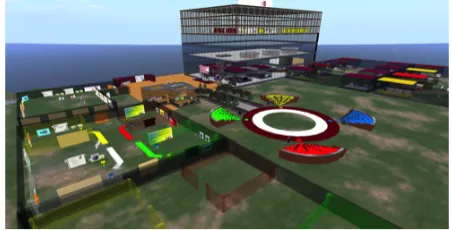
To conduct this investigation, the ‘VirtualSHU’ (Fig 1, 2) has been developed using the Opensimulator MUVE. The design of VirtualSHU is based on the educational MUVEs design guidelines proposed by Nisiotis [8]. The environment is representing a common educational setting with recognisable facilities. The layout features a main campus building and number of other areas featuring different functionality each. It provides an orientation area where students can learn the basic functionalities and navigation features of the environment, a courtyard for students to meet up and set off for activities, and a number of classrooms and collaborative areas dedicated to each of the topics of the module. Each room was designed to provide access to PowerPoint slides, website loaders, YouTube videos and information boards. Sandbox areas where the environment building and flying restrictions are lifted as well as a quiet area for students who are away from keyboard but still logged in the environment are also provided.
[image:3.612.333.559.55.170.2]
Fig. 1. The VirtualSHU overview
Fig. 2. VirtualSHU collaborative areas
C. Experimental Procedures
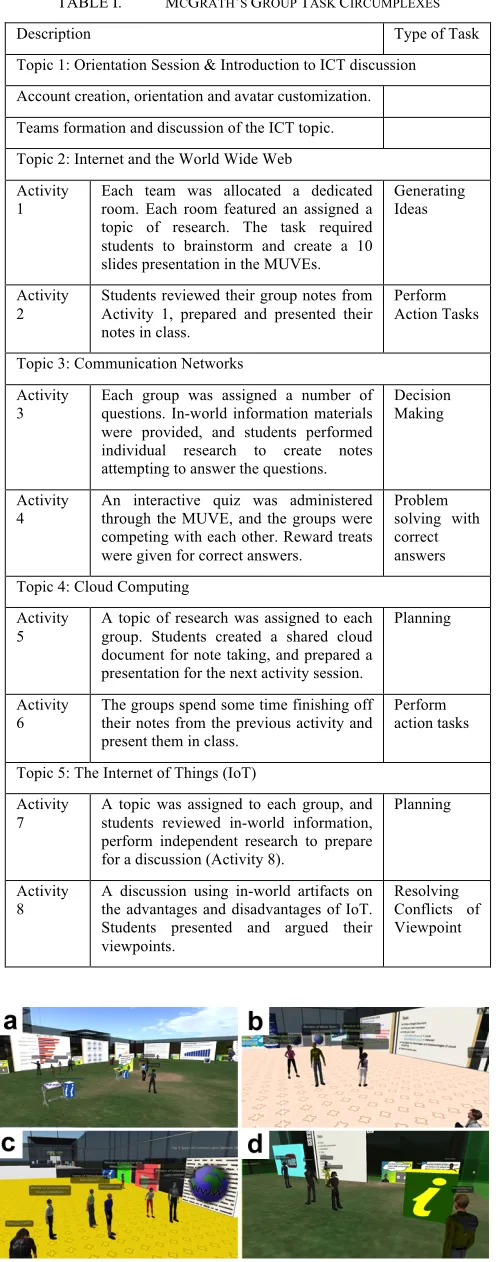
[image:3.612.333.559.216.335.2]TABLE I. MCGRATH’S GROUP TASK CIRCUMPLEXES
Description Type of Task
Topic 1: Orientation Session & Introduction to ICT discussion
Account creation, orientation and avatar customization.
Teams formation and discussion of the ICT topic.
Topic 2: Internet and the World Wide Web
Activity
1 Each team was allocated a dedicated room. Each room featured an assigned a topic of research. The task required students to brainstorm and create a 10 slides presentation in the MUVEs.
Generating Ideas
Activity 2
Students reviewed their group notes from Activity 1, prepared and presented their notes in class.
Perform Action Tasks
Topic 3: Communication Networks
Activity 3
Each group was assigned a number of questions. In-world information materials were provided, and students performed individual research to create notes attempting to answer the questions.
Decision Making
Activity
4 An interactive quiz was administered through the MUVE, and the groups were competing with each other. Reward treats were given for correct answers.
Problem solving with correct answers
Topic 4: Cloud Computing
Activity 5
A topic of research was assigned to each group. Students created a shared cloud document for note taking, and prepared a presentation for the next activity session.
Planning
Activity 6
The groups spend some time finishing off their notes from the previous activity and present them in class.
Perform action tasks
Topic 5: The Internet of Things (IoT)
Activity 7
A topic was assigned to each group, and students reviewed in-world information, perform independent research to prepare for a discussion (Activity 8).
Planning
Activity 8
A discussion using in-world artifacts on the advantages and disadvantages of IoT. Students presented and argued their viewpoints.
Resolving Conflicts of Viewpoint
Fig. 3. The VirtualSHU collaborative classrooms
D. Data Collection Instruments
To investigate the concept of TMS among groups working within the MUVE, its development and evolution, the Transactive Memory System scale developed by Lewis [21] was used. The scale investigates the factors of Specialisation, Credibility and Coordination, and its statistical interpretation suggests that when a TMS exists, it causes specialised knowledge, trust in each other’s knowledge, and coordination in tasks processing. In order to test the hypothesis that a TMS within working groups is improving when collaboration continues over time, we have administered the questionnaire on the 6th week of the
experiments and re-administered at the end of the experiment. From the total number of enrolled students (74), we have collected responses from 51 students (38 male and 13 female) in the data collection during the experiment and 48 students (34 male and 14 female) for the post experiment. While the reliability of the instrument used in this study was previously validated and reported by the original author, we have also performed reliability tests on the scales using the Cronbach’s alpha coefficient. The tests revealed high reliability and internal consistencies among the items comprising each scale.
III. RESULTS
Prior to conducting any statistical analyses, the data has been tested and verified for normality; therefore parametric tests have been used. The overall TMS results collected during and after the experiment have first been investigated using descriptive statistics and are summarized in Table III. It can be observed that the factors comprising TM have been perceived positively, halfway and also at the end of the experiment suggesting that a TMS was established in the MUVE from the time of the first measurement (6 Weeks).
TABLE II. DESCRIPTIVE STATISTICS
Factor During the experiment After the Experiment
M SD Min Max M SD Min Max
Spec 2.84 .60 1.2 4 3.34 .95 1 5
Cred 3.63 .51 2.6 4.6 4.1 .60 2.2 5
Crd 3.5 .55 2.2 4.6 4.03 .68 2.4 5
TMS 3.3 .39 2.2 4.2 3.8 .60 2.33 5
N 51 48
Legend: Spec = Specialization; Cred = Credibility; Crd = Coordination, TMS = Overall Transactive Management System
T-Test results revealed strong evidence that Specialization 3.03, p=004), Credibility 3.89, p=000), Coordination (t=-4.87, p=000), and the Overall TMS (t=-5.27, p=000) have been significantly increased over time, refuting the null hypothesis of no difference.
Following these findings, we have grouped the collected results for TMS and its comprising factors by each team during (Table V) and after (Table VI) the experiment, to report their average Specialization, Credibility, Coordination and overall TMS.
TABLE III. INDIVIDUAL TEAM STATISTICS (DURING EXPERIMENT)
Tutorial
Spec Cred Crd TMS
Team N Mean Mean Mean Mean
Class 1 A1 5 3.04 3.56 3.44 3.35
B1 5 2.36 3.88 3.60 3.28
C1 4 2.60 3.65 3.55 3.27
D1 6 2.37 3.67 3.27 3.10
Class 2 E2 3 2.87 3.73 3.67 3.42
F2 3 3.00 3.00 3.07 3.02
G2 3 2.20 3.73 3.27 3.07
Class 3 I3 5 3.20 3.84 3.52 3.52
J3 2 3.20 3.50 3.80 3.50
K3 5 3.04 3.52 3.48 3.35
L3 5 3.52 4.04 4.36 3.97
Class 4 M4 2 2.60 2.80 2.60 2.67
N4 3 2.93 3.40 3.27 3.20
Legend: N= Number of Students; Spec = Specialization; Cred = Credibility; Crd = Coordination; TMS = Overall TMS
TABLE IV. INDIVIDUAL TEAM STATISTICS (POST EXPERIMENT)
Tutorial
Spec Cred Crd TMS
Team N Mean Mean Mean Mean
Class 1 A1 5 3.72 4.00 4.16 3.96
B1 2 2.50 4.40 4.40 3.77
C1 5 3.16 4.28 4.08 3.84
D1 3 2.00 4.13 3.47 3.20
Class 2 E2 3 3.60 4.47 4.33 4.13
F2 2 4.40 4.60 4.90 4.63
G2 3 3.53 4.07 4.07 3.89
H2 2 3.60 3.50 3.90 3.67
Class 3 I3 3 3.33 4.00 3.87 3.73
J3 2 3.90 4.50 4.60 4.33
K3 3 3.53 4.33 3.87 3.91
L3 2 2.60 4.10 3.90 3.53
Class 4 M4 3 4.20 4.27 4.60 4.36
N4 3 3.20 3.60 4.13 3.64
O4 5 3.36 3.72 3.52 3.53
P4 2 2.50 3.30 3.00 2.93
Legend: N= Number of Students; Spec = Specialization; Cred = Credibility; Crd = Coordination; TMS = Overall TMS
It can be observed that for the significant majority of groups, the average results have been increased. Therefore it is important to further investigate and ascertain the extent to which there is statistical significance in the TMS developed
between groups for the results collected during and after the end of the experiment. A one-way-ANOVA test was employed using the student groups as the dependent variable, and the TMS and its associated factors as the independent variable, to investigate the statistical significance of differences between groups. Prior to conducting the test, a homogeneity (Levene) test was employed and passed the assumption stating that the population variances are equal for all groups. The one-way ANOVA results for the analysis of the data collected during the experiment revealed that there was statistically significant difference for Specialization (F(12,38) = 2.413, p = .019), Coordination (F(12,38) = 2.660, p = .011), and the Overall TMS (F(12,38) = 3.583, p = .001). These results indicate that while the majority of the groups have reported the development of moderately high TM (Table VI), not all groups had developed a consistently high TMS at that point. There was no statistically significant difference identified between groups for Credibility (F(12,38) = .358, p = .134). The test results for the data collected after the experiment are shown in Table VIII. The one-way ANOVA test revealed no statistically significant differences between groups, suggesting that a consistently strong TMS has been successfully developed within all groups at the end of the experiment.
IV. DISCUSSION AND CONCLUSION
The aim of this work was to investigate the evolution of TMS through a MUVE. To achieve this, we set up a two-stage data collection process, where we measured TM half-way through the semester and at the end. The students followed a structured program of tasks representing various types of activities (TABLE I. ). We aimed for this variability of activities, so the TM results would not be polarized due to the activity type.
Revisiting our research questions, in RQ1 the results indicate that a TMS has been successfully developed in the MUVE from the first 6 weeks where the first measurement was taken. This is consistent with our previous research [18, 19], confirming the validity and reliability of the results collected in this experiment, and the ability of a MUVE to support the development of a TMS.
Looking deeper into the similarities or differences among working groups in this experiment (RQ3) we identified statistically significant differences in the TMS developed between groups halfway, but not at the end of the experiment. Based on these results we can infer that while a TMS has been developed from the vast majority of the groups halfway through the experiment, not all groups have developed a TMS at the same level, hence the statistical significant differences in TMS across groups. However, the end of experiment results suggest that a consistently high TMS has been developed in all teams, consequently, no statistically significant differences observed. This supports the argument that the longer the groups are collaborating, the higher and more consistent the TMS is developed among all groups.
Considering the results of this research, it can be argued that a TMS can successfully be developed in a MUVE, and that the longer the collaboration is facilitated, the stronger the TM is developed within the working groups.
Although the authors made all efforts to maintain validity and reliability of the instruments employed, no research comes without limitations. One of the most important limitations of this research is that some students decided not to participate in either pre or post – experimental data collection. This may have impacted the results since some members of the team might have not replied to both questionnaires. However, we were interested about the overall TMS in the team, so we believe that their absence did not affect the overall outcome of the study.
A second limitation is that students engaged in both collocated and online activities. Taking this into consideration we cannot claim that the developed TMS is the result of their collaboration through the MUVE but that the MUVE acted as a medium for supporting the development of TMS. In addition, the activities completed by students both offline and online were designed in such a way that students would collaborate. One might consider this as a limitation, but we consider this as a contribution of this work. We have proven that through well designed in-class activities we can facilitate collaboration and the development of TMS especially in the long term.
Immediate future work will focus on improving this experimental setup. For example, an immediate improvement could be to extract students’ specialization through a skills questionnaire and develop diverse skills groups facilitating the diversity between people and supporting the development of TMS. Additional investigation can be perform to collect qualitative results by directly asking the students about their collaborative experience within the MUVE to get a more holistic understanding of the dynamics developed over time.
ACKNOWLEDGMENT
We would like to thank the 1st year Business and Technology students at Sheffield Hallam University.
V. REFERENCES
[1] Schmidt, K. 1992. Taking CSCW Seriously: Supporting Articulation Work Cooperative Work and Coordinative Practices. Springer, 1992, 45-71
[2] Dickey, M.D. "Three-Dimensional Virtual Worlds and Distance Learning: Two Case Studies of Active Worlds as a Medium for Distance Education". British Journal of Educational Technology, Vol 36, (3), 2005, pp. 439–451. [3] Nisiotis, L., Beer, M., Uruchurtu, E. "The Use of Cyber
Campuses to Support Online Learning for Students Experiencing Barriers Accessing Education". (EAI) Endorsed Transactions Future Intelligent Educational Environments, Vol 2, (6), 2016
[4] Jarmon, L., Traphagan, T., Mayrath, M., Trivedi, A. "Virtual World Teaching, Experiential Learning, and Assessment: An Interdisciplinary Communication Course in Second Life". Computers & Education, Vol 53, (1), 2009, pp. 169-182.
[5] Nisiotis, L., Beer, M., Uruchurtu, E. 2014. The Evaluation of SHU3DED Cyber Campus - a Pilot Study. The 14th ICALT. IEEE, 688-690.
[6] Nisiotis, L., Beer, M., Uruchurtu, E. 2015. The Evaluation of a Cyber Campus to Support Distance Learning Activities. In: Proceedings from the inaugural ILRN Conference, Prague, CZ.
[7] De Lucia, A., Francese, R., Passero, I., Tortora, G. "Development and Evaluation of a Virtual Campus on Second Life: The Case of SecondDmi". Computers & Education, Vol 52, (1), 2009, pp. 220-233.
[8] Nisiotis, L. 2015. A Cyber Campus to Support Students Experiencing Barriers Accessing Education. Doctoral Dissertation, Sheffield Hallam University.
[9] Ghanbarzadeh, R., Ghapanchi, A.H. "Investigating Various Application Areas of Three‐Dimensional Virtual Worlds for Higher Education". British Journal of Educational Technology, Vol, 2016
[10] Witmer, B., Singer, M. "Measuring Presence in Virtual Environments: A Presence Questionnaire". Presence: Teleoperators and Virtual Environments, Vol 7, (3), 1998, pp. 225-240.
[11] Scoresby, J., Shelton, B.E. "Visual Perspectives within Educational Computer Games: Effects on Presence and Flow within Virtual Immersive Learning Environments".
Instructional Science, Vol 39, (3), 2011, pp. 227-254. [12] János, O., ZSolt, K. "Learning, Teaching and
Developing in Virtual Education". Teaching - Education - Information Society, Vol, 2013, pp. 6-89.
[13] Gregory, S., Lee, M.J., Dalgarno, B., Tynan, B. " Learning in Virtual Worlds: Research and Applications", Athabasca University Press.
[14] Wegner, D.M. 1987. Transactive Memory: A Contemporary Analysis of the Group Mind. Theories of Group Behavior. Springer, 1987, 185-208
[16] Lewis, K. "Measuring Transactive Memory Systems in the Field: Scale Development and Validation". Journal of Applied Psychology, Vol 88, (4), 2003, pp. 587-603. [17] Kahn, A.S., Williams, D. "We’re All in This (Game)
Together: Transactive Memory Systems, Social Presence, and Team Structure in Multiplayer Online Battle Arenas". Communication Research, Vol 43, (4), 2016, pp. 487-517.
[18] Kleanthous, S., Michael, M., Samaras, G., Christodoulou, E. 2016. Transactive Memory in Task-Driven 3D Virtual World Teams. Proceedings of the 9th Nordic Conference on Human-Computer Interaction (ACM). 93.
[19] Nisiotis, L., Kleanthous Loizou, S., Beer, M., Uruchurtu, E. 2017. The Development of Transactive Memory Systems in Collaborative Educational Virtual Worlds. In: D. Beck et al (eds.) ILRN, Portugal, 2017. Springer International Publishing, 2017, 35-46
[20] McGrath, J.E., Hollingshead, A.B. "Putting the" Group" Back in Group Support Systems: Some Theoretical Issues About Dynamic Processes in Groups with Technological Enhancements". Group support systems: New perspectives, Vol, 1993, pp. 78-96.
[21] Lewis, K. "Knowledge and Performance in Knowledge-Worker Teams: A Longitudinal Study of Transactive Memory Systems". Management science, Vol 50, (11), 2004, pp. 1519-1533.